

Revelation 1:8
Greek (Tischendorf 8th ed.) Revelation 1:8 appears in the Greek New Testament. The text above is from the Tischendorf 8th edition. Each word links to its Strong’s number and a concise gloss. Click any word for its full Thayer’s Greek Lexicon entry.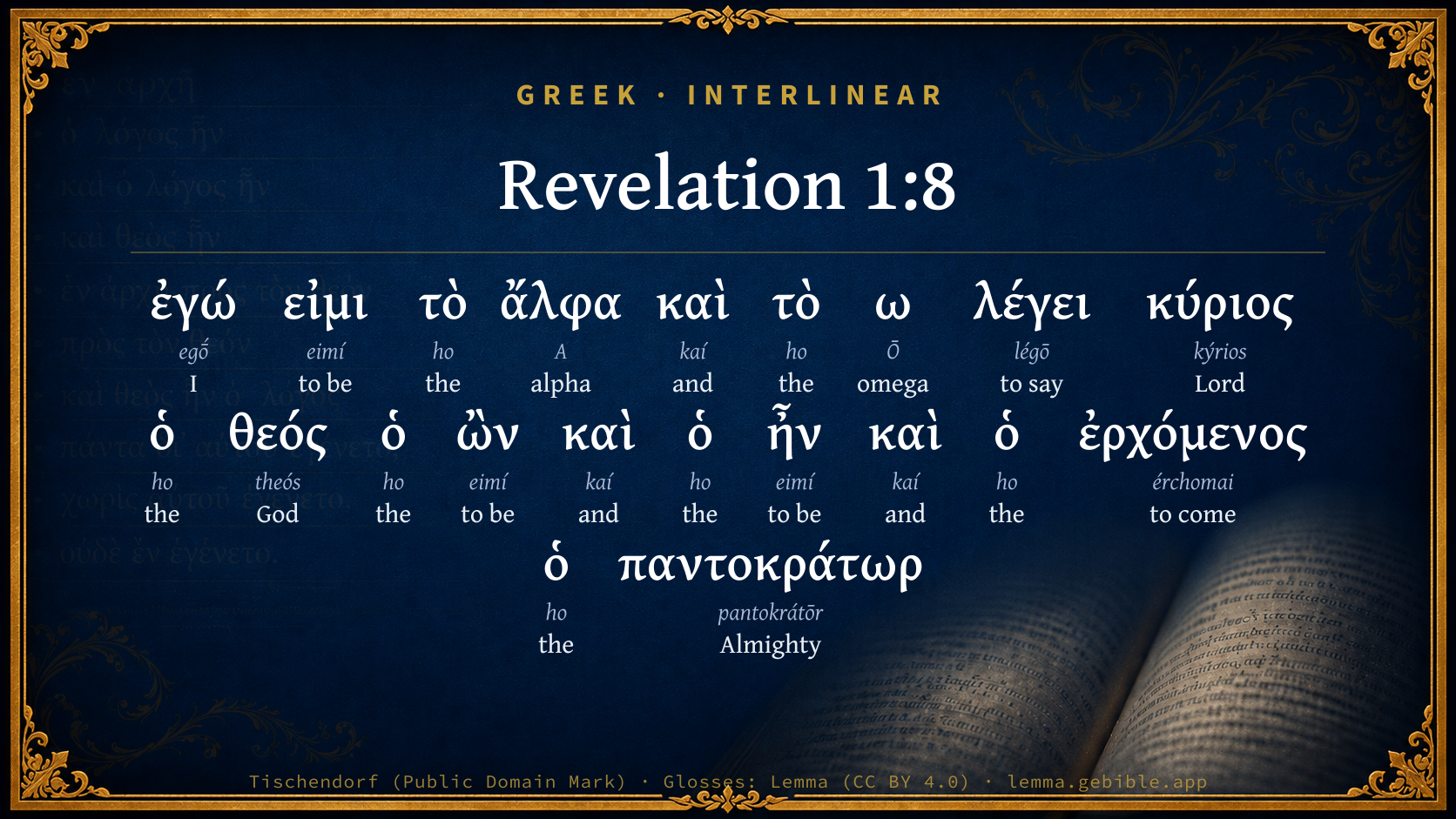
"I am the Alpha and the Omega," says the Lord God, "who is and who was and who is to come, the Almighty."
Download a study sheet
One document with this verse’s original text, its word-by-word gloss line, the meaning frame, cross-references with their text, attributed commentary, and full source and license credits — printable, and it pastes into notes with its structure intact.
This verse Autodidact and up
A passage Seminary Student
Up to 50 verses in one chapter. A passage sheet keeps up to 6 commentary sources and 12 cross-references per verse, in the order this page ranks them, and says so on the sheet whenever that leaves anything out. Ask for a single verse and you get the Autodidact verse sheet above.
Everything on this page stays free to read, with no account — the sheet is a download of what is already on screen, not access to it.
Compare translations 3
The same verse in 3 English versions, stacked beneath the original-language interlinear above. Click any original word for its lexicon entry.
Each is an independent rendering of the whole verse — the interlinear is not word-aligned to these translations.
Highlighted words mark where these versions differ — a whole-verse word diff, not a word-by-word alignment.
-
World English Bible Public Domain
"I am the Alpha and the Omega," says the Lord God, "who is and who was and who is to come, the Almighty."
-
King James Version Public Domain
I am Alpha and Omega, the beginning and the ending, saith the Lord, which is, and which was, and which is to come, the Almighty.
-
unfoldingWord Literal Text CC BY-SA 4.0
“I am the alpha and the omega,” says the Lord God, “the one being and the one having been and the one coming, the Ruler of All.”
unfoldingWord Literal Text — © unfoldingWord, licensed CC BY-SA 4.0. Word-aligned USFM3 via Door43 (git.door43.org/unfoldingWord/en_ult).
Show all 19 translations
Every available English version of this verse, each an independent rendering of the whole verse.
-
World English Bible Public Domain
"I am the Alpha and the Omega," says the Lord God, "who is and who was and who is to come, the Almighty."
-
Berean Standard Bible Public Domain
“I am the Alpha and the Omega,” says the Lord God, who is and was and is to come—the Almighty.
-
Majority Standard Bible Public Domain
“I am the Alpha and the Omega,” says the Lord God, who is and was and is to come—the Almighty.
-
King James Version Public Domain
I am Alpha and Omega, the beginning and the ending, saith the Lord, which is, and which was, and which is to come, the Almighty.
-
American Standard Version (1901) Public Domain
I am the Alpha and the Omega, saith the Lord God, who is and who was and who is to come, the Almighty.
-
Revised Version (1885) Public Domain
I am the Alpha and the Omega, saith the Lord God, which is and which was and which is to come, the Almighty.
-
Geneva Bible (1599) Public Domain
I am Alpha and Omega, the beginning and the ending, saith the Lord, Which is, and Which was, and Which is to come, euen the Almightie.
-
Douay-Rheims (1899) Public Domain
I am Alpha and Omega, the beginning and the end, saith the Lord God, who is, and who was, and who is to come, the Almighty.
-
Young's Literal Translation Public Domain
`I am the Alpha and the Omega, beginning and end, saith the Lord, who is, and who was, and who is coming -- the Almighty.'
-
Literal Standard Version CC BY-SA 4.0
“I am the Alpha and the Omega, beginning and end, says the LORD, who is, and who was, and who is coming—the Almighty.”
-
Unlocked Literal Bible CC BY-SA 4.0
“I am the alpha and the omega,” says the Lord God, “the one who is, and who was, and who is to come, the Almighty.”
-
unfoldingWord Literal Text CC BY-SA 4.0
“I am the alpha and the omega,” says the Lord God, “the one being and the one having been and the one coming, the Ruler of All.”
-
Darby Bible Public Domain
I am the Alpha and the Omega, saith [the] Lord God, he who is, and who was, and who is to come, the Almighty.
-
World Messianic Bible Public Domain
“I am the Alef and the Tav, ” says the Lord God, “who is and who was and who is to come, the Almighty.”
-
Webster's Bible Public Domain
I am Alpha and Omega, the beginning and the ending, saith the Lord, who is, and who was, and who is to come, the Almighty.
-
Free Bible Version CC BY-SA 4.0
“I am the Beginning and the End,” says the All-powerful Lord God, who was, who is, and who is to come.
-
Bible in Basic English Public Domain
I am the First and the Last, says the Lord God who is and was and is to come, the Ruler of all.
-
Text-Critical English NT CC BY 4.0
“I am the Alpha and the Omega,” says the Lord God, “who is and who was and who is to come, the Almighty.”
-
Tyndale New Testament (1534) Public Domain
I am Alpha and Omega the begynninge and the endinge sayth the Lorde almyghty which is and which was and which is to come.
Literal Standard Version (2020), Covenant Press — licensed CC BY-SA 4.0. Text via the HelloAO Bible API (eBible.org). Unlocked Literal Bible (unfoldingWord) — licensed CC BY-SA 4.0. Text via the HelloAO Bible API (eBible.org). unfoldingWord Literal Text — © unfoldingWord, licensed CC BY-SA 4.0. Word-aligned USFM3 via Door43 (git.door43.org/unfoldingWord/en_ult). Free Bible Version, Dr. Jonathan Gallagher — licensed CC BY-SA 4.0. Text via the HelloAO Bible API (eBible.org).
Word by word
More ways to search: Search by grammar → Find every occurrence → Compare this word →
Practice this passage: Drill this verse → Learn its vocabulary →
- Appears 3× in the Greek New Testament
- First appears here
- Part of Speech
- Noun · Letter (indeclinable)
Full Thayer's Definition
- ἐγώ egṓ G1473 “I” Personal pronoun, 1st person, Nominative, Singular
- εἰμι eimí G1510 “to be” Verb, Present, Active, Indicative, 1st person, Singular
- τὸ ho G3588 “the” Article, Nominative, Singular, Neuter
- ἄλφα A G1 “alpha” Noun, Letter (indeclinable)
- καὶ kaí G2532 “and” Conjunction
- τὸ ho G3588 “the” Article, Nominative, Singular, Neuter
- ω Ō G5598 “omega” Noun, Letter (indeclinable)
- λέγει légō G3004 “to say” Verb, Present, Active, Indicative, 3rd person, Singular
- κύριος kýrios G2962 “Lord” Noun, Nominative, Singular, Masculine
- ὁ ho G3588 “the” Article, Nominative, Singular, Masculine
- θεός theós G2316 “God” Noun, Nominative, Singular, Masculine
- ὁ ho G3588 “the” Article, Nominative, Singular, Masculine
- ὢν eimí G1510 “to be” Verb, Present, Active, Participle, Nominative, Singular, Masculine
- καὶ kaí G2532 “and” Conjunction
- ὁ ho G3588 “the” Article, Nominative, Singular, Masculine
- ἦν eimí G1510 “to be” Verb, Imperfect, Active, Indicative, 3rd person, Singular
- καὶ kaí G2532 “and” Conjunction
- ὁ ho G3588 “the” Article, Nominative, Singular, Masculine
- ἐρχόμενος érchomai G2064 “to come” Verb, Present, Middle or Passive deponent, Participle, Nominative, Singular, Masculine
- ὁ ho G3588 “the” Article, Nominative, Singular, Masculine
- παντοκράτωρ pantokrátōr G3841 “Almighty” Noun, Nominative, Singular, Masculine
About this verse
These counts appear in no published source. They are computed here, from the morphology-tagged text and Lemma’s own curated glosses. What Lemma adds →
- 21
- words
- 11
- distinct lemmas
- Revelation
- section
Notable vocabulary
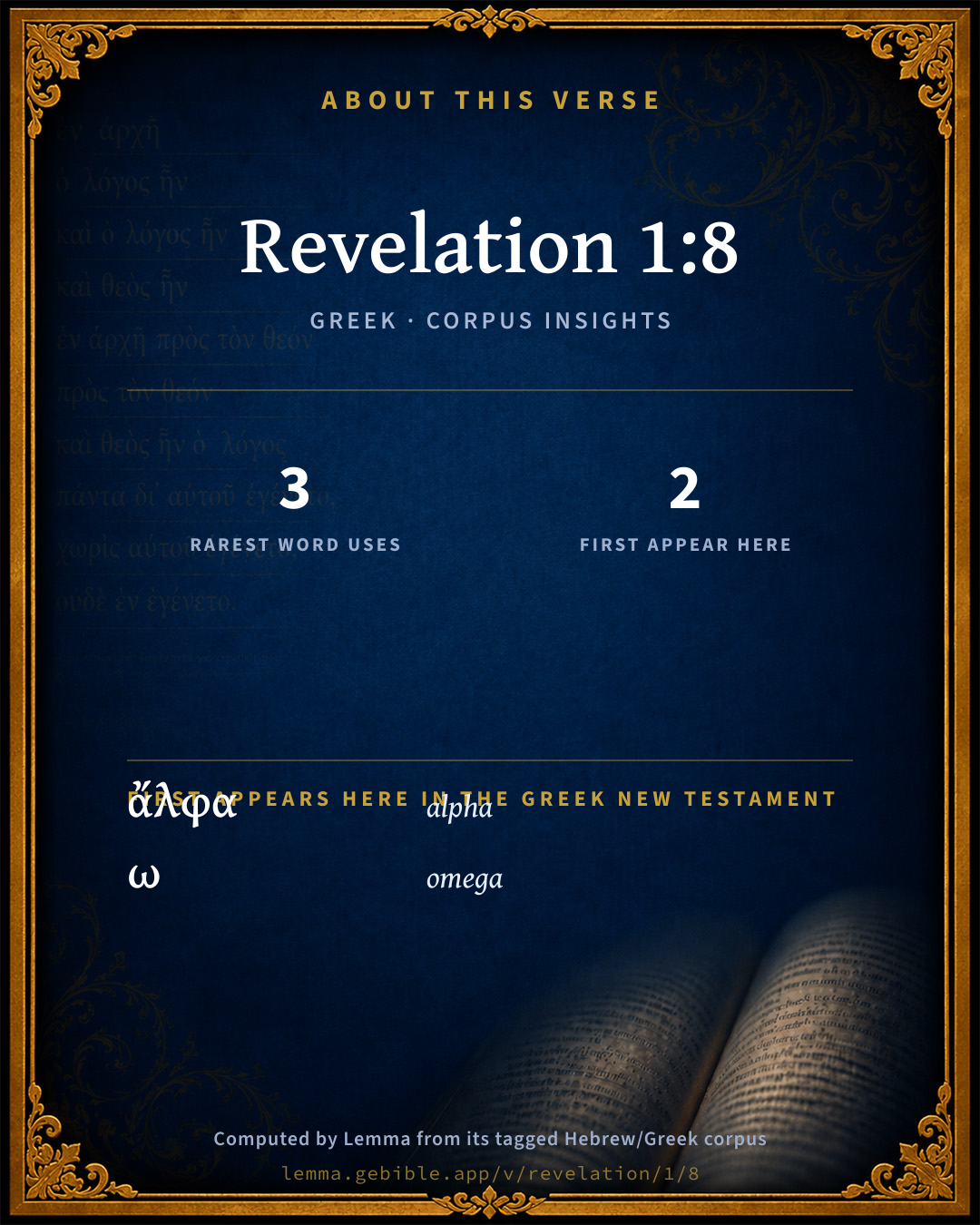
The rarest word here is ἄλφα alpha G1 — appearing just 3 times in the whole Greek New Testament.
First appearance in Scripture
These words make their first canonical appearance in the Greek New Testament here:
Shared distinctive vocabulary
ἄλφα alpha G1 occurs in 3 verses of the Greek New Testament. Also found in:
Cross-references
25Topical passages linked to Revelation 1:8 in the Treasury of Scripture Knowledge — connected by theme and wording, ordered by reader-vote popularity; previews shown in the World English Bible.
- Isaiah 44:6 Thus says Yahweh, the King of Israel, and his Redeemer, Yahweh of Hosts: I am the first, and I am the last; and besides me there is no God.
- Revelation 22:13 I am the Alpha and the Omega, the First and the Last, the Beginning and the End.
- Isaiah 48:12 Listen to me, O Jacob, and Israel my called: I am he; I am the first, I also am the last.
- Isaiah 43:10 You are my witnesses, says Yahweh, and my servant whom I have chosen; that you may know and believe me, and understand that I am he: before me there was no God formed, neither shall there be after me.
- Revelation 21:6 He said to me, "It is done! I am the Alpha and the Omega, the Beginning and the End. I will give freely to him who is thirsty from the spring of the water of life.
- Isaiah 41:4 Who has worked and done it, calling the generations from the beginning? I, Yahweh, the first, and with the last, I am he.
- Revelation 1:4 John, to the seven assemblies that are in Asia: Grace to you and peace, from God, who is and who was and who is to come; and from the seven Spirits who are before his throne;
- Revelation 11:17 saying: "We give you thanks, Lord God, the Almighty, the one who is and who was; because you have taken your great power, and reigned.
- Revelation 1:17 When I saw him, I fell at his feet like a dead man. He laid his right hand on me, saying, "Don't be afraid. I am the first and the last,
- Revelation 4:8 The four living creatures, each one of them having six wings, are full of eyes around about and within. They have no rest day and night, saying, "Holy, holy, holy, holy, holy, holy, holy, holy, holy is the Lord God, the Almighty, who was and who is and who is to come!"
- Revelation 2:8 "To the angel of the assembly in Smyrna write: "The first and the last, who was dead, and has come to life says these things:
- Isaiah 9:6 For to us a child is born, to us a son is given; and the government shall be on his shoulder: and his name shall be called Wonderful, Counselor, Mighty God, Everlasting Father, Prince of Peace.
- 2 Corinthians 6:18 I will be to you a Father. You will be to me sons and daughters,' says the Lord Almighty."
- Genesis 49:25 Even by the God of your father, who will help you, By the Almighty, who will bless you, With blessings of heaven above, Blessings of the deep that lies below, Blessings of the breasts, and of the womb.
- Revelation 19:15 Out of his mouth proceeds a sharp, double-edged sword, that with it he should strike the nations. He will rule them with a rod of iron. He treads the winepress of the fierceness of the wrath of God, the Almighty.
- Revelation 16:14 for they are spirits of demons, performing signs; which go forth to the kings of the whole inhabited earth, to gather them together for the war of that great day of God, the Almighty.
- Exodus 6:3 and I appeared to Abraham, to Isaac, and to Jacob, as God Almighty; but by my name Yahweh I was not known to them.
- Revelation 21:22 I saw no temple in it, for the Lord God, the Almighty, and the Lamb, are its temple.
- Genesis 35:11 God said to him, "I am God Almighty. Be fruitful and multiply. A nation and a company of nations will be from you, and kings will come out of your loins.
- Genesis 17:1 When Abram was ninety-nine years old, Yahweh appeared to Abram, and said to him, "I am God Almighty. Walk before me, and be blameless.
- Genesis 28:3 May God Almighty bless you, and make you fruitful, and multiply you, that you may be a company of peoples,
- Genesis 43:14 May God Almighty give you mercy before the man, that he may release to you your other brother and Benjamin. If I am bereaved of my children, I am bereaved."
- Numbers 24:4 He says, who hears the words of God, Who sees the vision of the Almighty, Falling down, and having his eyes open:
- Revelation 1:11 saying, "What you see, write in a book and send to the seven assemblies: to Ephesus, Smyrna, Pergamum, Thyatira, Sardis, Philadelphia, and to Laodicea."
- Genesis 48:3 Jacob said to Joseph, "God Almighty appeared to me at Luz in the land of Canaan, and blessed me,
Cross-references courtesy of OpenBible.info (CC BY 4.0).
Where the printed editions differ
2 variantsPlaces in this verse where the major printed Greek editions disagree on the wording in a way that affects the translation — a comparison of editions, not a manuscript-by-manuscript collation. The editions are the modern critical texts (Nestlé-Aland 28/27, SBL, Westcott-Hort, Tregelles, Tyndale House) and the traditional texts behind the KJV (the Textus Receptus and the Byzantine/Majority text). It is not a claim about which reading is original.
-
Extra text
ἀρχὴ καὶ τέλος,
“beginning and end”
In TR Not in NA28NA27TynSBLWHTregByzἀρχὴ καὶ τέλος, (archē kai telos) 'beginning and end' is only in traditional manuscripts (TR)
-
Extra text
ὁ θεός,
“<the> God,”
In NA28NA27TynSBLWHTregByz Not in TRὁ θεός, (ho theos) 'God,' is only in older manuscripts (NA28+NA27+Tyn+SBL+WH+Treg+Byz)
Textual data: Translators Amalgamated Greek New Testament (STEPBible TAGNT) · CC BY 4.0.
Lesson kit
Teaching starters — assembled from the data on this page, not authored interpretation. Every prompt links to the verse data it draws on. Edit before teaching.
Revelation, in the Revelation, opens this verse with 21 words (11 distinct Greek lemmas). Its most distinctive word is A (“alpha”). A historical commentator’s framing appears above. Read the whole chapter for the surrounding context.
Discussion questions
- What does “alpha” (A) contribute to the verse as a whole?
- 2 words here appear for the first time in Scripture. What is being introduced at this debut?
- Revelation 21:6 shares the word «alpha» with this verse. How do the two illuminate each other?
- “to be” occurs 3× in this one verse. What is the effect of the repetition?
- These translations render this verse differently. What is at stake in choosing one wording over another?
- Reading how The Biblical Illustrator and Joseph Benson's Commentary read this verse, where do the two commentators agree and where do they part?
Things to notice
- 2 words make their first canonical appearance in Scripture here.
- These translations choose different wording for 15 words in this verse.
- “to be” occurs 3× in this single verse.
- 11 distinct Greek lemmas span 21 words in this verse.
Commentary
Notes on Revelation 1:8 from classic Christian and Jewish commentators (each source and its license shown beneath its notes). The classic Christian expositions comment on the surrounding passage and are grouped to its opening verse, so a note may address several verses; the Jewish commentaries on the Tanakh (Rashi and others) are per-verse, so they appear only where the commentator wrote on this verse.
Lemma curates 59 commentaries, every one of them public domain or Creative Commons licensed, each selected and text-cleaned for this edition rather than reprinted as found. About our sources →
The Biblical Illustrator
Joseph S. Exell
The Biblical Illustrator, edited by Joseph S. Exell (c. 1880s–1900s) — public domain. Text from a community e-Sword module.
Joseph Benson's Commentary
Joseph Benson's Commentary on the Old and New Testaments (1811–1818) — public domain. Text from a community e-Sword module.
The Preacher's Complete Homiletical Commentary
Joseph S. Exell (gen. ed.)
The Preacher's Complete Homiletical Commentary (gen. ed. Joseph S. Exell; Funk & Wagnalls, c. 1892) — public domain (pre-1929). A full-Bible homiletical/sermon-outline anthology covering 65 of 66 books (2 John is absent from the source module). Text from a community e-Sword module.
Tyndale Open Study Notes
Tyndale Open Resources
Tyndale Open Study Notes — © Tyndale Open Resources, licensed CC BY-SA 4.0. Text via the HelloAO Bible API.
Bengel's Gnomon
Johann Albrecht Bengel
Bengel's Gnomon of the New Testament — English translation (T&T Clark, Edinburgh, 1860) — public domain. Text from a community e-Sword module.
Expositor's Greek Testament
ed. W. Robertson Nicoll
The Expositor's Greek Testament, edited by W. Robertson Nicoll (1897–1910) — public domain. Text from a community e-Sword module.
Geneva Bible (1599)
Geneva Bible translators
Geneva Bible (1599) marginal notes — public domain. Text via Bolls.life.
Jamieson, Fausset & Brown
Robert Jamieson, A. R. Fausset & David Brown
Jamieson, Fausset & Brown — Commentary Critical and Explanatory on the Whole Bible (1871) — public domain (CC PDM 1.0). Text via the HelloAO Bible API.
Adam Clarke's Commentary
Adam Clarke's Commentary on the Bible (1810–1826) — public domain. Text from a community e-Sword/MySword module.
Ellicott's Commentary for English Readers
A Bible Commentary for English Readers, edited by Charles John Ellicott (1878–1897) — public domain. Text from a community e-Sword module.
The Cambridge Bible for Schools and Colleges
gen. ed. J. J. S. Perowne
The Cambridge Bible for Schools and Colleges (gen. ed. J. J. S. Perowne; Cambridge University Press, 1878–1918) — public domain. Text from a community e-Sword module.
John Gill's Exposition
John Gill's Exposition of the Whole Bible (1746–1763) — public domain (CC PDM 1.0). Text via the HelloAO Bible API.
Trapp's Complete Commentary
John Trapp
John Trapp, A Commentary or Exposition upon All the Books of the Old and New Testament (1647–1656) — public domain. Text from a community e-Sword module.
Albert Barnes' Notes on the Bible
Albert Barnes' Notes on the Bible (1834–1885) — public domain. Text from a community e-Sword/MySword module.
Haydock's Catholic Bible Commentary
George Leo Haydock (1774–1849), Haydock's Catholic Family Bible and Commentary, 1859 edition — public domain. Excludes Psalms (Douay-Rheims chapter numbering differs from Protestant) and Deuterocanonical books (Catholic canon only).
Matthew Poole's English Annotations
Matthew Poole's English Annotations on the Holy Bible (1683–1685) — public domain. Text from a community e-Sword/MySword module.
Whedon's Commentary on the Bible
Daniel D. Whedon
Daniel D. Whedon (gen. ed.), Commentary on the Old and New Testaments (1874–1909) — public domain. Text from a community e-Sword module.
The Pulpit Commentary
The Pulpit Commentary (1880–1919), ed. H.D.M. Spence-Jones & Joseph S. Exell — public domain. Text from a community e-Sword module.
John Wesley's Explanatory Notes
John Wesley, Explanatory Notes Upon the Whole Bible (1754–1765) — public domain. Text via the GEBible commentary corpus.
Burkitt's Expository Notes on the New Testament
William Burkitt
William Burkitt's Expository Notes on the New Testament (1700–1703) — public domain. Text from a community e-Sword module.
The People's New Testament
B. W. Johnson
B. W. Johnson's The People's New Testament with Notes (1889–1891) — public domain. Electronic text from the Christian Classics Ethereal Library (CCEL) ThML edition.
Cambridge Greek Testament for Schools and Colleges
Cambridge Greek Testament for Schools and Colleges (Cambridge University Press, 1896; 21 vols, various authors incl. Carr, Maclear, Plummer, Farrar, Lumby, Moule, M. R. James, Simcox) — public domain. Text from a community e-Sword module.
Alford’s Greek Testament
Henry Alford
Henry Alford, The Greek Testament (1849–1861) — public domain. Text from a community e-Sword module.
Vincent's Word Studies in the New Testament
Marvin R. Vincent
Marvin R. Vincent, Word Studies in the New Testament (1887–1900) — public domain. Text from a community e-Sword/MySword module.