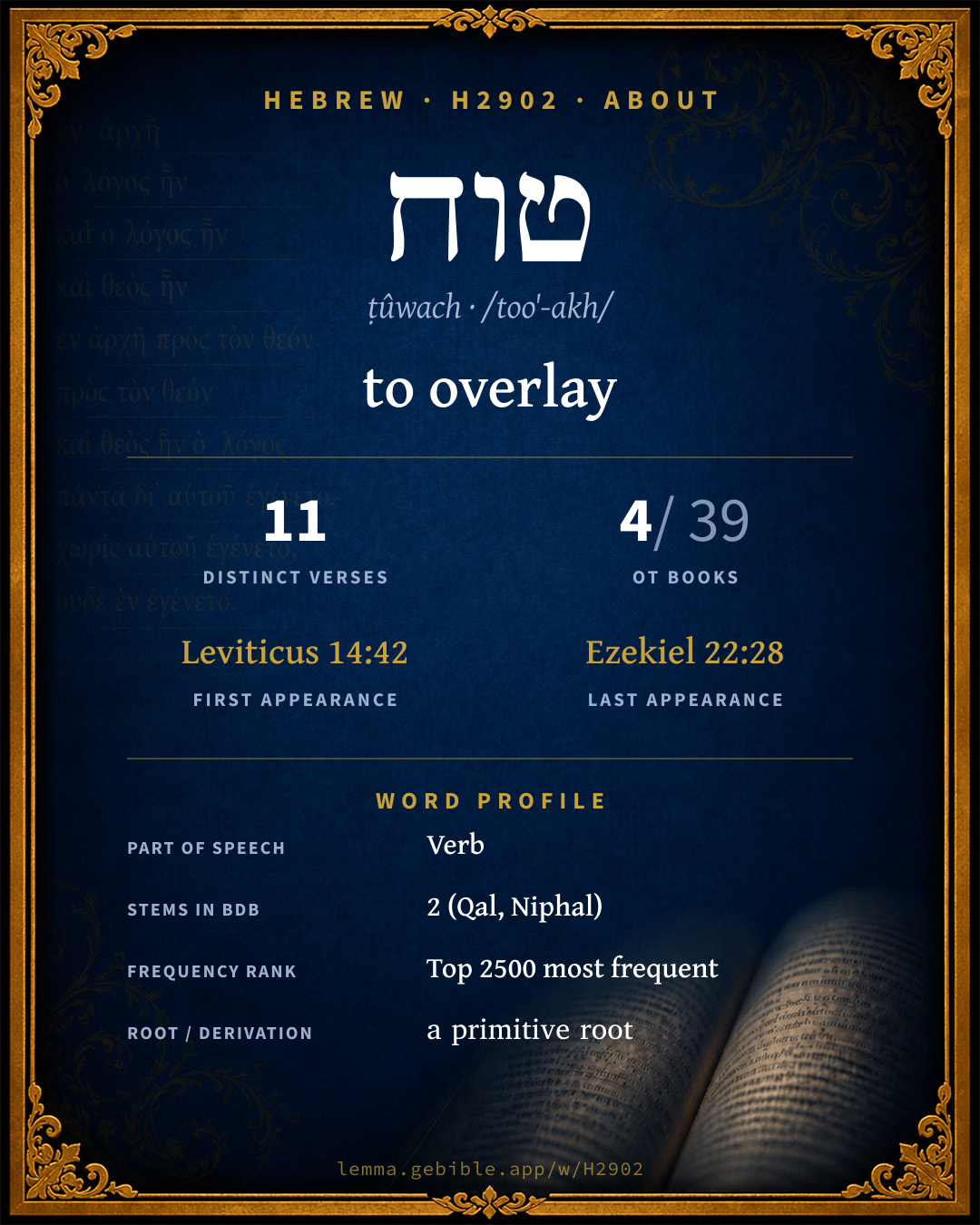
טוּחַ
to overlay
‘to overlay’ is one of 2 main senses fuller range ↓
Full lexicon entry — Brown-Driver-Briggs (BDB)
From Brown-Driver-Briggs (BDB)
Where this word appears
See every Qal verb in the Hebrew Bible →
Grammar key — what these labels mean
Part of speech
- Verb
- An action or state-of-being word.
Stem
- Niphal
- Usually the simple passive or reflexive of the Qal (“he was written”).
- Qal
- The basic, simple active stem — the plain form of the verb (“he wrote”). Here: ‘over-spread’
Form
- Infinitive Construct
- A bound verbal noun, frequently with prepositions (“to write / in writing”).
- Perfect
- A completed action or state — Hebrew marks aspect (completeness) more than strict tense (“he wrote”).
- Participle Active
- A verbal adjective expressing ongoing or characteristic action (“writing / one who writes”).
- Sequential Perfect
- A perfect with prefixed waw continuing a preceding imperfect or command (waw-consecutive perfect).
State
- Absolute
- The independent form of a noun, not bound to a following word.
- Construct
- A noun bound to a following noun in a possessive / “of” relationship (the construct chain).
Person
- 2nd Person
- The one addressed (“you”).
- 3rd Person
- The one spoken about (“he / she / it / they”).
Gender
- Masculine
- Grammatically masculine.
- Common
- Either gender — not distinguished for this form.
Number
- Plural
- More than one (in Hebrew, generally three or more).
- Singular
- One.
Grammatical forms
- Verb, Qal, Participle Active, Masculine, Plural, Absolute 3 times (25%)
- Verb, Niphal, Infinitive Construct 2 times (17%)
- Verb, Qal, Perfect, 2nd Person, Masculine, Plural 2 times (17%)
- Verb, Qal, Sequential Perfect, 3rd Person, Masculine, Singular 1 time (8%)
- Verb, Qal, Infinitive Construct 1 time (8%)
- Verb, Qal, Perfect, 3rd Person, Common, Plural 1 time (8%)
- Verb, Qal, Perfect, 3rd Person, Masculine, Singular 1 time (8%)
- Verb, Qal, Participle Active, Masculine, Plural, Construct 1 time (8%)
Parsed forms decoded from the imported morphology (morphhb / Westminster Leningrad Codex — WLC text public domain, morphhb tagging CC BY 4.0), counted across 12 parsed occurrences — not distinct verses.
Every verse where H2902 appears — 11 distinct verses across 4 books. Click any verse to open its interlinear word-by-word view. Verse text shown in the World English Bible for context — . Each verse’s Hebrew form is shown with its reference; the English is not keyword-highlighted, since the data carries no word-level English alignment. Use “Compare translations” on any verse to read it across multiple English versions. This concordance covers the Hebrew Bible; Septuagint (Greek Old Testament) occurrences are not indexed here.
Leviticus 3 verses
- Leviticus 14:42 וְ/טָ֥ח conj + Qal wpf 3ms They shall take other stones, and put them in the place of those stones; and he shall take other mortar, and shall plaster the house.
- Leviticus 14:43 הִטּֽוֹחַ Niphal inf.cs "If the plague comes again, and breaks out in the house, after he has taken out the stones, and after he has scraped the house, and after it was plastered;
- Leviticus 14:48 הִטֹּ֣חַ Niphal inf.cs "If the priest shall come in, and examine it, and, behold, the plague hasn't spread in the house, after the house was plastered, then the priest shall pronounce the house clean, because the plague is healed.
1 Chronicles 1 verse
Isaiah 1 verse
Ezekiel 6 verses
- Ezekiel 13:10 טָחִ֥ים Qal ptcp.act mp Because, even because they have seduced my people, saying, Peace; and there is no peace; and when one builds up a wall, behold, they daub it with whitewash:
- Ezekiel 13:11 טָחֵ֥י Qal ptcp.act mp cs tell those who daub it with whitewash, that it shall fall: there shall be an overflowing shower; and you, great hailstones, shall fall; and a stormy wind shall tear it.
- Ezekiel 13:12 טַחְתֶּֽם Qal pf 2mp Behold, when the wall is fallen, shall it not be said to you, Where is the daubing with which you have daubed it?
- Ezekiel 13:14 טַחְתֶּ֥ם Qal pf 2mp So will I break down the wall that you have daubed with whitewash, and bring it down to the ground, so that the foundation of it shall be uncovered; and it shall fall, and you shall be consumed in the midst of it: and you shall know that I am Yahweh.
- Ezekiel 13:15 וּ/בַ/טָּחִ֥ים הַ/טָּחִ֥ים conj + prep det + Qal ptcp.act mp ptcl def.art + Qal ptcp.act mp Thus will I accomplish my wrath on the wall, and on those who have daubed it with whitewash; and I will tell you, The wall is no more, neither those who daubed it;
- Ezekiel 22:28 טָח֤וּ Qal pf 3cp Her prophets have daubed for them with whitewash, seeing false visions, and divining lies to them, saying, Thus says the Lord Yahweh, when Yahweh has not spoken.
About this entry
At a glance — auto-summarized from this page’s data, not written by a person. Every figure links to its source below. This summary describes the numbers; it doesn’t interpret them.
טוח (ṭûwach) is a Hebrew verb most often rendered “to overlay.” It clusters heavily in Ezekiel, which alone accounts for 55% of its uses. It turns up in 11 verses across 4 books, an uncommon footprint. Scripture first uses it in Leviticus 14:42. Different stems carry different senses — BDB groups them under 2 stems, among them Qal and Niphal. The sections below give every sense, occurrence, and version rendering.
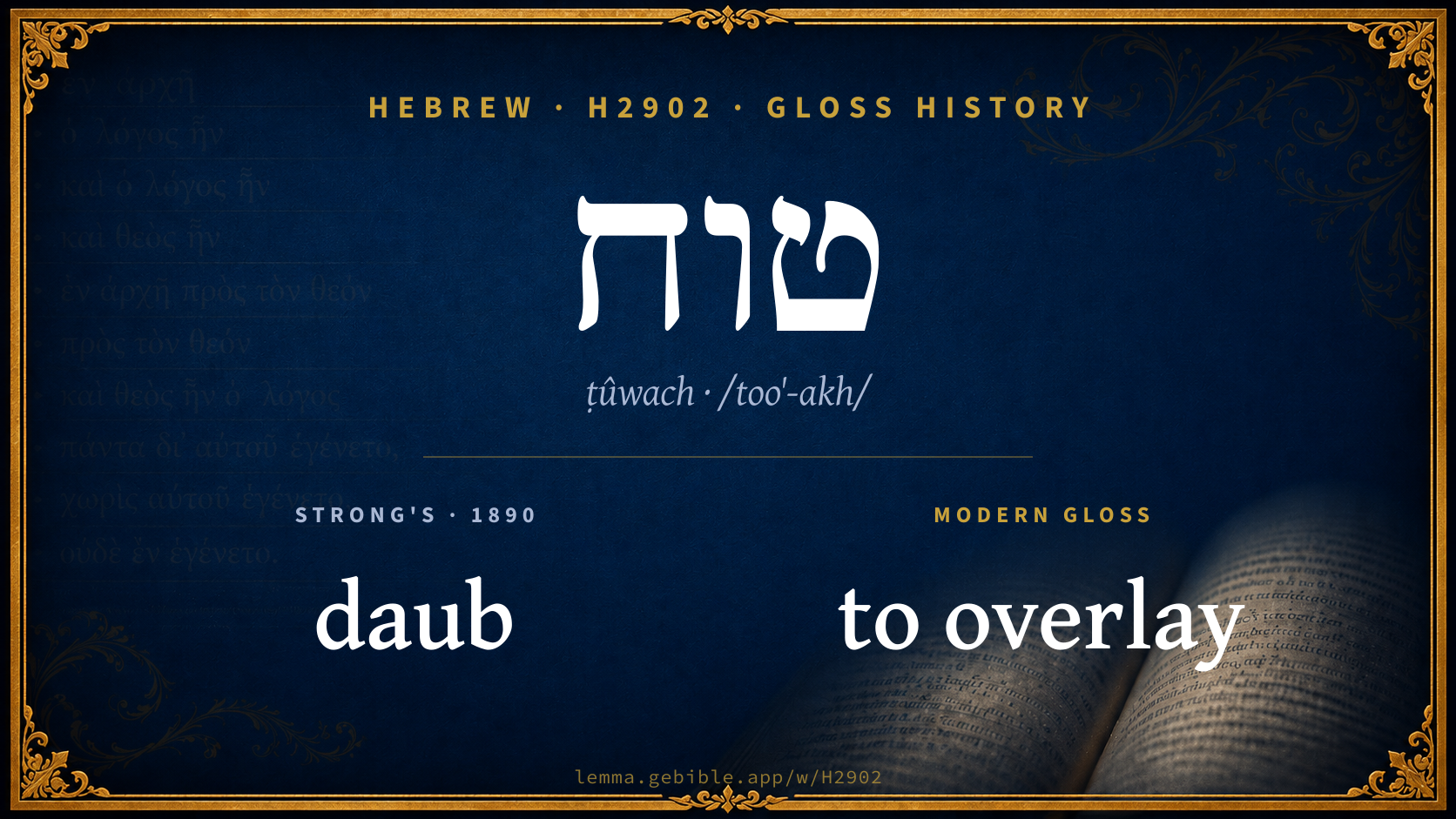
Gloss history
Strong's 1890 vs modern scholarship
About this word
Strong's H2902 catalogs a Hebrew word from the Hebrew Old Testament.
These counts are not copied from any lexicon or concordance. They are computed here, from the morphology-tagged Hebrew Old Testament. What Lemma adds →
- 11
- distinct verses
- The word appears in 11 distinct verses.
- 4 / 39
- OT books
- The word appears in 4 of 39 Old Testament books.
- #2,101
- by frequency
- Top 2500 most frequent Hebrew words (rank 2,101 of 8,640 Hebrew words by occurrence).
View all 11 occurrences in the concordance →
Most concentrated in
- Ezekiel 6 verses 55%
- Leviticus 3 verses 27%
- 1 Chronicles 1 verse 9%
By section of the Old Testament
By traditional corpus
Conventional, traditional groupings — biblical authorship is debated, so this is a traditional corpus grouping, not an authorship claim. Each share is this word’s portion of its verses in that division of the Hebrew canon. Each figure is a share of the word’s 11 distinct verses.
- Prophets (Nevi'im) 7 verses · 64%
- Torah (Pentateuch) 3 verses · 27%
- Writings (Ketuvim) 1 verse · 9%
How translations render this word
Counts come from each version’s own published word-to-Strong’s tagging or interlinear alignment — an approximate guide to how each version renders this word, not a word-level alignment the data otherwise carries. Because each total is that version’s own tagged count, the per-version totals vary from one another and need not match the appearance or distinct-verse counts above. These counts may also differ from a printed concordance because Lemma counts each distinctly tagged rendering and does not collapse phrase taggings into a single head-word total. This is a fixed set of word-tagged versions (KJV, ASV, BSB, ULT) and does not change with the reading translation you choose elsewhere. Each version’s license is shown beside its name below (and on Sources).
BDB lists this Strong’s number as 2 distinct words (homographs). Each count above pools all of them and is not split by sense — see the Senses section below. A low-frequency rendering may belong to a different one of those words, not the primary meaning.
- King James Version†: Have daubed 2×
- American Standard Version†: Have daubed 2×
- Berean Standard Bible†: Whitewashing 2×
- unfoldingWord Literal Text†: Are 1×, Have painted 1×, He shall plaster 1×
King James Version Public Domain
Renders H2902 across 12† tagged occurrences — most commonly:
Plus 10 renderings that appear only once — usually multi-word phrases or single function words the recovered tagging swept in, not distinct renderings.
American Standard Version Public Domain
Renders H2902 across 12† tagged occurrences — most commonly:
Plus 10 renderings that appear only once — usually multi-word phrases or single function words the recovered tagging swept in, not distinct renderings.
Berean Standard Bible Public Domain
Renders H2902 across 11† tagged occurrences — most commonly:
Plus 9 renderings that appear only once — usually multi-word phrases or single function words the recovered tagging swept in, not distinct renderings.
unfoldingWord Literal Text CC BY-SA 4.0
Renders H2902 across 12† tagged occurrences — most commonly:
Senses in the full BDB
Hebrew verbs can shift meaning by stem (binyan): Qal is the basic action, Niphal is often passive or reflexive, Piel often intensifies or makes it factitive, and Hiphil is typically causative. The senses below are grouped under the stem BDB assigns to each.
What do BDB’s symbols mean?
BDB uses these scholarly abbreviations:
| Symbol | Meaning |
|---|---|
| 𝔊 | the Septuagint (the ancient Greek translation, LXX) |
| 𝔙 | the Vulgate (the Latin translation) |
| 𝔖 | the Syriac version (the Peshitta) |
| 𝔗 | the Targum (the Aramaic translation) |
| ψ | the Psalms |
| √ | root (the underlying root or stem) |
| ‖ | parallel passage (a synonymous or contrasted parallel) |
| † | the dagger: every passage where the word occurs is cited |
The 2 senses and sub-senses the full Brown-Driver-Briggs lexicon distinguishes for this word, in lexicon order (not ranked by frequency), with BDB’s own verbatim wording and sub-sense lettering. Shown in Hebrew script with BDB’s own scholarly abbreviations. The condensed entry is in the Lexicon Entry tab. See also the Forms in the corpus table below.
טוח I over-spread, over-lay, coat, besmear
Qal
- over-spread, coat
Niphal
- . be coated
טוח II be besmeared
Senses from the full Brown-Driver-Briggs lexicon (Brown, Driver, Briggs; Oxford 1906 — public domain), digitized via Sefaria, supplemented by the OpenScriptures HebrewLexicon (CC BY 4.0). Full attribution on Sources.
Word origin
[ טוּחַ ] vb. over-spread, over-lay, coat, besmear
[ טָחַח ] vb. be besmeared —only Qal Pf. Is 44:18
— Brown-Driver-Briggs (Oxford 1906, public domain), digitized via Sefaria, supplemented by the OpenScriptures HebrewLexicon (CC BY 4.0). See Sources.
Origin: a primitive root
Jastrow Dictionary
A second Hebrew/Aramaic lexicon for comparison, covering Aramaic and post-biblical (Talmudic, Targumic, Midrashic) usage that the biblical-Hebrew BDB does not. Matched by lemma rather than by Strong’s number, so a lemma may carry more than one Jastrow headword (shown separately below), and the entries cover usage well beyond the Bible.
טוּחַ I
- (b. h.)
- 1. to cover with a cohesive substance, to plaster. Part. טָח. M. Kat. 7ᵃ ואינו טָח בטיט but puts no clay on. Cant. R. to VIII, 6 טָחֵי גגות roof-plasterers. Neg. XIII, 1 וטח and plasters the spot over; a. fr.—Part. pass. טוּחַ coated, covered with viscid or glittering matter.—Midd. IV, 1 ט׳ בזהב coated with gold; (Num. R. s. 12 נִטּוֹחַ).—Nidd. 24ᵃ בפניו טוּחוֹת (Rashi טָחוֹת) when the face of the embryo is covered over (no features distinguishable).
- to be pasted on, to stick. Y. Kil. VI, 30ᶜ top והיא נִיטּוֹחָה and it (the fig) stuck (against the wall); Y. Sabb. XI, 13ᵃ bot. והיה נ׳ (corr. acc.). Tosef. Kel. B. Mets. II, 17 לִיטּוֹחַ some ed. (ed. Zuck. ליטול, corr. acc.), v. infra.
- 1. to plaster, to polish. Ḥull. 25ᵃ … עתיד (לַהֲטִיחוֹ) להָטִיחַ וכ׳ (Tosef. Kel. l. c. ליטוח, v. supra) which wants polishing, v. אֲטוּנָס. Bets. 9ᵃ להָטִיחַ גגו וכ׳ he needs the ladder for plastering his roof. [Tosef. Kel. B. Kam. IV, 19, sq. [read:] אם יכול הטיח, v. טִיחַ.]
- 2. to cast mud, trnsf. (with or without דברים) to speak rebelliously, to reproach (with נגד or כלפי). Taan. 25ᵃ; Meg. 22ᵇ, a. e. לעולם אל יָטִיחַ וכ׳ one must, in his prayer, never reproach the Lord. Ber. 31ᵇ, sq.—Gen. R. s. 53 (ref. to כמטחוי, Gen. XXI, 16) כמֵטַחַת וכ׳ as if thrusting reproaches against the Lord; Tanḥ. Vayetse 5. Ex. R. s. 3. B. Bath. 134ᵃ ה׳ עלי וכ׳ Ben U. insulted me. e.g. Genesis 21:16
טוּחַ
- , to plaster, smear. Pes. 30ᵃ, v. טִיחְיָא.
- 1. same. Zeb. 95ᵇ אַטְחוּ (Ms. R. 2 דטחו), v. טִיחְיָא.
- 2. (with מִלִּין) to talk rebelliously. Targ. Y. Gen. XV, 6.
טוּחַ II
- (v. טחי) to press, squeeze. Ḥull. 109ᵇ טָחוֹ בכותל presses it against the wall (to make the milk flow out).—Part. pass. טוּחַ squeezed in. Num. R. s. 10 (ref. to Job XXXVIII, 36) אלו הכליות שהן טוּחוֹת וכ׳ that means the kidneys which are wedged into the body. e.g. Job 38:36
- 1. to press, squeeze, knock against. Ber. 34ᵇ אלמלי ה׳ וכ׳ (Ms. M. הניח, v. Rabb. D. S. a. l. note) if Ben. Z. (myself) had squeezed his head between his (the son’s) knees (praying for his recovery). Gen. R. s. 20 התחיל מֵטִיחַ וכ׳ he knocked his head against the wall; Yalk. ib. 30 להָטִיחַ. Ohol. XVII, 2 ה׳ בסלע struck (with the plough) against a rock. B. Kam. 28ᵇ ה׳ צלוחיתו וכ׳ he struck (with) his bottle against the stone; Y. ib. III, 3ᶜ top, v. הֲטָחָה.—Tanḥ. P’kudé 11 כיון שהֵטִיחוּ פניהם וכ׳ when they had squeezed their faces from all sides (had in vain tried in all directions).
- 2. to press the bow-string, to shoot; (euphem.) to emit semen virile. Yeb. 54ᵃ. Snh. 46ᵃ ה׳ באשתו Ms. M. (ed. את אשתו).
A Dictionary of the Targumim, the Talmud Babli and Yerushalmi, and the Midrashic Literature (Marcus Jastrow; London, Luzac, 1903) — Public Domain. Digitized via Sefaria. Digitized via Sefaria. Full attribution on Sources.
Forms in the corpus
The 12 distinct written forms H2902 takes in the Hebrew Bible, most frequent first — each parse links to that stem’s occurrences in the concordance. Hebrew forms include their vowel points and cantillation, so a single lemma takes many written forms.
Same root — word family
Other BDB entries built from the same root as H2902, grouped by Strong’s listed origin. These share a root / origin per the lexicon — not necessarily a shared meaning. Each links to that word’s own entry.
Derived from this word
Compare all same-root words → They share a root, not necessarily a meaning.
Septuagint verse parallels
This word appears in 11 verses that also exist in the Greek Old Testament (Septuagint), out of the 11 Hebrew verses it occurs in. You can read those verses in Greek by switching the Old Testament edition to the Septuagint.
Read these verses in the Septuagint
This is a verse-level parallel only — the same verses exist in both the Hebrew and Greek Old Testaments. No word-level Hebrew↔Greek correspondence is claimed: the data carries no such alignment, so no Greek word is shown as this Hebrew word’s translation. Coverage is not total — the Septuagint omits the deuterocanon and renumbers the Psalms, so some Hebrew verses have no direct Greek parallel.