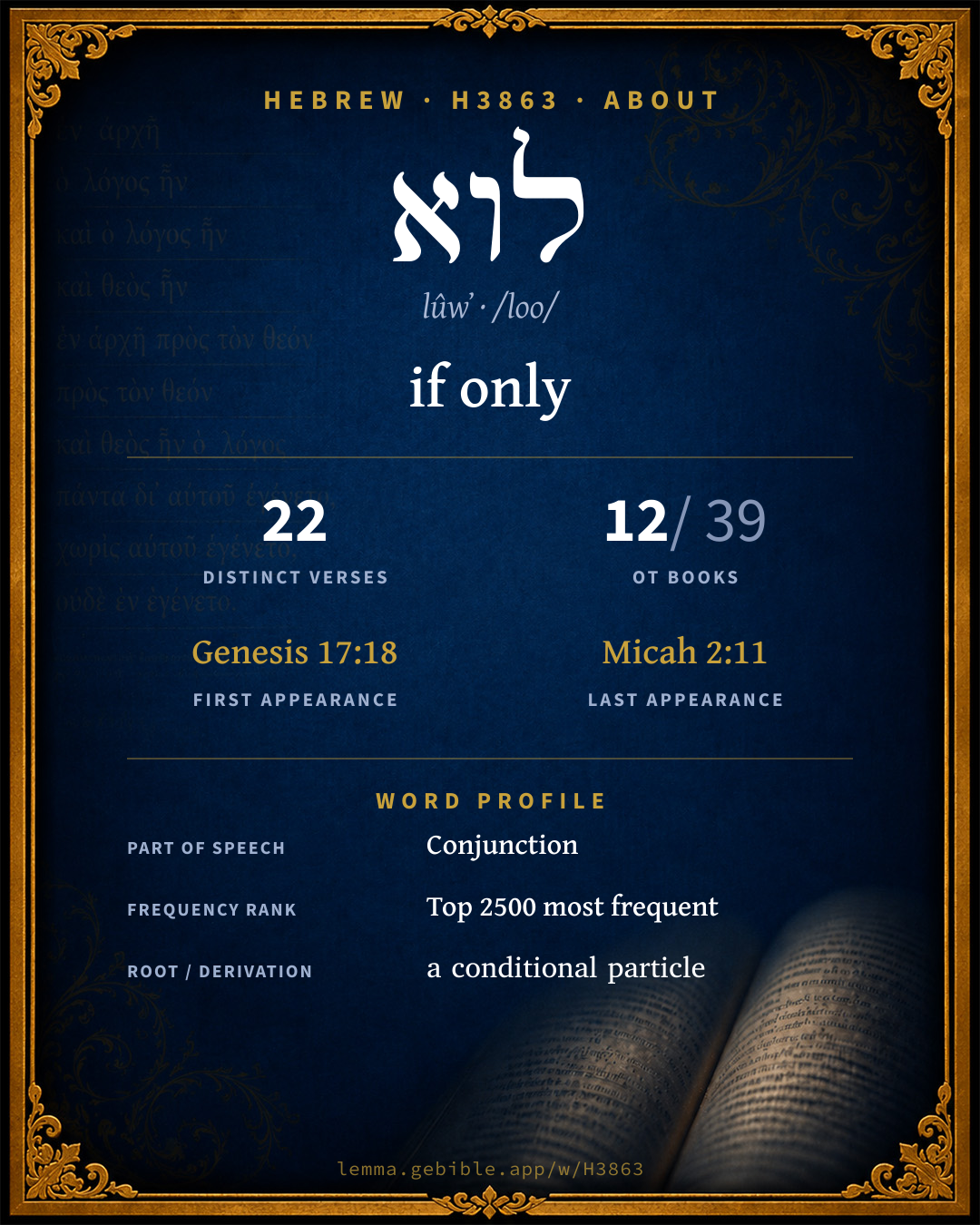
לוּ
if only
‘if only’ is one of 3 main senses fuller range ↓
Full lexicon entry — Brown-Driver-Briggs (BDB)
From Brown-Driver-Briggs (BDB)
Where this word appears
Grammar key — what these labels mean
Part of speech
- Conjunction
- A joining word (e.g. “and,” “but”) linking words or clauses.
- Particle
- A short function word — article, negation, interrogative, the sign of the direct object, and the like.
Grammatical forms
- Conjunction 23 times (92%)
- Particle, Negative 2 times (8%)
Parsed forms decoded from the imported morphology (morphhb / Westminster Leningrad Codex — WLC text public domain, morphhb tagging CC BY 4.0), counted across 25 parsed occurrences — not distinct verses.
Every verse where H3863 appears — 22 distinct verses across 12 books. Click any verse to open its interlinear word-by-word view. Verse text shown in the World English Bible for context — . Each verse’s Hebrew form is shown with its reference; the English is not keyword-highlighted, since the data carries no word-level English alignment. Use “Compare translations” on any verse to read it across multiple English versions. This concordance covers the Hebrew Bible; Septuagint (Greek Old Testament) occurrences are not indexed here.
Genesis 4 verses
- Genesis 17:18 ל֥וּ conj Abraham said to God, "Oh that Ishmael might live before you!"
- Genesis 23:13 ל֖וּ conj He spoke to Ephron in the audience of the people of the land, saying, "But if you will, please hear me. I will give the price of the field. Take it from me, and I will bury my dead there."
- Genesis 30:34 ל֖וּ conj Laban said, "Behold, I desire it to be according to your word."
- Genesis 50:15 ל֥וּ conj When Joseph's brothers saw that their father was dead, they said, "It may be that Joseph will hate us, and will fully pay us back for all of the evil which we did to him.
Numbers 3 verses
- Numbers 14:2 לוּ לוּ conj conj All the children of Israel murmured against Moses and against Aaron: and the whole congregation said to them, Would that we had died in the land of Egypt! or would that we had died in this wilderness!
- Numbers 20:3 וְ/ל֥וּ conj + conj The people strove with Moses, and spoke, saying, Would that we had died when our brothers died before Yahweh!
- Numbers 22:29 ל֤וּ conj Balaam said to the donkey, Because you have mocked me, I would there were a sword in my hand, for now I had killed you.
Deuteronomy 1 verse
Joshua 1 verse
Judges 2 verses
- Judges 8:19 ל֚וּ conj He said, They were my brothers, the sons of my mother: as Yahweh lives, if you had saved them alive, I would not kill you.
- Judges 13:23 לוּ֩ conj But his wife said to him, If Yahweh were pleased to kill us, he wouldn't have received a burnt offering and a meal-offering at our hand, neither would he have shown us all these things, nor would at this time have told such things as these.
1 Samuel 1 verse
2 Samuel 2 verses
- 2 Samuel 18:12 ו/לא וְ/ל֨וּא conj + conj conj + conj The man said to Joab, Though I should receive a thousand [pieces of] silver in my hand, I still wouldn't put forth my hand against the king's son; for in our hearing the king charged you and Abishai and Ittai, saying, Beware that none touch the young man Absalom.
- 2 Samuel 19:6 לא ל֣וּ ptcl neg conj in that you love those who hate you, and hate those who love you. For you have declared this day, that princes and servants are nothing to you: for this day I perceive that if Absalom had lived, and all we had died this day, then it had pleased you well.
Job 3 verses
- Job 6:2 ל֗וּ conj "Oh that my anguish were weighed, And all my calamity laid in the balances!
- Job 9:33 לֹ֣א ptcl neg There is no umpire between us, That might lay his hand on us both.
- Job 16:4 ל֤וּ conj I also could speak as you do. If your soul were in my soul's place, I could join words together against you, And shake my head at you.
Psalms 1 verse
Isaiah 2 verses
Ezekiel 1 verse
Micah 1 verse
About this entry
At a glance — auto-summarized from this page’s data, not written by a person. Every figure links to its source below. This summary describes the numbers; it doesn’t interpret them.
At its core, לוא (lûwʼ) means “if only.” Translators differ — “if” in the King James Version, then “only” (Berean Standard Bible), as the renderings breakdown shows. It turns up in 22 verses across 12 books, an uncommon footprint. It first appears in Genesis 17:18. Not a single-sense word: explore its full sense range. Dig into 22-verse concordance and the renderings breakdown below.
Gloss history
Strong's 1890 vs modern scholarship
About this word
Strong's H3863 catalogs a Hebrew word from the Hebrew Old Testament.
These counts are not copied from any lexicon or concordance. They are computed here, from the morphology-tagged Hebrew Old Testament. What Lemma adds →
- 22
- distinct verses
- The word appears in 22 distinct verses.
- 12 / 39
- OT books
- The word appears in 12 of 39 Old Testament books.
- #1,282
- by frequency
- Top 2500 most frequent Hebrew words (rank 1,282 of 8,640 Hebrew words by occurrence).
View all 22 occurrences in the concordance →
By section of the Old Testament
By traditional corpus
Conventional, traditional groupings — biblical authorship is debated, so this is a traditional corpus grouping, not an authorship claim. Each share is this word’s portion of its verses in that division of the Hebrew canon. Each figure is a share of the word’s 22 distinct verses.
- Prophets (Nevi'im) 10 verses · 45%
- Torah (Pentateuch) 8 verses · 36%
- Writings (Ketuvim) 4 verses · 18%
How translations render this word
Counts come from each version’s own published word-to-Strong’s tagging or interlinear alignment — an approximate guide to how each version renders this word, not a word-level alignment the data otherwise carries. Because each total is that version’s own tagged count, the per-version totals vary from one another and need not match the appearance or distinct-verse counts above. These counts may also differ from a printed concordance because Lemma counts each distinctly tagged rendering and does not collapse phrase taggings into a single head-word total. This is a fixed set of word-tagged versions (KJV, ASV, BSB, ULT) and does not change with the reading translation you choose elsewhere. Each version’s license is shown beside its name below (and on Sources).
- King James Version: If 5×, That 3×, Oh 2×
- American Standard Version: If 4×, Oh that 4×, Oh 2×
- Berean Standard Bible: Only 9×, If 8×
- unfoldingWord Literal Text: If 12×, Only 10×
King James Version Public Domain
Renders H3863 across 22 tagged occurrences — most commonly:
Plus 12 renderings that appear only once — usually multi-word phrases or single function words the recovered tagging swept in, not distinct renderings.
American Standard Version Public Domain
Renders H3863 across 21 tagged occurrences — most commonly:
Plus 11 renderings that appear only once — usually multi-word phrases or single function words the recovered tagging swept in, not distinct renderings.
Berean Standard Bible Public Domain
Renders H3863 across 20 tagged occurrences — most commonly:
Plus 3 renderings that appear only once — usually multi-word phrases or single function words the recovered tagging swept in, not distinct renderings. Not rendered by a distinct English word in 1 further occurrence.
unfoldingWord Literal Text CC BY-SA 4.0
Renders H3863 across 25 tagged occurrences — most commonly:
Plus 3 renderings that appear only once — usually multi-word phrases or single function words the recovered tagging swept in, not distinct renderings.
Senses in the full BDB
What do BDB’s symbols mean?
BDB uses these scholarly abbreviations:
| Symbol | Meaning |
|---|---|
| 𝔊 | the Septuagint (the ancient Greek translation, LXX) |
| 𝔙 | the Vulgate (the Latin translation) |
| 𝔖 | the Syriac version (the Peshitta) |
| 𝔗 | the Targum (the Aramaic translation) |
| ψ | the Psalms |
| √ | root (the underlying root or stem) |
| ‖ | parallel passage (a synonymous or contrasted parallel) |
| † | the dagger: every passage where the word occurs is cited |
The 6 senses and sub-senses the full Brown-Driver-Briggs lexicon distinguishes for this word, in lexicon order (not ranked by frequency), with BDB’s own verbatim wording and sub-sense lettering. Shown in Hebrew script with BDB’s own scholarly abbreviations. The condensed entry is in the Lexicon Entry tab. See also the Forms in the corpus table below.
- 1. if (stating a case which has not been, or is not likely to be, realized):
- a. sq. pf. (so mostly), Dt 32:29 לו חכמו ישׂכילו זאת if they had been wise (which they are not), they would understand this; Mi 2:11 (apod. וְהָיָה); Ju 8:19; 13:23 לו חפץ י׳ להמיתנו לא לקח if J. had desired to slay us, he would not have taken, &c. 1 S 14:30 2 S 19:7. e.g. Deuteronomy 32:29
- b. sq. impf. Ez 14:15 if I were to send, &c. (but read prob. אוֹ, cf. v 17, 19). e.g. Ezekiel 14:15
- c. sq. ptcp., 2 S 18:12 וְלֻא אָנֹכִי שֹׁקֵל and though I should be weighing 1000 pieces of silver upon my hand, I would not, &c. ψ 81:14–17 לו עמי שֹׁמֵעַ לי if my people were hearkening to me, … quickly would I bow down, &c. e.g. 2 Samuel 18:12
- d. sq. יֵשׁ Job 16:4.—With the apod. omitted, Gn 50:15 לוּ יִשְׁמְמֵנוּ if Joseph were to hate us (how should we fare then?). e.g. Job 16:4
- 2. If only …! i.e. O that! would that! (cf. εἰ γάρ, εἴθε) usually sq. perf., as Nu 14:2(×2) לוּ מַתְנוּ if only we had died in the land of Egypt! 20:3; Jos 7:7 וְלוּ הוֹאַלְנוּ וַנֵּשֶׁב Is 48:18; 63:19; sq. יֵשׁ Nu 22:29; sq. impf. Gn 17:18 לו יחיה O that Ishmael might live before thee! Jb 6:2; sq. juss. Gn 30:34 לו יהי כדברך; sq. imv. 23:13 אם אתה לוּ שׁמעני if thou—O that thou wouldst hear me! (+ prob. v 5 לאמר ׃ לוּ שׁמעני for לאמר לוֹ ׃ שׁ׳, and similarly v 15).—Read also prob. לֻא for Mas. לֹא Ju 21:22 (with כִּי עַתָּה for כָּעֵת), 1 S 13:13; 20:14(×2) Jb 9:33 (sq. יֵשׁ); and perhaps 14:4 (Ew Kö). e.g. Numbers 14:2
Senses from the full Brown-Driver-Briggs lexicon (Brown, Driver, Briggs; Oxford 1906 — public domain), digitized via Sefaria, supplemented by the OpenScriptures HebrewLexicon (CC BY 4.0). Full attribution on Sources.
Word origin
and לוּא (†1 S 14:30; Is 48:18; 63:19), also לֻא (Qr לוּ), †2 S 18:12; 19:7 (Arabic لَوْ, Aramaic ܠܘܰܝ, לְוַי, Mishn. לְוַי, Assyrian lû, with opt. force, Dl§§ 78 end, 93, 145; cf. Köii. 333), conj. if, O that:—
— Brown-Driver-Briggs (Oxford 1906, public domain), digitized via Sefaria, supplemented by the OpenScriptures HebrewLexicon (CC BY 4.0). See Sources.
Origin: a conditional particle
Jastrow Dictionary
A second Hebrew/Aramaic lexicon for comparison, covering Aramaic and post-biblical (Talmudic, Targumic, Midrashic) usage that the biblical-Hebrew BDB does not. Matched by lemma rather than by Strong’s number, so a lemma may carry more than one Jastrow headword (shown separately below), and the entries cover usage well beyond the Bible.
לְוָא
- , v. לְוִי
לְוִי
- 1. to join, cling to. Targ. II Sam. XX, 2 (h. text דבק).
- 2. to join a caravan, travel with.—Ḥull. 7ᵃ ההוא טייעא דלווה בהדייהו an Arab that had been travelling with them.
- 3. to escort, v. infra.
- to escort. Targ. Y. II, Gen. XXVIII, 12 דִּילַוָּון (Y. I והינון לָוָון).—Gen. R. s. 48, end לַוֵּי, v. אֲכַל I. Tosef. Keth. VII, 6 לַוֵּי דִּילַוּוּנָךְ (ed. Zuck. לְוִי, Var. דילוין לך, read: דִילַוּוּן) escort (the dead) that people may escort thee; Y. ib. VII, 31ᵇ bot. לווי דילוון (not לוויי); Bab. ib. 72ᵃ דלַוַּאי יְלַוּוּנֵיח him who escorted, people will escort; a. e.
- same. Targ. Gen. XII, 20. Ib. O. XVIII, 16 לאַלְווֹאֵיהוֹן ed. Berl. (some ed. לאַלְוָיוּתְהוֹן; Y. לאַלְוָאֵיהוֹן; h. text לשלחם); a. e.—Sot. 40ᵇ אַלְוֵיה לר׳ וכ׳ walked with R. A. (on dismissing him) from &c.; Ber. 31ᵃ אַלְוְיֵיה; a. fr.
A Dictionary of the Targumim, the Talmud Babli and Yerushalmi, and the Midrashic Literature (Marcus Jastrow; London, Luzac, 1903) — Public Domain. Digitized via Sefaria. Digitized via Sefaria. Full attribution on Sources.
Forms in the corpus
The 18 distinct written forms H3863 takes in the Hebrew Bible, most frequent first — each parse links to that state’s occurrences in the concordance. Hebrew forms include their vowel points and cantillation, so a single lemma takes many written forms.
| Form | Parsing | Example | Uses |
|---|---|---|---|
| ל֥וּ | Conjunction | Deuteronomy 32:29 | 3 |
| לוּ | Conjunction | Micah 2:11 | 3 |
| ל֖וּ | Conjunction | Genesis 23:13 | 2 |
| ל֗וּ | Conjunction | Job 6:2 | 2 |
| ל֤וּ | Conjunction | Job 16:4 | 2 |
| ו/לא | Conjunction | 2 Samuel 18:12 | 1 |
| וְ/ל֥וּ | Conjunction | Numbers 20:3 | 1 |
| וְ/ל֨וּא | Conjunction | 2 Samuel 18:12 | 1 |
| וְ/לוּ֙ | Conjunction | Joshua 7:7 | 1 |
| ל֚וּ | Conjunction | Judges 8:19 | 1 |
| ל֣וּ | Conjunction | 2 Samuel 19:6 | 1 |
| ל֥וּא | Conjunction | Isaiah 48:18 | 1 |
| לֹ֣א | Particle, Negative | Job 9:33 | 1 |
| לֽוּ | Conjunction | Ezekiel 14:15 | 1 |
| לא | Particle, Negative | 2 Samuel 19:6 | 1 |
| לוּ֩ | Conjunction | Judges 13:23 | 1 |
| לוּא | Conjunction | Isaiah 64:1 | 1 |
| לוּא֩ | Conjunction | 1 Samuel 14:30 | 1 |
Same root — word family
Other BDB entries built from the same root as H3863, grouped by Strong’s listed origin. These share a root / origin per the lexicon — not necessarily a shared meaning. Each links to that word’s own entry.
Derived from this word
Compare all same-root words → They share a root, not necessarily a meaning.
Septuagint verse parallels
This word appears in 21 verses that also exist in the Greek Old Testament (Septuagint), out of the 22 Hebrew verses it occurs in. You can read those verses in Greek by switching the Old Testament edition to the Septuagint.
Read these verses in the Septuagint
- Genesis 17:18
- Numbers 14:2
- Deuteronomy 32:29
- Joshua 7:7
- Judges 8:19
- 1 Samuel 14:30
- 2 Samuel 18:12
- Job 6:2
- Isaiah 48:18
- Ezekiel 14:15
- Micah 2:11
This is a verse-level parallel only — the same verses exist in both the Hebrew and Greek Old Testaments. No word-level Hebrew↔Greek correspondence is claimed: the data carries no such alignment, so no Greek word is shown as this Hebrew word’s translation. Coverage is not total — the Septuagint omits the deuterocanon and renumbers the Psalms, so some Hebrew verses have no direct Greek parallel.