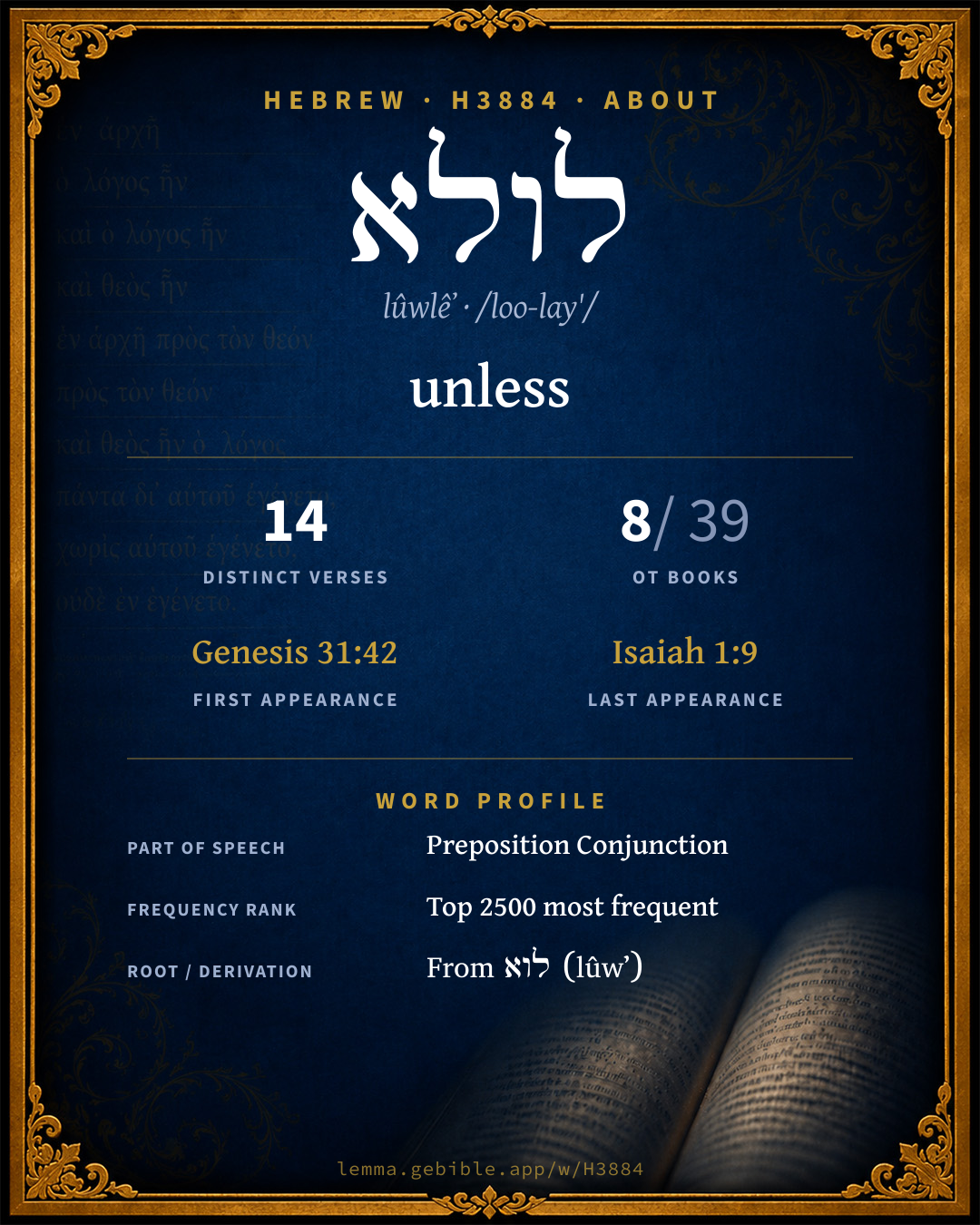
לוּלֵא
unless
Full lexicon entry — Brown-Driver-Briggs (BDB)
From Brown-Driver-Briggs (BDB)
Where this word appears
Grammar key — what these labels mean
Part of speech
- Conjunction
- A joining word (e.g. “and,” “but”) linking words or clauses.
Every verse where H3884 appears — 14 distinct verses across 8 books. Click any verse to open its interlinear word-by-word view. Verse text shown in the World English Bible for context — . Each verse’s Hebrew form is shown with its reference; the English is not keyword-highlighted, since the data carries no word-level English alignment. Use “Compare translations” on any verse to read it across multiple English versions. This concordance covers the Hebrew Bible; Septuagint (Greek Old Testament) occurrences are not indexed here.
Genesis 2 verses
- Genesis 31:42 לוּלֵ֡י conj Unless the God of my father, the God of Abraham, and the fear of Isaac, had been with me, surely now you would have sent me away empty. God has seen my affliction and the labor of my hands, and rebuked you last night."
- Genesis 43:10 לוּלֵ֣א conj for unless we had lingered, surely we would have returned a second time by now."
Deuteronomy 1 verse
Judges 1 verse
1 Samuel 1 verse
2 Samuel 1 verse
2 Kings 1 verse
Psalms 6 verses
- Psalms 27:13 לׅׄוּלֵׅׄ֗אׅׄ conj I am still confident of this: I will see the goodness of Yahweh in the land of the living.
- Psalms 94:17 לוּלֵ֣י conj Unless Yahweh had been my help, My soul would have soon lived in silence.
- Psalms 106:23 לוּלֵ֡י conj Therefore he said that he would destroy them, Had Moses, his chosen, not stood before him in the breach, To turn away his wrath, so that he wouldn't destroy them.
- Psalms 119:92 לוּלֵ֣י conj Unless your law had been my delight, I would have perished in my affliction.
- Psalms 124:1 לוּלֵ֣י conj If it had not been Yahweh who was on our side, Let Israel now say,
- Psalms 124:2 לוּלֵ֣י conj If it had not been Yahweh who was on our side, When men rose up against us;
Isaiah 1 verse
About this entry
At a glance — auto-summarized from this page’s data, not written by a person. Every figure links to its source below. This summary describes the numbers; it doesn’t interpret them.
לולא (lûwlêʼ) is a Hebrew preposition most often rendered “unless.” It first appears in Genesis 31:42. It turns up in 14 verses across 8 books, an uncommon footprint. It concentrates in Psalms, which alone accounts for 43% of its uses. The sections below give every sense, occurrence, and version rendering.
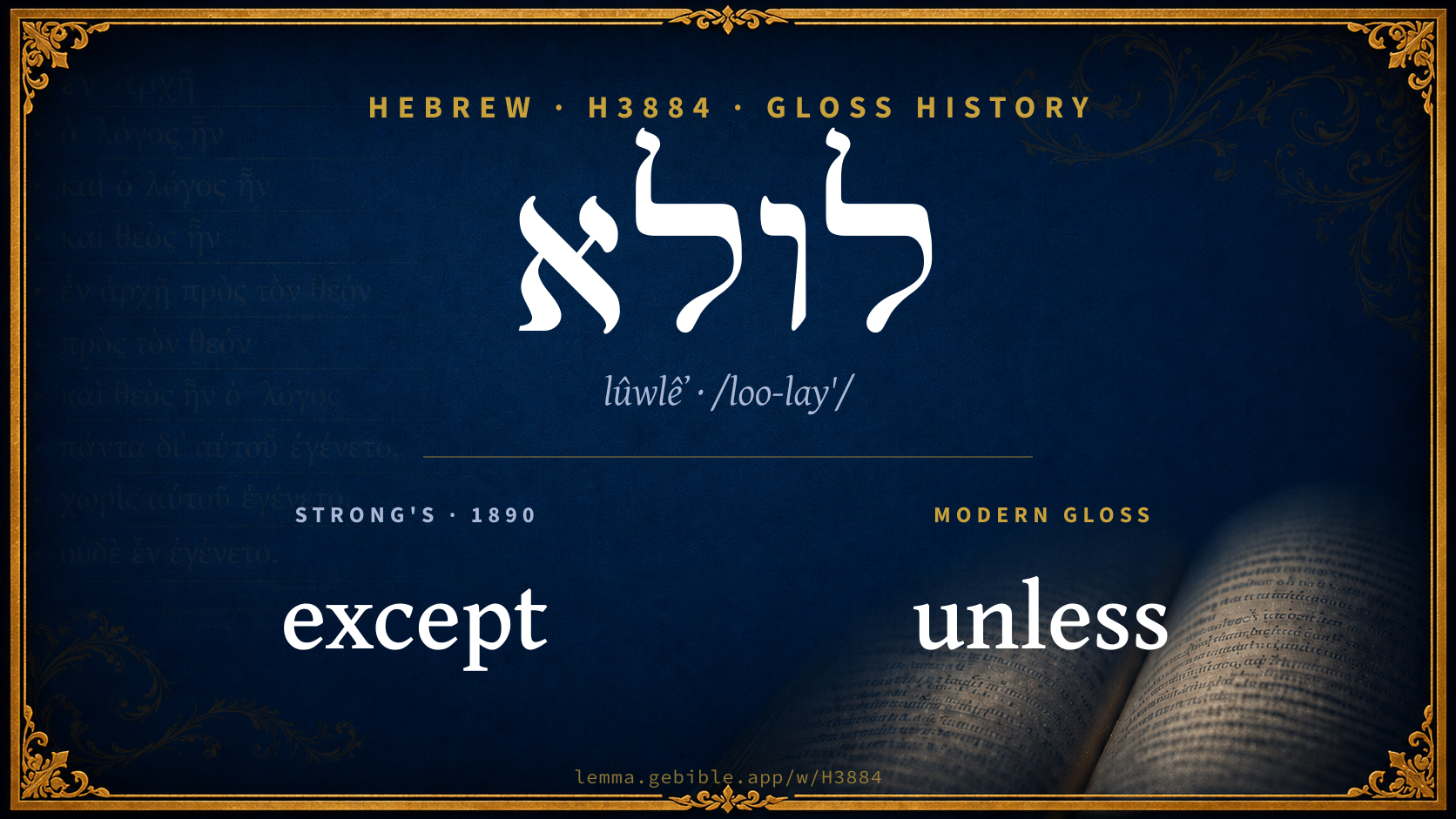
Gloss history
Strong's 1890 vs modern scholarship
About this word
Strong's H3884 catalogs a Hebrew word from the Hebrew Old Testament.
These counts are not copied from any lexicon or concordance. They are computed here, from the morphology-tagged Hebrew Old Testament. What Lemma adds →
- 14
- distinct verses
- The word appears in 14 distinct verses.
- 8 / 39
- OT books
- The word appears in 8 of 39 Old Testament books.
- #1,910
- by frequency
- Top 2500 most frequent Hebrew words (rank 1,910 of 8,640 Hebrew words by occurrence).
View all 14 occurrences in the concordance →
Most concentrated in
- Psalms 6 verses 43%
- Genesis 2 verses 14%
- Deuteronomy 1 verse 7%
By section of the Old Testament
By traditional corpus
Conventional, traditional groupings — biblical authorship is debated, so this is a traditional corpus grouping, not an authorship claim. Each share is this word’s portion of its verses in that division of the Hebrew canon. Each figure is a share of the word’s 14 distinct verses.
- Writings (Ketuvim) 6 verses · 43%
- Prophets (Nevi'im) 5 verses · 36%
- Torah (Pentateuch) 3 verses · 21%
How translations render this word
Counts come from each version’s own published word-to-Strong’s tagging or interlinear alignment — an approximate guide to how each version renders this word, not a word-level alignment the data otherwise carries. Because each total is that version’s own tagged count, the per-version totals vary from one another and need not match the appearance or distinct-verse counts above. These counts may also differ from a printed concordance because Lemma counts each distinctly tagged rendering and does not collapse phrase taggings into a single head-word total. This is a fixed set of word-tagged versions (KJV, ASV, BSB, ULT) and does not change with the reading translation you choose elsewhere. Each version’s license is shown beside its name below (and on Sources).
BDB lists this Strong’s number as 2 distinct words (homographs). Each count above pools all of them and is not split by sense — see the Senses section below. A low-frequency rendering may belong to a different one of those words, not the primary meaning.
- King James Version†: Except 3×, If 3×, Unless 3×
- American Standard Version†: Except 3×, If 2×, Them 2×
- Berean Standard Bible†: Had not 5×, Unless 2×
- unfoldingWord Literal Text†: Not 9×, If 7×, Unless 3×
King James Version Public Domain
Renders H3884 across 14† tagged occurrences — most commonly:
Plus 5 renderings that appear only once — usually multi-word phrases or single function words the recovered tagging swept in, not distinct renderings.
American Standard Version Public Domain
Renders H3884 across 14† tagged occurrences — most commonly:
Plus 5 renderings that appear only once — usually multi-word phrases or single function words the recovered tagging swept in, not distinct renderings.
Berean Standard Bible Public Domain
Renders H3884 across 11† tagged occurrences — most commonly:
Plus 4 renderings that appear only once — usually multi-word phrases or single function words the recovered tagging swept in, not distinct renderings. Not rendered by a distinct English word in 3 further occurrences.
unfoldingWord Literal Text CC BY-SA 4.0
Renders H3884 across 21† tagged occurrences — most commonly:
Plus 2 renderings that appear only once — usually multi-word phrases or single function words the recovered tagging swept in, not distinct renderings.
Senses in the full BDB
What do BDB’s symbols mean?
BDB uses these scholarly abbreviations:
| Symbol | Meaning |
|---|---|
| 𝔊 | the Septuagint (the ancient Greek translation, LXX) |
| 𝔙 | the Vulgate (the Latin translation) |
| 𝔖 | the Syriac version (the Peshitta) |
| 𝔗 | the Targum (the Aramaic translation) |
| ψ | the Psalms |
| √ | root (the underlying root or stem) |
| ‖ | parallel passage (a synonymous or contrasted parallel) |
| † | the dagger: every passage where the word occurs is cited |
The 4 senses and sub-senses the full Brown-Driver-Briggs lexicon distinguishes for this word, in lexicon order (not ranked by frequency), with BDB’s own verbatim wording and sub-sense lettering. Shown in Hebrew script with BDB’s own scholarly abbreviations. The condensed entry is in the Lexicon Entry tab. See also the Forms in the corpus table below.
- a. sq. pf., Ju 14:18 לולא חרשׁתם … לא מצאתם unless ye had ploughed with my heifer, ye would not have found out my riddle, 1 S 25:34 (second כי resumptive: כִּי 1 d), ψ 106:23; with apod. introd. by כִּי עַתָּה Gn 31:42; 43:10; by אָז 2 S 2:27 (כי resumptive); by כִּמְעַט Is 1:9; with an aposiop. ψ 27:13 if I had not believed …! e.g. Judges 14:18
- b. sq. impf. Dt 32:27 אמרתי … לולי אגור I should have said, &c. … except I dreaded, &i>c. e.g. Deuteronomy 32:27
- c. sq. ptcp., 2 K 3:14. e.g. 2 Kings 3:14
- d. without a verb, ψ 94:17 (apod. כמעט), 119:92 (apod. אָז). In the later language, ψ 124:1, 2 לוּלֵי י׳ שֶׁ- (apod. אֲזַי) except that … (cf. Aramaic ܕ ? … ܐܶܠܘܽ ܠܴܐ ψ 106:23, אִילּוּלֵי … דִּי ψ 27:13 𝔗).—Read also לוּלֵי for אוּלַי in Nu 22:33 (apod. כִּי עַתָּה). See further on לוּ and לוּלֵא Dr§§ 139–145 Köiii. 487 f. 565. e.g. Psalms 94:17
Senses from the full Brown-Driver-Briggs lexicon (Brown, Driver, Briggs; Oxford 1906 — public domain), digitized via Sefaria, supplemented by the OpenScriptures HebrewLexicon (CC BY 4.0). Full attribution on Sources.
Word origin
Gn 43:10; Ju 14:18; 2 S 2:27; ψ 27:13, elsewhere לוּלֵי10 if not, unless (from לוּ if, and לֵא, by dissim. (Köii 236, 489) for לֹא not; cf. Arabic لَوْلَا ), the neg. of לוּ, and used similarly:—
— Brown-Driver-Briggs (Oxford 1906, public domain), digitized via Sefaria, supplemented by the OpenScriptures HebrewLexicon (CC BY 4.0). See Sources.
Derived from לוא (lûwʼ) (H3863) — if only.
Jastrow Dictionary
A second Hebrew/Aramaic lexicon for comparison, covering Aramaic and post-biblical (Talmudic, Targumic, Midrashic) usage that the biblical-Hebrew BDB does not. Matched by lemma rather than by Strong’s number, so a lemma may carry more than one Jastrow headword (shown separately below), and the entries cover usage well beyond the Bible.
לוּלָא
- , small room with a staircase. Y. Yoma I, 38ᶜ; Y. Meg. IV, 75ᶜ bot. ל׳ דר׳ אילעא דהוה עביד וכ׳ the Lul of R. Il. which was made (with reference to the law of M’zuzah) in agreement with the opinions of the Rabbis.
A Dictionary of the Targumim, the Talmud Babli and Yerushalmi, and the Midrashic Literature (Marcus Jastrow; London, Luzac, 1903) — Public Domain. Digitized via Sefaria. Digitized via Sefaria. Full attribution on Sources.
Forms in the corpus
The 9 distinct written forms H3884 takes in the Hebrew Bible, most frequent first — each parse links to that state’s occurrences in the concordance. Hebrew forms include their vowel points and cantillation, so a single lemma takes many written forms.
| Form | Parsing | Example | Uses |
|---|---|---|---|
| לוּלֵ֣י | Conjunction | 1 Samuel 25:34 | 5 |
| לוּלֵ֡י | Conjunction | Genesis 31:42 | 2 |
| לׅׄוּלֵׅׄ֗אׅׄ | Conjunction | Psalms 27:13 | 1 |
| לוּלֵ֖א | Conjunction | 2 Samuel 2:27 | 1 |
| לוּלֵ֗י | Conjunction | Deuteronomy 32:27 | 1 |
| לוּלֵ֛י | Conjunction | 2 Kings 3:14 | 1 |
| לוּלֵ֣א | Conjunction | Genesis 43:10 | 1 |
| לוּלֵא֙ | Conjunction | Judges 14:18 | 1 |
| לוּלֵי֙ | Conjunction | Isaiah 1:9 | 1 |
Septuagint verse parallels
This word appears in 11 verses that also exist in the Greek Old Testament (Septuagint), out of the 14 Hebrew verses it occurs in. You can read those verses in Greek by switching the Old Testament edition to the Septuagint.
Read these verses in the Septuagint
- Genesis 31:42
- Deuteronomy 32:27
- Judges 14:18
- 1 Samuel 25:34
- 2 Samuel 2:27
- 2 Kings 3:14
- Psalms 106:23
- Isaiah 1:9
This is a verse-level parallel only — the same verses exist in both the Hebrew and Greek Old Testaments. No word-level Hebrew↔Greek correspondence is claimed: the data carries no such alignment, so no Greek word is shown as this Hebrew word’s translation. Coverage is not total — the Septuagint omits the deuterocanon and renumbers the Psalms, so some Hebrew verses have no direct Greek parallel.