
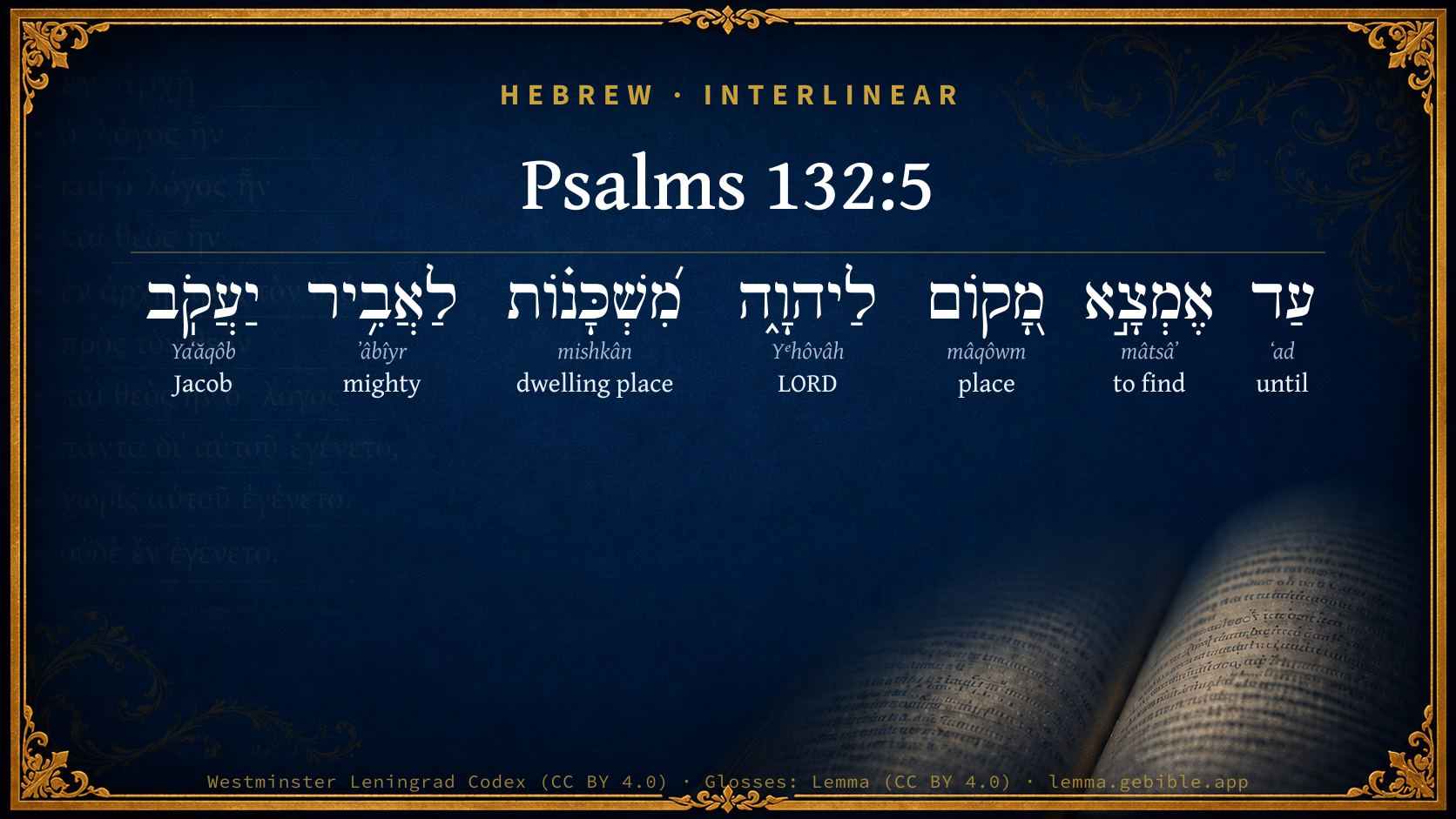
Psalms 132:5

Hebrew (Westminster Leningrad Codex) Psalms 132:5 appears in the Hebrew Old Testament. The text above is from the Westminster Leningrad Codex. Each word links to its Strong’s number, a concise gloss, and parsing drawn from the Open Scriptures Hebrew Bible morphology. Click any word for its full Brown-Driver-Briggs (BDB) entry.
Download image
Cite this verse

Psalms 132:5 (World English Bible). Public Domain. Lemma interlinear Bible study tool, https://lemma.gebible.app/v/psalms/132/5.

Show BibTeX & RIS
BibTeX
RIS
English Translation
Until I find out a place for Yahweh, A dwelling for the Mighty One of Jacob."
World English Bible · Public Domain
Download a study sheet

One document with this verse’s original text, its word-by-word gloss line, the meaning frame, cross-references with their text, attributed commentary, and full source and license credits — printable, and it pastes into notes with its structure intact.

This verse Autodidact and up

Study sheet (.html) Plain text (.txt)

A passage Seminary Student

Up to 50 verses in one chapter. A passage sheet keeps up to 6 commentary sources and 12 cross-references per verse, in the order this page ranks them, and says so on the sheet whenever that leaves anything out. Ask for a single verse and you get the Autodidact verse sheet above.

Everything on this page stays free to read, with no account — the sheet is a download of what is already on screen, not access to it.

Want to remove ads? Support Godless Engineer
Compare translations 3

The same verse in 3 English versions, stacked beneath the original-language interlinear above. Click any original word for its lexicon entry.

Each is an independent rendering of the whole verse — the interlinear is not word-aligned to these translations.

Highlighted words mark where these versions differ — a whole-verse word diff, not a word-by-word alignment.

  • World English Bible Public Domain
    Until I find out a place for Yahweh, A dwelling for the Mighty One of Jacob."
  • King James Version Public Domain
    Until I find out a place for the LORD, an habitation for the mighty God of Jacob.
  • unfoldingWord Literal Text CC BY-SA 4.0
    until I find a place for Yahweh, dwellings for the Mighty One of Jacob.”

unfoldingWord Literal Text — © unfoldingWord, licensed CC BY-SA 4.0. Word-aligned USFM3 via Door43 (git.door43.org/unfoldingWord/en_ult).

Versions to compare (up to 4)

3 of 4 selected

Show all 17 translations

Every available English version of this verse, each an independent rendering of the whole verse.

  • World English Bible Public Domain
    Until I find out a place for Yahweh, A dwelling for the Mighty One of Jacob."
  • Berean Standard Bible Public Domain
    until I find a place for the LORD, a dwelling for the Mighty One of Jacob.”
  • Majority Standard Bible Public Domain
    until I find a place for the LORD, a dwelling for the Mighty One of Jacob.”
  • King James Version Public Domain
    Until I find out a place for the LORD, an habitation for the mighty God of Jacob.
  • American Standard Version (1901) Public Domain
    Until I find out a place for Jehovah, A tabernacle for the Mighty One of Jacob.
  • Revised Version (1885) Public Domain
    Until I find out a place for the LORD, a tabernacle for the Mighty One of Jacob.
  • Geneva Bible (1599) Public Domain
    Vntill I finde out a place for the Lord, an habitation for the mightie God of Iaakob.
  • Young's Literal Translation Public Domain
    Till I do find a place for Jehovah, Tabernacles for the Mighty One of Jacob.
  • Literal Standard Version CC BY-SA 4.0
    Until I find a place for YHWH, dwelling places for the Mighty One of Jacob.”
  • Unlocked Literal Bible CC BY-SA 4.0
    until I find a place for Yahweh, a tabernacle for the Mighty One of Jacob.”
  • unfoldingWord Literal Text CC BY-SA 4.0
    until I find a place for Yahweh, dwellings for the Mighty One of Jacob.”
  • Darby Bible Public Domain
    Until I find out a place for Jehovah, habitations for the Mighty One of Jacob....
  • World Messianic Bible Public Domain
    until I find out a place for the LORD, a dwelling for the Mighty One of Jacob.”
  • Webster's Bible Public Domain
    Until I find a place for the LORD, a habitation for the mighty God of Jacob.
  • Free Bible Version CC BY-SA 4.0
    until I find a place where the Lord can live, a home for the Mighty One of Jacob.”
  • Bible in Basic English Public Domain
    Till I have got a place for the Lord, a resting-place for the great God of Jacob.
  • JPS Tanakh (1917) Public Domain
    Until I find out a place for the LORD, a dwelling-place for the Mighty One of Jacob.'

Literal Standard Version (2020), Covenant Press — licensed CC BY-SA 4.0. Text via the HelloAO Bible API (eBible.org). Unlocked Literal Bible (unfoldingWord) — licensed CC BY-SA 4.0. Text via the HelloAO Bible API (eBible.org). unfoldingWord Literal Text — © unfoldingWord, licensed CC BY-SA 4.0. Word-aligned USFM3 via Door43 (git.door43.org/unfoldingWord/en_ult). Free Bible Version, Dr. Jonathan Gallagher — licensed CC BY-SA 4.0. Text via the HelloAO Bible API (eBible.org).

Word by word

More ways to search: Search by grammar → Find every occurrence → Compare this word →

Practice this passage: Drill this verse → Learn its vocabulary →

About this verse

These counts appear in no published source. They are computed here, from the morphology-tagged text and Lemma’s own curated glosses. What Lemma adds →

7
words
7
distinct lemmas
Wisdom
section

Notable vocabulary

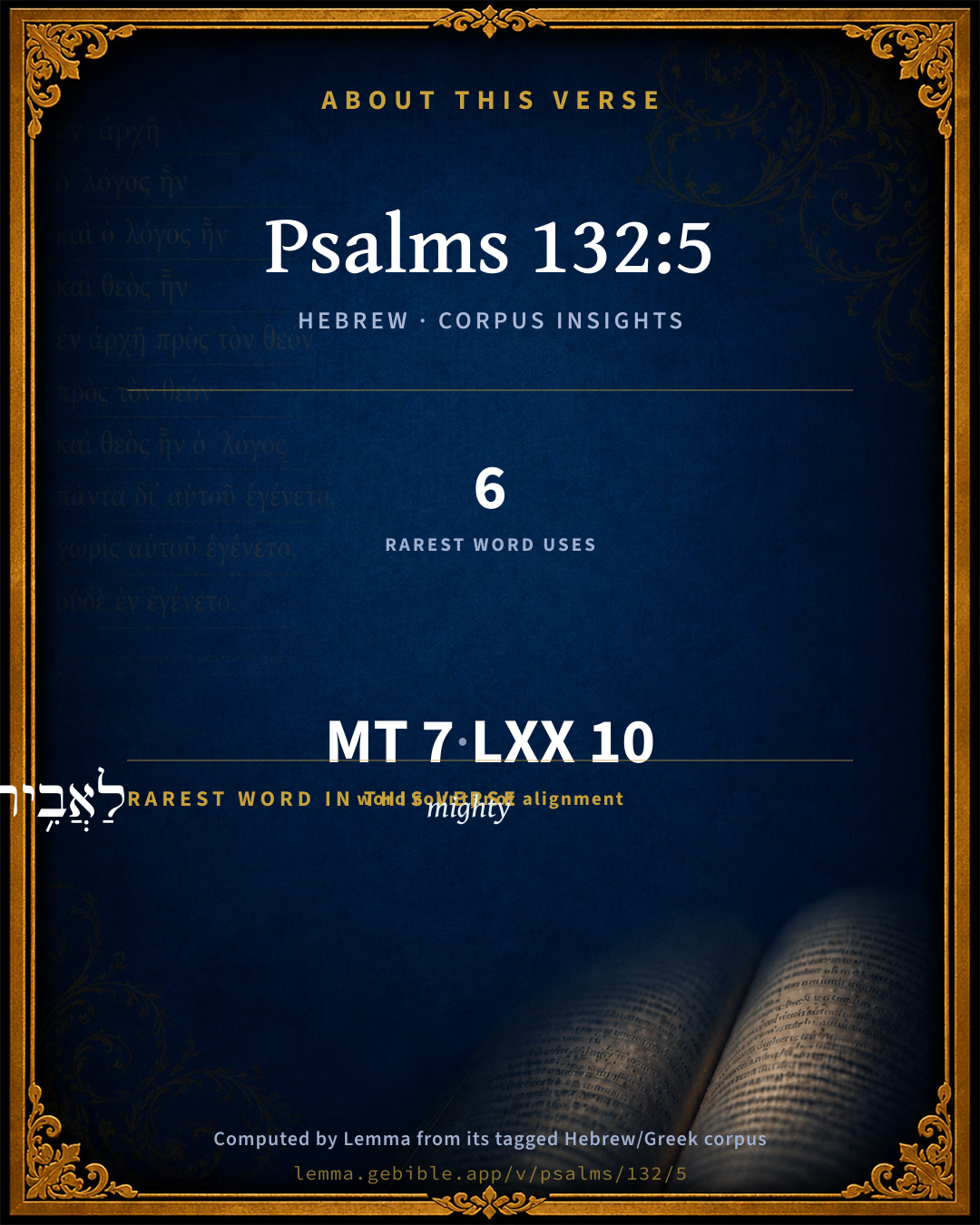
The rarest word here is לַאֲבִ֥יר mighty H46 — appearing just 6 times in the whole Hebrew Bible.

Shared distinctive vocabulary

לַאֲבִ֥יר mighty H46 occurs in 6 verses of the Hebrew Bible. Also found in:

Grammatical profile

  • 1 verb
  • 4 nouns
  • 1 adjective
  • 1 preposition

Verb forms

  • אֶמְצָ֣א Qal · Imperfect

Hebrew & Septuagint length

In English translation the verse runs 16 words from the Hebrew and 15 from the Septuagint (LXX English) — closely comparable.

A rough comparison of the two English renderings, which tokenize alike — not a word-level alignment.

Word counts can differ between the Hebrew and the Greek without any difference in meaning — e.g. the Hebrew direct-object marker אֵת has no separate Greek word, and Greek often adds the article ὁ.

In the original languages it is 7 Hebrew tokens and 10 Greek tokens — but the two are counted differently (Hebrew bundles its prefixes and suffixes into one token; the Greek is in lemma form), so that isn’t a like-for-like length.

Cross-references

9

Topical passages linked to Psalms 132:5 in the Treasury of Scripture Knowledge — connected by theme and wording, ordered by reader-vote popularity; previews shown in the World English Bible.

  • Ephesians 2:22 in whom you also are built together for a habitation of God in the Spirit.
  • 1 Chronicles 22:7 David said to Solomon his son, As for me, it was in my heart to build a house to the name of Yahweh my God.
  • 2 Chronicles 2:6 But who is able to build him a house, seeing heaven and the heaven of heavens can't contain him? who am I then, that I should build him a house, save only to burn incense before him?
  • Acts 7:46–49 who found favor in the sight of God, and asked to find a habitation for the God of Jacob.
  • 2 Samuel 6:17 They brought in the ark of Yahweh, and set it in its place, in the midst of the tent that David had pitched for it; and David offered burnt offerings and peace-offerings before Yahweh.
  • 1 Kings 8:27 But will God in very deed dwell on the earth? behold, heaven and the heaven of heavens can't contain you; how much less this house that I have built!
  • 1 Chronicles 15:3 David assembled all Israel at Jerusalem, to bring up the ark of Yahweh to its place, which he had prepared for it.
  • 1 Chronicles 15:12 and said to them, You are the heads of the fathers' [houses] of the Levites: sanctify yourselves, both you and your brothers, that you may bring up the ark of Yahweh, the God of Israel, to [the place] that I have prepared for it.
  • Isaiah 66:1 Thus says Yahweh, heaven is my throne, and the earth is my footstool: what manner of house will you build to me? and what place shall be my rest?

Cross-references courtesy of OpenBible.info (CC BY 4.0).

Hebrew and Greek witnesses Masoretic Hebrew ↔ Greek Septuagint

The same verse in the two great witnesses to the Old Testament, shown verse-for-verse.

You’re reading Greek Psalm 131 (Hebrew Psalm 132). The Septuagint counts the superscription, so verse numbers can differ from the Hebrew — chapter-level alignment, not verse-by-verse. Numbering follows Rahlfs.

These are two independent witnesses, not word-aligned to each other, and the Septuagint is shown in lemma (dictionary) form.

Hebrew Psalms 132:5 Masoretic · Westminster Leningrad Codex

עַד אֶמְצָ֣א מָ֭קוֹם לַיהוָ֑ה מִ֝שְׁכָּנ֗וֹת לַאֲבִ֥יר יַעֲקֹֽב

Until I find out a place for Yahweh, A dwelling for the Mighty One of Jacob."

World English Bible · Public Domain

Greek LXX Greek Psalm 131:5 Septuagint · lemma form

ἕως ὅς εὑρίσκω τόπος ὁ κύριος σκήνωμα ὁ θεός ἰακώβ

until I find a place for the Lord, a tabernacle for the God of Jacob.

LXX2012 (modern English Septuagint) · Public Domain

Hebrew: Westminster Leningrad Codex (CC BY 4.0). Greek: Septuagint (public domain); English from LXX2012 (modern English Septuagint) (Public Domain). How the Septuagint differs from the Hebrew →

Commentary

Notes on Psalms 132:5 from classic Christian and Jewish commentators (each source and its license shown beneath its notes). The classic Christian expositions comment on the surrounding passage and are grouped to its opening verse, so a note may address several verses; the Jewish commentaries on the Tanakh (Rashi and others) are per-verse, so they appear only where the commentator wrote on this verse.

Lemma curates 59 commentaries, every one of them public domain or Creative Commons licensed, each selected and text-cleaned for this edition rather than reprinted as found. About our sources →

Trapp's Complete Commentary

John Trapp

Psa 132:5 Until I find out a place for the LORD, an habitation for the mighty [God] of Jacob.

Ver. 5. Until I find out a place for the Lord] The Jewish doctors tell us, that as the earth is in the middle of the world, so is Judea in the middle of the earth, Jerusalem in the middle of Judea, the temple in the middle of Jerusalem, and the ark in the middle of the temple.

An habitation] Heb. habitations; haply because the temple consisted of three parts, or partitions.

John Trapp, A Commentary or Exposition upon All the Books of the Old and New Testament (1647–1656) — public domain. Text from a community e-Sword module.

J. A. Alexander on Psalms

Joseph Addison Alexander

5. (Psa 132:5) Until I find a place for Jehovah, dwellings for the Mighty One of Jacob. The implication in the first clause, that Jehovah was without a place on earth, may remind us of Christ's memorable saying, Mat 8:20, Luk 9:58. The word translated dwellings is peculiarly expressive, because, although strictly a generic term, it is specially applied in usage to the sanctuary with its enclosures and appendages. See above, on Psa 84:1.

Joseph Addison Alexander, The Psalms Translated and Explained (1850) — public domain. Text from a community e-Sword module.

Geneva Bible (1599)

Geneva Bible translators

That is, the Ark, which was a sign of God’s presence.

Geneva Bible (1599) marginal notes — public domain. Text via Bolls.life.

Adam Clarke's Commentary

Verse 5. The mighty God of Jacob.] עביר יעקב abir yaacob, the Mighty One of Jacob. We have this epithet of God for the first time, Ge 49:24. Hence, perhaps, the abirim of the heathen, the stout ones, the strong beings.

Adam Clarke's Commentary on the Bible (1810–1826) — public domain. Text from a community e-Sword/MySword module.

The Cambridge Bible for Schools and Colleges

gen. ed. J. J. S. Perowne

5. a place] Cp. 1Ch_15:1.

a habitation &c.] A dwelling place for the Mighty One of Jacob, where His presence might ‘dwell’ among His people (Exo_25:8-9). The word for dwelling place, or tabernacle, is in the ‘amplificative’ plural, expressing the dignity of the house of Jehovah. Cp. Psa_43:3; Psa_84:1.

The Cambridge Bible for Schools and Colleges (gen. ed. J. J. S. Perowne; Cambridge University Press, 1878–1918) — public domain. Text from a community e-Sword module.

John Gill's Exposition

We will go into his tabernacles,.... The tabernacles of him that was heard of at Ephratah; born in Bethlehem, and found in the ministry of the word among the Gentiles: enter into his churches, raised and formed there, which are the tabernacles or dwelling places of Christ; where he has his residence, takes his walks, and dwells; and which are very lovely, amiable, and pleasant, and so desirable by believers to go into; because of the presence of God in them, the provisions there made for them, the company there enjoyed; the work there done, prayer, praise, preaching, and hearing the word, and administration of all ordinances. Some render it as a mutual exhortation, "let us go into his tabernacles" (w); see Isa 2:2;

we will worship at his footstool; any place of worship on earth may be called the footstool of God, with respect to heaven his throne, Isa 66:1; particularly the ark is so called, Ch1 28:2; in which the law was; over which was the mercy seat, and over that the cherubim of glory, and between them the Majesty of God dwelt; so that the ark was properly his footstool: and all this being typical of Christ may direct us to observe, that all religious, spiritual, and evangelic worship, is to be performed in his name, and in the faith of him, and by the assistance of his grace and Spirit; see Psa 99:5.

(w) So Tigurine version, Vatablus, Musculus, Gejerus, Cocceius, Michaelis.

John Gill's Exposition of the Whole Bible (1746–1763) — public domain (CC PDM 1.0). Text via the HelloAO Bible API.

Albert Barnes' Notes on the Bible

Until I find out a place for the Lord - A place for the ark of God; a place where it may constantly and safely remain. The symbol of the divine presence rested on the mercy-seat, the cover of the ark, and hence, this was represented as the seat or the house of God.

An habitation for the mighty God of Jacob - Hebrew, “For the mighty One of Jacob.” The reference is to a permanent dwelling-place for the ark. It had been moved from place to place. There was no house appropriated to it, or reared expressly for it, and David resolved to provide such a house - at first, a tent or tabernacle on Mount Zion - and then, a more spacious and magnificent structure, the temple. The latter he was not permitted to build, though the purpose was in his heart.

Albert Barnes' Notes on the Bible (1834–1885) — public domain. Text from a community e-Sword/MySword module.

Matthew Poole's English Annotations

Until I find out a place for the Lord; either,

1. Until I can understand from God what place he hath chosen for his house to be built in. Or rather,

2. Until I have fitted or raised a house in which the ark may be put;

a habitation, as this is explained both in the next clause, and in Psa 132:7; Act 7:46. For this, and not the former, was the matter both of David’s desire, and-of God’s answer delivered by Nathan, 2Sa 7.

Matthew Poole's English Annotations on the Holy Bible (1683–1685) — public domain. Text from a community e-Sword/MySword module.

The Treasury of David

Charles H. Spurgeon

Ver. 5. Until I find out a place for the Lord, an habitation for the mighty God of Jacob. He resolved to find a place where Jehovah would allow his worship to be celebrated, a house where God would fix the symbol of his presence, and commune with his people. At that time, in all David's land, there was no proper place for that ark whereon the Lord had placed the mercy seat, where prayer could be offered, and where the manifested glory shone forth. All things had fallen into decay, and the outward forms of public worship were too much disregarded; hence the King resolves to be first and foremost in establishing a better order of things.

Yet one cannot help remembering that the holy resolve of David gave to a place and a house much more importance than the Lord himself ever attached to such matters. This is indicated in Nathan's message from the Lord to the king"Go and tell my servant David, Thus saith the Lord, Shalt thou build me an house for me to dwell in? Whereas I have not dwelt in any house since the time that I brought up the children of Israel out of Egypt, even to this day, but have walked in a tent and in a tabernacle. In all the places wherein I have walked with all the children of Israel spake I a word with any of the tribes of Israel, whom I commanded to feed my people Israel, saying, Why build ye not me an house of cedar?" Stephen in his inspired speech puts the matter plainly: "Solomon built him an house. Howbeit the Most High dwelleth not in temples made with hands." It is a striking fact that true religion never flourished more in Israel than before the temple was built, and that from the day of the erection of that magnificent house the spirit of godliness declined. Good men may have on their hearts matters which seem to them of chief importance, and it may be acceptable with God that they should seek to carry them out; and yet in his infinite wisdom he may judge it best to prevent their executing their designs. God does not measure his people's actions by their wisdom, or want of wisdom, but by the sincere desire for his glory which has led up to them. David's resolution, though he was not allowed to fulfil it, brought a blessing upon him: the Lord promised to build the house of David, because he had desired to build the house of the Lord. Moreover, the King was allowed to prepare the treasure for the erection of the glorious edifice which was built by his son and successor. The Lord shows the acceptance of what we desire to do by permitting us to do something else which his infinite mind judges to be fitter for us, and more honourable to himself.

Ver. 5. An habitation for the mighty God of Jacob. Jacob "vowed a vow", when he declared, "this...shall be God's house": Ge 28:20-22. David accordingly preserved a reminiscence of the fact, when he vowed a vow in connection with a similar object. H. T. Armfield.

Ver. 5. Something to live forto find fresh habitations for God.

1. The Condescension implied: God with us.

2. The Districts explored: hearts, homes, "dark places of the earth."

3. The Royalty of the Work. It makes King David busy, and is labour worthy of a king. W. B. H.

Ver. 5. "A place for the LORD." In the heart, the home, the assembly, the life. Everywhere we must find or make a place for the Lord.

Ver. 5. "The mighty God of Jacob."

1. Mighty, and therefore he joined heaven and earth at Bethel.

2. Mighty, and therefore brought Jacob back from Mesopotamia.

3. Mighty, and yet wrestled with him at Jabbok.

4. Mighty, and yet allowed him to be afflicted.

5. Mighty, and therefore gave him full deliverance.

Psalms 132:6*

Charles H. Spurgeon's The Treasury of David (1869–1885) — public domain. Psalms only. Text from a community e-Sword/MySword module.

Whedon's Commentary on the Bible

Daniel D. Whedon

5. Place—Abiding place, a settled abode.

Habitation—Hebrew, tabernacles; the word is plural as in Psa_132:7.

Mighty God of Jacob— Mighty One of Jacob, same as Gen_49:24, of which it is a quotation.

Daniel D. Whedon (gen. ed.), Commentary on the Old and New Testaments (1874–1909) — public domain. Text from a community e-Sword module.

The Pulpit Commentary

Until I find out a place for the Lord. The "place" which David desired to "find" was a permanent resting-place for the ark of God, which he had already "brought up from the house of Obed-Edom into the city of David with gladness", (2Sa_6:12) but which he had only established in a temporary abode of the nature of a tent, or tabernacle. (2Sa_6:17) God approved David"s zeal, but did not allow him to accomplish his design. (2Sa_7:5-16) A habitation for the mighty God of Jacob; rather, the Mighty One of Jacob (comp. ver. 2 and the comment ad loc.).

"A place for the Lord.

I TO SECURE THIS SHOULD BE THE OBJECT OF OUR INTENSE DESIRE AND ENDEAVOR.

1. Because the Lord so desires it. See his name here, "the mighty God of Jacob." What a poor mean wretch Jacob too often was! And yet how God compassionated, pitied, uplifted, and saved him! What does not such a redeeming God deserve and demand!

2. For the sake of our fellow-men. It is the world"s great and crying need that the Lord God should dwell among them. It is heaven where "the tabernacle of the Lord is with men.

3. For our own sake. For God"s "loving-kindness is better than life." God is the soul"s exceeding Joy.

II WHERE WE SHOULD MAKE THIS ENDEAVOR.

1. In our own heart. Until he have a place, a habitation, there, it is no good our trying to find him a place elsewhere.

2. In our homes. Let our own family be the scene of our first aggressive work.

3. In the branch of the Church to which we belong. The Church should be God"s rest forever; he would have it so (ver. 13). But it too often is not. And until the Church is right, the world will remain wrong. To have a better world we must have a better Church.

4. In our own neighborhood. All who dwell around ought to be the better for our dwelling in their midst. "Let your light so shine," etc.

5. Throughout the world. The missionary cause should be dear to our heart.

III HOW WE SHOULD GO TO WORK.

1. By personal self-surrender to Christ. This stands at the threshold of all our work. Nothing can be done till this is done.

2. By believing prayer, importunate and persevering, and by holy example and faithful testimony.

3. By consecration of our substance to this work.

4. By continual self-denial.

5. By perpetual trust in Christ.

6. By firm, holy, and abiding resolve. (Vers. 2-4) S.C.

Housing God"s symbols.

The fitting old place was a temple; the fitting place now is a heart. The old economy was an elaborate picture-teaching of spiritual truths and relations. It is urged that, as man is a composite being, and can never transcend his bodily conditions, his religion must always be as composite as himself. it must have its visible symbols, and they must have their fitting earthly, material, surroundings. On the other hand, it is urged, as by the Hindus, that precisely what man has to do, precisely what has to be the issue of life, is full deliverance from the sensible and material, from all reliance on form, symbol, sacrament, or other outward help; and absolute absorption in, and satisfaction with, spiritual and eternal realities. To many this must seem a dream; and it may confidently be affirmed that the majority of men will never transcend their dependence on material symbols. Religion for humanity will always have its shrines, its sacraments, and its services. And if this be so, then adequate and efficient material helps will be sought by all devout souls. And this is illustrated in David"s anxiety.

I THE PITTING PLACE FOR DIVINE SYMBOLS. David had to deal with a sacred ark, which was the symbol of Jehovah"s presence as the supreme King of the nation. Clearly what was befitting to the King was a dwelling-place. But David had restored that ark to a nation that had at last gained settled permanency. The sense of security led to the idea of building a palace for David. How natural that David should thing of building a palace for his supreme and sovereign Lord! A movable tent was no longer in harmony with the national life. The houses built for God, the churches and chapels of today, ought to represent that sense of God and of God"s presence which they have for whom they are built. If the house holds the symbols which God gives, it is the symbol of God which man creates. It represents his thought of God.

II THE FITTING PLACE FOR THE REALITY REPRESENTED BY SYMBOLS. For symbols are never realities, and never must be thought of as such, or treated as such. They are only symbols. The Divine presence is a spiritual reality. And that must have its shrine. That shrine is a human heart. "To that man will I look, and with him will I dwell, who is humble and contrite in heart." The heart-temple must be worthy of its real presence. R.T.

The Pulpit Commentary (1880–1919), ed. H.D.M. Spence-Jones & Joseph S. Exell — public domain. Text from a community e-Sword module.

John Wesley's Explanatory Notes

Until - Until I have raised an house in which the ark may be put.

John Wesley, Explanatory Notes Upon the Whole Bible (1754–1765) — public domain. Text via the GEBible commentary corpus.

Rashi

Rabbi Shlomo Yitzchaki (Rashi)

Until I find a place Until it will be known where the place of His sanctuary will be. (I found this.)

Rashi on the Tanakh — English translations: “The Judaica Press complete Tanach with Rashi, translated by A. J. Rosenberg” (CC BY 4.0); “Pentateuch with Rashi's commentary by M. Rosenbaum and A.M. Silbermann, 1929-1934” (public domain); “The Metsudah Tanach series, Lakewood, N.J” (CC BY 4.0); and “The Book of Joshua, Metsudah Publications, 1997” (CC BY 4.0). Text via Sefaria.

Lesson kit

Teaching starters — assembled from the data on this page, not authored interpretation. Every prompt links to the verse data it draws on. Edit before teaching.

Psalms, in the Wisdom, opens this verse with 7 words (7 distinct Hebrew lemmas). Its most distinctive word is ʼâbîyr (“mighty”). A historical commentator’s framing appears above. Read the whole chapter for the surrounding context.

Discussion questions

  1. What does “mighty” (ʼâbîyr) contribute to the verse as a whole?
  2. How does Genesis 49:24, which shares the word «mighty», read alongside this verse?
  3. The translations on this page render this verse differently — a whole-verse word diff, not a word-by-word alignment. What might account for the different wordings?
  4. «אֶמְצָ֣א» is a Qal Imperfect verb. How does that grammatical form shape the action described?
  5. Compare how Trapp's Complete Commentary and J. A. Alexander on Psalms read this verse. Where do they agree or differ?

Things to notice

Reading settings

Reading text

Shown beneath each verse's original-language words.

Old Testament
Old Testament edition

Read the OT as the Masoretic Hebrew (MT) or the Greek Septuagint (LXX).

English shown for the Greek Septuagint (in the Hebrew ↔ Greek comparison).

Comparing translations? Open the Compare panel on any verse page to stack up to four side by side.