
Zechariah 3:9

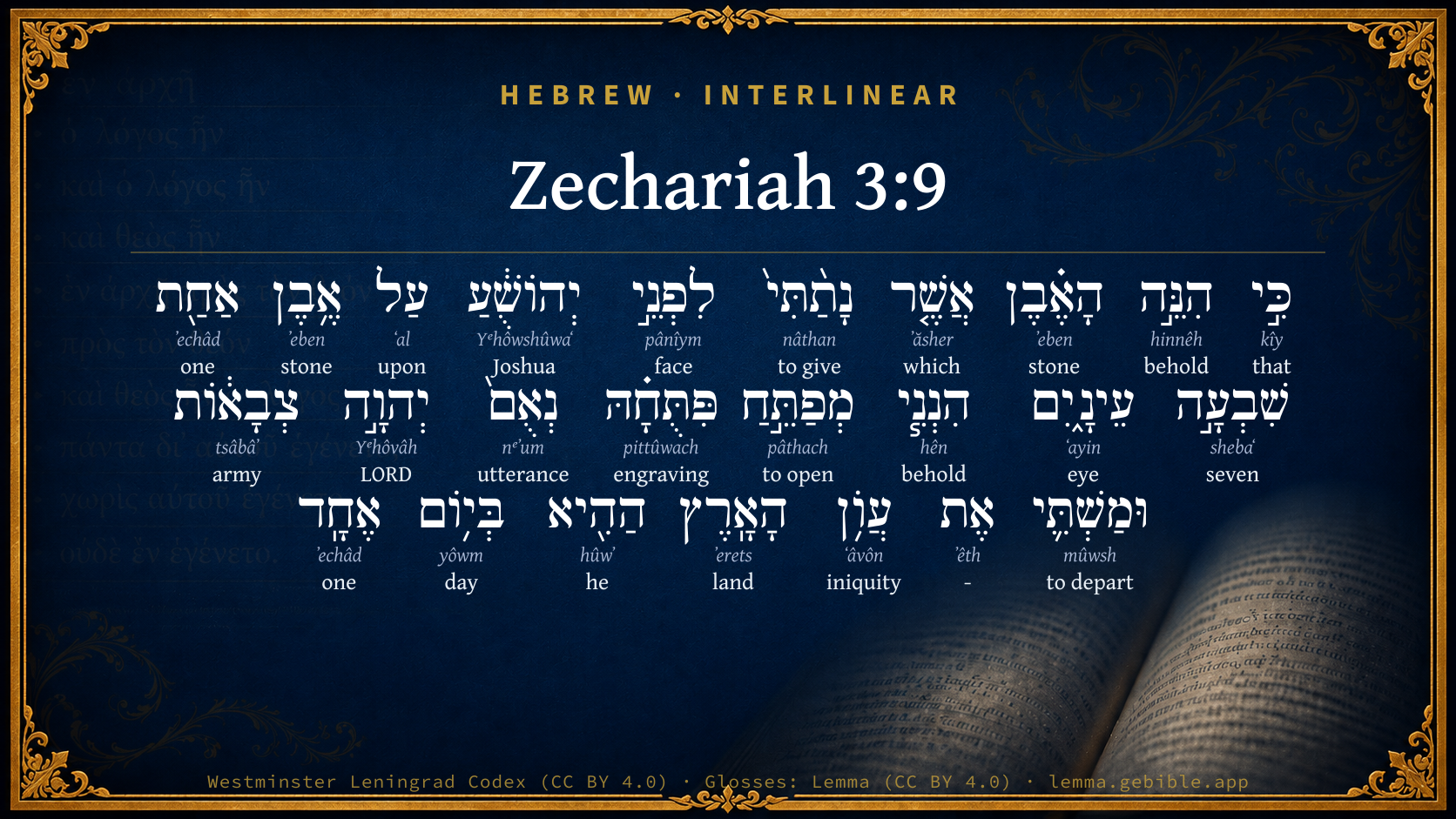
Hebrew (Westminster Leningrad Codex) Zechariah 3:9 appears in the Hebrew Old Testament. The text above is from the Westminster Leningrad Codex. Each word links to its Strong’s number, a concise gloss, and parsing drawn from the Open Scriptures Hebrew Bible morphology. Click any word for its full Brown-Driver-Briggs (BDB) entry.
Download image
Cite this verse

Zechariah 3:9 (World English Bible). Public Domain. Lemma interlinear Bible study tool, https://lemma.gebible.app/v/zechariah/3/9.

Show BibTeX & RIS
BibTeX
RIS
English Translation
For, behold, the stone that I have set before Joshua; on one stone are seven eyes: behold, I will engrave the engraving of it,' says Yahweh of Hosts, 'and I will remove the iniquity of that land in one day.
World English Bible · Public Domain
Download a study sheet

One document with this verse’s original text, its word-by-word gloss line, the meaning frame, cross-references with their text, attributed commentary, and full source and license credits — printable, and it pastes into notes with its structure intact.

This verse Autodidact and up

Study sheet (.html) Plain text (.txt)

A passage Seminary Student

Up to 50 verses in one chapter. A passage sheet keeps up to 6 commentary sources and 12 cross-references per verse, in the order this page ranks them, and says so on the sheet whenever that leaves anything out. Ask for a single verse and you get the Autodidact verse sheet above.

Everything on this page stays free to read, with no account — the sheet is a download of what is already on screen, not access to it.

Want to remove ads? Support Godless Engineer
Compare translations 3

The same verse in 3 English versions, stacked beneath the original-language interlinear above. Click any original word for its lexicon entry.

Each is an independent rendering of the whole verse — the interlinear is not word-aligned to these translations.

Highlighted words mark where these versions differ — a whole-verse word diff, not a word-by-word alignment.

  • World English Bible Public Domain
    For, behold, the stone that I have set before Joshua; on one stone are seven eyes: behold, I will engrave the engraving of it,' says Yahweh of Hosts, 'and I will remove the iniquity of that land in one day.
  • King James Version Public Domain
    For behold the stone that I have laid before Joshua; upon one stone shall be seven eyes: behold, I will engrave the graving thereof, saith the LORD of hosts, and I will remove the iniquity of that land in one day.
  • unfoldingWord Literal Text CC BY-SA 4.0
    For behold, the stone that I have set to the face of Joshua, on one stone seven eyes. Behold, I am engraving its engraving’—the declaration of Yahweh of Armies—‘and I will remove the iniquity of that land in one day.

unfoldingWord Literal Text — © unfoldingWord, licensed CC BY-SA 4.0. Word-aligned USFM3 via Door43 (git.door43.org/unfoldingWord/en_ult).

Versions to compare (up to 4)

3 of 4 selected

Show all 18 translations

Every available English version of this verse, each an independent rendering of the whole verse.

  • World English Bible Public Domain
    For, behold, the stone that I have set before Joshua; on one stone are seven eyes: behold, I will engrave the engraving of it,' says Yahweh of Hosts, 'and I will remove the iniquity of that land in one day.
  • Berean Standard Bible Public Domain
    See the stone I have set before Joshua; on that one stone are seven eyes. Behold, I will engrave on it an inscription, declares the LORD of Hosts, and I will remove the iniquity of this land in a single day.
  • Majority Standard Bible Public Domain
    See the stone I have set before Joshua; on that one stone are seven eyes. Behold, I will engrave on it an inscription, declares the LORD of Hosts, and I will remove the iniquity of this land in a single day.
  • King James Version Public Domain
    For behold the stone that I have laid before Joshua; upon one stone shall be seven eyes: behold, I will engrave the graving thereof, saith the LORD of hosts, and I will remove the iniquity of that land in one day.
  • American Standard Version (1901) Public Domain
    For, behold, the stone that I have set before Joshua; upon one stone are seven eyes: behold, I will engrave the graving thereof, saith Jehovah of hosts, and I will remove the iniquity of that land in one day.
  • Revised Version (1885) Public Domain
    For behold, the stone that I have set before Joshua; upon one stone are seven eyes: behold, I will engrave the graving thereof, saith the LORD of hosts, and I will remove the iniquity of that land in one day.
  • Geneva Bible (1599) Public Domain
    For loe, the stone that I haue layd before Iehoshua: vpon one stone shalbe seuen eyes: beholde, I will cut out the grauing thereof, saith the Lord of hostes, and I will take away the iniquitie of this land in one day.
  • Douay-Rheims (1899) Public Domain
    For behold the stone that I have laid before Jesus: upon one stone there are seven eyes: behold I will grave the graving thereof, saith the Lord of hosts: and I will take away the iniquity of that land in one day.
  • Young's Literal Translation Public Domain
    For lo, the stone that I put before Joshua, On one stone `are' seven eyes, Lo, I am graving its graving, An affirmation of Jehovah of Hosts, And I have removed the iniquity of that land in one day.
  • Literal Standard Version CC BY-SA 4.0
    For behold, the stone that I put before Joshua, || On one stone [are] seven eyes, || Behold, I am engraving its engraving, || A declaration of YHWH of Hosts, || And I have removed the iniquity of that land in one day.
  • Unlocked Literal Bible CC BY-SA 4.0
    Now look at the stone that I have set before Joshua. There are seven eyes on this single stone, and I will engrave an inscription—this is the declaration of Yahweh of hosts— and I will remove the sin from this land in one day.
  • unfoldingWord Literal Text CC BY-SA 4.0
    For behold, the stone that I have set to the face of Joshua, on one stone seven eyes. Behold, I am engraving its engraving’—the declaration of Yahweh of Armies—‘and I will remove the iniquity of that land in one day.
  • Darby Bible Public Domain
    For behold, the stone that I have laid before Joshua -- upon one stone are seven eyes; behold, I will engrave the graving thereof, saith Jehovah of hosts, and I will remove the iniquity of this land in one day.
  • World Messianic Bible Public Domain
    For, behold, the stone that I have set before Joshua: on one stone are seven eyes; behold, I will engrave its inscription,’ says the LORD of Hosts, ‘and I will remove the iniquity of that land in one day.
  • Webster's Bible Public Domain
    For behold, the stone that I have laid before Joshua; upon one stone shall be seven eyes; behold, I will engrave the graving of it saith the LORD of hosts, and I will remove the iniquity of that land in one day.
  • Free Bible Version CC BY-SA 4.0
    See that I have placed a precious stone in front of Joshua, a single stone with seven faces. Watch, for I myself am going to engrave seven eyes on it, declares the Lord Almighty, and I will wipe away the sins of this land in a single day.
  • Bible in Basic English Public Domain
    For see, the stone which I have put before Joshua; on one stone are seven eyes: see, the design cut on it will be my work, says the Lord of armies, and I will take away the sin of that land in one day.
  • JPS Tanakh (1917) Public Domain
    For behold the stone that I have laid before Joshua; upon one stone are seven facets; behold, I will engrave the graving thereof, saith the LORD of hosts: And I will remove the iniquity of that land in one day.

Literal Standard Version (2020), Covenant Press — licensed CC BY-SA 4.0. Text via the HelloAO Bible API (eBible.org). Unlocked Literal Bible (unfoldingWord) — licensed CC BY-SA 4.0. Text via the HelloAO Bible API (eBible.org). unfoldingWord Literal Text — © unfoldingWord, licensed CC BY-SA 4.0. Word-aligned USFM3 via Door43 (git.door43.org/unfoldingWord/en_ult). Free Bible Version, Dr. Jonathan Gallagher — licensed CC BY-SA 4.0. Text via the HelloAO Bible API (eBible.org).

Word by word

More ways to search: Search by grammar → Find every occurrence → Compare this word →

Practice this passage: Drill this verse → Learn its vocabulary →

פִּתֻּחָ֗הּ
pittûwach
H6603
“engraving · her”
Noun, Common, Masculine, Singular, Construct + Suffix, Personal, 3rd Person, Feminine, Singular
Part of Speech
Noun
Type
Common
Gender
Masculine
Number
Singular
State
Construct
Full BDB Definition

Origin: pass part of H6605

TWOT: 1855a

engraving, carving
  1. כִּ֣י kîy H3588 “that” Conjunction
  2. הִנֵּ֣ה hinnêh H2009 “behold” Particle, Demonstrative
  3. הָאֶ֗בֶן ʼeben H68 “the · stone” Particle, Definite Article + Noun, Common, Feminine, Singular, Absolute
  4. אֲשֶׁ֤ר ʼăsher H834 “which” Particle, Relative
  5. נָתַ֨תִּי֙ nâthan H5414 “to give” Verb, Qal, Perfect, 1st Person, Common, Singular
  6. לִפְנֵ֣י pânîym H6440 “to/for · face(s) of” Preposition + Noun, Common, Both, Plural, Construct
  7. יְהוֹשֻׁ֔עַ Yᵉhôwshûwaʻ H3091 “Joshua” Noun, Proper
  8. עַל ʻal H5921 “upon” Preposition
  9. אֶ֥בֶן ʼeben H68 “stone” Noun, Common, Feminine, Singular, Absolute
  10. אַחַ֖ת ʼechâd H259 “one” Adjective, Cardinal number, Feminine, Singular, Absolute
  11. שִׁבְעָ֣ה shebaʻ H7651 “seven” Adjective, Cardinal number, Masculine, Singular, Absolute
  12. עֵינָ֑יִם ʻayin H5869 “eyes” Noun, Common, Both, Dual, Absolute
  13. הִנְנִ֧י hên H2005 “behold · me” Particle, Demonstrative + Suffix, Personal, 1st Person, Common, Singular
  14. מְפַתֵּ֣חַ pâthach H6605 “opening” Verb, Piel, Participle Active, Masculine, Singular, Absolute
  15. נְאֻם֙ nᵉʼum H5002 “utterance of” Noun, Common, Masculine, Singular, Construct
  16. יְהוָ֣ה Yᵉhôvâh H3068 “LORD” Noun, Proper
  17. צְבָא֔וֹת tsâbâʼ H6635 “armies” Noun, Common, Both, Plural, Absolute
  18. וּמַשְׁתִּ֛י mûwsh H4185 “and · to depart” Conjunction + Verb, Qal, Sequential Perfect, 1st Person, Common, Singular
  19. אֶת ʼêth H853 “-” Particle, Direct Object
  20. עֲוֺ֥ן ʻâvôn H5771 “iniquity of” Noun, Common, Both, Singular, Construct
  21. הָאָֽרֶץ ʼerets H776 “the · land” Particle, Definite Article + Noun, Common, Both, Singular, Absolute
  22. הַהִ֖יא hûwʼ H1931 “the · he” Particle, Definite Article + Pronoun, Personal, 3rd Person, Feminine, Singular
  23. בְּי֥וֹם yôwm H3117 “in/at · day” Preposition + Noun, Common, Masculine, Singular, Absolute
  24. אֶחָֽד ʼechâd H259 “one” Adjective, Cardinal number, Masculine, Singular, Absolute

About this verse

These counts appear in no published source. They are computed here, from the morphology-tagged text and Lemma’s own curated glosses. What Lemma adds →

25
words
23
distinct lemmas
Prophets
section

Notable vocabulary

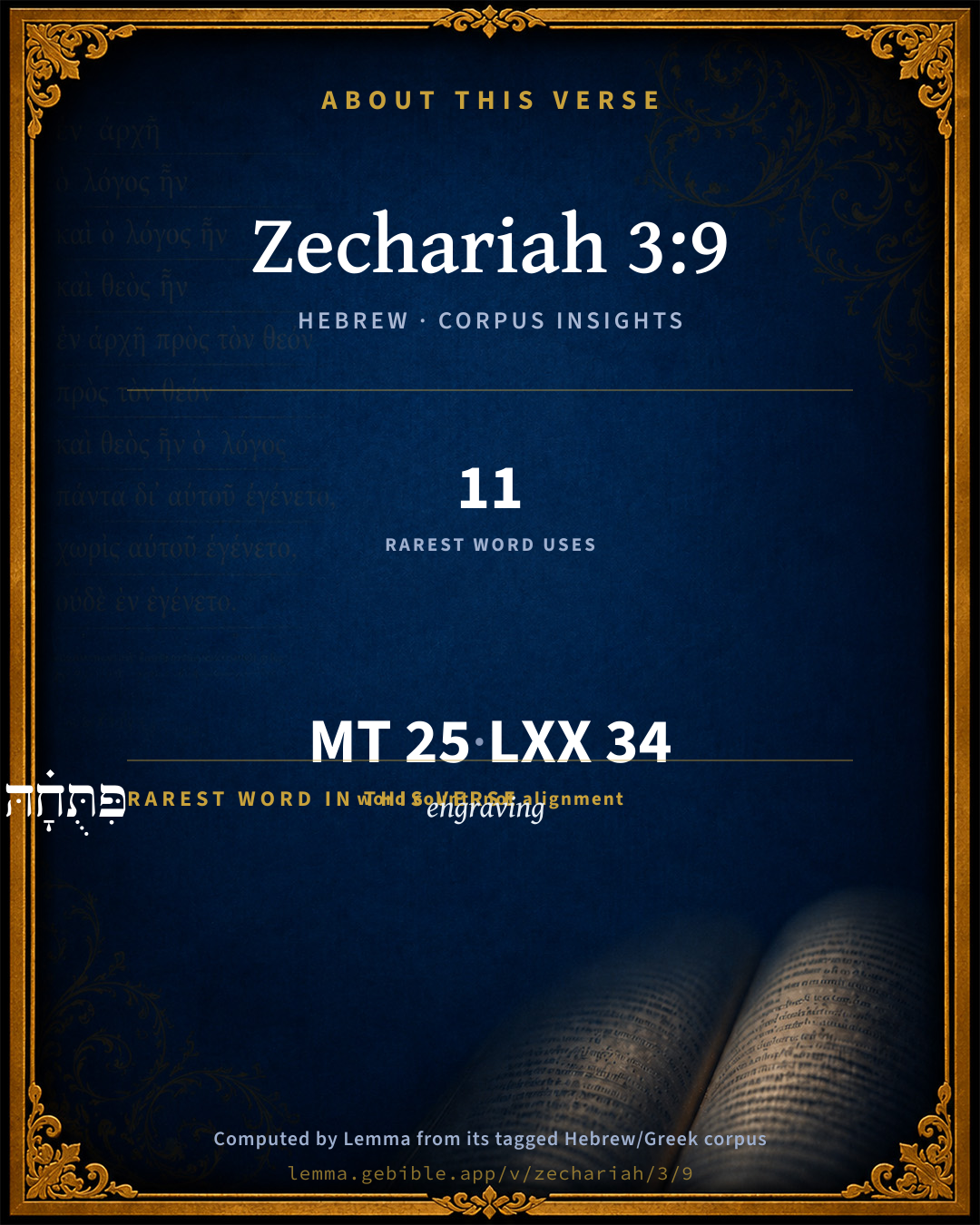
The rarest word here is פִּתֻּחָ֗הּ engraving H6603 — appearing just 11 times in the whole Hebrew Bible.

Shared distinctive vocabulary

פִּתֻּחָ֗הּ engraving H6603 occurs in 11 verses of the Hebrew Bible. Also found in:

Grammatical profile

  • 3 verbs
  • 12 nouns
  • 3 adjectives
  • 1 pronoun
  • 1 preposition
  • 1 conjunction
  • 4 particles

Verb forms

  • נָתַ֨תִּי֙ Qal · Perfect
  • מְפַתֵּ֣חַ Piel · Participle Active
  • וּמַשְׁתִּ֛י Qal · Sequential Perfect

Repetition

Words recur within this verse — often emphatic in Hebrew:

  • הָאֶ֗בֶן stone H68 ×2
  • אַחַ֖ת one H259 ×2

Hebrew & Septuagint length

In English translation the verse runs 40 words from the Hebrew and 28 from the Septuagint (LXX English) — the Septuagint runs noticeably shorter here. See the side-by-side →

A rough comparison of the two English renderings, which tokenize alike — not a word-level alignment.

Word counts can differ between the Hebrew and the Greek without any difference in meaning — e.g. the Hebrew direct-object marker אֵת has no separate Greek word, and Greek often adds the article ὁ.

In the original languages it is 25 Hebrew tokens and 34 Greek tokens — but the two are counted differently (Hebrew bundles its prefixes and suffixes into one token; the Greek is in lemma form), so that isn’t a like-for-like length.

Cross-references

32

Topical passages linked to Zechariah 3:9 in the Treasury of Scripture Knowledge — connected by theme and wording, ordered by reader-vote popularity; previews shown in the World English Bible.

  • Zechariah 4:10 Indeed, who despises the day of small things? For these seven shall rejoice, and shall see the plumb line in the hand of Zerubbabel. These are the eyes of Yahweh, which run back and forth through the whole earth."
  • Jeremiah 50:20 In those days, and in that time, says Yahweh, the iniquity of Israel shall be sought for, and there shall be none; and the sins of Judah, and they shall not be found: for I will pardon them whom I leave as a remnant.
  • Revelation 5:6 I saw in the midst of the throne and of the four living creatures, and in the midst of the elders, a Lamb standing, as though it had been slain, having seven horns, and seven eyes, which are the seven Spirits of God, sent out into all the earth.
  • Isaiah 28:16 therefore thus says the Lord Yahweh, Behold, I lay in Zion for a foundation a stone, a tried stone, a precious corner -[stone] of sure foundation: he who believes shall not be in haste.
  • Psalms 118:22 The stone which the builders rejected has become the head of the corner.
  • Jeremiah 31:34 and they shall teach no more every man his neighbor, and every man his brother, saying, Know Yahweh; for they shall all know me, from the least of them to the greatest of them, says Yahweh: for I will forgive their iniquity, and their sin will I remember no more.
  • Matthew 21:42–44 Jesus said to them, "Did you never read in the Scriptures, 'The stone which the builders rejected, The same was made the head of the corner. This was from the Lord. It is marvelous in our eyes?'
  • Romans 9:33 even as it is written, "Behold, I lay in Zion a stumbling stone and a rock of offense; And no one who believes in him will be disappointed."
  • Hebrews 9:25–26 nor yet that he should offer himself often, as the high priest enters into the holy place year by year with blood not his own,
  • 1 Peter 2:4–8 coming to him, a living stone, rejected indeed by men, but chosen by God, precious.
  • Daniel 9:24–27 Seventy weeks are decreed on your people and on your holy city, to finish disobedience, and to make an end of sins, and to make reconciliation for iniquity, and to bring in everlasting righteousness, and to seal up vision and prophecy, and to anoint the most holy.
  • Micah 7:18–19 Who is a God like you, who pardons iniquity, And passes over the disobedience of the remnant of his heritage? He doesn't retain his anger forever, Because he delights in loving kindness.
  • 2 Corinthians 1:22 who also sealed us, and gave us the down payment of the Spirit in our hearts.
  • 1 Timothy 2:5–6 For there is one God, and one mediator between God and men, the man Christ Jesus,
  • 2 Timothy 2:19 However God's firm foundation stands, having this seal, "The Lord knows those who are his," and, "Let every one who names the name of the Lord depart from unrighteousness."
  • Hebrews 7:27 who doesn't need, like those high priests, to daily offer up sacrifices, first for his own sins, and then for the sins of the people. For this he did once for all, when he offered up himself.
  • Exodus 28:21 The stones shall be according to the names of the children of Israel, twelve, according to their names; like the engravings of a signet, everyone according to his name, they shall be for the twelve tribes.
  • Exodus 28:36 "You shall make a plate of pure gold, and engrave on it, like the engravings of a signet, 'HOLY TO YAHWEH.'
  • 2 Chronicles 16:9 For the eyes of Yahweh run back and forth throughout the whole earth, to show himself strong in the behalf of them whose heart is perfect toward him. Herein you have done foolishly; for from henceforth you shall have wars.
  • Isaiah 8:14–15 He shall be for a sanctuary; but for a stone of stumbling and for a rock of offense to both the houses of Israel, for a gin and for a snare to the inhabitants of Jerusalem.
  • Isaiah 53:4–12 Surely he has borne our sickness, and carried our suffering; yet we considered him plagued, struck by God, and afflicted.
  • Zechariah 3:4 He answered and spoke to those who stood before him, saying, "Take the filthy garments off of him." To him he said, "Behold, I have caused your iniquity to pass from you, and I will clothe you with rich clothing."
  • Zechariah 13:1 "In that day there will be a spring opened to the house of David and to the inhabitants of Jerusalem, for sin and for uncleanness.
  • John 1:29 The next day, he saw Jesus coming to him, and said, "Behold, the Lamb of God, who takes away the sin of the world!
  • John 6:27 Don't work for the food which perishes, but for the food which remains to eternal life, which the Son of Man will give to you. For God the Father has sealed him."
  • Acts 4:11 He is 'the stone which was regarded as worthless by you, the builders, which has become the head of the corner.'
  • 2 Corinthians 3:3 being revealed that you are a letter of Christ, ministered by us, written not with ink, but with the Spirit of the living God; not in tablets of stone, but in tablets that are hearts of flesh.
  • Ephesians 2:16–17 and might reconcile them both in one body to God through the cross, having killed the hostility thereby.
  • Colossians 1:20–21 and through him to reconcile all things to himself, by him, whether things on the earth, or things in the heavens, having made peace through the blood of his cross.
  • Hebrews 10:10–18 by which will we have been sanctified through the offering of the body of Jesus Christ once for all.
  • 1 John 2:2 And he is the atoning sacrifice for our sins, and not for ours only, but also for the whole world.
  • Exodus 28:11 With the work of an engraver in stone, like the engravings of a signet, shall you engrave the two stones, according to the names of the children of Israel: you shall make them to be enclosed in settings of gold.

Cross-references courtesy of OpenBible.info (CC BY 4.0).

Hebrew and Greek witnesses Masoretic Hebrew ↔ Greek Septuagint

The same verse in the two great witnesses to the Old Testament, shown verse-for-verse.

Here the Septuagint runs noticeably shorter than the Hebrew — LXX2012 (modern English Septuagint) 28 words vs World English Bible 40. A rough length comparison of the two English translations, not a word-level alignment — read both below.

These are two independent witnesses, not word-aligned to each other, and the Septuagint is shown in lemma (dictionary) form.

Hebrew Zechariah 3:9 Masoretic · Westminster Leningrad Codex

כִּ֣י הִנֵּ֣ה הָאֶ֗בֶן אֲשֶׁ֤ר נָתַ֨תִּי֙ לִפְנֵ֣י יְהוֹשֻׁ֔עַ עַל אֶ֥בֶן אַחַ֖ת שִׁבְעָ֣ה עֵינָ֑יִם הִנְנִ֧י מְפַתֵּ֣חַ פִּתֻּחָ֗הּ נְאֻם֙ יְהוָ֣ה צְבָא֔וֹת וּמַשְׁתִּ֛י אֶת עֲוֺ֥ן הָאָֽרֶץ הַהִ֖יא בְּי֥וֹם אֶחָֽד

For, behold, the stone that I have set before Joshua; on one stone are seven eyes: behold, I will engrave the engraving of it,' says Yahweh of Hosts, 'and I will remove the iniquity of that land in one day.

World English Bible · Public Domain

Greek LXX Zechariah 3:9 Septuagint · lemma form

διότι ὁ λίθος ὅς δίδωμι πρό πρόσωπον ἰησοῦς ἐπί ὁ λίθος ὁ εἷς ἑπτά ὀφθαλμός εἰμί ἰδού ἐγώ ὀρύσσω βόθρος λέγω κύριος παντοκράτωρ καί ψηλαφάω πᾶς ὁ ἀδικία ὁ γῆ ἐκεῖνος ἐν ἡμέρα εἷς

Hear now, Jesus the high priest, you, and your neighbors that are sitting before you: for they are diviners, for, behold, I bring forth my servant The Branch.

LXX2012 (modern English Septuagint) · Public Domain

On this verse, Ellicott's Commentary for English Readers discusses the Septuagint’s reading. Read the note in Commentary ↓

Hebrew: Westminster Leningrad Codex (CC BY 4.0). Greek: Septuagint (public domain); English from LXX2012 (modern English Septuagint) (Public Domain). How the Septuagint differs from the Hebrew →

Targum (Aramaic paraphrase)

1

The Targum is the ancient Jewish Aramaic paraphrase of the Hebrew Scriptures — an interpretive translation, not the Hebrew text itself. Onkelos (literal) and Pseudo-Jonathan (expansive) render the Torah, and Jonathan the Prophets. Coverage is partial: where no permissively-licensed English translation exists for a verse, only the Aramaic is shown. This is verse-level text, not a word-by-word alignment to the Hebrew.

  1. Targum Jonathan Prophets (Joshua–Malachi)
    אֲרֵי הָא אַבְנָא דִיהָבֵית קֳדָם יְהוֹשֻׁעַ עַל אַבְנָא חֲדָא שַׁבְעָא עַיְנִין חֶזְיָאן לָהּ הָא אֲנָא גָלֵי חֶזְיָתָהָא אֲמַר יְיָ צְבָאוֹת וְאַעְדַי יַת חוֹב אַרְעָא הַהִיא בְּיוֹמָא חָד:

    (no public-domain English translation for this verse)

    Targum Jonathan — Aramaic: “Mikraot Gedolot” (public domain). English: “Sefaria Community Translation” (CC0 1.0 (public-domain dedication)); “London "Chaldee Paraphrase," 1871” (public domain). Text via Sefaria.

Commentary

Notes on Zechariah 3:9 from classic Christian and Jewish commentators (each source and its license shown beneath its notes). The classic Christian expositions comment on the surrounding passage and are grouped to its opening verse, so a note may address several verses; the Jewish commentaries on the Tanakh (Rashi and others) are per-verse, so they appear only where the commentator wrote on this verse.

Lemma curates 59 commentaries, every one of them public domain or Creative Commons licensed, each selected and text-cleaned for this edition rather than reprinted as found. About our sources →

Ellicott's Commentary for English Readers

(9) The stone.—If this were the meaning of the original, the words “upon one stone” ought to have been upon that stone. But “the stone” means the stones, the singular noun being used as a noun of multitude, as it is in Gen_11:3; Exo_39:10. The stones are the material stones with which the House was to be built; the laying them before Joshua is used as figuring the whole command to build the House.

Upon one stone.—Better, upon one particular stone (for this use of the numeral “one,” comp. Note on Zec_14:7), i.e., either the foundation-stone laid in the time of Cyrus, or the stone on which the Ark had formerly stood (Jewish tradition), or the head-stone, or chief corner-stone; or, possibly, upon each stone (for this construction comp. Eze_1:6; Eze_10:14, and my Hebrew Student’s Commentary on Zechariah, p. 37)—viz., upon the whole scheme and process of re-building.

Seven eyes.—Ewald supposes the “seven eyes” to have been engraved on the stone, and thinks that they represent the “seven spirits” (Rev_1:4). But it seems more probable that they represent the all-embracing, and here special, providence of God (Zec_4:10). The expression “to put the eyes upon” is used in Jer_39:12; Jer_40:4, in the sense “to protect,” “take care of.” The completion of this material building was an important era in the train of events, which, under Divine providence, was preparing the way for the coming of the Messiah. (See a further development of the meaning of “building” in Zec_6:12-13.)

Engrave the graving thereof.—As the graving of the figures, &c., puts the finishing touch to precious stones (Exo_28:36), so the expression is here used to denote putting the final stroke to the work of rebuilding. It is impossible to take “And I will remove,” &c., as the sentence engraved on the stone, as many have done; for such an inscription could not possibly commence with vâv conversive and the perfect. Job_19:25, “Yet I know, my Vindicator liveth,” is in no sense a parallel case (see Delitzsch in loc.). LXX., ἰδοὺ ἐγὼ ὀρύσσω βόθρον, “lo! I am digging a trench,” misreading the word “graving.”

In one day.—The day when the Temple should be completed and consecrated. The successful completion of this great work would be a sign and seal of the forgiveness of the past “iniquity of the land.” “In one day” cannot refer to “the day of Golgotha” (Hengstenberg), for how could Zec_3:10 be applied to that day? How could Zec_12:10, sqq., and Zec_3:9-10, be possibly referred to the same event? For “and I will remove,” LXX., καὶ ψηλαφήσω, confounding the verb, which means “to remove,” with a somewhat similar verb, meaning “to grope after.”

A Bible Commentary for English Readers, edited by Charles John Ellicott (1878–1897) — public domain. Text from a community e-Sword module.

Trapp's Complete Commentary

John Trapp

Zec 3:9 For behold the stone that I have laid before Joshua; upon one stone [shall be] seven eyes: behold, I will engrave the graving thereof, saith the LORD of hosts, and I will remove the iniquity of that land in one day.

Ver. 9. For behold the stone, &c.] Another title given to Christ, who is the foundation and chief corner stone of his Church; and another "behold," prefixed as a starry note, or a hand pointing to a remarkable matter. All the prophets pointed to Christ, who is therefore called the branch, the stone, that in these creatures (everywhere obvious), as in so many opticglasses, we may see him, and be put in continual remembrance of him: It being as necessary to remember Christ as to breathe, saith a father. See Psa 118:22 Isa 28:16 1Pe 2:6-8.

That I have laid, and that I will engrave] The Church is God’s building, and we are his workmanship, {ποιημα, Eph 2:10} his artificial manufacture, created in Christ Jesus unto good works; there being not so much of the glory of God in all his works of creation and providence, as in one gracious action that a Christian performeth. As for the glorious work of our redemption by Christ, it was a plot of God’s own contriving, a fabric of God’s own erecting; it was the Lord’s own doing, and it is justly marvellous in our eyes.

Upon one stone shall be seven eyes] That is, Christ shall draw all eyes and hearts to him; as the stones of the temple did the disciples’ eyes, Mat 24:2 Mar 13:1 "Master," say they to Christ, "see what manner of stones and what buildings are here." Thus some sense it. I should rather by these seven eyes understand the Spirit in his various operations upon Christ, as Isa 11:2, for he received not the Spirit by measure, as others; but had as much of it as a creature could possibly have. See Trapp on "Rev 1:4" where the Holy Ghost, for his manifold good gifts and perfect givings, is called The seven Spirits; like as he is also styled the seven golden pipes, Zec 4:2-3. There are those who by these seven eyes upon one stone understand the providence and wisdom of Christ in the government of his Church. He is indeed, as one saith, πλοφθαλμος, All-eye. Sic spectat universos quasi singulos; sic singules quasi solos: like a well drawn picture he eyeth all. Christ as he is a living, so he is also a looking stone; he looketh at the miseries and matters of his Church, and saith, as once, I have seen, I have seen the afflictions of my people ia Egypt, Exo 3:7.

Behold, I will engrave the graving thereof] Hae coelaturae dona et stigmata Christi repraesentaut, saith a Lapide. These gravings represent the gifts and wounds of Christ, in allusion to the polished corners of the temple. Caelum dictum eat quod caelatum, id est signatum sideribus, saith Varro. Heaven hath its name in Latin from its being enamelled and bespangled with glistering stars, as with curious workmanship, or costly furniture. Of the third heaven, the habitation of saints and angels, God is said to be by a specialty the builder and maker, or (as the Greek hath it) the cunning artificer, and public architect, Heb 11:10. A great deal of skill and workmanship he laid out upon it; but nothing so much as upon the human nature of Christ, wherein, as in a temple, dwelt all the fulness of the Godhead bodily, that is, personally, by virtue of the hypostatical union, Col 2:9 "For the Word was made flesh, and dwelt among us, (and we beheld his glory, the glory as of the only begotten of the Father,) full of grace and truth," Joh 1:14; full, full to the very brim, full with a double fulness, vasis et fontis, of the vessel, and of the fountain. Hence, he was fairer, much fairer, double fairer (as the original importeth) than the sons of men, sc. with the beauty of wisdom and holiness: grace was poured into his lips, God had anointed him with the oil of gladness above his fellows, Psa 45:2; Psa 45:7. The priests in the law were consecrated first with oil, compounded and confected of divers precious spices; so was Christ with gifts and graces of the Spirit, Act 10:38; Act 4:27 Isa 61:1; not by measure, as we are, Eph 4:7, but without measure, as much as a finite nature was capable of; particularly, he was furnished and polished with wisdom, as a prophet, against our ignorance; with holiness, as a priest, against our guilt; and with power, as a king, against our corruptions; these and all other endowments, he had, well heaped, pressed down, and running over, poured into his bosom. Next, as the priests under the law were also consecrated with blood, so was the Lord Christ with his own blood, when his Father engraved him with graving; or, as the Hebrew hath it here, opened him with opening in his bloody passion, baptized him in his own blood, stewed him in his own broth, as it were; when in a cold winter’s night he sweat great clots of blood, which through clothes and all fell to the very ground. When after this they digged his hands and his feet, Psa 22:16, and made his heart melt in the midst of his bowels, Psa 22:14. Wounded he was in the head, to cure our vile imaginations; in the hands, to expiate our evil actions; in the heart and feet, for our base affections and unworthy walkings. Tormented he was for our transgressions, bruised for our iniquities, the chastisement of our peace was upon him, tanquam pulcherrima corporis caelatura, and by his stripes, or bloody weals, we were healed, Isa 53:5. Adam signifieth man red-earth, or bloody. Christ was man in his incarnation, and bloody all over in his passion. This death of Christ, therefore, look on (saith Master Bradford, martyr) as the very pledge of God’s dear love towards thee; see the very heart of it as in an anatomy. See, God’s hands are nailed, they cannot strike thee; his feet also, he cannot run from thee; his arms are wide open to embrace thee; his head hangs down to kiss thee; his very heart is open, so that therein look, nay, even spy, and thou shalt see nothing therein but love, love, love to thee, &c.

“ Cernis ut in toto corpore sculptus amor. ”

And I will remove the iniquity of that land in one day] "I will remove," i.e. remit and pardon the iniquity, both guilt and punishment. "O that land," i.e. of the Church, that pleasant land, more dear to God than all the earth besides. "In one day," i.e. together and at once suddenly and in an instant. See Isa 66:8.

John Trapp, A Commentary or Exposition upon All the Books of the Old and New Testament (1647–1656) — public domain. Text from a community e-Sword module.

Joseph Benson's Commentary

Zec 3:9. For behold the stone, &c. — Or, as some render the former part of the verse, For this is the stone which I lay before Joshua; there are in the same stone seven eyes: I will engrave it with its engravings, saith the Lord — There seems to be an allusion in these words to the foundation, or chief corner stone of the temple, which probably was laid with great solemnity in the presence of Joshua. Christ is not only the rod out of the stem of Jesse, and the branch that should grow out of his roots, the fruit of which is excellent and comely for the remnant of Israel that escape the corruption which is in the world, but the foundation of the spiritual temple laid in Zion. And it is here foretold, that when he should be brought forth, seven, that is, many, eyes should be upon him. “The eye of the Father was upon him, to take care of him and protect him, especially in his sufferings. The eyes of all the prophets and Old Testament saints were upon this one stone: Abraham rejoiced to see Christ’s day, and he saw it and was glad. The eyes of all believers are upon him, as the eyes of the stung Israelites were upon the brazen serpent. They look unto him and are saved.” — Henry. Or, the seven eyes upon this stone may be explained, as the eyes upon the wheels in Ezekiel’s vision: they may signify the perfection and plenitude of knowledge and wisdom which were in Jesus Christ for the good of his church, and his ever watchful care of his people: or the various gifts and graces of the Holy Spirit, with which he was endued: for he hath the seven spirits of God, as well as the seven stars, Rev 3:1; and his eyes are as a flame of fire, piercing through all disguises, and searching the reins and the heart of every human creature, and especially of every one that professes to be his disciple. “The Branch and the Stone,” says Dr. Dodd, “are the same; which stone hath seven eyes, because the Messiah is the searcher of hearts, whom God engraved with his engraving; as in John the evangelist, him the Father sealed, endowed him with those gifts, virtues, and powers of the Spirit, which the prophets had foretold should be in the Messiah, by whom, dying on the cross, God removed the iniquity of that land in one day. In a day when every man (Zec 3:10) called his neighbour, &c., that is, when the whole world was in profound peace.” But, instead of, Upon one stone shall be seven eyes, Blayney reads, From one stone seven fountains, the word עיןsignifying a fountain as well as an eye. “It seems,” says he, “as if the prophet saw in his vision a stone or rock, set before Joshua, with seven fountains springing out of it, which God says were opened by himself.” There is, he thinks, here “a plain allusion to the rock which Moses smote in the wilderness, and brought waters out of it for the refreshment of the people of God; and that rock, St. Paul says, was Christ, 1Co 10:4. In speaking of which transaction, the psalmist says, He opened the rock and the waters gushed out, Psa 105:41 :” in which passage the same verb, פתח, is used, which in the next clause is translated, I will engrave, &c., which Blayney renders, Behold, I open the passage thereof; that is, the hole or orifice through which the fountains shall flow. Again, it is said, Isa 41:18, I will open rivers in the high places, where not only the same verb is used, but is followed by the same preposition as is here placed before the word rendered stone. And it is said chap. Zec 13:1, In that day shall there be opened a fountain (the same verb being again used) to the house of David, and to the inhabitants of Jerusalem. For what purpose? for sin and for uncleanness. “This was spoken of the gospel times; and, in like manner, it is here said of the same, And I will remove, or take away, the iniquity of the land in one day, namely, that one day on which Christ died to put away sin by the offering of himself. There cannot, surely, remain a doubt of what is intended, nor that עיניםmust signify fountains of living waters, issuing from Christ. The living waters are the doctrines of the gospel, and the fountains, the dispensers of them, the apostles and evangelists, who are said to be fellow-workers with Christ, and therefore aptly represented by the companions of Joshua. The number seven is frequently used in Scripture to denote multitudes, 1Sa 2:5; Jer 15:9, &c., &c.” It must be observed, however, that both the LXX. and the Vulgate read seven eyes, and not seven fountains.

Joseph Benson's Commentary on the Old and New Testaments (1811–1818) — public domain. Text from a community e-Sword module.

Tyndale Open Study Notes

Tyndale Open Resources

3:9 The single stone signifies authority. It might refer to the final stone of the Temple laid by Zerubbabel (4:7), the “foundation stone” of the restored Jerusalem (Isa 28:16), or the precious stones on the ephod of the high priests (Exod 25:7; 35:9). • The seven facets (literally seven eyes) of the stone imply perfection and completeness of knowledge and wisdom. They might relate to the seven lamps of the golden lampstand (Zech 4:2) or to God’s “sevenfold Spirit” (Rev 1:4). • The inscription is reminiscent of the names of the tribes inscribed on the stones of the high priest’s shoulder-pieces (Exod 39:6). • The removal of Israel’s sin in a single day alludes to the Day of Atonement (Lev 16). It foreshadows Christ’s crucifixion, when the Lamb of God would take away the sin of the world (John 1:29).

Tyndale Open Study Notes — © Tyndale Open Resources, licensed CC BY-SA 4.0. Text via the HelloAO Bible API.

Geneva Bible (1599)

Geneva Bible translators

Though I have punished this land for a time, yet I will even now be pacified, and visit their sins no more.

He showeth that the ministers cannot build, before God lay the first stone, which is Christ, who is full of eyes, both because he giveth light unto all others, and that all ought to seek light at him, Zech. 4:10.

That is, I will make perfect in all points, as a thing wrought by the hand of GOD.

Geneva Bible (1599) marginal notes — public domain. Text via Bolls.life.

Jamieson, Fausset & Brown

Robert Jamieson, A. R. Fausset & David Brown

For--expressing the ground for encouragement to the Jews in building the temple: I (Jehovah) have laid the (foundation) stone as the chief architect, before (in the presence of) Joshua, by "the hand of Zerubbabel" (Zac 4:10; Ezr 3:8-13), so that your labor in building shall not be vain. Antitypically, the (foundation) stone alluded to is Christ, before called "the Branch." Lest any should think from that term that His kingdom is weak, He now calls it "the stone," because of its solidity and strength whereby it is to be the foundation of the Church, and shall crush all the world kingdoms (Psa 118:22; compare Isa 28:16; Dan 2:45; Mat 21:42; Co1 3:11; Pe1 2:6-7). The angel pointing to the chief stone lying before Him, intimates that a deeper mystery than the material temple is symbolized. MOORE thinks the "stone" is the Jewish Church, which Jehovah engages watchfully to guard. The temple, rather, is that symbolically. But the antitype of the foundation-stone is Messiah.

upon one stone shall be seven eyes--namely, the watchful "eyes" of Jehovah's care ever fixed "upon" it (Zac 4:10) [MAURER]. The eye is the symbol of Providence: "seven," of perfection (Rev 5:6; compare Ch2 16:9; Psa 32:8). Antitypically, "the seven eyes upon the stone" are the eyes of all angels (Ti1 3:16), and of all saints (Joh 3:14-15; Joh 12:32), and of the patriarchs and prophets (Joh 8:56; Pe1 1:10-11), fixed on Christ; above all, the eyes of the Father ever rest with delight on Him. CALVIN (perhaps better) considers the seven eyes to be carved on the stone, that is, not the eyes of the Father and of angels and saints ever fixed on Him, but His own sevenfold (perfect) fullness of grace, and of gifts of the Spirit (Isa 11:2-3; Joh 1:16; Joh 3:34; Col 1:19; Col 2:9), and His watchful providence now for the Jews m building the temple, and always for His Church, His spiritual temple. Thus the "stone" is not as other stones senseless, but living and full of eyes of perfect intelligence (Pe1 2:4, "a living stone"), who not only attracts the eyes (Joh 12:32) of His people, but emits illumination so as to direct them to Him.

engrave . . . graying--implying Messiah's exceeding beauty and preciousness; alluding to the polished stones of the temple: Christ excelled them, as much as God who "prepared His body" (Heb 10:5; compare Joh 2:21) is superior to all human builders.

remove . . . iniquity of that land in one day--that is, the iniquity and its consequences, namely the punishment to which the Jews heretofore had been subjected (Hag 1:6, Hag 1:9-11). The remission of sin is the fountain of every other blessing. The "one day" of its removal is primarily the day of national atonement celebrated after the completion of the temple (Lev 23:27) on the tenth day of the seventh month. Antitypically, the atonement by Messiah for all men, once for all ("one day") offered, needing no repetition like the Mosaic sacrifices (Heb 10:10, Heb 10:12, Heb 10:14).

Jamieson, Fausset & Brown — Commentary Critical and Explanatory on the Whole Bible (1871) — public domain (CC PDM 1.0). Text via the HelloAO Bible API.

Adam Clarke's Commentary

Verse 9. For behold the stone that I have laid] Alluding no doubt to the foundation stone of the temple: but this represented Christ Jesus: "Behold, I lay in Zion for a foundation a STONE, a tried stone, a precious CORNER STONE, a SURE FOUNDATION," Isa 28:16. This means Christ, and none other; on him his whole Church rests, as a building does on its foundation.

Upon one stone shall be seven eyes] This is supposed to mean the providence of God, as under it all the work should be completed.

There may be an allusion to the seven counsellors, which stood always about the persons of the Asiatics sovereigns; and those who were the governors of provinces were termed the eyes of the king. To this there is an allusion in Re 1:4. In Christ there is a plentitude of wisdom, power, goodness, mercy, truth, love, and compassion, to direct, protect, save, uphold, purify, govern, and preserve all the souls that trust in him.

I will engrave the graving thereof] This is an allusion to engraving precious stones, in which the ancients greatly excelled. Heads, animals, and various devices were the subjects of those engravings. But what was this engraving? Was it not the following words? I will remove the iniquity of that land in one day;" and was not this when Jesus Christ expired upon the cross? This was the grand, the only atonement, satisfaction, and sacrifice for the sins of the whole world. Does not our Lord refer to this place, Joh 6:27? Him hath God thy Father sealed; and on the inscription there was, "This is my beloved Son, in whom I am well pleased." See the note on the above passage.

Adam Clarke's Commentary on the Bible (1810–1826) — public domain. Text from a community e-Sword/MySword module.

John Calvin's Commentaries

He more fully sets forth what we have observed in the last verse; but he speaks figuratively. He says that there were seven eyes on the stone which was set before Joshua; and that God would in one day take away the iniquity of the land, so that nothing would prevent it from recovering its ancient glory. This is the import of the whole; but interpreters vary, especially as to the eyes.

Almost all Christians agree as to the stone; for they think Christ to be meant; and we know that there are many similar passages, where Christ is called a stone, because the Church is on him founded; “Behold, I lay in Zion a precious stone,” says Isaiah in the Isaiah 28:1; and in Psalm 118:1 and in other places there are similar words. I yet think that the Prophet alludes to the temple, which was then begun to be built; but at the same time I take this as admitted, that Christ is called metaphorically a stone, as before he was called a Branch. But we must bear in mind that the external figure of the visible temple is applied to Christ himself. Behold, says God, the stone which I have set before Joshua has seven eyes; and further, I will engrave it with sculptures, that it may appear wonderful before the whole world. We now perceive what the subject is, and the mode of speaking here adopted.

As to the subject, the angel says, that the temple which Joshua had begun to build, was a celestial building; for God here declares himself to be its founder and builder, — The stone, he says, which I have set; and he says this, that Joshua might know that he labored not in vain in building the temple. For had it been the work of men, it might have fallen, and might have been pulled down a hundred times by the hand of enemies; but God declares that the temple was founded by his own hand. He, at the same time, as I have said, raises up the thoughts of the godly to Christ, which is the substance and reality of the temple. Hence he says, I set a stone before Joshua; that is, “Though Joshua builds, and workmen diligently labor with him, yet I am the chief framer and architect of the temple.”

He then says, on this stone shall be seven eyes. Some apply this to the seven graces of the Spirit: but the definition which they make, who have said, that the grace of the Spirit is sevenfold, is puerile; they know not about what they prattle and vainly talk; for Scripture speaks of many more. They also falsely adduce a passage from the Isaiah 11:1 for they mistake there as to the number: the Latin version has led them astray. Others think that the seven eyes have a reference to the whole world; as though the angel had said, that all will direct their eyes to this stone, according to what is said by Christ, that he was raised up on high, that he might draw all men to himself: then seven eyes, that is the eyes of all men, shall be turned to this stone. Some again apply this to the fullness of grace which has been given to Christ. But I think that the simpler view is, that his glory is set forth, according to what immediately follows, — I will engrave its engravings. For it is a vain refinement to say, that God engraved engravings when the side of Christ was pierced, when his hands and his feet were perforated: this is to trifle, and not seriously to explain Scripture. But the Prophet by engraving, means the valuable and extraordinary character of this stone; as though he had said, “It will be a stone remarkable for every excellency; for God will adorn this stone with wonderful engravings; and then it will be a stone having eyes, that is, it will not only turn to itself the eyes of others, but it will illuminate them, and exhibit as it were such brightness as will, by its own reflection, lead men to behold it.” We now understand the full meaning of the Prophet. What remains I cannot finish now.

John Calvin's Commentaries (1540-1563) — public domain. Text from the Calvin Translation Society English edition (1840s-50s) via the Christian Classics Ethereal Library (ccel.org). Calvin's coverage is partial (roughly two-thirds of the Bible); uncommented books and verses are honest gaps, never fabricated. The 19th-century editor's footnotes and remarks are omitted so the notes are faithfully Calvin's own voice.

The Cambridge Bible for Schools and Colleges

gen. ed. J. J. S. Perowne

9. the stone that I have laid] set, R. V. The primary and immediate reference is to the Temple, in re-building which Joshua was then engaged. The “stone,” which was perhaps seen lying before him in the vision, is most probably not the foundation-stone, which had been laid years before, but the head-stone (Zec_4:7; Zec_4:9), which would complete the building, and which He, with whom to purpose is to accomplish, here announces that He has already laid; so certainly shall it be set in its place in due time. The ultimate reference is to Him, who as “the Branch” should hereafter “build the temple of the Lord” (Zec_6:12), of which He is not only the Foundation-stone (Isa_28:16; 1Pe_2:4-5), but also the chief corner-stone (Psa_118:22; Mat_21:42; Eph_2:20). The two fulfilments of the prophecy are intimately connected. The first is, in the purpose of God, the necessary preparation for the second.

upon one stone shall be seven eyes] are, R. V. This may mean that seven eyes shall be, or are, sculptured upon the stone; though in that case it is difficult to understand the force of the word “one,” or the significance of the prediction as regards the Temple then in progress. Typically, the seven eyes sculptured on the stone might be held to represent Him whom the stone symbolises, as “having the seven spirits of God” (Rev_5:6). It is better, however, to understand the words to be a promise that the seven eyes (i.e. the perfect watchfulness and care—seven being the number of perfection) of God shall be fixed upon this stone; that He will never, so to speak, take His eyes off either type or anti-type, till His purpose respecting them is accomplished. So Solomon prays, at the dedication of the first Temple, that God’s “eyes may be open upon it night and day,” to hear the prayers that are offered there. 1Ki_8:29. This view is confirmed by Zec_4:10, where the eyes of Jehovah are said to rejoice when (fixed as we are here told in unwearying solicitude on the Temple) they see the plummet in the hand of Zerubbabel, as he busies himself in its restoration.

I will engrave the graving thereof] Supposing the eyes to have been marked out for cutting upon the stone, some have thought that God in these words engages that He Himself will cut them there. This clause, however, is rather to be regarded as an additional promise. My eyes, I have said, are fixed upon the stone. My hand shall engrave upon it whatever is needed to beautify and fit it for the place of honour it is to hold. The word here used for “engrave” occurs three times in Exodus 28, in the expression “engravings of a signet;” twice of the jewels in the High Priest’s dress (11, 21), once of the golden plate on his mitre (36). It is used, however, of a bolder kind of engraving, more like what would here be contemplated, of “cherubim, lions and palm trees,” on the panels of the “bases,” on which the lavers were set in Solomon’s Temple. (1Ki_7:36).

in one day] It is possible that the renewal of the typical expiation of sin in “one day,” the Day of Atonement (Lev_16:21; Lev_16:30; Lev_16:34), consequent upon the re-building of the Temple and the resumption of its services, is here glanced at. But the goal of the prophecy is “the day of Golgotha.” “A Jewish writer confessed the mystery while he said, ‘One day, I know not what that day is.’ Ask any Christian child, ‘On what day was iniquity removed, not from the land only, but from all lands?’ He would say, ‘On the day when Jesus died.’ ” Pusey.

The Cambridge Bible for Schools and Colleges (gen. ed. J. J. S. Perowne; Cambridge University Press, 1878–1918) — public domain. Text from a community e-Sword module.

John Gill's Exposition

In that day, saith the Lord of hosts,.... The Gospel dispensation, which began with the incarnation, sufferings, death, and resurrection of Christ, and still continues; called sometimes the day of salvation, the acceptable time, and year of the redeemed:

shall ye call every man his neighbour under the vine, and under the fig tree; which may be expressive of the desire of gracious souls after the conversion of others; they would have them come under the means of grace; and are desirous that the means might be blessed to them; that they might know Christ, and be partakers of the same grace with them; which arises from a sense they have of the blessings they share in; from a love to immortal souls, and a desire to promote the glory of God; also of the fruitfulness and plenty of the Gospel dispensation; Christ is the true vine, laden with precious fruits; from him saints have all their fruitfulness; they sit under his shadow with delight, and his fruit is sweet unto them; the provisions of his house are very excellent and precious, to which others are invited to partake of: likewise of the fellowship and communion which saints have with each other; they converse in private, join in public worship, and feast together at the Lord's table; and encourage one another so to do; all which is crowned with the presence of God, and fellowship with him: moreover, the words may suggest that peace and tranquillity enjoyed by believers under the Gospel dispensation, and that safety and security which they have in and through Christ; See Gill on Mic 4:4.

Next: Zechariah Chapter 4

John Gill's Exposition of the Whole Bible (1746–1763) — public domain (CC PDM 1.0). Text via the HelloAO Bible API.

Albert Barnes' Notes on the Bible

For behold the stone, that I hare laid before Joshua - This must be an expansion of what he had said, or the ground of it, being introduced by, for. It must be something future, to be done by God Himself, since God says, “I will grave the graving thereof;” something connected with the remission of sins, which follows upon that graying. The stone, then, cannot be the stone of foundation of the material temple (Rashi). For this had long before been laid. The head-cornerstone, the completion of the building , had nothing remarkable, why God should be said to grave it. The plumbline was not a part even of the material temple. “The stone is one stone.” But to interpret it by other prophecy, one stone there is, of which God says, “Behold I lay in Zion for a foundation, a stone, a tried stone, a precious cornerstone, a sure foundation, he that believeth shall not make haste” Isa 28:16; that stone, of which our Lord reminded the Jews, “the stone which the builders refused is become the head-stone of the corner” ; “Jesus Christ Himself, the chief cornerstone, in whom all the building, fitly framed together, groweth into an holy temple in the Lord, in whom ye also are builded together for an habitation of God through the Spirit” Eph 2:20-21.

On this stone had Joshua, with all those typical priests, to look, in whom alone they and all have forgiveness, whose Sacrifice their sacrifices pictured and pleaded. “It,” says an old mystical Jewish book , a “is the stone of foundation, on which the earth is founded, which God Himself laid, that the world might receive blessing from it” . “The Shechinah is called the stone, through which the world subsisteth; of which it is said, ‘A stone of seven eyes, and, the stone which the builders refused.’” This “stone,” God says, I have laid or set before Joshua, that is, for him to consider; as He speaks to Solomon and his children, of “My commandments which I have set before you” 1Ki 9:6.

Rup.: “That the stone is the Lord Jesus Christ, the head cornerstone, elect, laid as a foundation; and that the seven eyes on the one stone are the sevenfold Spirit of God which rested upon Him, is or ought to be unknown to no one. For to Him “God giveth not the Spirit by measure” Joh 3:34, and “in Him dwelleth all the fullness of the Godhead bodily” Col 2:9. This stone was rejected by people, but chosen and honored by God.” Osorius: “This stone then, on which the house of God and our whole salvation resteth, is placed by God before that high priest. That is, the most holy Name of Jesus, the virtue piety and largeness of Jesus is, by the Divine Spirit, showed to the priest, that he might understand the End of the law and holiness, to whom all the actions of life and the offices of the priesthood were to be referred. In which stone was foreshown to the divine man, not the invisible strength only, but also the manifold light of the Divine Intelligence. For it follows;”

Upon this one stone are seven eyes - Whether they are the eyes of God, resting in loving care upon it, or whether, as the wheels in Ezekiel’s vision were “full of eyes round about” Eze 1:18; Eze 10:12, the eyes are pictured as on the stone itself, marking that it symbolized a being with manifold intelligence. Zechariah speaks of the eyes of “the Lord which run to and fro on the earth” Zec 4:10, and John, of the “Lamb, as it had been slain, having seven horns and seven eyes, which are the seven spirits of God, seat forth into all the earth” Rev 5:6. Either symbol harmonizes with the context, and is admissible in language. before and afterward, I have laid it, I will engrave the graving thereof; and so it corresponds to the “It shall grow up before Him as a tender plant” Isa 53:2. But the contrast, that on one stone there are seven eyes, perhaps rather suggests that the eyes are on the stone itself, and He, the “Living Stone,” is pictured with an universality of sight, whereby, with a divine knowledge, He surveys and provides for the well-being of His whole Church. It has some analogy too to the sevenfold Spirit which was to rest upon Him. . “For this stone to have seven eyes is to retain in operation the whole virtue of the Spirit of seven-fold grace. For according to the distribution of the Holy Spirit, ones receives prophecy; another, knowledge; another, miracles; another, kinds of tongues; another, interpretation of words; but no one attaineth to have all the gifts of that same Spirit. But our Creator taking on Him our infirmities, because, through the power of His Divinity, He showed that He had at once in Him all the virtues of the Holy Spirit, united beyond doubt the bright gleams of the sevenfold constellation.” “None among men had together all the operations of the Holy Spirit, save the Mediator of God and man alone, whose is that same Spirit, who proceeds from the Father before all worlds.”

Osorius: “The stone is one. For as we have in God One Spirit, one faith, one sacrament of that most pure laver, so we worship One Christ, the one only Deliverer of the human race, and Author of our righteousness and everlasting salvation; and strengthened by His guardianship, we hope for immortality and eternal glory. Who, though He be One, governs all things with ineffable wisdom. For His wisdom is aptly described by the seven eyes. For the number seven generally describes an universality of good.”

Behold I will engrave the graving thereof - As of a costly stone. What the graving is, is not explained; but manifestly it is everything which concurs to its beauty. . “This stone is of earth, and of the power and workmanship of God.” . “It signifies Him who had His birth in virgin-earth, but framed skillfully by the power of the Holy Spirit.” That Precious Stone was further graven, through the providence and will of God, when Jerome: “He caused it to be wounded by the nails of the Cross and the soldier’s lance, and in His passion took away the iniquity of the earth in one day, of which it is written, “This is the day which the Lord hath made, we will rejoice and be glad in it” Psa 118:24. Beautiful were the gifts and graces which Christ received, as Man; but beautiful beyond all beauty must be those glorious scars, with which He allowed His whole Body to be riven, that , “throughout the whole frame His love might be engraven.” Ribera: “What even in the Body of the Lord can be lovelier or more lightful than those five Wounds, which He willed to retain in His immortal Being, lest the blessed should be deprived of that splendor, surpassing far the light of sun had stars?”

And I will remove the iniquity of the land in one day - On “one day” in the year was the typical atonement; in one day absolutely, God Himself would make the iniquity of that land to depart. “One day” is always emphatic , that things are crowded into it, which seemed too much for one day. Year by year came the day of atonement: its yearly repetition showed that nothing lasting was effected. On “one day” that removal should be, which needed no renewal . A Jewish writer confessed the mystery, while he said, (Rashi), “One day; I know not what that day is.” Ask any Christian child, “On what day was iniquity removed, not from the land only, but from all lands?” he would say, “On the day when Jesus died.”

Albert Barnes' Notes on the Bible (1834–1885) — public domain. Text from a community e-Sword/MySword module.

Haydock's Catholic Bible Commentary

The stone. Another emblem of Christ, the rock, foundation, and corner-stone of his Church. --- Eyes. The manifold providence of Christ over his Church, or the seven gifts of the Spirit of God. (Challoner) --- The Jews were lately returned from a country where seven chief officers were styled "the king’s eyes," having to inform him of the conduct of governors, &c. Zorobabel shall build the temple, as a figure of Christ establishing his Church, chap. iv. 10. --- Grave. Septuagint, "dig a pit." The rest agree with us. Christ adorns and instructs his Church. (Calmet) --- Day. The day of the passion of Christ, the source of all our good: when this precious stone shall be graved, that is cut and pierced with whips, thorns, nails, and spear. (Challoner)

George Leo Haydock (1774–1849), Haydock's Catholic Family Bible and Commentary, 1859 edition — public domain. Excludes Psalms (Douay-Rheims chapter numbering differs from Protestant) and Deuterocanonical books (Catholic canon only).

Matthew Poole's English Annotations

Here is an ellipsis, and to make it up we must repeat that of the 8th verse,

Hear now, & c. For behold, (pointing to a particular stone,) that stone which I have laid, saith God, in the sight of Joshua, or which he saw laid in the building of the temple; on that one stone are seven eyes; and Joshua and his fellows are commanded to observe it, the meaning of which the angel will suggest to them presently. It is not improbable this one stone might be a corner-stone, and a principal corner-stone, and the eyes engraven on it so placed that they might look many ways; so it will be a more exact emblem of Christ the chief Cornerstone, and of his perfect knowledge and wisdom, fitting him to govern his church and provide for it.

I will engrave the graving; the engraving engraved, i.e. most artificially, lively, and with excellent contrivance.

And I will remove; or, and I have removed, I have pardoned the iniquity of this land at once. Thus the emblem or type, which I shall once more set before you in plainer words than those of our version. Hear now, O Joshua, thou and thy fellows, for behold there is one stone, and on that stone seven eyes, most curiously engraved, and this laid in thy sight, and in the sight of thy fellows: this learn by it, that the temple, founded on such a corner-stone, built by the wisdom of the chief Builder, guarded and watched over by all-seeing Providence, is the blessing and honour of that people, whose sins are all forgiven. The further spiritual meaning discovers the Messiah the chief Corner-stone, the gospel church founded thereon, guided by perfect wisdom, and preserved by never-erring Providence, and blest with the pardon of all her sins, taken away in one day, by the meritorious death of her Redeemer.

Matthew Poole's English Annotations on the Holy Bible (1683–1685) — public domain. Text from a community e-Sword/MySword module.

The Pulpit Commentary

For behold. This gives the reason why the "Branch" is brought forth; the Church is to be firmly established and all iniquity to be abolished. The stone that I have laid (set) before Joshua. In the vision a stone is seen lying at the feet of Joshua, either the foundation stone of the temple, say the commentators, or the cornerstone, or the coping; or, as the Talmud testifies, a stone that rose some three fingers" measure above the ground, and upon which the high priest used to set the censer of incense. But it was more probably none of these, but some rough, unhewed block, not yet polished or fitted into its place. What does it represent? Many critics of note answer at once, the Messiah. He who was above called "Branch" is now called the "Stone." And certainly this term in applied unto him in prophetical language, as in Isa_28:16 Psa_118:22; and references are made to the appellation is the New Testament as to a well known title, e.g. Mat_21:42 Eph_2:20. But there are objections to taking this as the primary sense. As Knabenbauer points out, it is not likely that in one verse the Lord"s Servant Branch is said to be destined to be brought forth, and in the next the same is called the stone which is set before Joshua and has to be graven by a hand Divine. Besides, if both terms mean Messiah, we have the very lame conclusion: I will bring Messiah because I have already placed him before Joshua. The stone, too, is represented as somewhat under the management of Joshua, and needing graving and polishing, neither of which facts apply to the Messiah. Putting out of sight other interpretations which are all more or less inadmissible, we shall be safest in considering the stone to represent the theocracy, the spiritual kingdom of Israel, now indeed lying imperfect and unpolished before Joshua, but ordained to become beautiful and extensive and admirable. So Daniel (Dan_2:35, Dan_2:45) speaks of the stone cut out of the mountains without hands, which filled the whole earth, a figure of the Church and kingdom of God, small in its beginning, but in the end establishing its rule over the world. Upon one stone; LXX, epi toyon to , "upon the one stone." The stone is termed "one" in contrast with the number seven that follows. Shall be (are) seven eyes. Upon this stone the eyes of God are directed in watchful care. (comp. Zec_4:10; and for the phrase, see 1Ki_8:29 Psa_33:18 Psa_34:15 Jer_39:12) "Seven" is the number of perfection, and may denote here the infinite care which God takes of his Church, even as St. John in the Revelation (Rev_1:4 Rev_5:6) beheld the Lamb "having seven eyes, which are the seven Spirits of God sent forth into all the earth." The expression is metaphorical, and we are not to suppose, with Ewald, that the eyes were graven on the stone, or that Zechariah derived his notion from the tenets of Zoroaster or the degrees of rank in the Persian court. There may be an allusion to the seven gifts of the Spirit with which Messiah is anointed, (Isa_11:2) and which animate and strengthen his body, the Church. I will engrave the graving thereof. As God engraved the tables of the Law. (Exo_32:16) I will out and polish this rough stone to fit it for its place in the temple. The verb is used of the bold engraving and ornamentation of stonework, the finishing which it undergoes to perfect its preparation. (comp. 1Ki_7:36 2Ch_2:7 2Ch_3:7) Those who regard the stone as typifying the Messiah, see in this clause an intimation of the Passion of Christ, who "was wounded for our transgressions." The LXX has, "I dig a trench," which Jerome explains of the wounds of Christ on the cross. I will remove the iniquity of that land. The shaping of the stone involves the bestowal of purity and holiness. God will pardon the inhabitants of the land of Israel, and make them a holy nation. (Jer_33:7, Jer_33:8) But the promise stretches far beyond the limits primarily assigned to it. In one day. The day when Christ died for the sins of men. There is an allusion to the great Day of Atonement, when the high priest went once a year into the holy of holies with the blood of sacrifice. This, however, was an imperfect reconciliation, and had to be repeated annually. "But Christ being come a High Priest of the good things to come... through his own blood entered in once for all (efapax ) into the holy place, having obtained eternal redemption Now once at the end of the ages hath he been manifested to put away sin by the sacrifice of himself". (Heb_9:11-26; comp. Heb_7:27 Heb_10:10)

The Pulpit Commentary (1880–1919), ed. H.D.M. Spence-Jones & Joseph S. Exell — public domain. Text from a community e-Sword module.

John Wesley's Explanatory Notes

Behold - Behold (pointing to a particular stone) that stone which I have laid in the sight of Joshua. Upon one stone - On that stone are seven eyes, probably so placed, that they may look many ways; so it was a more exact emblem of Christ, and of his perfect knowledge and wisdom. I have removed - I have pardoned the iniquity of this land at once. The temple, founded on such a corner-stone, guarded and watched over by all-seeing Providence, is the blessing and honour of that people, whose sins are all forgiven.

John Wesley, Explanatory Notes Upon the Whole Bible (1754–1765) — public domain. Text via the GEBible commentary corpus.

Scofield Reference Notes

C. I. Scofield

stone (See Scofield "1Pe 2:8").

seven eyes Cf. Zec 4:10; Rev 5:6.

The Scofield Reference Bible (1917 edition), notes by C. I. Scofield — public domain. Text from a community e-Sword module.

Rashi

Rabbi Shlomo Yitzchaki (Rashi)

For, behold the stone The foundation of the house that you laid in the days of Cyrus - they stopped you, and that foundation and the thickness of the wall appeared little in your sight, as explained in Ezra (3:12f.) and in the prophecy of Haggai (2:2f.).

Seven eyes are directed to one stone It will eventually be widened seven times as much. And so did Jonathan render: On one stone, seven eyes see it. The expression of עֵינַיִם is an expression of appearances. It appears to me that the seven eyes are because of the eyes of the Holy One, blessed be He in Whose eyes and heart it is [planned] to add seven times as much because of the prophecy similar to this one (4:10): “And they shall see the plummet in the hand of Zerubbabel these seven times; the eyes of the Lord they are roving to and fro throughout the land.” This is but to say that He directed His eyes to increase the glory of the Temple in its building.

Behold! I untie its knots I untie its knots I thwart the plot of the enemies who wrote an accusation to stop the work.

and I will remove Heb. ומשתי.

in one day I do not know what day.

Rashi on the Tanakh — English translations: “The Judaica Press complete Tanach with Rashi, translated by A. J. Rosenberg” (CC BY 4.0); “Pentateuch with Rashi's commentary by M. Rosenbaum and A.M. Silbermann, 1929-1934” (public domain); “The Metsudah Tanach series, Lakewood, N.J” (CC BY 4.0); and “The Book of Joshua, Metsudah Publications, 1997” (CC BY 4.0). Text via Sefaria.

Lesson kit

Teaching starters — assembled from the data on this page, not authored interpretation. Every prompt links to the verse data it draws on. Edit before teaching.

Zechariah, in the Prophets, opens this verse with 25 words (23 distinct Hebrew lemmas). Its most distinctive word is pittûwach (“engraving”). The Greek Septuagint runs shorter here. A historical commentator’s framing appears above. Read the whole chapter for the surrounding context.

Discussion questions

  1. How does “engraving” (pittûwach) shape what this verse is saying?
  2. How does Exodus 28:11, which shares the word «engraving», read alongside this verse?
  3. What does the repetition of “stone” (2× in this one verse) do in this verse?
  4. The Septuagint runs shorter here than the Hebrew. What might account for the difference?
  5. These translations render this verse differently. What is at stake in choosing one wording over another?
  6. «נָתַ֨תִּי֙» is a Qal Perfect verb. How does that grammatical form shape the action described?
  7. Compare how Ellicott's Commentary for English Readers and Trapp's Complete Commentary read this verse. Where do they agree or differ?

Things to notice

Reading settings

Reading text

Shown beneath each verse's original-language words.

Old Testament
Old Testament edition

Read the OT as the Masoretic Hebrew (MT) or the Greek Septuagint (LXX).

English shown for the Greek Septuagint (in the Hebrew ↔ Greek comparison).

Comparing translations? Open the Compare panel on any verse page to stack up to four side by side.