Galatians 5:12

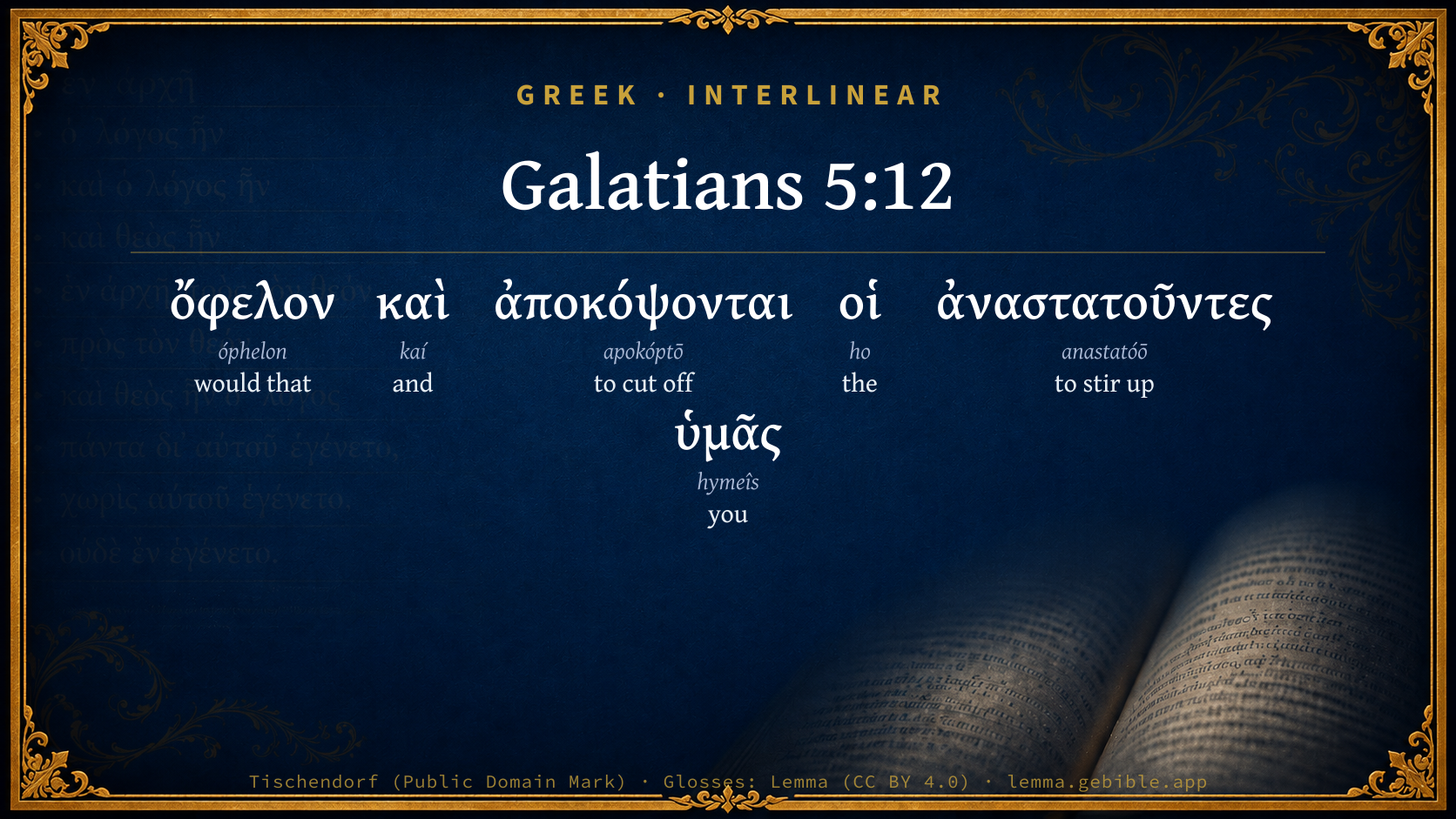
Greek (Tischendorf 8th ed.) Galatians 5:12 appears in the Greek New Testament. The text above is from the Tischendorf 8th edition. Each word links to its Strong’s number and a concise gloss. Click any word for its full Thayer’s Greek Lexicon entry.
Download image
Cite this verse

Galatians 5:12 (World English Bible). Public Domain. Lemma interlinear Bible study tool, https://lemma.gebible.app/v/galatians/5/12.

Show BibTeX & RIS
BibTeX
RIS
English Translation
I wish that those who disturb you would cut themselves off.
World English Bible · Public Domain
Download a study sheet

One document with this verse’s original text, its word-by-word gloss line, the meaning frame, cross-references with their text, attributed commentary, and full source and license credits — printable, and it pastes into notes with its structure intact.

This verse Autodidact and up

Study sheet (.html) Plain text (.txt)

A passage Seminary Student

Up to 50 verses in one chapter. A passage sheet keeps up to 6 commentary sources and 12 cross-references per verse, in the order this page ranks them, and says so on the sheet whenever that leaves anything out. Ask for a single verse and you get the Autodidact verse sheet above.

Everything on this page stays free to read, with no account — the sheet is a download of what is already on screen, not access to it.

Want to remove ads? Support Godless Engineer
Compare translations 3

The same verse in 3 English versions, stacked beneath the original-language interlinear above. Click any original word for its lexicon entry.

Each is an independent rendering of the whole verse — the interlinear is not word-aligned to these translations.

Highlighted words mark where these versions differ — a whole-verse word diff, not a word-by-word alignment.

  • World English Bible Public Domain
    I wish that those who disturb you would cut themselves off.
  • King James Version Public Domain
    I would they were even cut off which trouble you.
  • unfoldingWord Literal Text CC BY-SA 4.0
    I wish the ones disturbing you will even castrate themselves!

unfoldingWord Literal Text — © unfoldingWord, licensed CC BY-SA 4.0. Word-aligned USFM3 via Door43 (git.door43.org/unfoldingWord/en_ult).

Versions to compare (up to 4)

3 of 4 selected

Show all 19 translations

Every available English version of this verse, each an independent rendering of the whole verse.

  • World English Bible Public Domain
    I wish that those who disturb you would cut themselves off.
  • Berean Standard Bible Public Domain
    As for those who are agitating you, I wish they would proceed to emasculate themselves!
  • Majority Standard Bible Public Domain
    As for those who are agitating you, I wish they would proceed to emasculate themselves!
  • King James Version Public Domain
    I would they were even cut off which trouble you.
  • American Standard Version (1901) Public Domain
    I would that they that unsettle you would even go beyond circumcision.
  • Revised Version (1885) Public Domain
    I would that they which unsettle you would even cut themselves off.
  • Geneva Bible (1599) Public Domain
    Would to God they were euen cut off, which doe disquiet you.
  • Douay-Rheims (1899) Public Domain
    I would they were even cut off, who trouble you.
  • Young's Literal Translation Public Domain
    O that even they would cut themselves off who are unsettling you!
  • Literal Standard Version CC BY-SA 4.0
    O that even they would cut themselves off who are unsettling you!
  • Unlocked Literal Bible CC BY-SA 4.0
    As for those who are disturbing you, I wish they would castrate themselves!
  • unfoldingWord Literal Text CC BY-SA 4.0
    I wish the ones disturbing you will even castrate themselves!
  • Darby Bible Public Domain
    I would that they would even cut themselves off who throw you into confusion.
  • World Messianic Bible Public Domain
    I wish that those who disturb you would cut themselves off.
  • Webster's Bible Public Domain
    I would they were even cut off who trouble you.
  • Free Bible Version CC BY-SA 4.0
    If only those who are causing you trouble would go even further than circumcision and castrate themselves!
  • Bible in Basic English Public Domain
    My desire is that they who give you trouble might even be cut off themselves.
  • Text-Critical English NT CC BY 4.0
    Oh that those who are unsettling you would cut themselves off!
  • Tyndale New Testament (1534) Public Domain
    I wolde to God they were seperated from you which trouble you.

Literal Standard Version (2020), Covenant Press — licensed CC BY-SA 4.0. Text via the HelloAO Bible API (eBible.org). Unlocked Literal Bible (unfoldingWord) — licensed CC BY-SA 4.0. Text via the HelloAO Bible API (eBible.org). unfoldingWord Literal Text — © unfoldingWord, licensed CC BY-SA 4.0. Word-aligned USFM3 via Door43 (git.door43.org/unfoldingWord/en_ult). Free Bible Version, Dr. Jonathan Gallagher — licensed CC BY-SA 4.0. Text via the HelloAO Bible API (eBible.org).

Word by word

More ways to search: Search by grammar → Find every occurrence → Compare this word →

Practice this passage: Drill this verse → Learn its vocabulary →

About this verse

These counts appear in no published source. They are computed here, from the morphology-tagged text and Lemma’s own curated glosses. What Lemma adds →

6
words
6
distinct lemmas
Pauline Epistles
section

Notable vocabulary

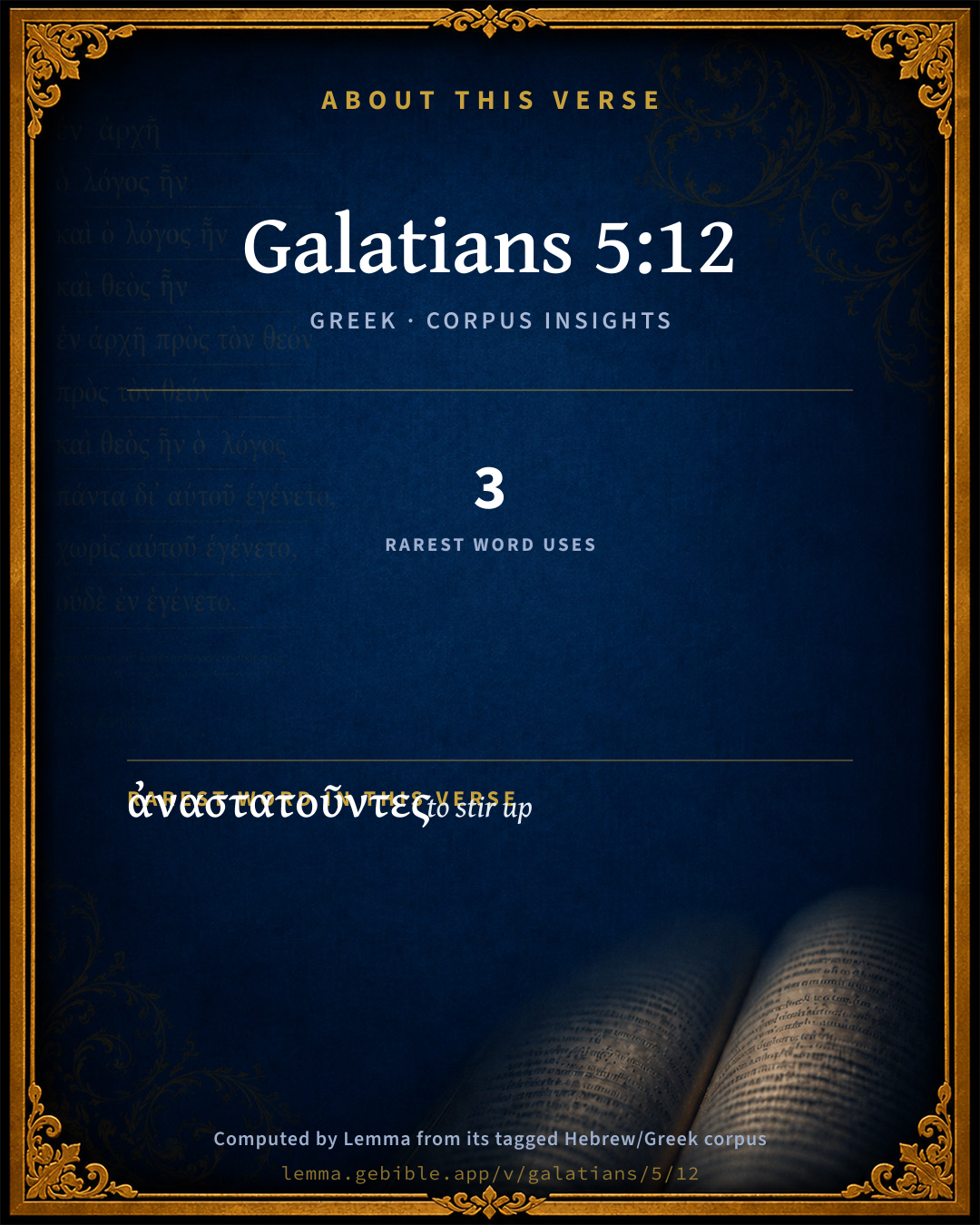
The rarest word here is ἀναστατοῦντες to stir up G387 — appearing just 3 times in the whole Greek New Testament.

Shared distinctive vocabulary

ἀναστατοῦντες to stir up G387 occurs in 3 verses of the Greek New Testament. Also found in:

Cross-references

16

Topical passages linked to Galatians 5:12 in the Treasury of Scripture Knowledge — connected by theme and wording, ordered by reader-vote popularity; previews shown in the World English Bible.

  • Galatians 5:10 I have confidence toward you in the Lord that you will think no other way. But he who troubles you will bear his judgment, whoever he is.
  • 1 Corinthians 5:13 But those who are outside, God judges. "Put away the wicked man from among yourselves."
  • Genesis 17:14 The uncircumcised male who is not circumcised in the flesh of his foreskin, that soul shall be cut off from his people. He has broken my covenant."
  • Exodus 12:15 Seven days shall you eat unleavened bread; even the first day you shall put away yeast out of your houses, for whoever eats leavened bread from the first day until the seventh day, that soul shall be cut off from Israel.
  • Exodus 30:33 Whoever compounds any like it, or whoever puts any of it on a stranger, he shall be cut off from his people.'"
  • Leviticus 22:3 Tell them, 'If anyone of all your seed throughout your generations approaches the holy things, which the children of Israel make holy to Yahweh, having his uncleanness on him, that soul shall be cut off from before me. I am Yahweh.
  • Joshua 7:25 Joshua said, Why have you troubled us? Yahweh shall trouble you this day. All Israel stoned him with stones; and they burned them with fire, and stoned them with stones.
  • Galatians 2:4 This was because of the false brothers secretly brought in, who stole in to spy out our liberty which we have in Christ Jesus, that they might bring us into bondage;
  • Titus 3:10 Avoid a factious man after a first and second warning;
  • Joshua 7:12 Therefore the children of Israel can't stand before their enemies; they turn their backs before their enemies, because they are become accursed: I will not be with you any more, except you destroy the devoted thing from among you.
  • John 9:34 They answered him, "You were altogether born in sins, and do you teach us?" They threw him out.
  • Acts 5:5 Ananias, hearing these words, fell down and died. Great fear came on all who heard these things.
  • Acts 5:9 But Peter asked her, "How is it that you have agreed together to tempt the Spirit of the Lord? Behold, the feet of those who have buried your husband are at the door, and they will carry you out."
  • Acts 15:1–2 Some men came down from Judea and taught the brothers, "Unless you are circumcised after the custom of Moses, you can't be saved."
  • Acts 15:24 Because we have heard that some who went out from us have troubled you with words, unsettling your souls, saying, 'You must be circumcised and keep the law,' to whom we gave no commandment;
  • Galatians 1:8–9 But even though we, or an angel from heaven, should preach to you any gospel other than that which we preached to you, let him be cursed.

Cross-references courtesy of OpenBible.info (CC BY 4.0).

Commentary

Notes on Galatians 5:12 from classic Christian and Jewish commentators (each source and its license shown beneath its notes). The classic Christian expositions comment on the surrounding passage and are grouped to its opening verse, so a note may address several verses; the Jewish commentaries on the Tanakh (Rashi and others) are per-verse, so they appear only where the commentator wrote on this verse.

Lemma curates 59 commentaries, every one of them public domain or Creative Commons licensed, each selected and text-cleaned for this edition rather than reprinted as found. About our sources →

The Biblical Illustrator

Joseph S. Exell

Gal_5:12

I would they were even cut off that trouble you.

Reasons for Pauls indignation

Not content with argument he charges the Judaizers with what is base, cowardly, and corrupt. They are mean and time-serving, and dread the loss of caste among their fellow-countrymen. His whole being at last becomes excited with indignation; his brow darkens; his feelings explode; and the flash and the thunderbolt leap forth in an anathema. Only something very serious could justify even an apostle in such a mode of conducting religious controversy. What was it? The error he denounced was--

1. A species of blasphemy against the Divine fact which constituted Gods method of reconciliation, and, as such, it shocked Pauls love and reverence for the Christ it dishonoured (Gal_2:21).

2. A species of apostasy from Christ, whatever might be their verbal profession of belief, and thus it shocked and was resented by his love for man (Gal_5:2-5).

3. A thing absurd in itself, and, as such, it shocked his understanding (Gal_2:16-18).

4. It opposed the idea of progress, intellectually considered, and it was thus inconsistent with Pauls hope for humanity (Gal_4:9).

5. It was a yoke put on the neck of the Gentiles, and, as such, it shocked the apostles respect for liberty, and offended and aroused his spirit of independence (Gal_5:1).

6. It was an attempt to perpetuate a national distinction, and to keep up the supremacy of a particular people, and, as such, it offended St. Pauls philanthropy and ran counter to his conviction of the design of the gospel, the oneness of the race, and the equality of the nations (Gal_3:26-28).

7. It interfered with the bestowal of the gifts of the Spirit, and, as such, it grieved the apostle on account of his anxiety for the holiness of the Church (Gal_3:2-3). (T. Binney.)

Church troublers

The Church is troubled--

I. By false doctrine; thus Ahab troubled Israel (1Ki_18:18), and false apostles the Galatians.

II. By wicked example; thus Achan troubled Israel (Jos_7:15).

III. By force and cruelty; thus tyrants and persecutors trouble the Church (Act_12:1). (W. Perkins.)

The Biblical Illustrator, edited by Joseph S. Exell (c. 1880s–1900s) — public domain. Text from a community e-Sword module.

Tyndale Open Study Notes

Tyndale Open Resources

5:12 mutilate themselves (literally cut themselves off; cp. Phil 3:2): Paul uses biting sarcasm and wordplay with multiple levels of meaning: (1) Paul might be alluding to pagan priests in the province of Galatia who castrated themselves in devotion to pagan gods. An insistence on circumcision for Christians is essentially no different. It involved cutting the flesh to become acceptable to God by physical deeds rather than by faith in Christ. (2) Depending on circumcision mutilated the false teachers’ standing before God, so they might as well mutilate themselves physically. (3) In the old covenant, emasculated men were not allowed to enter the congregation (Deut 23:1); similarly, those who rely on circumcision have no place in the new covenant community. Paul probably wished that the Judaizers would cut themselves off by removing themselves from the community.

Tyndale Open Study Notes — © Tyndale Open Resources, licensed CC BY-SA 4.0. Text via the HelloAO Bible API.

Bengel's Gnomon

Johann Albrecht Bengel

Gal 5:12. Ἀποκόψονται, shall be cut off) Immediately after the reproof concerning the past, Paul entertains [and expresses] good hope of the Galatians for the future; but he denounces punishment against the seducers in two sentences, which, by disjoining in the meantime the particle ὄφελον, are as follows:—ὁ δὲ ταράσσων ὑμᾶς βαστάσει τὸ κρίμα, κ.τ.λ., καὶ ἀποκόψονται οἱ ἀναστατοῦντες ὑμᾶς. That one concealed troubler, worse than the others, Gal 5:10, who boasted that Paul himself agreed with him about circumcision, is here, cursorily in passing, refuted, Gal 5:11; but the others also, who are disturbing the Galatians about the status of the Gospel [in relation to circumcision and the law], are threatened with being cut off. Thus the particle καὶ, and, retains its natural meaning, and these words cohere, βαστάσει—δὲ—καὶ ἀποκόψονται, as well as those, κρίνετε—δὲ—καὶ ἐξαρεῖτε, 1Co 5:12-13: ἀποκόψονται is the future middle, which, as often happens, so here, has a passive signification: it corresponds to the Hebrew word כרת, and is a conjugate of the verb ἐγκόπτειν, Gal 5:7. Either the whole, when a part is cut off [the whole has the part cut off], or a part cut off from the whole, is said respectively ἀποκόπτεσθαι. Some ascribe the former sense in this passage to the zeal of the apostle, so that the mutilation of the body of the circumcised [viz. by taking away not merely the foreskin, but the whole member] may be denoted; and, indeed, the LXX. often translate כרת by κόπτω, ἀπόκοπτω, etc., especially Deu 23:1) 2, where ἀποκεκομμένος is used for that, which the French here translate more than circumcised; but we can scarcely receive what is said by the apostle but by metonymy, i.e., that as persons cut off they may be debarred from the Church. Deut. as above. The second sense is more consistent with the gravity of the apostle, that he should speak thus: As the prepuce is cut off by circumcision, as a thing which it becomes an Israelite to want, so those shall be cut off, as a worthless prepuce, from the communion of the saints, and shall be accursed (anathema): ch. Gal 1:7, and following verses. With a similar reference to circumcision, Paul, Php 3:2, speaks of κατατομὴν, concision; nor is it altogether foreign to the subject, what Apollon. in Philostr. Gal 5:11, says of the Jews, already of old time, they not only cut themselves off from the Romans, but also from all men. Now, what is to be done with the particle ὄφελον? Most construe ὄφελον καὶ ἀποκόψονται; but ὄφελον, though it is a particle of sufficiently frequent occurrence, is nowhere to be found construed with the future of the indicative. The Complutensian Edition acknowledging this fact, to avoid this difficulty, have given ἀποκόψωνται; but it is unsupported by the copies.[49] There are many imprecations in the sacred writings, and this word ὄφελον is not used in any of their formulæ: nor would Paul in this passage, after a categorical (unconditional) denunciation, finally make war by a prayer against the disturbers of the peace. Στιγμή, the point, is put after ὄφελον in the sixth Augustan. I think it will be found so in many MSS., if philologers would notice such things; for the comma is certainly in some ancient editions, especially in that of Basle, 1545. Nay, ὄφελον may be very conveniently connected with the preceding words: ἄρα κατήργηται τὸ σκάνδαλον τοῦ σταυροῦ; ὄφελον,—was then the offence of the Cross taken away? I wish it were. Ὄφελον is subjoined in reference to a thing desirable (such as is also noticed 1Co 4:8), as μὴ γένοιτο, Gal 3:21, is used in reference to a matter by no means pleasant; and as εἶεν among the Greeks in cases of concession, or esto among the Latins. And, as in ch. Gal 2:17, after ἄρα is put μὴ γένοιτο, so here, after ἄρα is put ὄφελον. I wish that the Cross were a scandal to no one—I wish that all, along with Paul, may hereafter glory in the Cross, ch. Gal 6:14-15.—οἱ ἀναστοῦντες ὑμᾶς) The same word as at Act 17:6. It denotes, to remove a man entirely from the station which he occupies.

[49] Beng. errs in this. D(Δ)G support ἀποκόψωνται: and fg Vulg. have ‘abscindantur.’ But ABC, the weightiest authorities, have ἀποκόψονται, the difficulty of explaining which gave birth to ἀποκοψονται.—ED.

Bengel's Gnomon of the New Testament — English translation (T&T Clark, Edinburgh, 1860) — public domain. Text from a community e-Sword module.

Meyer's Critical & Exegetical Commentary

Heinrich August Wilhelm Meyer

Gal_5:12. The vivid realization of the doings of his opponents, who were not ashamed to resort even to such falsehood (Gal_5:11), now wrings from his soul a strong and bitterly sarcastic wish[232] of holy indignation: Would that they, who set you in commotion, might mutilate themselves! that they who attach so much importance to circumcision, and thereby create commotion among you, might not content themselves with being circumcised, but might even have themselves emasculated! On ὄφελον as a particle, see on 1Co_4:8. Omnino autem observandum est, ὤφελον (as to the form ὄφελον, see Interpr. ad Moer. p. 285 f.) non nisi tum adhiberi, quum quis optat, ut fuerit aliquid, vel sit, vel futurum sit, quod non fuit aut est aut futurum est, Hermann, ad Viger. p. 756. It is but very seldom used with the future, as Lucian, Soloec. 1. See Hermann l.c.; Graev. ad Luc. Sol. II. p. 730.

καί] the climactic even, not that of the corresponding relation of retribution (Wieseler), in which sense it would be only superfluous and cumbrous.

ἀποκόψονται] denotes castration (Arrian, Epict. ii. 20. 19), either by incision of the vena seminalis (Deu_23:1) or otherwise. See the passages in Wetstein. Comp. ἀπόκοπος, castrated, Strabo, xiii. p. 630; ἀποκεκομμένος, Deu_23:1. Owing to καί, which, after Gal_5:11, points to something more than the circumcision therein indicated, this interpretation is the only one suited to the context: it is followed by Chrysostom and his successors, Jerome, Ambrose, Augustine, Cajetanus, Grotius, Estius, Wetstein, Semler, Koppe, and many others; also Winer, Rückert, Usteri, Matthies, Schott, Olshausen, de Wette, Hilgenfeld, Hofmann, Reithmayr, Holsten; comp. Ewald, who explains it of a still more complete mutilation, as does Pelagius, Theodore of Mopsuestia, and others. In opposition to the context, others, partly influenced by an incorrect aesthetical standard (comp. Calovius: glossa impura), and sacrificing the middle signification,which is always reflexive in Greek prose writers (Kühner, II. p. 19), and is also to be maintained throughout in the N.T. (Winer, p. 239, [E. T. 316]),have found in it the sense: exitium imprecatur impostoribus (Calvin, acknowledging, however, the word as an allusion to circumcision; Calovius, and others); or have explained it of the divine extirpation (Wieseler); or: may they be excommunicated (Erasmus, Beza, Piscator, Cornelius a Lapide, Bengel, Michaelis, Zachariae, Morus, Baumgarten-Crusius, Windischmann, and others);[233] or: may all opportunity of perverting you be taken from them (Elsner, Wolf, Baumgarten); or: may they cut themselves off from you (Ellicott).

ἀναστατοῦν] stronger than ταράσσειν, means here to stir up (against true Christianity), to alarm. Comp. Act_17:6; Act_21:38. The word, used instead of the classic ἀνάστατον ποιεῖν, belongs to the later Greek; Sturz, dial. Mac. p. 146.

[232] According to Hofmann, indeed, it is quite earnestly meant, and is supposed to contain the thought that their perversity, which is now rendered dangerous by their being able to appeal to the revealed law, would thereby assume a shape in which it would cease to be dangerous. How arbitrarily the thought is imported! And yet the wish, if earnestly meant, would be at all events a silly one. For a similar instance of a bitterly pointed saying against the Judaistic overvaluing of circumcision, see Php_3:2.

[233] Luther, in his translation, rendered it: to be extirpated (thus like Calvin); in his Commentary, 1519, he does not explain it specially, but speaks merely of a curse which is expressed. In 1524, however, he says characteristically: Si omnino volunt circumcidi, opto, ut et abscindantur et sint eunuchi illi amputatis testiculis et veretro, i. e. qui docere et gignere filios spirituales nequeunt, extra ecclesiam ejiciendi. On the other hand, in the Commentary of 1538, he says quite simply, allusit … ad circumcisionem, q. d. cogunt vos circumcidi, utinam ipsi funditus et radicitus excindantur.

Meyer — Critical and Exegetical Commentary on the New Testament — English translation by Peter Christie, edited by Frederick Crombie (T&T Clark, 1880) — public domain. Text from a community e-Sword module.

Expositor's Greek Testament

ed. W. Robertson Nicoll

Gal 5:12 . ὄφελον . This adverb occurs also in 1Co 4:8 , 2Co 11:1 , Rev 3:15 . In all three places it expresses dissatisfaction with the actual position, “Would that it were otherwise”. But it acquires this force from its combination with past tenses, like the aorist ὤφελον in Attic Greek. When coupled however with a future as it is here, it does not express a wish, but like the future of ὀφείλειν declares what ought to be the logical outcome of the present. The clause predicts in bitter irony to what final consummation this superstitious worship of circumcision must lead. Men who exalt an ordinance of the flesh above the spirit of Christ will be bound in the end to proceed to mutilation of the flesh like heathen votaries. ἀποκόψονται . This word was habitually used to describe the practice of mutilation which was so prevalent in the Phrygian worship of Cybele. The Galatians were necessarily familiar with it, and it can hardly bear any other sense. ἀναστατοῦντες . This word forcibly expresses the revolutionary character of the agitation which was upsetting the peace and order of the Galatian Churches. It is used in Act 17:6 ; Act 21:38 to denounce seditious and riotous conduct.

The Expositor's Greek Testament, edited by W. Robertson Nicoll (1897–1910) — public domain. Text from a community e-Sword module.

Geneva Bible (1599)

Geneva Bible translators

An example of a true Pastor inflamed with the zeal of God’s glory and love of his flock.

For they that preach the Law, cause men’s consciences always to tremble.

Geneva Bible (1599) marginal notes — public domain. Text via Bolls.life.

Jamieson, Fausset & Brown

Robert Jamieson, A. R. Fausset & David Brown

they . . . which trouble you--Translate, as the Greek is different from Gal 5:10, "they who are unsettling you."

were even cut off--even as they desire your foreskin to be cut off and cast away by circumcision, so would that they were even cut off from your communion, being worthless as a castaway foreskin (Gal 1:7-8; compare Phi 3:2). The fathers, JEROME, AMBROSE, AUGUSTINE, and CHRYSOSTOM, explain it, "Would that they would even cut themselves off," that is, cut off not merely the foreskin, but the whole member: if circumcision be not enough for them, then let them have excision also; an outburst hardly suitable to the gravity of an apostle. But Gal 5:9-10 plainly point to excommunication as the judgment threatened against the troublers: and danger of the bad "leaven" spreading, as the reason for it.

Jamieson, Fausset & Brown — Commentary Critical and Explanatory on the Whole Bible (1871) — public domain (CC PDM 1.0). Text via the HelloAO Bible API.

Adam Clarke's Commentary

Verse 12. I would they were even cut off which trouble you.] This saying has puzzled many, and different interpretations of the place have been proposed by learned men.

At first sight it seems as if the apostle was praying for the destruction of the false teachers who had perverted the Churches of Galatia. Mr. Wakefield thought οφελον αποκοψονται might be translated, I wish that they were made to weep; and in his translation of the New Testament the passage stands thus: "I wish that they who are unsettling you may lament it." I believe the apostle never meant any such thing. As the persons who were breeding all this confusion in the Churches of Galatia were members of that Church, the apostle appears to me to be simply expressing his desire that they might be cut off or excommunicated from the Church. Kypke has given an abundance of examples where the word is used to signify amputating; cutting off from society, office, c. excluding. In opposition to the notion of excommunication, it might be asked: "Why should the apostle wish these to be excommunicated when it was his own office to do it?" To this it may be answered: The apostle's authority was greatly weakened among that people by the influence of the false teachers, so that in all probability he could exercise no ecclesiastical function; he could therefore only express his wish. And the whole passage is so parallel to that, 1Co 5:6-7, that I think there can be no reasonable doubt of the apostle's meaning: Let those who are unsettling the Church of Christ in your district be excommunicated; this is my wish, that they should no longer have any place among you."

Adam Clarke's Commentary on the Bible (1810–1826) — public domain. Text from a community e-Sword/MySword module.

John Calvin's Commentaries

12. Would that they were even cut off. His indignation proceeds still farther, and he prays for destruction on those impostors by whom the Galatians had been deceived. The word, “cut off,” appears to be employed in allusion to the circumcision which they pressed. “They tear the church for the sake of circumcision: I wish they were entirely cut off.” Chrysostom favors this opinion. But how can such an imprecation be reconciled with the mildness of an apostle, who ought to wish that all should be saved, and that not a single person should perish? So far as men are concerned, I admit the force of this argument; for it is the will of God that we should seek the salvation of all men without exception, as Christ suffered for the sins of the whole world. But devout minds are sometimes carried beyond the consideration of men, and led to fix their eye on the glory of God, and the kingdom of Christ. The glory of God, which is in itself more excellent than the salvation of men, ought to receive from us a higher degree of esteem and regard. Believers earnestly desirous that the glory of God should be promoted, forget men, and forget the world, and would rather choose that the whole world should perish, than that the smallest portion of the glory of God should be withdrawn.

Let us remember, however, that such a prayer as this proceeds from leaving men wholly out of view, and fixing our attention on God alone. Paul cannot be accused of cruelty, as if he were opposed to the law of love. Besides, if a single man or a few persons be brought into comparison, how immensely must the church preponderate! It is a cruel kind of mercy which prefers a single man to the whole church. “On one side, I see the flock of God in danger; on the other, I see a wolf “seeking,” like Satan, “whom he may devour.” (1 Peter 5:8.) Ought not my care of the church to swallow up all my thoughts, and lead me to desire that its salvation should be purchased by the destruction of the wolf? And yet I would not wish that a single individual should perish in this way; but my love of the church and my anxiety about her interests carry me away into a sort of ecstasy, so that I can think of nothing else.” With such zeal as this, every true pastor of the church will burn. The Greek word translated “who trouble you,” signifies to remove from a certain rank or station. By using the word καὶ, even, he expresses more strongly his desire that the impostors should not merely be degraded, but entirely separated and cut off.

John Calvin's Commentaries (1540-1563) — public domain. Text from the Calvin Translation Society English edition (1840s-50s) via the Christian Classics Ethereal Library (ccel.org). Calvin's coverage is partial (roughly two-thirds of the Bible); uncommented books and verses are honest gaps, never fabricated. The 19th-century editor's footnotes and remarks are omitted so the notes are faithfully Calvin's own voice.

Ellicott's Commentary for English Readers

(12) I would they were even cut off.—The Authorised version is undoubtedly wrong here. The words may mean “cut themselves off,” i.e., from your communion, but it seems far best to take the words, with all the ancient Greek interpreters and a large majority of modern commentators, including Dr. Lightfoot and Bishop Wordsworth, as referring to an extension of the rite of circumcision, such as the Galatians might see frequently practised by the priests of Cybele, whose worship had one of its most imporant centres in their country—I would they would even make themselves eunuchs. Let them carry their self-mutilation still further, and not stop at circumcision.

The expression is in several ways surprising as coming from St. Paul. We should remember, in some mitigation of it, the fact just alluded to, that the Galatians were themselves familiar with this particular form of self-mutilation; and familiar with it, no doubt, in discourse as well as in act. Christianity, while it has had the effect of putting a stop to such horrible practices, has also banished them even from thought and word. It is less, perhaps, a matter of wonder that we should have to appeal to the difference in standard between the Apostle’s times and our own, than that we have to appeal to it so seldom. Still, at the best, words like these must be allowed to come some way short of the “meekness and gentleness of Christ.” We may compare with them, as well for the particular expression as for the general vehemence of language, Php_3:2 : “Beware of dogs, beware of evil workers, beware of concision” (with a play on “circumcision”). The Apostle himself would have been the last to claim that he had “already attained, either were already perfect.” A highly nervous and excitable constitution such as his, shattered by bodily hardships and mental strain, could not but at times impair his power of self-control. It is to be noticed, however, that his indignation, if it sometimes carries him somewhat too far, is always roused in a worthy cause. Such momentary ebullitions as these are among the very few flaws in a truly noble and generous character, and are themselves in great part due to the ardour which makes it so noble.

Which trouble you.—A different word from that which is similarly translated in Gal_5:10. Its meaning is stronger: “to uproot and overthrow.”

A Bible Commentary for English Readers, edited by Charles John Ellicott (1878–1897) — public domain. Text from a community e-Sword module.

The Cambridge Bible for Schools and Colleges

gen. ed. J. J. S. Perowne

12. The Apostle gives vent to his righteous indignation.

they were even cut off] Two explanations of this expression are given. All expositors however agree in translating the verb as a middle, not as passive.

(1) ‘I would that they who are such advocates for circumcision would go further and practise self-mutilation, like the priests of Cybele’. This is the view of Chrysostom and has the support of the most eminent commentators, ancient and modern. Bp. Lightfoot remarks, that ‘by glorying in the flesh’ the Galatians were returning in a very marked way to the bondage of their former heathenism; and Dr Jowett considers that ‘the common interpretation of the Fathers, confirmed by the use of language in the Septuagint, is not to be rejected only because it is displeasing to the delicacy of modern times’.

(2) ‘I would that they who are not merely teaching error, but stirring up sedition among you, would go further and even cut themselves off from you’, i.e. that instead of remaining as a disturbing element in the Church, they would openly secede and sever themselves. In favour of this interpretation (which seems to be adopted by the R.V. ‘even cut themselves off’[30]) the following considerations are of weight: (a) The word occurs three times (exclusive of repetitions) in the active voice in the N. T. and always in the physical sense = ‘amputate’ or cut through. It occurs nowhere else in the middle. And it is common for a verb to undergo a change from the physical to the ethical sense with the change of voice. (b) It is not met with in the middle in the LXX. The passive participle occurs once in the sense of ‘mutilated’. (c) The word rendered ‘trouble’ you, is not the same as that used in Gal_5:10, but a term descriptive of the action of those leaders who stirred up a body of disaffected citizens, inducing them to abandon their homes and live by warfare or depredation, comp. Act_21:38. What wish more natural than that men with such sectarian aims should sever themselves wholly from the company of believers? (d) The coarseness of the former explanation is heightened by the abruptness of the wish. There is moreover no other allusion in St Paul’s writings to the practice in question.

[30] With the alternative in the Margin, ‘Mutilate themselves’.

Between the two interpretations the student must choose that which approves itself to his judgment.

The Cambridge Bible for Schools and Colleges (gen. ed. J. J. S. Perowne; Cambridge University Press, 1878–1918) — public domain. Text from a community e-Sword module.

John Gill's Exposition

For brethren, ye have been called unto liberty,.... He calls them "brethren", to testify his affection to them, and to put them in mind of their relation to one another, which required mutual love, a thing he is about to press them to; he asserts that they were "called" not merely externally, but internally, by the effectual grace of God, out of bondage to sin, Satan, and the law, unto the liberty of the Gospel and of the grace of God; that liberty wherewith Christ had made them free, Gal 5:1 this he said in a judgment of charity, hoping well of them:

only use not liberty for an occasion to the flesh; corrupt nature, which in unregenerate men takes encouragement from, and makes an ill use of the best of things, as the mercy and patience of God; and not only takes an occasion by the law, forbidding sin to work and stir up all manner of concupiscence; but also by the Gospel, and the doctrines of it, such as eternal election, free justification, &c. which though the source and fountain, the barrier and security, of all true and real holiness, are improved and abused by wicked minds, under the influence and instigation of Satan, to vile purposes; and though regenerate persons are not in the flesh, and do not live after it, yet that is in them, and there is a proneness in them to sin; and Satan is watching all opportunities and advantages against them; so that there is need for such a caution as this, that they do not misuse their Christian liberty by indulging the flesh and the lusts of it, which is apt to take an occasion to cherish its lusts, and especially when given: Christ's free men should not do so, for that is to disgrace the doctrine of Christian liberty, to enthral themselves in, bondage instead of using their liberty aright, and to give the enemy occasion to blaspheme: the doctrine of Christian liberty may bc abused, or used as an occasion to the flesh, and to fulfil the lusts of it; when under a pretence thereof men think themselves exempt from obedience to the civil magistrate, which is using this liberty as a cloak of maliciousness; or that they are free from obedience to the law of God, as a rule of walk and conversation; or from subjection to the ordinances of the Gospel; or when they use the creatures God has given them the free use of without thankfulness, and in an immoderate manner; and when they make things indifferent which are not, or use indifferent things to the prejudice of others; and their liberty becomes a stumblingblock to weak Christians, which the apostle seems greatly to regard here; since he adds,

but by love serve one another: the Vulgate Latin version reads, "by the love of the Spirit": and so some copies; Gospel liberty and the service of the saints are not at all inconsistent; as it becomes them to love one another, as the new command of Christ, their profession of religion, and their relation to each other, require, so they should show their love by their service; as by praying one with and for another, by bearing each other's burdens, sympathizing with and communicating to each other in things temporal and spiritual; in forbearing with and forgiving one another; by admonishing each other when there is occasion for it, in a meek, tender, and brotherly way; by instructing and building up one another on their most holy faith, and by stirring up one another to all the duties of religion, private and public.

John Gill's Exposition of the Whole Bible (1746–1763) — public domain (CC PDM 1.0). Text via the HelloAO Bible API.

Trapp's Complete Commentary

John Trapp

12 I would they were even cut off which trouble you.

Ver. 12. I would they were even cut] Not circumcised only, cut round, but cut off, Non circumcidantur modo, sed et abscindantur. (Chrys.)

That trouble you] That turn you upside down, or that turn you out of house and home.

John Trapp, A Commentary or Exposition upon All the Books of the Old and New Testament (1647–1656) — public domain. Text from a community e-Sword module.

Albert Barnes' Notes on the Bible

I would they were even cut off - That is, as I understand it, from the communion of the church. So far am I, says Paul, from agreeing with them, and preaching the necessity of circumcision as they do, that I sincerely wish they were excluded from the church as unworthy a place among the children of God. For a very singular and monstrous interpretation of this passage, though adopted by Chrysostom, Theodoret, Theophylact, Jerome, Grotius, Rosenmuller, Koppe, and others, the learned reader may consult Koppe on this verse. To my amazement, I find that this interpretation has also been adopted by Robinson in his Lexicon, on the word ἀποκόπτω apokoptō. I will state the opinion in the words of Koppe. “Non modo circumcidant se, sed, si velint, etiam mutilant se - ipsa genitalia resecent.” The simple meaning is, I think, that Paul wished that the authors of these errors and disturbances were excluded from the church.

Which trouble you - Who pervert the true doctrines of salvation, and who thus introduce error into the church. Error always sooner or later causes trouble; compare the note at 1Co 5:7.

Albert Barnes' Notes on the Bible (1834–1885) — public domain. Text from a community e-Sword/MySword module.

Matthew Poole's English Annotations

I wish that God would some way or other put an end to these that trouble you. This Paul speaketh not out of hatred to their persons, but out of a zeal to the glory of God, and a just indignation against these men, who had so much hindered the salvation of the members of this church. And it is not improbable that the apostle here spake by the Spirit of prophecy, as knowing God would cut them off; so that his and the like imprecations of holy men in Scripture are not to be drawn into precedents, or made matters for our imitation, unless we had the same discerning of spirits which they had, or the same Spirit of prophecy and revelations from God as to future things. But how far it is lawful or unlawful for ordinary persons, whether ministers or private Christians, to pray against God’s or his church’s enemies, is a question for the arguing which this place is too narrow.

Matthew Poole's English Annotations on the Holy Bible (1683–1685) — public domain. Text from a community e-Sword/MySword module.

Whedon's Commentary on the Bible

Daniel D. Whedon

12. I am so far from preaching circumcision, that I would they might inflict upon themselves excision. There is clearly an antithesis between the circumcision and the excision; but the question is, what excision is meant? A large number of modern expositors understand, with our English translators, excision from the Church. And Bengel sustains the antithesis under this interpretation in words which we shall leave in their original Latin: “Quemadmodum preputium per circumcisionem abscinditur, ut quiddam, quo carere decet Israelitam; ita isti tanquam preputium rejiculum de communione sanctorum rejicientur et anathema erunt.”

But those who best knew the true meaning of the Greek term for this excision—the old Greek commentators—give another sense of the word; a sense which the decency which Christianity has created in modern times induces many to believe that the apostle could hardly have intended. The same Greek word is in the Septuagint version of Deuteronomy xxiii, 1, for one made a eunuch. The rite of circumcision undoubtedly symbolized the cutting off the sensual from our nature; and it is wonderful that among some heathen the same rite was so increased in severity, perhaps with a similar meaning, at first, as to produce a complete, relentless emasculation. Now in Galatia it was probably no more repulsive to name this excision than to speak of circumcision. The city of Pessinus, capital of Galatia, was the seat of the worship of Cybele, whose priests mutilated themselves as a religious rite. In literature, in public discourse, and in conversation, the thought and the name were familiar. St. Paul, therefore, in language at that time entirely inoffensive, indignantly preferred that these circumcisionists should go the whole extent, and turn excisionists, priests of Cybele, and the salvation of his Church would no longer be endangered. Circumcision was now as useless as this excision; both had better be abandoned to pagans, and Christians abstain from and contemn both alike. And this indignant expression of contempt for both Paul now follows with a lesson of Christian spiritual purity.

Daniel D. Whedon (gen. ed.), Commentary on the Old and New Testaments (1874–1909) — public domain. Text from a community e-Sword module.

The Pulpit Commentary

I would they were even cut off which trouble you (ofelon kaiyontai oiJ ajnastatountev uJmav); would to God they would make themselves even as the apocopi of Cybele (Greek, would even mutilate themselves), who are casting you out of country and home! The word ofelon, originally a verb, had got, thus stripped of its augment, to be a mere particle of wishing. Its sense with an indicative aorist is seen (1Co_4:8)

Ofelon ge ejbasileusate, "Would to God ye had come to your kingship which is far from being really the case yet!;" (Exo_16:3; Num_14:2 Num_20:3) (Septuagint)

Ofelon ajpeqanomen, "Would to God we had died!" with an indicative imperfect, (2Co_11:1)

Ofelon ajneicesqe mon mikronhv, "Would to God ye were i.e. could be tolerant of a little foolishness of mine! might I hope for it?;" (Rev_3:15)

Ofelon yucrov hv, etc., "Would that thou wert cold," etc. With an indicative future (an extremely rare combination), it may still be regarded as expressing a longing that something might be looked forward to, which in reality is not to be anticipated; different from a simple desire that a thing may be, unaccompanied by the feeling that it cannot be, which is its three with an optative, as infelon, Psa_119:5. The tone of especially fervid aspiration, the vivacity, which usually marks wishes introduced by o) is perhaps unduly tamed down by the rendering "I would that." In respect to the verb ajpokoyontai, Greek scholars are pretty well agreed that the passive rendering of our Authorized Version, "were cut off," cannot be defended. There is no certain instance (Bishop Ellicott remarks) of a similar interchange of the middle,voice with the passive. The sense of the verb is shown by the Septuagint rendering of Deu_23:1, Oujk eijseleusetai qladiav kainov eijv ejkklhsian Qeou: where the word "to the ajpokekommenov answers Hebrew keruth shophkah, rightly rendered in the Vulgate and in our English Bible (cf. Gesenius"s "Thesaurus," and Furst, under shophkah). "This meaning is assigned to ajpokoyontai," observes Bishop Lightfoot, "by all the Greek commentators, I believe, without exception (the Latin Fathers, who read "abseimtantur" in their text had more latitude), and seems alone tenable." (See Grotius, in Peele"s "Synopsis.") This interpretation gives its full force to kai (not only circumcise, but even," etc.): it explains the form of the aspiration as one not likely to be realized; whereas the excision flora the Church of these extremely aberrant members, falling nearly if not quite under the anathema of the first chapter, was a thing quite within the apostle"s own power: it harmonizes with the intense resentment which colours the phrase, oiJ ajnastatountev hJmav (see below). The sentiment, it is true, seems one which it would be impossible for a public speaker, or even a writer, amongst ourselves to give such open expression to. Nevertheless, when viewed as framed in amid the surroundings which environed it at the time, it wears none of that aspect of coarseness which would confessedly be felt to attach to it under the conditions of modern life. That the worship of Cybele at Pessinus, one of the principal cities of Galatia, was deformed by the practice of such self-mutilation on the part of some of its devotees, was a matter of universal notoriety, and we may confidently assume that the apostle, when in the neighbourhood, heard frequent mention of those apocopi as they were called, and thus was led now to allude to it as he seems to do in this malediction. For it is a malediction, as Chrysostom describes it; a malediction, however, which in severity falls far short of the anathema which has been previously pronounced. Good were it (he means) for the Church, and even perhaps themselves, if they would have the rashness to go a little further with what they call "circumcision," which in their case is mere concision, (Php_3:2) and make it clear to all men how purely senseless and unchristian their action in this matter is. "Casting you out of country and home." The verb ajnastatoun occurs besides only in Act_17:6 ("turned upside down") and Act_21:38 ("madest an uproar"). It is not found in classical Greek, in which we have in its stead ajnastatouv poiein or tiqenai: the verbal adjective ajnastatov, when it is applied, as it frequently is, to populations, meaning, "made to rise up and depart," "driven from house and home;" applied to cities, "ruined," "laid waste" (Liddell and Scott). Chrysostom observes, "Well does he say, ajnastatountev uJmav: for they compelled them to abandon their own proper country and liberty and heavenly kindred, and to seek an alien and strange one; casting them out of "Jerusalem which is above and free," and forcing them to wander abroad as captives and perforce emigrants." The present tense of the participle points to the action of these perverters as one which. if successful, would have this result; which (ver. 10) the apostle hopes to defeat. The selection of this particular verb, which goes far beyond the tarassontev before used, and which the word "unsettle" adopted here by the Revisers, does not, as commonly used, completely represent, betokens the apostle"s intense feeling of the ruinous consequences of the proposed Judaizing reaction. It shows that he adds the words aetiologically, that is, to justify his strong words, ofelon ajpokoyontai. The energy of both expressions suggests the feeling that probably the apostle would not have written as he has here done except for his burning resentment on behalf of Christ"s people threatened with so great a hurt. In 1 Car. 6:4 indignant feeling carries him away beyond himself to an utterance which in the next verse he virtually retracts, remarking, "I say it to move you to shame." Perhaps we have here something of the same kind.

A fierce stroke of apostolic irony.

The apostle had been so profoundly stirred by the false accusations of the Judaizers and their fanatical zeal for circumcision, which was, after all, a mere "glorying in the flesh," that he throws out a wish that those who were trying to unhinge Galatian Christianity would themselves exemplify this "glorying" to the extent that was so familiar among the worshippers of Cybele at Pessinus, one of the towns of Galatia. His readers would have no difficulty in understanding the allusion. If circumcision was good, the priests of Cybele had something better to offer. It was a piece of contemptuous sarcasm, which exhibits the passionate feeling of the apostle caused by their unceasing efforts to undermine the gospel for the sake of a mere mark in the flesh,

The Pulpit Commentary (1880–1919), ed. H.D.M. Spence-Jones & Joseph S. Exell — public domain. Text from a community e-Sword module.

John Wesley's Explanatory Notes

I would they were even cut off - From your communion; cast out of your church, that thus trouble you.

John Wesley, Explanatory Notes Upon the Whole Bible (1754–1765) — public domain. Text via the GEBible commentary corpus.

Luther on Galatians

Martin Luther

VERSE 12. I would they were even cut off which trouble you.

It hardly seems befitting an apostle, not only to denounce the false apostles as troublers of the Church, and to consign them to the devil, but also to wish that they were utterly cut off--what else would you call it but plain cursing? Paul, I suppose, is alluding to the rite of circumcision. As if he were saying to the Galatians: "The false apostles compel you to cut off the foreskin of your flesh. Well, I wish they themselves were utterly cut off by the roots."

We had better answer at once the question, whether it is right for Christians to curse. Certainly not always, nor for every little cause. But when things have come to such a pass that God and His Word are openly blasphemed, then we must say: "Blessed be God and His Word, and cursed be everything that is contrary to God and His Word, even though it should be an apostle, or an angel from heaven."

This goes to show again how much importance Paul attached to the least points of Christian doctrine, that he dared to curse the false apostles, evidently men of great popularity and influence. What right, then, have we to make little of doctrine? No matter how nonessential a point of doctrine may seem, if slighted it may prove the gradual disintegration of the truths of our salvation.

Let us do everything to advance the glory and authority of God’s Word. Every tittle of it is greater than heaven and earth. Christian charity and unity have nothing to do with the Word of God. We are bold to curse and condemn all men who in the least point corrupt the Word of God, "for a little leaven leaveneth the whole lump."

Paul does right to curse these troublers of the Galatians, wishing that they were cut off and rooted out of the Church of God and that their doctrine might perish forever. Such cursing is the gift of the Holy Ghost. Thus Peter cursed Simon the sorcerer, "Thy money perish with thee." Many instances of this holy cursing are recorded in the sacred Scriptures, especially in the Psalms, e.g., "Let death seize upon them, and let them go down quick into hell." (Psa 55:15.)

THE DOCTRINE OF GOOD WORKS

Now come all kinds of admonitions and precepts. It was the custom of the apostles that after they had taught faith and instructed the conscience they followed it up with admonitions unto good works, that the believers might manifest the duties of love toward each other. In order to avoid the appearance as if Christianity militated against good works or opposed civil government, the Apostle also urges us to give ourselves unto good works, to lead an honest life, and to keep faith and love with one another. This will give the lie to the accusations of the world that we Christians are the enemies of decency and of public peace. The fact is we Christians know better what constitutes a truly good work than all the philosophers and legislators of the world because we link believing with doing.

Martin Luther — Commentary on the Epistle to the Galatians (1535), English translation by Theodore Graebner (Zondervan, 1939) — public domain (U.S. copyright not renewed). Text from a community e-Sword module.

Burkitt's Expository Notes on the New Testament

William Burkitt

The apostle’s meaning is, "That it were very fit, were it seasonable, that those which had thus seduced them, should be excommunicated and and cut off from the church’s communion.

Where note, 1. How implicity and interpretatively St. Paul compares these seducers to rotten members, which are and ought to be cut off, lest the gangrene overspread the whole body: I would they were cut off; implying, that like rotten members they deserved it, and the church’s safety called for it, would her then circumstances admit of it.

Note, 2. That in the very expression here used by St. Paul, of cutting off, there seems to be an allusion to the practice of circumcision, which is a cutting off the foreskin of the flesh, and throwing it away.

Now, says the apostle, I wish that these judaizing teachers, that urge you to be circumcised, that is, to cut off and cast away the foreskin of your flesh, I wish that they might be cut off as superfluous flesh, and cast out of the fellowship and communion of the church.

Yet, note, 3. The apostle doth rather declare what such seducers deserve, than actually inflict the censure itself; he satisfied himself with an affectionate wish, lest the number of the seduced being great, and perhaps the seducers not a few, they should be hardened rather than reformed, and the ordinance itself exposed; I would they were even cut off, &c.

William Burkitt's Expository Notes on the New Testament (1700–1703) — public domain. Text from a community e-Sword module.

McGarvey & Pendleton's Commentaries

J. W. McGarvey

I would that they that unsettle you would even go beyond circumcision. [If those who trouble you insist on mutilating themselves, I wish they would go further and cut themselves entirely off from the church. Having fully established the liberty of the gospel, the apostle now turns to correct any false antinomian theories which might have arisen out of a misconception of his words. Liberty is permissible, but not license. The liberty of a son is infinitely larger than that of a ward, and yet the son is not wholly without restraint.]

J. W. McGarvey (with Philip Y. Pendleton), Commentaries on the New Testament (The Fourfold Gospel, 1914; Acts; and the epistles) — public domain. Text from a community e-Sword/MySword module.

The People's New Testament

B. W. Johnson

12. I would they were even cut off. These men are seeking to make the mark of bondage by cutting your flesh. I would that they would cut themselves off (see Revision). I take it that he means “Cut themselves off from the church so as to have nothing more to do with it.”

B. W. Johnson's The People's New Testament with Notes (1889–1891) — public domain. Electronic text from the Christian Classics Ethereal Library (CCEL) ThML edition.

Cambridge Greek Testament for Schools and Colleges

12. ὄφελον. This shortened form of ὤφελον has become virtually a particle, utinam, both in the LXX. (Exo 16:3) and in the N.T., with a past tense (1Co 4:8; 2Co 11:1; Rev 3:15[138]) of an impracticable wish. Only here with the future, of a practicable wish. See Burton, Tenses, § 27; Blass, Gr. § 63. 5 and § 66. 1.

[138] Is affixed to a word it means that all the passages are mentioned where that word occurs in the New Testament.

καὶ ἀποκόψονται, “would that they would even make themselves eunuchs.” So Deu 23:1 (2). Cf. Hesychius, ὁ ἀπόκοπος ἤτοι ὁ εὐνοῦχος. St Paul vividly, if somewhat coarsely, contrasts partial with complete mutilation, the latter being “a recognized form of heathen self-devotion” (Lightfoot). The metaphorical meaning of excision from the Church (cf. ἀποκοπή of divorce, Deu 24:3 (1) in Aquila, or according to another reading κοπή, and in Symmachus διακοπή), though more in accordance with our modern notions of delicacy of expression, is contrary to the unanimous opinion of the Greek commentators. It also does not suit the middle voice so well.

οἱ ἀναστατοῦντες ὑμᾶς, “who throw you into confusion.” Dan. (LXX.) Dan 7:23; Act 17:6; Act 21:38[139]; also some six times in the Hexapla. See especially Symm. Isa 22:3, ἀνεστατώθησαν (LXX. πεφεύγασι, Theod. μετεκινήθησαν); an unknown Greek translator of Hab 3:16, ἀνεστατώθη τὰ σπλάγχνα μου (LXX. ἐπτοήθη ἡ κοιλία μου). In the well known naughty boy’s letter to his father (ii.—iii. cents. A.D.) he writes “My mother said to Archelaus ‘He quite upsets me! off with him,’ ” ἀναστατοῖ με· ἄρρον αὐτόν (see e.g. Deissmann, Licht vom Osten, p. 133, or Moulton and Milligan, Expositor, VII. 5, p. 269, 1908).

[139] Is affixed it means that all the passages are mentioned where the word occurs in the Greek Bible.

Cambridge Greek Testament for Schools and Colleges (Cambridge University Press, 1896; 21 vols, various authors incl. Carr, Maclear, Plummer, Farrar, Lumby, Moule, M. R. James, Simcox) — public domain. Text from a community e-Sword module.

Alford’s Greek Testament

Henry Alford

12.] The καί introduces a climax—I would (reff.) that they who are unsettling you would even … As to ἀποκόψονται, (1) it cannot be passive, as E. V., ‘were even cut off.’ (2) It can hardly mean ‘would cut themselves off from your communion,’ as the καί is against so mild a wish, besides that this sense of the word is unexampled. (3) There is certainly an allusion to ἐνέκοψεν in ver. 7, so that in reading aloud the Greek, the stress would be, ὄφελ. κ. ἀποκόψονται οἱ ἀν. ὑμ. But (4) this allusion is one only of sound, and on account of the καί, all the more likely to be to some well-known and harsh meaning of the word, even as far as to which the Apostle’s wish extends. And (5) such a meaning of the word is that in which (agreeably to its primitive classical sense, of hewing off limbs, see Lidd. and Scott) it is used by the LXX, ref. Deut., by Arrian, Epict. ii. 20, by Hesych., ὁ ἀπόκοπος, ἤτοι ὁ εὐνοῦχος—by Philo, de legg. special. ad vi. vii. dec. cap. § 7, vol. ii. p. 306, τὰ γεννητικὰ προσαπέκοψαν,—de vict. offerent. § 13, p. 261, θλαδίας κ. ἀποκεκομμένος τὰ γεννητικά (Wetst.). It seems to me that this sense must be adopted, in spite of the protests raised against it; e.g. that of Mr. Bagge recently, who thinks it “involves a positive insult to St. Paul” (?). And so Chrys., and the great consensus of ancient and modern Commentators: and, as Jowett very properly observes, “the common interpretation of the Fathers, confirmed by the use of language in the LXX, is not to be rejected only because it is displeasing to the delicacy of modern times.”

ὄφελον is used in the N. T. as a mere particle: see reff.: also Hermann on Viger, p. 756-7, who says: “omnino observandum est, ὤφελον nonnisi tunc adhiberi, quum quis optat ut fuerit aliquid, vel sit, vel futurum sit, quod non fuit aut est aut futurum est.” The construction with a future is very unusual; in Lucian, Solœc. 1, ὄφελον καὶ νῦν ἀκολουθῆσαι δυνήσῃ is given as an example of a solœcism. I need hardly enter a caution against the punctuation of a few mss. and editions, by which ὄφελον is taken alone, and the following future supposed to be assertive, as βαστάσει above, ver. 10. The reff. will shew, how alien such an usage is from the usage of the N. T.

ἀναστατοῦντες, ἀνατρέποντες, Hesych. It belongs to later Greek: the classical expression is ἀνάστατον ποιεῖν, Polyb. iii. 81. 6 al.: or τιθέναι, Soph. Antig. 670: and it is said to belong to the Macedonian dialect. Ellic., referring to Tittmann, p. 266: where however I can find no such assertion.

13-Ch.

Henry Alford, The Greek Testament (1849–1861) — public domain. Text from a community e-Sword module.

International Critical Commentary

12. Ὄφελον καὶ ἀποκόψονται οἱ ἀναστατοῦντες ὑμᾶς. “I would that they who are disturbing you would even have themselves mutilated.” οἱ ἀναστατοῦντες are evidently the same who are directly referred to in 1:6 as οἱ ταράσσοντες ὑμᾶς, and hypothetically in ὁ ταράσσων of v. 10. ἀποκόψονται is clearly shown by usage (see exx. below) and the context to refer not, except quite indirectly (see below), to a withdrawal from the Christian community, or any other like act, but to bodily mutilation. In the bitterness of his feeling, the apostle expresses the wish that his opponents would not stop with circumcision, but would go on to emasculation. There is possibly a tacit reference to the emasculation of the priests of Cybele, with which the Galatians would doubtless be familiar and, quite possibly, in the apostle’s mind, at least, though he could hardly have expected his Galatian readers to think of it, to the language of Deu 23:1 (see below). The whole expression is most significant as showing that to Paul circumcision had become not only a purely physical act without religious significance, but a positive mutilation, like that which carried with it exclusion from the congregation of the Lord. It is not improbable that he has this consequence in mind: “I wish that they who advocate this physical act would follow it out to the logical conclusion and by a further act of mutilation exclude themselves from the congregation of the Lord.” Cf. Php 3:2, where he applies to circumcision as a physical act the derogatory term κατατομή, “mutilation.” To get the full significance of such language in the mouth of a Jew, or as heard by Jewish Christians, we must imagine a modern Christian speaking of baptism and the Lord’s Supper as if they were merely physical acts without spiritual significance; yet even this would lack the element of deep disgust which the language of Paul suggests.

On ἀναστατόω, meaning “to disturb,” see M. and M. Voc. s. v. ὄφελον, a shortened aorist indicative for ὤφελον, “I ought,” has in N. T. the force of an interjection, “would that.” Used by classical writers generally with the infinitive, it occurs in Callimachus (260 B. C.) with a past tense of the indicative; so also in the Lxx (Exo 16:3, Num 14:3, etc.) and elsewhere in N. T. (1Co 4:8, 2Co 11:1, Rev 3:15) of a wish probably conceived of as unattainable. It occurs with the future here only, probably with the intent of presenting the wish rhetorically as attainable, though it can hardly have been actually thought of as such. BMT 27. Rem. 1:2.

Ἀποκόπτεσθαι with an accusative of specification, τὰ γεννητικά, expressed, or unexpressed but to be supplied mentally, refers to a form of emasculation said to be still common in the East. See Deu 23:2 (1): οὐκ εἰσελεύσονται θλαδίας οὐδὲ ἀποκεκομμένος εἰς ἐκκλησίαν Κυρίου. Epict. Diss. 2. 20:19: οἱ ἀποκεκομμένοι τάς γε προθυμίας τὰς τῶν ἀνδρῶν ἀποκόψασθαι οὐ δύνανται. Philo, Sacrif. 325 (13); Leg. alleg. III 8 (3); Dion. Cass. 79:11. Cf. Keil and Delitzsch on Deu 23:2: “בּצוּעַ־דַבָּה [Lxx θλαδίας] literally ‘wounded by crushing,’ denotes one who is mutilated in this way; Vulg. eunuchus attritis vel amputatis testiculis. כְּרוּת שָׁפְבָה [Lxx ἀποκεκομμένος] is one whose sexual member was cut off; Vulg. abscisso veretro. According to Mishnah Jebam. VI 2, ‘contusus דַּכָּה est omnis, cuius testiculi vulnerati sunt, vel certe unus eorum; exsectus (כְּרוּת), cujus membrum virile praecisum. est.’ In the modern East emasculation is generally performed in this way. (See Tournefort, Reise, ii, p. 259 [The Levant, 1718, 2:7] and Burckhardt, Nubien, pp. 450, 451.)”

(b) Exhortation not to convert their liberty in Christ into an occasion for yielding to the impulse of the flesh (5:13-26)

In this paragraph the apostle deals with a new phase of the subject, connected, indeed, with the main theme of the letter, but not previously touched upon. Aware that on the one side it will probably be urged against his doctrine of freedom from law that it removes the restraints that keep men from immorality, and certainly on the other that those who accept it are in danger of misinterpreting it as if this were the case, he fervently exhorts the Galatians not to fall into this error, but, instead, through love to serve one another. This exhortation he enforces by the assurance that thus they will fulfil the full requirement of the law, that they will not fulfil the desire of the flesh, nor be under law, and by impressive lists, on the one hand of the works of the flesh, and on the other of the products of the Spirit in the soul.

13For ye were called for freedom, brethren. Only convert not your freedom into an opportunity for the flesh, but through love be servants one of another. 14For the whole law is fulfilled in one word, even in this, Thou shalt love thy neighbour as thyself. 15But if ye are biting and devouring one another, take heed lest ye be consumed by one another. 16But I say, Walk by the Spirit and ye will not fulfil the desire of the flesh. 17For the desire of the flesh is against that of the Spirit, and the desire of the Spirit against that of the flesh; for these are opposed to one another, that whatsoever ye will ye may not do. 18But if ye are led by the Spirit, ye are not under law. 19Now the works of the flesh are manifest, which are fornication, uncleanness, wantonness; 20idolatry, witchcraft; enmities, strife, jealousy, angers, self-seekings, parties, divisions, 21envyings; drunkenness, carousings, and the things like these; respecting which I tell you beforehand, as I have (already) told you in advance, that they who do such things will not inherit the kingdom of God. 22But the fruit of the Spirit is love, joy, peace, long-suffering, kindness, goodness, faithfulness, 23gentleness, self-control. Against such things there is no law. 24And they that belong to the Christ, Jesus, have crucified the flesh with its disposition and its desires. 25If we live by the Spirit, by the Spirit also let us walk. 26Let us not become vain-minded, provoking one another, envying one another.

International Critical Commentary — older volumes (1896–1929), various authors — public domain. Text from a community e-Sword module.

Vincent's Word Studies in the New Testament

Marvin R. Vincent

They were cut off [αποκοψονται] . More correctly, would cut themselves off. Perhaps the severest expression in Paul 's Epistles. It turns on the practice of circumcision. Paul says in effect : "These people are disturbing you by insisting on circumcision. I would that they would make thorough work of it in their own case, and, instead of merely amputating the foreskin, would castrate themselves, as heathen priests do. Perhaps that would be even a more powerful help to salvation." With this passage should be compared Phi 3:2, 3, also aimed at the Judaisers : "Beware of the concision" [την κατατομην] , the word directing attention to the fact that these persons had no right to claim circumcision in the true sense. Unaccompanied by faith, love, and obedience, circumcision was no more than physical mutilation. They belonged in the category of those referred to in Lev 21:5. Comp. Paul 's words on the true circumcision, Rom 2:28, 29; Phi 3:3; Col 2:11.

Which trouble [αναστατουντες] . Only here in Paul, and twice elsewhere, Act 17:6; Act 21:38. o LXX Stronger than tarassein disturb. Rather to upset or overthrow. The usual phrase in Class. is ajnastaton poiein to make an upset. Used of driving out from home, ruining a city or country. See on madest an uproar, Act 21:38. Rev. unsettle is too weak.

Marvin R. Vincent, Word Studies in the New Testament (1887–1900) — public domain. Text from a community e-Sword/MySword module.

Lesson kit

Teaching starters — assembled from the data on this page, not authored interpretation. Every prompt links to the verse data it draws on. Edit before teaching.

Galatians, in the Pauline Epistles, opens this verse with 6 words (6 distinct Greek lemmas). Its most distinctive word is anastatóō (“to stir up”). A historical commentator’s framing appears above. Read the whole chapter for the surrounding context.

Discussion questions

  1. What does “to stir up” (anastatóō) contribute to the verse as a whole?
  2. Acts 17:6 shares the word «to stir up» with this verse. How do the two illuminate each other?
  3. These translations render this verse differently; the difference is in the English rendering, not the original. What questions does that raise?
  4. Reading how The Biblical Illustrator and Tyndale Open Study Notes read this verse, where do the two commentators agree and where do they part?

Things to notice

Reading settings

Reading text

Shown beneath each verse's original-language words.

Old Testament
Old Testament edition

Read the OT as the Masoretic Hebrew (MT) or the Greek Septuagint (LXX).

English shown for the Greek Septuagint (in the Hebrew ↔ Greek comparison).

Comparing translations? Open the Compare panel on any verse page to stack up to four side by side.