
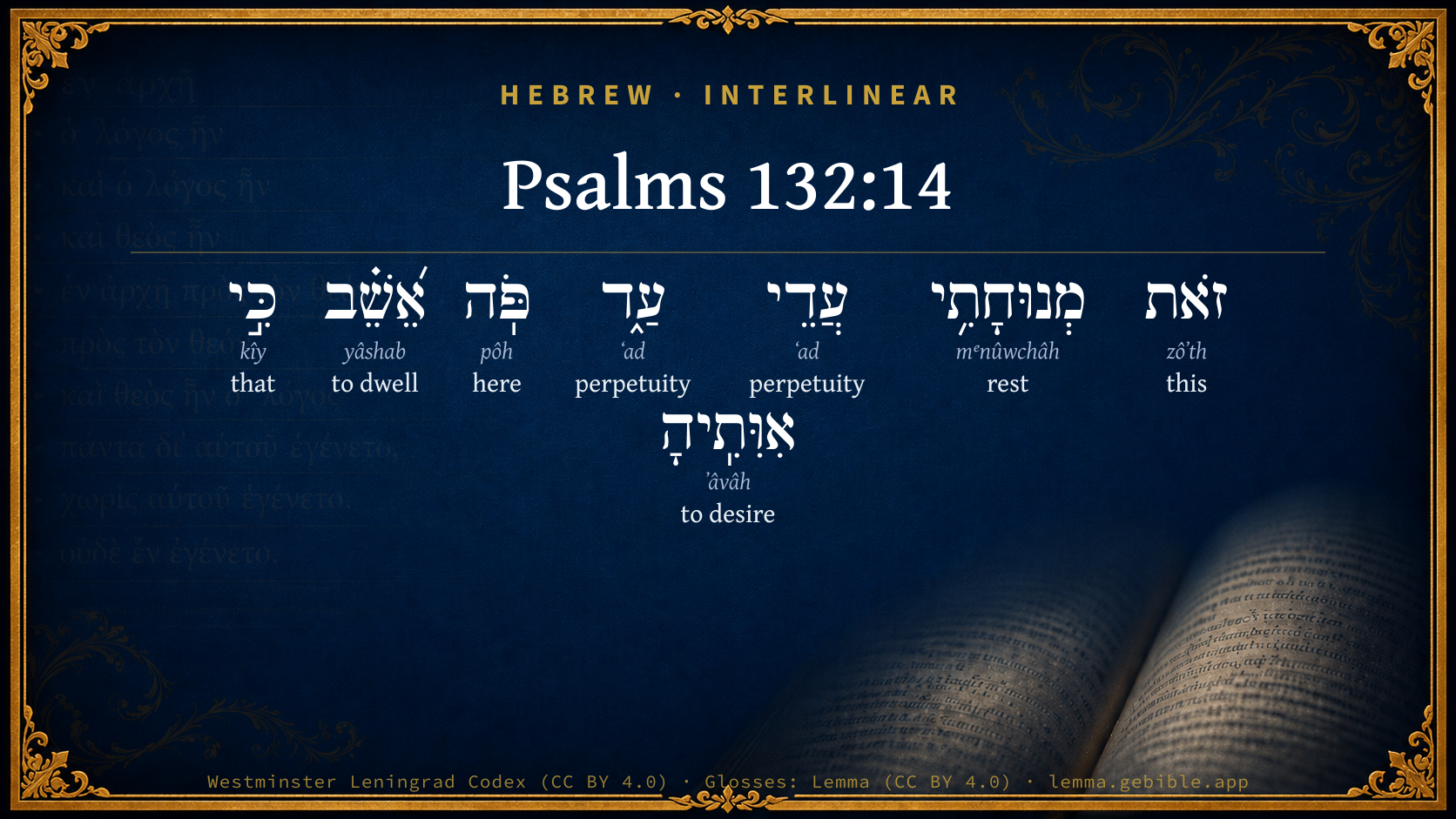
Psalms 132:14

Hebrew (Westminster Leningrad Codex) Psalms 132:14 appears in the Hebrew Old Testament. The text above is from the Westminster Leningrad Codex. Each word links to its Strong’s number, a concise gloss, and parsing drawn from the Open Scriptures Hebrew Bible morphology. Click any word for its full Brown-Driver-Briggs (BDB) entry.
Download image
Cite this verse

Psalms 132:14 (World English Bible). Public Domain. Lemma interlinear Bible study tool, https://lemma.gebible.app/v/psalms/132/14.

Show BibTeX & RIS
BibTeX
RIS
English Translation
"This is my resting place forever. Here I will live, for I have desired it.
World English Bible · Public Domain
Download a study sheet

One document with this verse’s original text, its word-by-word gloss line, the meaning frame, cross-references with their text, attributed commentary, and full source and license credits — printable, and it pastes into notes with its structure intact.

This verse Autodidact and up

Study sheet (.html) Plain text (.txt)

A passage Seminary Student

Up to 50 verses in one chapter. A passage sheet keeps up to 6 commentary sources and 12 cross-references per verse, in the order this page ranks them, and says so on the sheet whenever that leaves anything out. Ask for a single verse and you get the Autodidact verse sheet above.

Everything on this page stays free to read, with no account — the sheet is a download of what is already on screen, not access to it.

Want to remove ads? Support Godless Engineer
Compare translations 3

The same verse in 3 English versions, stacked beneath the original-language interlinear above. Click any original word for its lexicon entry.

Each is an independent rendering of the whole verse — the interlinear is not word-aligned to these translations.

Highlighted words mark where these versions differ — a whole-verse word diff, not a word-by-word alignment.

  • World English Bible Public Domain
    "This is my resting place forever. Here I will live, for I have desired it.
  • King James Version Public Domain
    This is my rest for ever: here will I dwell; for I have desired it.
  • unfoldingWord Literal Text CC BY-SA 4.0
    “This my resting place unto perpetuity; here I will dwell, for I have desired it.

unfoldingWord Literal Text — © unfoldingWord, licensed CC BY-SA 4.0. Word-aligned USFM3 via Door43 (git.door43.org/unfoldingWord/en_ult).

Versions to compare (up to 4)

3 of 4 selected

Show all 17 translations

Every available English version of this verse, each an independent rendering of the whole verse.

  • World English Bible Public Domain
    "This is my resting place forever. Here I will live, for I have desired it.
  • Berean Standard Bible Public Domain
    “This is My resting place forever and ever; here I will dwell, for I have desired this home.
  • Majority Standard Bible Public Domain
    “This is My resting place forever and ever; here I will dwell, for I have desired this home.
  • King James Version Public Domain
    This is my rest for ever: here will I dwell; for I have desired it.
  • American Standard Version (1901) Public Domain
    This is my resting-place for ever: Here will I dwell; for I have desired it.
  • Revised Version (1885) Public Domain
    This is my resting place for ever: here will I dwell; for I have desired it.
  • Geneva Bible (1599) Public Domain
    This is my rest for euer: here will I dwell, for I haue a delite therein.
  • Young's Literal Translation Public Domain
    This `is' My rest for ever and ever, Here do I sit, for I have desired it.
  • Literal Standard Version CC BY-SA 4.0
    “This [is] My rest forever and ever, || Here I sit, for I have desired it.
  • Unlocked Literal Bible CC BY-SA 4.0
    “This is my resting place forever. I will live here, for I desire her.
  • unfoldingWord Literal Text CC BY-SA 4.0
    “This my resting place unto perpetuity; here I will dwell, for I have desired it.
  • Darby Bible Public Domain
    This is my rest for ever; here will I dwell, for I have desired it.
  • World Messianic Bible Public Domain
    “This is my resting place forever. I will live here, for I have desired it.
  • Webster's Bible Public Domain
    This is my rest for ever: here will I dwell; for I have desired it.
  • Free Bible Version CC BY-SA 4.0
    “This will always be my home; this is where I want to live.
  • Bible in Basic English Public Domain
    This is my rest for ever: here will I ever be; for this is my desire.
  • JPS Tanakh (1917) Public Domain
    'This is My resting-place for ever; here will I dwell; for I have desired it.

Literal Standard Version (2020), Covenant Press — licensed CC BY-SA 4.0. Text via the HelloAO Bible API (eBible.org). Unlocked Literal Bible (unfoldingWord) — licensed CC BY-SA 4.0. Text via the HelloAO Bible API (eBible.org). unfoldingWord Literal Text — © unfoldingWord, licensed CC BY-SA 4.0. Word-aligned USFM3 via Door43 (git.door43.org/unfoldingWord/en_ult). Free Bible Version, Dr. Jonathan Gallagher — licensed CC BY-SA 4.0. Text via the HelloAO Bible API (eBible.org).

Word by word

More ways to search: Search by grammar → Find every occurrence → Compare this word →

Practice this passage: Drill this verse → Learn its vocabulary →

About this verse

These counts appear in no published source. They are computed here, from the morphology-tagged text and Lemma’s own curated glosses. What Lemma adds →

8
words
7
distinct lemmas
Wisdom
section

Notable vocabulary

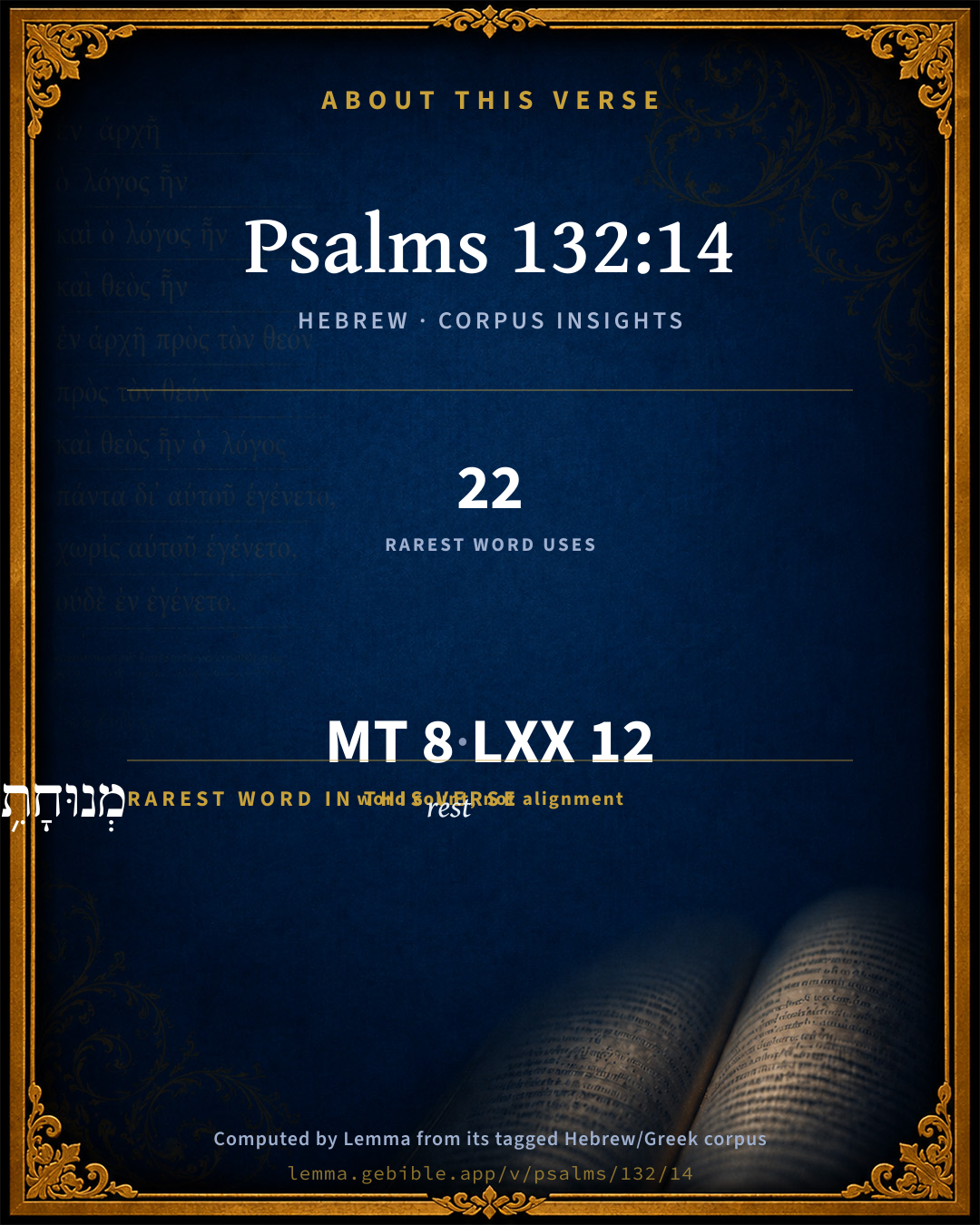
The rarest word here is מְנוּחָתִ֥י rest H4496 — appearing just 22 times in the whole Hebrew Bible.

Shared distinctive vocabulary

מְנוּחָתִ֥י rest H4496 occurs in 22 verses of the Hebrew Bible. Also found in:

Grammatical profile

  • 2 verbs
  • 2 nouns
  • 1 pronoun
  • 1 preposition
  • 1 conjunction
  • 1 adverb

Verb forms

  • אֵ֝שֵׁ֗ב Qal · Imperfect
  • אִוִּתִֽיהָ Piel · Perfect

Repetition

A word recurs within this verse — often emphatic in Hebrew:

  • עֲדֵי perpetuity H5703 ×2

Hebrew & Septuagint length

In English translation the verse runs 15 words from the Hebrew and 15 from the Septuagint (LXX English) — the same length.

A rough comparison of the two English renderings, which tokenize alike — not a word-level alignment.

Word counts can differ between the Hebrew and the Greek without any difference in meaning — e.g. the Hebrew direct-object marker אֵת has no separate Greek word, and Greek often adds the article ὁ.

In the original languages it is 8 Hebrew tokens and 12 Greek tokens — but the two are counted differently (Hebrew bundles its prefixes and suffixes into one token; the Greek is in lemma form), so that isn’t a like-for-like length.

Cross-references

19

Topical passages linked to Psalms 132:14 in the Treasury of Scripture Knowledge — connected by theme and wording, ordered by reader-vote popularity; previews shown in the World English Bible.

  • Psalms 132:8 Arise, Yahweh, into your resting place; You, and the ark of your strength.
  • 1 Kings 8:13 I have surely built you a house of habitation, a place for you to dwell in forever.
  • Psalms 76:2 His tent is also in Salem; His dwelling place in Zion.
  • Psalms 87:2 Yahweh loves the gates of Zion more than all the dwellings of Jacob.
  • Psalms 135:21 Blessed be Yahweh from Zion, Who dwells at Jerusalem. Praise Yah!
  • Isaiah 12:6 Cry aloud and shout, you inhabitant of Zion; for great in the midst of you is the Holy One of Israel!"
  • Psalms 68:18 You have ascended on high. You have led away captives. You have received gifts among men, Yes, among the rebellious also, that Yah God might dwell there.
  • Isaiah 8:18 Behold, I and the children whom Yahweh has given me are for signs and for wonders in Israel from Yahweh of Hosts, who dwells in Mount Zion.
  • Zephaniah 3:17 Yahweh, your God, is in the midst of you, a mighty one who will save. He will rejoice over you with joy. He will rest in his love. He will rejoice over you with singing.
  • Isaiah 11:10 It shall happen in that day, that the root of Jesse, who stands for an ensign of the peoples, to him shall the nations seek; and his resting-place shall be glorious.
  • Isaiah 57:15 For thus says the high and lofty One who inhabits eternity, whose name is Holy: I dwell in the high and holy place, with him also who is of a contrite and humble spirit, to revive the spirit of the humble, and to revive the heart of the contrite.
  • Isaiah 66:1 Thus says Yahweh, heaven is my throne, and the earth is my footstool: what manner of house will you build to me? and what place shall be my rest?
  • Matthew 23:21 He who swears by the temple, swears by it, and by him who was living in it.
  • Ephesians 2:22 in whom you also are built together for a habitation of God in the Spirit.
  • 1 Kings 8:27 But will God in very deed dwell on the earth? behold, heaven and the heaven of heavens can't contain you; how much less this house that I have built!
  • Psalms 68:16 Why do you look in envy, you rugged mountains, At the mountain where God chooses to reign? Yes, Yahweh will dwell there forever.
  • Joel 3:21 I will cleanse their blood, That I have not cleansed: For Yahweh dwells in Zion."
  • Hebrews 12:22 But you have come to Mount Zion, and to the city of the living God, the heavenly Jerusalem, and to innumerable hosts of angels,
  • Revelation 21:23 The city has no need for the sun, neither of the moon, to shine, for the very glory of God illuminated it, and its lamp is the Lamb.

Cross-references courtesy of OpenBible.info (CC BY 4.0).

Hebrew and Greek witnesses Masoretic Hebrew ↔ Greek Septuagint

The same verse in the two great witnesses to the Old Testament, shown verse-for-verse.

You’re reading Greek Psalm 131 (Hebrew Psalm 132). The Septuagint counts the superscription, so verse numbers can differ from the Hebrew — chapter-level alignment, not verse-by-verse. Numbering follows Rahlfs.

These are two independent witnesses, not word-aligned to each other, and the Septuagint is shown in lemma (dictionary) form.

Hebrew Psalms 132:14 Masoretic · Westminster Leningrad Codex

זֹאת מְנוּחָתִ֥י עֲדֵי עַ֑ד פֹּֽה אֵ֝שֵׁ֗ב כִּ֣י אִוִּתִֽיהָ

"This is my resting place forever. Here I will live, for I have desired it.

World English Bible · Public Domain

Greek LXX Greek Psalm 131:14 Septuagint · lemma form

οὗτος ὁ κατάπαυσις ἐγώ εἰς αἰών αἰών ὧδε καταοἰκέω ὅτι αἱρετίζω αὐτός

This is my rest for ever: here will I dwell; for I have chosen it.

LXX2012 (modern English Septuagint) · Public Domain

On this verse, Keil & Delitzsch discusses the Septuagint’s reading. Read the note in Commentary ↓

Hebrew: Westminster Leningrad Codex (CC BY 4.0). Greek: Septuagint (public domain); English from LXX2012 (modern English Septuagint) (Public Domain). How the Septuagint differs from the Hebrew →

Commentary

Notes on Psalms 132:14 from classic Christian and Jewish commentators (each source and its license shown beneath its notes). The classic Christian expositions comment on the surrounding passage and are grouped to its opening verse, so a note may address several verses; the Jewish commentaries on the Tanakh (Rashi and others) are per-verse, so they appear only where the commentator wrote on this verse.

Lemma curates 59 commentaries, every one of them public domain or Creative Commons licensed, each selected and text-cleaned for this edition rather than reprinted as found. About our sources →

Trapp's Complete Commentary

John Trapp

Psa 132:14 This [is] my rest for ever: here will I dwell; for I have desired it.

Ver. 14. This is my rest for ever] It was so because God was pleased to make it so; he rested in his love; he would seek no farther, Zep 3:17.

For I have desired it] This alone made the difference, as it also did between Aaron’s rod and the rest that were laid with it.

John Trapp, A Commentary or Exposition upon All the Books of the Old and New Testament (1647–1656) — public domain. Text from a community e-Sword module.

J. A. Alexander on Psalms

Joseph Addison Alexander

14. (Psa 132:14) This is my resting-place to perpetuity; here will I dwell, because I have desired it. These are the words of God, though not expressly so described. See above, on Psa 87:4; Psa 89:3-4. The word translated dwell means originally to sit, and especially to sit enthroned, so that this idea would be necessarily suggested with the other to a Hebrew reader. See above, on Psa 29:10; Psa 102:12; Psa 123:1.

Joseph Addison Alexander, The Psalms Translated and Explained (1850) — public domain. Text from a community e-Sword module.

Geneva Bible (1599)

Geneva Bible translators

Meaning, for his own sake, and not for the plentifulness of the place: for he promiseth to bless it, declaring before that it was barren.

Geneva Bible (1599) marginal notes — public domain. Text via Bolls.life.

Adam Clarke's Commentary

Verse 14. This is my rest for ever] Here the Christian Church is most indubitably meant. This is God's place for ever. After this there never will be another dispensation; Christianity closes and completes all communications from heaven to earth. God has nothing greater to give to mankind on this side heaven; nor does man need any thing better; nor is his nature capable of any thing more excellent.

Adam Clarke's Commentary on the Bible (1810–1826) — public domain. Text from a community e-Sword/MySword module.

John Calvin's Commentaries

14. This is my rest for ever. The same truth is here put into the mouth of God, to give it additional weight; and it is declared not to have been in vain that the Temple had been erected, since God would show effectually and by practical testimonies the delight which he had in the worship of his own appointment. God’s resting, or talking up his habitation, are expressions which denote his being present with men in the manifestation of his power. Thus he dwelt in Zion, in the sense that there his people worshipped him according to the prescription of his law, and found besides the benefit of the service in his favorable answer to their requests. It was eventually seen, in a very striking manner, that this was the promise of an infallible God, whet, after the Temple had been overthrown, the altar cast down, and the whole frame of legal service interrupted, the glory of the Lord afterwards returned to it once more, and remained there up to the advent of Christ. We all know in what a wicked and shameful manner the Jews abused the divine promise which is here made, under the impression that it necessarily laid God under an obligation to favor them, taking occasion from if, in the pride of their hearts, to despise, and even cruelly persecute the Prophets. Luther on this account calls it “the bloody promise;” for, like all hypocrites who make God’s holy name a covert for iniquity, they did not hesitate, when charged with the, worst, crimes, to insist that it was beyond the power of the Prophets to take from them privileges which God had bestowed. With them to assert that the Temple could be stripped of its glory, was equivalent to charging God with falsehood, and impeaching his faithfulness. Under the influence of this spirit of vain confidence they proceeded such inconceivable lengths in shedding innocent blood. Were the Devil of Rome armed with pretensions as splendid, what bounds would be set to its audacity? As it is, we see how fiercely, and with what bloody pride it arrogates the name of the Church, while outraging all religion, in open contempt of God and flagrant violation of humanity. But what of that? the hierarchy would otherwise fall, and this must stand, if Christ would not desert his spouse the Church! The refutation of such a plea is not far to seek. The Church is limited to no one place: now that the glory of the Lord shines through all the earth, his rest is where Christ and his members are. It is necessary that we rightly understand what the Psalmist says of the everlasting continuance of the Temple. The advent of Christ was “the time of reformation,” and the figures of the former Testament, instead of being then proved or rendered vain, were substantiated, and received their fulfillment in him. If it be still objected that mount Zion is here spoken of as the everlasting residence of God, it is sufficient to answer that the whole world became an enlarged mount Zion upon the advent of Christ.

John Calvin's Commentaries (1540-1563) — public domain. Text from the Calvin Translation Society English edition (1840s-50s) via the Christian Classics Ethereal Library (ccel.org). Calvin's coverage is partial (roughly two-thirds of the Bible); uncommented books and verses are honest gaps, never fabricated. The 19th-century editor's footnotes and remarks are omitted so the notes are faithfully Calvin's own voice.

The Cambridge Bible for Schools and Colleges

gen. ed. J. J. S. Perowne

14. Jehovah speaks. The expression of His Will in the facts of history is translated into the form of an utterance. Observe the stress laid on the Divine choice: in making Jerusalem the religious centre of the nation (and ultimately of the world) David was fulfilling Jehovah’s purpose. This verse corresponds to the prayer of Psa_132:8, as Psa_132:16 to that of Psa_132:9.

my rest] My resting-place, as in Psa_132:8. Cp. 1Ch_28:2; Isa_11:10; Isa_66:1.

The Cambridge Bible for Schools and Colleges (gen. ed. J. J. S. Perowne; Cambridge University Press, 1878–1918) — public domain. Text from a community e-Sword module.

John Gill's Exposition

I will also clothe her priests with salvation,.... With the garments of salvation, as the Targum; in answer to the petition, Psa 132:9; but more is promised than prayed for, "salvation" including "righteousness" and all other blessings; and may be interpreted, as there, either of the ministers of the Gospel clothed with the doctrine of salvation by Christ, coming forth full fraught with it, openly publishing and proclaiming it; salvation being made public and manifest by them as a garment, as Aben Ezra observes: moreover Gospel ministers are instruments of saving others; the Gospel preached by them being the power of God unto salvation, as well as they themselves are saved in the same way, Ti1 4:16; besides, they are kept by the power of God, and in the hands of Christ, who protects them, and as it were covers them with the garment of salvation, while they are publishing it to the world, to whose reproaches and insults they are exposed: or else this may be interpreted of the people of God in common, who are all kings and priests to God, and are all clothed with the garments of salvation, Isa 61:10. Salvation by Christ is brought near to them, is applied to them, and put upon them as a garment; it is from Christ, and without them, though upon them; it is their clothing and their ornament, as well as their security from sin, law, death, and hell; see Psa 149:4;

and her saints shall shout aloud for joy; not only "shout", as is entreated, Psa 132:9; but "shout aloud"; it shall be a jubilee time with them on account of the Gospel of salvation, the joyful sound sounded in their ears by the ministers of it clothed with it; and on account of the salvation itself, so great, so suitable, so free, so complete and full, and in which the glory of God is so much displayed; and on account of the application of it to themselves, being clothed with it and possessed of the joys of it. These the Jewish writers generally understand of the Levites.

John Gill's Exposition of the Whole Bible (1746–1763) — public domain (CC PDM 1.0). Text via the HelloAO Bible API.

Albert Barnes' Notes on the Bible

This is my rest for ever - My home; my permanent abode. I will no more remove from place to place - as when the ark was carried in the wilderness, and as it has been since; but Zion shall now be the fixed seat of religion. See the notes at Psa 68:16.

Here will I dwell ... - Permanently; constantly.

Albert Barnes' Notes on the Bible (1834–1885) — public domain. Text from a community e-Sword/MySword module.

Matthew Poole's English Annotations

I will no more wander to several places as I have done, but here I have fixed my abode.

Matthew Poole's English Annotations on the Holy Bible (1683–1685) — public domain. Text from a community e-Sword/MySword module.

The Treasury of David

Charles H. Spurgeon

Ver. 14. This is my rest for ever. Oh, glorious words! It is God himself who here speaks. Think of rest for God! A Sabbath for the Eternal and a place of abiding for the Infinite. He calls Zion my rest. Here his love remains and displays itself with delight. "He shall rest in his love." And this forever. He will not seek another place of repose, nor grow weary of his saints. In Christ the heart of Deity is filled with content, and for his sake he is satisfied with his people, and will be so world without end. These august words declare a distinctive choicethis and no other; a certain choicethis which is well known to me; a present choice this which is here at this moment. God has made his election of old, he has not changed it, and he never will repent of it: his church was his rest and is his rest still. As he will not turn from his oath, so he will never turn from his choice. Oh, that we may enter into his rest, may be part and parcel of his church, and yield by our loving faith a delight to the mind of him who taketh pleasure in them that fear him, in them that hope in his mercy. Here will I dwell; for I have desired it. Again are we filled with wonder that he who fills all things should dwell in Zionshould dwell in his church. God does not unwillingly visit his chosen; he desires to dwell with them; he desires them. He is already in Zion, for he says here, as one upon the spot. Not only will he occasionally come to his church, but he will dwell in it, as his fixed abode. He cared not for the magnificence of Solomon's temple, but he determined that at the mercy seat he would be found by suppliants, and that thence he would shine forth in brightness of grace among the favoured nation. All this, however, was but a type of the spiritual house, of which Jesus is foundation and cornerstone, upon which all the living stones are builded together for an habitation of God through the Spirit. Oh, the sweetness of the thought that God desires to dwell in his people and rest among them! Surely if it be his desire he will cause it to be so. If the desire of the righteous shall be granted much more shall the desire of the righteous God be accomplished. This is the joy of our souls, for surely we shall rest in God, and certainly our desire is to dwell in him. This also is the end of our fears for the church of God; for if the Lord dwell in her, she shall not be moved; if the Lord desire her, the devil cannot destroy her.

Ver. 14. This is my rest for ever. Of the Christian church we may affirm with undoubted certainty, that it is God's rest for ever: after this dispensation of his will, there will never succeed another; Christianity closes and completes the Divine communication from God to man; nothing greater, nothing better can or will be imparted to him on this side eternity; and even in heaven itself we shall, through an everlasting duration, be employed in contemplating and adoring the riches of that grace, the brightest glories of which have been realized in the consummations of Calvary, the ascension of the Messiah, the breaking down of all national peculiarity, and the gift and mission of the Divine Spirit. Let the argument of the apostle to the Hebrews be fully weighed, and the conclusion of every mind must be, that God has "removed those things that are shaken, as of things that are made, that those things which cannot be shaken may remain:" Heb 12:27. John Morison, in "An Exposition of the Book of Psalms", 1829.

Ver. 14. This is my rest for ever. The heart of the saints is the dwelling place of God. He rests in those who rest in him. He rests when he causes us to rest. Pasquier Quesnel.

Ver. 14. Dwell. The word translated "dwell" means originally to sit, and especially to sit enthroned, so that this idea would be necessarily suggested with the other to a Hebrew reader. Joseph Addison Alexander.

Ver. 14-18. Now that he might apparently see how near the Lord is to all them that call upon him in faithfulness and truth, he waiteth not long for an answer, but carries it away with him before he departs. For to David's petition, "Return, O LORD, unto thy resting place, thou, and the ark of thy strength"; God's answer is this, "This shall be my resting place, here will I dwell, for I have a delight therein. I will bless her victuals with increase, and will satisfy her poor with bread." To David's petition, "Let thy priests be clothed with righteousness, and let thy saints sing with joyfulness", God's answer is this: "I will clothe her priests with salvation: and her saints shall rejoice and sing." Lastly, to David's petition, "For thy servant David's sake turn not away the face of thine anointed", God's answer is this: "There will I make the horn of David to flourish: I have ordained a light for mine anointed. As for his enemies, I will clothe them with shame; but upon himself shall his crown flourish." As if he should have said, Turn away the face of mine anointed Nay, that will I never do; I will indeed turn away the face of the enemies of mine anointed; their face shall be covered with confusion, and clothed with shame. But contrariwise, I have ordained a light for mine anointed. He shall even have a light in his face and a crown upon his head. "As for his enemies, I will clothe them with shame; but upon himself shall his crown flourish." Thomas Playfere, 1633.

Ver. 14.

1. God finding rest in his church.

a) The three persons honoured.

b) The divine nature exercised.

c) Eternal purposes fulfilled.

d) Almighty energies rewarded.

e) Tremendous sacrifices remembered.

f) Glorious attributes extolled.

g) Dearest relationships indulged.

2. This rest enduring for ever.

a) There will always be a church.

b) That church will always be such as God can rest in.

c) That church will therefore be secure on earth.

d) That church will be glorified eternally in heaven.

Charles H. Spurgeon's The Treasury of David (1869–1885) — public domain. Psalms only. Text from a community e-Sword/MySword module.

The Pulpit Commentary

This is my rest forever: here will I dwell; for I have desired it. (comp. Psa_68:16)

Limited permanency.

For the changed locations of the ark, see Bethel, (Jud_1:20:26, 27) Mizpeh, Shiloh, Kirjath-jearim, house of Obed-Edom, Jerusalem. We are often disturbed by the fact that God"s promises have a sound of permanency, but that permanency has not been realized, at least in the way in which the realization was expected. There are two things which need to be taken into consideration.

1. The Bible is largely poetry, and the poetry is of the Eastern type, in which there is always an element of intensity and exaggeration. In dealing with all poetry we have to use an answering imagination to that of the writer of it, and so get at what he suggests rather than what he says.

2. It is to be borne in mind that, strictly speaking, the idea of absolute permanency can never be applied to anything created, for every created thing must be dependent on the good will of its Creator. To these considerations a third may be added. The introduction of sin, as human self-will, into the world, has introduced frailty and brevity into everything related to the sinner. The promise of permanence for David"s royal house, or for the temple which his son built, was certainly not formally realized. David"s dynasty ceased; the Babylonians destroyed the temple. And it was not that the promises were conditional; it was that they were never intended to be permanent. It would not have been the best blessing for the world for David"s dynasty or the Solomonic temple to have continued forever, in a literal sense.

I A THING IS REALLY PERMANENT THAT CONTINUES SO LONG AS IT IS REALLY NEEDED. A thousand things are better passed away when they are done with. Mere length of endurance in time is no necessary blessing to anybody. True permanency is fitting to use. "A man is immortal until his work is done." Then it is best for him to be mortal.

II A THING IS REALLY PERMANENT THAT PASSES INTO WHAT IT PREPARED FOR. For everything is a matrix, forth from which something comes which is to live and be a matrix in its turn. In one sense everything is destroyed; in another sense nothing is destroyed. We live forever in the great succession of things. Our living force goes into the stream of time, flows on to the ocean of eternity, and can never be lost. R.T.

The Pulpit Commentary (1880–1919), ed. H.D.M. Spence-Jones & Joseph S. Exell — public domain. Text from a community e-Sword module.

Keil & Delitzsch

C. F. Keil & F. Delitzsch

Shiloh has been rejected (Psa 78:60), for a time only was the sacred Ark in Bethel (Jdg 20:27) and Mizpah (Jdg 21:5), only somewhat over twenty years was it sheltered by the house of Abinadab in Kirjath-Jearim (Sa1 7:2), only three months by the house of Obed-Edom in Perez-uzzah (Sa2 6:11) - but Zion is Jahve's abiding dwelling-place, His own proper settlement, מנוּחה (as in Isa 11:10; Isa 66:1, and besides Ch1 28:2). In Zion, His chosen and beloved dwelling-place, Jahve blesses everything that belongs to her temporal need (צידהּ for זידתהּ, vid., on Psa 27:5, note); so that her poor do not suffer want, for divine love loves the poor most especially. His second blessing refers to the priests, for by means of these He will keep up His intercourse with His people. He makes the priesthood of Zion a real institution of salvation: He clothes her priests with salvation, so that they do not merely bring it about instrumentally, but personally possess it, and their whole outward appearance is one which proclaims salvation. And to all her saints He gives cause and matter for high and lasting joy, by making Himself known also to the church, in which He has taken up His abode, in deeds of mercy (loving-kindness or grace). There (שׁם, Psa 133:3) in Zion is indeed the kingship of promise, which cannot fail of fulfilment. He will cause a horn to shoot forth, He will prepare a lamp, for the house of David, which David here represents as being its ancestor and the anointed one of God reigning at that time; and all who hostilely rise up against David in his seed, He will cover with shame as with a garment (Job 8:22), and the crown consecrated by promise, which the seed of David wears, shall blossom like an unfading wreath. The horn is an emblem of defensive might and victorious dominion, and the lamp (נר, Sa2 21:17, cf. ניר, Ch2 21:7, lxx λύχνον) an emblem of brilliant dignity and joyfulness. In view of Eze 29:21, of the predictions concerning the Branch (zemach) in Isa 4:2; Jer 23:5; Jer 33:15; Zac 3:8; Zac 6:12 (cf. Heb 7:14), and of the fifteenth Beracha of the Shemone-Esre (the daily Jewish prayer consisting of eighteen benedictions): "make the branch (zemach) of David Thy servant to shoot forth speedily, and let his horn rise high by virtue of Thy salvation," - it is hardly to be doubted that the poet attached a Messianic meaning to this promise. With reference to our Psalm, Zacharias, the father of John the Baptist, changes that supplicatory beracha of his nation (Luk 1:68-70) into a praiseful one, joyfully anticipating the fulfilment that is at hand in Jesus.

Keil & Delitzsch — Biblical Commentary on the Old Testament (1861–1891) — public domain (CC PDM 1.0). Text via the HelloAO Bible API. (Old Testament only.)

Lesson kit

Teaching starters — assembled from the data on this page, not authored interpretation. Every prompt links to the verse data it draws on. Edit before teaching.

Psalms, in the Wisdom, opens this verse with 8 words (7 distinct Hebrew lemmas). Its most distinctive word is mᵉnûwchâh (“rest”). A historical commentator’s framing appears above. Read the whole chapter for the surrounding context.

Discussion questions

  1. The word mᵉnûwchâh carries the sense “rest.” How does it shape the verse?
  2. How does Genesis 49:15, which shares the word «rest», read alongside this verse?
  3. What does the repetition of “perpetuity” (2× in this one verse) do in this verse?
  4. These translations render this verse differently. What is at stake in choosing one wording over another?
  5. «אֵ֝שֵׁ֗ב» is a Qal Imperfect verb. How does that grammatical form shape the action described?
  6. Compare how Trapp's Complete Commentary and J. A. Alexander on Psalms read this verse. Where do they agree or differ?

Things to notice

Reading settings

Reading text

Shown beneath each verse's original-language words.

Old Testament
Old Testament edition

Read the OT as the Masoretic Hebrew (MT) or the Greek Septuagint (LXX).

English shown for the Greek Septuagint (in the Hebrew ↔ Greek comparison).

Comparing translations? Open the Compare panel on any verse page to stack up to four side by side.