Exodus 32:25

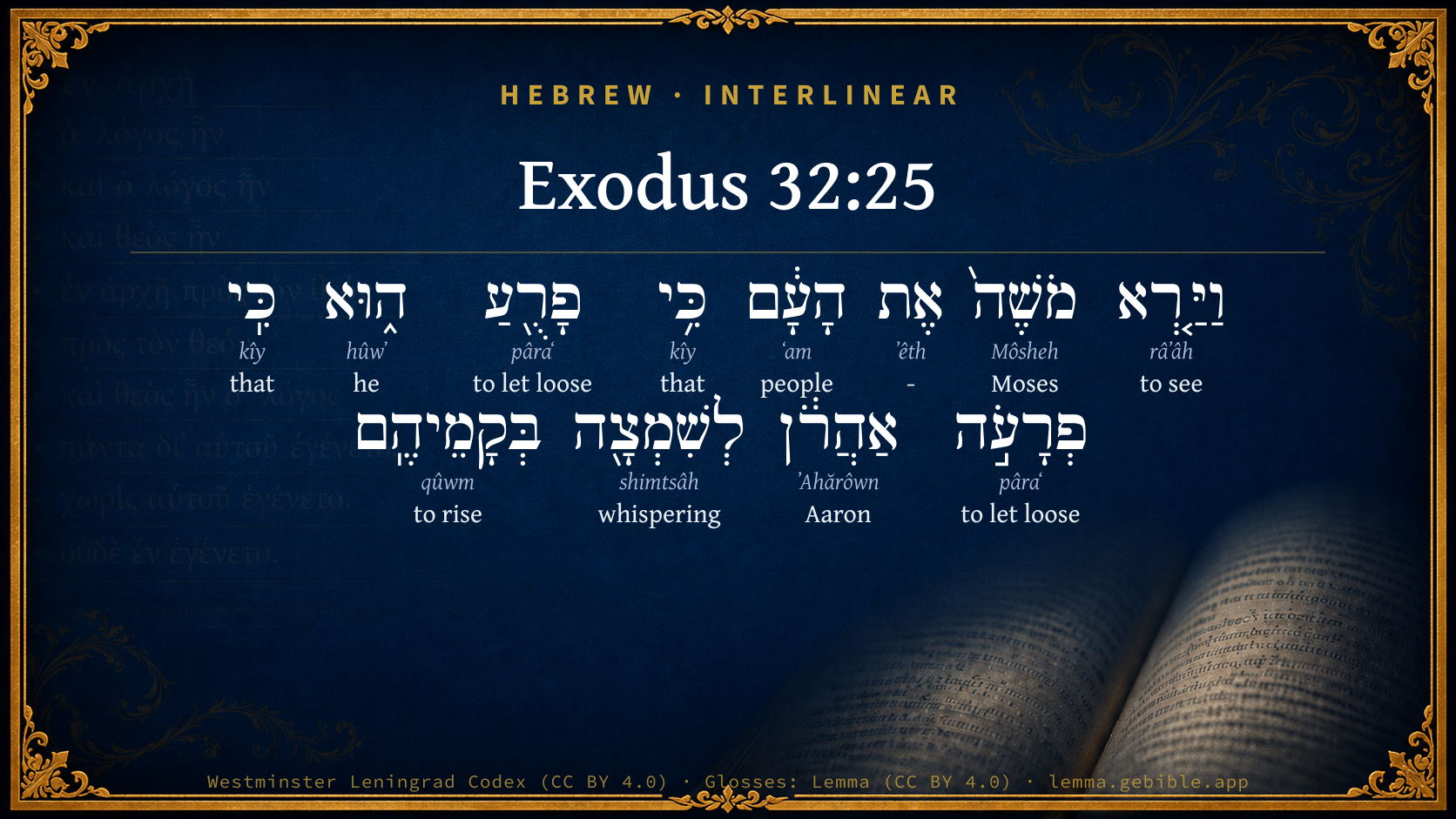
Hebrew (Westminster Leningrad Codex) Exodus 32:25 appears in the Hebrew Old Testament. The text above is from the Westminster Leningrad Codex. Each word links to its Strong’s number, a concise gloss, and parsing drawn from the Open Scriptures Hebrew Bible morphology. Click any word for its full Brown-Driver-Briggs (BDB) entry.
Download image
Cite this verse

Exodus 32:25 (World English Bible). Public Domain. Lemma interlinear Bible study tool, https://lemma.gebible.app/v/exodus/32/25.

Show BibTeX & RIS
BibTeX
RIS
English Translation
When Moses saw that the people had broken loose, (for Aaron had let them loose for a derision among their enemies),
World English Bible · Public Domain
Highlights
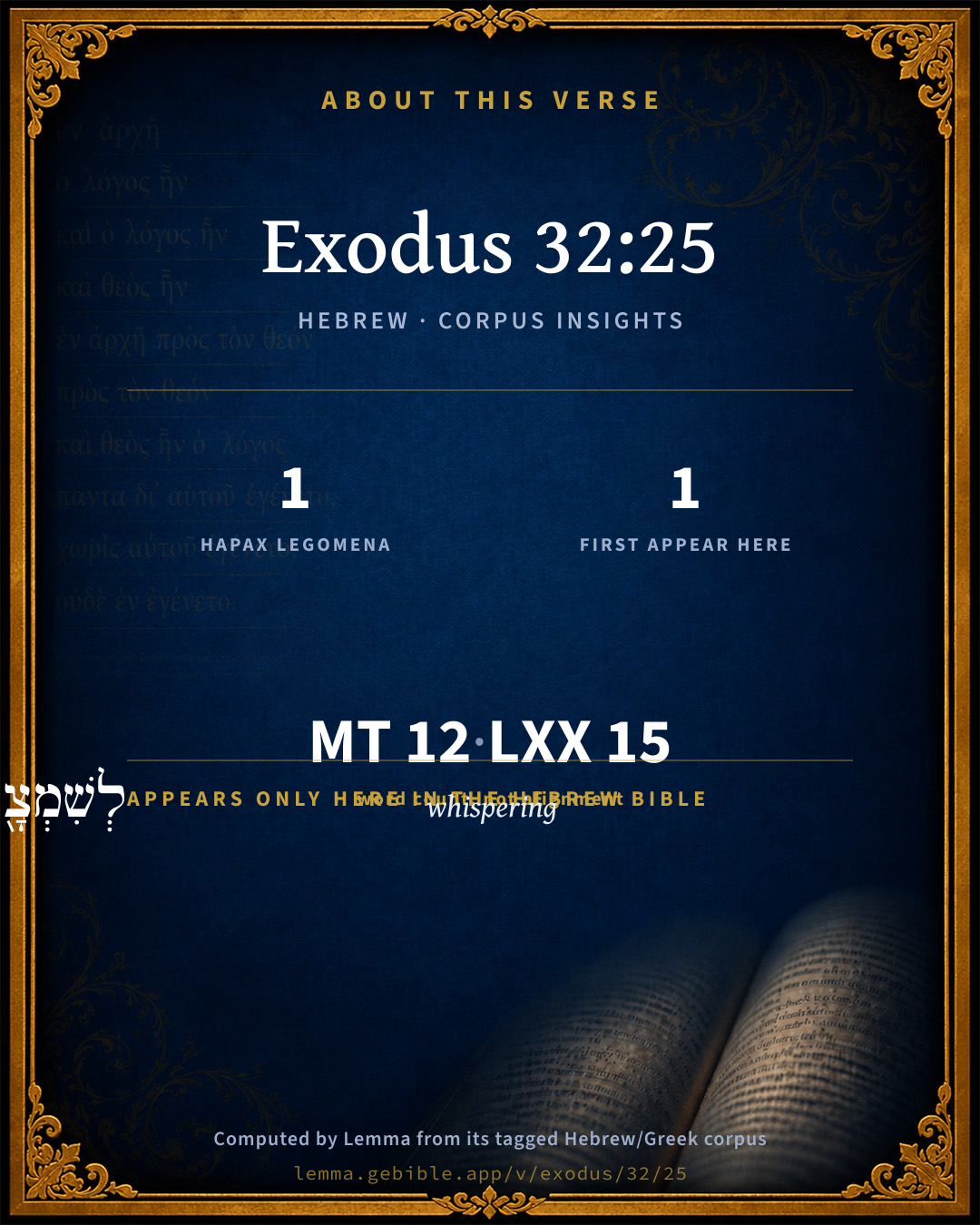
  • 1 hapax legomenon — only here in the Hebrew Bible
  • 1 first appearance in the Hebrew Bible
Full analysis ↓
Download a study sheet

One document with this verse’s original text, its word-by-word gloss line, the meaning frame, cross-references with their text, attributed commentary, and full source and license credits — printable, and it pastes into notes with its structure intact.

This verse Autodidact and up

Study sheet (.html) Plain text (.txt)

A passage Seminary Student

Up to 50 verses in one chapter. A passage sheet keeps up to 6 commentary sources and 12 cross-references per verse, in the order this page ranks them, and says so on the sheet whenever that leaves anything out. Ask for a single verse and you get the Autodidact verse sheet above.

Everything on this page stays free to read, with no account — the sheet is a download of what is already on screen, not access to it.

Want to remove ads? Support Godless Engineer
Compare translations 3

The same verse in 3 English versions, stacked beneath the original-language interlinear above. Click any original word for its lexicon entry.

Each is an independent rendering of the whole verse — the interlinear is not word-aligned to these translations.

Highlighted words mark where these versions differ — a whole-verse word diff, not a word-by-word alignment.

  • World English Bible Public Domain
    When Moses saw that the people had broken loose, (for Aaron had let them loose for a derision among their enemies),
  • King James Version Public Domain
    And when Moses saw that the people were naked; (for Aaron had made them naked unto their shame among their enemies:)
  • unfoldingWord Literal Text CC BY-SA 4.0
    And Moses saw the people, that it was let loose, for Aaron had let it loose, to mockery by the risers-up against them.

unfoldingWord Literal Text — © unfoldingWord, licensed CC BY-SA 4.0. Word-aligned USFM3 via Door43 (git.door43.org/unfoldingWord/en_ult).

Versions to compare (up to 4)

3 of 4 selected

Show all 18 translations

Every available English version of this verse, each an independent rendering of the whole verse.

  • World English Bible Public Domain
    When Moses saw that the people had broken loose, (for Aaron had let them loose for a derision among their enemies),
  • Berean Standard Bible Public Domain
    Moses saw that the people were out of control, for Aaron had let them run wild and become a laughingstock to their enemies.
  • Majority Standard Bible Public Domain
    Moses saw that the people were out of control, for Aaron had let them run wild and become a laughingstock to their enemies.
  • King James Version Public Domain
    And when Moses saw that the people were naked; (for Aaron had made them naked unto their shame among their enemies:)
  • American Standard Version (1901) Public Domain
    And when Moses saw that the people were broken loose, (for Aaron had let them loose for a derision among their enemies,)
  • Revised Version (1885) Public Domain
    And when Moses saw that the people were broken loose; for Aaron had let them loose for a derision among their enemies:
  • Geneva Bible (1599) Public Domain
    Moses therefore sawe that the people were naked (for Aaron had made them naked vnto their shame among their enemies)
  • Douay-Rheims (1899) Public Domain
    And when Moses saw that the people were naked, (for Aaron had stripped them by occasion of the shame of the filth, and had set them naked among their enemies,)
  • Young's Literal Translation Public Domain
    And Moses seeth the people that it `is' unbridled, for Aaron hath made it unbridled for contempt among its withstanders,
  • Literal Standard Version CC BY-SA 4.0
    And Moses sees the people, that it [is] unbridled, for Aaron has made it unbridled for contempt among its withstanders,
  • Unlocked Literal Bible CC BY-SA 4.0
    Moses saw that the people were running wild (for Aaron had let them get out of control, causing their enemies to mock them).
  • unfoldingWord Literal Text CC BY-SA 4.0
    And Moses saw the people, that it was let loose, for Aaron had let it loose, to mockery by the risers-up against them.
  • Darby Bible Public Domain
    And Moses saw the people how they were stripped; for Aaron had stripped them to [their] shame before their adversaries.
  • World Messianic Bible Public Domain
    When Moses saw that the people were out of control, (for Aaron had let them lose control, causing derision among their enemies),
  • Webster's Bible Public Domain
    And when Moses saw that the people were naked (for Aaron had made them naked to their shame, among their enemies:)
  • Free Bible Version CC BY-SA 4.0
    Moses saw the people going completely wild because Aaron had let them, and that this had brought ridicule on them from their enemies.
  • Bible in Basic English Public Domain
    And Moses saw that the people were out of control, for Aaron had let them loose to their shame before their haters:
  • JPS Tanakh (1917) Public Domain
    And when Moses saw that the people were broken loose — for Aaron had let them loose for a derision among their enemies —

Literal Standard Version (2020), Covenant Press — licensed CC BY-SA 4.0. Text via the HelloAO Bible API (eBible.org). Unlocked Literal Bible (unfoldingWord) — licensed CC BY-SA 4.0. Text via the HelloAO Bible API (eBible.org). unfoldingWord Literal Text — © unfoldingWord, licensed CC BY-SA 4.0. Word-aligned USFM3 via Door43 (git.door43.org/unfoldingWord/en_ult). Free Bible Version, Dr. Jonathan Gallagher — licensed CC BY-SA 4.0. Text via the HelloAO Bible API (eBible.org).

Word by word

More ways to search: Search by grammar → Find every occurrence → Compare this word →

Practice this passage: Drill this verse → Learn its vocabulary →

לְשִׁמְצָ֖ה
shimtsâh
H8103
“to/for · whispering”
Preposition + Noun, Common, Feminine, Singular, Absolute
Part of Speech
Preposition + Noun
Type
Common
Gender
Feminine
Number
Singular
State
Absolute
Full BDB Definition

Origin: from H8102

TWOT: 2413b

whisper, derision, whispering
  1. וַיַּ֤רְא râʼâh H7200 “and · to see” Conjunction + Verb, Qal, Sequential Imperfect, 3rd Person, Masculine, Singular
  2. מֹשֶׁה֙ Môsheh H4872 “Moses” Noun, Proper
  3. אֶת ʼêth H853 “-” Particle, Direct Object
  4. הָעָ֔ם ʻam H5971 “the · people” Particle, Definite Article + Noun, Common, Masculine, Singular, Absolute
  5. כִּ֥י kîy H3588 “that” Conjunction
  6. פָרֻ֖עַ pâraʻ H6544 “let loose” Verb, Qal, Participle Passive, Masculine, Singular, Absolute
  7. ה֑וּא hûwʼ H1931 “he” Pronoun, Personal, 3rd Person, Masculine, Singular
  8. כִּֽי kîy H3588 “that” Conjunction
  9. פְרָעֹ֣ה pâraʻ H6544 “to let loose · him” Verb, Qal, Perfect, 3rd Person, Masculine, Singular + Suffix, Personal, 3rd Person, Masculine, Singular
  10. אַהֲרֹ֔ן ʼAhărôwn H175 “Aaron” Noun, Proper
  11. בְּקָמֵיהֶֽם qûwm H6965 “in/at · rising · them” Preposition + Verb, Qal, Participle Active, Masculine, Plural, Construct + Suffix, Personal, 3rd Person, Masculine, Plural

About this verse

These counts appear in no published source. They are computed here, from the morphology-tagged text and Lemma’s own curated glosses. What Lemma adds →

12
words
10
distinct lemmas
Pentateuch
section

Notable vocabulary

1 hapax legomenon — a word that appears only here in the entire Hebrew Bible:

  • לְשִׁמְצָ֖ה whispering H8103

First appearance in Scripture

This word makes its first canonical appearance in the Hebrew Bible here:

  • לְשִׁמְצָ֖ה whispering H8103

Shared distinctive vocabulary

פָרֻ֖עַ to let loose H6544 occurs in 15 verses of the Hebrew Bible. Also found in:

Grammatical profile

  • 4 verbs
  • 4 nouns
  • 1 pronoun
  • 2 conjunctions
  • 1 particle

Verb forms

  • וַיַּ֤רְא Qal · Sequential Imperfect
  • פָרֻ֖עַ Qal · Participle Passive
  • פְרָעֹ֣ה Qal · Perfect
  • בְּקָמֵיהֶֽם Qal · Participle Active

Repetition

Words recur within this verse — often emphatic in Hebrew:

  • פָרֻ֖עַ to let loose H6544 ×2
  • כִּ֥י that H3588 ×2

Hebrew & Septuagint length

In English translation the verse runs 21 words from the Hebrew and 24 from the Septuagint (LXX English) — closely comparable.

A rough comparison of the two English renderings, which tokenize alike — not a word-level alignment.

Word counts can differ between the Hebrew and the Greek without any difference in meaning — e.g. the Hebrew direct-object marker אֵת has no separate Greek word, and Greek often adds the article ὁ.

In the original languages it is 12 Hebrew tokens and 15 Greek tokens — but the two are counted differently (Hebrew bundles its prefixes and suffixes into one token; the Greek is in lemma form), so that isn’t a like-for-like length.

Cross-references

12

Topical passages linked to Exodus 32:25 in the Treasury of Scripture Knowledge — connected by theme and wording, ordered by reader-vote popularity; previews shown in the World English Bible.

  • Isaiah 47:3 Your nakedness shall be uncovered, yes, your shame shall be seen: I will take vengeance, and will spare no man.
  • Micah 1:11 Pass on, inhabitant of Shaphir, in nakedness and shame. The inhabitant of Zaanan won't come out. The wailing of Beth Ezel will take from you his protection.
  • Revelation 16:15 "Behold, I come like a thief. Blessed is he who watches, and keeps his clothes, so that he doesn't walk naked, and they see his shame."
  • Genesis 3:10 The man said, "I heard your voice in the garden, and I was afraid, because I was naked; and I hid myself."
  • Exodus 33:4–6 When the people heard this evil news, they mourned: and no one put on his jewelry.
  • Deuteronomy 9:20 Yahweh was very angry with Aaron to destroy him: and I prayed for Aaron also at the same time.
  • 2 Chronicles 28:19 For Yahweh brought Judah low because of Ahaz king of Israel; for he had dealt wantonly in Judah, and trespassed severely against Yahweh.
  • Ezekiel 16:63 that you may remember, and be confounded, and never open your mouth any more, because of your shame, when I have forgiven you all that you have done, says the Lord Yahweh.
  • Daniel 12:2 Many of those who sleep in the dust of the earth shall awake, some to everlasting life, and some to shame and everlasting contempt.
  • Hosea 2:3 Lest I strip her naked, And make her bare as in the day that she was born, And make her like a wilderness, And set her like a dry land, And kill her with thirst.
  • Romans 6:21 What fruit then did you have at that time in the things of which you are now ashamed? For the end of those things is death.
  • Revelation 3:17–18 Because you say, 'I am rich, and have gotten riches, and have need of nothing;' and don't know that you are the wretched one, miserable, poor, blind, and naked;

Cross-references courtesy of OpenBible.info (CC BY 4.0).

Hebrew and Greek witnesses Masoretic Hebrew ↔ Greek Septuagint

The same verse in the two great witnesses to the Old Testament, shown verse-for-verse.

These are two independent witnesses, not word-aligned to each other, and the Septuagint is shown in lemma (dictionary) form.

Hebrew Exodus 32:25 Masoretic · Westminster Leningrad Codex

וַיַּ֤רְא מֹשֶׁה֙ אֶת הָעָ֔ם כִּ֥י פָרֻ֖עַ ה֑וּא כִּֽי פְרָעֹ֣ה אַהֲרֹ֔ן לְשִׁמְצָ֖ה בְּקָמֵיהֶֽם

When Moses saw that the people had broken loose, (for Aaron had let them loose for a derision among their enemies),

World English Bible · Public Domain

Greek LXX Exodus 32:25 Septuagint · lemma form

καί ὁράω μωυσῆς ὁ λαός ὅτι διασκεδάζω διασκεδάζω γάρ αὐτός ααρων ἐπίχαρμα ὁ ὑπεναντίος αὐτός

And when Moses saw that the people was scattered, —for Aaron had scattered them so as to be a rejoicing to their enemies, —

LXX2012 (modern English Septuagint) · Public Domain

On this verse, The Cambridge Bible for Schools and Colleges discusses the Septuagint’s reading. Read the note in Commentary ↓

Hebrew: Westminster Leningrad Codex (CC BY 4.0). Greek: Septuagint (public domain); English from LXX2012 (modern English Septuagint) (Public Domain). How the Septuagint differs from the Hebrew →

Targum (Aramaic paraphrase)

2

The Targum is the ancient Jewish Aramaic paraphrase of the Hebrew Scriptures — an interpretive translation, not the Hebrew text itself. Onkelos (literal) and Pseudo-Jonathan (expansive) render the Torah, and Jonathan the Prophets. Coverage is partial: where no permissively-licensed English translation exists for a verse, only the Aramaic is shown. This is verse-level text, not a word-by-word alignment to the Hebrew.

  1. Targum Onkelos Torah (Genesis–Deuteronomy)
    וַחֲזָא משֶׁה יָת עַמָא אֲרֵי בְטִיל הוּא אֲרֵי בָטֵילִנוּן אַהֲרֹן לַאֲסָבוּתְהוֹן שׁוּם בִּישׁ לְדָרֵיהוֹן:

    (no public-domain English translation for this verse)

    Targum Onkelos — Aramaic: “Onkelos Genesis” (public domain); “Onkelos Exodus” (public domain); “Onkelos Leviticus” (public domain); “Onkelos Numbers” (public domain); “Onkelos Deuteronomy” (public domain). English: “Sefaria Community Translation” (CC0 1.0 (public-domain dedication)); “J.W. Etheridge. The Targums of Onkelos and Jonathan Ben Uzziel on the Pentateuch. London: Longmans, Green, 1862” (public domain). Text via Sefaria.

  2. Targum Pseudo-Jonathan Torah (Genesis–Deuteronomy)
    וַחֲמָא משֶׁה יַת עַמָּא אֲרוּם פְּרִיעִין הִינוּן אֲרוּם פְּרִיעוּ עַל יְדוֹי דְאַהֲרן יַת כְּלִילָא קַדִּישָׁא דַהֲוָה בְּרֵישֵׁיהוֹן וַהֲוָה שְׁמָא רַבָּא וְיַקִּירָא חָקִיק וּמְפָרַשׁ בֵּיהּ וּנְפַק טִבְּהוֹן בִּישׁ בְּעַמְמֵי אַרְעָא וְקָנוּן בְּהוֹן שׁוּם בִּישׁ לְדָרֵיהוֹן

    And Mosheh saw that the people were naked; for they had been stripped by the hand of Aharon of the holy crown which was upon their head, inscribed and beautified with the great and glorious Name; and that their evil report would go forth among the nations of the earth, and they would get to them an evil name unto their generations.

    Targum Pseudo-Jonathan — Aramaic: “Targum Jonathan on Genesis” (public domain); “Targum Jonathan on Exodus” (public domain); “Targum Jonathan on Leviticus” (public domain); “Targum Jonathan on Numbers” (public domain); “Targum Jonathan on Deuteronomy” (public domain). English: “The Targum of Jonathan ben Uzziel, trans. J. W. Etheridge, London, 1862” (public domain). Text via Sefaria.

Commentary

Notes on Exodus 32:25 from classic Christian and Jewish commentators (each source and its license shown beneath its notes). The classic Christian expositions comment on the surrounding passage and are grouped to its opening verse, so a note may address several verses; the Jewish commentaries on the Tanakh (Rashi and others) are per-verse, so they appear only where the commentator wrote on this verse.

Lemma curates 59 commentaries, every one of them public domain or Creative Commons licensed, each selected and text-cleaned for this edition rather than reprinted as found. About our sources →

Trapp's Complete Commentary

John Trapp

Exo 32:25 And when Moses saw that the people [were] naked; (for Aaron had made them naked unto [their] shame among their enemies:)

Ver. 25. Aaron had made them naked.] As Aaron’s engraving instrument writes down his sin: so the confession of other more ingenuous Jews proclaims the Israelites, saying that, No punishment befalleth thee, O Israel, in which there is not an ounce of this calf. {a}

{a} Mos. Gerund.

John Trapp, A Commentary or Exposition upon All the Books of the Old and New Testament (1647–1656) — public domain. Text from a community e-Sword module.

Joseph Benson's Commentary

Exo 32:25. Moses saw that the people were naked — This is the most common and obvious meaning of the word פרע, paruang, here used, as many examples in the Old Testament show, and it is the sense which seems best to suit this place. They were stripped of their ornament and armour, not only of their jewels, but of the innocence of their minds and lives, and of their defence, the favour and protection of God, by which alone they were secured from the Egyptians, and by which they were to be defended against those many and mighty enemies toward whom they were about to march, and to whom, being thus disarmed and helpless, they would become an easy prey.

Joseph Benson's Commentary on the Old and New Testaments (1811–1818) — public domain. Text from a community e-Sword module.

The Preacher's Complete Homiletical Commentary

Joseph S. Exell (gen. ed.)

MAIN HOMILETICS OF THE PARAGRAPH.—Exo_32:25-30

RETRIBUTION

We observe—

I. The sin by which the retribution was provoked. This sin was one which could not be lightly passed over; it was a violation of the fundamental law which God had given unto Israel (Exo_20:3-5). In these days direct sins against God are lightly thought of, but Israel was taught a very different theology. God saw that in the making of an image His real nature would first be eclipsed, and soon His existence would be forgotten: the image first degraded the idea of God, and then displaced God in the eye and heart of the people. And whatever lowered God in the estimation of the people, whatever let God down to the level of the people, whatever stole away the reverence and love of the people from God—this was a cardinal evil. They who teach us to see God in nature, until nature takes the place of God; they who teach us to see God in humanity, until humanity takes the place of God; they who teach us to see God in the blessings of life, until the blessings of life take the place of God; they who teach us to see God in the Church, until the Church takes the place of God;—all these Aarons are causing Israel to sin the sin which is unto death. Let us beware of losing sight of the Divine spirituality, of the Divine existence. Idolatry is the root of all sin—renunciation of the spiritual holy God is the mother of all crimes and sorrows. Ceasing to revere the Eternal One, what greatness can be admired? ceasing to adore the All Beautiful, what excellence can be venerated? ceasing to believe in the Holy One, what purity can be sacred? ceasing to commune with the Happy One, what woes are not possible? Idolatry and atheism are direct violations of the most fundamental law of existence, and directly provoke God’s anger. We observe—

II. The retribution by which the sin was punished, Exo_32:27,

Exo_32:28.

1. This retribution was swift. The scene of feasting and song, Exo_32:18, was soon turned into a scene of death and dirge. God can bring swift destruction on splendid empires, on proud sinners. Let us remember, in the day of our pride and vanity, how easily and swiftly God can visit us. “The laughter of fools is as the crackling of thorns under a pot.” “The triumphing of the wicked is short.”

2. This retribution was terrible. There was great mercy exercised by God in this event, and yet how terrible this judgment, even softened by grace! It is a fearful thing to sin against God. Idolatry, atheism, libertinism—bring with them awful punishments in this life; and if in this life, what of the next?

3. This retribution was just. We see what dreadful penalties are inflicted on men for transgressing the great laws of nature, and we feel that if this is right, it is just in God also to punish those who violate the highest law of all. What frightful diseases, wars, famines, deaths, come out of sin, and the event recorded in the text is in consistency with the same law!

III. The penitence by which the retribution was escaped, Exo_32:26. “Who is on the Lord’s side?” The Levites, no doubt, had participated in the general sin, but at the call of Moses they repent, and become the instruments to execute God’s judgment, although they had to slay their own son or brother. Let us put ourselves on the Lord’s side, whatever it may cost us. “O Lord our God, other lords besides Thee have had dominion over us: but by Thee only will we make mention of Thy name” (Isa_26:13).

ILLUSTRATIONS

BY

REV. WILLIAM ADAMSON

Idol-Idiosyncrasy. Exo_32:1-35.

(1.) Material idolatry has passed away among civilised nations in its literal import. As Macmillan says, the old worship of stocks and stones is now impossible among a professedly Christian people. But although the outward mode has passed away, the essence of the temptation remains the same. Human society is changed, but human nature is unchanged. The impulse which led Israel to seek the golden calf is as strong as ever, and images are set up and worshipped now as fantastic as any pagan fetish or joss. For what is idolatry! Is it not in its essence the lowering of the idea of God and of God’s nature, and the exaltation of a dead image above a man’s own living spirit! Is not an idol whatever is loved more than God, whatever is depended upon for happiness and help independent of God?

(2.) Sooner or later, as Moses pounded the calf and gave the Israelites the dust to drink in punishment of their idolatry, will all such moral idolaters have to drink the dust of their idols. Our sin will become our punishment, our idols our scourges. God is a jealous God, and every soul that turns aside from His love to the lying vanities of the world must drink the bitter water of jealousy, filled with the dust of the bruised and mutilated idols of spiritual idolatry: “This shall ye have at My hand, ye shall lie down in sorrow.”

“Thou art the man within whose heart’s deep cell

All evil sleeping lies;

Lust, in a dark hour waking, breaks the spell,

And straightway there arise

Monsters of evil thoughts and base desire.”

—Greok.

The Preacher's Complete Homiletical Commentary (gen. ed. Joseph S. Exell; Funk & Wagnalls, c. 1892) — public domain (pre-1929). A full-Bible homiletical/sermon-outline anthology covering 65 of 66 books (2 John is absent from the source module). Text from a community e-Sword module.

Tyndale Open Study Notes

Tyndale Open Resources

32:25 much to the amusement of their enemies: After the Israelites’ great show of worshiping the Lord as a different kind of God, their actions proclaimed that he was merely another of the idols that their enemies had been worshiping all along (see Ezek 36:19-20).

Tyndale Open Study Notes — © Tyndale Open Resources, licensed CC BY-SA 4.0. Text via the HelloAO Bible API.

Geneva Bible (1599)

Geneva Bible translators

Both destitute of God’s favor, and an occasion to their enemies to speak evil of their God.

Geneva Bible (1599) marginal notes — public domain. Text via Bolls.life.

Jamieson, Fausset & Brown

Robert Jamieson, A. R. Fausset & David Brown

naked--either unarmed and defenseless, or ashamed from a sense of guilt. Some think they were literally naked, as the Egyptians performed some of their rites in that indecent manner.

Jamieson, Fausset & Brown — Commentary Critical and Explanatory on the Whole Bible (1871) — public domain (CC PDM 1.0). Text via the HelloAO Bible API.

Adam Clarke's Commentary

Verse 25. Moses saw that the people were naked] They were stripped, says the Targum, of the holy crown that was upon their heads, on which the great and precious name [Ancient Hebrew] JEHOVAH was engraved. But it is more likely that the word פרע parua implies that they were reduced to the most helpless and wretched state, being abandoned by God in the midst of their enemies. This is exactly similar to that expression, 2Ch 28:19: For the Lord brought Judah low, because of Ahaz king of Israel: for he made Judah NAKED, הפריע hiphria, and transgressed sore against the Lord. Their nakedness, therefore, though in the first sense it may imply that several of them were despoiled of their ornaments, yet it may also express their defenceless and abandoned state, in consequence of their sin. That they could not literally have all been despoiled of their ornaments, appears evident from their offerings. See Ex 35:21, &c.

Adam Clarke's Commentary on the Bible (1810–1826) — public domain. Text from a community e-Sword/MySword module.

Ellicott's Commentary for English Readers

(25) When Moses saw that the people were naked.—Most modern commentators prefer to translate “that the people were licentious,” or “unruly.” But the rendering of the Authorised Version may be defended. In the lewd and excited dancing of idolatrous orgies, garments were frequently cast aside, and the person exposed indecently. Egyptian dancers are represented on the monuments with scarcely any clothing.

Among their enemies.—Amalekites may have held many fastnesses among the hills, from which they may have been able to see what was going on in the camp.

A Bible Commentary for English Readers, edited by Charles John Ellicott (1878–1897) — public domain. Text from a community e-Sword module.

The Cambridge Bible for Schools and Colleges

gen. ed. J. J. S. Perowne

25. broken loose … let them loose] viz. from their allegiance to Jehovah, under Aaron’s leadership: cf. for the word Exo_5:4.

for a whispering (i.e. a derision: LXX. ἐπίχαρμα) among them that rose up against them] The expression is poetical, and may have been taken from an ancient song (so Ew. Hist. ii. 182). Their foes would deride, when they heard that they had deserted their national God, who they boasted had led them out of Egypt.

25–29. The people being in rebellion, the Levites, responding in a body to Moses’ appeal for help, seize their swords, and slay 3000 of them. For the zeal thus displayed on Jehovah’s behalf, they are rewarded with the priesthood. It is noticeable that, though Aaron is a ‘Levite’ (Exo_4:17 : see note), the other ‘Levites’ here take part against him. For another view of these verses,—viz. that they are not in their original context, and that they describe the punishment, not for the worship of the Golden Calf, but for some independent act of rebellion against Jehovah,—see Di., C.-H., and McNeile (pp. xxxiv f., 207 f.).

The Cambridge Bible for Schools and Colleges (gen. ed. J. J. S. Perowne; Cambridge University Press, 1878–1918) — public domain. Text from a community e-Sword module.

John Gill's Exposition

Then Moses stood in the gate of the camp,.... In one of the gates of it; for it doubtless had more than one to go in and out of, as is clear from Exo 32:27 it being probably entrenched all around; here Moses set himself, it being the usual place, as in cities, where the people were summoned together on important occasions, and justice and judgment were administered:

and said, who is on the Lord's side? let him come unto me; who is for the worship of the true God, and him only, and against the worship of a gold calf, or any other idol, and is zealous for the glory of God, and the honour of his name:

and all the sons of Levi gathered themselves together unto him; that is, all those that had not given in to the idolatry of the calf; all is put for many. Jarchi infers from hence, that this tribe was wholly free from that sin; but the contrary is most evident, for it appears from the context that many of them were slain for it; yea, as, on the one hand, they were only of the tribe of Levi, who joined themselves to Moses, though there was no doubt many in all the tribes that were not in the idolatry; so, on the other hand, there were none slain, or very few, but of the tribe of Levi, as will appear in the exposition of the following verses, the being principally concerned with Aaron in making the calf; and therefore those of the same tribe that joined them not were the more zealous and studious to purge themselves from the imputation of the crime, by going over to Moses at once, and showing themselves to be on the Lord's side.

John Gill's Exposition of the Whole Bible (1746–1763) — public domain (CC PDM 1.0). Text via the HelloAO Bible API.

Haydock's Catholic Bible Commentary

Naked. Having lost not only their gold, and their honour, but what was worst of all, being stripped also of the grace of God, and having lost him. --- The shame of the filth. That is, of the idol, which they had taken for their god. It is the usual phrase of the Scripture to call idols filth, and abominations. (Challoner) --- Of the filth, is not in Hebrew. But it serves to explain how the Hebrews came to be so unprotected and disconcerted. See 2 Paralipomenon xxviii. 29.

George Leo Haydock (1774–1849), Haydock's Catholic Family Bible and Commentary, 1859 edition — public domain. Excludes Psalms (Douay-Rheims chapter numbering differs from Protestant) and Deuterocanonical books (Catholic canon only).

Matthew Poole's English Annotations

i.e. That they were stripped both of their ornament, which was not so much the jewels of their ears, as the innocency of their minds and lives; and of their defence, to wit, of the favour and protection of God, by which alone they were secured from the Egyptians, and were to be defended against those many and mighty enemies towards whom they were about to march; and that being thus disarmed and helpless, they would be a prey to every enemy: when Moses considered this, he took the following course to cover their nakedness, to expiate their sins, to regain the favour of God, and by punishing the most eminent and incorrigible offenders, to bring the rest to repentance.

Aaron had made them naked, as Ahaz is said to have made Judah naked, 2Ch 28:19.

Quest. How were they made naked or ashamed amongst their enemies, when at this time they were in their own camp, remote from all their enemies?

Answ. He speaks not only of their present shame, but of their everlasting reproach, especially among their and God’s enemies, who, being constant to their idols, would justly scorn the Israelites for their levity in forsaking their God so quickly and easily. See Jer 2:11. But the Hebrew word may be, and is by some, translated thus, amongst those that do or shall rise up or be born of them i.e. that shall succeed them; for so the word rising is used Exo 1:8; Mat 11:11. And so the Chaldee here renders it, amongst their generations; and the other Chaldee interpreter, and the Syriac, in their latter days, or in aftertimes. So the sense is, that Aaron had put a note of perpetual infamy upon them, even to all after-ages.

Matthew Poole's English Annotations on the Holy Bible (1683–1685) — public domain. Text from a community e-Sword/MySword module.

Whedon's Commentary on the Bible

Daniel D. Whedon

25. Naked — This word, twice employed in this verse, indicates a letting the people loose from all restraint, and giving them over to licentious and dangerous revelling. See the note on פרע, at Jdg_5:1.

Daniel D. Whedon (gen. ed.), Commentary on the Old and New Testaments (1874–1909) — public domain. Text from a community e-Sword module.

The Pulpit Commentary

Vers. 25-29. MOSES PUNISHES THE RINGLEADERS. The presence of Moses in the camp his impressive act in breaking the tables even his seizure of the idol and consignment of it to destruction didnot arrest the licentious orgy in which the people had engaged before his coming. The "play" that had followed on the feasting still continued; though we may suppose that many had been impressed and had desisted. Moses felt that an example must be made, and a stop put to conduct which was more and more provoking the Almighty, and might at any moment bring down the judgment of complete destruction upon the whole people. He therefore took his station at the main gate of the camp (ver. 26), and shouted the words "Who is on Jehovah"s side? Here, to me!" The sound of the words could not, of course, have reached very far but they rallied to him those of his own tribe who stood near, and thus placed a strong force at his disposal. Moses bade them get their swords, and proceed through the camp from end to end, slaying the idolaters not, we may be sure, indiscriminately, but executing God"s judgment on those who were most conspicuous and persistent. They were especially bidden not to spare their own nearest and dearest, which implies that many Levites were among the ringleaders. The result was the destruction by the sword of three thousand men and the suppression of the festival. It is not to be doubted that Moses had Divine sanction for what he did in this matter (ver. 27).

The people were naked. It has been suggested that "licentious" or "unruly" would be a better rendering (Gesenius, Dathe, Rosenmuller, Kalisch, Cook), but the primary sense of pharua is "naked," "stript;" and of the licentious orgies of the East, stripping or uncovering the person was a feature (Heb 2:60), so that there is no reason for changing the expression used in the Authorised Version. Moses saw that most of the people were still without the garments that they had laid aside when they began to dance, and were probably still engaged in dancing and shouting. Aaron had made them naked. Aaron is said to have done that to which his actions had led. He had made the calf and proclaimed a festival. The "nakedness" had naturally followed. Unto their shame among their enemies. Amalekites were no doubt still hovering about the camp; indeed, the tribe probably still held most of the surrounding mountains. They would witness the orgy, and see the indecent and shameful exposure.

HOMILIES BY J. ORR Vers. 25-30. The zeal of Levi.

Panic was in the comp. The idolaters stood as they had been taken in their guilty revels. Their sin had been of too heinous a nature to admit of its being passed over without severe punishment. Law must be vindicated. Vengeance must be taken for the injury offered to the majesty of Jehovah. Stern as the duty is, the mediator does not shrink from immediately addressing himself to the execution of judgment.

I THE SUMMONS. He stood in the gate of the camp and said, "Who is on the Lord"s side? Let him come unto me" (ver. 26). This must be taken to mean, not, "Who is willing to be on the Lord"s side now?" but "Who has shown himself on the Lord"s side during the recent apostasy?" Note the Lord"s side, though for a time the unpopular one, proves in the end to be the side of honour, of safety, and of comfort. Fidelity has its ultimate reward. Wisdom is justified of her children. (Mat_11:19)

II THE RESPONSE. "All the sons of Levi gathered themselves together unto him" (ver. 26). The Levites, as a tribe, would thus appear to have been less implicated in the idolatry than the rest of the people.

Faithful found Among the faithless, faithful only he

This now turns to their honour. The text, however, does not forbid the supposition that individuals from the other tribes also came out, anti separated themselves at the call of Moses.

III THE COMMISSION. This was sufficiently sanguinary. It put the fidelity, of Levi to a terrible test. "Thus saith the Lord God of Israel, Put every man his sword by his side, and go in and out," etc. (ver. 27).

1. In the work of executing Jehovah"s vengeance, the Levites were to "consecrate" themselves (ver. 29). They were to devote themselves. They were to be actuated in what they did by pure zeal for God"s glory. They were to obey to the letter the command he had given them.

2. In the doing of this work, they were sternly to repress all natural impulses: "every man upon his son, and upon his brother". (ver. 29; cf. Deu_33:9) So earthly ties are not to be permitted to stand between us and duty to Christ. (Mat_8:21, 22 10:27)

IV THE EXECUTION OF THE MANDATE.

1. The Levites showed unflinching zeal in the work entrusted to them. By their zeal on this, and on other occasions, (Deu_33:8) they reversed the curse which lay upon their tribe, and won for themselves great honour and blessing. In particular, they won the privilege of serving in the sanctuary.

2. They slew three thousand of the people (ver. 28). "Terrible surgery this," as Carlyle says of the storming of Drogheda; "but is it surgery, and judgment, or atrocious murder merely?" The number of the slain was after all small as compared with the whole body of the people. Probably only the ringleaders and chief instigators of the revolt were put to death, with those who still showed the disposition to resist. Note, that notwithstanding their great zeal on this occasion, the Levites were among those afterwards excluded from Canaan for unbelief. This is a striking circumstance. It shows how those that think they stand need to take heed lest they fall. (1Co_10:12) It reminds us that one heroic act of service is not enough to win for us the kingdom of God. "We are made partakers of Christ, if we hold the beginning of our confidence fast unto the end". (Heb_3:14) It may suggest to us also, that many of the Israelites who failed under the later trial, and so were excluded from Canaan, thus forfeiting the earthly inheritance, may yet have had the root of the matter in them, and so, spiritually, were saved. J.O.

The Pulpit Commentary (1880–1919), ed. H.D.M. Spence-Jones & Joseph S. Exell — public domain. Text from a community e-Sword module.

John Wesley's Explanatory Notes

The people were naked - Stript of their armour, and liable to insults.

John Wesley, Explanatory Notes Upon the Whole Bible (1754–1765) — public domain. Text via the GEBible commentary corpus.

Keil & Delitzsch

C. F. Keil & F. Delitzsch

Moses then turned to the unbridled nation, whom Aaron had set free from all restraint, "for a reproach among their foes," inasmuch as they would necessarily become an object of scorn and derision among the heathen on account of the punishment which their conduct would bring down upon them from God (compare Exo 32:12 and Deu 28:37), and sought to restrain their licentiousness and ward off the threatened destruction of the nation through the infliction of a terrible punishment. If the effect of this punishment should show that there were still some remains of obedience and faithfulness towards God left in the nation, Moses might then hope, that in accordance with the pleading of Abraham in Gen 18:23., he should obtain mercy from God for the whole nation for the sake of those who were righteous. He therefore went into the gate of the camp (the entrance to the camp) and cried out: "Whoever (belongs) to the Lord, (come) to me?" and his hope was not disappointed. "All the Levites gathered together to him." Why the Levites? Certainly not merely, nor chiefly, "because the Levites for the most part had not assented to the people's sin and the worship of the calf, but had been displeased on account of it" (C. a Lapide); but partly because the Levites were more prompt in their determination to confess their crime, and return with penitence, and partly out of regard to Moses, who belonged to their tribe, in connection with which it must be borne in mind that the resolution and example of a few distinguished men was sure to be followed by all the rest of their tribe. The reason why no one came over to the side of Moses from any of the other tribes, must also be attributed, to some extent, to the bond that existed among members of the same tribe, and is not sufficiently explained by Calvin's hypothesis, that "they were held back, not by contempt or obstinacy, so much as by shame, and that they were all so paralyzed by their alarm, that they waited to see what Moses was about to do and to what length he would proceed."

Keil & Delitzsch — Biblical Commentary on the Old Testament (1861–1891) — public domain (CC PDM 1.0). Text via the HelloAO Bible API. (Old Testament only.)

Kretzmann's Popular Commentary

Paul E. Kretzmann

The Slaughter of the Idolaters

v. 25. And when Moses saw that the people were naked; they had stripped themselves of their ornaments and had also neglected to keep the camp properly protected; (for Aaron had made them naked unto their shame among their enemies, he had given them free reign in their festivities, a fact which caused the camp to be unprotected and exposed the children of Israel to derision in more than one respect;)

v. 26. then Moses stood in the gate of the camp and said, Who is on the Lord’s side; who will take the Lord’s part? Let him come unto me. And all the sons of Levi gathered themselves together unto him. They were the first to turn from their sin in true repentance and to show their willingness to make amends for their sin.

v. 27. And he said unto them, Thus saith the Lord God of Israel, Put every man his sword by his side, and go in and out from gate to gate throughout the camp, that is, passing through the length of the camp twice, going and returning, and slay every man his brother, and every man his companion, and every man his neighbor. No matter how close the relationship, there was to be indiscriminate slaughter: all those whom it would strike should die.

v. 28. And the children of Levi did according to the word of Moses; and there fell of the people that day about three thousand men.

v. 29. For Moses had said, before the men of Levi went forth to the slaughter, Consecrate yourselves today to the Lord, even every man upon his son and upon his brother, that He may bestow upon you a blessing this day. They were to dedicate themselves to the Lord by this implicit and unquestioning obedience, which disregarded the ties of even the closest relationship in order to secure the blessing of the Lord. For the Christians also it often becomes necessary to deny the nearest relatives, namely, when the alternative is Christ or the world. Obedience toward our Lord must always be the first consideration.

Paul E. Kretzmann, Popular Commentary of the Bible (1921–1924) — public domain. Text from a community e-Sword module.

unfoldingWord translationNotes

Door43 World Missions Community

were running wild

"were behaving wildly" or "were not controlling themselves"

Then Moses stood at the entrance ... "Whoever is on Yahweh's side, come to me."

This can be stated as an indirect quote. AT: "Then Moses stood at the entrance to the camp and said that whoever was on Yahweh's side should come to him" (See: Direct and Indirect Quotations)

Whoever is on Yahweh's side

Moses speaks of being loyal to Yahweh as being on Yahweh's side. AT: "Whoever is loyal to Yahweh" or "Whoever serves Yahweh" (See: Metaphor)

go back and forth from entrance to entrance

"go from side of the camp to the other, starting at one entrance to the camp and going to the entrance on the other side of the camp"

translationWords

Levi

sword

neighbor

unfoldingWord translationNotes — © Distant Shores Media and the Door43 World Missions Community, licensed CC BY-SA 4.0. Source: git.door43.org/Door43/en_tn.

Rashi

Rabbi Shlomo Yitzchaki (Rashi)

פרע means UNCOVERED — its (the people’s) shame and disgrace were revealed; the word has the same meaning as in (Numbers 5:18) “[and the priest shall uncover (ופרע) the woman’s head”.

לשמצה בקמיהם means, that this thing would become an ignominy for them in the mouth of all who will rise against them.

Rashi on the Tanakh — English translations: “The Judaica Press complete Tanach with Rashi, translated by A. J. Rosenberg” (CC BY 4.0); “Pentateuch with Rashi's commentary by M. Rosenbaum and A.M. Silbermann, 1929-1934” (public domain); “The Metsudah Tanach series, Lakewood, N.J” (CC BY 4.0); and “The Book of Joshua, Metsudah Publications, 1997” (CC BY 4.0). Text via Sefaria.

Ramban (Nachmanides)

Rabbi Moshe ben Nachman (Ramban / Nachmanides)

AND MOSES SAW THAT THE PEOPLE WERE ‘PHARUA’ (BROKEN LOOSE). The meaning of this is that although Aaron defended himself and said that he was not at fault with them, yet Moses knew in his heart that the people were broken loose — For they are a nation void of counsel, and there is no understanding in them. It is similar to the expression, ‘vatiphr’u’ (and ye have set at nought) all my counsel, and similar also to the verse, for ‘hiphria’ (he had cast away restraint) in Judah, and acted treacherously against the Eternal. [Thus the verse is stating that Moses saw] that Aaron had let the people loose, and left them without any counsel and instruction, so that they became like sheep scattered upon the mountains without counsellor and guide. Scripture stated this [especially] because they had thought that the calf would be their guide, but in fact they appeared as if they had no counsel, not knowing the way wherein they must walk, and the deeds they must do, for some of them intended it for the good, according to their way of thinking, and others intended it for real evil [i.e., outright idolatry], and thus each one went his own way.

L’SHIMTZAH B’KAMEIHEM’ (FOR A DERISION AMONG THEIR ENEMIES). This means that even those who had no evil design [in the affair of the golden calf] will be slandered throughout the generations by the evil report of their enemies, who will say that the whole people were bereft of counsel and instruction; some [of the nations] will say it for a purely evil purpose, and others will merely say it in the lips of the talkers, and the evil report of the people. Moses said this with reference to Aaron, meaning that he sinned towards all [i.e., even towards those who did not really intend to sin in the matter of the golden calf]. This is in accordance with the opinion of Onkelos who translated l’shimtzah b’kameihem — “to give them a bad name in their generations.” However, since Onkelos rendered it “in their generations,” as meaning “for an evil report” is in agreement with the above interpretation. However, that which Onkelos said “in their generations” shows that his intent is that even throughout the generations in Israel this affair will become a source of evil, as is explained further on. it would seem that his intention was to explain that the calf which they made will become a cause of evil talk throughout the generations of Israel, for they will say: “It was not in vain that our fathers made the calf and worshipped it, for they knew that it was this which brought them up out of the land of Egypt, and they found worshipping it to be to their benefit, so we will do likewise, it being better for us to serve it;” as indeed happened in the case of Jeroboam who said, Ye have gone up long enough to Jerusalem; behold thy gods, O Israel, which brought thee up out of the land of Egypt. Moses thus saw how the incident of the calf would remain a cause for sin throughout the generations.

Now shimtzah according to Onkelos means “evil report,” it being a common term in the language of our Rabbis, such as “a shemetz (a blemish of) descent.” Perhaps according to their opinion, that which Scripture states, and mine ear received a ‘shemetz’ thereof, also means that his [i.e., Eliphaz the Temanite’s] ear received knowledge of man’s blemish and imperfection, saying, Behold, He putteth no trust in His servants, and His angels He chargeth with folly; how much less them that dwell in houses of clay, whose foundation is in dust., Verses 18-19. Similarly, and what ‘shemetz davar’ is heard of Him, 26:14. means that of all His ways there is nothing deserving of reproach or censure, but only praise and adoration.In line with the plain meaning of Scripture shemetz means “little.” Thus [and mine ear received a ‘shemetz’ thereof means] that his ear received but a whisper thereof. And what ‘shemetz davar’ is heard of Him, 26:14. means that whatever is heard and said about G-d’s strength and His powers, is but a minute amount in relation to the greatness of His deeds. Similarly, l’shimtzah b’kameihem means that Aaron had uncovered the people, thus enabling their enemies to diminish them, for this great sin would lessen them in the eyes of their enemies, or reduce their merits when coming to battle with the enemy, something like that which is said, and I shall diminish them, that they shall no more rule over the nations, or as it is said, O Eternal, correct me, but in measure; not in Thine anger, lest Thou diminish me.

Ramban (Nachmanides) on the Tanakh — English translation: “Commentary on the Torah by Ramban (Nachmanides). Translated and annotated by Charles B. Chavel. New York, Shilo Pub. House, 1971-1976” (CC BY 4.0). Text via Sefaria.

Sforno

Rabbi Ovadia Sforno

For Aharon allowed them to be exposed. Aharon revealed that there were no truly righteous people among them, for if there had been they would have come to his aid when the people clamored for the calf and then he would have had the strength to resist them.

And now they would be disgraced. Their adversaries would observe that they had broken their covenant with God and gathered against their prophet and leader, Aharon. Even though those who demanded the making of the calf were a minority, all would share in the disgrace for failing to protest.

Sforno on the Tanakh — English translation: “Yalkut, Sifsei Chachomim Chumash, Metsudah Publications, 2009” (CC BY 4.0). Text via Sefaria.

Lesson kit

Teaching starters — assembled from the data on this page, not authored interpretation. Every prompt links to the verse data it draws on. Edit before teaching.

Exodus, in the Pentateuch, opens this verse with 12 words (10 distinct Hebrew lemmas). Its most distinctive word is shimtsâh (“whispering”). A historical commentator’s framing appears above. Read the whole chapter for the surrounding context.

Discussion questions

  1. What does “whispering” (shimtsâh) contribute to the verse as a whole?
  2. This verse holds 1 word here found nowhere else in the Hebrew Bible. What might the rare word draw attention to?
  3. The word “whispering” first appears here in Scripture. What is being introduced at this debut?
  4. Exodus 5:4 shares the word «to let loose» with this verse. How do the two illuminate each other?
  5. “to let loose” occurs 2× in this one verse. What is the effect of the repetition?
  6. The translations on this page render this verse differently — a whole-verse word diff, not a word-by-word alignment. What might account for the different wordings?
  7. The verb «וַיַּ֤רְא» is Qal Sequential Imperfect. How does its form color the action?
  8. Reading how Trapp's Complete Commentary and Joseph Benson's Commentary read this verse, where do the two commentators agree and where do they part?

Things to notice

  • 1 word in this verse appears nowhere else in the Hebrew Bible.
  • 1 word makes its first canonical appearance in Scripture here.
  • This verse counts 12 Hebrew ↔ 15 Greek words.
  • These translations choose different wording for 13 words in this verse.
  • “to let loose” occurs 2× in this single verse.

Reading settings

Reading text

Shown beneath each verse's original-language words.

Old Testament
Old Testament edition

Read the OT as the Masoretic Hebrew (MT) or the Greek Septuagint (LXX).

English shown for the Greek Septuagint (in the Hebrew ↔ Greek comparison).

Comparing translations? Open the Compare panel on any verse page to stack up to four side by side.