
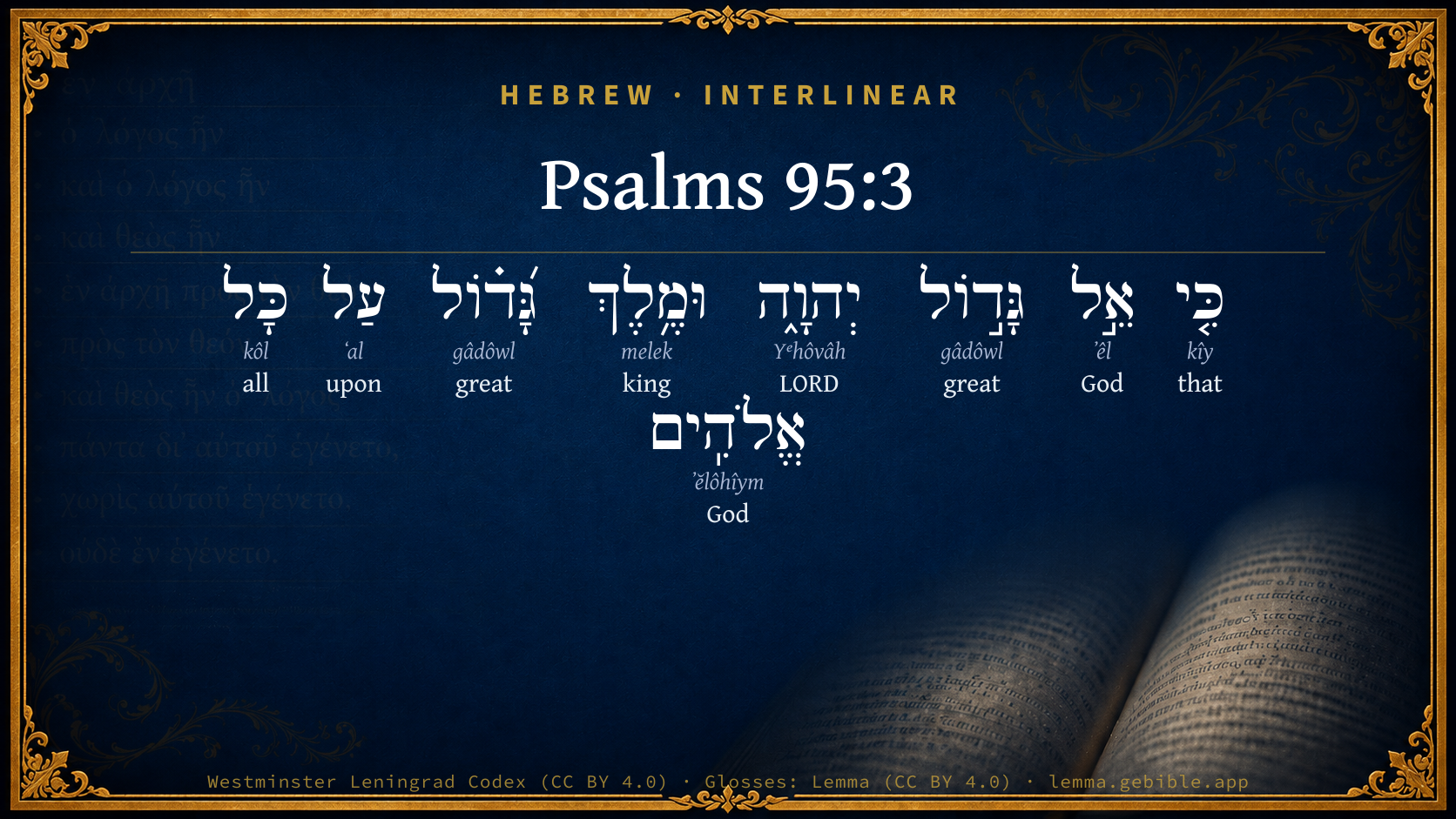
Psalms 95:3

Hebrew (Westminster Leningrad Codex) Psalms 95:3 appears in the Hebrew Old Testament. The text above is from the Westminster Leningrad Codex. Each word links to its Strong’s number, a concise gloss, and parsing drawn from the Open Scriptures Hebrew Bible morphology. Click any word for its full Brown-Driver-Briggs (BDB) entry.
Download image
Cite this verse

Psalms 95:3 (World English Bible). Public Domain. Lemma interlinear Bible study tool, https://lemma.gebible.app/v/psalms/95/3.

Show BibTeX & RIS
BibTeX
RIS
English Translation
For Yahweh is a great God, A great King above all gods.
World English Bible · Public Domain
Download a study sheet

One document with this verse’s original text, its word-by-word gloss line, the meaning frame, cross-references with their text, attributed commentary, and full source and license credits — printable, and it pastes into notes with its structure intact.

This verse Autodidact and up

Study sheet (.html) Plain text (.txt)

A passage Seminary Student

Up to 50 verses in one chapter. A passage sheet keeps up to 6 commentary sources and 12 cross-references per verse, in the order this page ranks them, and says so on the sheet whenever that leaves anything out. Ask for a single verse and you get the Autodidact verse sheet above.

Everything on this page stays free to read, with no account — the sheet is a download of what is already on screen, not access to it.

Want to remove ads? Support Godless Engineer
Compare translations 3

The same verse in 3 English versions, stacked beneath the original-language interlinear above. Click any original word for its lexicon entry.

Each is an independent rendering of the whole verse — the interlinear is not word-aligned to these translations.

Highlighted words mark where these versions differ — a whole-verse word diff, not a word-by-word alignment.

  • World English Bible Public Domain
    For Yahweh is a great God, A great King above all gods.
  • King James Version Public Domain
    For the LORD is a great God, and a great King above all gods.
  • unfoldingWord Literal Text CC BY-SA 4.0
    For Yahweh a great God and a great king above all gods,

unfoldingWord Literal Text — © unfoldingWord, licensed CC BY-SA 4.0. Word-aligned USFM3 via Door43 (git.door43.org/unfoldingWord/en_ult).

Versions to compare (up to 4)

3 of 4 selected

Show all 18 translations

Every available English version of this verse, each an independent rendering of the whole verse.

  • World English Bible Public Domain
    For Yahweh is a great God, A great King above all gods.
  • Berean Standard Bible Public Domain
    For the LORD is a great God, a great King above all gods.
  • Majority Standard Bible Public Domain
    For the LORD is a great God, a great King above all gods.
  • King James Version Public Domain
    For the LORD is a great God, and a great King above all gods.
  • American Standard Version (1901) Public Domain
    For Jehovah is a great God, And a great King above all gods.
  • Revised Version (1885) Public Domain
    For the LORD is a great God, and a great King above all gods.
  • Geneva Bible (1599) Public Domain
    For the Lord is a great God, and a great King aboue all gods.
  • Douay-Rheims (1899) Public Domain
    For the Lord is a great God, and a great King above all gods.
  • Young's Literal Translation Public Domain
    For a great God `is' Jehovah, And a great king over all gods.
  • Literal Standard Version CC BY-SA 4.0
    For YHWH [is] a great God, || And a great King over all gods.
  • Unlocked Literal Bible CC BY-SA 4.0
    For Yahweh is a great God and a great King superior to all gods.
  • unfoldingWord Literal Text CC BY-SA 4.0
    For Yahweh a great God and a great king above all gods,
  • Darby Bible Public Domain
    For Jehovah is a great ùGod, and a great king above all gods.
  • World Messianic Bible Public Domain
    For the LORD is a great God, a great King above all gods.
  • Webster's Bible Public Domain
    For the LORD is a great God, and a great King above all gods.
  • Free Bible Version CC BY-SA 4.0
    For the Lord is a great God, a great king above all gods.
  • Bible in Basic English Public Domain
    For the Lord is a great God, and a great King over all gods.
  • JPS Tanakh (1917) Public Domain
    For the LORD is a great God, and a great King above all gods;

Literal Standard Version (2020), Covenant Press — licensed CC BY-SA 4.0. Text via the HelloAO Bible API (eBible.org). Unlocked Literal Bible (unfoldingWord) — licensed CC BY-SA 4.0. Text via the HelloAO Bible API (eBible.org). unfoldingWord Literal Text — © unfoldingWord, licensed CC BY-SA 4.0. Word-aligned USFM3 via Door43 (git.door43.org/unfoldingWord/en_ult). Free Bible Version, Dr. Jonathan Gallagher — licensed CC BY-SA 4.0. Text via the HelloAO Bible API (eBible.org).

Word by word

More ways to search: Search by grammar → Find every occurrence → Compare this word →

Practice this passage: Drill this verse → Learn its vocabulary →

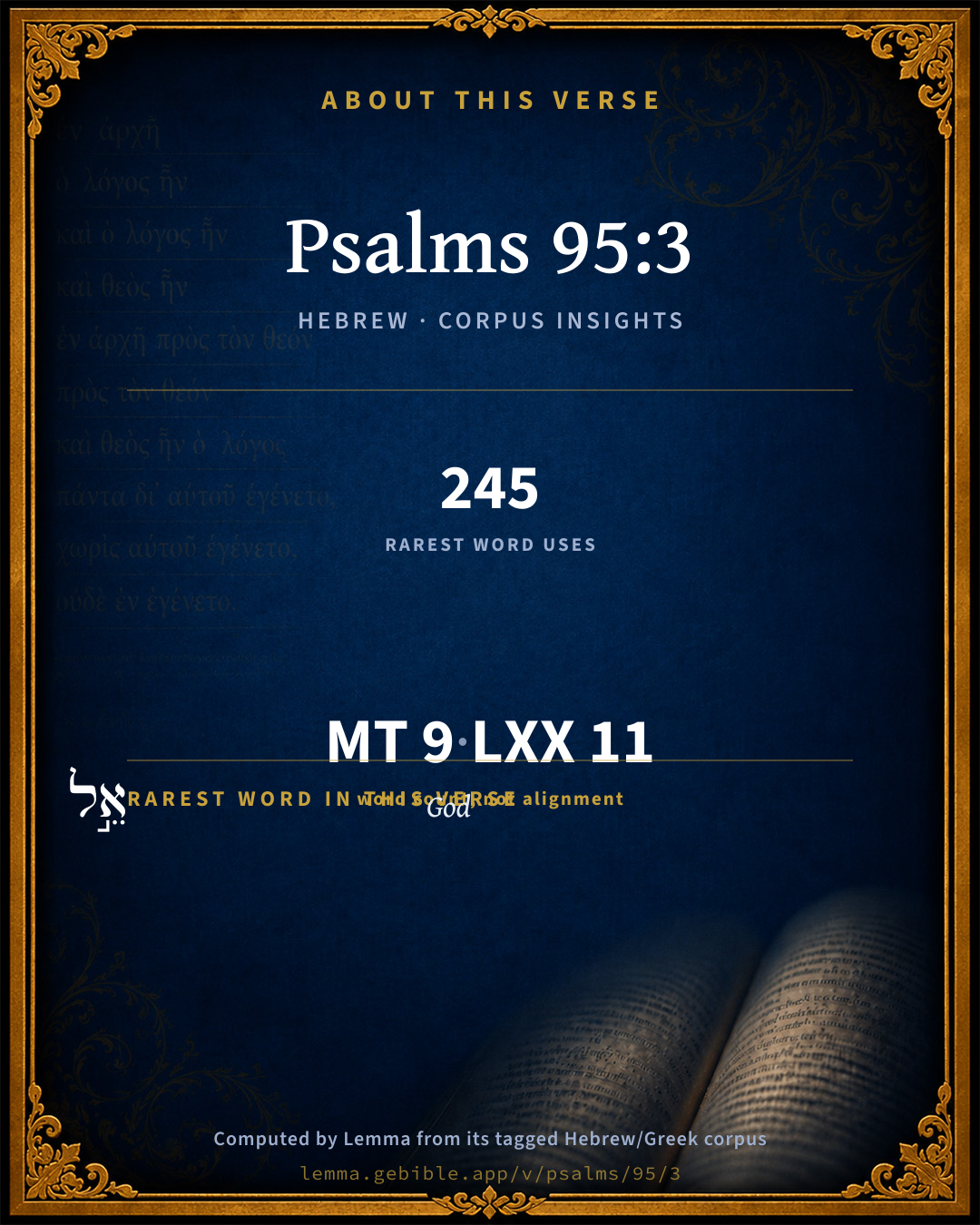
About this verse

These counts appear in no published source. They are computed here, from the morphology-tagged text and Lemma’s own curated glosses. What Lemma adds →

9
words
8
distinct lemmas
Wisdom
section

Grammatical profile

  • 5 nouns
  • 2 adjectives
  • 1 preposition
  • 1 conjunction

Repetition

A word recurs within this verse — often emphatic in Hebrew:

  • גָּד֣וֹל great H1419 ×2

Hebrew & Septuagint length

In English translation the verse runs 12 words from the Hebrew and 23 from the Septuagint (LXX English) — closely comparable.

A rough comparison of the two English renderings, which tokenize alike — not a word-level alignment.

Word counts can differ between the Hebrew and the Greek without any difference in meaning — e.g. the Hebrew direct-object marker אֵת has no separate Greek word, and Greek often adds the article ὁ.

In the original languages it is 9 Hebrew tokens and 11 Greek tokens — but the two are counted differently (Hebrew bundles its prefixes and suffixes into one token; the Greek is in lemma form), so that isn’t a like-for-like length.

Cross-references

17

Topical passages linked to Psalms 95:3 in the Treasury of Scripture Knowledge — connected by theme and wording, ordered by reader-vote popularity; previews shown in the World English Bible.

  • Psalms 96:4 For great is Yahweh, and greatly to be praised! He is to be feared above all gods.
  • Jeremiah 10:6–7 There is none like you, Yahweh; you are great, and your name is great in might.
  • Psalms 145:3 Great is Yahweh, and greatly to be praised! His greatness is unsearchable.
  • Psalms 97:9 For you, Yahweh, are most high above all the earth. You are exalted far above all gods.
  • Psalms 135:5 For I know that Yahweh is great, That our Lord is above all gods.
  • Exodus 18:11 Now I know that Yahweh is greater than all gods because of the thing in which they dealt arrogantly against them."
  • Psalms 47:2 For Yahweh Most High is awesome. He is a great King over all the earth.
  • Psalms 48:1–2 Great is Yahweh, and greatly to be praised, In the city of our God, in his holy mountain.
  • Matthew 5:35 nor by the earth, for it is the footstool of his feet; nor by Jerusalem, for it is the city of the great King.
  • Psalms 86:8–10 There is no one like you among the gods, Lord, Nor any deeds like your deeds.
  • Daniel 4:37 Now I, Nebuchadnezzar, praise and extol and honor the King of heaven; for all his works are truth, and his ways justice; and those who walk in pride he is able to abase.
  • Malachi 1:11 For from the rising of the sun even to the going down of the same, my name is great among the nations, and in every place incense will be offered to my name, and a pure offering: for my name is great among the nations," says Yahweh of Hosts.
  • Isaiah 44:8 Don't fear, neither be afraid: haven't I declared to you of old, and shown it? You are my witnesses. Is there a God besides me? Indeed, there is not. I don't know any Rock.
  • Jeremiah 10:10–16 But Yahweh is the true God; he is the living God, and an everlasting King: at his wrath the earth trembles, and the nations are not able to abide his indignation.
  • Jeremiah 46:18 As I live, says the King, whose name is Yahweh of Hosts, surely like Tabor among the mountains, and like Carmel by the sea, so shall he come.
  • Malachi 1:14 "But the deceiver is cursed, who has in his flock a male, and vows, and sacrifices to the Lord a blemished thing; for I am a great King," says Yahweh of hosts, "and my name is awesome among the nations."
  • Jeremiah 48:15 Moab is laid waste, and they are gone up into his cities, and his chosen young men are gone down to the slaughter, says the King, whose name is Yahweh of Hosts.

Cross-references courtesy of OpenBible.info (CC BY 4.0).

Hebrew and Greek witnesses Masoretic Hebrew ↔ Greek Septuagint

The same verse in the two great witnesses to the Old Testament, shown verse-for-verse.

You’re reading Greek Psalm 94 (Hebrew Psalm 95). The Septuagint counts the superscription, so verse numbers can differ from the Hebrew — chapter-level alignment, not verse-by-verse. Numbering follows Rahlfs.

These are two independent witnesses, not word-aligned to each other, and the Septuagint is shown in lemma (dictionary) form.

Hebrew Psalms 95:3 Masoretic · Westminster Leningrad Codex

כִּ֤י אֵ֣ל גָּד֣וֹל יְהוָ֑ה וּמֶ֥לֶךְ גָּ֝ד֗וֹל עַל כָּל אֱלֹהִֽים

For Yahweh is a great God, A great King above all gods.

World English Bible · Public Domain

Greek LXX Greek Psalm 94:3 Septuagint · lemma form

ὅτι θεός μέγας κύριος καί βασιλεύς μέγας ἐπί πᾶς ὁ θεός

For the Lord is a great God, and a great king over all gods: for the Lord will not cast off his people.

LXX2012 (modern English Septuagint) · Public Domain

On this verse, Keil & Delitzsch discusses the Septuagint’s reading. Read the note in Commentary ↓

Hebrew: Westminster Leningrad Codex (CC BY 4.0). Greek: Septuagint (public domain); English from LXX2012 (modern English Septuagint) (Public Domain). How the Septuagint differs from the Hebrew →

Commentary

Notes on Psalms 95:3 from classic Christian and Jewish commentators (each source and its license shown beneath its notes). The classic Christian expositions comment on the surrounding passage and are grouped to its opening verse, so a note may address several verses; the Jewish commentaries on the Tanakh (Rashi and others) are per-verse, so they appear only where the commentator wrote on this verse.

Lemma curates 59 commentaries, every one of them public domain or Creative Commons licensed, each selected and text-cleaned for this edition rather than reprinted as found. About our sources →

Trapp's Complete Commentary

John Trapp

Psa 95:3 For the LORD [is] a great God, and a great King above all gods.

Ver. 3. For the Lord is a great God] Understand it of Christ, as the apostle also does, Heb 3:4 1Co 10:4

Above all gods] Whether reputed so, or deputed, as kings.

John Trapp, A Commentary or Exposition upon All the Books of the Old and New Testament (1647–1656) — public domain. Text from a community e-Sword module.

The Biblical Illustrator

Joseph S. Exell

Psa_95:3

For the Lord is a great God, and a great King above all gods.

On the existence, greatness, and government of God

I. The transcendent greatness of the psalmists God.

1. He is great in the eternity of His existence. God only hath immortality. Finite beings are always going forward to further immortality; but God possesses it in the most absolute sense. Other beings depend for their immortality on the will of their Maker, and flow of their duration; but He is the same yesterday, to-day, and for ever. And as He is infinite in essence, He must necessarily be indestructible in the nature of His existence; for the power that destroys must always be greater than what is destroyed.

2. He is great in the immateriality, unity, and immensity of His existence. These are all necessarily implied in His eternity.

3. He is great in Omnipotence. Creation, in all its works of greatness and grandeur, falls infinitely short of a full exhibition of omnipotent power. For no finite substances, however multiplied and extended, could ever fill boundless space, or circumscribe the efforts of God Omnipotent. Here we might contemplatively roam after the ways and works of the Almighty Architect, until we were bewildered and lost in the magnitudes, mazes, and mysteries of creation. His power is also manifested in upholding all things created. He commands all the suns, systems, and planetary orbs, and they move in obedience to His sovereign pleasure.

4. He is boundless in love. Our first parents proved His goodness in the Garden of Eden, where His benevolence lavished around them every charm. There the Tree of Life, in grand and conspicuous pre-eminence, unfolded its verdant glories, and invited the human pair to partake of its immortality. The redemption of this fallen world is another proof of Divine love--into which angels desire to look, and in which we are everlastingly interested.

5. He is gloriously great in holiness. All the works of His creation, holiness of His laws, dispensations of His providence, influences of His Spirit, and condemnation and overthrow of wicked men and devils, proclaim that He is holy. And Holy, holy, holy, Lord God Almighty, will be the sublimest song that immortal millions can endlessly sing in the heaven of heavens.

6. He is incomprehensibly great in omniscience.

II. He is a great King above all Gods.

1. His right to the empire.

(1) Right of eternal priority. As there can be but one absolute and endless monarchy, so there is but one supreme and independent King.

(2) Right of eternal sufficiency. His throne is for ever and ever. It is founded in infinite wisdom, and upheld by everlasting strength. Amidst the revolutions of ages it stands the same.

(3) Right of universal inheritance. In His administration no law can be defective, no faithful subject go unprotected, and no enemy be triumphant. The thunders of the throne shall prevent all invasion, and His omnipotence defy all usurpation, until His right to reign shall be indisputably acknowledged, and the God of everlasting sovereignty be gloriously magnified.

2. His extensive empire.

(1) He reigns in the Kingdom of Nature. He reigns over inanimate nature by those fixed laws which regulate and revolve all matter; and carries forward as undeviatingly His superintendence over an atom as over a magnificent world. He reigns over animate irrational nature by instinct. He reigns over man by reason, conscience, and revelation.

(2) He reigns in the kingdom of providence.

(3) He reigns in the kingdom of darkness and damnation.

(4) He reigns in the kingdom of grace, for the protection and complete triumph of His Church.

(5) He reigns in the kingdom of glory--the heaven of heavens, the home of all the saint. (W. Barns.)

God of gods

I. The Divine sovereignty in the physical realm. Nature is full of the manifestations of a great intelligence, full of remarkable adjustments and adaptations, full of ordered sequences and wise contrivances. In other words, Nature, through all her domain, from those gleaming stars which shoot their rays through vast and interminable spaces down to those invisible and primordial atoms of which all substances are composed, and which maintain their ceaseless movements to and fro, is subject to a high and beneficent power. Everywhere there is manifest the sovereignty of law, and the sovereignty of law is the sovereignty of God. In most great cities they have a mansion house, or some similar building, which is a symbol and centre of that civic authority which rules over the whole of the area comprised in the civic boundary; and so this physical universe is the mansion house of creations God--not a house empty and tenantless, so far as the Creators presence is concerned, but occupied and inhabited throughout with that same creative spirit which in the beginning created all things, and which ever since has sustained and controlled all things.

II. The Divine sovereignty in the moral and spiritual realm. The kingdom of grace is the extension of the kingdom of nature, and the laws and principles which operate in the one operate in the other.

1. There is the prominence given to beauty. One might almost say that the object of the Creator was the creation of beauty, and that the great Designer had set His heart upon producing a picture of surpassing loveliness. And the object of God in redemption is clearly the creation or the re-creation of beauty, not outward beauty merely, but inward--beauty of character, beauty of soul.

2. There is the insistence of the Divine constancy and faithfulness. Banks fail, governments are overturned, empires break up and pass away, but the sun never refuses to shine, and the earth never declines to bring forth the vintage of her fruits and the harvest of her flowers. And this characteristic of faithfulness belongs as truly to the sphere of grace as of nature. The promises of God are all yea and amen.

3. There is the recognition of the value of the individual. Nature cares for the whole, and she cares not less for the individual parts of which the whole is composed. There is not a cowslip in the meadow, nor yet a blade of grass which catches its little drop of crystal and holds it suspended in the early sunlight but witnesses to the care and providence of God, and to the individualizing character of that providence. And the same is true of the grace which bringeth salvation. The disciples were all chosen and called separately and individually. There is not one of us, down to the least and the youngest, whose name is not written in Creations book, and for whom there is not a place reserved in Redemptions record! (T. Sanderson.)

The Biblical Illustrator, edited by Joseph S. Exell (c. 1880s–1900s) — public domain. Text from a community e-Sword module.

Whedon's Commentary on the Bible

Daniel D. Whedon

3. For the Lord is a great God—This is the theme of Psa_95:3-5, and the reason for this call for abundant and loud praise.

Above all gods—Above all the “gods” of the nations. But the title “gods” is also sometimes given to princes, judges, and rulers, (Psa_8:6; Psa_82:6; Psa_96:4-5,) to whom it better applies here.

Daniel D. Whedon (gen. ed.), Commentary on the Old and New Testaments (1874–1909) — public domain. Text from a community e-Sword module.

J. A. Alexander on Psalms

Joseph Addison Alexander

3. (Psa 95:3) For a great God (is) Jehovah, and a great King above all gods. This is not inconsistent with the doctrine elsewhere taught, that other gods have no real existence. See below; Psa 96:4-5, where both truths are asserted together. The very name of God used in the first clause is expressive of omnipotence.

Joseph Addison Alexander, The Psalms Translated and Explained (1850) — public domain. Text from a community e-Sword module.

Tyndale Open Study Notes

Tyndale Open Resources

95:3-5 The Lord is the great King over the whole universe.

95:3 above all gods: The psalmist refutes idolatry and paganism (96:4-6; 135:15-18; see also Isa 46:5-7).

Tyndale Open Study Notes — © Tyndale Open Resources, licensed CC BY-SA 4.0. Text via the HelloAO Bible API.

Geneva Bible (1599)

Geneva Bible translators

Even the Angels (who in respect of men are thought as gods) are nothing in his sight, much less the idols, which man’s brain inventeth.

Geneva Bible (1599) marginal notes — public domain. Text via Bolls.life.

Adam Clarke's Commentary

Verse 3. For the Lord is a great God] Or, "A great God is Jehovah, and a great King above all gods;" or, "God is a great King over all." The Supreme Being has three names here: אל EL, יהוה JEHOVAH, אלהים ELOHIM, and we should apply none of them to false gods. The first implies his strength; the second his being and essence; the third, his covenant relation to mankind. In public worship these are the views we should entertain of the Divine Being.

Adam Clarke's Commentary on the Bible (1810–1826) — public domain. Text from a community e-Sword/MySword module.

John Calvin's Commentaries

3. For Jehovah is a great God. By these words the Psalmist reminds us what abundant grounds we have for praising God, and how far we are from needing to employ the lying panegyric with which rhetoricians flatter earthly princes. First, he extols the greatness of God, drawing a tacit contrast between him and such false gods as men have invented for themselves. We know that there has always been a host of gods in the world, as Paul says,

“There are many on the earth who are called gods,” (1 Corinthians 8:5.)

We are to notice the opposition stated between the God of Israel and all others which man has formed in the exercise of an unlicensed imagination. Should any object, that “an idol is nothing in the world,” (1 Corinthians 8:4,) it is enough to reply, that the Psalmist aims at denouncing the vain delusions of men who have framed gods after their own foolish device. I admit, however, that under this term he may have comprehended the angels, asserting God to be possessed of such excellence as exalted him far above all heavenly glory, and whatever might be considered Divine, as well as above the feigned deities of earth. Angels are not indeed gods, but the name admits of an improper application to them on account of their being next to God, and still more, on account of their being accounted no less than gods by men who inordinately and superstitiously extol them. If the heavenly angels themselves must yield before the majesty of the one God, it were the height of indignity to compare him with gods who are the mere fictions of the brain. In proof of his greatness, he bids us look to his formation of the world, which he declares to be the work of God’s hands, and subject to his power. This is one general ground why God is to be praised, that he has clearly shown forth his glory in the creation of the world, and will have us daily recognize him in the government of it. When it is said, that the depths of the earth are in his hand, the meaning is, that it is ruled by his providence, and subject to his power. Some read, the bounds of the earth, but the word means abysses or depths, as opposed to the heights of the mountains. The Hebrew word properly signifies searching.

John Calvin's Commentaries (1540-1563) — public domain. Text from the Calvin Translation Society English edition (1840s-50s) via the Christian Classics Ethereal Library (ccel.org). Calvin's coverage is partial (roughly two-thirds of the Bible); uncommented books and verses are honest gaps, never fabricated. The 19th-century editor's footnotes and remarks are omitted so the notes are faithfully Calvin's own voice.

Ellicott's Commentary for English Readers

(3) Above all gods.—Not here angelic beings, but the gods of surrounding tribes, as accurately explained in Psa_96:4-5. (Comp. Exo_15:11; Exo_18:11.) Commentators vex themselves with the difficulty of the ascription of a real existence to these tribal deities in the expression,” King above all gods.” But how else was Israel constantly falling into the sin of worshipping them? It was in the inspired rejection of them as possessing any sovereign power, and in the recognition of Jehovah’s supremacy shown by the psalmists and prophets, that the preservation of Israel’s religion consisted.

A Bible Commentary for English Readers, edited by Charles John Ellicott (1878–1897) — public domain. Text from a community e-Sword module.

The Cambridge Bible for Schools and Colleges

gen. ed. J. J. S. Perowne

3. The thoughts of the greatness of Jehovah, of His sovereignty, and of His supremacy over the gods of the heathen, are characteristic of this group of Psalms. They are not new thoughts (Exo_15:11; Exo_15:18), but fresh reality had been given to them by His revelation of Himself in the humiliation of Babylon and its gods, and the deliverance of Israel.

That the Psalmist attributes any real existence to the gods of the heathen is not to be supposed. They are mere idols, things of nought (Psa_96:5), gods in name but not in reality. He cannot have gone back from the teaching of Jer_10:3 ff., in which the living God, the Eternal King, the Creator, is contrasted with helpless perishable idols; or have forgotten the scathing sarcasms of Isa_40:18 ff; Isa_44:9 ff.

3–5. The reason for this service:—His greatness as the supreme King, the Lord of the world.

The Cambridge Bible for Schools and Colleges (gen. ed. J. J. S. Perowne; Cambridge University Press, 1878–1918) — public domain. Text from a community e-Sword module.

John Gill's Exposition

For the Lord is a great God,.... Christ is truly and properly God, wherefore divine service is to be performed unto him; particularly singing psalms, setting forth therein his greatness and glory: and he is a great one; great in power, wisdom, justice, truth, mercy, and grace; greatness is to be ascribed unto him, and worship given him, because of his greatness, Tit 2:13.

and a great King over all gods; he is King of the whole world; his kingdom ruleth over all; he is King of kings, and Lord of lords; he is King of saints, the government of the whole church is upon his shoulders, which he exercises in the most wise, powerful, and righteous manner imaginable; he is above all that are called gods, all the nominal and fictitious deities of the Heathens; above all civil magistrates, who are gods by office; and above the angels, who have this name, Pe1 3:22. Aben Ezra interprets it of angels.

John Gill's Exposition of the Whole Bible (1746–1763) — public domain (CC PDM 1.0). Text via the HelloAO Bible API.

Albert Barnes' Notes on the Bible

For the Lord is a great God - For Yahweh is a great God. The object is to exalt Jehovah, the true God, as distinguished from all who were worshipped as gods. The first idea is that he is “great;” that he is exalted over all the universe; that he rules over all, and that he is to be worshipped as such.

And a great King above all gods - This does not mean that he is a great ruler of all other gods, as if they had a real existence, but that he is king or ruler far above all that were worshipped as gods, or to whom homage was paid. Whoever, or whatever was worshipped as God, Yahweh was supreme over all things. He occupied the throne; and all others must be beneath him, and under his dominion. If the sun, the moon, or the stars were worshipped - if the mountains or the rivers - if angels good or bad - yet Yahweh was above all these. If imaginary beings were worshipped, yet Yahweh in his perfections was exalted far above all that was ascribed to them, for He was the true God, and the Ruler of the universe, while they were beings of the imagination only.

Albert Barnes' Notes on the Bible (1834–1885) — public domain. Text from a community e-Sword/MySword module.

Matthew Poole's English Annotations

Above all that are accounted and called

gods, angels, and earthly potentates, and especially the false gods of the heathens, which upon Christ’s coming into the world were struck dumb, and could no more deliver their oracles, as Plutarch and other heathens observed, with admiration, nor deceive the world, but were forced to give place to the true God, and to the knowledge and worship of him alone, which was propagated among all nations by the gospel.

Matthew Poole's English Annotations on the Holy Bible (1683–1685) — public domain. Text from a community e-Sword/MySword module.

The Treasury of David

Charles H. Spurgeon

Ver. 3. For the LORD is a great God, and a great King above all gods. No doubt the surrounding nations imagined Jehovah to be a merely local deity, the god of a small nation, and therefore one of the inferior deities; the psalmist utterly repudiates such an idea. Idolaters tolerated gods many and lords many, giving to each a certain measure of respect; the monotheism of the Jews was not content with this concession, it rightly claimed for Jehovah the chief place, and the supreme power. He is great, for he is all in all; he is a great King above all other powers and dignitaries, whether angels or princes, for they owe their existence to him; as for the idol gods, they are not worthy to be mentioned. This verse and the following supply some of the reasons for worship, drawn from the being, greatness, and sovereign dominion of the Lord.

Ver. 3. He that hath a mind to praise God, shall not want matter of praise, as they who come before princes do, who for want of true grounds of praise in them, do give them flattering words; for the Lord is a great God, for power and preeminence, for strength and continuance. David Dickson.

Ver. 3. The Supreme Being has three names here: la El, hwhy Jehovah, Myhla Elohim, and we should apply none of them to false gods. The first implies his strength; the second, his being and essence; the third, his covenant relation to mankind. In public worship these are the views we should entertain of the Divine Being. Adam Clarke.

Ver. 3. Above all gods. When He is called a great God and King above all gods, we may justly imagine that the reference is to the angels who are wont to be introduced absolutely under this name, and to the supreme Judges in the land, who also wear this title, as we have it in Ps 82:1-8. Venema.

Ver. 3.

1. The greatness of God as god. He is to be conceived of as great in goodness, power, glory, etc.

2. His dominion over all other powers in heaven or earth.

3. The worship which is consequently due to him.

Psalms 95:4*

Charles H. Spurgeon's The Treasury of David (1869–1885) — public domain. Psalms only. Text from a community e-Sword/MySword module.

The Pulpit Commentary

For the Lord is a great God. Thanks and praise are due to God, in the first place, because of his greatness (see Psalm cf. 2). "Who is so great a god as our God?"; (Psa_77:13) "His greatness is unsearchable". (Psa_145:3) And a great King above all gods; i.e. "a goat King above all other so called gods above the great of the earth, (Psa_82:1, Psa_82:6) above angels, (Deu_10:17) above the imaginary gods of the heathen. (Exo_12:12, etc.)

The Pulpit Commentary (1880–1919), ed. H.D.M. Spence-Jones & Joseph S. Exell — public domain. Text from a community e-Sword module.

John Wesley's Explanatory Notes

God's - Above all that are called God's angels, earthly potentates, and especially the false gods of the Heathen.

John Wesley, Explanatory Notes Upon the Whole Bible (1754–1765) — public domain. Text via the GEBible commentary corpus.

Keil & Delitzsch

C. F. Keil & F. Delitzsch

The adorableness of God receives a threefold confirmation: He is exalted above all gods as King, above all things as Creator, and above His people as Shepherd and Leader. אלהים (gods) here, as in Psa 96:4., Psa 97:7, Psa 97:9, and frequently, are the powers of the natural world and of the world of men, which the Gentiles deify and call kings (as Moloch Molech, the deified fire), which, however, all stand under the lordship of Jahve, who is infinitely exalted above everything that is otherwise called god (Psa 96:4; Psa 97:9). The supposition that תּועפות הרים denotes the pit-works (μέταλλα) of the mountains (Bφttcher), is at once improbable, because to all appearance it is intended to be the antithesis to מחקרי־ארץ, the shafts of the earth. The derivation from ועף (יעף), κάμνειν, κοπιᾶν, also does not suit תועפות in Num 23:22; Num 24:8, for "fatigues" and "indefatigableness" are notions that lie very wide apart. The כּסף תּועפות of Job 22:25 might more readily be explained according to this "silver of fatigues," i.e., silver that the fatiguing labour of mining brings to light, and תועפות הרים in the passage before us, with Gussetius, Geier, and Hengstenberg: cacumina montium quia defatigantur qui eo ascendunt, prop. ascendings = summits of the mountains, after which כסף תועפות, Job 22:25, might also signify "silver of the mountain-heights." But the lxx, which renders δόξα in the passages in Numbers and τὰ ὕψη τῶν ὀρέων in the passage before us, leads one to a more correct track. The verb יעף (ועף), transposed from יפע (ופע), goes back to the root יף, וף, to stand forth, tower above, to be high, according to which תועפות = תופעות signifies eminentiae, i.e., towerings = summits, or prominences = high (the highest) perfection (vid., on Job 22:25). In the passage before us it is a synonym of the Arabic mı̂fan, mı̂fâtun, pars terrae eminens (from Arab. wfâ = יפע, prop. instrumentally: a means of rising above, viz., by climbing), and of the names of eminences derived from Arab. yf' (after which Hitzig renders: the teeth of the mountains). By reason of the fact that Jahve is the Owner (cf. Sa1 2:8), because the Creator of all things, the call to worship, which concerns no one so nearly as it does Israel, the people, which before other peoples is Jahve's creation, viz., the creation of His miraculously mighty grace, is repeated. In the call or invitation, השׁתּחוה signifies to stretch one's self out full length upon the ground, the proper attitude of adoration; כּרע, to curtsey, to totter; and בּרך, Arabic baraka, starting from the radical signification flectere, to kneel down, in genua (πρόχνυ, pronum = procnum) procumbere, Ch2 6:13 (cf. Hlemann, Bibelstudien, i. 135f.). Beside עם מרעיתו, people of His pasture, צאן ידו is not the flock formed by His creating hand (Augustine: ipse gratiâ suâ nos oves fecit), but, after Gen 30:35, the flock under His protection, the flock led and defended by His skilful, powerful hand. Bttcher renders: flock of His charge; but יד in this sense (Jer 6:3) signifies only a place, and "flock of His place" would be poetry and prose in one figure.

Keil & Delitzsch — Biblical Commentary on the Old Testament (1861–1891) — public domain (CC PDM 1.0). Text via the HelloAO Bible API. (Old Testament only.)

Lesson kit

Teaching starters — assembled from the data on this page, not authored interpretation. Every prompt links to the verse data it draws on. Edit before teaching.

Psalms, in the Wisdom, opens this verse with 9 words (8 distinct Hebrew lemmas). Its most distinctive word is ʼêl (“God”). A historical commentator’s framing appears above. Read the whole chapter for the surrounding context.

Discussion questions

  1. How does “God” (ʼêl) shape what this verse is saying?
  2. How does Psalms 96:4, which shares this passage’s theme, read alongside this verse?
  3. What does the repetition of “great” (2× in this one verse) do in this verse?
  4. The translations on this page render this verse differently — a whole-verse word diff, not a word-by-word alignment. What might account for the different wordings?
  5. Compare how Trapp's Complete Commentary and The Biblical Illustrator read this verse. Where do they agree or differ?

Things to notice

Reading settings

Reading text

Shown beneath each verse's original-language words.

Old Testament
Old Testament edition

Read the OT as the Masoretic Hebrew (MT) or the Greek Septuagint (LXX).

English shown for the Greek Septuagint (in the Hebrew ↔ Greek comparison).

Comparing translations? Open the Compare panel on any verse page to stack up to four side by side.