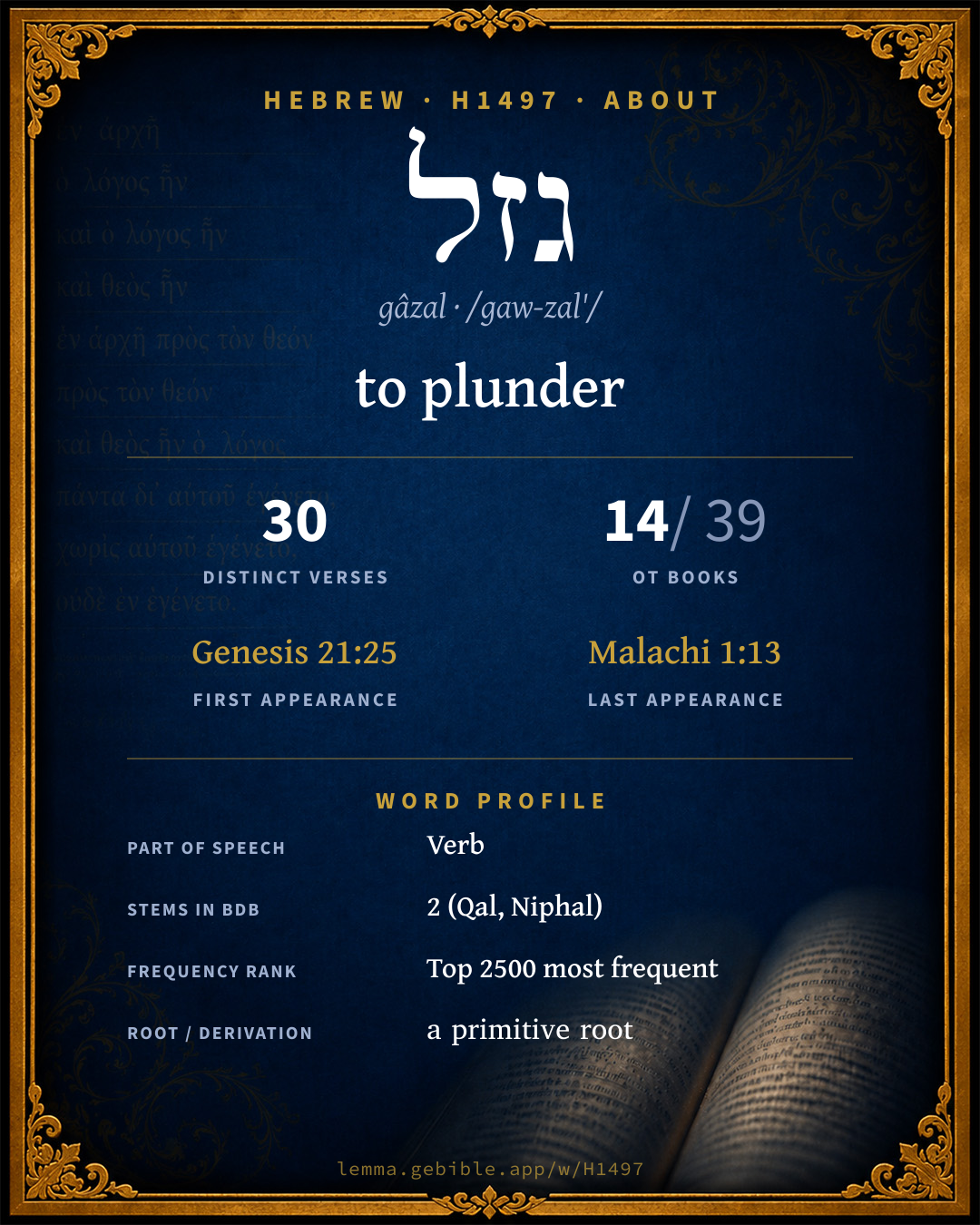
גָּזַל
to plunder
‘to plunder’ is one of 5 main senses fuller range ↓
Full lexicon entry — Brown-Driver-Briggs (BDB)
From Brown-Driver-Briggs (BDB)
Where this word appears
See every Qal verb in the Hebrew Bible →
Grammar key — what these labels mean
Part of speech
- Verb
- An action or state-of-being word.
Stem
- Qal
- The basic, simple active stem — the plain form of the verb (“he wrote”).
- Niphal
- Usually the simple passive or reflexive of the Qal (“he was written”).
Form
- Perfect
- A completed action or state — Hebrew marks aspect (completeness) more than strict tense (“he wrote”).
- Participle Passive
- A verbal adjective expressing action received (“written”).
- Sequential Imperfect
- An imperfect with prefixed waw — the standard past-narrative form (waw-consecutive imperfect).
- Imperfect
- An incomplete, ongoing, or future action (“he will / would write”).
- Infinitive Construct
- A bound verbal noun, frequently with prepositions (“to write / in writing”).
- Sequential Perfect
- A perfect with prefixed waw continuing a preceding imperfect or command (waw-consecutive perfect).
- Participle Active
- A verbal adjective expressing ongoing or characteristic action (“writing / one who writes”).
- Jussive
- A third- or second-person volitional form expressing wish or command (“let him write”).
State
- Absolute
- The independent form of a noun, not bound to a following word.
- Construct
- A noun bound to a following noun in a possessive / “of” relationship (the construct chain).
Person
- 3rd Person
- The one spoken about (“he / she / it / they”).
- 2nd Person
- The one addressed (“you”).
- 1st Person
- The speaker (“I / we”).
Gender
- Masculine
- Grammatically masculine.
- Common
- Either gender — not distinguished for this form.
- Feminine
- Grammatically feminine.
Number
- Singular
- One.
- Plural
- More than one (in Hebrew, generally three or more).
Grammatical forms 16 distinct
- Verb, Qal, Perfect, 3rd Person, Masculine, Singular 5 times (17%)
- Verb, Qal, Participle Passive, Masculine, Singular, Absolute 5 times (17%)
- Verb, Qal, Perfect, 3rd Person, Common, Plural 4 times (13%)
- Verb, Qal, Sequential Imperfect, 3rd Person, Masculine, Singular 2 times (7%)
- Verb, Qal, Imperfect, 2nd Person, Masculine, Singular 2 times (7%)
- Verb, Qal, Imperfect, 3rd Person, Masculine, Plural 2 times (7%)
- Verb, Qal, Infinitive Construct 1 time (3%)
- Verb, Niphal, Sequential Perfect, 3rd Person, Feminine, Singular 1 time (3%)
+8 more forms (8 occurrences)
Parsed forms decoded from the imported morphology (morphhb / Westminster Leningrad Codex — WLC text public domain, morphhb tagging CC BY 4.0), counted across 30 parsed occurrences — not distinct verses.
Every verse where H1497 appears — 30 distinct verses across 14 books. Click any verse to open its interlinear word-by-word view. Verse text shown in the World English Bible for context — . Each verse’s Hebrew form is shown with its reference; the English is not keyword-highlighted, since the data carries no word-level English alignment. Use “Compare translations” on any verse to read it across multiple English versions. This concordance covers the Hebrew Bible; Septuagint (Greek Old Testament) occurrences are not indexed here.
Genesis 2 verses
Leviticus 2 verses
- Leviticus 6:4 גָּזָ֗ל Qal pf 3ms then it shall be, if he has sinned, and is guilty, he shall restore that which he took by robbery, or the thing which he has gotten by oppression, or the deposit which was committed to him, or the lost thing which he found,
- Leviticus 19:13 תִגְזֹ֑ל Qal impf 2ms "'You shall not oppress your neighbor, nor rob him. The wages of a hired servant shall not remain with you all night until the morning.
Deuteronomy 2 verses
- Deuteronomy 28:29 וְ/גָז֛וּל conj + Qal ptcp.pass ms and you shall grope at noonday, as the blind gropes in darkness, and you shall not prosper in your ways: and you shall be only oppressed and robbed always, and there shall be none to save you.
- Deuteronomy 28:31 גָּז֣וּל Qal ptcp.pass ms Your ox shall be slain before your eyes, and you shall not eat of it: your donkey shall be violently taken away from before your face, and shall not be restored to you: your sheep shall be given to your enemies, and you shall have none to save you.
Judges 2 verses
- Judges 9:25 וַ/יִּגְזְל֗וּ conj + Qal wimpf 3mp The men of Shechem set liers-in-wait for him on the tops of the mountains, and they robbed all who came along that way by them: and it was told Abimelech.
- Judges 21:23 גָּזָ֑לוּ Qal pf 3cp The children of Benjamin did so, and took them wives, according to their number, of those who danced, whom they carried off: and they went and returned to their inheritance, and built the cities, and lived in them.
2 Samuel 1 verse
1 Chronicles 1 verse
Job 4 verses
- Job 20:19 גָּ֝זַ֗ל Qal pf 3ms For he has oppressed and forsaken the poor. He has violently taken away a house, and he shall not build it up.
- Job 24:2 גָּ֝זְל֗וּ Qal pf 3cp There are people who remove the landmarks. They violently take away flocks, and feed them.
- Job 24:9 יִ֭גְזְלוּ Qal impf 3mp There are those who pluck the fatherless from the breast, And take a pledge of the poor,
- Job 24:19 יִגְזְל֥וּ Qal impf 3mp Drought and heat consume the snow waters; So does Sheol those who have sinned.
Psalms 2 verses
- Psalms 35:10 מִ/גֹּזְלֽ/וֹ prep + Qal ptcp.act ms cs + sfx pers 3ms All my bones shall say, "Yahweh, who is like you, Who delivers the poor from him who is too strong for him, Yes, the poor and the needy from him who robs him?"
- Psalms 69:4 גָ֝זַ֗לְתִּי Qal pf 1cs Those who hate me without a cause are more than the hairs of my head. Those who want to cut me off, being my enemies wrongfully, are mighty. I have to restore what I didn't take away.
Proverbs 3 verses
- Proverbs 4:16 וְֽ/נִגְזְלָ֥ה conj + Niphal wpf 3fs For they don't sleep, unless they do evil. Their sleep is taken away, unless they make someone fall.
- Proverbs 22:22 תִּגְזָל Qal juss 2ms Don't exploit the poor, because he is poor; And don't crush the needy in court;
- Proverbs 28:24 גּוֹזֵ֤ל Qal ptcp.act ms Whoever robs his father or his mother, and says, "It's not wrong." He is a partner with a destroyer.
Isaiah 1 verse
Jeremiah 2 verses
- Jeremiah 21:12 גָז֖וּל Qal ptcp.pass ms House of David, thus says Yahweh, Execute justice in the morning, and deliver him who is robbed out of the hand of the oppressor, lest my wrath go forth like fire, and burn so that none can quench it, because of the evil of your doings.
- Jeremiah 22:3 גָז֖וּל Qal ptcp.pass ms Thus says Yahweh: Execute you justice and righteousness, and deliver him who is robbed out of the hand of the oppressor: and do no wrong, do no violence, to the foreigner, the fatherless, nor the widow; neither shed innocent blood in this place.
Ezekiel 5 verses
- Ezekiel 18:7 יִגְזֹ֑ל Qal impf 3ms and has not wronged any, but has restored to the debtor his pledge, has taken nothing by robbery, has given his bread to the hungry, and has covered the naked with a garment;
- Ezekiel 18:12 גָּזָ֔ל Qal pf 3ms has wronged the poor and needy, has taken by robbery, has not restored the pledge, and has lifted up his eyes to the idols, has committed abomination,
- Ezekiel 18:16 גָזָ֑ל Qal pf 3ms neither has wronged any, has not taken anything to pledge, neither has taken by robbery, but has given his bread to the hungry, and has covered the naked with a garment;
- Ezekiel 18:18 גָּזַל֙ Qal pf 3ms As for his father, because he cruelly oppressed, robbed his brother, and did that which is not good among his people, behold, he shall die in his iniquity.
- Ezekiel 22:29 וְ/גָזְל֖וּ conj + Qal pf 3cp The people of the land have used oppression, and exercised robbery; yes, they have vexed the poor and needy, and have oppressed the foreigner wrongfully.
Micah 2 verses
- Micah 2:2 וְ/גָזָ֔לוּ conj + Qal wpf 3cp They covet fields, and seize them; And houses, and take them away: And they oppress a man and his house, Even a man and his heritage.
- Micah 3:2 גֹּזְלֵ֤י Qal ptcp.act mp cs You who hate the good, And love the evil; Who tear off their skin, And their flesh from off their bones;
Malachi 1 verse
About this entry
At a glance — auto-summarized from this page’s data, not written by a person. Every figure links to its source below. This summary describes the numbers; it doesn’t interpret them.
The Hebrew verb גזל centers on the idea of “to plunder.” Debuting at Genesis 21:25, it then recurs through the corpus. It appears 30 verses across 14 books of the Hebrew Bible, among its moderately common vocabulary. The verb spans 2 stems, from Qal to Niphal. It shares a root with גוזל, גזל and גזל. Dig into 30-verse concordance and the renderings breakdown below.
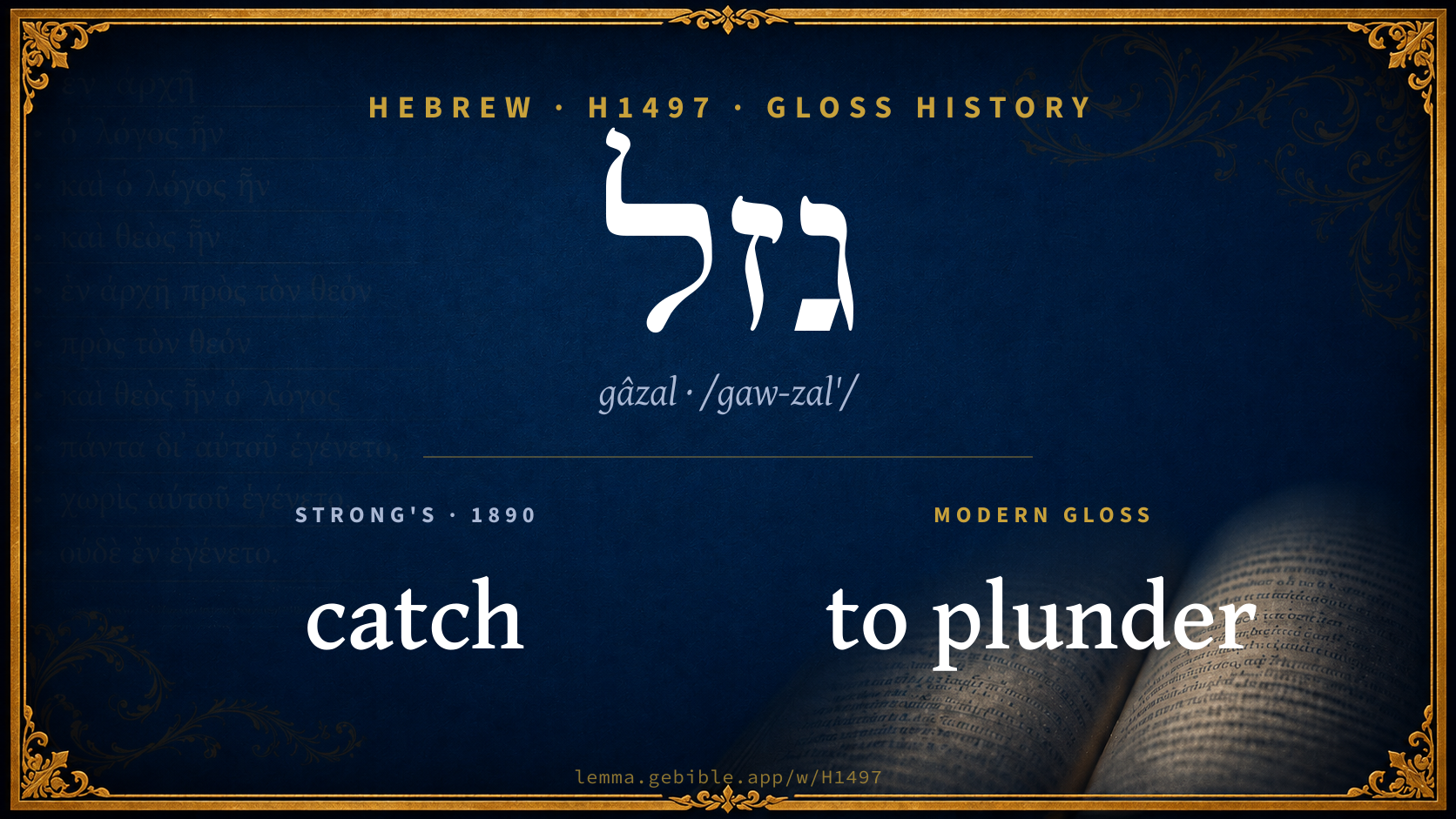
Gloss history
Strong's 1890 vs modern scholarship
About this word
Strong's H1497 catalogs a Hebrew word from the Hebrew Old Testament.
These counts are not copied from any lexicon or concordance. They are computed here, from the morphology-tagged Hebrew Old Testament. What Lemma adds →
- 30
- distinct verses
- The word appears in 30 distinct verses.
- 14 / 39
- OT books
- The word appears in 14 of 39 Old Testament books.
- #1,139
- by frequency
- Top 2500 most frequent Hebrew words (rank 1,139 of 8,640 Hebrew words by occurrence).
View all 30 occurrences in the concordance →
By section of the Old Testament
By traditional corpus
Conventional, traditional groupings — biblical authorship is debated, so this is a traditional corpus grouping, not an authorship claim. Each share is this word’s portion of its verses in that division of the Hebrew canon. Each figure is a share of the word’s 30 distinct verses.
- Prophets (Nevi'im) 14 verses · 47%
- Writings (Ketuvim) 10 verses · 33%
- Torah (Pentateuch) 6 verses · 20%
How translations render this word
Counts come from each version’s own published word-to-Strong’s tagging or interlinear alignment — an approximate guide to how each version renders this word, not a word-level alignment the data otherwise carries. Because each total is that version’s own tagged count, the per-version totals vary from one another and need not match the appearance or distinct-verse counts above. These counts may also differ from a printed concordance because Lemma counts each distinctly tagged rendering and does not collapse phrase taggings into a single head-word total. This is a fixed set of word-tagged versions (KJV, ASV, BSB, ULT) and does not change with the reading translation you choose elsewhere. Each version’s license is shown beside its name below (and on Sources).
- King James Version: Hath spoiled 3×, Spoiled 3×, Plucked 2×
- American Standard Version: Hath taken 3×, Rob 3×, Is robbed 2×
- Berean Standard Bible: Snatched 2×, Stolen 2×, Victim of robbery 2×
- unfoldingWord Literal Text: Rob 3×, He seized 2×, Robbed 2×
King James Version Public Domain
Renders H1497 across 30 tagged occurrences — most commonly:
Plus 20 renderings that appear only once — usually multi-word phrases or single function words the recovered tagging swept in, not distinct renderings.
American Standard Version Public Domain
Renders H1497 across 29 tagged occurrences — most commonly:
Plus 19 renderings that appear only once — usually multi-word phrases or single function words the recovered tagging swept in, not distinct renderings.
Berean Standard Bible Public Domain
Renders H1497 across 28 tagged occurrences — most commonly:
Plus 22 renderings that appear only once — usually multi-word phrases or single function words the recovered tagging swept in, not distinct renderings. Not rendered by a distinct English word in 2 further occurrences.
unfoldingWord Literal Text CC BY-SA 4.0
Renders H1497 across 34 tagged occurrences — most commonly:
Plus 27 renderings that appear only once — usually multi-word phrases or single function words the recovered tagging swept in, not distinct renderings.
Senses in the full BDB
Hebrew verbs can shift meaning by stem (binyan): Qal is the basic action, Niphal is often passive or reflexive, Piel often intensifies or makes it factitive, and Hiphil is typically causative. The senses below are grouped under the stem BDB assigns to each.
What do BDB’s symbols mean?
BDB uses these scholarly abbreviations:
| Symbol | Meaning |
|---|---|
| 𝔊 | the Septuagint (the ancient Greek translation, LXX) |
| 𝔙 | the Vulgate (the Latin translation) |
| 𝔖 | the Syriac version (the Peshitta) |
| 𝔗 | the Targum (the Aramaic translation) |
| ψ | the Psalms |
| √ | root (the underlying root or stem) |
| ‖ | parallel passage (a synonymous or contrasted parallel) |
| † | the dagger: every passage where the word occurs is cited |
The 2 senses and sub-senses the full Brown-Driver-Briggs lexicon distinguishes for this word, in lexicon order (not ranked by frequency), with BDB’s own verbatim wording and sub-sense lettering. Shown in Hebrew script with BDB’s own scholarly abbreviations. The condensed entry is in the Lexicon Entry tab. See also the Forms in the corpus table below.
Qal
- Pf. גָּזַל Jb 20:19 Ez 18:18, גָּזָ֑ל Lv 5:23 + 2 times, גָּזַלְתִּי ψ 69:5 etc.; Impf. יִגְזֹל Ez 18:7, וַיִּגְזֹל 2 S 23:21 1 Ch 11:23 etc.; Inf. גְּזֹל Is 10:2; Pt. act. גּוֹזֵל Pr 28:24; sf. גֹּזְלוֹ ψ 35:10; pl. cstr. גֹּזְלֵי Mi 3:2; pass. גָּזוּל Dt 28:29 + 4 times;—tear away, rob, c. obj. rei (movable), flock (עֵדֶר) Jb 24:2, ass Dt 28:31, women Ju 21:23 cf. Gn 31:31 (E), tear away orphan child from breast Jb 24:9 יתום מִשֹּׁד, snatch a spear from enemy’s hand 2 S 23:21 = 1 Ch 11:23; fig. of drying up snow-water Jb 24:19; (obj. stationary) take violent possession of, well of water Gn 21:25 (E), house Jb 20:19, fields Mi 2:2; (hyperb.) the skin Mi 3:2; c. acc. cogn. = seize, plunder, obj. גְּזֵלָה Lv 5:23 (P) Ez 18:7, 12, 16, גָּזֵל Ez 18:18; 22:29; indef. ψ 69:5; fig., obj. מִשְׁפָּט Is 10:2; c. obj. pers. robbed ψ 35:10 Pr 22:22; 28:24, prob. also Ju 9:25 cf. Lv 19:13 (H; abs.); cf. also pass. Dt 28:29 (‖ עָשׁוּק); הציל גָּזוּל מיד עושׁק Je 21:12 cf. 22:3; Mal 1:13 גָּזוּל (‖ פִּסֵּחַ lame and חוֹלֶה sick), prob. that rescued after seizure by wild beasts, therefore mutilated. e.g. Job 20:19
Niphal
- Pf. 3 fs. וְנִגְזְלָה, subj. sleep Pr 4:16 לא (‖ יִשְֽׁנוּ). e.g. Proverbs 4:16
Senses from the full Brown-Driver-Briggs lexicon (Brown, Driver, Briggs; Oxford 1906 — public domain), digitized via Sefaria, supplemented by the OpenScriptures HebrewLexicon (CC BY 4.0). Full attribution on Sources.
Word origin
vb. tear away, seize, rob (NH id., Ph. גזל Niph., Aramaic גְּזַל, ܓܠܰܙ & (Nas.) ܓܙܰܠ; Arabic جَزَلَ cut off)—
— Brown-Driver-Briggs (Oxford 1906, public domain), digitized via Sefaria, supplemented by the OpenScriptures HebrewLexicon (CC BY 4.0). See Sources.
Origin: a primitive root
Jastrow Dictionary
A second Hebrew/Aramaic lexicon for comparison, covering Aramaic and post-biblical (Talmudic, Targumic, Midrashic) usage that the biblical-Hebrew BDB does not. Matched by lemma rather than by Strong’s number, so a lemma may carry more than one Jastrow headword (shown separately below), and the entries cover usage well beyond the Bible.
גָּזַל
- (b. h.) to tear away, rob (with accus. of person or of object); to take illegitimately. B. Kam. X, 5 הגּוֹזֵל שדה מ־ he who robs a field from his neighbor (takes forcible possession). Ib. 6 הגוזל את וכ׳ he who robs his neighbor (takes illegitimately what belongs to his neighbor). Ib. 7 גְּזַלְתִּיךָ I have wronged thee (and owe thee retribution). Ber. 35ᵇ כאילו גוֹזֵל להקב"ה as though he robbed the Lord. Taan. 16ᵃ ג׳ מריש ובנאו בבירה if one robbed a beam and placed it in a large building; a. v. fr.—Part. גּוֹזֵל robber, pl. גּוֹזְלִין. Y. B. Bath. III, 14ᵃ bot. האומנין והג׳ וכ׳ mechanics (who take working material to their homes) and robbers cannot claim the right of possession, v. חֲזָקָה.—Part. pass. גָּזוּל robbed, illegitimately acquired. Succ. III, 1; a. fr.
- to be robbed (of object taken, or of person deprived). B. Kam. 95ᵃ, a. e. קרקע אינה נִגְזֶלֶת landed property cannot be robbed, i.e. can never become legitimate property by the law of limitation, v. יִאוּשׁ.—Part. נִגְזָל the person robbed of his property, claimant. Shebu. VII, 1; a. fr.
גְּזַל I
- Targ. Lev. V, 23; a. e.—B. Kam. 103ᵃ מִיגְזַל גַזְלוּהָ they acquired it illegitimately. Ib. 96ᵃ; a. fr.—[גזל to spin, Targ. Y. Ex. XXXV, 26, quoted in Ar. s. v. כש 3, read עזל.]
גָּזֵל
- robbery, wrong, oppression. Sabb. 32ᵇ בעוון ג׳ וכ׳ as a punishment for the crime of oppression, the locust rises &c. (ref. to Am. IV, 1 a. 9). Gen. R. s. 31, beg. שׁטופים בזימה ובג׳ steeped in lust and violence. Pes. 113ᵇ Canaan bequeathed to his sons … אהבו את הג׳ love ye violence. B. Kam. 80ᵇ אין בו משום ג׳ the law of robbery does not apply to it (it is not private property). Erub. 100ᵇ we should have learned ג׳ מנמלה the regard of property from the ant. B. Kam. 109ᵃ עד שיוציא גְּזֵילוֹ וכ׳ until he dispossesses himself of his robbery. Ib. שיוציא גזילה (corr. acc.). Ib.ᵇ גזילו יוצא וכ׳ his robbery must go out of his possession. Y. B. Mets. II, 8ᶜ גזילו של גוי וכ׳ what has been illegitimately taken from a gentile, is forbidden (must be restored). Y. Gitt. IV, 45ᶜ מפני ג׳ השבט in order to protect the (priestly) tribe from loss; Y. Orl. II, 61ᵈ bot. מפני גיל השבט (corr. acc.); a. fr. e.g. Amos 4:1
A Dictionary of the Targumim, the Talmud Babli and Yerushalmi, and the Midrashic Literature (Marcus Jastrow; London, Luzac, 1903) — Public Domain. Digitized via Sefaria. Digitized via Sefaria. Full attribution on Sources.
Forms in the corpus
The 28 distinct written forms H1497 takes in the Hebrew Bible, most frequent first — each parse links to that stem’s occurrences in the concordance. Hebrew forms include their vowel points and cantillation, so a single lemma takes many written forms.
Same root — word family
Other BDB entries built from the same root as H1497, grouped by Strong’s listed origin. These share a root / origin per the lexicon — not necessarily a shared meaning. Each links to that word’s own entry.
Derived from this word
Compare all same-root words → They share a root, not necessarily a meaning.
Septuagint verse parallels
This word appears in 30 verses that also exist in the Greek Old Testament (Septuagint), out of the 30 Hebrew verses it occurs in. You can read those verses in Greek by switching the Old Testament edition to the Septuagint.
Read these verses in the Septuagint
- Genesis 21:25
- Leviticus 6:4
- Deuteronomy 28:29
- Judges 9:25
- 2 Samuel 23:21
- 1 Chronicles 11:23
- Job 20:19
- Psalms 35:10
- Proverbs 4:16
- Isaiah 10:2
- Jeremiah 21:12
- Ezekiel 18:7
This is a verse-level parallel only — the same verses exist in both the Hebrew and Greek Old Testaments. No word-level Hebrew↔Greek correspondence is claimed: the data carries no such alignment, so no Greek word is shown as this Hebrew word’s translation. Coverage is not total — the Septuagint omits the deuterocanon and renumbers the Psalms, so some Hebrew verses have no direct Greek parallel.