
Acts 2:45

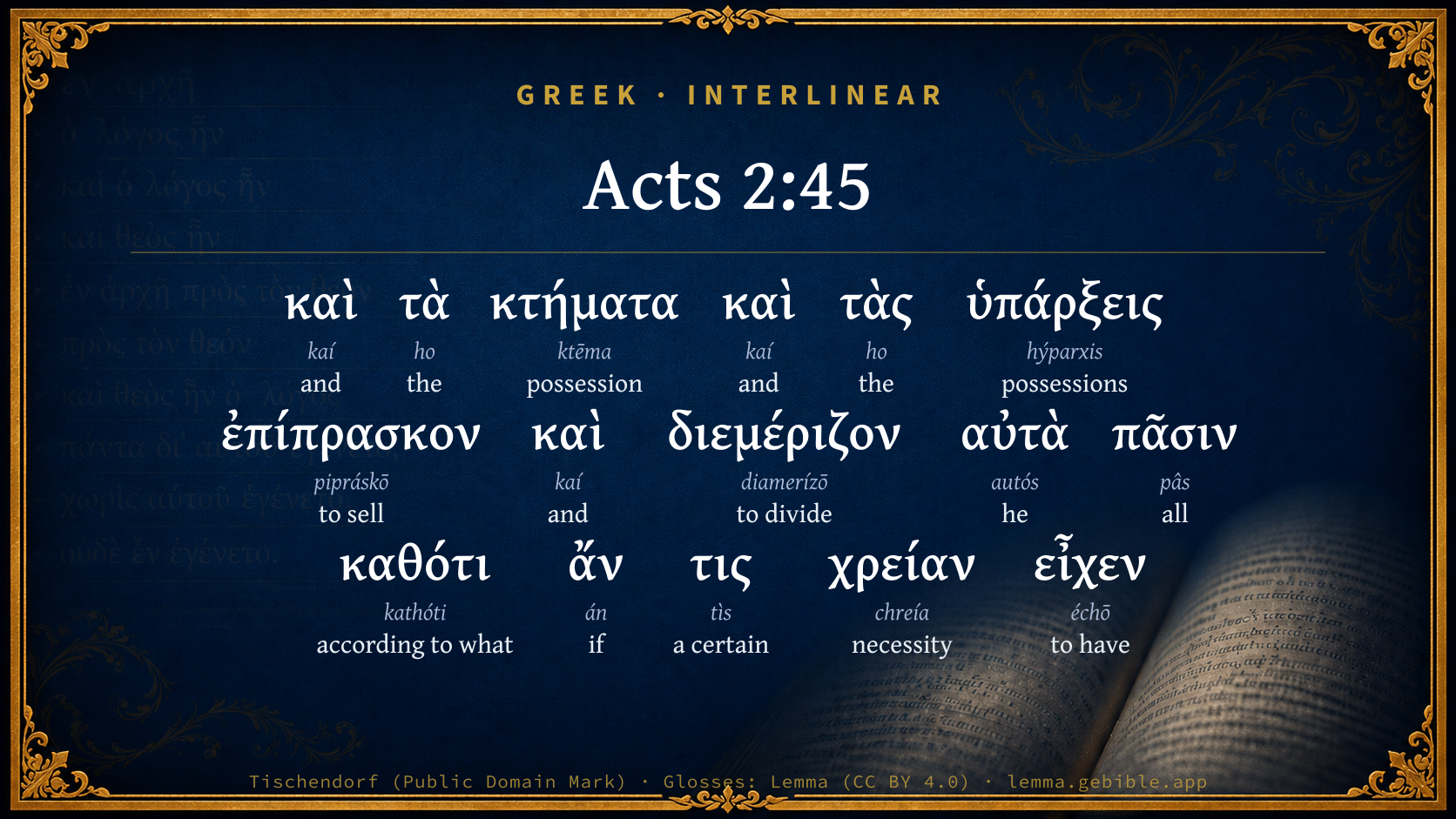
Greek (Tischendorf 8th ed.) Acts 2:45 appears in the Greek New Testament. The text above is from the Tischendorf 8th edition. Each word links to its Strong’s number and a concise gloss. Click any word for its full Thayer’s Greek Lexicon entry.
Download image
Cite this verse

Acts 2:45 (World English Bible). Public Domain. Lemma interlinear Bible study tool, https://lemma.gebible.app/v/acts/2/45.

Show BibTeX & RIS
BibTeX
RIS
English Translation
They sold their possessions and goods, and distributed them to all, according as anyone had need.
World English Bible · Public Domain
Highlights
  • 1 first appearance in the Greek New Testament
Full analysis ↓
Download a study sheet

One document with this verse’s original text, its word-by-word gloss line, the meaning frame, cross-references with their text, attributed commentary, and full source and license credits — printable, and it pastes into notes with its structure intact.

This verse Autodidact and up

Study sheet (.html) Plain text (.txt)

A passage Seminary Student

Up to 50 verses in one chapter. A passage sheet keeps up to 6 commentary sources and 12 cross-references per verse, in the order this page ranks them, and says so on the sheet whenever that leaves anything out. Ask for a single verse and you get the Autodidact verse sheet above.

Everything on this page stays free to read, with no account — the sheet is a download of what is already on screen, not access to it.

Want to remove ads? Support Godless Engineer
Compare translations 3

The same verse in 3 English versions, stacked beneath the original-language interlinear above. Click any original word for its lexicon entry.

Each is an independent rendering of the whole verse — the interlinear is not word-aligned to these translations.

Highlighted words mark where these versions differ — a whole-verse word diff, not a word-by-word alignment.

  • World English Bible Public Domain
    They sold their possessions and goods, and distributed them to all, according as anyone had need.
  • King James Version Public Domain
    And sold their possessions and goods, and parted them to all men, as every man had need.
  • unfoldingWord Literal Text CC BY-SA 4.0
    and they were selling properties and possessions and they were distributing them to all, as anyone might have need

unfoldingWord Literal Text — © unfoldingWord, licensed CC BY-SA 4.0. Word-aligned USFM3 via Door43 (git.door43.org/unfoldingWord/en_ult).

Versions to compare (up to 4)

3 of 4 selected

Show all 19 translations

Every available English version of this verse, each an independent rendering of the whole verse.

  • World English Bible Public Domain
    They sold their possessions and goods, and distributed them to all, according as anyone had need.
  • Berean Standard Bible Public Domain
    Selling their possessions and goods, they shared with anyone who was in need.
  • Majority Standard Bible Public Domain
    Selling their possessions and goods, they shared with anyone who was in need.
  • King James Version Public Domain
    And sold their possessions and goods, and parted them to all men, as every man had need.
  • American Standard Version (1901) Public Domain
    and they sold their possessions and goods, and parted them to all, according as any man had need.
  • Revised Version (1885) Public Domain
    and they sold their possessions and goods, and parted them to all, according as any man had need.
  • Geneva Bible (1599) Public Domain
    And they sold their possessions and goods, and parted them to all me, as euery one had need.
  • Douay-Rheims (1899) Public Domain
    Their possessions and goods they sold, and divided them to all, according as every one had need.
  • Young's Literal Translation Public Domain
    and the possessions and the goods they were selling, and were parting them to all, according as any one had need.
  • Literal Standard Version CC BY-SA 4.0
    and they were selling the possessions and the goods, and were parting them to all, according as anyone had need.
  • Unlocked Literal Bible CC BY-SA 4.0
    and they sold their property and possessions and distributed them to all, according to the needs anyone had.
  • unfoldingWord Literal Text CC BY-SA 4.0
    and they were selling properties and possessions and they were distributing them to all, as anyone might have need
  • Darby Bible Public Domain
    and sold their possessions and substance, and distributed them to all, according as any one might have need.
  • World Messianic Bible Public Domain
    They sold their possessions and goods, and distributed them to all, according as anyone had need.
  • Webster's Bible Public Domain
    And sold their possessions and goods, and parted them to all men, as every man had need.
  • Free Bible Version CC BY-SA 4.0
    They sold their property and belongings, sharing the proceeds with everyone as they needed.
  • Bible in Basic English Public Domain
    And exchanging their goods and property for money, they made division of it among them all, as they had need.
  • Text-Critical English NT CC BY 4.0
    They were selling their possessions and belongings, and distributing the proceeds to all, as anyone had need.
  • Tyndale New Testament (1534) Public Domain
    and solde their possessions and goodes and departed them to all men as every man had nede.

Literal Standard Version (2020), Covenant Press — licensed CC BY-SA 4.0. Text via the HelloAO Bible API (eBible.org). Unlocked Literal Bible (unfoldingWord) — licensed CC BY-SA 4.0. Text via the HelloAO Bible API (eBible.org). unfoldingWord Literal Text — © unfoldingWord, licensed CC BY-SA 4.0. Word-aligned USFM3 via Door43 (git.door43.org/unfoldingWord/en_ult). Free Bible Version, Dr. Jonathan Gallagher — licensed CC BY-SA 4.0. Text via the HelloAO Bible API (eBible.org).

Word by word

More ways to search: Search by grammar → Find every occurrence → Compare this word →

Practice this passage: Drill this verse → Learn its vocabulary →

ὑπάρξεις
hýparxis
G5223
“possessions”
Noun, Accusative, Plural, Feminine
Part of Speech
Noun
Case
Accusative
Number
Plural
Gender
Feminine
Full Thayer's Definition

Origin: from G5225

TDNT: None

1. possessions, goods, wealth, property
  1. καὶ kaí G2532 “and” Conjunction
  2. τὰ ho G3588 “the” Article, Accusative, Plural, Neuter
  3. κτήματα ktēma G2933 “possession” Noun, Accusative, Plural, Neuter
  4. καὶ kaí G2532 “and” Conjunction
  5. τὰς ho G3588 “the” Article, Accusative, Plural, Feminine
  6. ἐπίπρασκον pipráskō G4097 “to sell” Verb, Imperfect, Active, Indicative, 3rd person, Plural
  7. καὶ kaí G2532 “and” Conjunction
  8. διεμέριζον diamerízō G1266 “to divide” Verb, Imperfect, Active, Indicative, 3rd person, Plural
  9. αὐτὰ autós G846 “he” Personal pronoun, Accusative, Plural, Neuter
  10. πᾶσιν pâs G3956 “all” Adjective, Dative, Plural, Masculine
  11. καθότι kathóti G2530 “according to what” Adverb
  12. ἄν án G302 “if” Particle
  13. τις tìs G5100 “a certain” Indefinite pronoun, Nominative, Singular, Masculine
  14. χρείαν chreía G5532 “necessity” Noun, Accusative, Singular, Feminine
  15. εἶχεν échō G2192 “to have” Verb, Imperfect, Active, Indicative, 3rd person, Singular

About this verse

These counts appear in no published source. They are computed here, from the morphology-tagged text and Lemma’s own curated glosses. What Lemma adds →

16
words
13
distinct lemmas
Acts
section

Notable vocabulary

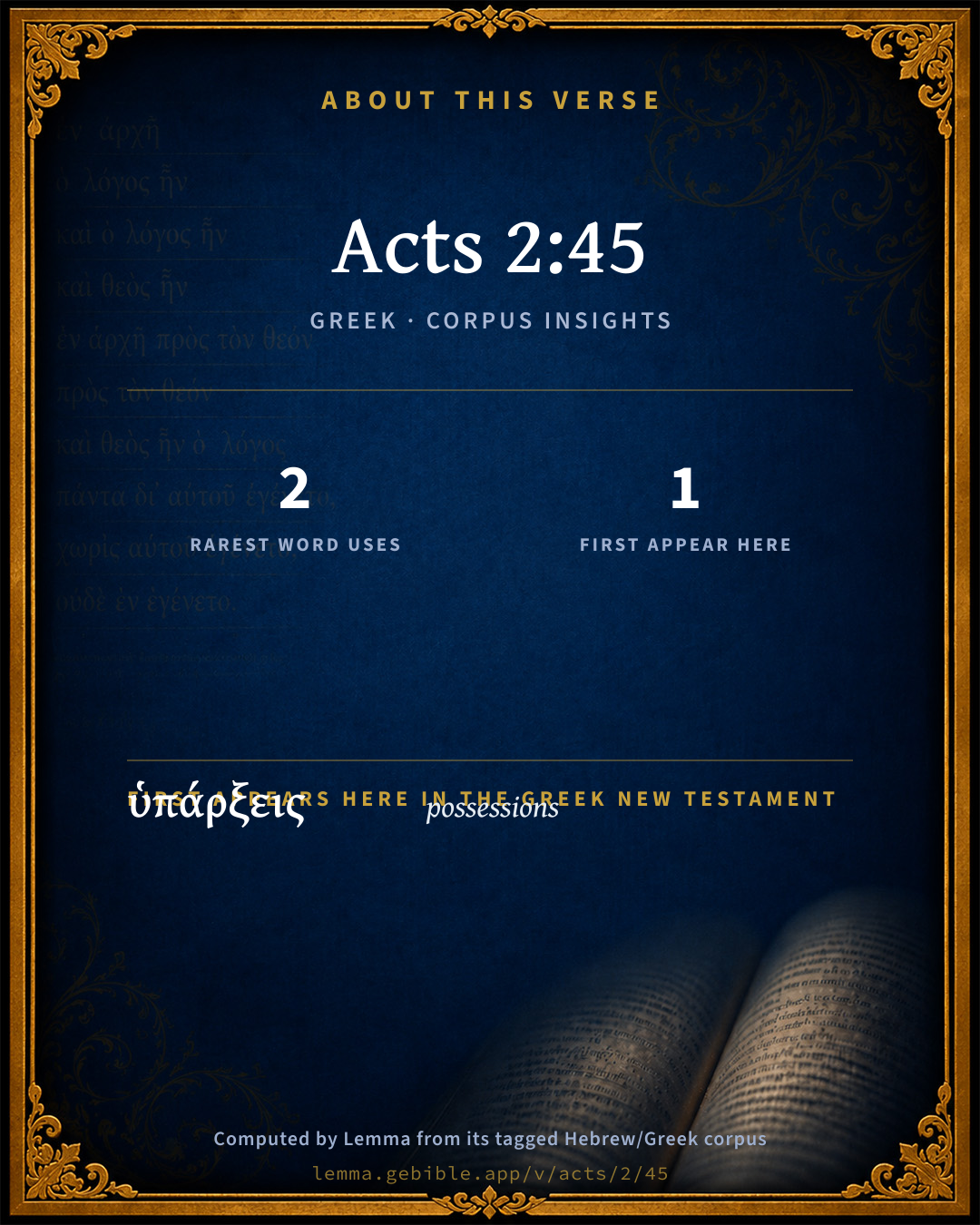
The rarest word here is ὑπάρξεις possessions G5223 — appearing just 2 times in the whole Greek New Testament.

First appearance in Scripture

This word makes its first canonical appearance in the Greek New Testament here:

  • ὑπάρξεις possessions G5223

Shared distinctive vocabulary

ὑπάρξεις possessions G5223 occurs in 2 verses of the Greek New Testament. Also found in:
Repetition

Words recur within this verse:

Cross-references

18

Topical passages linked to Acts 2:45 in the Treasury of Scripture Knowledge — connected by theme and wording, ordered by reader-vote popularity; previews shown in the World English Bible.

  • 1 John 3:17 But whoever has the world's goods, and sees his brother in need, and closes his heart of compassion against him, how does the love of God remain in him?
  • 1 Timothy 6:18–19 that they do good, that they be rich in good works, that they be ready to distribute, willing to communicate;
  • Acts 4:34–5:2 For neither was there among them any who lacked, for as many as were owners of lands or houses sold them, and brought the proceeds of the things that were sold,
  • James 2:14–16 What good is it, my brothers, if a man says he has faith, but has no works? Can faith save him?
  • Proverbs 19:17 He who has pity on the poor lends to Yahweh; He will reward him.
  • Luke 18:22 When Jesus heard these things, he said to him, "You still lack one thing. Sell all that you have, and distribute it to the poor. You will have treasure in heaven. Come, follow me."
  • Proverbs 11:24–25 There is one who scatters, and increases yet more. There is one who withholds more than is appropriate, but gains poverty.
  • Isaiah 58:7–12 Isn't it to deal your bread to the hungry, and that you bring the poor who are cast out to your house? when you see the naked, that you cover him; and that you not hide yourself from your own flesh?
  • Matthew 19:21 Jesus said to him, "If you want to be perfect, go, sell what you have, and give to the poor, and you will have treasure in heaven; and come, follow me."
  • Luke 12:33–34 Sell that which you have, and give gifts to the needy. Make for yourselves purses which don't grow old, a treasure in the heavens that doesn't fail, where no thief approaches, neither moth destroys.
  • Acts 11:29 As any of the disciples had plenty, each determined to send relief to the brothers who lived in Judea;
  • 2 Corinthians 9:9 As it is written, "He has scattered abroad, he has given to the poor. His righteousness remains forever."
  • Psalms 112:9 He has dispersed, he has given to the poor. His righteousness endures forever. His horn will be exalted with honor.
  • Ecclesiastes 11:1–2 Cast your bread on the waters; For you shall find it after many days.
  • Luke 19:8 Zacchaeus stood and said to the Lord, "Behold, Lord, half of my goods I give to the poor. If I have wrongfully exacted anything of anyone, I restore four times as much."
  • Luke 16:9 I tell you, make for yourselves friends by means of unrighteous mammon, so that when you fail, they may receive you into the eternal tents.
  • James 5:1–5 Come now, you rich, weep and howl for your miseries that are coming on you.
  • 2 Corinthians 9:1 It is indeed unnecessary for me to write to you concerning the service to the saints,

Cross-references courtesy of OpenBible.info (CC BY 4.0).

Commentary

Notes on Acts 2:45 from classic Christian and Jewish commentators (each source and its license shown beneath its notes). The classic Christian expositions comment on the surrounding passage and are grouped to its opening verse, so a note may address several verses; the Jewish commentaries on the Tanakh (Rashi and others) are per-verse, so they appear only where the commentator wrote on this verse.

Lemma curates 59 commentaries, every one of them public domain or Creative Commons licensed, each selected and text-cleaned for this edition rather than reprinted as found. About our sources →

Bengel's Gnomon

Johann Albrecht Bengel

Act 2:45. Κτήματα, possessions) lands and houses: ch. Act 5:1; Act 5:8.—ὑπάρξεις, their goods, effects) viz. of a moveable kind.—ἐπίπρασκον, they sold) The direction of the Lord, Luk 12:33, “Sell that ye have, and give alms,” spoken a short while before to the disciples, and applying to all times, was especially applicable to the time then being. [So afterwards, at the destruction of Jerusalem, they had nothing to lose: and their all was in the meantime laid out to the best account. The impending calamities of the time move the more prudent, not to parsimony, but to liberality. Ecc 11:2, “Give a portion to seven and also to eight, for thou knowest not what evil shall be upon the earth.” Jas 5:3.—V. g.]—διεμέριζον, they parted or distributed them) The Passive, διεδίδοτο, division was made, ch. Act 4:35. The multitude was from time to time increasing.[23] The dividers of their goods were believers themselves; the apostles; the seven deacons.—αὐτὰ, them) all things in common, even the money from the goods which were sold.—καθότι, according as) not as in the societies of the world, where each receives from the common fund according to the magnitude of the share that he has contributed, not according to his need.

[23] Therefore, whilst at first they shared their goods (διεμέριζον) with all, subsequently, when the numbers of believers were large, a division was made on a more systematic plan.—E. and T.

Bengel's Gnomon of the New Testament — English translation (T&T Clark, Edinburgh, 1860) — public domain. Text from a community e-Sword module.

Expositor's Greek Testament

ed. W. Robertson Nicoll

Act 2:45 . τὰ κτήματα … τὰς ὑπάρξεις : according to their derivation, the former word would mean that which is acquired, and the latter that which belongs to a man for the time being. But in ordinary usage κτήματα was always used of real property, fields, lands, cf. Act 5:1 , whilst ὑπάρξεις was used of personal property (= τὰ ὑπάρχοντα in Heb 10:34 ). This latter word, to, τὰ ὑπάρχοντα , was a favourite with St. Luke, who uses it eight times in his Gospel and in Act 4:32 . No doubt κτῆμα is used in LXX for field and vineyard, Pro 23:10 ; Pro 31:16 , but the above distinction was not strictly observed, for τὰ ὑπάρχοντα , ὕπαρξις , are used both of movable and immovable property (see Hatch and Redpath, sub v. ). ἐπίπρασκον : all three verbs are in the imperfect, and if we remember that this tense may express an action which is done often and continuously without being done universally or extending to a complete accomplishment ( cf. Act 4:34 , Act 18:8 , Mar 12:41 ), considerable light may be thrown upon the picture here drawn (see Blass, Grammatik des N. G. , p. 186, on the tense and this passage): “And kept getting … and distributing to all, as any man [ τις ] [not ‘every man,’ A.V.] had need”. See Rendall, Acts, in loco , and on Act 4:32 , and Expositor , vii., p. 358, 3rd series. καθότι : peculiar to St. Luke; in Gospel twice, and in Acts four times, ἄν makes the clause more indefinite: it is found in relative clauses after ὅς , ὅστις , etc., with the indicative here it is best explained as signifying “accidisse aliquid non certo quodam tempore, sed quotiescumque occasio ita ferret,” quoted by Wendt from Herm., ad Vig. , p. 820; cf. Mar 6:56 , Blass, in loco , and Viteau, Le Grec du N. T. , p. 142 (1893). Grimm renders καθότι ἄν here “in so far,” or “so often as,” “according as”. Spitta refers Act 2:45-47 to the Apostles only, but to justify this he is obliged to refer Act 2:44 to his reviser. Hilgenfeld brackets the whole verse, referring it to his “author to Theophilus,” retaining Act 2:44 , whilst Weiss also refers the whole verse to a reviser, who introduced it in imitation of St. Luke’s love of poverty as indicated in his Gospel. But by such expedients the picture of the whole body of the believers sharing in the Apostles’ life and liberality is completely marred.

The Expositor's Greek Testament, edited by W. Robertson Nicoll (1897–1910) — public domain. Text from a community e-Sword module.

Ellicott's Commentary for English Readers

(45) And sold their possessions and goods.—The verbs throughout this description are in the imperfect tense, as expressing the constant recurrence of the act. The Greek words for “possessions” and “goods” both mean “property,” the former as a thing acquired, the latter as that which belongs to a man for the time being. Custom, however, had introduced a technical distinction, and “possessions” stands for real property, “goods” for personal. So in Act_5:1; Act_5:3; Act_5:8, the former word is used interchangeably with that which is translated “field,” and in the LXX. of Pro_23:10; Pro_31:16, is used both for “field” and “vineyard.”

As every man had need.—The words imply at least the endeavour to discriminate. The money was not given literally to every one who applied for it, and so the way was prepared for more fixed and definite rules.

A Bible Commentary for English Readers, edited by Charles John Ellicott (1878–1897) — public domain. Text from a community e-Sword module.

The Cambridge Bible for Schools and Colleges

gen. ed. J. J. S. Perowne

45. And sold their possessions, &c.] For the money which resulted from such sales would be the most convenient form in which their bounty could be bestowed on those who needed it.

as every man had need] Better, according as any man had need. We gather from this that the first converts kept their homes and things needful for themselves, but held the rest as a trust for the Church to be bestowed whenever need was seen. This is an earlier stage than that in which the money was brought and put at the disposal of the Apostles.

The Cambridge Bible for Schools and Colleges (gen. ed. J. J. S. Perowne; Cambridge University Press, 1878–1918) — public domain. Text from a community e-Sword module.

John Gill's Exposition

And they continued daily with one accord in the temple,.... Every day they went up to the temple, at the time of prayer, or whenever any religious service was to be performed; this was their constant practice, and in this they agreed:

and breaking bread from house to house; either administering the Lord's supper in private houses, as the Jews kept their passover, sometimes administering it at one house, and sometimes at another; or because their number was so large, that one house could not hold them, they divided themselves into lesser bodies; and some met, and had the ordinance administered to them in one house, and some in another: or this may be understood of their common meals, which they ate together at one another's houses in great love and friendship; for

they did eat their meat with gladness; with great thankfulness to the God of their mercies for their daily food, acknowledging that all came from him, and that they were undeserving of it, and with much cheerfulness and affability one among another, without murmuring and repining at their lot, or envying each other, or grudging what each other partook of:

and singleness of heart; without deceit and hypocrisy; either in their thanksgivings to God, or in their welcome and entertainment of each other; and with great sincerity, openness, and frankness before God, and one another. The Syriac version joins this clause with the beginning of the next verse, "with singleness of heart, praising God".

John Gill's Exposition of the Whole Bible (1746–1763) — public domain (CC PDM 1.0). Text via the HelloAO Bible API.

Trapp's Complete Commentary

John Trapp

45 And sold their possessions and goods, and parted them to all men, as every man had need.

Ver. 45. And sold] So Tyre when once converted, Isa 23:17-18.

John Trapp, A Commentary or Exposition upon All the Books of the Old and New Testament (1647–1656) — public domain. Text from a community e-Sword module.

Albert Barnes' Notes on the Bible

And sold - That is, they sold as much as was necessary in order to procure the means of providing for the needs of each other.

Possessions - Property, particularly real estate. This word, κτήματα ktēmata, refers properly to their fixed property, as lands, houses, vineyards, etc. The word rendered “goods,” ὑπάρξεις huparxeis, refers to their personal or movable “property.”

And parted them to all - They distributed them to supply the needs of their poorer brethren, according to their necessities.

As every man had need - This expression limits and fixes the meaning of what is said before. The passage does not mean that they sold all their possessions, or that they relinquished their title to all their property, but that they so far regarded all as common as to be willing to part with it if it was needful to supply the needs of the others. Hence, the property was laid at the disposal of the apostles, and they were desired to distribute it freely to meet the needs of the poor, Act 4:34-35.

This was an important incident in the early propagation of religion, and it may suggest many useful reflections:

1. We see the effect of religion. The love of property is one of the strongest affections which people have. There is nothing that will overcome it but religion. That will; and one of the first effects of the gospel was to loosen the hold of Christians on property.

2. It is the duty of the church to provide for the needs of its poor and needy members. There can be no doubt that property should now be regarded as so far common as that the needs of the poor should be supplied by those who are rich. Compare Mat 26:11.

3. If it be asked why the early disciples evinced this readiness to part with their property in this manner, it may be replied:

That the apostles had done it before them. The family of the Saviour had all things common.

(2)It was the nature of religion to do it.

(3)The circumstances of the persons assembled on this occasion were such as to require it. They were many of them from distant regions, and probably many of them of the poorer class of the people in Jerusalem. In this they evinced what should be done in behalf of the poor in the church at all times.

4. If it be asked whether this was done commonly among the early Christians, it may be replied that there is no evidence that it was. It is mentioned here, and in Act 4:32-37, and Act 5:1-7. It does not appear that it was done even by all who were afterward converted in Judea; and there is no evidence that it was done in Antioch, Ephesus, Corinth, Philippi, Rome, etc. That the effect of religion was to make people liberal and willing to provide for the poor there can be no doubt. See 2Co 8:19; 2Co 9:2; 1Co 16:2; Gal 2:10. But there is no proof that it was common to part with their possessions and to lay them at the feet of the apostles. Religion does not contemplate, evidently, that people should break up all the arrangements in society, but it contemplates that those who have property should be ready and willing to part with it for the help of the poor and needy.

5. If it be asked, then, whether all the arrangements of property should be broken up now, and believers have all things in common, we are prepared to answer “No.” Because:

This was an extraordinary case.

(2)It was not even enjoined by the apostles on them.

(3)It was practiced nowhere else.

(4)It would be impracticable. No community where all things were held in common has long prospered. It has been attempted often, by pagans, by infidels, and by fanatical sects of Christians. It ends soon in anarchy, licentiousness, idleness, and profligacy; or the more cunning secure the mass of the property, and control the whole. Until all people are made alike, there could be no hope of such a community; and if there could be, it would not be desirable. God evidently intended that people should be excited to industry by the hope of gain; and then he demands that their gains shall be devoted to his service. Still, this was a noble instance of Christian generosity, and evinced the power of religion in loosing the hold which people commonly have on the world. It rebukes also those professors of religion, of whom, alas, there are many, who give nothing to benefit either the souls or bodies of their fellow-men.

Albert Barnes' Notes on the Bible (1834–1885) — public domain. Text from a community e-Sword/MySword module.

Matthew Poole's English Annotations

Those proportions of their estate they set apart to this charitable work; whether they did arise out of the sale of house or land, called

possessions, or of any chattels or movable estate, called here goods: but that they did not divest themselves of all property, appears in that we find soon after this, Act 12:12, Mary the mother of St. Mark to have a house; and Lydia, after she was baptized, did not renounce any propriety in her house, Act 16:15, but entreated St. Paul, and those who were with him, to come into her house, &c.

Matthew Poole's English Annotations on the Holy Bible (1683–1685) — public domain. Text from a community e-Sword/MySword module.

Whedon's Commentary on the Bible

Daniel D. Whedon

45. Sold their possessions—Under the Pentecostal power the solids melted into fluids.

Daniel D. Whedon (gen. ed.), Commentary on the Old and New Testaments (1874–1909) — public domain. Text from a community e-Sword module.

The Pulpit Commentary

They sold for sold, A.V.; all for all men, A.V.; according as any for as every, A.V.

The Pulpit Commentary (1880–1919), ed. H.D.M. Spence-Jones & Joseph S. Exell — public domain. Text from a community e-Sword module.

John Wesley's Explanatory Notes

And sold their possessions - Their lands and houses; and goods - Their movables. And parted them to all as any one had need - To say the Christians did this only till the destruction of Jerusalem, is not true; for many did it long after. Not that there was any positive command for so doing: it needed not; for love constrained them. It was a natural fruit of that love wherewith each member of the community loved every other as his own soul. And if the whole Christian Church had continued in this spirit, this usage must have continued through all ages. To affirm therefore that Christ did not design it should continue, is neither more nor less than to affirm, that Christ did not design this measure of love should continue. I see no proof of this.

John Wesley, Explanatory Notes Upon the Whole Bible (1754–1765) — public domain. Text via the GEBible commentary corpus.

McGarvey & Pendleton's Commentaries

J. W. McGarvey

See notes on verse 44

J. W. McGarvey (with Philip Y. Pendleton), Commentaries on the New Testament (The Fourfold Gospel, 1914; Acts; and the epistles) — public domain. Text from a community e-Sword/MySword module.

The People's New Testament

B. W. Johnson

45. Sold their possessions. Real estate. Goods. Personal property. Parted them to all men. On this special liberality we may note, (1) It partly arose from the non-resident or pilgrim character of a large part of the converts. (2) It was not an obligatory rule; the laws of ownership or property were not disturbed or questioned. Even Ananias might have kept all his land unblamed,

B. W. Johnson's The People's New Testament with Notes (1889–1891) — public domain. Electronic text from the Christian Classics Ethereal Library (CCEL) ThML edition.

Cambridge Greek Testament for Schools and Colleges

45. κτήματα … ὑπάρξεις. The Vulg. distinguishes the words by rendering ‘possessiones et substantias.’ The former of the Greek words seems to imply those means which were at the time actively employed in the acquisition of more wealth; this would include farming and trade stock, &c., while ὕπαρξις refers rather to realized property (cf. however Act 4:34). Soon, it seemed, there would be no need for either, and the produce of their sale was the most convenient form in which the bounty could be used for those who needed it.

καθότι ἄν τις χρείαν εἶχεν, according as any man had need. We gather from this that the first converts kept their homes and things needful for themselves, but held the rest as a trust for the Church to be bestowed whenever need was seen. This is an earlier stage than that in which the money was brought and put at the disposal of the Apostles.

The verb εἶχεν is in the indicative notwithstanding the preceding καθότι ἂν, because the writer’s intention is to describe a fact, viz. that there were persons in need.

Cambridge Greek Testament for Schools and Colleges (Cambridge University Press, 1896; 21 vols, various authors incl. Carr, Maclear, Plummer, Farrar, Lumby, Moule, M. R. James, Simcox) — public domain. Text from a community e-Sword module.

Alford’s Greek Testament

Henry Alford

45.] κτήματα, [probably] landed property, ch. 5:1—see reff.: ὑπάρξεις, any other possession; moveables, as distinguished from land.

αὐτά, their price; see a similar construction Mat 26:9; and Winer, edn. 6, § 22. 3. 4.

καθότι ἂν …] The ἄν with imperf. indic. in this connexion implies ‘accidisse aliquid non certo quodam tempore, sed quotiescunque occasio ita ferret,’ Herm. ad Viger., p. 818. See ch. 4:35; Mar 6:56; Mar 11:24; Soph. Philoct. 290 ff.; Aristoph. Lys. 510 ff.

Henry Alford, The Greek Testament (1849–1861) — public domain. Text from a community e-Sword module.

Vincent's Word Studies in the New Testament

Marvin R. Vincent

Possessions [κτηματα] . Landed property.

Goods [υπαρξεις] . Possessions in general; movables.

Marvin R. Vincent, Word Studies in the New Testament (1887–1900) — public domain. Text from a community e-Sword/MySword module.

Lesson kit

Teaching starters — assembled from the data on this page, not authored interpretation. Every prompt links to the verse data it draws on. Edit before teaching.

Acts, in the Acts, opens this verse with 16 words (13 distinct Greek lemmas). Its most distinctive word is hýparxis (“possessions”). A historical commentator’s framing appears above. Read the whole chapter for the surrounding context.

Discussion questions

  1. What does “possessions” (hýparxis) contribute to the verse as a whole?
  2. The word “possessions” first appears here in Scripture. What is being introduced at this debut?
  3. Hebrews 10:34 shares the word «possessions» with this verse. How do the two illuminate each other?
  4. “and” occurs 3× in this one verse. What is the effect of the repetition?
  5. These translations render this verse differently; the difference is in the English rendering, not the original. What questions does that raise?
  6. Reading how Bengel's Gnomon and Expositor's Greek Testament read this verse, where do the two commentators agree and where do they part?

Things to notice

  • 1 word makes its first canonical appearance in Scripture here.
  • These translations choose different wording for 15 words in this verse.
  • “and” occurs 3× in this single verse.
  • 13 distinct Greek lemmas span 16 words in this verse.

Reading settings

Reading text

Shown beneath each verse's original-language words.

Old Testament
Old Testament edition

Read the OT as the Masoretic Hebrew (MT) or the Greek Septuagint (LXX).

English shown for the Greek Septuagint (in the Hebrew ↔ Greek comparison).

Comparing translations? Open the Compare panel on any verse page to stack up to four side by side.