
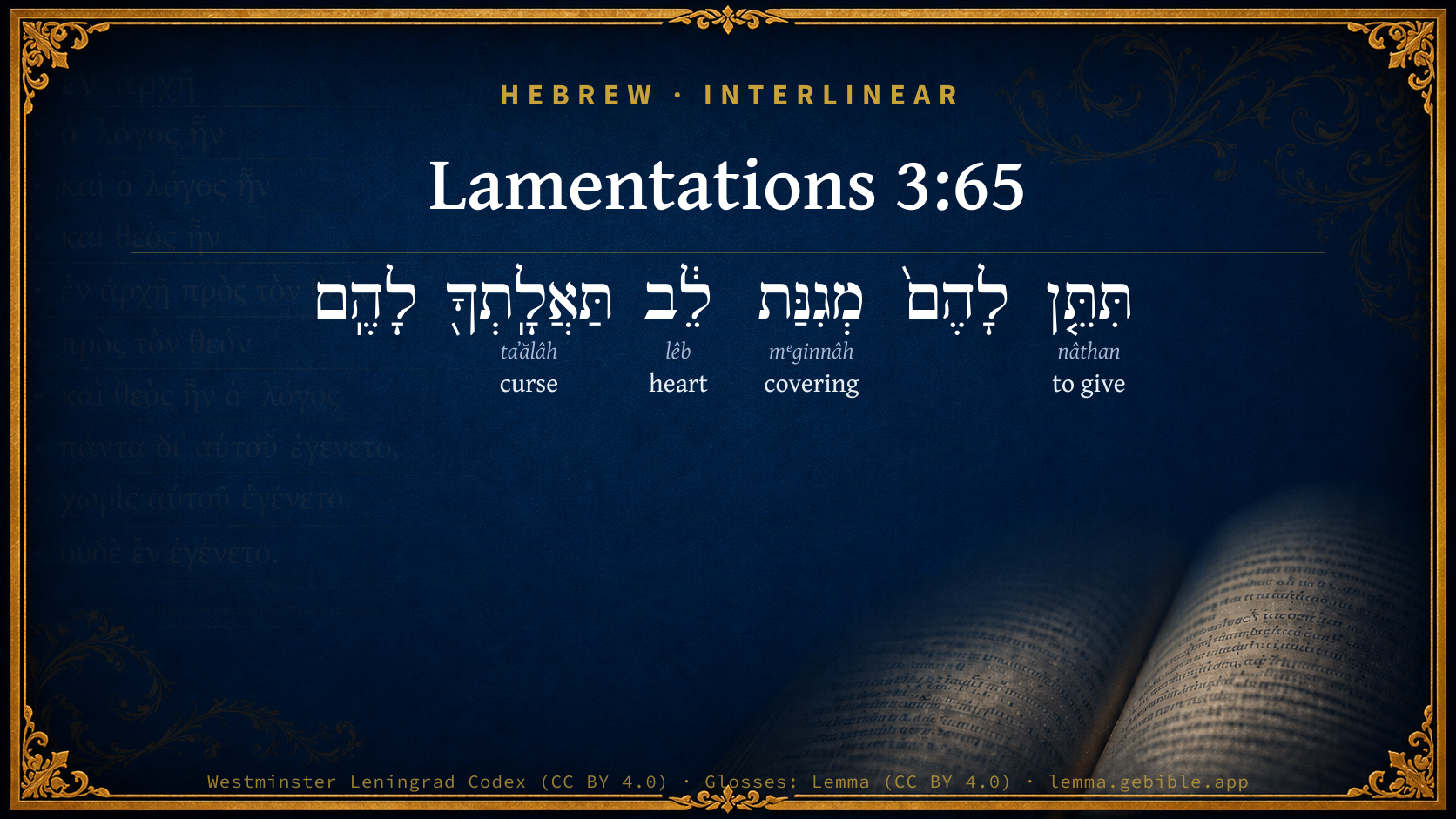
Lamentations 3:65

Hebrew (Westminster Leningrad Codex) Lamentations 3:65 appears in the Hebrew Old Testament. The text above is from the Westminster Leningrad Codex. Each word links to its Strong’s number, a concise gloss, and parsing drawn from the Open Scriptures Hebrew Bible morphology. Click any word for its full Brown-Driver-Briggs (BDB) entry.
Download image
Cite this verse

Lamentations 3:65 (World English Bible). Public Domain. Lemma interlinear Bible study tool, https://lemma.gebible.app/v/lamentations/3/65.

Show BibTeX & RIS
BibTeX
RIS
English Translation
You will give them hardness of heart, your curse to them.
World English Bible · Public Domain
Highlights
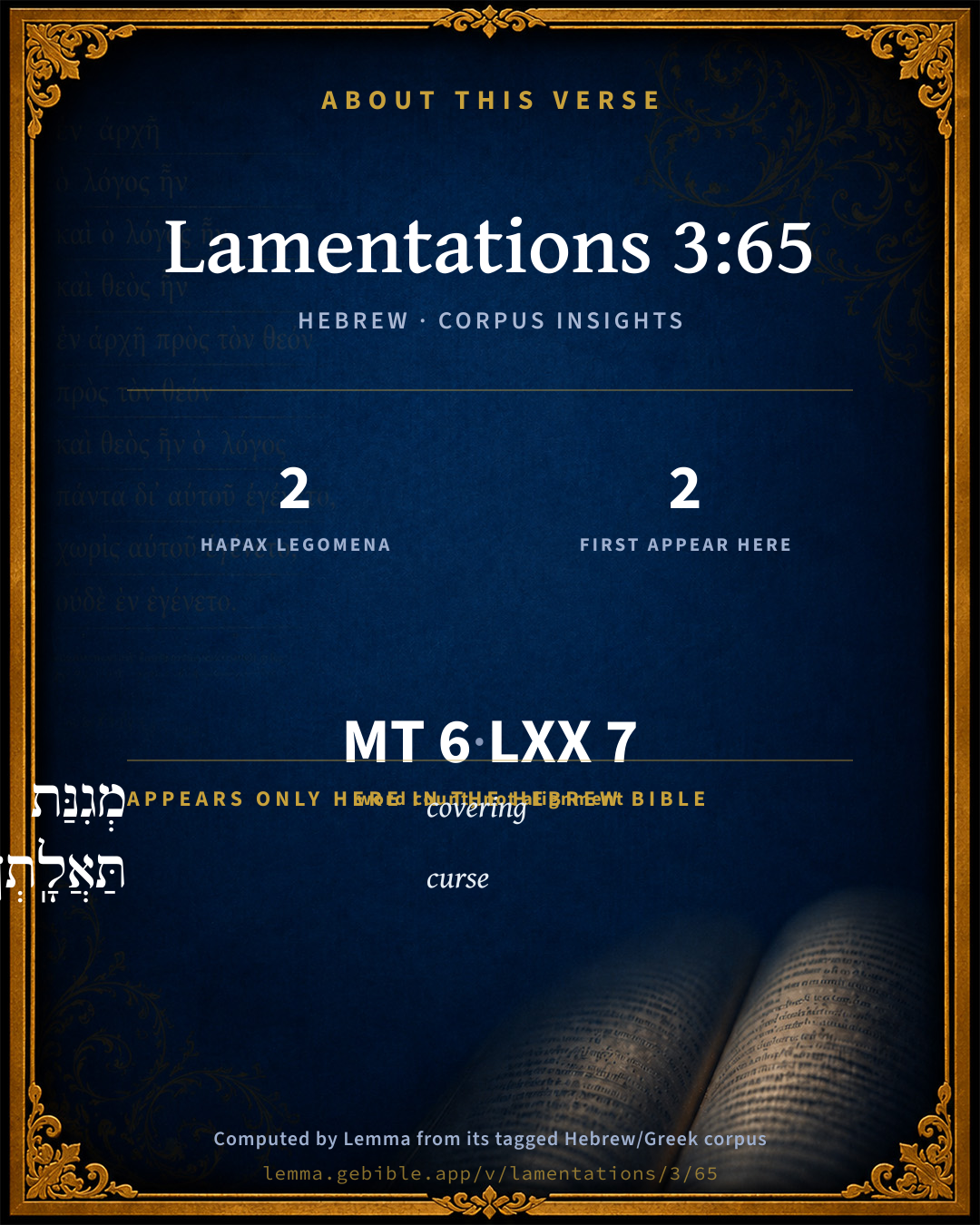
  • 2 hapax legomena — only here in the Hebrew Bible
  • 2 first appearances in the Hebrew Bible
Full analysis ↓
Download a study sheet

One document with this verse’s original text, its word-by-word gloss line, the meaning frame, cross-references with their text, attributed commentary, and full source and license credits — printable, and it pastes into notes with its structure intact.

This verse Autodidact and up

Study sheet (.html) Plain text (.txt)

A passage Seminary Student

Up to 50 verses in one chapter. A passage sheet keeps up to 6 commentary sources and 12 cross-references per verse, in the order this page ranks them, and says so on the sheet whenever that leaves anything out. Ask for a single verse and you get the Autodidact verse sheet above.

Everything on this page stays free to read, with no account — the sheet is a download of what is already on screen, not access to it.

Want to remove ads? Support Godless Engineer
Compare translations 3

The same verse in 3 English versions, stacked beneath the original-language interlinear above. Click any original word for its lexicon entry.

Each is an independent rendering of the whole verse — the interlinear is not word-aligned to these translations.

Highlighted words mark where these versions differ — a whole-verse word diff, not a word-by-word alignment.

  • World English Bible Public Domain
    You will give them hardness of heart, your curse to them.
  • King James Version Public Domain
    Give them sorrow of heart, thy curse unto them.
  • unfoldingWord Literal Text CC BY-SA 4.0
    You will give them a covering of heart; your curse be on them.

unfoldingWord Literal Text — © unfoldingWord, licensed CC BY-SA 4.0. Word-aligned USFM3 via Door43 (git.door43.org/unfoldingWord/en_ult).

Versions to compare (up to 4)

3 of 4 selected

Show all 18 translations

Every available English version of this verse, each an independent rendering of the whole verse.

  • World English Bible Public Domain
    You will give them hardness of heart, your curse to them.
  • Berean Standard Bible Public Domain
    Put a veil of anguish over their hearts; may Your curse be upon them!
  • Majority Standard Bible Public Domain
    Put a veil of anguish over their hearts; may Your curse be upon them!
  • King James Version Public Domain
    Give them sorrow of heart, thy curse unto them.
  • American Standard Version (1901) Public Domain
    Thou wilt give them hardness of heart, thy curse unto them.
  • Revised Version (1885) Public Domain
    Thou wilt give them hardness of heart, thy curse unto them.
  • Geneva Bible (1599) Public Domain
    Giue them sorow of heart, euen thy curse to them.
  • Douay-Rheims (1899) Public Domain
    Thau. Thou shalt give them a buckler of heart, thy labour.
  • Young's Literal Translation Public Domain
    Thou givest to them a covered heart, Thy curse to them.
  • Literal Standard Version CC BY-SA 4.0
    You give to them a covered heart, || Your curse to them.
  • Unlocked Literal Bible CC BY-SA 4.0
    You will let their hearts be shameless! May your condemnation be upon them!
  • unfoldingWord Literal Text CC BY-SA 4.0
    You will give them a covering of heart; your curse be on them.
  • Darby Bible Public Domain
    give them obduracy of heart, thy curse unto them;
  • World Messianic Bible Public Domain
    You will give them hardness of heart, your curse to them.
  • Webster's Bible Public Domain
    Give them sorrow of heart, thy curse to them.
  • Free Bible Version CC BY-SA 4.0
    Give them a covering for their minds! May your curse be on them!
  • Bible in Basic English Public Domain
    You will let their hearts be covered over with your curse on them.
  • JPS Tanakh (1917) Public Domain
    Thou wilt give them hardness of heart, Thy curse unto them.

Literal Standard Version (2020), Covenant Press — licensed CC BY-SA 4.0. Text via the HelloAO Bible API (eBible.org). Unlocked Literal Bible (unfoldingWord) — licensed CC BY-SA 4.0. Text via the HelloAO Bible API (eBible.org). unfoldingWord Literal Text — © unfoldingWord, licensed CC BY-SA 4.0. Word-aligned USFM3 via Door43 (git.door43.org/unfoldingWord/en_ult). Free Bible Version, Dr. Jonathan Gallagher — licensed CC BY-SA 4.0. Text via the HelloAO Bible API (eBible.org).

Word by word

More ways to search: Search by grammar → Find every occurrence → Compare this word →

Practice this passage: Drill this verse → Learn its vocabulary →

מְגִנַּת
mᵉginnâh
H4044
“covering of”
Noun, Common, Feminine, Singular, Construct
Part of Speech
Noun
Type
Common
Gender
Feminine
Number
Singular
State
Construct
Full BDB Definition

Origin: from H4042

TWOT: 367d

covering - covering, obstinacy, blindness (of the heart)
  1. תִּתֵּ֤ן nâthan H5414 “to give” Verb, Qal, Imperfect, 2nd Person, Masculine, Singular
  2. לֵ֔ב lêb H3820 “heart” Noun, Common, Masculine, Singular, Absolute
  3. תַּאֲלָֽתְךָ֖ taʼălâh H8381 “curse · your” Noun, Common, Feminine, Singular, Construct + Suffix, Personal, 2nd Person, Masculine, Singular

About this verse

These counts appear in no published source. They are computed here, from the morphology-tagged text and Lemma’s own curated glosses. What Lemma adds →

6
words
4
distinct lemmas
Prophets
section

Notable vocabulary

2 hapax legomena — words that appear only here in the entire Hebrew Bible:

  • מְגִנַּת covering H4044
  • תַּאֲלָֽתְךָ֖ curse H8381

First appearance in Scripture

These words make their first canonical appearance in the Hebrew Bible here:

  • מְגִנַּת covering H4044
  • תַּאֲלָֽתְךָ֖ curse H8381

Grammatical profile

  • 1 verb
  • 3 nouns
  • 2 prepositions

Verb forms

  • תִּתֵּ֤ן Qal · Imperfect

Hebrew & Septuagint length

In English translation the verse runs 11 words from the Hebrew and 13 from the Septuagint (LXX English) — closely comparable.

A rough comparison of the two English renderings, which tokenize alike — not a word-level alignment.

Word counts can differ between the Hebrew and the Greek without any difference in meaning — e.g. the Hebrew direct-object marker אֵת has no separate Greek word, and Greek often adds the article ὁ.

In the original languages it is 6 Hebrew tokens and 7 Greek tokens — but the two are counted differently (Hebrew bundles its prefixes and suffixes into one token; the Greek is in lemma form), so that isn’t a like-for-like length.

Cross-references

5

Topical passages linked to Lamentations 3:65 in the Treasury of Scripture Knowledge — connected by theme and wording, ordered by reader-vote popularity; previews shown in the World English Bible.

  • Isaiah 6:10 Make the heart of this people fat; Make their ears heavy, and shut their eyes; Lest they see with their eyes, And hear with their ears, And understand with their heart, And turn again, and be healed."
  • Deuteronomy 2:30 But Sihon king of Heshbon would not let us pass by him; for Yahweh your God hardened his spirit, and made his heart obstinate, that he might deliver him into your hand, as at this day.
  • 1 Corinthians 16:22 If any man doesn't love the Lord Jesus Christ, let him be accursed. Come, Lord!
  • Deuteronomy 27:15–26 Cursed be the man who makes an engraved or molten image, an abomination to Yahweh, the work of the hands of the craftsman, and sets it up in secret. All the people shall answer and say, Amen.
  • Psalms 109:17–18 Yes, he loved cursing, and it came to him. He didn't delight in blessing, and it was far from him.

Cross-references courtesy of OpenBible.info (CC BY 4.0).

Hebrew and Greek witnesses Masoretic Hebrew ↔ Greek Septuagint

The same verse in the two great witnesses to the Old Testament, shown verse-for-verse.

These are two independent witnesses, not word-aligned to each other, and the Septuagint is shown in lemma (dictionary) form.

Hebrew Lamentations 3:65 Masoretic · Westminster Leningrad Codex

תִּתֵּ֤ן לָהֶם֙ מְגִנַּת לֵ֔ב תַּאֲלָֽתְךָ֖ לָהֶֽם

You will give them hardness of heart, your curse to them.

World English Bible · Public Domain

Greek LXX Lamentations 3:65 Septuagint · lemma form

ἀποδίδωμι αὐτός ὑπερασπισμός καρδία μόχθος σύ αὐτός

THAU. You will give them as a covering, the grief of my heart.

LXX2012 (modern English Septuagint) · Public Domain

Hebrew: Westminster Leningrad Codex (CC BY 4.0). Greek: Septuagint (public domain); English from LXX2012 (modern English Septuagint) (Public Domain). How the Septuagint differs from the Hebrew →

Commentary

Notes on Lamentations 3:65 from classic Christian and Jewish commentators (each source and its license shown beneath its notes). The classic Christian expositions comment on the surrounding passage and are grouped to its opening verse, so a note may address several verses; the Jewish commentaries on the Tanakh (Rashi and others) are per-verse, so they appear only where the commentator wrote on this verse.

Lemma curates 59 commentaries, every one of them public domain or Creative Commons licensed, each selected and text-cleaned for this edition rather than reprinted as found. About our sources →

Ellicott's Commentary for English Readers

(65) Sorrow of heart—Literally, covering, with a sense like that of the “veil upon the heart” of 2Co_3:15, and so signifying the blindness of obstinacy. The imperatives in both Lam_3:65-66 are better rendered as futures—Thou shalt give; Thou shalt persecute.

A Bible Commentary for English Readers, edited by Charles John Ellicott (1878–1897) — public domain. Text from a community e-Sword module.

Trapp's Complete Commentary

John Trapp

Lam 3:65 Give them sorrow of heart, thy curse unto them.

Ver. 65. Give them sorrow of heart.] In place of their mad mirth and sinful music; turn their psalm - as the Vulgate rendereth the word music in the foregoing verse - into a black santis, as they call it, ferale carmen, a doleful ditty. Dabis eis scutum cordis, saith the Vulgate. And, indeed, the word rendered sorrow signifieth a shield or cover. It noteth, saith one, the cardiaca passio, {a} whereby the heart is so oppressed, and there is such a stopping, that it is as it were covered sicut scute, as with a shield; there is a lid, as it were, put over the heart to keep off the most refreshing cordials, and so the heart is suffocated with sorrow. {b} It is as if he should say, Put them into such a condition that no creature may yield them the least refreshment. Spira was in this condition.

Thy curse upon them.] All the curses written and unwritten in thy book. This is not more a prayer than a prophecy. How effectual Christ’s curse is, may be seen in the withered fig tree in the Gospel, presently dried up by the roots.

{a} A Lapide.

{b} Mr Burrough’s Hos. Operculum cordis, vel apostema cordis.

John Trapp, A Commentary or Exposition upon All the Books of the Old and New Testament (1647–1656) — public domain. Text from a community e-Sword module.

Geneva Bible (1599)

Geneva Bible translators

Or, an obstinate heart.

Geneva Bible (1599) marginal notes — public domain. Text via Bolls.life.

Jamieson, Fausset & Brown

Robert Jamieson, A. R. Fausset & David Brown

sorrow--rather, blindness or hardness; literally, "a veil" covering their heart, so that they may rush on to their own ruin (Isa 6:10; Co2 3:14-15).

Jamieson, Fausset & Brown — Commentary Critical and Explanatory on the Whole Bible (1871) — public domain (CC PDM 1.0). Text via the HelloAO Bible API.

Adam Clarke's Commentary

Verse 65. Give them sorrow of heart] They shall have a callous heart, covered with obstinacy, and thy execration. The former is their state, the latter their fate. This is the consequence of their hardening their hearts from thy fear. Blayney translates, "Thou wilt give with a hearty concordance thy curse unto them." That is, Thou wilt give it to them freely, and without reserve; intimating that God felt no longer any bowels of compassion for them. Formerly he inflicted punishments with reluctance, while there was any hope of amendment: but, in the instance before us, the case was so hopeless, that God acts according to the simple principle of vindictive justice. The prophet therefore considers them on the utmost verge of final reprobation: another plunge, and they are lost for ever.

Adam Clarke's Commentary on the Bible (1810–1826) — public domain. Text from a community e-Sword/MySword module.

John Calvin's Commentaries

He expresses what the vengeance was to be, even that God would give them up to a reprobate mind; for by מגנת-לב, meganet-leb, he no doubt meant the blindness of the heart, and at the same time included stupidity, as though he had said, “O Lord, so oppress them with evils, that they may become stupified.” For it is an extremity of evil, when we are so overpowered as not to be as it were ourselves, and when our evils do not drive us to prayer.

We now then perceive what the Prophet meant by asking God to give to his enemies the impediment of heart, even that he might take away a sound mind, and smite them with blindness and madness, as it is said elsewhere. — I run on quickly, that I may finish, lest the hour should prevent us. The last verse of this triple alphabet follows, —

John Calvin's Commentaries (1540-1563) — public domain. Text from the Calvin Translation Society English edition (1840s-50s) via the Christian Classics Ethereal Library (ccel.org). Calvin's coverage is partial (roughly two-thirds of the Bible); uncommented books and verses are honest gaps, never fabricated. The 19th-century editor's footnotes and remarks are omitted so the notes are faithfully Calvin's own voice.

The Cambridge Bible for Schools and Colleges

gen. ed. J. J. S. Perowne

65. hardness] or, as mg. blindness, Heb. covering. Cp. 2Co_3:15.

thy curse unto them] dependent on “wilt give,” or meaning, thy curse shall be unto them. Either of these explanations is more in accordance with the context than to make the clause an imprecation, May thy curse be upon them!

The Cambridge Bible for Schools and Colleges (gen. ed. J. J. S. Perowne; Cambridge University Press, 1878–1918) — public domain. Text from a community e-Sword module.

Haydock's Catholic Bible Commentary

Buckler, to cover all the body. They shall be surrounded with misery, (Psalm cviii. 29.) while God will protect his servants, Psalm v. 13. (Calmet) --- Let sorrow pierce their heart, as thy enemies are treated. (Worthington)

George Leo Haydock (1774–1849), Haydock's Catholic Family Bible and Commentary, 1859 edition — public domain. Excludes Psalms (Douay-Rheims chapter numbering differs from Protestant) and Deuterocanonical books (Catholic canon only).

Matthew Poole's English Annotations

The word translated

sorrow of heart is found no where else in holy writ, which makes a certain particular explication of it to be difficult, and hath given interpreters a strange liberty in translating it shield, sorrow, and grief, obstinacy or hardness of heart, perplexity, abjection or breaking of heart; the best guides we have to direct us in the sense of it are,

1. The other things joined with it; persecution, destruction, a recompence according to their works, so that some afflictive evil of a heavy nature is certainly signified by it.

2. The analogy of faith, which restraineth us from wishing or praying for spiritual or eternal evils against our worst enemies; it therefore probably signifies such perplexity and breakings of mind as commonly attend a state of great affliction.

Matthew Poole's English Annotations on the Holy Bible (1683–1685) — public domain. Text from a community e-Sword/MySword module.

The Pulpit Commentary

Sorrow of heart; rather, a covering of the heart; spiritual blindness, like the "veil upon the heart" in 2Co_3:15. Thy curse unto them. This should rather form a separate interjectional clause, "Thy curse upon them!"

The Pulpit Commentary (1880–1919), ed. H.D.M. Spence-Jones & Joseph S. Exell — public domain. Text from a community e-Sword module.

Rashi

Rabbi Shlomo Yitzchaki (Rashi)

Give them a weakness of heart Heb. מְגִנַת לֵב, a breaking of the heart, as Scripture says: (Hosea 11:8): “I shall break you (אֲמַגֶנְךָ), O Israel”; (Gen. 14:20): “who broke (מִגֵן) your adversaries in your hand.” Another explanation: מְגִנַתלֵב, stopping up of the heart, trouble and sighing, which are like a shield against the heart. But he who explains it as an expression of grief (תּוּגָה וְיָגוֹן) is in error, for there is no “nun” in this word, for the “nun” in יָגוֹן is not a radical, but is like the “nun” of הָמוֹן from the root of הָמוּ גוֹיִם and like קָלוֹן from the root of נִקְלֶה, and like the “nun” of צִיוֹן from the root of צִיָה and so the “nun” of שִּׁבְרוֹן from the root of שֶּׁבֶר (and like the “nun” of שִּׁגָעוֹן, שְּׁמָמוֹן. It appears to me that this is the correct reading, and this is easy to understand.)

Your curse An expression of (Isa. 19: 13): נוֹאֲלוּ שָׂרֵי צֹעַן, “The princes of Zoan have become foolish.”

Rashi on the Tanakh — English translations: “The Judaica Press complete Tanach with Rashi, translated by A. J. Rosenberg” (CC BY 4.0); “Pentateuch with Rashi's commentary by M. Rosenbaum and A.M. Silbermann, 1929-1934” (public domain); “The Metsudah Tanach series, Lakewood, N.J” (CC BY 4.0); and “The Book of Joshua, Metsudah Publications, 1997” (CC BY 4.0). Text via Sefaria.

Lesson kit

Teaching starters — assembled from the data on this page, not authored interpretation. Every prompt links to the verse data it draws on. Edit before teaching.

Lamentations, in the Prophets, opens this verse with 6 words (4 distinct Hebrew lemmas). Its most distinctive word is mᵉginnâh (“covering”). A historical commentator’s framing appears above. Read the whole chapter for the surrounding context.

Discussion questions

  1. What does “covering” (mᵉginnâh) contribute to the verse as a whole?
  2. 2 words here appear nowhere else in the Hebrew Bible. Why might the author reach for such rare wording?
  3. 2 words make their first appearance in Scripture here. What does this debut establish?
  4. How does Isaiah 6:10, which shares this passage’s theme, read alongside this verse?
  5. The translations on this page render this verse differently — a whole-verse word diff, not a word-by-word alignment. What might account for the different wordings?
  6. «תִּתֵּ֤ן» is a Qal Imperfect verb. How does that grammatical form shape the action described?
  7. Compare how Ellicott's Commentary for English Readers and Trapp's Complete Commentary read this verse. Where do they agree or differ?

Things to notice

Reading settings

Reading text

Shown beneath each verse's original-language words.

Old Testament
Old Testament edition

Read the OT as the Masoretic Hebrew (MT) or the Greek Septuagint (LXX).

English shown for the Greek Septuagint (in the Hebrew ↔ Greek comparison).

Comparing translations? Open the Compare panel on any verse page to stack up to four side by side.