
Proverbs 17:12

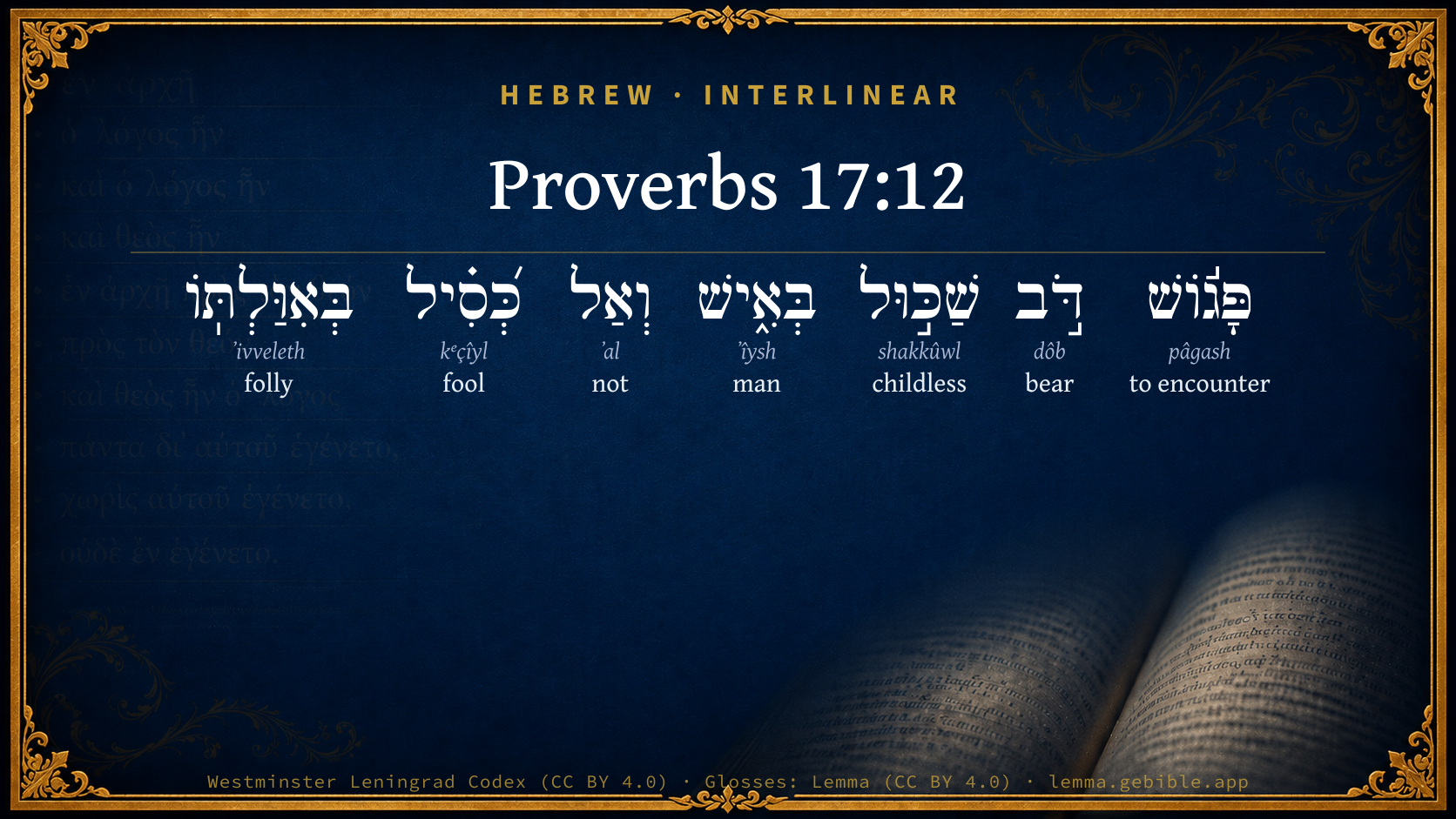
Hebrew (Westminster Leningrad Codex) Proverbs 17:12 appears in the Hebrew Old Testament. The text above is from the Westminster Leningrad Codex. Each word links to its Strong’s number, a concise gloss, and parsing drawn from the Open Scriptures Hebrew Bible morphology. Click any word for its full Brown-Driver-Briggs (BDB) entry.
Download image
Cite this verse

Proverbs 17:12 (World English Bible). Public Domain. Lemma interlinear Bible study tool, https://lemma.gebible.app/v/proverbs/17/12.

Show BibTeX & RIS
BibTeX
RIS
English Translation
Let a bear robbed of her cubs meet a man, Rather than a fool in his folly.
World English Bible · Public Domain
Download a study sheet

One document with this verse’s original text, its word-by-word gloss line, the meaning frame, cross-references with their text, attributed commentary, and full source and license credits — printable, and it pastes into notes with its structure intact.

This verse Autodidact and up

Study sheet (.html) Plain text (.txt)

A passage Seminary Student

Up to 50 verses in one chapter. A passage sheet keeps up to 6 commentary sources and 12 cross-references per verse, in the order this page ranks them, and says so on the sheet whenever that leaves anything out. Ask for a single verse and you get the Autodidact verse sheet above.

Everything on this page stays free to read, with no account — the sheet is a download of what is already on screen, not access to it.

Want to remove ads? Support Godless Engineer
Compare translations 3

The same verse in 3 English versions, stacked beneath the original-language interlinear above. Click any original word for its lexicon entry.

Each is an independent rendering of the whole verse — the interlinear is not word-aligned to these translations.

Highlighted words mark where these versions differ — a whole-verse word diff, not a word-by-word alignment.

  • World English Bible Public Domain
    Let a bear robbed of her cubs meet a man, Rather than a fool in his folly.
  • King James Version Public Domain
    Let a bear robbed of her whelps meet a man, rather than a fool in his folly.
  • unfoldingWord Literal Text CC BY-SA 4.0
    Let a female bear robbed of offspring meet a man and not a stupid one in his folly!

unfoldingWord Literal Text — © unfoldingWord, licensed CC BY-SA 4.0. Word-aligned USFM3 via Door43 (git.door43.org/unfoldingWord/en_ult).

Versions to compare (up to 4)

3 of 4 selected

Show all 18 translations

Every available English version of this verse, each an independent rendering of the whole verse.

  • World English Bible Public Domain
    Let a bear robbed of her cubs meet a man, Rather than a fool in his folly.
  • Berean Standard Bible Public Domain
    It is better to meet a bear robbed of her cubs than a fool in his folly.
  • Majority Standard Bible Public Domain
    It is better to meet a bear robbed of her cubs than a fool in his folly.
  • King James Version Public Domain
    Let a bear robbed of her whelps meet a man, rather than a fool in his folly.
  • American Standard Version (1901) Public Domain
    Let a bear robbed of her whelps meet a man, Rather than a fool in his folly.
  • Revised Version (1885) Public Domain
    Let a bear robbed of her whelps meet a man, rather than a fool in his folly.
  • Geneva Bible (1599) Public Domain
    It is better for a man to meete a beare robbed of her whelpes, then a foole in his follie.
  • Douay-Rheims (1899) Public Domain
    It is better to meet a bear robbed of her whelps, than a fool trusting in his own folly.
  • Young's Literal Translation Public Domain
    The meeting of a bereaved bear by a man, And -- not a fool in his folly.
  • Literal Standard Version CC BY-SA 4.0
    The meeting of a bereaved bear by a man, || And—not a fool in his folly.
  • Unlocked Literal Bible CC BY-SA 4.0
    It is better to meet a bear robbed of her cubs than to meet a fool in his foolishness.
  • unfoldingWord Literal Text CC BY-SA 4.0
    Let a female bear robbed of offspring meet a man and not a stupid one in his folly!
  • Darby Bible Public Domain
    Let a bear robbed of her whelps meet a man rather than a fool in his folly.
  • World Messianic Bible Public Domain
    Let a bear robbed of her cubs meet a man, rather than a fool in his folly.
  • Webster's Bible Public Domain
    Let a bear robbed of her whelps meet a man, rather than a fool in his folly.
  • Free Bible Version CC BY-SA 4.0
    Better to meet a she-bear robbed of her cubs than a stupid person and their foolishness.
  • Bible in Basic English Public Domain
    It is better to come face to face with a bear whose young ones have been taken away than with a foolish man acting foolishly.
  • JPS Tanakh (1917) Public Domain
    Let a bear robbed of her whelps meet a man, rather than a fool in his folly.

Literal Standard Version (2020), Covenant Press — licensed CC BY-SA 4.0. Text via the HelloAO Bible API (eBible.org). Unlocked Literal Bible (unfoldingWord) — licensed CC BY-SA 4.0. Text via the HelloAO Bible API (eBible.org). unfoldingWord Literal Text — © unfoldingWord, licensed CC BY-SA 4.0. Word-aligned USFM3 via Door43 (git.door43.org/unfoldingWord/en_ult). Free Bible Version, Dr. Jonathan Gallagher — licensed CC BY-SA 4.0. Text via the HelloAO Bible API (eBible.org).

Word by word

More ways to search: Search by grammar → Find every occurrence → Compare this word →

Practice this passage: Drill this verse → Learn its vocabulary →

About this verse

These counts appear in no published source. They are computed here, from the morphology-tagged text and Lemma’s own curated glosses. What Lemma adds →

7
words
7
distinct lemmas
Wisdom
section

Notable vocabulary

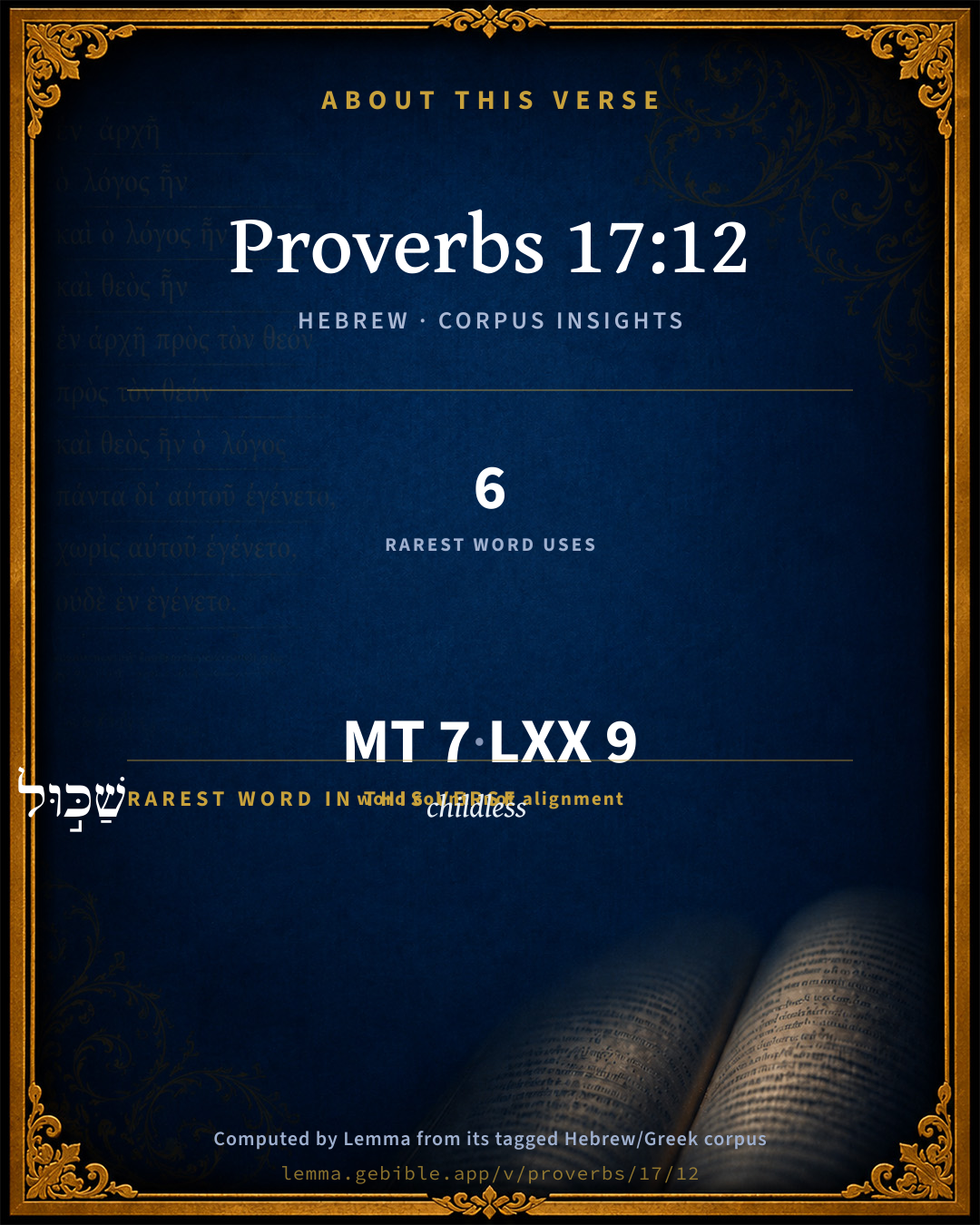
The rarest word here is שַׁכּ֣וּל childless H7909 — appearing just 6 times in the whole Hebrew Bible.

Shared distinctive vocabulary

שַׁכּ֣וּל childless H7909 occurs in 6 verses of the Hebrew Bible. Also found in:

Grammatical profile

  • 1 verb
  • 3 nouns
  • 2 adjectives
  • 1 particle

Verb forms

  • פָּג֬וֹשׁ Qal · Infinitive Absolute

Hebrew & Septuagint length

In English translation the verse runs 17 words from the Hebrew and 12 from the Septuagint (LXX English) — the Septuagint runs noticeably shorter here. See the side-by-side →

A rough comparison of the two English renderings, which tokenize alike — not a word-level alignment.

Word counts can differ between the Hebrew and the Greek without any difference in meaning — e.g. the Hebrew direct-object marker אֵת has no separate Greek word, and Greek often adds the article ὁ.

In the original languages it is 7 Hebrew tokens and 9 Greek tokens — but the two are counted differently (Hebrew bundles its prefixes and suffixes into one token; the Greek is in lemma form), so that isn’t a like-for-like length.

Cross-references

6

Topical passages linked to Proverbs 17:12 in the Treasury of Scripture Knowledge — connected by theme and wording, ordered by reader-vote popularity; previews shown in the World English Bible.

  • 2 Samuel 17:8 Hushai said moreover, You know your father and his men, that they are mighty men, and they are fierce in their minds, as a bear robbed of her cubs in the field; and your father is a man of war, and will not lodge with the people.
  • Hosea 13:8 I will meet them like a bear that is bereaved of her cubs, And will tear the covering of their heart. And there I will devour them like a lioness. The wild animal will tear them.
  • Proverbs 27:3 A stone is heavy, And sand is a burden; But a fool's provocation is heavier than both.
  • Proverbs 28:15 As a roaring lion or a charging bear, So is a wicked ruler over helpless people.
  • 2 Kings 2:24 He looked behind him and saw them, and cursed them in the name of Yahweh. There came forth two she-bears out of the wood, and mauled forty-two lads of them.
  • Matthew 2:16 Then Herod, when he saw that he was mocked by the wise men, was exceedingly angry, and sent out, and killed all the male children who were in Bethlehem and in all the surrounding countryside, from two years old and under, according to the exact time which he had learned from the wise men.

Cross-references courtesy of OpenBible.info (CC BY 4.0).

Hebrew and Greek witnesses Masoretic Hebrew ↔ Greek Septuagint

The same verse in the two great witnesses to the Old Testament, shown verse-for-verse.

Here the Septuagint runs noticeably shorter than the Hebrew — LXX2012 (modern English Septuagint) 12 words vs World English Bible 17. A rough length comparison of the two English translations, not a word-level alignment — read both below.

These are two independent witnesses, not word-aligned to each other, and the Septuagint is shown in lemma (dictionary) form.

Hebrew Proverbs 17:12 Masoretic · Westminster Leningrad Codex

פָּג֬וֹשׁ דֹּ֣ב שַׁכּ֣וּל בְּאִ֑ישׁ וְאַל כְּ֝סִ֗יל בְּאִוַּלְתּֽוֹ

Let a bear robbed of her cubs meet a man, Rather than a fool in his folly.

World English Bible · Public Domain

Greek LXX Proverbs 17:12 Septuagint · lemma form

ἐνπίπτω μέριμνα ἀνήρ νοήμων ὁ δέ ἄφρων διαλογίζομαι κακός

Care may befall a man of understanding; but fools will meditate evils.

LXX2012 (modern English Septuagint) · Public Domain

On this verse, The Pulpit Commentary discusses the Septuagint’s reading. Read the note in Commentary ↓

Hebrew: Westminster Leningrad Codex (CC BY 4.0). Greek: Septuagint (public domain); English from LXX2012 (modern English Septuagint) (Public Domain). How the Septuagint differs from the Hebrew →

Commentary

Notes on Proverbs 17:12 from classic Christian and Jewish commentators (each source and its license shown beneath its notes). The classic Christian expositions comment on the surrounding passage and are grouped to its opening verse, so a note may address several verses; the Jewish commentaries on the Tanakh (Rashi and others) are per-verse, so they appear only where the commentator wrote on this verse.

Lemma curates 59 commentaries, every one of them public domain or Creative Commons licensed, each selected and text-cleaned for this edition rather than reprinted as found. About our sources →

Trapp's Complete Commentary

John Trapp

Pro 17:12 Let a bear robbed of her whelps meet a man, rather than a fool in his folly.

Ver. 12. Let a bear robbed of her whelps meet a man.] A bear is a fierce and fell creature, the she ear especially, as Aristotle notes, but most of all when robbed of her whelps, which she licketh into form, and loveth without measure. To meet her in this rage is to meet death in the face; and yet that danger may be sooner shifted and shunned than a furious fool set upon mischief. Such were the primitive persecutors, not sparing those Christians whom bears and lions would not meddle with. Such a one was our bloody Bonner, who in five years’ time took and roasted three hundred martyrs, most of them within his own walk and diocese. {a} Such another was that merciless Minerius, one of the Pope’s captains, who destroyed twenty-two towns of the innocent Merindelians in France, together with the inhabitants; and being entreated for some few of them that escaped in their shirts to cover their nakedness, he sternly answered that he knew what he had to do, and that not one of them should escape his hands, but he would send them to hell to dwell among devils. {b}

{a} Acts and Mon.

{b} Ibid.

John Trapp, A Commentary or Exposition upon All the Books of the Old and New Testament (1647–1656) — public domain. Text from a community e-Sword module.

The Biblical Illustrator

Joseph S. Exell

Pro_17:12

Let a bear robbed of her whelps meet a man, rather than a fool in his folly.

The cruelty of fools

The rage of wild beasts is short-lived, and their power is circumscribed within narrow limits. Man has more cause to dread his brother than all the beasts of the forest. Ambition, jealousy, and superstition are sad sources of cruelty. We all abhor the deeds of cruelty which the fool in his folly so frequently commits; but alas! we have not all an adequate estimate of the guilt attaching to the man at the moment, and in the act of entering into his folly. (W. Arnot, D. D.)

The Biblical Illustrator, edited by Joseph S. Exell (c. 1880s–1900s) — public domain. Text from a community e-Sword module.

Joseph Benson's Commentary

Pro 17:12. Let a bear robbed of her whelps — When she is most cruel and fierce; meet a man, rather than a fool in his folly — That is, in the heat of his lust or passion, because the danger is greater, all things considered, and more unavoidable. A man may more easily stop, escape from, or guard against, an enraged bear than an outrageous man. It is observed by Bochart, (de Animal Sacr., lib. 3. cap. 9,) that the female bear is more fierce than the male; that she is more fierce than ordinary when she has whelps; and that when she is robbed of them she is fiercest of all.

Joseph Benson's Commentary on the Old and New Testaments (1811–1818) — public domain. Text from a community e-Sword module.

Tyndale Open Study Notes

Tyndale Open Resources

17:12 This saying cautions those who try to teach fools. A fool caught in foolishness will react with anger and violence.

Tyndale Open Study Notes — © Tyndale Open Resources, licensed CC BY-SA 4.0. Text via the HelloAO Bible API.

Geneva Bible (1599)

Geneva Bible translators

Whereby he meaneth the wicked in his rage, who hath no fear of God.

Geneva Bible (1599) marginal notes — public domain. Text via Bolls.life.

Matthew Henry's Commentary

Note, 1. A passionate man is a brutish man. However at other times he may have some wisdom, take him in his passion ungoverned, and he is a fool in his folly; those are fools in whose bosom anger rests and in whose countenance anger rages. He has put off man, and is become like a bear, a raging bear, a bear robbed of her whelps; he is as fond of the gratifications of his lusts and passions as a bear of her whelps (which, though ugly, are her own), as eager in the pursuit of them as she is in quest of her whelps when they are missing, and as full of indignation if crossed in the pursuit. 2. He is a dangerous man, falls foul of every one that stands in his way, though innocent, though his friend, as a bear robbed of her whelps sets upon the first man she meets as the robber. Ira furor brevis est - Anger is temporary madness. One may more easily stop, escape, or guard against an enraged bear, than an outrageous angry man. Let us therefore watch over our own passions (lest they get head and do mischief) and so consult our own honour; and let us avoid the company of furious men, and get out of their way when they are in their fury, and so consult our own safety. Currenti cede furori - Give place unto wrath.

Matthew Henry's Commentary on the Whole Bible (1708–1710) — public domain (CC PDM 1.0). Text via the HelloAO Bible API.

Jamieson, Fausset & Brown

Robert Jamieson, A. R. Fausset & David Brown

They are less rational in anger than wild beasts.

Jamieson, Fausset & Brown — Commentary Critical and Explanatory on the Whole Bible (1871) — public domain (CC PDM 1.0). Text via the HelloAO Bible API.

Adam Clarke's Commentary

Verse 12. Let a bear robbed of her whelps] At which times such animals are peculiarly fierce. 2Sa 17:8.

Adam Clarke's Commentary on the Bible (1810–1826) — public domain. Text from a community e-Sword/MySword module.

Ellicott's Commentary for English Readers

(12) A bear robbed of her whelps.—Proverbially dangerous then (2Sa_17:8; Hos_13:8). (See also 1Ki_2:24.)

A fool (khesîl).—Comp. Pro_1:32.

A Bible Commentary for English Readers, edited by Charles John Ellicott (1878–1897) — public domain. Text from a community e-Sword module.

The Cambridge Bible for Schools and Colleges

gen. ed. J. J. S. Perowne

12. a bear &c.] “The Syrian bear is fiercer than the brown bears to which we are accustomed. It attacks flocks (1Sa_17:34), and even oxen (Plin. viii. 64). The fierceness of the she-bear, bereaved of her whelps, became a proverb (2Sa_17:8).” Pusey on Hos_13:8.

rather than] Lit. and not.

The Cambridge Bible for Schools and Colleges (gen. ed. J. J. S. Perowne; Cambridge University Press, 1878–1918) — public domain. Text from a community e-Sword module.

John Gill's Exposition

Let a bear robbed of her whelps meet a man,.... A bear is a very fierce and furious creature, especially a she bear; and she is still more so when robbed of her whelps, which she has just whelped, and been at great pains to lick into shape and form, by which her fondness to them is increased; and therefore, being stripped of them, is full of rage; and ranging about in quest of them, falls furiously upon the first she meets with. Jerom (n) observes, that those who have written of the nature of beasts say, that, among all wild beasts, there is none more fierce than a she bear, when she has lost her whelps, or wants food. And yet, as terrible and as dangerous as it is, it is safer and more eligible of the two, to meet an enraged bear in those circumstances,

rather than a fool in his folly; in the height of his folly, in a paroxysm or fit of that; in the heat of his lusts, and the pursuit of them, in which there is no stopping him, or turning him from them; especially in the heat of passion and anger, which exceeds that of a bear, and is not so easily avoided. Jarchi applies it to such fools as seduce persons to idolatry, whom to meet is very dangerous: such are the followers of the man of sin, who have no mercy on the souls of men they deceive, and whose damnation they are the cause of; and who are implacably cruel to those who will not join with them in their idolatrous worship; the beast of Rome, his feet are as the feet of a bear, Rev 13:2; and one had better meet a bear than him and his followers.

(n) Comment, in Hos. xiii. 8. So Aristot. Hist. Animal. l. 6. c. 18.

John Gill's Exposition of the Whole Bible (1746–1763) — public domain (CC PDM 1.0). Text via the HelloAO Bible API.

Albert Barnes' Notes on the Bible

The large brown bear of Syria, in her rage at the loss of her whelps, was to the Israelites the strongest type of brute ferocity. Compare 2Sa 17:8; 2Ki 2:24.

Albert Barnes' Notes on the Bible (1834–1885) — public domain. Text from a community e-Sword/MySword module.

Haydock's Catholic Bible Commentary

Fool. Hebrew, "fool in his folly." The danger is not greater in meeting (Calmet) a female bear, though it be the most terrible. (Aristotle, Anim. ix. 1.)

George Leo Haydock (1774–1849), Haydock's Catholic Family Bible and Commentary, 1859 edition — public domain. Excludes Psalms (Douay-Rheims chapter numbering differs from Protestant) and Deuterocanonical books (Catholic canon only).

Matthew Poole's English Annotations

Robbed of her whelps, when she is most cruel and fierce.

In his folly; in the heat of his lust or passion, because the danger is greater, all things considered, and more unavoidable.

Matthew Poole's English Annotations on the Holy Bible (1683–1685) — public domain. Text from a community e-Sword/MySword module.

Whedon's Commentary on the Bible

Daniel D. Whedon

12. Let a bear robbed of her whelps — At which time she is particularly dangerous.

Rather than (Hebrew, but not) a fool in his folly — That is, a man had better encounter a ferocious she bear than a wicked fool. So the versions and critics generally. On the bereaved bear, compare 2Sa_17:8; 2Ki_2:24; Hos_13:8.

Daniel D. Whedon (gen. ed.), Commentary on the Old and New Testaments (1874–1909) — public domain. Text from a community e-Sword module.

The Pulpit Commentary

Let a bear robbed of her whelps meet a man. The Syrian bear was once common throughout Palestine; it is now found in but few localities, such as the hills of Hermon and Lebanon, and in the hills east of the Jordan, the destruction of wood and forest having deprived these animals of the shelter necessary to their existence. The ferocity of the bear when deprived of its young had become proverbial. (see 2Sa_17:8 Hos_13:8; Hart, "Animals of the Bible," 28, etc.) Rather than a fool in his folly; i.e. in the paroxysm of his passion. Compare Saul"s ungoverned language to Jonathan, (1Sa_20:30) and Herod"s murder of the children. (Mat_2:16) So we read of the people being filled with anoia against Jesus. (Luk_6:11) Oort supposes that this proverb arose from the riddle, "What is worse to meet than a bear?" Septuagint, "Care will fall upon a man of understanding; but fools imagine evils." The Greek translators take "bear" as us d metaphorically for terror and anxiety, but go far astray from the Hebrew text.

The Pulpit Commentary (1880–1919), ed. H.D.M. Spence-Jones & Joseph S. Exell — public domain. Text from a community e-Sword module.

John Wesley's Explanatory Notes

Folly - In the heat of his lust or passion.

John Wesley, Explanatory Notes Upon the Whole Bible (1754–1765) — public domain. Text via the GEBible commentary corpus.

Keil & Delitzsch

C. F. Keil & F. Delitzsch

12 Meet a bear robbed of one of her whelps,

Only not a fool in his folly.

The name of the bear, as that of the cow, Job 21:10; Psa 144:14, preserves its masculine form, even when used in reference to sexual relationship (Ewald, 174b); the ursa catulis orbata is proverbially a raging beast. How the abstract expression of the action פּגושׁ [to meet], here as e.g., Psa 17:5, with the subj. following, must sound as finite (occurrat, may always meet), follows from ואל = ואל־יפגּשׁ (non autem occurrat). פּגושׁ has on the last syllable Mehuppach, and Zinnorith on the preceding open syllable (according to the rule, Accentssystem, vi. 5d).

(Note: In the Torath Emeth, p. 18, the word is irregularly represented as Milel - a closed syllable with Cholem can suffer no retrogression of the tone.)

שׁכּוּל, in the state of his folly, i.e., when he is in a paroxysm of his anger, corresponds with the conditional noun-adjective שׁכּוּל, for folly morbidly heightened is madness (cf. Hos 11:7; Psychol. p. 291f.).

Keil & Delitzsch — Biblical Commentary on the Old Testament (1861–1891) — public domain (CC PDM 1.0). Text via the HelloAO Bible API. (Old Testament only.)

Kretzmann's Popular Commentary

Paul E. Kretzmann

v. 12. Let a bear robbed of her whelps meet a man rather than a fool in his folly, for a malignant fool is a greater menace to society and mankind in general than an angry bear.

Paul E. Kretzmann, Popular Commentary of the Bible (1921–1924) — public domain. Text from a community e-Sword module.

Rashi

Rabbi Shlomo Yitzchaki (Rashi)

May a bereaving bear encounter a person It is better for a person that a bereaving bear encounter him rather than one of the foolish heathens, who entice him to idolatry.

Rashi on the Tanakh — English translations: “The Judaica Press complete Tanach with Rashi, translated by A. J. Rosenberg” (CC BY 4.0); “Pentateuch with Rashi's commentary by M. Rosenbaum and A.M. Silbermann, 1929-1934” (public domain); “The Metsudah Tanach series, Lakewood, N.J” (CC BY 4.0); and “The Book of Joshua, Metsudah Publications, 1997” (CC BY 4.0). Text via Sefaria.

Lesson kit

Teaching starters — assembled from the data on this page, not authored interpretation. Every prompt links to the verse data it draws on. Edit before teaching.

Proverbs, in the Wisdom, opens this verse with 7 words (7 distinct Hebrew lemmas). Its most distinctive word is shakkûwl (“childless”). The Greek Septuagint runs shorter here. A historical commentator’s framing appears above. Read the whole chapter for the surrounding context.

Discussion questions

  1. The word shakkûwl carries the sense “childless.” How does it shape the verse?
  2. 2 Samuel 17:8 shares the word «childless» with this verse. How do the two illuminate each other?
  3. Compared with the Hebrew, the Septuagint runs shorter here. What questions does that raise?
  4. These translations render this verse differently. What is at stake in choosing one wording over another?
  5. The verb «פָּג֬וֹשׁ» is Qal Infinitive Absolute. How does its form color the action?
  6. Reading how Trapp's Complete Commentary and The Biblical Illustrator read this verse, where do the two commentators agree and where do they part?

Things to notice

Reading settings

Reading text

Shown beneath each verse's original-language words.

Old Testament
Old Testament edition

Read the OT as the Masoretic Hebrew (MT) or the Greek Septuagint (LXX).

English shown for the Greek Septuagint (in the Hebrew ↔ Greek comparison).

Comparing translations? Open the Compare panel on any verse page to stack up to four side by side.