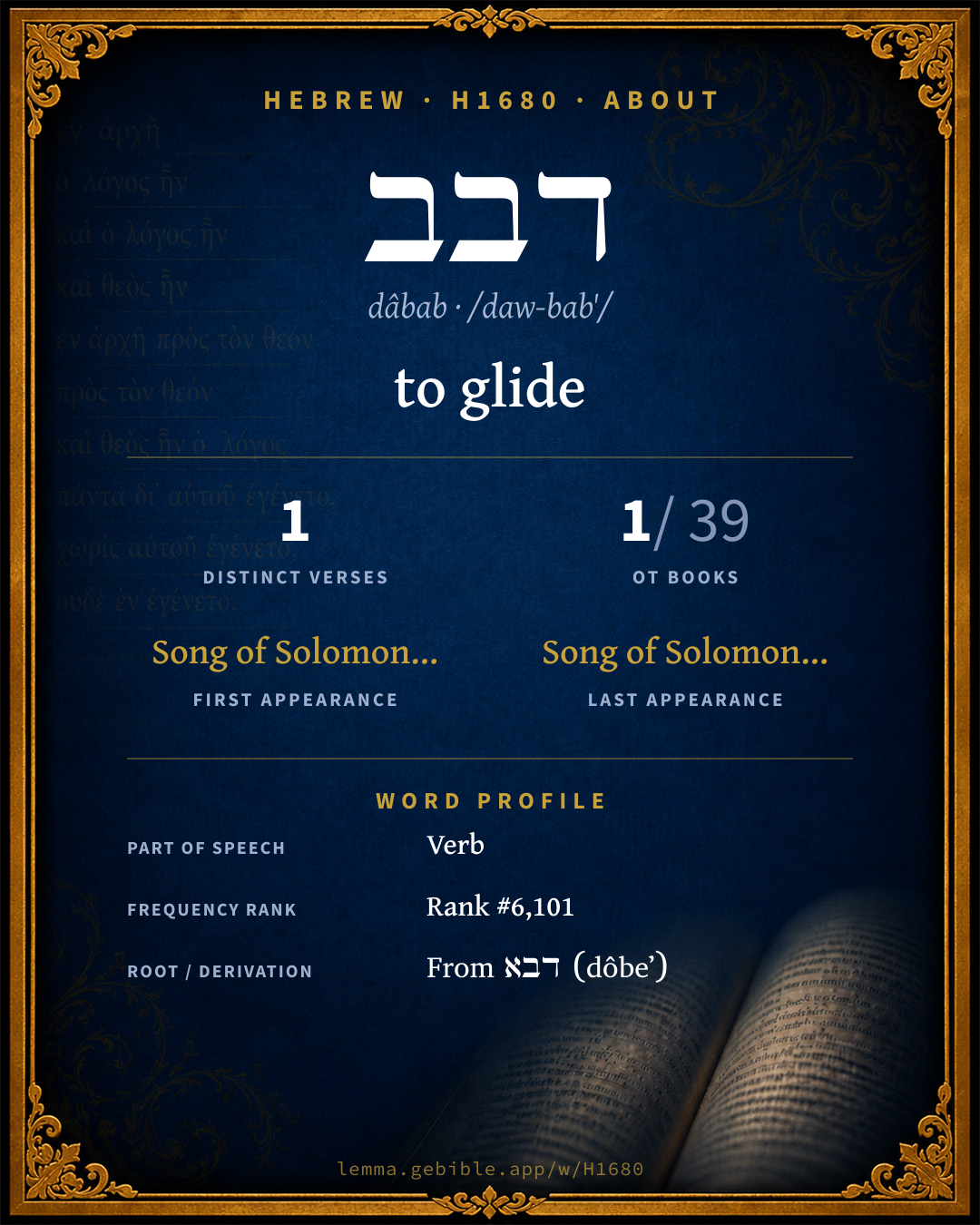
דָּבַב
to glide
‘to glide’ is one of 2 main senses fuller range ↓
Full lexicon entry — Brown-Driver-Briggs (BDB)
From Brown-Driver-Briggs (BDB)
Where this word appears
Grammar key — what these labels mean
Part of speech
- Verb
- An action or state-of-being word.
Stem
- Qal
- The basic, simple active stem — the plain form of the verb (“he wrote”).
Form
- Participle Active
- A verbal adjective expressing ongoing or characteristic action (“writing / one who writes”).
State
- Absolute
- The independent form of a noun, not bound to a following word.
Gender
- Masculine
- Grammatically masculine.
Number
- Singular
- One.
Every verse where H1680 appears — 1 distinct verse across 1 book. Click any verse to open its interlinear word-by-word view. Verse text shown in the World English Bible for context — . Each verse’s Hebrew form is shown with its reference; the English is not keyword-highlighted, since the data carries no word-level English alignment. Use “Compare translations” on any verse to read it across multiple English versions. This concordance covers the Hebrew Bible; Septuagint (Greek Old Testament) occurrences are not indexed here.
Song of Solomon 1 verse
About this entry
At a glance — auto-summarized from this page’s data, not written by a person. Every figure links to its source below. This summary describes the numbers; it doesn’t interpret them.
דבב — transliterated dâbab — is a Hebrew verb carrying the sense “to glide.” A scarce word — 1 verse in all of the Hebrew Bible. Its uses cluster heavily in Song of Solomon (100% of all occurrences). It occurs only once, in Song of Solomon 7:9. Its lexical range runs to 2 senses. See the sense tree, 1-verse concordance, and the renderings breakdown below.
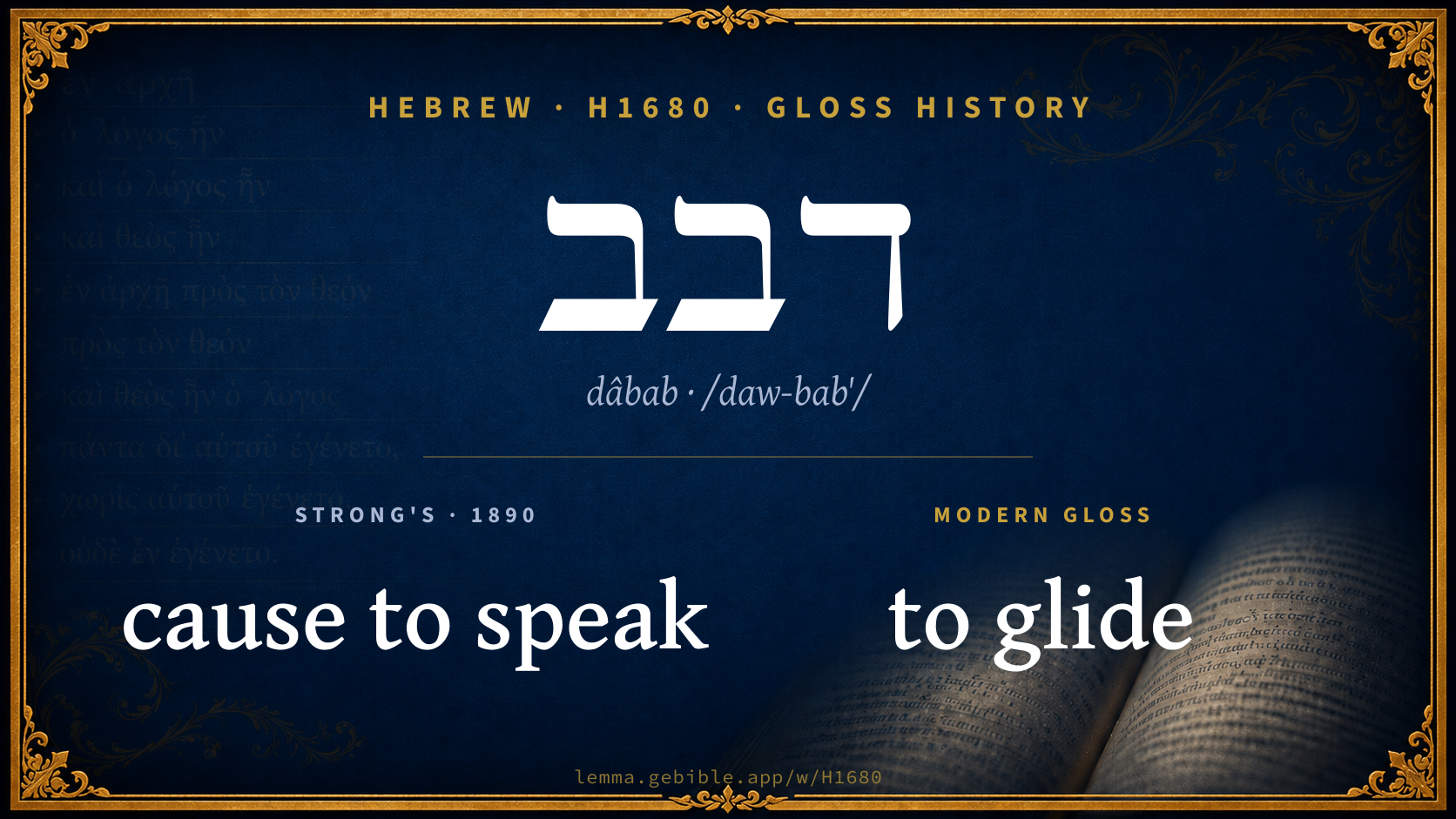
Gloss history
Strong's 1890 vs modern scholarship
About this word
Strong's H1680 catalogs a Hebrew word from the Hebrew Old Testament.
These counts are not copied from any lexicon or concordance. They are computed here, from the morphology-tagged Hebrew Old Testament. What Lemma adds →
- 1
- distinct verses
- The word appears in 1 distinct verse.
- 1 / 39
- OT books
- The word appears in 1 of 39 Old Testament books.
- #6,101
- by frequency
- Rank #6,101 (rank 6,101 of 8,640 Hebrew words by occurrence).
View all 1 occurrence in the concordance →
Most concentrated in
- Song of Solomon 1 verse 100%
By section of the Old Testament
By traditional corpus
Conventional, traditional groupings — biblical authorship is debated, so this is a traditional corpus grouping, not an authorship claim. Each share is this word’s portion of its verses in that division of the Hebrew canon. Each figure is a share of the word’s 1 distinct verse.
- Writings (Ketuvim) 1 verse · 100%
How translations render this word
Counts come from each version’s own published word-to-Strong’s tagging or interlinear alignment — an approximate guide to how each version renders this word, not a word-level alignment the data otherwise carries. Because each total is that version’s own tagged count, the per-version totals vary from one another and need not match the appearance or distinct-verse counts above. These counts may also differ from a printed concordance because Lemma counts each distinctly tagged rendering and does not collapse phrase taggings into a single head-word total. This is a fixed set of word-tagged versions (KJV, ASV, BSB, ULT) and does not change with the reading translation you choose elsewhere. Each version’s license is shown beside its name below (and on Sources).
- King James Version: Speak 1×
- American Standard Version: Gliding 1×
- Berean Standard Bible: Gliding gently over 1×
- unfoldingWord Literal Text: Gliding over 1×
King James Version Public Domain
Renders H1680 across 1 tagged occurrence — most commonly:
American Standard Version Public Domain
Renders H1680 across 1 tagged occurrence — most commonly:
Berean Standard Bible Public Domain
Renders H1680 across 1 tagged occurrence — most commonly:
unfoldingWord Literal Text CC BY-SA 4.0
Renders H1680 across 1 tagged occurrence — most commonly:
Senses in BDB
The 2 senses BDB distinguishes for this word, in lexicon order (not ranked by frequency or importance). The full entry — with sub-senses — is in the Lexicon Entry tab.
- to move gently, glide, glide over
- (Qal) glide over (participle)
Word origin
[ דָּבַב ] vb. move gently, glide, glide over Ct 7:10
— Brown-Driver-Briggs (Oxford 1906, public domain), digitized via Sefaria, supplemented by the OpenScriptures HebrewLexicon (CC BY 4.0). See Sources.
Derived from דבא (dôbeʼ) (H1679) — strength.
Jastrow Dictionary
A second Hebrew/Aramaic lexicon for comparison, covering Aramaic and post-biblical (Talmudic, Targumic, Midrashic) usage that the biblical-Hebrew BDB does not. Matched by lemma rather than by Strong’s number, so a lemma may carry more than one Jastrow headword (shown separately below), and the entries cover usage well beyond the Bible.
בָּב
- (reduplic. of בא, v. בּוֹא; cmp. b. h. בִּאָה a. מָבוֹא) entrance, door, gate. Targ. Esth. V, 14.—Sabb. 32ᵃ, v. חוּטְרָא a. בִּזְיוּנָא I. Ib. 156ᵇ קרי אכ׳ called at the door (begging). Erub. 11ᵇ; a. fr.—Pl. בָּבֵי. Ber. 58ᵇ; a. fr. Men. 34ᵃ בָּאבֵי.—Trnsf. (of writings) section, clause. ב׳ דרישא the clause of the first proposition. Sabb. 3ᵃ top; a. fr.—Hence ב׳ קמא (abbr. ב"ק), (ב"מ) ב׳ מציעא, (ב"ב) ב׳ בתרא Baba Kamma, Baba Metsia, Baba Bathra (first, middle, last section), names of three Talmudic treatises of the order of N’zikin (civil law); v. נֶזֶק. [Tosefta Kelim is likewise divided into three Babas with the same names.].—Pl. as above. R. Hash. 33ᵇ תקיעה דכולי ב׳ the tune T’kiah in all the three sections.
בָּב II
- Bab Nahăra (Gate of the River) name of a tributary or a canal of the Euphrates. Ab. Zar. 39ᵃ דב׳ נ׳ (Ms. M. דנהרא); Succ. 18ᵃ (Ms. M. 1 דבנהרא, 2 דפום נהרא, cmp. Yeb. 16ᵇ sq.).
דָּבַב I
- (b. h.) to drip, flow; to murmur, speak lowly, whisper. Yeb. 97ᵃ (ref. to Cant. VII, 10) מה כומר … מיד דּוֹבֵב as the heated mass of grapes drips as soon as you apply your finger, כך … דּוֹבְבוֹת וכ׳ so do the lips of scholars in the grave murmur when their names are cited; Snh. 90ᵇ; Bekh. 31ᵇ (Y. Ber. II, 4ᵇ bot. רוחשות, Ar. דובבות); a. e.—2) *to drop pitch. Y. Ab. Zar. II, 41ᵇ bot. נכרי עובדן ודוֹבְבָן a gentile may tan them (the leather bottles) and pitch them; [Tosef. ib. IV (V), 10 זופתן ed. Zuck. (Var. רובבן; Bab. Ab. Zar. 33ᵃ ריבבן; Tosaf. a. l. quotes fr. Tosef. רובד׳, v. רָבַב a. רָבַד.] e.g. Song of Solomon 7:10
דָּבַב II
- (deriv. of דִּבָּה or דְּבָב) to speak evil, be hostile, only in part. pass. דָּבוּב, f. דְּבוּבָה. Y. Erub. VII, 24ᶜ bot. a woman שהיתה ד׳ לחבירתה who was on bad terms with her neighbor (ib. III, 20ᵈ bot. דבי׳, corr. acc.).—Pl. דְּבוּבִין, דְּבוּבוֹת. Cant. R. to III, 11 two legions ד׳ זה עם זה hostile to each other. Ib. fire and hail ד׳ זה וכ׳ are hostile elements; Pesik. Vayhi, p. 4ᵃ רכו׳ (corr. acc.).
דְּבַב I
- , to murmur. חזינהו לסיפוותיה דקא דַבְבָן Ar. (prob. quot. of B. Kam. 117ᵃ bot. חזא דפריט׳ סיפוותיה Ms. M.).
דְּבָב
- (= דִּבָּה, v. דָּבַב) whisper, evil speech; only in בַּעַל ד׳, pl. בַּעֲלֵי ד׳ man of evil speech, i.e. opponent, informer. Cant. R. to VII, 10 (play on dobeb, ib.) הייתי נעשה בעל ד׳ וכ׳ I should have become an opponent of those (patriarchs) sleeping &c. Sifra B’ḥuck. Par. 2, ch. IV בעלי ד׳ וכ׳ informers shall surround you from without; Yalk. Lev. 673 בעל דבבא. Sifra Emor, Par. 14, ch. XIX the whole congregation shall act כבעלי ד׳ לו as if they were his accusers.
דְּבַב II
- , with בְּעֵל, בְּעֵיל. Targ. Ps. VIII, 3 (h. text אוֹיֵב); a. fr.—Gitt. 55ᵇ וב׳ דְּבָבֵיה בר וכ׳ and his enemy was Bar K., opp. רחמיה.—Pl. בעלי ד׳, also ב׳ דְבָבִין, דְבָבַיָּא. Targ. Ps. LXVIII, 24. Ib. XXXVII, 20.—Targ. Lam. I, 2; a. fr. [Sifré Num. 42, v. next w. Yalk. Lev. 637, v. preced.]
A Dictionary of the Targumim, the Talmud Babli and Yerushalmi, and the Midrashic Literature (Marcus Jastrow; London, Luzac, 1903) — Public Domain. Digitized via Sefaria. Digitized via Sefaria. Full attribution on Sources.
Same root — word family
Other BDB entries built from the same root as H1680, grouped by Strong’s listed origin. These share a root / origin per the lexicon — not necessarily a shared meaning. Each links to that word’s own entry.
Derives from
Derived from this word
Compare all same-root words → They share a root, not necessarily a meaning.
Septuagint verse parallels
This word appears in 1 verse that also exists in the Greek Old Testament (Septuagint), out of the 1 Hebrew verse it occurs in. You can read those verses in Greek by switching the Old Testament edition to the Septuagint.
Read these verses in the Septuagint
This is a verse-level parallel only — the same verses exist in both the Hebrew and Greek Old Testaments. No word-level Hebrew↔Greek correspondence is claimed: the data carries no such alignment, so no Greek word is shown as this Hebrew word’s translation. Coverage is not total — the Septuagint omits the deuterocanon and renumbers the Psalms, so some Hebrew verses have no direct Greek parallel.