
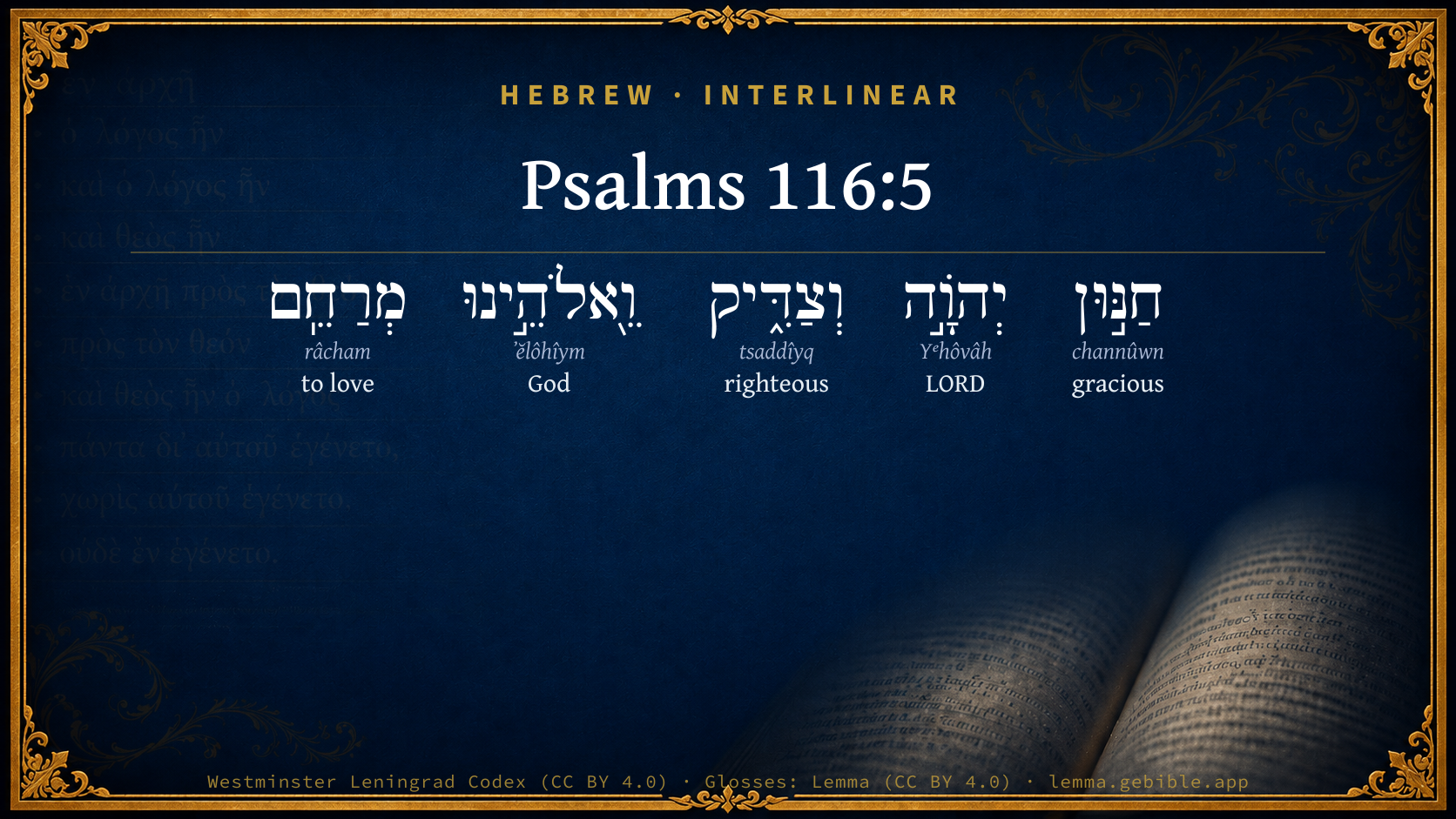
Psalms 116:5

Hebrew (Westminster Leningrad Codex) Psalms 116:5 appears in the Hebrew Old Testament. The text above is from the Westminster Leningrad Codex. Each word links to its Strong’s number, a concise gloss, and parsing drawn from the Open Scriptures Hebrew Bible morphology. Click any word for its full Brown-Driver-Briggs (BDB) entry.
Download image
Cite this verse

Psalms 116:5 (World English Bible). Public Domain. Lemma interlinear Bible study tool, https://lemma.gebible.app/v/psalms/116/5.

Show BibTeX & RIS
BibTeX
RIS
English Translation
Gracious is Yahweh, and righteous; Yes, our God is merciful.
World English Bible · Public Domain
Download a study sheet

One document with this verse’s original text, its word-by-word gloss line, the meaning frame, cross-references with their text, attributed commentary, and full source and license credits — printable, and it pastes into notes with its structure intact.

This verse Autodidact and up

Study sheet (.html) Plain text (.txt)

A passage Seminary Student

Up to 50 verses in one chapter. A passage sheet keeps up to 6 commentary sources and 12 cross-references per verse, in the order this page ranks them, and says so on the sheet whenever that leaves anything out. Ask for a single verse and you get the Autodidact verse sheet above.

Everything on this page stays free to read, with no account — the sheet is a download of what is already on screen, not access to it.

Want to remove ads? Support Godless Engineer
Compare translations 3

The same verse in 3 English versions, stacked beneath the original-language interlinear above. Click any original word for its lexicon entry.

Each is an independent rendering of the whole verse — the interlinear is not word-aligned to these translations.

Highlighted words mark where these versions differ — a whole-verse word diff, not a word-by-word alignment.

  • World English Bible Public Domain
    Gracious is Yahweh, and righteous; Yes, our God is merciful.
  • King James Version Public Domain
    Gracious is the LORD, and righteous; yea, our God is merciful.
  • unfoldingWord Literal Text CC BY-SA 4.0
    Yahweh merciful and righteous, and our God compassionate.

unfoldingWord Literal Text — © unfoldingWord, licensed CC BY-SA 4.0. Word-aligned USFM3 via Door43 (git.door43.org/unfoldingWord/en_ult).

Versions to compare (up to 4)

3 of 4 selected

Show all 17 translations

Every available English version of this verse, each an independent rendering of the whole verse.

  • World English Bible Public Domain
    Gracious is Yahweh, and righteous; Yes, our God is merciful.
  • Berean Standard Bible Public Domain
    The LORD is gracious and righteous; our God is full of compassion.
  • Majority Standard Bible Public Domain
    The LORD is gracious and righteous; our God is full of compassion.
  • King James Version Public Domain
    Gracious is the LORD, and righteous; yea, our God is merciful.
  • American Standard Version (1901) Public Domain
    Gracious is Jehovah, and righteous; Yea, our God is merciful.
  • Revised Version (1885) Public Domain
    Gracious is the LORD, and righteous; yea, our God is merciful.
  • Geneva Bible (1599) Public Domain
    The Lord is mercifull and righteous, and our God is full of compassion.
  • Young's Literal Translation Public Domain
    Gracious `is' Jehovah, and righteous, Yea, our God `is' merciful,
  • Literal Standard Version CC BY-SA 4.0
    YHWH [is] gracious, and righteous, || Indeed, our God [is] merciful,
  • Unlocked Literal Bible CC BY-SA 4.0
    Yahweh is merciful and fair; our God is compassionate.
  • unfoldingWord Literal Text CC BY-SA 4.0
    Yahweh merciful and righteous, and our God compassionate.
  • Darby Bible Public Domain
    Gracious is Jehovah and righteous; and our God is merciful.
  • World Messianic Bible Public Domain
    The LORD is gracious and righteous. Yes, our God is merciful.
  • Webster's Bible Public Domain
    Gracious is the LORD, and righteous; yes, our God is merciful.
  • Free Bible Version CC BY-SA 4.0
    The Lord is so kind and good! Our God is so compassionate!
  • Bible in Basic English Public Domain
    The Lord is full of grace and righteousness; truly, he is a God of mercy.
  • JPS Tanakh (1917) Public Domain
    Gracious is the LORD, and righteous; yea, our God is compassionate.

Literal Standard Version (2020), Covenant Press — licensed CC BY-SA 4.0. Text via the HelloAO Bible API (eBible.org). Unlocked Literal Bible (unfoldingWord) — licensed CC BY-SA 4.0. Text via the HelloAO Bible API (eBible.org). unfoldingWord Literal Text — © unfoldingWord, licensed CC BY-SA 4.0. Word-aligned USFM3 via Door43 (git.door43.org/unfoldingWord/en_ult). Free Bible Version, Dr. Jonathan Gallagher — licensed CC BY-SA 4.0. Text via the HelloAO Bible API (eBible.org).

Word by word

More ways to search: Search by grammar → Find every occurrence → Compare this word →

Practice this passage: Drill this verse → Learn its vocabulary →

About this verse

These counts appear in no published source. They are computed here, from the morphology-tagged text and Lemma’s own curated glosses. What Lemma adds →

5
words
5
distinct lemmas
Wisdom
section

Notable vocabulary

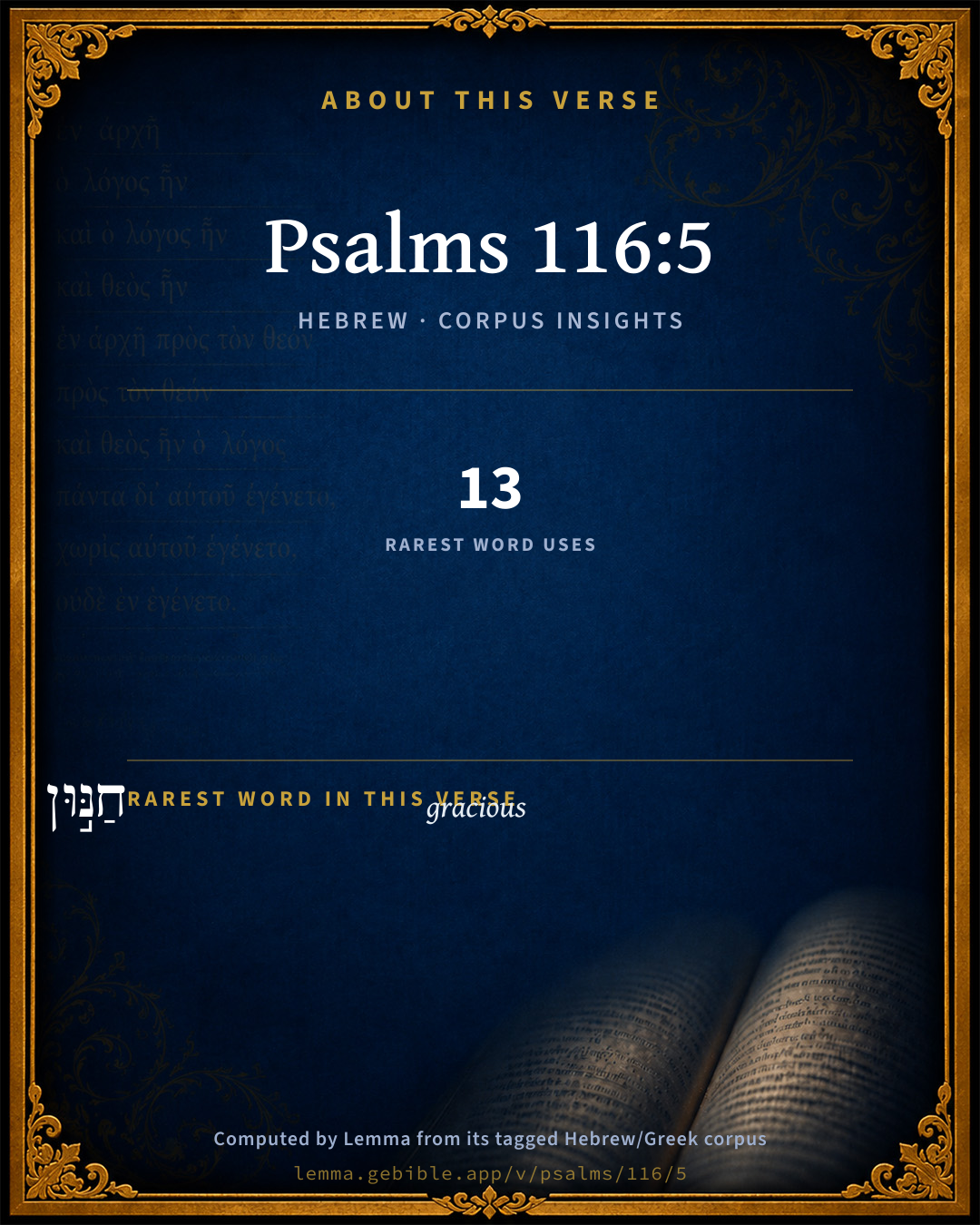
The rarest word here is חַנּ֣וּן gracious H2587 — appearing just 13 times in the whole Hebrew Bible.

Shared distinctive vocabulary

חַנּ֣וּן gracious H2587 occurs in 13 verses of the Hebrew Bible. Also found in:

Grammatical profile

  • 1 verb
  • 2 nouns
  • 2 adjectives

Verb forms

  • מְרַחֵֽם Piel · Participle Active

Hebrew & Septuagint length

In English translation the verse runs 10 words from the Hebrew and 15 from the Septuagint (LXX English) — closely comparable.

A rough comparison of the two English renderings, which tokenize alike — not a word-level alignment.

Word counts can differ between the Hebrew and the Greek without any difference in meaning — e.g. the Hebrew direct-object marker אֵת has no separate Greek word, and Greek often adds the article ὁ.

Cross-references

26

Topical passages linked to Psalms 116:5 in the Treasury of Scripture Knowledge — connected by theme and wording, ordered by reader-vote popularity; previews shown in the World English Bible.

  • Psalms 103:8 Yahweh is merciful and gracious, Slow to anger, and abundant in loving kindness.
  • Psalms 145:17 Yahweh is righteous in all his ways, And gracious in all his works.
  • Psalms 119:137 You are righteous, Yahweh. Your judgments are upright.
  • Ezra 9:15 Yahweh, the God of Israel, you are righteous; for we are left a remnant that is escaped, as it is this day: behold, we are before you in our guiltiness; for none can stand before you because of this.
  • Nehemiah 9:8 and found his heart faithful before you, and made a covenant with him to give the land of the Canaanite, the Hittite, the Amorite, and the Perizzite, and the Jebusite, and the Girgashite, to give it to his seed, and have performed your words; for you are righteous.
  • Psalms 86:15 But you, Lord, are a merciful and gracious God, Slow to anger, and abundant in loving kindness and truth.
  • Ephesians 1:6–8 to the praise of the glory of his grace, by which he freely bestowed favor on us in the Beloved,
  • 1 Timothy 1:14 The grace of our Lord abounded exceedingly with faith and love which is in Christ Jesus.
  • Exodus 34:6–7 Yahweh passed by before him, and proclaimed, "Yahweh! Yahweh, a merciful and gracious God, slow to anger, and abundant in loving kindness and truth,
  • Psalms 112:4 Light dawns in the darkness for the upright, Gracious, merciful, and righteous.
  • Daniel 9:7 Lord, righteousness belongs to you, but to us confusion of face, as at this day; to the men of Judah, and to the inhabitants of Jerusalem, and to all Israel, who are near, and who are far off, through all the countries where you have driven them, because of their trespass that they have trespassed against you.
  • Daniel 9:14 Therefore has Yahweh watched over the evil, and brought it on us; for Yahweh our God is righteous in all his works which he does, and we have not obeyed his voice.
  • Ephesians 2:4 But God, being rich in mercy, for his great love with which he loved us,
  • Nehemiah 9:17 and refused to obey, neither were mindful of your wonders that you did among them, but hardened their neck, and in their rebellion appointed a captain to return to their bondage. But you are a God ready to pardon, gracious and merciful, slow to anger, and abundant in loving kindness, and didn't forsake them.
  • Nehemiah 9:31 Nevertheless in your manifold mercies you did not make a full end of them, nor forsake them; for you are a gracious and merciful God.
  • Nehemiah 9:33 However you are just in all that is come on us; for you have dealt truly, but we have done wickedly;
  • Psalms 86:5 For you, Lord, are good, and ready to forgive; Abundant in loving kindness to all those who call on you.
  • Psalms 115:1 Not to us, Yahweh, not to us, But to your name give glory, For your loving kindness, and for your truth's sake.
  • Psalms 145:4–8 One generation will commend your works to another, And will declare your mighty acts.
  • Isaiah 45:21 Declare you, and bring [it] forth; yes, let them take counsel together: who has shown this from ancient time? who has declared it of old? Haven't I, Yahweh? and there is no God else besides me, a just God and a Savior; there is no one besides me.
  • Jeremiah 12:1 Righteous are you, Yahweh, when I contend with you; yet would I reason the cause with you: why does the way of the wicked prosper? why are all they at ease who deal very treacherously?
  • Daniel 9:9 To the Lord our God belong mercies and forgiveness; for we have rebelled against him;
  • Romans 3:25–26 whom God set forth to be an atoning sacrifice, through faith in his blood, for a demonstration of his righteousness through the passing over of prior sins, in God's forbearance;
  • Romans 5:20–21 The law came in besides, that the trespass might abound; but where sin abounded, grace did abound more exceedingly;
  • Titus 3:4–7 But when the kindness of God our Savior and his love toward mankind appeared,
  • 1 John 1:9 If we confess our sins, he is faithful and righteous to forgive us the sins, and to cleanse us from all unrighteousness.

Cross-references courtesy of OpenBible.info (CC BY 4.0).

Hebrew and Greek witnesses Masoretic Hebrew ↔ Greek Septuagint

The same verse in the two great witnesses to the Old Testament, shown verse-for-verse.

You’re reading Greek Psalm 114 (Hebrew Psalm 116). The Septuagint counts the superscription, so verse numbers can differ from the Hebrew — chapter-level alignment, not verse-by-verse. Numbering follows Rahlfs.

These are two independent witnesses, not word-aligned to each other, and the Septuagint is shown in lemma (dictionary) form.

Hebrew Psalms 116:5 Masoretic · Westminster Leningrad Codex

חַנּ֣וּן יְהֹוָ֣ה וְצַדִּ֑יק וֵ֖אלֹהֵ֣ינוּ מְרַחֵֽם

Gracious is Yahweh, and righteous; Yes, our God is merciful.

World English Bible · Public Domain

Greek LXX Greek Psalm 114:5 Septuagint · lemma form

ἐλεήμων ὁ κύριος καί δίκαιος καί ὁ θεός ἐγώ ἐλεάω

They have a mouth, but they can’t speak; they have eyes, but they can’t see:

LXX2012 (modern English Septuagint) · Public Domain

On this verse, John Calvin's Commentaries discusses the Septuagint’s reading. Read the note in Commentary ↓

Hebrew: Westminster Leningrad Codex (CC BY 4.0). Greek: Septuagint (public domain); English from LXX2012 (modern English Septuagint) (Public Domain). How the Septuagint differs from the Hebrew →

Commentary

Notes on Psalms 116:5 from classic Christian and Jewish commentators (each source and its license shown beneath its notes). The classic Christian expositions comment on the surrounding passage and are grouped to its opening verse, so a note may address several verses; the Jewish commentaries on the Tanakh (Rashi and others) are per-verse, so they appear only where the commentator wrote on this verse.

Lemma curates 59 commentaries, every one of them public domain or Creative Commons licensed, each selected and text-cleaned for this edition rather than reprinted as found. About our sources →

Trapp's Complete Commentary

John Trapp

Psa 116:5 Gracious [is] the LORD, and righteous; yea, our God [is] merciful.

Ver. 5. Gracious is the Lord, &c.] Gracious God is said to be, and merciful, that we despair not; righteous also, that we presume not. Or, faithful in performing his promises, as 1Jn 1:9, and this was David’s comfort amidst his sorrows.

John Trapp, A Commentary or Exposition upon All the Books of the Old and New Testament (1647–1656) — public domain. Text from a community e-Sword module.

Joseph Benson's Commentary

Psa 116:5-6. Gracious is the Lord — Therefore he will maintain my just cause against my unrighteous oppressors, will perform his promises, and save those who faithfully serve and trust in him. The Lord preserveth the simple — That is, those who are upright and sincere, and make use of no crafty arts or counsels, no indirect or unlawful means for their deliverance; who, as the original word implies, depend wholly upon God, as little children do upon their parents. I was brought low — Plunged into the depth of distress and misery; and he helped me — Patiently to bear what was laid upon me, and to hope for deliverance at the proper time.

Joseph Benson's Commentary on the Old and New Testaments (1811–1818) — public domain. Text from a community e-Sword module.

J. A. Alexander on Psalms

Joseph Addison Alexander

5. (Psa 116:5) Gracious (is) Jehovah and righteous, and our God shews pity. With the first clause compare Psa 111:4; Psa 112:4. The last word in Hebrew is the active participle of the verb to pity, to compassionate, and is here used to denote a habit as distinguished from a momentary feeling.

Joseph Addison Alexander, The Psalms Translated and Explained (1850) — public domain. Text from a community e-Sword module.

Tyndale Open Study Notes

Tyndale Open Resources

116:5-7 The gracious, righteous, and compassionate Lord (see 111:1-5) rescued and gave rest to the psalmist.

Tyndale Open Study Notes — © Tyndale Open Resources, licensed CC BY-SA 4.0. Text via the HelloAO Bible API.

Geneva Bible (1599)

Geneva Bible translators

He showeth forth the fruit of his love in calling upon him, confessing him to be just and merciful, and to help them that are destitute of aid and counsel.

Geneva Bible (1599) marginal notes — public domain. Text via Bolls.life.

Adam Clarke's Commentary

Verse 5. Gracious is the Lord] In his own nature.

And righteous] In all his dealings with men.

Our God is merciful.] Of tender compassion to all penitents.

Adam Clarke's Commentary on the Bible (1810–1826) — public domain. Text from a community e-Sword/MySword module.

John Calvin's Commentaries

5 Jehovah is gracious. He comes now to point out the fruits of that love of which he spoke, setting before him God’s titles, in order that they might serve to preserve his faith in him. First, he denominates him gracious, because he is so ready graciously to render assistance. From this source springs that justice which he displays for the protection of his own people. To this is subjoined mercy, without which we would not deserve God’s aid. And as the afflictions which overtake us frequently appear to preclude the exercise of his justice, hence it follows that there is nothing better than to repose upon him alone; so that his fatherly kindness may engross our thoughts, and that no voluptuous pleasure may steal them away to any thing else. He then accommodates the experience of God’s benignity and equity to the preserving of the simple, that is, of such as, being undesigning, do not possess the requisite prudence for managing their own affairs. The term, rendered simple, is often understood in a bad sense, denoting persons inconsiderate and foolish, who will not follow wholesome advice. But, in this place, it is applied to those who are exposed to the abuse of the wicked, who are not sufficiently subtle and circumspect to elude the snares which are laid for them, — in short, to those who are easily overreached; while, on the contrary, the children of this world are full of ingenuity, and have every means at their command for maintaining and protecting themselves. David, therefore, acknowledges himself to be as a child, unable to consult his own safety, and totally unfit to ward off the dangers to which he was exposed. Hence the LXX. have not improperly translated the Hebrew term by the Greek, τὰ νήπια, little children. The amount is, that when those who are liable to suffering have neither the prudence nor the means of effecting their deliverance, God manifests his wisdom towards them, and interposes the secret protection of his providence between them and all the dangers by which their safety may be assailed. In fine, David holds forth himself as a personal example of this fact, in that, after being reduced to the greatest straits, he had, by the grace of God, been restored to his former state.

John Calvin's Commentaries (1540-1563) — public domain. Text from the Calvin Translation Society English edition (1840s-50s) via the Christian Classics Ethereal Library (ccel.org). Calvin's coverage is partial (roughly two-thirds of the Bible); uncommented books and verses are honest gaps, never fabricated. The 19th-century editor's footnotes and remarks are omitted so the notes are faithfully Calvin's own voice.

The Cambridge Bible for Schools and Colleges

gen. ed. J. J. S. Perowne

5. Cp. Psa_111:4, and passages referred to there, all based on the fundamental passage, Exo_34:6.

5, 6. The character of Jehovah, realised in the Psalmist’s experience.

The Cambridge Bible for Schools and Colleges (gen. ed. J. J. S. Perowne; Cambridge University Press, 1878–1918) — public domain. Text from a community e-Sword module.

John Gill's Exposition

Gracious is the Lord,.... So the psalmist found him, calling upon him; so he is in Christ, the author and giver of all grace, to help in time of need.

And righteous; faithful to his promises, just in every dispensation of his providence, even in afflictive ones; righteous in punishing the enemies of his people, and in saving, justifying, and pardoning them for Christ's sake.

Yea, our God is merciful; compassionate, tenderhearted, a heart full of pity, as a father to his child; and sympathizes with his people under all their afflictions, and saves them out of them; see Psa 86:5.

John Gill's Exposition of the Whole Bible (1746–1763) — public domain (CC PDM 1.0). Text via the HelloAO Bible API.

Albert Barnes' Notes on the Bible

Gracious is the Lord - This fact was his encouragement when he called on God. He believed that God was a gracious Being, and he found him to be so. Compare the notes at Heb 11:6.

And righteous ... - Just; true; faithful. This, too, is a proper foundation of appeal to God: not that we are righteous, and have a claim to his favor, but that he is a Being who will do what is right; that is, what is best to be done in the case. If he were an unjust Being; if he were one on whose stability of character, and whose regard for right, no reliance could be placed, we could never approach him with confidence or hope. In this sense we may rely on his justice - his justness of character - as a ground of hope. Compare the notes at 1Jo 1:9 : “If we confess our sins, he is faithful and just to forgive us Our sins.”

Albert Barnes' Notes on the Bible (1834–1885) — public domain. Text from a community e-Sword/MySword module.

Matthew Poole's English Annotations

Gracious is the Lord: this he mentions either,

1. As that which he found by experience in answer to his prayers; or,

2. As the argument by which he encouraged himself to pray.

And righteous; therefore he will maintain me and my just cause against my unrighteous oppressors, and perform his promises, and save those who faithfully serve aim and put their trust in him.

Matthew Poole's English Annotations on the Holy Bible (1683–1685) — public domain. Text from a community e-Sword/MySword module.

The Treasury of David

Charles H. Spurgeon

Ver. 5. Gracious is the Lord, and righteous. In hearing prayer the grace and righteousness of Jehovah are both conspicuous. It is a great favour to hear a sinner's prayer, and yet since the Lord has promised to do so, he is not unrighteous to forget his promise and disregard the cries of his people. The combination of grace and righteousness in the dealings of God with his servants can only be explained by remembering the atoning sacrifice of our Lord Jesus Christ. At the cross we see how gracious is the Lord and righteous.

Yea, our God is merciful, or compassionate, tender, pitiful, full of mercy. We who have accepted him as ours have no doubt as to his mercy, for he would never have been our God if he had not been merciful. See how the attribute of righteousness seems to stand between two guards of love: gracious, righteous, merciful. The sword of justice is scabarded in a jewelled sheath of grace.

Ver. 5. Gracious is the Lord, etc. He is gracious in hearing, he is "righteous" in judging, he is "merciful" in pardoning, and how, then, can I doubt of his will to help me? He is righteous to reward according to deserts; he is gracious to reward above deserts; yea, he is merciful to reward without deserts; and how, then, can I doubt of his will to help me? He is gracious, and this shows his bounty; he is righteous, and this shows his justice; yea, he is merciful, and this shows his love; and how, then, can I doubt of his will to help me? If he were not gracious I could not hope he would hear me; if he were not righteous, I could not depend upon his promise; if he were not merciful, I could not expect his pardon; but now that he is gracious and righteous and merciful too, how can I doubt of his will to help me? Sir Richard Baker.

Ver. 5. The first attribute, "gracious, "(Nwgx) hath especial respect to that goodness which is in God himself. The root (Ngx) whence it cometh signifieth to do a thing gratis, freely, of one's own mind and goodwill. This is that word which is used to set out the free grace and mere goodwill of God, thus (Nxa ddva ta ytgxw) "I will be gracious to whom I will be gracious, "Ex 33:19. There is also an adverb (Mgh) derived thence, which signifieth gratis, freely, as where Laban thus speaketh to Jacob, "Shouldest thou serve me for nought?" Thus is the word opposed to merit. And hereby the prophet acknowledged that the deliverance which God gave was for the Lord's own sake, upon no desert of him that was delivered.

The second attribute, "righteous" or just, (qydu), hath particular relation to the promise of God. God's righteousness largely taken is the integrity or equity of all his counsels, words, and actions... Particularly is God's righteousness manifested in giving reward and taking vengeance. Thus it is said to be "a righteous thing with God to recompense tribulation to them that trouble you; and to you who are troubled rest, "2Th 1:6-7... But the occasion of mentioning God's righteousness here in this place being to show the ground of his calling on God, and of God's delivering him, it must needs have respect to God's word and promise, and to God's truth in performing what he hath promised. William Gouge.

Ver. 5. The Lord; our God. The first title, "Lord, "sets out the excellency of God. Fit mention is here made thereof, to shew the blessed concurrence of greatness and goodness in God. Though he be Jehovah the Lord, yet is he gracious, and righteous, and merciful. The second title, "our God, "manifests a peculiar relation betwixt him and the faithful that believe in him, and depend on him, as this prophet did. And to them in an especial manner the Lord is gracious, which moved him thus to change the person; for where he had said in the third person "the Lord is gracious, "here, in the first person, he says, "our God, "yet so that he appropriates not this privilege to himself, but acknowledgeth it to be common to all of like character by using the plural number, "our." William Gouge.

Ver. 5. The "Berlenburger Bibelwerk" says, "The righteousness is very significantly placed between the grace and the mercy: for it is still necessary, that the evil should be mortified and driven out. Grace lays, as it were, the foundation for salvation, and mercy perfects the work; but not till righteousness has finished its intermediary work." Rudolph Stier.

Ver. 5. Our God is merciful. Mercy is God's darling attribute; and by his infinite wisdom he has enabled mercy to triumph over justice without in any degree violating his honour or his truth. The character of merciful is that by which our God seems to delight in being known. When he proclaimed himself amid terrific grandeur to the children of Israel, it was as "the Lord, the Lord God merciful and gracious, pardoning iniquity, transgression, and sin." And such was the impression of this his character on the mind of Jonah that he says to him, "I knew that thou wert a merciful God." These, however, are not mere assertionsclaims made to the character by God on the one hand, and extorted without evidence from man on the other; for in whatever way we look upon God, and examine into his conduct towards his creatures, we perceive it to bear the impression of mercy. Nor can we more exalt the Lord our God than by speaking of his mercy and confiding in it; for our "Lord's delight is in them that fear him, and put their trust in his mercy." John Gwyther, 1833.

Ver. 5.

1. Eternal grace, or the purpose of love.

2. Infinite justice, or the difficulty of holiness.

3. Boundless mercy, or the outcome of atonement.

Psalms 116:6*

Charles H. Spurgeon's The Treasury of David (1869–1885) — public domain. Psalms only. Text from a community e-Sword/MySword module.

Whedon's Commentary on the Bible

Daniel D. Whedon

5. Righteous… merciful—Righteous in keeping his covenant, merciful in making and adapting it to man.

Daniel D. Whedon (gen. ed.), Commentary on the Old and New Testaments (1874–1909) — public domain. Text from a community e-Sword module.

The Pulpit Commentary

Gracious is the Lord, and righteous. God"s answers to prayer show him to be both "gracious" and "righteous gracious, because it is of his mercy that he listens to men; righteous, because, having promised to hear prayer, he is bound to keep his promises. Yea, our God is merciful; or, "compassionate."

The Pulpit Commentary (1880–1919), ed. H.D.M. Spence-Jones & Joseph S. Exell — public domain. Text from a community e-Sword module.

Keil & Delitzsch

C. F. Keil & F. Delitzsch

With "gracious" and "compassionate" is here associated, as in Psa 112:4, the term "righteous," which comprehends within itself everything that Jahve asserts concerning Himself in Exo 34:6. from the words "and abundant in goodness and truth" onwards. His love is turned especially toward the simple (lxx τὰ νήπια, cf. Mat 11:25), who stand in need of His protection and give themselves over to it. פּתאים, as in Pro 9:6, is a mode of writing blended out of פּתאים and פּתיים. The poet also has experienced this love in a time of impotent need. דּלּותי is accented on the ultima here, and not as in Psa 142:7 on the penult. The accentuation is regulated by some phonetic or rhythmical law that has not yet been made clear (vid., on Job 19:17).

(Note: The national grammarians, so far as we are acquainted with them, furnish no explanation. De Balmis believes that these Milra forms דּלּותי, בּלּותי, and the like, must be regarded as infinitives, but at the same time confirms the difference of views existing on this point.)

יהושׁיע is a resolved Hiphil form, the use of which became common in the later period of the language, but is not alien to the earlier period, especially in poetry (Ps 45:18, cf. Psa 81:6; Sa1 17:47; Isa 52:5). In Psa 116:7 we hear the form of soliloquy which has become familiar to us from Psa 42:1; Ps 103. שׁוּבי is Milra here, as also in two other instances. The plural מנוּחים signifies full, complete rest, as it is found only in God; and the suffix in the address to the soul is ajchi for ajich, as in Psa 103:3-5. The perfect גּמל states that which is a matter of actual experience, and is corroborated in Psa 116:8 in retrospective perfects. In Psa 116:8-9 we hear Ps 56:14 again amplified; and if we add Psa 27:13, then we see as it were to the bottom of the origin of the poet's thoughts. מן־דּמעה belongs still more decidedly than יהושׁיע to the resolved forms which multiply in the later period of the language. In Psa 116:9 the poet declares the result of the divine deliverance. The Hithpa. אתהלּך denotes a free and contented going to and fro; and instead of "the land of the living," Psa 27:13, the expression here is "the lands (ארצות), i.e., the broad land, of the living." There he walks forth, with nothing to hinder his feet or limit his view, in the presence of Jahve, i.e., having his Deliverer from death ever before his eyes.

Keil & Delitzsch — Biblical Commentary on the Old Testament (1861–1891) — public domain (CC PDM 1.0). Text via the HelloAO Bible API. (Old Testament only.)

unfoldingWord translationNotes

Door43 World Missions Community

General Information:

The person who made this song continues to speak.

the naive

This refers to people who are inexperienced or who cannot care for themselves. The adjective can be translated as a noun phrase. AT: "those who are naive" or "those who are helpless" (See: Nominal Adjectives)

I was brought low

The writer speaks of being humbled as in being in a lower position. AT: "I was helpless" (See: Metaphor)

translationWords

mercy

God

compassion

save

unfoldingWord translationNotes — © Distant Shores Media and the Door43 World Missions Community, licensed CC BY-SA 4.0. Source: git.door43.org/Door43/en_tn.

Lesson kit

Teaching starters — assembled from the data on this page, not authored interpretation. Every prompt links to the verse data it draws on. Edit before teaching.

Psalms, in the Wisdom, opens this verse with 5 words (5 distinct Hebrew lemmas). Its most distinctive word is channûwn (“gracious”). A historical commentator’s framing appears above. Read the whole chapter for the surrounding context.

Discussion questions

  1. The word channûwn carries the sense “gracious.” How does it shape the verse?
  2. How does Exodus 22:27, which shares the word «gracious», read alongside this verse?
  3. These translations render this verse differently; the difference is in the English rendering, not the original. What questions does that raise?
  4. «מְרַחֵֽם» is a Piel Participle Active verb. How does that grammatical form shape the action described?
  5. Compare how Trapp's Complete Commentary and Joseph Benson's Commentary read this verse. Where do they agree or differ?

Things to notice

Reading settings

Reading text

Shown beneath each verse's original-language words.

Old Testament
Old Testament edition

Read the OT as the Masoretic Hebrew (MT) or the Greek Septuagint (LXX).

English shown for the Greek Septuagint (in the Hebrew ↔ Greek comparison).

Comparing translations? Open the Compare panel on any verse page to stack up to four side by side.