
2 Kings 13:22

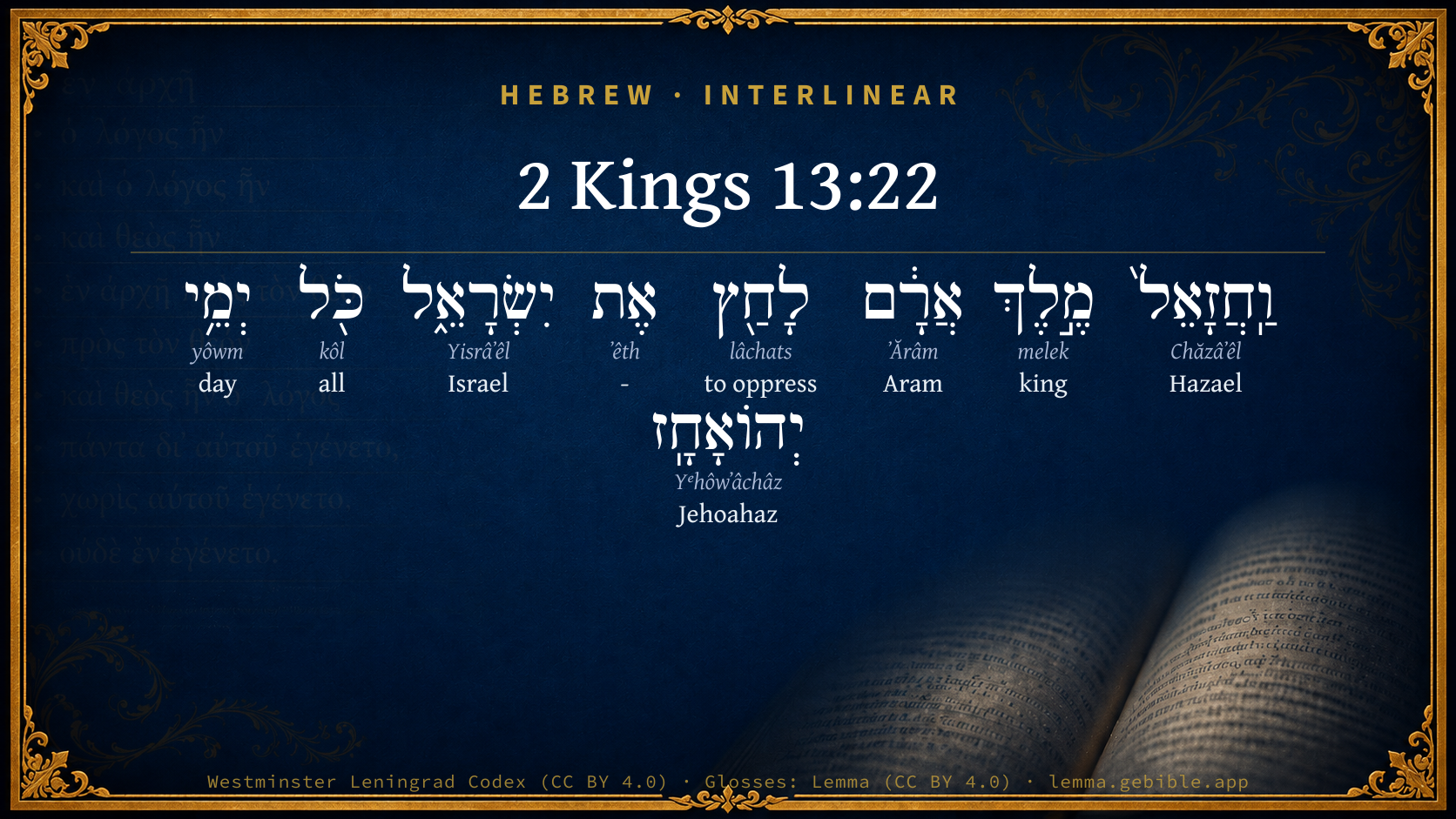
Hebrew (Westminster Leningrad Codex) 2 Kings 13:22 appears in the Hebrew Old Testament. The text above is from the Westminster Leningrad Codex. Each word links to its Strong’s number, a concise gloss, and parsing drawn from the Open Scriptures Hebrew Bible morphology. Click any word for its full Brown-Driver-Briggs (BDB) entry.
Download image
Cite this verse

2 Kings 13:22 (World English Bible). Public Domain. Lemma interlinear Bible study tool, https://lemma.gebible.app/v/2-kings/13/22.

Show BibTeX & RIS
BibTeX
RIS
English Translation
Hazael king of Syria oppressed Israel all the days of Jehoahaz.
World English Bible · Public Domain
Download a study sheet

One document with this verse’s original text, its word-by-word gloss line, the meaning frame, cross-references with their text, attributed commentary, and full source and license credits — printable, and it pastes into notes with its structure intact.

This verse Autodidact and up

Study sheet (.html) Plain text (.txt)

A passage Seminary Student

Up to 50 verses in one chapter. A passage sheet keeps up to 6 commentary sources and 12 cross-references per verse, in the order this page ranks them, and says so on the sheet whenever that leaves anything out. Ask for a single verse and you get the Autodidact verse sheet above.

Everything on this page stays free to read, with no account — the sheet is a download of what is already on screen, not access to it.

Want to remove ads? Support Godless Engineer
Compare translations 3

The same verse in 3 English versions, stacked beneath the original-language interlinear above. Click any original word for its lexicon entry.

Each is an independent rendering of the whole verse — the interlinear is not word-aligned to these translations.

Highlighted words mark where these versions differ — a whole-verse word diff, not a word-by-word alignment.

  • World English Bible Public Domain
    Hazael king of Syria oppressed Israel all the days of Jehoahaz.
  • King James Version Public Domain
    But Hazael king of Syria oppressed Israel all the days of Jehoahaz.
  • unfoldingWord Literal Text CC BY-SA 4.0
    Now Hazael, the king of Aram, had oppressed Israel all of the days of Jehoahaz.

unfoldingWord Literal Text — © unfoldingWord, licensed CC BY-SA 4.0. Word-aligned USFM3 via Door43 (git.door43.org/unfoldingWord/en_ult).

Versions to compare (up to 4)

3 of 4 selected

Show all 18 translations

Every available English version of this verse, each an independent rendering of the whole verse.

  • World English Bible Public Domain
    Hazael king of Syria oppressed Israel all the days of Jehoahaz.
  • Berean Standard Bible Public Domain
    And Hazael king of Aram oppressed Israel throughout the reign of Jehoahaz.
  • Majority Standard Bible Public Domain
    And Hazael king of Aram oppressed Israel throughout the reign of Jehoahaz.
  • King James Version Public Domain
    But Hazael king of Syria oppressed Israel all the days of Jehoahaz.
  • American Standard Version (1901) Public Domain
    And Hazael king of Syria oppressed Israel all the days of Jehoahaz.
  • Revised Version (1885) Public Domain
    And Hazael king of Syria oppressed Israel all the days of Jehoahaz.
  • Geneva Bible (1599) Public Domain
    But Hazael King of Aram vexed Israel all the dayes of Iehoahaz.
  • Douay-Rheims (1899) Public Domain
    Now Hazael king of Syria afflicted Israel all the days of Joachaz:
  • Young's Literal Translation Public Domain
    And Hazael king of Aram hath oppressed Israel all the days of Jehoahaz,
  • Literal Standard Version CC BY-SA 4.0
    And Hazael king of Aram has oppressed Israel all the days of Jehoahaz,
  • Unlocked Literal Bible CC BY-SA 4.0
    Hazael king of Aram oppressed Israel all the days of Jehoahaz.
  • unfoldingWord Literal Text CC BY-SA 4.0
    Now Hazael, the king of Aram, had oppressed Israel all of the days of Jehoahaz.
  • Darby Bible Public Domain
    And Hazael king of Syria oppressed Israel all the days of Jehoahaz.
  • World Messianic Bible Public Domain
    Hazael king of Syria oppressed Israel all the days of Jehoahaz.
  • Webster's Bible Public Domain
    But Hazael king of Syria oppressed Israel all the days of Jehoahaz.
  • Free Bible Version CC BY-SA 4.0
    Hazael, king of Aram, caused problems for Israel through all Jehoahaz's reign.
  • Bible in Basic English Public Domain
    And Israel was crushed under the power of Hazael, king of Aram, all the days of Jehoahaz.
  • JPS Tanakh (1917) Public Domain
    And Hazael king of Aram oppressed Israel all the days of Jehoahaz.

Literal Standard Version (2020), Covenant Press — licensed CC BY-SA 4.0. Text via the HelloAO Bible API (eBible.org). Unlocked Literal Bible (unfoldingWord) — licensed CC BY-SA 4.0. Text via the HelloAO Bible API (eBible.org). unfoldingWord Literal Text — © unfoldingWord, licensed CC BY-SA 4.0. Word-aligned USFM3 via Door43 (git.door43.org/unfoldingWord/en_ult). Free Bible Version, Dr. Jonathan Gallagher — licensed CC BY-SA 4.0. Text via the HelloAO Bible API (eBible.org).

Word by word

More ways to search: Search by grammar → Find every occurrence → Compare this word →

Practice this passage: Drill this verse → Learn its vocabulary →

About this verse

These counts appear in no published source. They are computed here, from the morphology-tagged text and Lemma’s own curated glosses. What Lemma adds →

9
words
9
distinct lemmas
Historical
section

Notable vocabulary

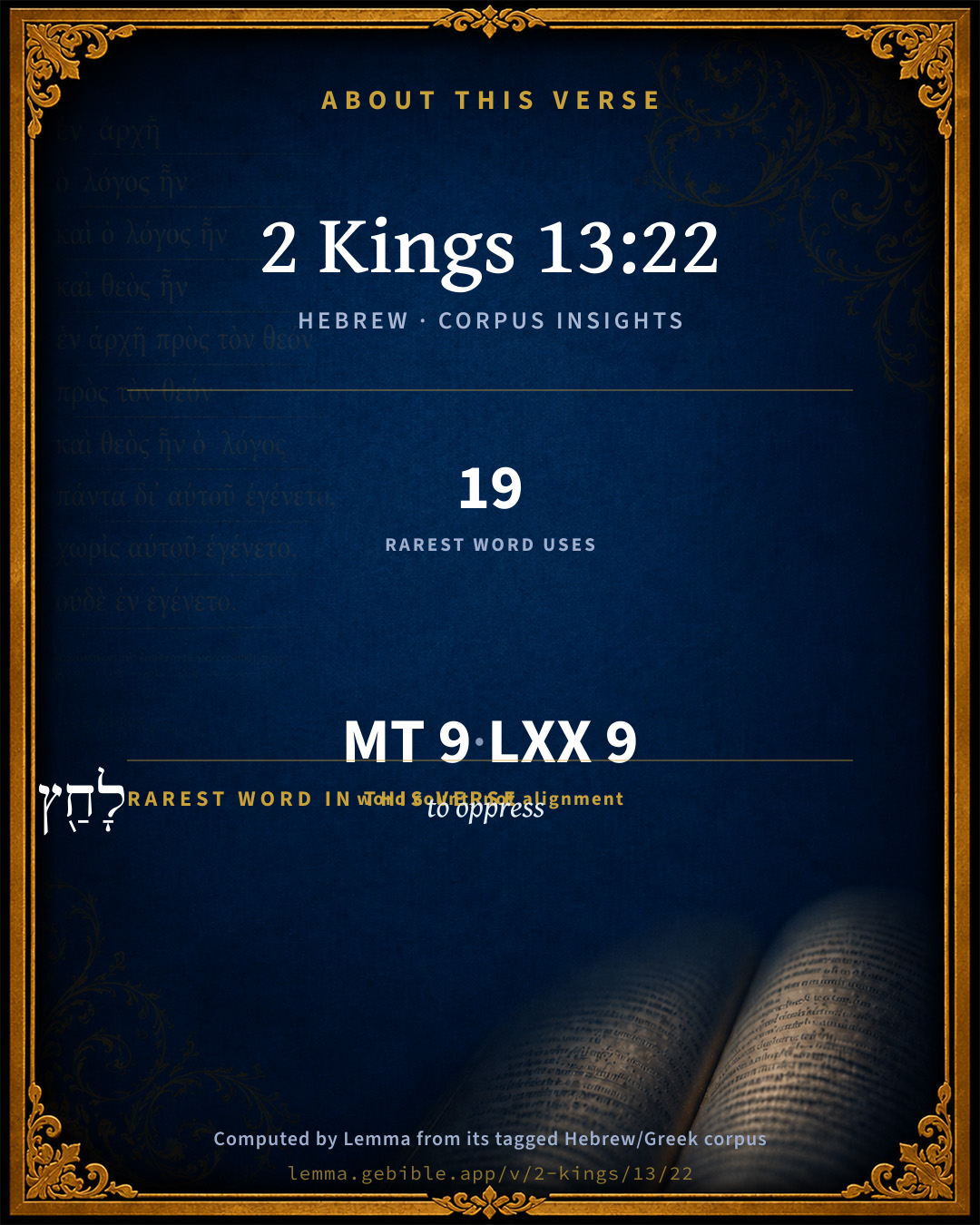
The rarest word here is לָחַ֖ץ to oppress H3905 — appearing just 19 times in the whole Hebrew Bible.

Shared distinctive vocabulary

לָחַ֖ץ to oppress H3905 occurs in 18 verses of the Hebrew Bible. Also found in:

Grammatical profile

  • 1 verb
  • 7 nouns
  • 1 particle

Verb forms

  • לָחַ֖ץ Qal · Perfect

Hebrew & Septuagint length

In English translation the verse runs 11 words from the Hebrew and 10 from the Septuagint (LXX English) — closely comparable.

A rough comparison of the two English renderings, which tokenize alike — not a word-level alignment.

Word counts can differ between the Hebrew and the Greek without any difference in meaning — e.g. the Hebrew direct-object marker אֵת has no separate Greek word, and Greek often adds the article ὁ.

In the original languages it is 9 Hebrew tokens and 9 Greek tokens — but the two are counted differently (Hebrew bundles its prefixes and suffixes into one token; the Greek is in lemma form), so that isn’t a like-for-like length.

Cross-references

3

Topical passages linked to 2 Kings 13:22 in the Treasury of Scripture Knowledge — connected by theme and wording, ordered by reader-vote popularity; previews shown in the World English Bible.

  • 2 Kings 8:12 Hazael said, Why weeps my lord? He answered, Because I know the evil that you will do to the children of Israel: their strongholds will you set on fire, and their young men will you kill with the sword, and will dash in pieces their little ones, and rip up their women with child.
  • 2 Kings 13:3–7 The anger of Yahweh was kindled against Israel, and he delivered them into the hand of Hazael king of Syria, and into the hand of Benhadad the son of Hazael, continually.
  • Psalms 106:40–42 Therefore Yahweh burned with anger against his people. He abhorred his inheritance.

Cross-references courtesy of OpenBible.info (CC BY 4.0).

Hebrew and Greek witnesses Masoretic Hebrew ↔ Greek Septuagint

The same verse in the two great witnesses to the Old Testament, shown verse-for-verse.

These are two independent witnesses, not word-aligned to each other, and the Septuagint is shown in lemma (dictionary) form.

Hebrew 2 Kings 13:22 Masoretic · Westminster Leningrad Codex

וַֽחֲזָאֵל֙ מֶ֣לֶךְ אֲרָ֔ם לָחַ֖ץ אֶת יִשְׂרָאֵ֑ל כֹּ֖ל יְמֵ֥י יְהוֹאָחָֽז

Hazael king of Syria oppressed Israel all the days of Jehoahaz.

World English Bible · Public Domain

Greek LXX 2 Kings 13:22 Septuagint · lemma form

καί αζαηλ ἐκθλίβω ὁ ἰσραήλ πᾶς ὁ ἡμέρα ιωαχας

And Azael greatly afflicted Israel all the days of Joachaz.

LXX2012 (modern English Septuagint) · Public Domain

Hebrew: Westminster Leningrad Codex (CC BY 4.0). Greek: Septuagint (public domain); English from LXX2012 (modern English Septuagint) (Public Domain). How the Septuagint differs from the Hebrew →

Targum (Aramaic paraphrase)

1

The Targum is the ancient Jewish Aramaic paraphrase of the Hebrew Scriptures — an interpretive translation, not the Hebrew text itself. Onkelos (literal) and Pseudo-Jonathan (expansive) render the Torah, and Jonathan the Prophets. Coverage is partial: where no permissively-licensed English translation exists for a verse, only the Aramaic is shown. This is verse-level text, not a word-by-word alignment to the Hebrew.

  1. Targum Jonathan Prophets (Joshua–Malachi)
    וַחֲזָאֵל מַלְכָּא דַאֲרָם דְחַק יַת יִשְׂרָאֵל כָּל יוֹמֵי יְהוֹאָחָז:

    (no public-domain English translation for this verse)

    Targum Jonathan — Aramaic: “Mikraot Gedolot” (public domain). English: “Sefaria Community Translation” (CC0 1.0 (public-domain dedication)); “London "Chaldee Paraphrase," 1871” (public domain). Text via Sefaria.

Commentary

Notes on 2 Kings 13:22 from classic Christian and Jewish commentators (each source and its license shown beneath its notes). The classic Christian expositions comment on the surrounding passage and are grouped to its opening verse, so a note may address several verses; the Jewish commentaries on the Tanakh (Rashi and others) are per-verse, so they appear only where the commentator wrote on this verse.

Lemma curates 59 commentaries, every one of them public domain or Creative Commons licensed, each selected and text-cleaned for this edition rather than reprinted as found. About our sources →

Trapp's Complete Commentary

John Trapp

2Ki 13:22 But Hazael king of Syria oppressed Israel all the days of Jehoahaz.

Ver. 22. All the days of Jehoahaz.] For about fifty years in all had this tyrant oppressed them. But God had promised them a saviour, viz., Joash, {2Ki 13:5} and this much about the time that Jehoahaz had besought the Lord, who was easily entreated to pity the low condition of his people. {2Ki 13:4}

John Trapp, A Commentary or Exposition upon All the Books of the Old and New Testament (1647–1656) — public domain. Text from a community e-Sword module.

Whedon's Commentary on the Bible

Daniel D. Whedon

DELIVERANCE FROM THE SYRIAN OPPRESSION, 2Ki_13:22-25.

22. All the days of Jehoahaz — So, though the Lord heard the prayer of this king of Israel, he did not answer it by sending a saviour until after his death. See 2Ki_13:4-5, notes.

Daniel D. Whedon (gen. ed.), Commentary on the Old and New Testaments (1874–1909) — public domain. Text from a community e-Sword module.

The Preacher's Complete Homiletical Commentary

Joseph S. Exell (gen. ed.)

CRITICAL AND EXPLANATORY NOTES.—

2Ki_13:25. Three times did Joash beat him—i.e., Benhadad, the son of Hazael; according to the number of arrows he shot (2Ki_13:19).—W. H. J.

HOMILETICS OF 2Ki_13:22-25

THE UNCHANGEABLENESS OF THE DIVINE MERCY

I. Seen in commiserating the sufferings of His people.—“Hazael oppressed Israel; and the Lord was gracious unto them and had compassion” (2Ki_13:22-23). The Divine heart is moved with the sight of suffering and woe. It is impossible for Him to be callous and indifferent to the afflictions of His people; the more they suffer, the more they are endeared to Him. The tenderness of the Divine mercy is unspeakably exquisite. How great is our sin to treat that mercy with coldness and persistent unbelief! Suffering is often the first thing that opens our eyes to the enormity of our sin and the marvellous condescension of the Divine mercy.

II. Seen in His reluctance to inflict the extreme penalty of disobedience.—“The Lord would not destroy them, neither cast He them from His presence as yet” (2Ki_13:23). The sins of the Israelites cried for chastisement. The greatest chastisement would be to be abandoned by Jehovah to the fury of their enemies, as was ultimately done (2Ki_17:18; 2Ki_17:20). But, though their iniquities deserved it, this extreme punishment was delayed by the Divine mercy. That mercy was reinforced by the Divine faithfulness. The Lord remembered “His covenant with Abraham, Isaac, and Jacob.” The exercise of mercy is always in harmony with every attribute of the Divine nature. If God be slow to punish because of His mercy, His justice ensures the certainty of punishment.

III. Seen in His faithful fulfilment of the promise of deliverance (2Ki_13:25). The dying Elisha, as the mouth-piece of Jehovah, had promised Israel three victories over Syria, and the resuscitation of the corpse when it touched the bones of the buried prophet would tend to strengthen faith in the fulfilment of the promise. In this verse the fact of that fulfilment is recorded—another indication that the history was written, not to set forth the valour and prowess of the Hebrews, and the external glory of the kingdom, but to illustrate the dealings of God with them, and trace the true causes of their decline and extinction as a nation. Every page of the history bears testimony to both the mercy and faithfulness of God. Mercy rejoices in providing means of deliverance, and faithfulness in carrying them out.

LESSONS:—The Divine mercy.—

1. Is tender and long-suffering.

2. Gives no licence to wrong-doing.

3. Provides an opportunity for repentance and reform.

GERM NOTES ON THE VERSES

2Ki_13:22-23.—National suffering. I. A chastisement for national sin. II. Awakens the Divine compassion. III. Is alleviated by the Divine mercy.

2Ki_13:23.—When God turns Himself from us, then we are given over to wretchedness: when he turns back to us again, then we find salvation. Abraham, Isaac, and Jacob had been dead for a thousand years, and yet their blessing was efficacious. God does not take pleasure in our ruin, but remembers, even in the midst of His anger, His promised grace and the covenant He has made.—Lange.

2Ki_13:25.—Property wrongfully acquired. I. Has no security in its possession. II. Acquired by violence, may be restored by violence. III. Is not worth the trouble it costs to acquire and keep.

—Tyrants are rods by means of which God chastises His people; but finally the tyrants themselves are chastised by God and cast into the fire.

—These cities were unjustly obtained and quickly lost. Unrighteous wealth rarely comes to the third generation.—Lange.

The Preacher's Complete Homiletical Commentary (gen. ed. Joseph S. Exell; Funk & Wagnalls, c. 1892) — public domain (pre-1929). A full-Bible homiletical/sermon-outline anthology covering 65 of 66 books (2 John is absent from the source module). Text from a community e-Sword module.

Ellicott's Commentary for English Readers

(22) But Hazael . . . oppressed.—Rather, Now Hazael . . . had oppressed. The narrative returns to 2Ki_13:3.

A Bible Commentary for English Readers, edited by Charles John Ellicott (1878–1897) — public domain. Text from a community e-Sword module.

The Cambridge Bible for Schools and Colleges

gen. ed. J. J. S. Perowne

22–25. Hazael’s oppression of Israel. God has compassion on them. The victories of Jehoash over Ben-hadad (Not in Chronicles)

22. But [R.V. And] Hazael … oppressed Israel] In these four verses we have a recapitulation of the attitude of Syria toward the Israelites in the two reigns of Jehoahaz and his son. The oppression lasted all the days of the former king, but yet, as in answer to his prayer (verse 4), Israel was not allowed to be destroyed. In the next reign came a greater relief.

The Cambridge Bible for Schools and Colleges (gen. ed. J. J. S. Perowne; Cambridge University Press, 1878–1918) — public domain. Text from a community e-Sword module.

The Pulpit Commentary

But Hazael King of Syria oppressed Israel all the days of Jehoahaz; rather, now Hazael King of Syria had oppressed Israel, etc. The author, having parenthetically related the extraordinary miracle wrought by the instrumentality of Elisha"s corpse, returns to the subject of the Syrian oppression. He had, in vers. 14-19, dwelt upon the promises of victory given by the prophet to Joash. He is now bent on relating their fulfillment. But before doing so he recapitulates. Ver. 22 refers back to ver. 3, and ver. 23 to vers. 4 and 5.

Vers. 22-25. Joash"s victories.

We have in the closing verses a record of the fulfillment of the promise given through Elisha. Notice

I THE GROUND OF THESE VICTORIES. While God had respect to the prayer of Jehoahaz, there was a deeper ground for his interposition to save Israel. He was gracious to them, and had compassion on them, and had respect to them, we are told, because of his covenant with Abraham and Isaac and Jacob. More specifically, we have as grounds:

1. Love to the fathers. God remembered Abraham and Isaac and Jacob, and would not hastily cast off their posterity (cf. Deu_4:37; Rom_11:28) Many of the blessings which sinners enjoy, the forbearance God shows them, etc., are due to the prayers of godly ancestors.

2. Regard for his own promise. God had made a covenant with the patriarchs, and had promised to be a God to them, and to their seed after them. That covenant was the main fact in the history of Israel. It underlies and governs all God"s dealings with them, past, present, and prospective. It was the remembrance of this covenant which led to the deliverance from; (Exo_2:24, Exo_2:25) to the settlement in Canaan; (Deu_9:3) and to God"s patient dealings with the nation amidst their various rebellious, and under their constant provocations. God saved them, not for their righteousness" sake, but for his own Name"s sake. He is the God of unchanging faithfulness.

3. Unwillingness to destroy the people. God casts off none hastily, for he has "no pleasure in the death of him that dieth". (Eze_18:32) He bears long with men, if haply they will repent. Wherefore it is said, "He would not destroy them, neither cast he them from his presence as yet.

There is a limit, however, to Divine forbearance. The time came when, still remaining impenitent, they were cast away, though even then not forever.

II THE EXTENT OF THESE VICTORIES. They amounted, as Elisha had predicted, only to three. Three times Joash beat the King of Syria, and recovered the cities of Israel from his hand. This was a great gain, but it might so easily have been greater, had Joash only fulfilled aright the conditions of success. How much blessing we often deprive ourselves of by our own unfaithfulness and shortcoming! It is reason for rejoicing that God does so much for us; but the joy must eternally be shaded by regret when we reflect that it is by our own doings that far more is not done. J.O.

The Pulpit Commentary (1880–1919), ed. H.D.M. Spence-Jones & Joseph S. Exell — public domain. Text from a community e-Sword module.

Keil & Delitzsch

C. F. Keil & F. Delitzsch

The prophecy which Elisha uttered before his death is here followed immediately by the account of its fulfilment, and to this end the oppression of the Israelites by Hazael is mentioned once more, together with that turn of affairs which took place through the compassion of God after the death of Hazael and in the reign of his son Benhadad. לחץ is a pluperfect: "Hazael had oppressed" (for the fact itself compare Kg2 13:4 and Kg2 13:7). For the sake of the covenant made with the patriarchs the Lord turned again to the Israelites, and would not destroy them, and did not cast them away from His face עתּה עד ("till now"), as was the case afterwards, but delivered them from the threatening destruction through the death of Hazael. For in the reign of his son and successor Benhadad, Joash the son of Jehoahaz took from him again (ויּשׁב is to be connected with ויּקּה) the cities which he (Hazael) had taken from Jehoahaz in the war. These cities which Hazael had wrested from Jehoahaz were on this side of the Jordan, for Hazael had conquered all Gilead in the time of Jehu (Kg2 10:32-33). Joash recovered the former from Benhadad, whilst his son Jeroboam reconquered Gilead also (see at Kg2 14:25).

Keil & Delitzsch — Biblical Commentary on the Old Testament (1861–1891) — public domain (CC PDM 1.0). Text via the HelloAO Bible API. (Old Testament only.)

unfoldingWord translationNotes

Door43 World Missions Community

But Yahweh was gracious to Israel, and had compassion on them and concern for them

It may be helpful to divide this sentence into shorter parts. AT: "But Yahweh was very kind to the Israelite people. He helped them"

So Yahweh did not destroy them

Yahweh's covenant is the reason he did not destroy Israel. This can be made explicit. AT: "This is the reason that Yahweh did not destroy them" or "Because of his covenant, Yahweh did not destroy them" (See: Assumed Knowledge and Implicit Information)

has not driven them away from his presence

Yahweh's rejection is spoken of as if he had physically driven Israel away from where he was. AT: "has not rejected them" (See: Metaphor)

translationWords

Aram

oppress

Yahweh

grace

compassion

covenant

Abraham

Isaac

Jacob

unfoldingWord translationNotes — © Distant Shores Media and the Door43 World Missions Community, licensed CC BY-SA 4.0. Source: git.door43.org/Door43/en_tn.

Lesson kit

Teaching starters — assembled from the data on this page, not authored interpretation. Every prompt links to the verse data it draws on. Edit before teaching.

2 Kings, in the Historical, opens this verse with 9 words (9 distinct Hebrew lemmas). Its most distinctive word is lâchats (“to oppress”). A historical commentator’s framing appears above. Read the whole chapter for the surrounding context.

Discussion questions

  1. The word lâchats carries the sense “to oppress.” How does it shape the verse?
  2. Exodus 3:9 shares the word «to oppress» with this verse. How do the two illuminate each other?
  3. These translations render this verse differently. What is at stake in choosing one wording over another?
  4. The verb «לָחַ֖ץ» is Qal Perfect. How does its form color the action?
  5. Reading how Trapp's Complete Commentary and Whedon's Commentary on the Bible read this verse, where do the two commentators agree and where do they part?

Things to notice

Reading settings

Reading text

Shown beneath each verse's original-language words.

Old Testament
Old Testament edition

Read the OT as the Masoretic Hebrew (MT) or the Greek Septuagint (LXX).

English shown for the Greek Septuagint (in the Hebrew ↔ Greek comparison).

Comparing translations? Open the Compare panel on any verse page to stack up to four side by side.