
Haggai 1:7

Hebrew (Westminster Leningrad Codex) Haggai 1:7 appears in the Hebrew Old Testament. The text above is from the Westminster Leningrad Codex. Each word links to its Strong’s number, a concise gloss, and parsing drawn from the Open Scriptures Hebrew Bible morphology. Click any word for its full Brown-Driver-Briggs (BDB) entry.
Download image
Cite this verse

Haggai 1:7 (World English Bible). Public Domain. Lemma interlinear Bible study tool, https://lemma.gebible.app/v/haggai/1/7.

Show BibTeX & RIS
BibTeX
RIS
English Translation
This is what Yahweh of Hosts says: "Consider your ways.
World English Bible · Public Domain
Download a study sheet

One document with this verse’s original text, its word-by-word gloss line, the meaning frame, cross-references with their text, attributed commentary, and full source and license credits — printable, and it pastes into notes with its structure intact.

This verse Autodidact and up

Study sheet (.html) Plain text (.txt)

A passage Seminary Student

Up to 50 verses in one chapter. A passage sheet keeps up to 6 commentary sources and 12 cross-references per verse, in the order this page ranks them, and says so on the sheet whenever that leaves anything out. Ask for a single verse and you get the Autodidact verse sheet above.

Everything on this page stays free to read, with no account — the sheet is a download of what is already on screen, not access to it.

Want to remove ads? Support Godless Engineer
Compare translations 3

The same verse in 3 English versions, stacked beneath the original-language interlinear above. Click any original word for its lexicon entry.

Each is an independent rendering of the whole verse — the interlinear is not word-aligned to these translations.

Highlighted words mark where these versions differ — a whole-verse word diff, not a word-by-word alignment.

  • World English Bible Public Domain
    This is what Yahweh of Hosts says: "Consider your ways.
  • King James Version Public Domain
    Thus saith the LORD of hosts; Consider your ways.
  • unfoldingWord Literal Text CC BY-SA 4.0
    Thus says Yahweh of Armies: ‘Set your heart upon your ways!

unfoldingWord Literal Text — © unfoldingWord, licensed CC BY-SA 4.0. Word-aligned USFM3 via Door43 (git.door43.org/unfoldingWord/en_ult).

Versions to compare (up to 4)

3 of 4 selected

Show all 18 translations

Every available English version of this verse, each an independent rendering of the whole verse.

  • World English Bible Public Domain
    This is what Yahweh of Hosts says: "Consider your ways.
  • Berean Standard Bible Public Domain
    This is what the LORD of Hosts says: “Consider carefully your ways.
  • Majority Standard Bible Public Domain
    This is what the LORD of Hosts says: “Consider carefully your ways.
  • King James Version Public Domain
    Thus saith the LORD of hosts; Consider your ways.
  • American Standard Version (1901) Public Domain
    Thus saith Jehovah of hosts: Consider your ways.
  • Revised Version (1885) Public Domain
    Thus saith the LORD of hosts: Consider your ways.
  • Geneva Bible (1599) Public Domain
    Thus sayth the Lord of hostes, Consider your owne wayes in your hearts.
  • Douay-Rheims (1899) Public Domain
    Thus saith the Lord of hosts: Set Your hearts upon your ways:
  • Young's Literal Translation Public Domain
    Thus said Jehovah of Hosts: Set your heart to your ways.
  • Literal Standard Version CC BY-SA 4.0
    Thus said YHWH of Hosts: “Set your heart to your ways.
  • Unlocked Literal Bible CC BY-SA 4.0
    Yahweh of hosts says this: “Consider your ways!
  • unfoldingWord Literal Text CC BY-SA 4.0
    Thus says Yahweh of Armies: ‘Set your heart upon your ways!
  • Darby Bible Public Domain
    Thus saith Jehovah of hosts: Consider your ways.
  • World Messianic Bible Public Domain
    “This is what the LORD of Hosts says: ‘Consider your ways.
  • Webster's Bible Public Domain
    Thus saith the LORD of hosts; Consider your ways.
  • Free Bible Version CC BY-SA 4.0
    The Lord Almighty says this: Think about what you're doing!
  • Bible in Basic English Public Domain
    This is what the Lord of armies has said: Give thought to your ways.
  • JPS Tanakh (1917) Public Domain
    Thus saith the LORD of hosts: Consider your ways.

Literal Standard Version (2020), Covenant Press — licensed CC BY-SA 4.0. Text via the HelloAO Bible API (eBible.org). Unlocked Literal Bible (unfoldingWord) — licensed CC BY-SA 4.0. Text via the HelloAO Bible API (eBible.org). unfoldingWord Literal Text — © unfoldingWord, licensed CC BY-SA 4.0. Word-aligned USFM3 via Door43 (git.door43.org/unfoldingWord/en_ult). Free Bible Version, Dr. Jonathan Gallagher — licensed CC BY-SA 4.0. Text via the HelloAO Bible API (eBible.org).

Word by word

More ways to search: Search by grammar → Find every occurrence → Compare this word →

Practice this passage: Drill this verse → Learn its vocabulary →

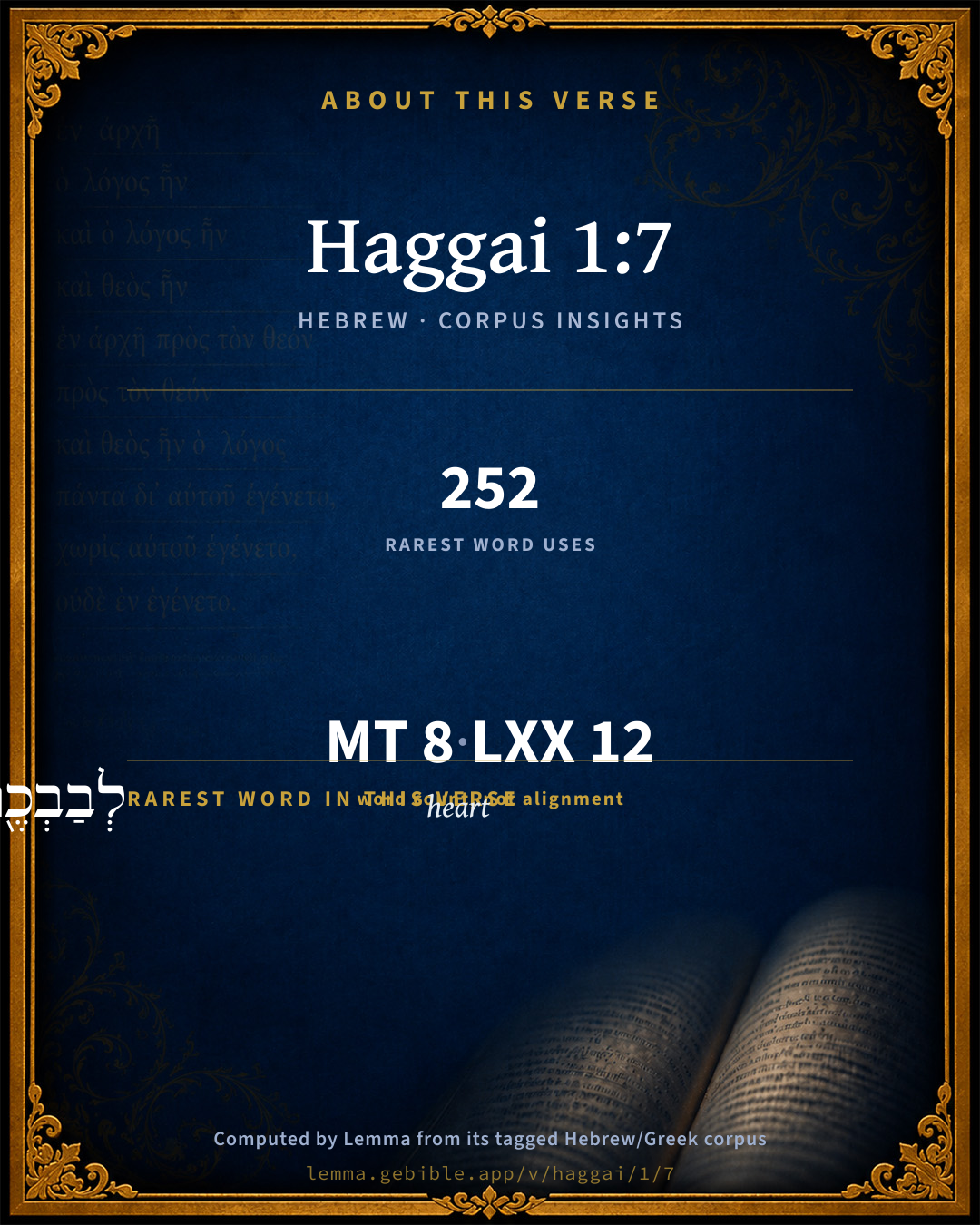
לְבַבְכֶ֖ם
lêbâb
H3824
“heart · your”
Noun, Common, Masculine, Singular, Construct + Suffix, Personal, 2nd Person, Masculine, Plural
Part of Speech
Noun
Type
Common
Gender
Masculine
Number
Singular
State
Construct
Full BDB Definition

Origin: from H3823

TWOT: 1071a

inner man, mind, will, heart, soul, understanding - inner part, midst - midst (of things) - heart (of man) - soul, heart (of man) - mind, knowledge, thinking, reflection, memory - inclination, resolution, determination (of will) - conscience - heart (of moral character) - as seat of appetites - as seat of emotions and passions - as seat of courage
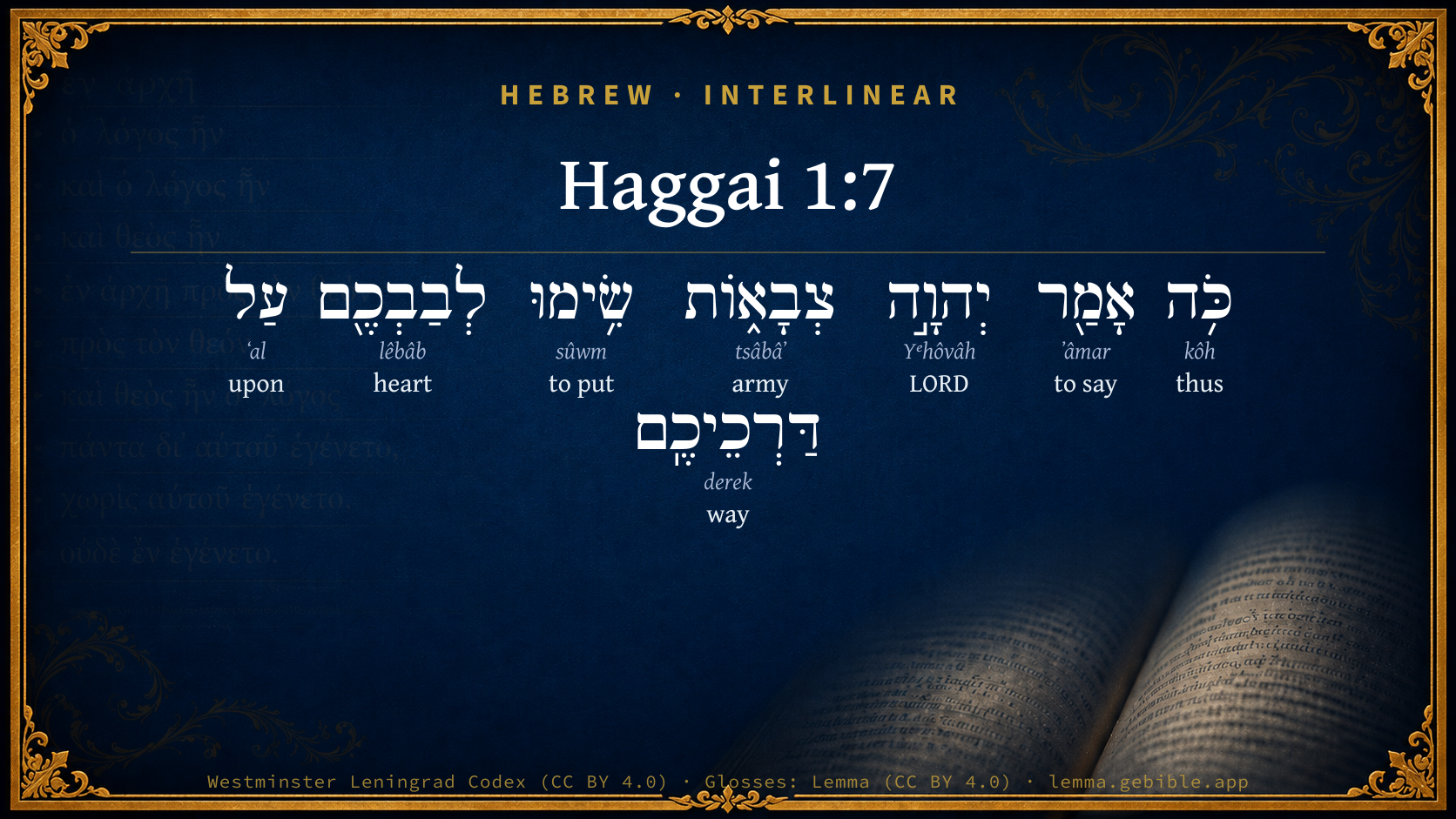
  1. כֹּ֥ה kôh H3541 “thus” Adverb
  2. אָמַ֖ר ʼâmar H559 “to say” Verb, Qal, Perfect, 3rd Person, Masculine, Singular
  3. יְהוָ֣ה Yᵉhôvâh H3068 “LORD” Noun, Proper
  4. צְבָא֑וֹת tsâbâʼ H6635 “armies” Noun, Common, Both, Plural, Absolute
  5. שִׂ֥ימוּ sûwm H7760 “put” Verb, Qal, Imperative, 2nd Person, Masculine, Plural
  6. עַל ʻal H5921 “upon” Preposition
  7. דַּרְכֵיכֶֽם derek H1870 “ways · your” Noun, Common, Both, Plural, Construct + Suffix, Personal, 2nd Person, Masculine, Plural

About this verse

These counts appear in no published source. They are computed here, from the morphology-tagged text and Lemma’s own curated glosses. What Lemma adds →

8
words
8
distinct lemmas
Prophets
section

Grammatical profile

  • 2 verbs
  • 4 nouns
  • 1 preposition
  • 1 adverb

Verb forms

  • אָמַ֖ר Qal · Perfect
  • שִׂ֥ימוּ Qal · Imperative

Hebrew & Septuagint length

In English translation the verse runs 10 words from the Hebrew and 8 from the Septuagint (LXX English) — closely comparable.

A rough comparison of the two English renderings, which tokenize alike — not a word-level alignment.

Word counts can differ between the Hebrew and the Greek without any difference in meaning — e.g. the Hebrew direct-object marker אֵת has no separate Greek word, and Greek often adds the article ὁ.

In the original languages it is 8 Hebrew tokens and 12 Greek tokens — but the two are counted differently (Hebrew bundles its prefixes and suffixes into one token; the Greek is in lemma form), so that isn’t a like-for-like length.

Cross-references

3

Topical passages linked to Haggai 1:7 in the Treasury of Scripture Knowledge — connected by theme and wording, ordered by reader-vote popularity; previews shown in the World English Bible.

  • Psalms 119:59–60 I considered my ways, And turned my steps to your statutes.
  • Haggai 1:5 Now therefore this is what Yahweh of Hosts says: Consider your ways.
  • Philippians 3:1 Finally, my brothers, rejoice in the Lord. To write the same things to you, to me indeed is not tiresome, but for you it is safe.

Cross-references courtesy of OpenBible.info (CC BY 4.0).

Hebrew and Greek witnesses Masoretic Hebrew ↔ Greek Septuagint

The same verse in the two great witnesses to the Old Testament, shown verse-for-verse.

These are two independent witnesses, not word-aligned to each other, and the Septuagint is shown in lemma (dictionary) form.

Hebrew Haggai 1:7 Masoretic · Westminster Leningrad Codex

כֹּ֥ה אָמַ֖ר יְהוָ֣ה צְבָא֑וֹת שִׂ֥ימוּ לְבַבְכֶ֖ם עַל דַּרְכֵיכֶֽם

This is what Yahweh of Hosts says: "Consider your ways.

World English Bible · Public Domain

Greek LXX Haggai 1:7 Septuagint · lemma form

ὅδε λέγω κύριος παντοκράτωρ τίθημι ὁ καρδία σύ εἰς ὁ ὁδός σύ

Thus says the Lord Almighty; Consider your ways.

LXX2012 (modern English Septuagint) · Public Domain

Hebrew: Westminster Leningrad Codex (CC BY 4.0). Greek: Septuagint (public domain); English from LXX2012 (modern English Septuagint) (Public Domain). How the Septuagint differs from the Hebrew →

Targum (Aramaic paraphrase)

1

The Targum is the ancient Jewish Aramaic paraphrase of the Hebrew Scriptures — an interpretive translation, not the Hebrew text itself. Onkelos (literal) and Pseudo-Jonathan (expansive) render the Torah, and Jonathan the Prophets. Coverage is partial: where no permissively-licensed English translation exists for a verse, only the Aramaic is shown. This is verse-level text, not a word-by-word alignment to the Hebrew.

  1. Targum Jonathan Prophets (Joshua–Malachi)
    כִּדְנַן אֲמַר יְיָ צְבָאוֹת שַׁווּ לִבְּכוֹן עַל אוֹרְחָתְכוֹן:

    (no public-domain English translation for this verse)

    Targum Jonathan — Aramaic: “Mikraot Gedolot” (public domain). English: “Sefaria Community Translation” (CC0 1.0 (public-domain dedication)); “London "Chaldee Paraphrase," 1871” (public domain). Text via Sefaria.

Commentary

Notes on Haggai 1:7 from classic Christian and Jewish commentators (each source and its license shown beneath its notes). The classic Christian expositions comment on the surrounding passage and are grouped to its opening verse, so a note may address several verses; the Jewish commentaries on the Tanakh (Rashi and others) are per-verse, so they appear only where the commentator wrote on this verse.

Lemma curates 59 commentaries, every one of them public domain or Creative Commons licensed, each selected and text-cleaned for this edition rather than reprinted as found. About our sources →

Trapp's Complete Commentary

John Trapp

Hag 1:7 Thus saith the LORD of hosts; Consider your ways.

Ver. 7. Consider your ways] See Hag 1:5. Do it early and earnestly. Excutite vos, iterumque excutite, as Tremellius rendereth that in Zep 2:1 "Search you, search you, O nation not worthy to be beloved." So Lam 3:40 "Let us search and try our ways." Not search only, but try, and, as it were, sift them to the bran. So 2Co 13:5 "Examine yourselves whether ye be in the faith: prove your own selves," as it were, with redoubled diligence, in a most needful but much neglected duty, of dealing with your own hearts. But if ye will not, see that flaming place, Eze 16:43. If men will not judge themselves, God will; as, though scholars will not scan their verses, their masters will. Men are as loth to review their actions, and read the blurred writings of their own hearts, as schoolboys are to parse their lessons and false Latins they have made. But as he who will not cast up his books, his books will cast up him at length; so those that will not consider their ways, and take themselves to task, shall find that sparing a little pains at first will double it in the end; and that the best that can come of this forlorn negligence is the bitter pangs of repentance. Oh, therefore, that, with Solomon’s wise man, we had our eyes in our heads, and not in the corners of the earth! Ecc 2:14. And that our eyes were, like the windows in Solomon’s temple, broad inward, that we might see our sins to confession, so should we never see them to our confusion, 1Ki 6:4. The Israelites confessed their murmuring and stubbornness when God sent evil angels among them, that is, some messengers of his wrath and displeasure. The prophet Haggai here would have their posterity consider, and better consider, since the hand of God was so heavy upon them, and that he came against them, as it were, with a drawn sword, how they might disarm his just indignation by a speedy reformation. To which purpose he addeth,

John Trapp, A Commentary or Exposition upon All the Books of the Old and New Testament (1647–1656) — public domain. Text from a community e-Sword module.

The Biblical Illustrator

Joseph S. Exell

Hag_1:7

Thus saith the Lord of hosts, Consider your ways.

The call of God

I. The person who issues this command. Note the Divine character of the speaker. The Lord of hosts. This name, containing in it every perfection, commands our regard and challenges our awe. Omnipotence, omniscience, and unlimited authority unite their beams in one blaze of glory in this truly august character, The Lord of hosts.

II. The command itself. Consider your ways. Fix your thoughts upon them with diligence, earnestness, and heart application. Be honest with yourselves, serious and particular in the inquiry into your real character in the sight of God. The command implies that--

1. God has given to us a revelation of His will as the rule of our duty, and the standard by which we are to examine our conduct. The Scriptures form the directory and rule by which we are to try our ways, and which God has in mercy given to us by His own revelation for this purpose.

2. God hath endowed us with the powers of recollection and reflection. By these we can bring the transactions of our whole lives into present view, and arrange the several actions of them in their proper order and colours. It is our wisdom to converse with our departed hours, that we may learn to redeem the time.

3. As God has given both the rule and capacity for the exercising of this duty, so the discharge of it is necessary and advantageous.

(1) The frequent and impartial consideration of our ways has a tendency to humble us before the footstool of the all-glorious Jehovah, and to convince us of our weakness, unworthiness, meanness, and insignificancy.

(2) The diligent and frequent consideration of our ways will be accompanied with this further advantage, of leading us to a cordial, entire dependence upon God, both for direction and assistance in every duty.

(3) Compliance with that required in our text will lead us to see and own that the salvation of a sinner is, and must be, all of grace and mercy. We shall then no longer boast of our good hearts, the integrity of our conduct, or our regular duties. We shall cry for mercy. If you would be humble Christians, dependent upon and sensible of your obligations to the free grace of God, be frequent and impartial in the consideration of your ways.

III. Appeal to every mans conscience in the sight of God.

1. Address the careless unconcerned part of the hearers.

2. Those who have experienced only some slight convictions of sin, and but a transient concern about their salvation.

3. Those who are backsliders. Invite them to serious thought about their present state and danger.

4. Those who are real believers. How crooked even their ways will appear in the review! How slow their progress in the path of duty and obedience. On the whole, as the consideration of our ways is a great duty, so it requires our present and most serious attention. The present now is the season that demands dispatch. Today we must hear Gods voice, before disease incapacitate, or death prevent us. (J. King, B. A.)

An address to servants

It should be the great concern of every one of us to consider our ways; to think over them; to search and try them. Applied to servants, we treat--

I. Their duties.

1. Your first duty is to God. You must turn unto Him as real penitents, seek forgiveness through the merits of Jesus Christ, wash in His precious blood, and believe the promises which He has given in His Gospel.

2. Earnest prayer is a duty which servants too often neglect. Weariness at night, and late rising in the morning, are the causes.

3. The diligent reading of the Scriptures. The busiest may find or make time for this spiritual improvement.

4. Attending constantly at the house of God. Whenever, that is, you can secure an opportunity. Faith cometh by hearing.

5. Consider your duty towards your employers. Such as the duty of fidelity or faithfulness; a strict regard for truth; obedience; keeping your temper. It is helpful and wise to make a friend, as we call it, of your master and mistress.

6. Consider your duty to your fellow-servants. You ought to show great care, tenderness, and affection for the welfare of each other. Endeavour to lead your fellow-servants into the paths of peace, by recommending, both by precept and example, religious habits. Aid them according to the ability which God giveth you, when they are in any distress.

II. Their trials and temptations.

1. Your early removal from your friends. Service is not like home, however comfortably you may be located. Home is home, however homely.

2. If a Christian servant, the irreligious habits of the families with whom you dwell is another trial.

3. The worldliness of your fellow-servants. These trials bring temptations. And there are special moral temptations for female servants.

III. Their privileges.

1. Wants supplied without involving personal anxiety.

2. Opportunity for receiving the Lords Supper.

3. Power to assist in the Lords work. (James R. Starey, M. A.)

Whither art thou going?

Every work, with every secret thing, shall reappear at the judgment-seat of Christ, whether good or whether evil. A journey ends somewhere; each step of it is somewhither. Whither, then, are we each going? Of some changes you must be aware, in some you have doubtless rejoiced. But what as to your souls? In what way have they changed? Are they fitter for their end, for that for which God created them? If you have not used Gods grace in the last year, you are, humanly speaking, less in the way to use it this next. Would you prepare for anything, which you care about in this life, as you prepare for eternity? You would not so prepare for any race in this life. God has divided our lives into lesser portions. But each resting-place should give us pause, and force us into ourselves, and make us think, for a time at ]east, whether we have made ever so little progress in the way, or have sat down in the way, or have turned altogether aside out of the way. Consider your ways. Consider what you have been doing, what you are doing, and whither those doings are tending. Set your heart upon them, your heart, the seat of your affections. How, if you have not done it, are you to set about this considering your ways? How would you do if you suspected that you were out of your way on this earth? You would, if you could see it, look back to your starting-point, and see how, little by little, you had swerved from the right path. Then look back to earliest days, see by what lesser or greater steps thou first departedst from the narrow way; look how evil habits strengthen by repetition. Sift thyself through and through, says the prophet, and so sift on. Then shalt thou make progress, not if thou findest not what to blame, but if thou blame what thou findest. When thou didst not set thy heart upon thy ways, thou didst incur daily, well-nigh countless sin, in thought, word, desire, deed, yea, and in omission of duty. Then judge thyself, that thou be not judged of the Lord. (E. B. Pusey, D. D.)

The Biblical Illustrator, edited by Joseph S. Exell (c. 1880s–1900s) — public domain. Text from a community e-Sword module.

Whedon's Commentary on the Bible

Daniel D. Whedon

Hag_1:7 urges the people again to stop and consider. It is possible, however, that “consider your ways” is an erroneous repetition from Hag_1:5, and that Hag_1:6 should be followed immediately by the direct appeal to build the temple (Hag_1:8), introduced by the common formula, “Thus saith Jehovah of hosts.”

Go up to the mountain — To gather wood for building material. The article is used generically: any mountain upon which building material could be found, not necessarily Mount Lebanon. At the time of Haggai the hills around Jerusalem may have been covered with woods.

Bring wood — The term may include building material of every sort. Wood would be the most important, since stones from the ruins of the first temple might be used in the foundation of the new. After gathering the material they were to proceed with the building operations.

I will take pleasure in it — Which he will prove by taking his abode there (compare Psa_132:13-14).

I will be glorified — Better, I will glorify myself. The completion of the temple will mark the dawn of the Messianic age, when Jehovah will glorify himself by pouring his blessing upon his people in abundant measure.

Hag_1:9-10 enforce the appeal of Hag_1:8 by calling attention once more to the present calamity and by emphasizing the thought that it is the direct result of their neglectfulness. They were disappointed in their expectations of a rich harvest, and the little they did reap vanished without doing any good.

I did blow upon it — So that it vanished. Misfortune came not by chance; Jehovah sent it because they neglected his house while living in luxury in their own (compare Hag_1:4). The description of the judgment is continued in Hag_1:10-11.

Over you — Better, R.V., “for your sake.” On account of your transgressions.

Dew — Jehovah withheld the dew, which is of great importance in Palestine (see on Hos_14:5), and as a result of this and of the drought mentioned in Hag_1:11, the land remained barren. The tenses should be changed in English so as to agree with those of 9a and 11. Some of the expressions in the original are peculiar, and several minor emendations have been proposed, but even with these the thought remains the same.

I called for a drought — As a means of judgment (see on Amo_4:7). “Drought,” Hebrews horebh, corresponds to “lieth waste,” Hebrews harebh (Hag_1:4; Hag_1:9). Because they left his house harebh he punished them with horebh, the judgment being according to the lex talionis.

Upon the mountains — So that the forests suffered.

Corn,… new wine,… oil — The chief products of Palestine (see on Joe_1:10).

That which the ground bringeth forth — All products of the soil not previously mentioned. The terrible drought brought intense suffering to man and beast (see on Joe_1:18).

All the labor of the hands — The drought made of no effect all the labor expended in the cultivation of the soil (compare Psa_128:2).

Daniel D. Whedon (gen. ed.), Commentary on the Old and New Testaments (1874–1909) — public domain. Text from a community e-Sword module.

Keil & Delitzsch

C. F. Keil & F. Delitzsch

After this allusion to the visitation of God, the prophet repeats the summons in Hag 1:7, Hag 1:8, to lay to heart their previous conduct, and choose the way that is well-pleasing to God. Hag 1:7. "Thus saith Jehovah of hosts, Direct your heart upon your ways. Hag 1:8. Go up to the mountains and fetch wood and build the house, and I will take pleasure therein and glorify myself, saith Jehovah." Hâhâr (the mountain) is not any particular mountain, say the temple mountain (Grotius, Maurer, Ros.), or Lebanon (Cocceius, Ewald, etc.); but the article is used generically, and hâhâr is simply the mountain regarded as the locality in which wood chiefly grows (cf. Neh 8:15). Fetching wood for building is an individualizing expression for providing building materials; so that there is no ground for the inference drawn by Hitzig and many of the Rabbins, that the walls of the temple had been left standing when it was destroyed, so that all that had to be done was to renew the wood-work, - an inference at variance not only with the reference made to the laying of the foundation of the temple in Hag 2:18 and Ezr 3:10, but also to the express statement in the account sent by the provincial governor to king Darius in Ezr 5:8, viz., that the house of the great God was built with square stones, and that timber was laid in the walls. וארצה־בּו, so will I take pleasure in it (the house); whereas so long as it lay in ruins, God was displeased with it. ואכּבד, and I will glorify myself, sc. upon the people, by causing my blessing to flow to it again. The keri ואכּבדה is an unnecessary emendation, inasmuch as, although the voluntative might be used (cf. Ewald, 350, a), it is not required, and has not been employed, both because it is wanting in ארצה, for the simple reason that the verbs לה do not easily admit of this form (Ewald, 228, a), and also because it is not used in other instances, where the same circumstances do not prevail (e.g., Zac 1:3).

(Note: The later Talmudists, indeed, have taken the omission of the ה, which stands for 5 when used as a numeral, as an indication that there were five things wanting in the second temple: (1) the ark of the covenant, with the atoning lid and the cherubim; (2) the sacred fire; (3) the shechinah; (4) the Holy Spirit; (5) the Urim and Thummim (compare the Babylonian tract Joma 21b, and Sal. ben Melech, Miclal Jophi on Hag 1:8).)

Ewald and Hitzig adopt this rendering, "that I may feel myself honoured," whilst Maurer and Rckert translate it as a passive, "that I may be honoured." But both of these views are much less in harmony with the context, since what is there spoken of is the fact that God will then turn His good pleasure to the people once more, and along with that His blessing. How thoroughly this thought predominates, is evident from the more elaborate description, which follows in Hag 1:9-11, of the visitation from God, viz., the failure of crops and drought.

Keil & Delitzsch — Biblical Commentary on the Old Testament (1861–1891) — public domain (CC PDM 1.0). Text via the HelloAO Bible API. (Old Testament only.)

John Calvin's Commentaries

The Prophet now adds, that since the Jews were thus taught by their evils, nothing else remained for them but to prepare themselves without delay for the work of building the Temple; for they were not to defer the time, inasmuch as they were made to know, that God had come forth with an armed hand to vindicate his own right: for the sterility of which he had spoken, and also the famine and other signs of a curse, were like a drawn sword in the hand of God; by which it was evident, that he intended to punish the negligence of the people. As God then had been robbed of his right, he not only exhorted the people by his Prophets, but also executed his vengeance on this contempt.

This is the reason why the Prophet now says, Apply your heart, and then adds, Go up to the mountain, bring wood, etc. And this passage strikingly sets forth why God punished their sins, in order that they might not only perceive that they had sinned, but that they might also seek to amend that which displeased God. We may also, in the second place, learn from what is said, how we are to proceed rightly in the course of true repentance. The beginning is, that our sins should become displeasing to us; but if any of us proceed no farther, it will be only an evanescent feeling: it is therefore necessary to advance to the second step; an amendment for the better ought to follow. The Prophet expresses both here: He says first, Lay your heart on your ways; that is, “Consider whence comes this famine to you, and then how it is that by laboring much ye gain nothing, except that God is angry with you.” Now this was what wisdom required. But he again repeats the same thing, Lay your heart on your ways, that is, “Not only that sin may be hated by you, but also that this sloth, which has hitherto offended God and provoked his wrath, may be changed into strenuous activity.” Hence he says, Go up to the mountain, and bring wood, and let the house be built

If any one is at a loss to know why the Prophet insists so much on building the Temple, the ready answer is this: that it was God’s design to exercise in this way his ancient people in the duties of religion. Though then the Temple itself was of no great importance before God, yet the end was to be regarded; for the people were preserved by the visible Temple in the hope of the future Christ; and then it behaved them always to bear in mind the heavenly pattern, that they might worship God spiritually under the external symbols. It was not then without reason that God was offended with their neglect of the temple; for it hence clearly appeared, that there was no care nor zeal for religion among the Jews. It often was the case that they were more sedulous than necessary in external worship, and God scorned their assiduity, when not connected with a right inward feeling; but the gross contempt of God in disregarding even the external building, is what is reprehended here by the Prophet.

He afterwards adds, And I will be propitious in it, or, I will take pleasure in it. Some read, It will please me; and they depart not from the real meaning of the verb: for רצה, retse—is to be acceptable. But more correct, in my view, is the opinion of those who think that the Prophet alludes to the promise of God; for he had said, that he would on this condition dwell among the Jews, that he might hear their prayers, and be propitious to them. As, then, the Jews came to the Temple to expiate their sins, that they might return to God’s favor, it is not without reason that God here declares that he would be propitious in that house.

‘If any one sin,’ said Solomon, ‘and entering this house, shall humbly pray, do thou also hear from thy heavenly habitation.’ (1 Kings 8:30.)

We further know that the covering of the ark was called the propitiatory, because God there received the suppliant into favor. This meaning, then, seems the most suitable—that the Prophet says, that if the Temple was built, God would be there propitious. But it was a proof of extreme impiety to think that they could prosper while God was adverse to them: for whence could they hope for happiness, except from the only fountain of all blessings, that is, when God favored them and was propitious to them? And how could his favor be sought, except they came to his sanctuary, and thence raise up their minds by faith to heaven? When, therefore, there was no care for the Temple, it was easy to conclude that God himself was neglected, and regarded almost with scorn. We then see how emphatically this was added, I will be propitious there, that is, in the Temple; as though he had said, “Your infirmity ought to have reminded you that you have need of this help, even of worshipping me in the sanctuary. But as I gave you, as it were, a visible mirror of my presence among you, when I ordered a Temple to be built for me on mount Sion, when ye despise the Temple, is it not the same as though I was rejected by you?”

He then adds, And I shall be glorified, saith Jehovah. He seems to express the reason why he should be propitious; for he would then see that his glory was regarded by the Jews. At the same time, this reason may be taken by itself, and this is what I prefer. The Prophet then employs two goads to awaken the Jews: When the Temple was built, God would bless them; for they would have him pacified, and whenever they found him displeased, they might come as suppliants to seek pardon; this was one reason why it behaved them strenuously to undertake the building of the Temple. The second reason was, that God would be glorified. Now, what could have been more inconsistent than to disregard God their deliverer, and so late a deliverer too? But how God was glorified by the Temple I have already briefly explained; not that it added anything to God; but such ordinances of religion were then necessary, as the Jews were as yet like children. It now follows—

John Calvin's Commentaries (1540-1563) — public domain. Text from the Calvin Translation Society English edition (1840s-50s) via the Christian Classics Ethereal Library (ccel.org). Calvin's coverage is partial (roughly two-thirds of the Bible); uncommented books and verses are honest gaps, never fabricated. The 19th-century editor's footnotes and remarks are omitted so the notes are faithfully Calvin's own voice.

John Gill's Exposition

Thus saith the Lord of hosts, Consider your ways. What they have been; what has been the consequence of them; and to what the above things are to be ascribed. This exhortation is repeated, to impress it the more upon their minds; and to denote the importance of it, and the necessity of such a conduct; See Gill on Hag 1:5.

.

Haggai 1:8

hag 1:8

hag 1:8

hag 1:8Go up to the mountain,.... Or, "that mountain" (u); pointing either to Lebanon, to cut down cedars, and bring them from thence for the building of the temple; or Mount Moriah, on which the temple was to be built; and thither carry the wood they fetched from Lebanon, or were brought from thence by the Tyrians:

and bring wood; or, "that ye may bring wood"; from Lebanon, or any other mountain on which wood grew, to Mount Moriah:

and build the house; the temple, whose foundation was already laid, but the superstructure was neglected: now the Lord would have them go on with it immediately, out of hand, with the utmost diligence, alacrity, and vigour; and not desist till the whole building was completed:

and I will take pleasure in it; as a type of Christ, for whose sake he was so desirous of having it built; into which he was to come, and there appear as the promised Saviour. It signifies, moreover, that the Lord would not only take pleasure in the temple built, but in their work in building it; which would be acceptable to him, being according to his mind and will; and that he would take pleasure in, and accept of them, being worshippers therein, when they worshipped him in spirit and in truth in it; and in their services, sacrifices, prayers, and praises, being rightly offered; and that he would forgive their sins, and be propitious to them for his Son's sake, the antitype of the temple:

and I will be glorified, saith the Lord; by his people here, and by the worship and service they should perform: or, "I will show myself glorious" (w); that is, show his glory, causing his Shechinah to dwell here in glory, as the Targum is. The Jews observe, that the letter is wanting in the word here used, which numerically signifies "five"; hence they gather that five things were wanting in the second temple, the ark, the Urim and Thummim, the fire from heaven, the Shechinah, or the divine Majesty, and the Holy Ghost.

(u) "in istum montem", Junius & Tremellius, Piscator. (w) "gloriosum me ostendam", Vatablus.

John Gill's Exposition of the Whole Bible (1746–1763) — public domain (CC PDM 1.0). Text via the HelloAO Bible API.

Matthew Poole's English Annotations

See Hag 1:5. Debate it with yourselves, both as to what is already past, and what will be for time to come; it hath not been a chance, or an evil which none can tell whence it proceeds, it is from your neglect of God, his temple and worship.

Matthew Poole's English Annotations on the Holy Bible (1683–1685) — public domain. Text from a community e-Sword/MySword module.

The Pulpit Commentary

Vers. 7-112. The prophet urges the people to work zealously at the building; only thus could they hope for the removal of their present disasters.

(See note on ver. 5.) The repetition of the call to reflection is needed. (comp. Php_3:1) Former experience opens the way to the injunction in ver. 8.

The Pulpit Commentary (1880–1919), ed. H.D.M. Spence-Jones & Joseph S. Exell — public domain. Text from a community e-Sword module.

unfoldingWord translationNotes

Door43 World Missions Community

bring timber

This represents only a part of what they needed to build the temple. (See: Synecdoche)

behold

"look" or "listen" or "pay attention to what I am about to tell you"

I blew it away

The people not being able to find what they were looking for is spoken of as if Yahweh had blown on dust so it would go away. AT: "I made sure there was nothing there for you to find" (See: Metaphor)

declares Yahweh of hosts

Yahweh speaks of himself by name to express the certainty of what he is declaring. AT: "this is what Yahweh has declared" or "this is what I, Yahweh, have declared" (See: First, Second, or Third Person)

translationWords

Yahweh of hosts

glory

unfoldingWord translationNotes — © Distant Shores Media and the Door43 World Missions Community, licensed CC BY-SA 4.0. Source: git.door43.org/Door43/en_tn.

Lesson kit

Teaching starters — assembled from the data on this page, not authored interpretation. Every prompt links to the verse data it draws on. Edit before teaching.

Haggai, in the Prophets, opens this verse with 8 words (8 distinct Hebrew lemmas). Its most distinctive word is lêbâb (“heart”). A historical commentator’s framing appears above. Read the whole chapter for the surrounding context.

Discussion questions

  1. The word lêbâb carries the sense “heart.” How does it shape the verse?
  2. How does Psalms 119:59–60, which shares this passage’s theme, read alongside this verse?
  3. These translations render this verse differently. What is at stake in choosing one wording over another?
  4. «אָמַ֖ר» is a Qal Perfect verb. How does that grammatical form shape the action described?
  5. Compare how Trapp's Complete Commentary and The Biblical Illustrator read this verse. Where do they agree or differ?

Things to notice

Reading settings

Reading text

Shown beneath each verse's original-language words.

Old Testament
Old Testament edition

Read the OT as the Masoretic Hebrew (MT) or the Greek Septuagint (LXX).

English shown for the Greek Septuagint (in the Hebrew ↔ Greek comparison).

Comparing translations? Open the Compare panel on any verse page to stack up to four side by side.