
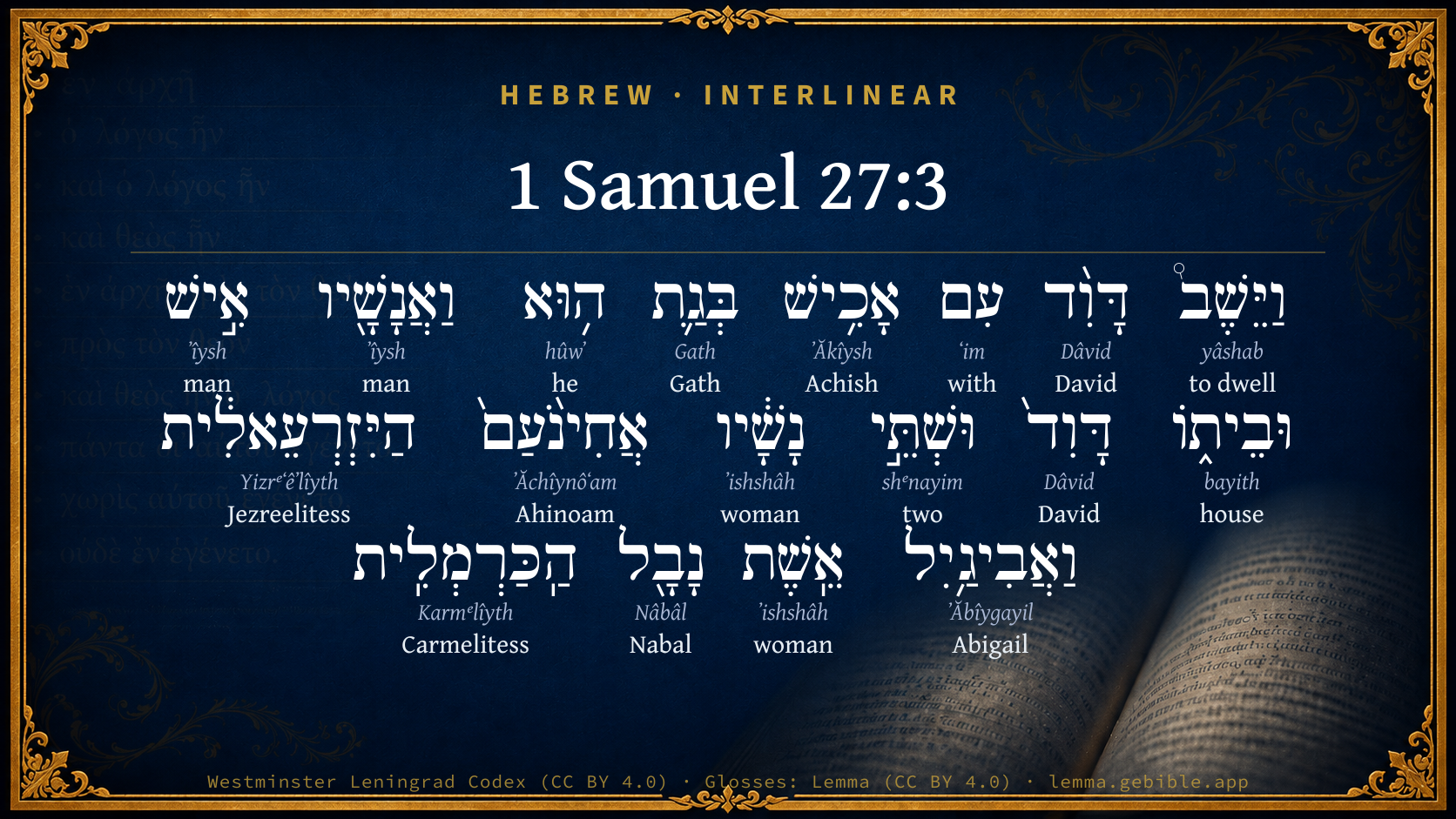
1 Samuel 27:3

Hebrew (Westminster Leningrad Codex) 1 Samuel 27:3 appears in the Hebrew Old Testament. The text above is from the Westminster Leningrad Codex. Each word links to its Strong’s number, a concise gloss, and parsing drawn from the Open Scriptures Hebrew Bible morphology. Click any word for its full Brown-Driver-Briggs (BDB) entry.
Download image
Cite this verse

1 Samuel 27:3 (World English Bible). Public Domain. Lemma interlinear Bible study tool, https://lemma.gebible.app/v/1-samuel/27/3.

Show BibTeX & RIS
BibTeX
RIS
English Translation
David lived with Achish at Gath, he and his men, every man with his household, even David with his two wives, Ahinoam the Jezreelitess, and Abigail the Carmelitess, Nabal's wife.
World English Bible · Public Domain
Highlights
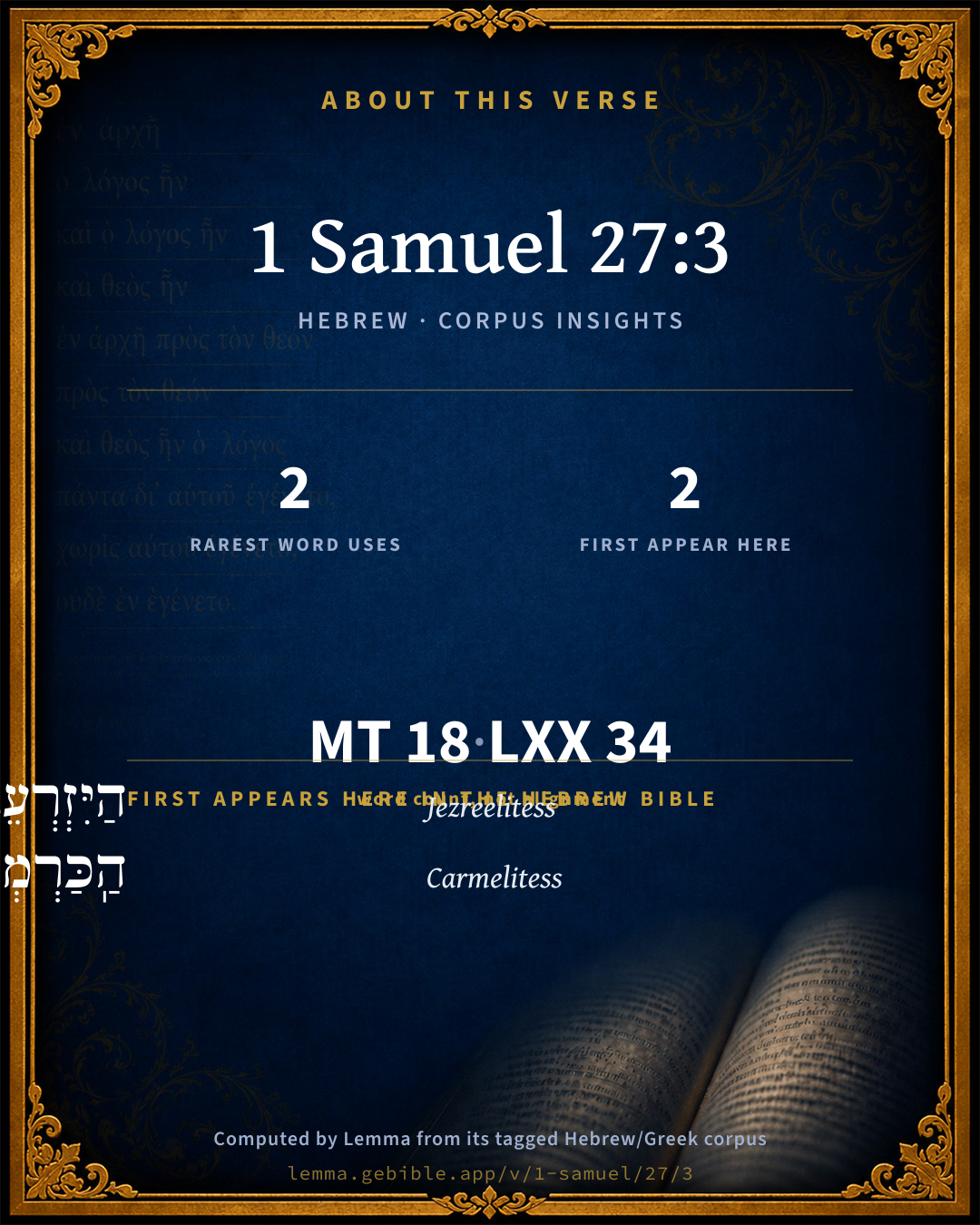
  • 2 first appearances in the Hebrew Bible
Full analysis ↓
Download a study sheet

One document with this verse’s original text, its word-by-word gloss line, the meaning frame, cross-references with their text, attributed commentary, and full source and license credits — printable, and it pastes into notes with its structure intact.

This verse Autodidact and up

Study sheet (.html) Plain text (.txt)

A passage Seminary Student

Up to 50 verses in one chapter. A passage sheet keeps up to 6 commentary sources and 12 cross-references per verse, in the order this page ranks them, and says so on the sheet whenever that leaves anything out. Ask for a single verse and you get the Autodidact verse sheet above.

Everything on this page stays free to read, with no account — the sheet is a download of what is already on screen, not access to it.

Want to remove ads? Support Godless Engineer
Compare translations 3

The same verse in 3 English versions, stacked beneath the original-language interlinear above. Click any original word for its lexicon entry.

Each is an independent rendering of the whole verse — the interlinear is not word-aligned to these translations.

Highlighted words mark where these versions differ — a whole-verse word diff, not a word-by-word alignment.

  • World English Bible Public Domain
    David lived with Achish at Gath, he and his men, every man with his household, even David with his two wives, Ahinoam the Jezreelitess, and Abigail the Carmelitess, Nabal's wife.
  • King James Version Public Domain
    And David dwelt with Achish at Gath, he and his men, every man with his household, even David with his two wives, Ahinoam the Jezreelitess, and Abigail the Carmelitess, Nabal's wife.
  • unfoldingWord Literal Text CC BY-SA 4.0
    And David dwelled with Achish in Gath, he and his men, a man and his house, David and the two of his wives, Ahinoam the Jezreelitess and Abigail the Carmelitess, the wife of Nabal.

unfoldingWord Literal Text — © unfoldingWord, licensed CC BY-SA 4.0. Word-aligned USFM3 via Door43 (git.door43.org/unfoldingWord/en_ult).

Versions to compare (up to 4)

3 of 4 selected

Show all 18 translations

Every available English version of this verse, each an independent rendering of the whole verse.

  • World English Bible Public Domain
    David lived with Achish at Gath, he and his men, every man with his household, even David with his two wives, Ahinoam the Jezreelitess, and Abigail the Carmelitess, Nabal's wife.
  • Berean Standard Bible Public Domain
    David and his men settled in Gath with Achish. Each man had his family with him, and David had his two wives: Ahinoam of Jezreel and Abigail of Carmel, the widow of Nabal.
  • Majority Standard Bible Public Domain
    David and his men settled in Gath with Achish. Each man had his family with him, and David had his two wives: Ahinoam of Jezreel and Abigail of Carmel, the widow of Nabal.
  • King James Version Public Domain
    And David dwelt with Achish at Gath, he and his men, every man with his household, even David with his two wives, Ahinoam the Jezreelitess, and Abigail the Carmelitess, Nabal's wife.
  • American Standard Version (1901) Public Domain
    And David dwelt with Achish at Gath, he and his men, every man with his household, even David with his two wives, Ahinoam the Jezreelitess, and Abigail the Carmelitess, Nabal's wife.
  • Revised Version (1885) Public Domain
    And David dwelt with Achish at Gath, he and his men, every man with his household, even David with his two wives, Ahinoam the Jezreelitess, and Abigail the Carmelitess, Nabal’s wife.
  • Geneva Bible (1599) Public Domain
    And Dauid dwelt with Achish at Gath, he, and his men, euery man with his housholde,Dauid with his two wiues, Ahinoam the Izreelite, and Abigail Nabals wife the Carmelite.
  • Douay-Rheims (1899) Public Domain
    And David dwelt with Achis at Geth, he and his men: every man with his household, and David with his two wives, Achinoam the Jezrahelitess, and Abigail the wife of Nabal of Carmel.
  • Young's Literal Translation Public Domain
    and David dwelleth with Achish in Gath, he and his men, each one with his household, `even' David and his two wives, Ahinoam the Jezreelitess, and Abigail wife of Nabal the Carmelitess.
  • Literal Standard Version CC BY-SA 4.0
    and David dwells with Achish in Gath, he and his men, each one with his household, [even] David and his two wives, Ahinoam the Jezreelitess, and Abigail wife of Nabal the Carmelitess.
  • Unlocked Literal Bible CC BY-SA 4.0
    David lived with Achish at Gath, he and his men, each man with his own household, and David with his two wives, Ahinoam the Jezreelite woman, and Abigail the Carmelite woman, Nabal's wife.
  • unfoldingWord Literal Text CC BY-SA 4.0
    And David dwelled with Achish in Gath, he and his men, a man and his house, David and the two of his wives, Ahinoam the Jezreelitess and Abigail the Carmelitess, the wife of Nabal.
  • Darby Bible Public Domain
    And David abode with Achish at Gath, he and his men, every man with his household; David with his two wives, Ahinoam the Jizreelitess, and Abigail the Carmelitess, Nabal's wife.
  • World Messianic Bible Public Domain
    David lived with Achish at Gath, he and his men, every man with his household, even David with his two wives, Ahinoam the Jezreelitess and Abigail the Carmelitess, Nabal’s wife.
  • Webster's Bible Public Domain
    And David dwelt with Achish at Gath, he and his men, every man with his household, even David with his two wives, Ahinoam the Jezreelitess, and Abigail the Carmelitess Nabal's wife.
  • Free Bible Version CC BY-SA 4.0
    David and his men settled down with Achish in Gath. All the men had their families with them, and David had his two wives, Ahinoam from Jezreel and Abigail from Carmel, Nabal's widow.
  • Bible in Basic English Public Domain
    And David and his men were living with Achish at Gath; every man had his family with him, and David had his two wives, Ahinoam of Jezreel, and Abigail of Carmel, who had been the wife of Nabal.
  • JPS Tanakh (1917) Public Domain
    And David dwelt with Achish at Gath, he and his men, every man with his household, even David with his two wives, Ahinoam the Jezreelitess, and Abigail the Carmelitess, Nabal's wife.

Literal Standard Version (2020), Covenant Press — licensed CC BY-SA 4.0. Text via the HelloAO Bible API (eBible.org). Unlocked Literal Bible (unfoldingWord) — licensed CC BY-SA 4.0. Text via the HelloAO Bible API (eBible.org). unfoldingWord Literal Text — © unfoldingWord, licensed CC BY-SA 4.0. Word-aligned USFM3 via Door43 (git.door43.org/unfoldingWord/en_ult). Free Bible Version, Dr. Jonathan Gallagher — licensed CC BY-SA 4.0. Text via the HelloAO Bible API (eBible.org).

Word by word

More ways to search: Search by grammar → Find every occurrence → Compare this word →

Practice this passage: Drill this verse → Learn its vocabulary →

הַֽכַּרְמְלִֽית
Karmᵉlîyth
H3762
“the · Carmelitess”
Particle, Definite Article + Noun, Gentilic, Feminine, Singular, Absolute
Part of Speech
Particle + Noun
Type
Gentilic
Gender
Feminine
Number
Singular
State
Absolute
Full BDB Definition

Origin: feminine of H3761

TWOT: None

Carmelitess = see Carmel " garden-land" - a female inhabitant of Carmel - Abigail, the wife of David, who came from Carmel
  1. וַיֵּשֶׁב֩ yâshab H3427 “and · to dwell” Conjunction + Verb, Qal, Sequential Imperfect, 3rd Person, Masculine, Singular
  2. דָּוִ֨ד Dâvid H1732 “David” Noun, Proper
  3. עִם ʻim H5973 “with” Preposition
  4. אָכִ֥ישׁ ʼĂkîysh H397 “Achish” Noun, Proper
  5. בְּגַ֛ת Gath H1661 “in/at · Gath” Preposition + Noun, Proper
  6. ה֥וּא hûwʼ H1931 “he” Pronoun, Personal, 3rd Person, Masculine, Singular
  7. וַאֲנָשָׁ֖יו ʼîysh H376 “and · men · his” Conjunction + Noun, Common, Masculine, Plural, Construct + Suffix, Personal, 3rd Person, Masculine, Singular
  8. אִ֣ישׁ ʼîysh H376 “man” Noun, Common, Masculine, Singular, Absolute
  9. וּבֵית֑וֹ bayith H1004 “and · house · his” Conjunction + Noun, Common, Masculine, Singular, Construct + Suffix, Personal, 3rd Person, Masculine, Singular
  10. דָּוִד֙ Dâvid H1732 “David” Noun, Proper
  11. וּשְׁתֵּ֣י shᵉnayim H8147 “and · two” Conjunction + Adjective, Cardinal number, Feminine, Dual, Construct
  12. נָשָׁ֔יו ʼishshâh H802 “women · his” Noun, Common, Feminine, Plural, Construct + Suffix, Personal, 3rd Person, Masculine, Singular
  13. אֲחִינֹ֨עַם֙ ʼĂchîynôʻam H293 “Ahinoam” Noun, Proper
  14. הַיִּזְרְעֵאלִ֔ית Yizrᵉʻêʼlîyth H3159 “the · Jezreelitess” Particle, Definite Article + Noun, Gentilic, Feminine, Singular, Absolute
  15. וַאֲבִיגַ֥יִל ʼĂbîygayil H26 “and · Abigail” Conjunction + Noun, Proper
  16. אֵֽשֶׁת ʼishshâh H802 “woman of” Noun, Common, Feminine, Singular, Construct
  17. נָבָ֖ל Nâbâl H5037 “Nabal” Noun, Proper

About this verse

These counts appear in no published source. They are computed here, from the morphology-tagged text and Lemma’s own curated glosses. What Lemma adds →

18
words
15
distinct lemmas
Historical
section

Notable vocabulary

The rarest word here is הַֽכַּרְמְלִֽית Carmelitess H3762 — appearing just 2 times in the whole Hebrew Bible.

First appearance in Scripture

These words make their first canonical appearance in the Hebrew Bible here:

  • הַיִּזְרְעֵאלִ֔ית Jezreelitess H3159
  • הַֽכַּרְמְלִֽית Carmelitess H3762

Shared distinctive vocabulary

הַֽכַּרְמְלִֽית Carmelitess H3762 occurs in 2 verses of the Hebrew Bible. Also found in:

Grammatical profile

  • 1 verb
  • 14 nouns
  • 1 adjective
  • 1 pronoun
  • 1 preposition

Verb forms

  • וַיֵּשֶׁב֩ Qal · Sequential Imperfect

Repetition

Words recur within this verse — often emphatic in Hebrew:

  • דָּוִ֨ד David H1732 ×2
  • וַאֲנָשָׁ֖יו man H376 ×2
  • נָשָׁ֔יו woman H802 ×2

Hebrew & Septuagint length

In English translation the verse runs 30 words from the Hebrew and 30 from the Septuagint (LXX English) — the same length.

A rough comparison of the two English renderings, which tokenize alike — not a word-level alignment.

Word counts can differ between the Hebrew and the Greek without any difference in meaning — e.g. the Hebrew direct-object marker אֵת has no separate Greek word, and Greek often adds the article ὁ.

In the original languages it is 18 Hebrew tokens and 34 Greek tokens — but the two are counted differently (Hebrew bundles its prefixes and suffixes into one token; the Greek is in lemma form), so that isn’t a like-for-like length.

Cross-references

5

Topical passages linked to 1 Samuel 27:3 in the Treasury of Scripture Knowledge — connected by theme and wording, ordered by reader-vote popularity; previews shown in the World English Bible.

  • 1 Samuel 25:42–43 Abigail hurried, and arose, and rode on a donkey, with five ladies of hers who followed her; and she went after the messengers of David, and became his wife.
  • 1 Samuel 25:3 Now the name of the man was Nabal; and the name of his wife Abigail; and the woman was of good understanding, and of a beautiful face: but the man was churlish and evil in his doings; and he was of the house of Caleb.
  • 1 Samuel 25:18–35 Then Abigail made haste, and took two hundred loaves, and two bottles of wine, and five sheep ready dressed, and five measures of parched grain, and one hundred clusters of raisins, and two hundred cakes of figs, and laid them on donkeys.
  • 1 Samuel 30:3 When David and his men came to the city, behold, it was burned with fire; and their wives, and their sons, and their daughters, were taken captive.
  • 1 Samuel 30:5 David's two wives were taken captive, Ahinoam the Jezreelitess, and Abigail the wife of Nabal the Carmelite.

Cross-references courtesy of OpenBible.info (CC BY 4.0).

Hebrew and Greek witnesses Masoretic Hebrew ↔ Greek Septuagint

The same verse in the two great witnesses to the Old Testament, shown verse-for-verse.

These are two independent witnesses, not word-aligned to each other, and the Septuagint is shown in lemma (dictionary) form.

Hebrew 1 Samuel 27:3 Masoretic · Westminster Leningrad Codex

וַיֵּשֶׁב֩ דָּוִ֨ד עִם אָכִ֥ישׁ בְּגַ֛ת ה֥וּא וַאֲנָשָׁ֖יו אִ֣ישׁ וּבֵית֑וֹ דָּוִד֙ וּשְׁתֵּ֣י נָשָׁ֔יו אֲחִינֹ֨עַם֙ הַיִּזְרְעֵאלִ֔ית וַאֲבִיגַ֥יִל אֵֽשֶׁת נָבָ֖ל הַֽכַּרְמְלִֽית

David lived with Achish at Gath, he and his men, every man with his household, even David with his two wives, Ahinoam the Jezreelitess, and Abigail the Carmelitess, Nabal's wife.

World English Bible · Public Domain

Greek LXX 1 Samuel 27:3 Septuagint · lemma form

καί καταἵζω δαυίδ μετά αγχους ἐν γεθ αὐτός καί ὁ ἀνήρ αὐτός ἕκαστος καί ὁ οἶκος αὐτός καί δαυίδ καί ἀμφότεροι ὁ γυνή αὐτός αχινααμ ὁ ιεζραηλῖτις καί αβιγαια ὁ γυνή ναβαλ ὁ καρμήλιος

And David lived with Anchus, he and his men, each with his family; and David and both his wives, Achinaam, the Jezraelitess, and Abigaia the wife of Nabal the Carmelite.

LXX2012 (modern English Septuagint) · Public Domain

Hebrew: Westminster Leningrad Codex (CC BY 4.0). Greek: Septuagint (public domain); English from LXX2012 (modern English Septuagint) (Public Domain). How the Septuagint differs from the Hebrew →

Targum (Aramaic paraphrase)

1

The Targum is the ancient Jewish Aramaic paraphrase of the Hebrew Scriptures — an interpretive translation, not the Hebrew text itself. Onkelos (literal) and Pseudo-Jonathan (expansive) render the Torah, and Jonathan the Prophets. Coverage is partial: where no permissively-licensed English translation exists for a verse, only the Aramaic is shown. This is verse-level text, not a word-by-word alignment to the Hebrew.

  1. Targum Jonathan Prophets (Joshua–Malachi)
    וִיתֵיב דָוִד עִם אָכִישׁ בְּגַת הוּא וְגַבְרוֹהִי גְבַר וֶאֱנַשׁ בֵיתֵיה דָוִד וְתַרְתֵּין נְשׁוֹהִי אֲחִנוֹעַם דְמִיזְרְעֶאל וַאֲבִיגַיִל אִתַּת נָבָל דְמִכַּרְמְלָא:

    (no public-domain English translation for this verse)

    Targum Jonathan — Aramaic: “Mikraot Gedolot” (public domain). English: “Sefaria Community Translation” (CC0 1.0 (public-domain dedication)); “London "Chaldee Paraphrase," 1871” (public domain). Text via Sefaria.

Commentary

Notes on 1 Samuel 27:3 from classic Christian and Jewish commentators (each source and its license shown beneath its notes). The classic Christian expositions comment on the surrounding passage and are grouped to its opening verse, so a note may address several verses; the Jewish commentaries on the Tanakh (Rashi and others) are per-verse, so they appear only where the commentator wrote on this verse.

Lemma curates 59 commentaries, every one of them public domain or Creative Commons licensed, each selected and text-cleaned for this edition rather than reprinted as found. About our sources →

Trapp's Complete Commentary

John Trapp

1Sa 27:3 And David dwelt with Achish at Gath, he and his men, every man with his household, [even] David with his two wives, Ahinoam the Jezreelitess, and Abigail the Carmelitess, Nabal’s wife.

Ver. 3. And David dwelt with Achish.] Where doubtless he was much vexed many times, as Lot was in Sodom, and cried, Oh that I had the wings of a dove! &c. Woe is me that I sojourn in Gath! a good place to pass through, but an ill place to dwell in, as one once said of Athens.

John Trapp, A Commentary or Exposition upon All the Books of the Old and New Testament (1647–1656) — public domain. Text from a community e-Sword module.

Geneva Bible (1599)

Geneva Bible translators

Thus God by his providence changeth the enemy’s hearts, and maketh them to favor his in their necessity.

Geneva Bible (1599) marginal notes — public domain. Text via Bolls.life.

Adam Clarke's Commentary

Verse 3. Every man with his household] So it appears that the men who consorted with David had wives and families. David and his company resembled a tribe of the wandering Arabs.

Adam Clarke's Commentary on the Bible (1810–1826) — public domain. Text from a community e-Sword/MySword module.

Ellicott's Commentary for English Readers

(3) And David dwelt with Achish at Gath.—His reception by the Philistines seems to have been most kindly. There was a wide difference between the circumstances of this and his former visit to Gath. Then he was a fugitive, almost unattended; now he was at the head of an army of trained and devoted soldiers. Such a guest might be of the greatest service to the Philistines in their perpetual wars with Saul, with whom David would now be considered to have finally broken off all relations, seeing he had sought a home and shelter among the most bitter of his foes.

A Bible Commentary for English Readers, edited by Charles John Ellicott (1878–1897) — public domain. Text from a community e-Sword module.

The Cambridge Bible for Schools and Colleges

gen. ed. J. J. S. Perowne

3. every man with his household] Cp. ch. 1Sa_30:3 ff.; 2Sa_2:3.

The Cambridge Bible for Schools and Colleges (gen. ed. J. J. S. Perowne; Cambridge University Press, 1878–1918) — public domain. Text from a community e-Sword module.

John Gill's Exposition

And David dwelt with Achish at Gath,.... The metropolis of his kingdom, called, Sa1 27:5, the royal city:

he and his men, every man with his household; or family; which they brought with them, to secure them from the malice of Saul; who in their absence might have destroyed them, as being the families of traitors and fugitives, and might be the more readily received by Achish, as he might hope for some advantage front them; and besides were pledges of their fidelity to him, and of their design to continue with him:

even David with his two wives, Ahinoam the Jezreelitess and Abigail the Carmelitess, Nabal's wife; who had been the wife of Nabal; of these See Gill on Sa1 25:43.

John Gill's Exposition of the Whole Bible (1746–1763) — public domain (CC PDM 1.0). Text via the HelloAO Bible API.

Haydock's Catholic Bible Commentary

Household. They were aware of the cruelty of Saul. The names of these valiant men are specified, 1 Paralipomenon xii. 1., &c.

George Leo Haydock (1774–1849), Haydock's Catholic Family Bible and Commentary, 1859 edition — public domain. Excludes Psalms (Douay-Rheims chapter numbering differs from Protestant) and Deuterocanonical books (Catholic canon only).

Whedon's Commentary on the Bible

Daniel D. Whedon

3. Every man with his household — From which it appears that many of David’s men, like their leader, had their families with them.

Daniel D. Whedon (gen. ed.), Commentary on the Old and New Testaments (1874–1909) — public domain. Text from a community e-Sword module.

The Pulpit Commentary

Vers. 3-12. (GATH, ZIKLAG.)

David"s residence among the Philistines.

David had taken the decisive step, crossed the border, and passed with his 600 men and their families ("a little ambulant kingdom") into the Philistine territory. His position was very different now from what it had been five or six years before, when he came to Gath.as a lonely fugitive; (1Sa_21:10) and he was gladly received by Achish, who regarded him as in open revolt against Saul and Israel, and expected to obtain from him valuable assistance in his future conflicts with them. And here and at Ziklag he continued sixteen months (ver. 7). His condition (like that of other good men who enter into intimate association with the ungodly, voluntarily, unnecessarily, and for the sake of worldly advantage; (see 1Sa_15:6) was marked by

I TEMPORARY SECURITY (ver. 4). By placing himself under the protection of Achish, David gained his end; for Saul dared not follow him lest he should excite another Philistine war, and (physically restrained, though.still retaining an evil will) "sought no more again for him." His outward circumstances were completely. changed. Instead of the uncertain, anxious, hazardous, and despised life which he had led in the wilderness, he enjoyed repose, comfort, safety, and respect in a royal city. To obtain advantages such as these men often swerve from the appointed path of duty, especially in times of persecution, not considering at what a cost they are obtained, how brief is their duration, or how great the trouble by which they may be followed.

II CONSCIOUS INCONSISTENCY (vers. 5-7). In open alliance with the enemies of Israel, silently witnessing their idolatrous practices, looked upon as a traitor to his country, and ready to aid them against it, David must have felt what a contradiction there was between his apparent and real character. Yet he might not declare himself by a single word or act, for thousands of watchful eyes were always on him. He did not feel at home, and requested (under the plea of the unsuitableness and expensiveness of his residence with his large retinue at Gath) that the king would give him "a place in some town in the country," his real motive being that he might be "out of the way of observation, so as to play the part of Saul"s enemy without acting against him." At Ziklag he would be less under restraint, and his real sentiments less likely to be discovered, though even there he might still be suspected. No outward advantages that good men may gain by their alliance with the ungodly can afford adequate compensation for the insincerity, distraction, restlessness, and vexation of soul which it involves. (2Pe_2:8)

III SUCCESSFUL ENTERPRISE (vers. 8, 9). As soon as he was settled at Ziklag he made warlike expeditions against the Amalekites, Geshurites, and Gezrites, "of old the inhabitants of the land" (unlike the Philistines); and from the rich booty which lie procured he supplied the wants of his men, and gave valuable presents to Achish (ver. 9). His setting forth on these expeditions, and the cruel severity with which he executed them, must be judged of in the light of "the circumstances of those times, and the constant practices of nations one to another, especially of the neighbouring nations towards the Hebrews" (Chandler), and of the ban under which some of them had been placed. (see 1Sa_15:1, 1Sa_15:32, 1Sa_15:33) He was doubtless animated therein by public spirit and religious zeal, (1Sa_30:26) but his motives were not altogether unmixed, and his successes brought him a doubtful honour (ver. 12).

IV CRAFTY POLICY (vers. 10, 11). To retain the confidence of Achish, he gave him the impression that his expeditions were directed against his own countrymen and their allies, instead of against Amalek and other neighbouring tribes; and he was thus, through distrust of God, again guilty of deceit. (1Sa_21:1, 1Sa_21:10) "If a man will put himself among Philistines, he cannot promise to come forth innocent" (Hall). "David might perhaps seek in some way to justify himself by the thought that in his ambiguous manner of speech he made use only of an allowable stratagem, and that he was a heathen to whom he veiled the truth. But he will yet be made to experience that God will weigh those who would be his in the balances of the sanctuary, in which, among others, that inviolable word is found as one of the weights, "Thou shalt not bear false witness (Krummacher).

V INCREASING POWER and importance. While at Ziklag he received large reinforcements (1Sa_22:1, 1Sa_22:2; 1Ch_12:1-22) some of whom were "of Saul"s brethren of Benjamin evidently from dissatisfaction with the turn which things had taken. (see also 2Sa_15:16-23) "As a matter of fact, David in this city laid the foundation of all his kingdom. Here he could already rule with greater freedom and independence, collect fugitives and deserters around him in larger and larger numbers, send or receive embassies like a prince, (1Sa_30:26-31) and, as a ruler over soldiers and over peaceable citizens, rehearse, on a small scale, those arts by which he afterwards acquired and maintained his great kingdom" (Ewald). Notwithstanding all this, his condition was one of

VI SPIRITUAL DISADVANTAGE, and even spiritual deterioration. That which he had dreaded as the worst of evils (1Sa_26:19) had come about by his own voluntary act. Although he was not forbidden the exercise of his religion under Achish, (1Sa_29:6) yet his circumstances were unfavourable to it; he was absent from the land and the sanctuary where God manifested his gracious presence to his people (1Sa_26:20; Psa_42:2, Psa_42:3) and his whole course of life is indicative of a lower tone of piety than before. "Being a genuine poet and lover of art, he took advantage of all his opportunities in this direction, and exercised himself as a musician in the Gittite and the Philistine style (Psalm 8., inscription), which he afterwards transferred from there to Jerusalem" (Ewald); but not a single psalm of his can be referred to this period.

VII DANGEROUS ENTANGLEMENTS, intense suffering, and probably also serious delay in the attainment of his high destiny. (1Sa_28:1, 2 30:3) The evils that sprang from his want of faith and patience were truly great. "His presence in Judah would have given an opportunity which Saul could hardly have refused, for calling him forth as the champion of Israel. At all events he would have been at hand to relieve the disaster, and would doubtless have been hailed as king by the united voice of Israel. As it was, his nation suffered a terrible defeat, which, instead of doing his best to avert, he narrowly escaped taking a share in inflicting; his recognition as king of Israel was postponed for seven years and a half at the cost of a civil war and a permanent alienation of Judah from the rest of Israel; and meanwhile he was involved in a course of pitiable deceit" (Smith, "Old Testament Hist."). Nevertheless the overruling hand of God must be recognised in all, and by Divine mercy he was delivered "out of all tribulation.

Ay me, how many perils do unfold The righteous man, to make him daily fall, Were not that heavenly grace doth him uphold, And steadfast truth acquit him out of all! Her love is firm, her care continual, So oft as he, through his own foolish pride Or weakness, is to sinful bands made thrall". (Spenser) D.

The Pulpit Commentary (1880–1919), ed. H.D.M. Spence-Jones & Joseph S. Exell — public domain. Text from a community e-Sword module.

John Wesley's Explanatory Notes

He voluntarily runs upon that rock, which he cursed his enemies for throwing him upon, chap. xxvi, 19, and upon many other snares and dangers, as the following history will shew; and withal, deprives the people of the Lord of those succors which he might have given them, in case of a battle. But God hereby designed to withdraw David from the Israelites, that they might fall by the hand of the Philistines, without any reproach or inconvenience to David.

John Wesley, Explanatory Notes Upon the Whole Bible (1754–1765) — public domain. Text via the GEBible commentary corpus.

Lesson kit

Teaching starters — assembled from the data on this page, not authored interpretation. Every prompt links to the verse data it draws on. Edit before teaching.

1 Samuel, in the Historical, opens this verse with 18 words (15 distinct Hebrew lemmas). Its most distinctive word is Karmᵉlîyth (“Carmelitess”). A historical commentator’s framing appears above. Read the whole chapter for the surrounding context.

Discussion questions

  1. What does “Carmelitess” (Karmᵉlîyth) contribute to the verse as a whole?
  2. 2 words here appear for the first time in Scripture. What is being introduced at this debut?
  3. 1 Chronicles 3:1 shares the word «Carmelitess» with this verse. How do the two illuminate each other?
  4. “David” occurs 2× in this one verse. What is the effect of the repetition?
  5. These translations render this verse differently; the difference is in the English rendering, not the original. What questions does that raise?
  6. The verb «וַיֵּשֶׁב֩» is Qal Sequential Imperfect. How does its form color the action?
  7. Reading how Trapp's Complete Commentary and Geneva Bible (1599) read this verse, where do the two commentators agree and where do they part?

Things to notice

Reading settings

Reading text

Shown beneath each verse's original-language words.

Old Testament
Old Testament edition

Read the OT as the Masoretic Hebrew (MT) or the Greek Septuagint (LXX).

English shown for the Greek Septuagint (in the Hebrew ↔ Greek comparison).

Comparing translations? Open the Compare panel on any verse page to stack up to four side by side.