

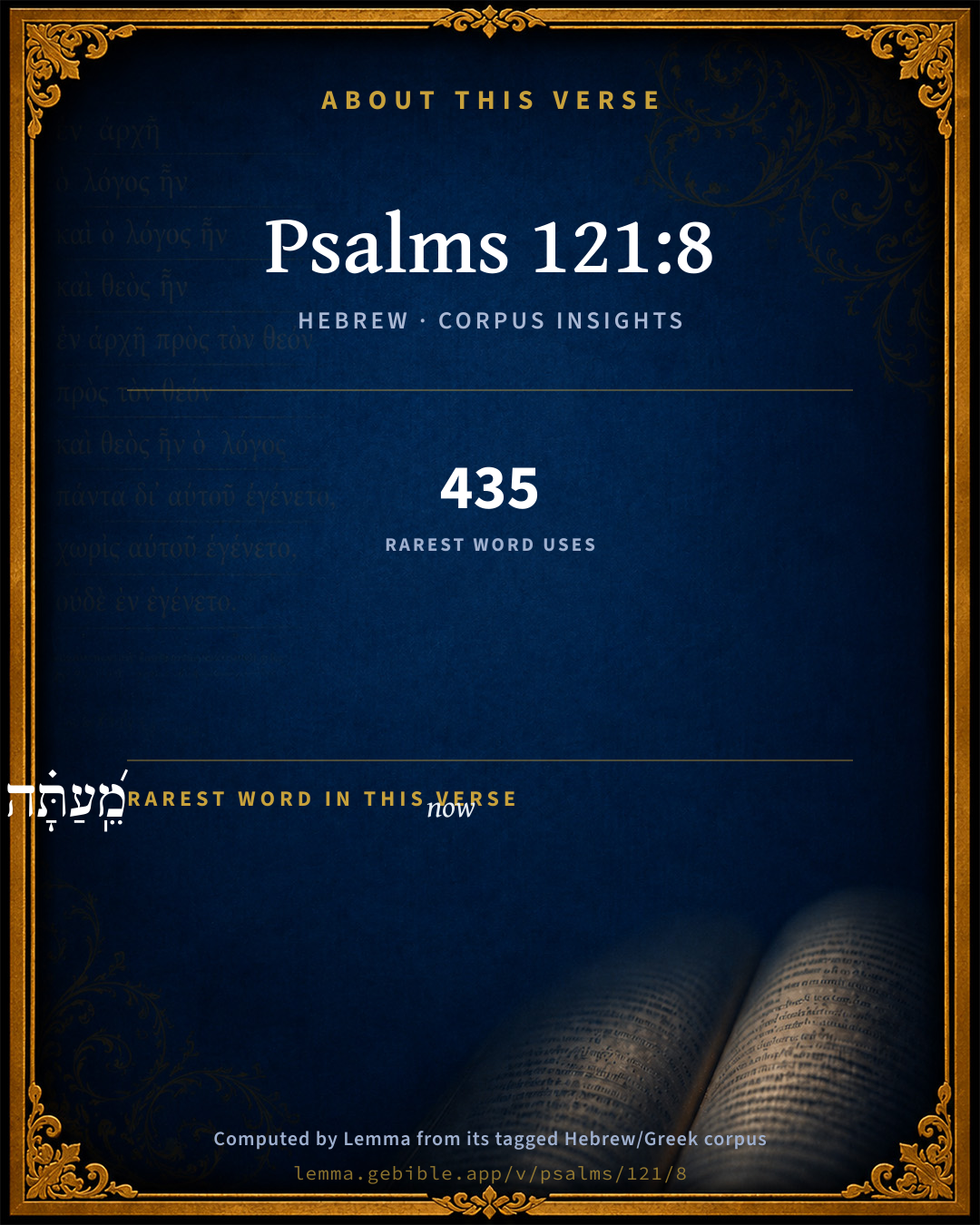
Psalms 121:8

Hebrew (Westminster Leningrad Codex) Psalms 121:8 appears in the Hebrew Old Testament. The text above is from the Westminster Leningrad Codex. Each word links to its Strong’s number, a concise gloss, and parsing drawn from the Open Scriptures Hebrew Bible morphology. Click any word for its full Brown-Driver-Briggs (BDB) entry.
Download image
Cite this verse

Psalms 121:8 (World English Bible). Public Domain. Lemma interlinear Bible study tool, https://lemma.gebible.app/v/psalms/121/8.

Show BibTeX & RIS
BibTeX
RIS
English Translation
Yahweh will keep your going out and your coming in, From this time forth, and forevermore.
World English Bible · Public Domain
Download a study sheet

One document with this verse’s original text, its word-by-word gloss line, the meaning frame, cross-references with their text, attributed commentary, and full source and license credits — printable, and it pastes into notes with its structure intact.

This verse Autodidact and up

Study sheet (.html) Plain text (.txt)

A passage Seminary Student

Up to 50 verses in one chapter. A passage sheet keeps up to 6 commentary sources and 12 cross-references per verse, in the order this page ranks them, and says so on the sheet whenever that leaves anything out. Ask for a single verse and you get the Autodidact verse sheet above.

Everything on this page stays free to read, with no account — the sheet is a download of what is already on screen, not access to it.

Want to remove ads? Support Godless Engineer
Compare translations 3

The same verse in 3 English versions, stacked beneath the original-language interlinear above. Click any original word for its lexicon entry.

Each is an independent rendering of the whole verse — the interlinear is not word-aligned to these translations.

Highlighted words mark where these versions differ — a whole-verse word diff, not a word-by-word alignment.

  • World English Bible Public Domain
    Yahweh will keep your going out and your coming in, From this time forth, and forevermore.
  • King James Version Public Domain
    The LORD shall preserve thy going out and thy coming in from this time forth, and even for evermore.
  • unfoldingWord Literal Text CC BY-SA 4.0
    Yahweh will keep your going out and your coming in, from now and to forever.

unfoldingWord Literal Text — © unfoldingWord, licensed CC BY-SA 4.0. Word-aligned USFM3 via Door43 (git.door43.org/unfoldingWord/en_ult).

Versions to compare (up to 4)

3 of 4 selected

Show all 17 translations

Every available English version of this verse, each an independent rendering of the whole verse.

  • World English Bible Public Domain
    Yahweh will keep your going out and your coming in, From this time forth, and forevermore.
  • Berean Standard Bible Public Domain
    The LORD will watch over your coming and going, both now and forevermore.
  • Majority Standard Bible Public Domain
    The LORD will watch over your coming and going, both now and forevermore.
  • King James Version Public Domain
    The LORD shall preserve thy going out and thy coming in from this time forth, and even for evermore.
  • American Standard Version (1901) Public Domain
    Jehovah will keep thy going out and thy coming in From this time forth and for evermore. Psalm 122 A Song of Ascents; of David.
  • Revised Version (1885) Public Domain
    The LORD shall keep thy going out and thy coming in, from this time forth and for evermore.
  • Geneva Bible (1599) Public Domain
    The Lord shall preserue thy going out, and thy comming in from henceforth and for euer.
  • Young's Literal Translation Public Domain
    Jehovah preserveth thy going out and thy coming in, From henceforth even unto the age!
  • Literal Standard Version CC BY-SA 4.0
    YHWH preserves your going out and your coming in, || From now on—even for all time!
  • Unlocked Literal Bible CC BY-SA 4.0
    Yahweh will protect you in all you do now and forevermore.
  • unfoldingWord Literal Text CC BY-SA 4.0
    Yahweh will keep your going out and your coming in, from now and to forever.
  • Darby Bible Public Domain
    Jehovah will keep thy going out and thy coming in, from henceforth and for evermore.
  • World Messianic Bible Public Domain
    The LORD will keep your going out and your coming in, from this time forward, and forever more.
  • Webster's Bible Public Domain
    The LORD will preserve thy going out and thy coming in from this time forth, and even for ever.
  • Free Bible Version CC BY-SA 4.0
    The Lord will look after you when you leave, and when you return, now and forever.
  • Bible in Basic English Public Domain
    The Lord will keep watch over your going out and your coming in, from this time and for ever.
  • JPS Tanakh (1917) Public Domain
    The LORD shall guard thy going out and thy coming in, from this time forth and for ever.

Literal Standard Version (2020), Covenant Press — licensed CC BY-SA 4.0. Text via the HelloAO Bible API (eBible.org). Unlocked Literal Bible (unfoldingWord) — licensed CC BY-SA 4.0. Text via the HelloAO Bible API (eBible.org). unfoldingWord Literal Text — © unfoldingWord, licensed CC BY-SA 4.0. Word-aligned USFM3 via Door43 (git.door43.org/unfoldingWord/en_ult). Free Bible Version, Dr. Jonathan Gallagher — licensed CC BY-SA 4.0. Text via the HelloAO Bible API (eBible.org).

Word by word

More ways to search: Search by grammar → Find every occurrence → Compare this word →

Practice this passage: Drill this verse → Learn its vocabulary →

About this verse

These counts appear in no published source. They are computed here, from the morphology-tagged text and Lemma’s own curated glosses. What Lemma adds →

7
words
7
distinct lemmas
Wisdom
section

Grammatical profile

  • 3 verbs
  • 2 nouns
  • 1 preposition
  • 1 adverb

Verb forms

  • יִשְׁמָר Qal · Imperfect
  • צֵאתְךָ֥ Qal · Infinitive Construct
  • וּבוֹאֶ֑ךָ Qal · Infinitive Construct

Hebrew & Septuagint length

In English translation the verse runs 16 words from the Hebrew and 17 from the Septuagint (LXX English) — closely comparable.

A rough comparison of the two English renderings, which tokenize alike — not a word-level alignment.

Word counts can differ between the Hebrew and the Greek without any difference in meaning — e.g. the Hebrew direct-object marker אֵת has no separate Greek word, and Greek often adds the article ὁ.

Cross-references

10

Topical passages linked to Psalms 121:8 in the Treasury of Scripture Knowledge — connected by theme and wording, ordered by reader-vote popularity; previews shown in the World English Bible.

  • Deuteronomy 28:6 Blessed shall you be when you come in, and blessed shall you be when you go out.
  • Proverbs 2:8 That he may guard the paths of justice, And preserve the way of his saints.
  • Proverbs 3:6 In all your ways acknowledge him, And he will direct your paths.
  • Psalms 113:2 Blessed be the name of Yahweh, From this time forth and forevermore.
  • Ezra 8:31 Then we departed from the river Ahava on the twelfth [day] of the first month, to go to Jerusalem: and the hand of our God was on us, and he delivered us from the hand of the enemy and the bandit by the way.
  • Psalms 115:18 But we will bless Yah, From this time forth and forevermore. Praise Yah!
  • Ezra 8:21 Then I proclaimed a fast there, at the river Ahava, that we might humble ourselves before our God, to seek of him a straight way for us, and for our little ones, and for all our substance.
  • James 4:13–16 Come now, you who say, "Today or tomorrow let's go into this city, and spend a year there, trade, and make a profit."
  • 2 Samuel 5:2 In times past, when Saul was king over us, it was you who led out and brought in Israel: and Yahweh said to you, You shall be shepherd of my people Israel, and you shall be prince over Israel.
  • Deuteronomy 28:19 Cursed shall you be when you come in, and cursed shall you be when you go out.

Cross-references courtesy of OpenBible.info (CC BY 4.0).

Hebrew and Greek witnesses Masoretic Hebrew ↔ Greek Septuagint

The same verse in the two great witnesses to the Old Testament, shown verse-for-verse.

You’re reading Greek Psalm 120 (Hebrew Psalm 121). The Septuagint counts the superscription, so verse numbers can differ from the Hebrew — chapter-level alignment, not verse-by-verse. Numbering follows Rahlfs.

These are two independent witnesses, not word-aligned to each other, and the Septuagint is shown in lemma (dictionary) form.

Hebrew Psalms 121:8 Masoretic · Westminster Leningrad Codex

יְֽהוָ֗ה יִשְׁמָר צֵאתְךָ֥ וּבוֹאֶ֑ךָ מֵֽ֝עַתָּ֗ה וְעַד עוֹלָֽם

Yahweh will keep your going out and your coming in, From this time forth, and forevermore.

World English Bible · Public Domain

Greek LXX Greek Psalm 120:8 Septuagint · lemma form

κύριος φυλάσσω ὁ εἴσοδος σύ καί ὁ ἔξοδος σύ ἀπό ὁ νῦν καί ἕως ὁ αἰών

The Lord shall keep your coming in, and your going out, from henceforth and even for ever.

LXX2012 (modern English Septuagint) · Public Domain

Hebrew: Westminster Leningrad Codex (CC BY 4.0). Greek: Septuagint (public domain); English from LXX2012 (modern English Septuagint) (Public Domain). How the Septuagint differs from the Hebrew →

Commentary

Notes on Psalms 121:8 from classic Christian and Jewish commentators (each source and its license shown beneath its notes). The classic Christian expositions comment on the surrounding passage and are grouped to its opening verse, so a note may address several verses; the Jewish commentaries on the Tanakh (Rashi and others) are per-verse, so they appear only where the commentator wrote on this verse.

Lemma curates 59 commentaries, every one of them public domain or Creative Commons licensed, each selected and text-cleaned for this edition rather than reprinted as found. About our sources →

Trapp's Complete Commentary

John Trapp

Psa 121:8 The LORD shall preserve thy going out and thy coming in from this time forth, and even for evermore.

Ver. 8. The Lord shall preserve thy going out, &c.] Thou shalt have his safe-conduct, his public faith for thy defence, in all thy lawful enterprises at home and abroad; together with good success in all thine affairs and actions, Pro 3:6.

John Trapp, A Commentary or Exposition upon All the Books of the Old and New Testament (1647–1656) — public domain. Text from a community e-Sword module.

J. A. Alexander on Psalms

Joseph Addison Alexander

8. (Psa 121:8) Jehovah will keep thy going out and thy coming in from now even to eternity. This is the third repetition of the phrase, Jehovah will keep, i.e. keep safe, protect, preserve, as if to silence the misgivings of a weak or tempted faith, by the reiterated declaration of this cheering truth. Going out and coming in is a proverbial Hebrew phrase for all the occupations and affairs of life. See Deu 28:6, 1Sa 29:6. The original reference is to man's going out to labour in the morning and returning home to rest at night. See above, on Psa 104:23. With the last clause compare Psa 113:2; Psa 116:18; Psa 125:2. The promise of eternal preservation is addressed directly to the church as such; but that it involves the blessed immortality of individual believers, is admitted even by those least disposed to find-allusions to the future state in the Book of Psalms.

Joseph Addison Alexander, The Psalms Translated and Explained (1850) — public domain. Text from a community e-Sword module.

Geneva Bible (1599)

Geneva Bible translators

Whatsoever thou dost enterprise, shall have good success.

Geneva Bible (1599) marginal notes — public domain. Text via Bolls.life.

Adam Clarke's Commentary

Verse 8. Thy going out and thy coming in] Night and day - in all thy business and undertakings; and this through the whole course of thy life: for evermore.

ANALYSIS OF THE HUNDRED AND TWENTY-FIRST PSALM

The scope of this Psalm is to show that God alone is the refuge of the distressed.

I. While some are looking for earthly comfort and support, "I will lift up mine eyes unto the hills," c.

II. Faith sees God, the only helper and says, "My help is the Lord."

And the first reason for this is given: God's omnipotence and sufficiency. "The Lord that made heaven and earth," and is consequently the author and dispenser of all spiritual and temporal blessings.

And the second reason is, his grace and goodness; "he will not suffer thy foot to be moved."

A third reason is, his watchful care: "He that keepeth thee will not slumber."

III. The end which God proposes in his watching, - to keep them.

1. He is the "Keeper of Israel." He guards his Church; he is as a wall of fire about it.

2. He is a shade. This certainly refers to that kind of umbraculum, or parasol, which was in very ancient use in the eastern countries. The sense of the passage is, Neither the day of prosperity nor the night of adversity shall hurt thee; nor the heat of persecution, nor the coldness of friends or relatives: all these shall work for thy good.

3. "He shall preserve thee from all evil;" - and,

4. Especially from every thing that might hurt thy soul: "He shall preserve thy soul."

The psalmist concludes with this encouraging assurance.

1. "The Lord shall preserve thy going out." We are always beginning or ending some action, going abroad or returning home; and we need the protecting care of God in all.

2. "From this time forth." Now that thou hast put thy whole trust and confidence in God, he will be thy continual portion and defence in all places, in all times, in all actions; in life, in prosperity, in adversity, in death, in time, and in eternity.

Adam Clarke's Commentary on the Bible (1810–1826) — public domain. Text from a community e-Sword/MySword module.

John Calvin's Commentaries

8. Jehovah will keep thy going out and thy coming in. The sense is, Whatever thou shalt undertake or engage in during thy life shall come to a happy and successful termination. God no doubt directs by his Holy Spirit the, deliberations of his servants; but it appears to me, that this passage is rather to be referred to prosperous issues. If, however, any one would give it a more extended meaning I have no objection. It is enough for me to embrace that sense which is indisputably certain and solid, That God will be the continual guide of his people, so that stretching out his hand to them he will conduct them according to their hearts’ desire from the beginning even to the end. Farther, it is of importance to mark the reason why the Prophet repeats so often what he had briefly and in one word expressed with sufficient plainness. Such repetition seems at first sight superfluous; but when we consider how difficult it is to correct our distrust, it will be easily perceived that he does not improperly dwell upon the commendation of the divine providence. How few are to be found who yield to God the honor of being a keeper, in order to their being thence assured of their safety, and led to call upon him in the midst of their perils! On the contrary, even when we seem to have largely experienced what this protection of God implies, we yet instantly tremble at the noise of a leaf falling from a tree, as if God had quite forgotten us. Being then entangled in so many unholy misgivings, and so much inclined to distrust, we are taught from the passage that if a sentence couched in a few words does not suffice us, we should gather together whatever may be found throughout the whole Scriptures concerning the providence of God, until this doctrine-” That God always keeps watch for us” — is deeply rooted in our hearts; so that depending upon his guardianship alone we may bid adieu to all the vain confidences of the world.

John Calvin's Commentaries (1540-1563) — public domain. Text from the Calvin Translation Society English edition (1840s-50s) via the Christian Classics Ethereal Library (ccel.org). Calvin's coverage is partial (roughly two-thirds of the Bible); uncommented books and verses are honest gaps, never fabricated. The 19th-century editor's footnotes and remarks are omitted so the notes are faithfully Calvin's own voice.

Ellicott's Commentary for English Readers

(8) Thy going out and thy coming in.—A common Hebrew expression to denote the whole of life. (See Deu_28:6, &c. comp. St. Paul’s prayer, 1Th_5:23.)

A Bible Commentary for English Readers, edited by Charles John Ellicott (1878–1897) — public domain. Text from a community e-Sword module.

The Cambridge Bible for Schools and Colleges

gen. ed. J. J. S. Perowne

8. thy going out and thy coming in] All thy undertakings and occupations. Cp. Deu_28:6; &c. Perhaps too a special allusion to the pilgrims’ journey to Jerusalem is intended.

from this time forth, and [omit even] for evermore] Personal hopes here lose themselves in national hopes: but in the light of the Gospel the individual can appropriate these words to himself. Cp. Psa_115:18.

Every pious Jew, as he leaves or enters the house, touches the Mezuza, i.e. the small metal cylinder affixed to the right-hand door-post, containing a piece of parchment inscribed with Deu_6:4-9; Deu_11:13-21, and recites this verse. Kitto’s Biblical Cyclopaedia, s.v. Mezuza.

The Cambridge Bible for Schools and Colleges (gen. ed. J. J. S. Perowne; Cambridge University Press, 1878–1918) — public domain. Text from a community e-Sword module.

Albert Barnes' Notes on the Bible

The Lord shall preserve thou going out and thy coming in - Preserve thee in going out and coming in; in going from thy dwelling, and returning to it; in going from home and coming back; that is, everywhere, and at all times. Compare Deu 28:6. See the notes also at Job 5:24. “From this time forth, and even forevermore.” Through this life and for ever. This is the gracious assurance which is made to all who put their trust in God. At home and abroad; in the house, in the field, and by the way; on the land and on the ocean; in their native country and in climes remote; on earth, in the grave, and in the eternal world, they are always safe. No evil that will endanger their salvation can befal them; nothing can happen to them here but what God shall see to be conducive to their ultimate good; and in the heavenly world they shall be safe forever from every kind of evil, for in that world there will be no sin, and consequently no need of discipline to prepare them for the future.

“In foreign realms, and lands remote,

Supported by thy care,

Through burning climes they pass unhurt,

And breathe in tainted air.

When by the dreadful tempest borne,

High on the broken wave,

They know thou art not slow to hear,

Nor impotent to save.

The storm is laid - the winds retire,

Obedient to thy will;

The sea that roars at thy command,

At thy command is still.

In midst of dangers, fears, and death,

Thy goodness we’ll adore;

We’ll praise thee for thy mercies past,

And humbly hope for more.

Our life, while thou preserv’st that life,

Thy sacrifice shall be;

And death, when death shall be our lot,

Shall join our souls to thee.”

Addison’s Spec.

Albert Barnes' Notes on the Bible (1834–1885) — public domain. Text from a community e-Sword/MySword module.

Matthew Poole's English Annotations

Shall preserve thy going out and thy coming in; shall guard and assist thee in all thy expeditions, and affairs, and actions, either at home or abroad. So this phrase is used Num 27:17; Deu 28:6.

Matthew Poole's English Annotations on the Holy Bible (1683–1685) — public domain. Text from a community e-Sword/MySword module.

The Treasury of David

Charles H. Spurgeon

Ver. 8. The Lord shall preserve thy going out and thy coming in from this time forth, and even for evermore. When we go out in the morning to labour, and come home at eventide to rest, Jehovah shall keep us. When we go out in youth to begin life, and come in at the end to die, we shall experience the same keeping. Our exits and our entrances are under one protection. Three times have we the phrase, "Jehovah shall keep", as if the sacred Trinity thus sealed the word to make it sure: ought not all our fears to be slain by such a threefold flight of arrows? What anxiety can survive this triple promise? This keeping is eternal; continuing from this time forth, even for evermore. The whole church is thus assured of everlasting security: the final perseverance of the saints is thus ensured, and the glorious immortality of believers is guaranteed. Under the aegis of such a promise we may go on pilgrimage without trembling, and venture into battle without dread. None are so safe as those whom God keeps; none so much in danger as the self secure. To goings out and comings in belong peculiar dangers since every change of position turns a fresh quarter to the foe, and it is for these weak points that an especial security is provided: Jehovah will keep the door when it opens and closes, and this he will perseveringly continue to do so long as there is left a single man that trusteth in him, as long as a danger survives, and, in fact, as long as time endures. Glory be unto the Keeper of Israel, who is endeared to us under that title, since our growing sense of weakness makes us feel more deeply than ever our need of being kept. Over the reader we would breathe a benediction, couched in the verse of Keble.

"God keep thee safe from harm and sin,

Thy Spirit keep; the Lord watch o'er

Thy going out, thy coming in,

From this time, evermore."

Ver. 8. The Lord shall preserve. The word "shamar" imports a most tender preservation; from it comes "shemuroth", signifying the eyelids, because they are the keepers of the eye, as the Lord is called in the verse precedingshomer Ishrael, "the keeper of Israel". If the lids of the eye open, it is to let the eye see; if they close, it is to let it lest, at least to defend it; all their motion is for the good of the eye. O, what a comfort is here! The Lord calls his Church "the apple of his eye": "he that toucheth you, touches the apple of mine eye". The Church is the apple of God's eye, and the Lord is the covering of it. O, how well are they kept whom "the keeper of Israel" keepeth! The Lord was a buckler to Abraham, none of his enemies could harm him; for his buckler covered him thoroughly. The Lord was a hedge unto Job; Satan himself confessed he could not get through it, howsoever many a time he assayed it, to have done evil unto Job...

But seeing this same promise of preservation was made before (for from the third verse to the end of the Psalm, six sundry times, is the word of keeping or preserving repeated), why is it now made over again? Not without cause; for this doubling and redoubling serves, first, for a remedy of our ignorance. Men, if they be in any good estate, are ready to "sacrifice to their own net, "or "to cause their mouth to kiss their own hand, "as if their own hand had helped them: thus to impute their "deliverance" to their "calf, "and therefore often is this resounded, "The Lord, " "The Lord." Is thy estate advanced? The Lord hath done it. Hast thou been preserved from desperate dangers? Look up to the Lord, thy help is from on high, and to him let the praise be returned. Secondly, it is for a remedy of our natural diffidence: the word of the Lord in itself is as sure when it is spoken, as when it is sworn; as sure spoken once, as when it is oftener repeated; yet is not the Lord content to speak only, but to swear also; nor to speak once, but often, one and the selfsame thing. The reason is showed us by the apostle, that hereby he may "declare to the heirs of promise the stability of his counsel." Heb 6:1 Ge 21:32. As Joseph spake of Pharaoh his vision, "It was doubled, because the thing is established by God, and God hasteth to perform it"; so is it with every word of the Lord, when it is repeated; it is because it is established, and God hastens to perform it. From a Sermon by Bishop Couper, entitled "His Majesties Coming in", 1623.

Ver. 8. The Lord shall preserve thy going out and thy coming in. All actions being comprehended under one of these two sorts, "going out" to more public, and "coming in" to more private affairs; or again, "going out" to begin, and "coming in" at the end of the work. But by this expression may here perhaps be more particularly signified that God would protect David, even to the end of his days, whenever he marched out with his armies, or brought them home. Thomas Fenton.

Ver. 8. From this time forth, and even for evermore. He has not led me so tenderly thus far to forsake me at the very gate of heaven. Adoniram Judson.

Ver. 8. Who? "The Lord." What? "Shall preserve thee." When? "Going out and coming in from this time forth." How long? "For evermore." What then? "I will lift up mine eyes."

Ver. 8.

1. Changinggoing out and coming in.

2. Unchanging"The Lord shall preserve, "etc.

In "Letters on Spiritual Subjects...by SAMUEL EYLES PIERCE... London: 1862, "Vol. I., pp. 359-370, there are "Some Observations on the Hundred and Twenty first Psalm."

In "Meditations on Twenty select Psalms, by Sir ANTHONY COPE, Chamberlain to Queen Katherine Parr. Reprinted from the edition of 1547; ...By WILLIAM H. COPE, M.A. 1848, "there is a Meditation on this psalm.

See also List of Works upon the Gradual Psalms, in notes on Psalm 120.

Charles H. Spurgeon's The Treasury of David (1869–1885) — public domain. Psalms only. Text from a community e-Sword/MySword module.

Whedon's Commentary on the Bible

Daniel D. Whedon

8. Going out and… coming in—A phrase of beautiful simplicity for daily undertakings. The “going out” to labour, and the returning home to rest, describe the sweep of life’s pendulum. On the going forth of man to labour see on Psa_104:23. Strong trust in the divine protection and faithfulness, and grateful praise, are the characteristic lessons of the psalm.

Daniel D. Whedon (gen. ed.), Commentary on the Old and New Testaments (1874–1909) — public domain. Text from a community e-Sword module.

The Pulpit Commentary

The Lord shall preserve thy going out and thy coming in. (comp. Deu_28:6 1Sa_29:6 2Sa_3:25 1Ki_3:7 2Ki_19:27) The phrase is an equivalent of "The Lord shall preserve thee in all thy ways". (Psa_91:11) From this time forth, and even forevermore; i.e. so long as thou hast "goings out" and "comings in." But the phrase used rather implies that these will never cease.

The sure keeping of God.

It has been remarked by a learned Bible scholar that part of the common complaints which are often brought against our English Bible is really owing to the likes and dislikes as to the usage of words in which we English people allow ourselves. It is constantly complained of that where, in the original Scriptures, the sacred writers employ only one word, our translators have put for that one word, two, three, four, five, or even several more different English words, thus conveying to our minds several ideas, where it was the intention of the Scriptures to convey only one. No doubt our translators did their best to find synonyms words, that is, which though, different in sound, have the same sense still the senses so given are only similar, and may not be seen by ordinary readers to be so similar as it was thought they were. Hence such difference of rendering is often misleading, and rather a hiding than a setting forth of the Scripture"s true meaning. Now, in this beautiful psalm we have a notable instance of such different rendering. We do not see that the sense is obscured in this instance, but we think the emphasis and force are lessened. The one prominent word in the psalm is "keep:" the whole psalm is about the Lord God"s sure keeping of his people, and that this might be impressed on the mind, the writer six times over in the last five verses of the psalm repeats this word "keep." Now in the three former verses out of these five our version adheres to the word "keep," but in the last two it changes over to the less forcible word "preserve." Our English dislike of using the same word repeatedly accounts for this change, and causes the loss of impressiveness which the repeated reverberations of the one emphatic word "keep" were intended to produce. But to pass on to what is of more importance, the truth itself of God"s sure keeping, let us

I TAKE THE PROMISE LITERALLY.

1. It referred to Israels journeyings from Babylon to Judah, or from wherever their abode might be, up to the great festivals. Now, even in this literal sense, the promise was no mean one. For those olden days were not days of settled law and order, in which life and property were secure, and evil-doers could scarce hope to escape punishment. But the very reverse was the truth. Might stood for right, and hence the going out and coming in" of Israel in those days was ever attended with much peril.

2. And for ourselves the promise holds good. God has made our journeyings safe by means of what we call the inventions of science and the resources of civilization. They are but God"s instruments for our good. And when some terrible catastrophe occurs, as from time to time is the case, still, if we be of God"s Israel, we are kept: "He shall preserve thy soul." Our real self is not harmed, the Lord is our Keeper, as he said.

II AS APPLYING TO THE WHOLE OF OUR ACTIVE LIFE. Such is a frequent meaning of the expression, "going out and coming in". (see Deu_28:6, 19 23:20 Jos_1:7 1Sa_29:6) The general conduct and occupation of a man in his varied affairs are what is meant in all these passages. And how we need to be kept amid our daily work and business! How "the cares of this world" need to be guarded against, and "the deceitfulness of riches" also! How business life tends to absorb all time, all thought, all energy, so that scarce any are left for God! Hence blessed are they who are in God"s holy keeping in all the goings out and comings in of daily life!

III TO OUR EXPERIENCES OF SORROW AND OF GLADNESS. "Going out" was a synonym for sorrow; "coming in," for gladness and joy. For Israel was a people that had known what it was to go out to drear and dreadful exile, and that more than once. Hence whilst the idea of "going out" suggested only what was sad, that of "coming in," the return from exile, was full of joy. "The redeemed of the Lord shall come with joy and singing," etc. And in the New Jerusalem, one of its sweetest promises was that its people should "go no more out forever." Sorrow has its snares, and so has joy. We need to be kept of God.

IV TO THE MORNING AND EVENING OF LIFE. "Man goeth forth to his work and to his labor until the evening;" then he cometh in for rest. And if we truly desire it, the Lord will keep our going out and our coming in, in this sense also. "Our help cometh from the Lord. S.C.

The safety of our days.

"The Lord shall keep thy going out and thy coming in." This expression is evidently borrowed from the blessing on obedience given in Deu_28:6, "Blessed shall thou be when thou comest in, and blessed shall thou be when thou goest out." Clearly it is but a poetical way of saying, that the defense and guidance and benediction of Jehovah shall rest on the godly man in all the actions and relations of his everyday life. The protection vouchsafed extends to all a man is and all a man does. It might seem as if the salvation of the soul from spiritual death were all we need be anxious about; but God never urges this point upon us. His salvation is not so limited, lie saves the whole man, and bears as real a relation to man"s temporal as to his spiritual needs. "With his dear Son he freely gives us all things." The true saving of a man for the life that now is involves the saving of the man for the life that is to come.

I THE "GOING OUT" OF LIFE MAY INDICATE ITS ACTIVITIES AND ENTERPRISES. We go out in the morning refreshed, vigorous, full of conscious power, and in some peril of stir-reliance. "The Lord shall preserve thy going out." Keeping thee from whatever form of temptation and moral evil may come through the putting forth of human energy in the daily duties of life. Man"s enterprise may bring him into situations of bodily danger. God will keep him then. But the very force he puts into life may unduly magnify self; and it is much more to say that God will keep him from ensnaring self.

II THE "COMING IN" OF LIFE MAY INDICATE ITS PASSIVITIES AND QUIET RELATION-strips. We come in tired. We come in to rest, enjoy; we come in to home relationships and quiet occupations; and we seldom suspect that there is a possible exaggerating of self in our times of passivity, as truly as in our times of activity. There are luxuries, listlessnesses, selfishnesses, of our very resting-times; rod we need God for our coming in lest the self or self-indulgence should gain undue power over us. R.T.

HOMILIES BY C. SHORT Vers. 1-8. The Source of help.

"I will lift up mine eyes unto the hills," etc.

I A STRONG, DEEP SENSE OF DEPENDENCE ON GOD IMPLANTED IN US.

II WE MUST LIFT OURSELVES UP IN THE WHOLE POWER OF OUR BEING TO REALIZE GOD"S NEARNESS TO HELP US. He dwelt in the mountain-group of Zion at Jerusalem, and in the other mountains of Israel. We have been taught to realize that God is Spirit, and dwells near us, as well as in the far-off mountains and in distant worlds. But we can see him only from the heights of the soul.

III THE CREATOR OF THE UNIVERSE IS THE PROVIDENCE OF THIS WORLD. (Ver. 2) The Being who framed man"s wonderful nature would naturally provide for its great wants the wants he had himself created. "Your Father knoweth that ye have need of all these things.

IV THE CREATOR WOULD NOT ONLY HAVE THE POWER, BUT THE DESIRE, THE DISPOSITION, TO HELP THE CHILD OF HIS LOVE. (Vers. 3-6) "He that keepeth thee will not slumber." God"s care for us will not suffer him to sleep or become indifferent to us.

V GOD"S ETERNAL CARE IS TO KEEP THE SOUL FROM EVIL FROM ALL REAL EVIL. Many calamitous, or what appear calamitous, events to us are not evils in the sight of tied, but, under his control, issue in our eternal good. S.

The Pulpit Commentary (1880–1919), ed. H.D.M. Spence-Jones & Joseph S. Exell — public domain. Text from a community e-Sword module.

Lesson kit

Teaching starters — assembled from the data on this page, not authored interpretation. Every prompt links to the verse data it draws on. Edit before teaching.

Psalms, in the Wisdom, opens this verse with 7 words (7 distinct Hebrew lemmas). Its most distinctive word is ʻattâh (“now”). A historical commentator’s framing appears above. Read the whole chapter for the surrounding context.

Discussion questions

  1. The word ʻattâh carries the sense “now.” How does it shape the verse?
  2. Deuteronomy 28:6 shares this passage’s theme. How do the two illuminate each other?
  3. The translations on this page render this verse differently — a whole-verse word diff, not a word-by-word alignment. What might account for the different wordings?
  4. The verb «יִשְׁמָר» is Qal Imperfect. How does its form color the action?
  5. Reading how Trapp's Complete Commentary and J. A. Alexander on Psalms read this verse, where do the two commentators agree and where do they part?

Things to notice

Reading settings

Reading text

Shown beneath each verse's original-language words.

Old Testament
Old Testament edition

Read the OT as the Masoretic Hebrew (MT) or the Greek Septuagint (LXX).

English shown for the Greek Septuagint (in the Hebrew ↔ Greek comparison).

Comparing translations? Open the Compare panel on any verse page to stack up to four side by side.