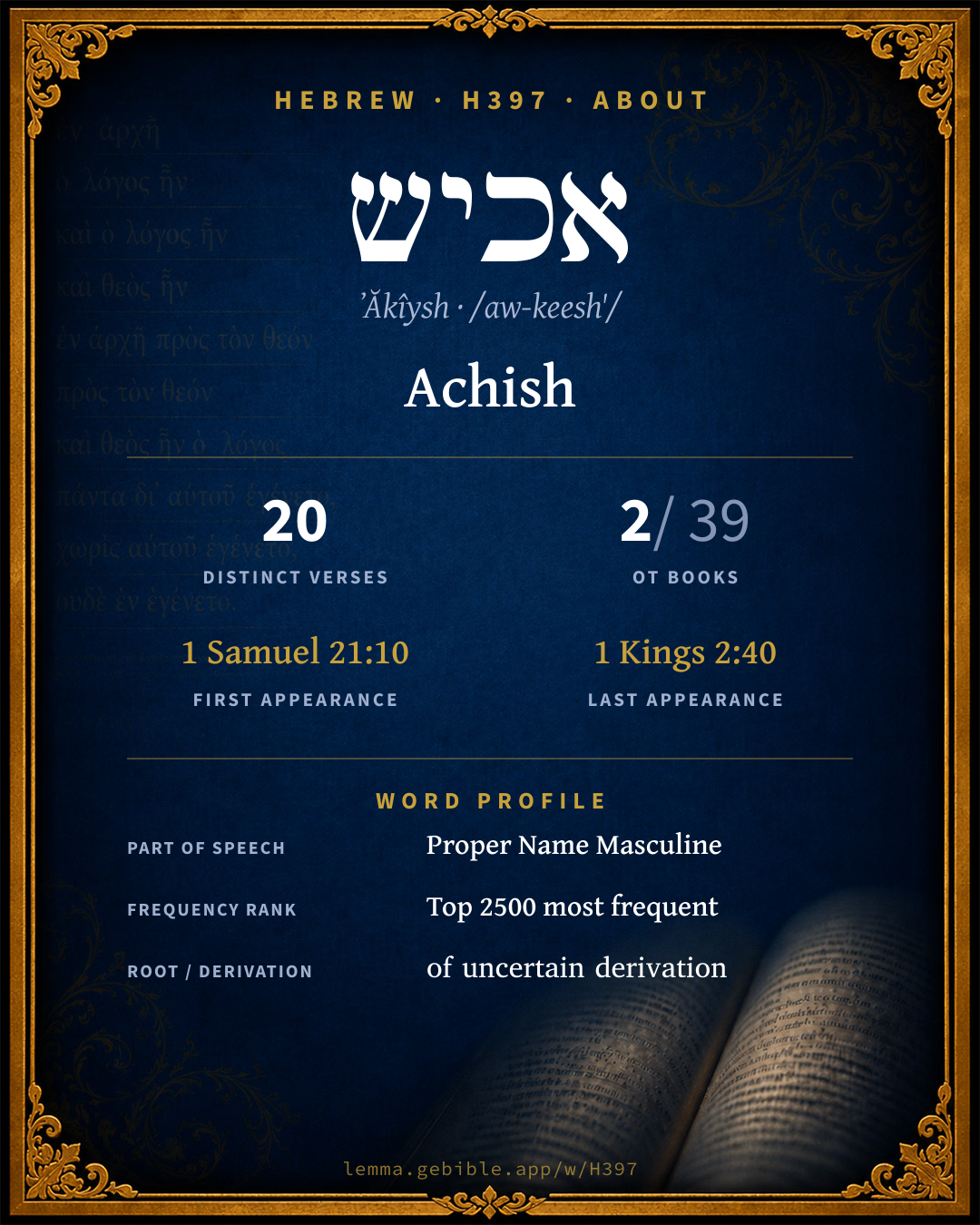
אָכִישׁ
Achish
BDB lists 2 entries for ‘Achish’ fuller range ↓
Full lexicon entry — Brown-Driver-Briggs (BDB)
From Brown-Driver-Briggs (BDB)
Where this word appears
Grammar key — what these labels mean
Part of speech
- Noun
- A naming word — a person, place, thing, or idea.
Noun type
- Proper
- A name of a specific person, place, or people (e.g. Abraham, Zion, Israel).
Every verse where H397 appears — 20 distinct verses across 2 books. Click any verse to open its interlinear word-by-word view. Verse text shown in the World English Bible for context — . Each verse’s Hebrew form is shown with its reference; the English is not keyword-highlighted, since the data carries no word-level English alignment. Use “Compare translations” on any verse to read it across multiple English versions. This concordance covers the Hebrew Bible; Septuagint (Greek Old Testament) occurrences are not indexed here.
1 Samuel 18 verses
- 1 Samuel 21:10 אָכִ֖ישׁ n Proper David arose, and fled that day for fear of Saul, and went to Achish the king of Gath.
- 1 Samuel 21:11 אָכִישׁ֙ n Proper The servants of Achish said to him, "Isn't this David the king of the land? Didn't they sing one to another about him in dances, saying, 'Saul has slain his thousands, David his ten thousands?'"
- 1 Samuel 21:12 אָכִ֥ישׁ n Proper David laid up these words in his heart, and was very afraid of Achish the king of Gath.
- 1 Samuel 21:14 אָכִ֖ישׁ n Proper Then said Achish to his servants, Look, you see the man is mad; why then have you brought him to me?
- 1 Samuel 27:2 אָכִ֥ישׁ n Proper David arose, and passed over, he and the six hundred men who were with him, to Achish the son of Maoch, king of Gath.
- 1 Samuel 27:3 אָכִ֥ישׁ n Proper David lived with Achish at Gath, he and his men, every man with his household, even David with his two wives, Ahinoam the Jezreelitess, and Abigail the Carmelitess, Nabal's wife.
- 1 Samuel 27:5 אָכִ֗ישׁ n Proper David said to Achish, If now I have found favor in your eyes, let them give me a place in one of the cities in the country, that I may dwell there: for why should your servant dwell in the royal city with you?
- 1 Samuel 27:6 אָכִ֛ישׁ n Proper Then Achish gave him Ziklag that day: why Ziklag pertains to the kings of Judah to this day.
- 1 Samuel 27:9 אָכִֽישׁ n Proper David struck the land, and saved neither man nor woman alive, and took away the sheep, and the oxen, and the donkeys, and the camels, and the clothing; and he returned, and came to Achish.
- 1 Samuel 27:10 אָכִ֔ישׁ n Proper Achish said, Against whom have you made a raid today? David said, Against the South of Judah, and against the South of the Jerahmeelites, and against the South of the Kenites.
- 1 Samuel 27:12 אָכִ֖ישׁ n Proper Achish believed David, saying, He has made his people Israel utterly to abhor him; therefore he shall be my servant forever.
- 1 Samuel 28:1 אָכִישׁ֙ n Proper It happened in those days, that the Philistines gathered their hosts together for warfare, to fight with Israel. Achish said to David, Know you assuredly, that you shall go out with me in the host, you and your men.
- 1 Samuel 28:2 אָכִ֔ישׁ אָכִישׁ֙ n Proper n Proper David said to Achish, Therefore you shall know what your servant will do. Achish said to David, Therefore will I make you keeper of my head for ever.
- 1 Samuel 29:2 אָכִֽישׁ n Proper The lords of the Philistines passed on by hundreds, and by thousands; and David and his men passed on in the rearward with Achish.
- 1 Samuel 29:3 אָכִ֜ישׁ n Proper Then said the princes of the Philistines, What [do] these Hebrews [here]? Achish said to the princes of the Philistines, Isn't this David, the servant of Saul the king of Israel, who has been with me these days, or [rather] these years, and I have found no fault in him since he fell away [to me] to this day?
- 1 Samuel 29:6 אָכִ֜ישׁ n Proper Then Achish called David, and said to him, As Yahweh lives, you have been upright, and your going out and your coming in with me in the host is good in my sight; for I have not found evil in you since the day of your coming to me to this day: nevertheless the lords don't favor you.
- 1 Samuel 29:8 אָכִ֗ישׁ n Proper David said to Achish, But what have I done? and what have you found in your servant so long as I have been before you to this day, that I may not go and fight against the enemies of my lord the king?
- 1 Samuel 29:9 אָכִישׁ֮ n Proper Achish answered David, I know that you are good in my sight, as an angel of God: notwithstanding the princes of the Philistines have said, He shall not go up with us to the battle.
1 Kings 2 verses
- 1 Kings 2:39 אָכִ֥ישׁ n Proper It happened at the end of three years, that two of the servants of Shimei ran away to Achish, son of Maacah, king of Gath. They told Shimei, saying, Behold, your servants are in Gath.
- 1 Kings 2:40 אָכִ֔ישׁ n Proper Shimei arose, and saddled his donkey, and went to Gath to Achish, to seek his servants; and Shimei went, and brought his servants from Gath.
About this entry
At a glance — auto-summarized from this page’s data, not written by a person. Every figure links to its source below. This summary describes the numbers; it doesn’t interpret them.
אכיש — transliterated ʼĂkîysh — is a Hebrew name carrying the sense “Achish.” Its uses cluster heavily in 1 Samuel (90% of all occurrences). With 20 verses in 2 books, it is an uncommon word in the Hebrew Bible. Debuting at 1 Samuel 21:10, it then recurs through the corpus. Each statement above links to its evidence; the full detail follows below.
Gloss history
Strong's 1890 vs modern scholarship
About this word
Strong's H397 catalogs a Hebrew word from the Hebrew Old Testament.
These counts are not copied from any lexicon or concordance. They are computed here, from the morphology-tagged Hebrew Old Testament. What Lemma adds →
- 20
- distinct verses
- The word appears in 20 distinct verses.
- 2 / 39
- OT books
- The word appears in 2 of 39 Old Testament books.
- #1,462
- by frequency
- Top 2500 most frequent Hebrew words (rank 1,462 of 8,640 Hebrew words by occurrence).
View all 20 occurrences in the concordance →
By traditional corpus
Conventional, traditional groupings — biblical authorship is debated, so this is a traditional corpus grouping, not an authorship claim. Each share is this word’s portion of its verses in that division of the Hebrew canon. Each figure is a share of the word’s 20 distinct verses.
- Prophets (Nevi'im) 20 verses · 100%
How translations render this word
Counts come from each version’s own published word-to-Strong’s tagging or interlinear alignment — an approximate guide to how each version renders this word, not a word-level alignment the data otherwise carries. Because each total is that version’s own tagged count, the per-version totals vary from one another and need not match the appearance or distinct-verse counts above. These counts may also differ from a printed concordance because Lemma counts each distinctly tagged rendering and does not collapse phrase taggings into a single head-word total. This is a fixed set of word-tagged versions (KJV, ASV, BSB, ULT) and does not change with the reading translation you choose elsewhere. Each version’s license is shown beside its name below (and on Sources).
- King James Version: Achish 20×
- American Standard Version: Achish 19×
- Berean Standard Bible: Achish 18×
- unfoldingWord Literal Text: Achish 21×
King James Version Public Domain
Renders H397 across 21 tagged occurrences — most commonly:
Plus 1 rendering that appears only once — usually multi-word phrases or single function words the recovered tagging swept in, not distinct renderings.
American Standard Version Public Domain
Renders H397 across 21 tagged occurrences — most commonly:
Plus 2 renderings that appear only once — usually multi-word phrases or single function words the recovered tagging swept in, not distinct renderings.
Berean Standard Bible Public Domain
Renders H397 across 19 tagged occurrences — most commonly:
Plus 1 rendering that appears only once — usually multi-word phrases or single function words the recovered tagging swept in, not distinct renderings. Not rendered by a distinct English word in 2 further occurrences.
unfoldingWord Literal Text CC BY-SA 4.0
Renders H397 across 21 tagged occurrences — most commonly:
Senses in BDB
The 2 senses BDB distinguishes for this word, in lexicon order (not ranked by frequency or importance). The full entry — with sub-senses — is in the Lexicon Entry tab.
- Achish = "I will blacken (or terrify)" or " only a man"
- Philistine king of Gath
Word origin
n.pr.m. king of Gath 1 S 21:11, 12, 13, 15 + 15 textual 1 S 27–29 + 1 K 2:39, 40 (perh. cf. ܐܰܟܬܳܐ anger).
— Brown-Driver-Briggs (Oxford 1906, public domain), digitized via Sefaria, supplemented by the OpenScriptures HebrewLexicon (CC BY 4.0). See Sources.
Origin: of uncertain derivation
Jastrow Dictionary
A second Hebrew/Aramaic lexicon for comparison, covering Aramaic and post-biblical (Talmudic, Targumic, Midrashic) usage that the biblical-Hebrew BDB does not. Matched by lemma rather than by Strong’s number, so a lemma may carry more than one Jastrow headword (shown separately below), and the entries cover usage well beyond the Bible.
כְּשַׁשׁ
- (v. כִּשְׁכֵּשׁ) to knock, strike.—Denom. מַכּוֹשָׁה.
- to strike, chase away by knocking. Gen. R. s. 44 נסב … והוה מַכֵּישׁ להון … מִתְכַּשִּׁין Ar. (ed. מכתשין) Abraham took a knocker and tried to frighten them away by knocking, but they minded it not; Yalk. ib. 77 והוה מכיש להון ולא הוו מתכתשין.…
- to be frightened off by knocking, v. supra.
A Dictionary of the Targumim, the Talmud Babli and Yerushalmi, and the Midrashic Literature (Marcus Jastrow; London, Luzac, 1903) — Public Domain. Digitized via Sefaria. Digitized via Sefaria. Full attribution on Sources.
Forms in the corpus
The 9 distinct written forms H397 takes in the Hebrew Bible, most frequent first — each parse links to that state’s occurrences in the concordance. Hebrew forms include their vowel points and cantillation, so a single lemma takes many written forms.
| Form | Parsing | Example | Uses |
|---|---|---|---|
| אָכִ֥ישׁ | Noun, Proper | 1 Kings 2:39 | 4 |
| אָכִ֔ישׁ | Noun, Proper | 1 Kings 2:40 | 3 |
| אָכִ֖ישׁ | Noun, Proper | 1 Samuel 21:10 | 3 |
| אָכִישׁ֙ | Noun, Proper | 1 Samuel 21:11 | 3 |
| אָכִ֗ישׁ | Noun, Proper | 1 Samuel 27:5 | 2 |
| אָכִ֜ישׁ | Noun, Proper | 1 Samuel 29:3 | 2 |
| אָכִֽישׁ | Noun, Proper | 1 Samuel 27:9 | 2 |
| אָכִ֛ישׁ | Noun, Proper | 1 Samuel 27:6 | 1 |
| אָכִישׁ֮ | Noun, Proper | 1 Samuel 29:9 | 1 |
Bible dictionary
Public-domain dictionary articles matched to this entry by name (Achish). A biblical name can be shared by more than one person or place, so an article may treat several.
Easton's Bible Dictionary · M. G. Easton, 1897
Angry, perhaps only a general title of royalty applicable to the Philistine kings. (1.) The king with whom David sought refuge when he fled from Saul (1 Sam. 21:10-15). He is called Abimelech in the superscription of Ps. 34. It was probably this same king to whom David a second time repaired at the head of a band of 600 warriors, and who assigned him Ziklag, whence he carried on war against the surrounding tribes (1 Sam. 27:5-12). Achish had great confidence in the valour and fidelity of David (1 Sam. 28:1, 2), but at the instigation of his courtiers did not permit him to go up to battle along with the Philistine hosts (1 Sam. 29:2-11). David remained with Achish a year and four months. (2.) Another king of Gath, probably grandson of the foregoing, to whom the two servants of Shimei fled. This led Shimei to go to Gath in pursuit of them, and the consequence was that Solomon put him to death (1 Kings 2:39-46).
Smith's Bible Dictionary · William Smith, 1863
(angry), a Philistine king of Gath, who in the title of the 34th Psalm is called Abimelech. David twice found a refuge with him when he fled from Saul. (B.C. 1061.) On the first occasion he was alarmed for his safety, feigned madness, and was sent away.
Hitchcock's Bible Names Dictionary · Roswell D. Hitchcock, 1869
thus it is; how is this
Classic public-domain reference works; full attribution on Sources.
Septuagint verse parallels
This word appears in 20 verses that also exist in the Greek Old Testament (Septuagint), out of the 20 Hebrew verses it occurs in. You can read those verses in Greek by switching the Old Testament edition to the Septuagint.
Read these verses in the Septuagint
This is a verse-level parallel only — the same verses exist in both the Hebrew and Greek Old Testaments. No word-level Hebrew↔Greek correspondence is claimed: the data carries no such alignment, so no Greek word is shown as this Hebrew word’s translation. Coverage is not total — the Septuagint omits the deuterocanon and renumbers the Psalms, so some Hebrew verses have no direct Greek parallel.