
Psalms 121:3

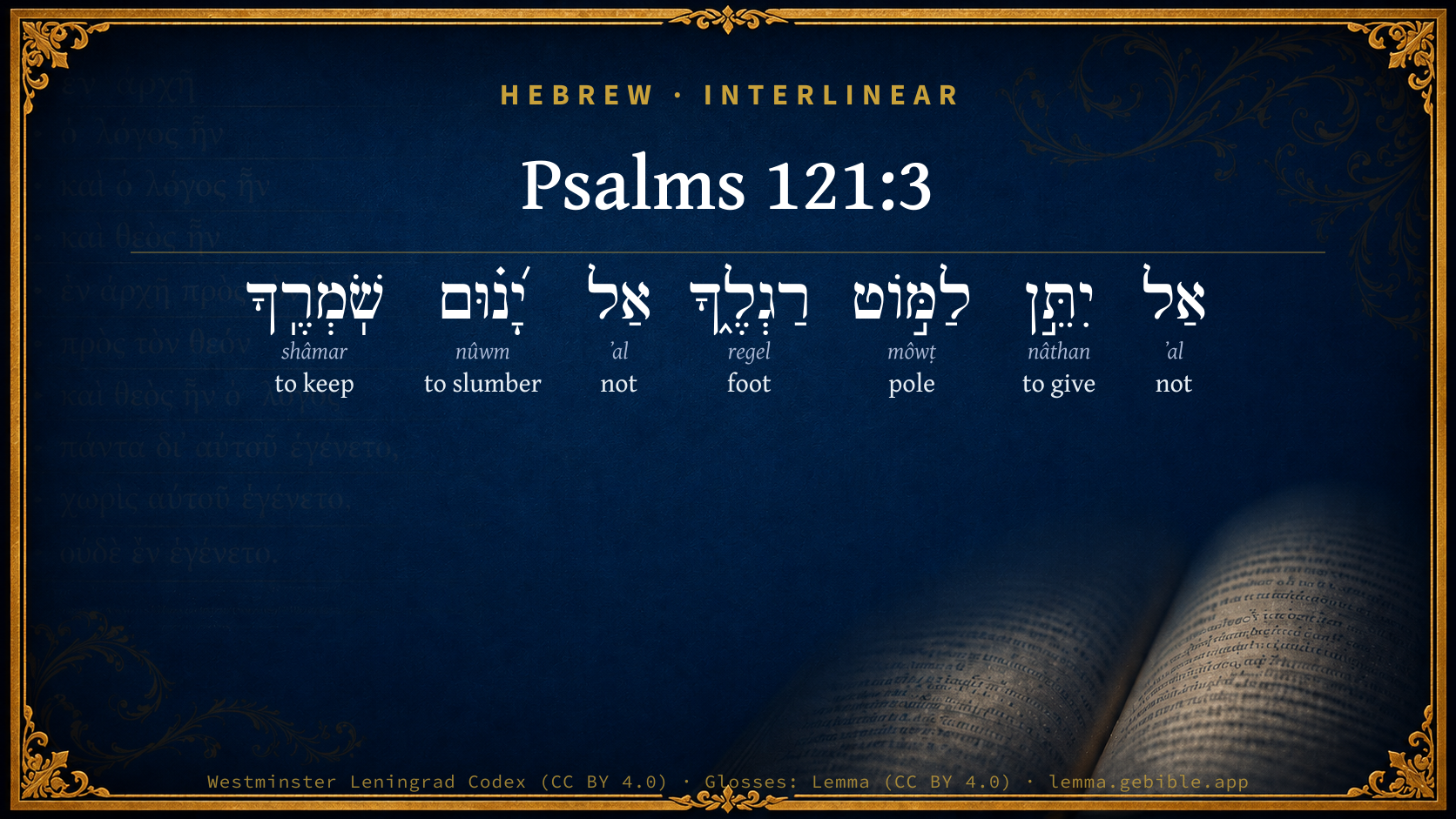
Hebrew (Westminster Leningrad Codex) Psalms 121:3 appears in the Hebrew Old Testament. The text above is from the Westminster Leningrad Codex. Each word links to its Strong’s number, a concise gloss, and parsing drawn from the Open Scriptures Hebrew Bible morphology. Click any word for its full Brown-Driver-Briggs (BDB) entry.
Download image
Cite this verse

Psalms 121:3 (World English Bible). Public Domain. Lemma interlinear Bible study tool, https://lemma.gebible.app/v/psalms/121/3.

Show BibTeX & RIS
BibTeX
RIS
English Translation
He will not allow your foot to be moved. He who keeps you will not slumber.
World English Bible · Public Domain
Download a study sheet

One document with this verse’s original text, its word-by-word gloss line, the meaning frame, cross-references with their text, attributed commentary, and full source and license credits — printable, and it pastes into notes with its structure intact.

This verse Autodidact and up

Study sheet (.html) Plain text (.txt)

A passage Seminary Student

Up to 50 verses in one chapter. A passage sheet keeps up to 6 commentary sources and 12 cross-references per verse, in the order this page ranks them, and says so on the sheet whenever that leaves anything out. Ask for a single verse and you get the Autodidact verse sheet above.

Everything on this page stays free to read, with no account — the sheet is a download of what is already on screen, not access to it.

Want to remove ads? Support Godless Engineer
Compare translations 3

The same verse in 3 English versions, stacked beneath the original-language interlinear above. Click any original word for its lexicon entry.

Each is an independent rendering of the whole verse — the interlinear is not word-aligned to these translations.

Highlighted words mark where these versions differ — a whole-verse word diff, not a word-by-word alignment.

  • World English Bible Public Domain
    He will not allow your foot to be moved. He who keeps you will not slumber.
  • King James Version Public Domain
    He will not suffer thy foot to be moved: he that keepeth thee will not slumber.
  • unfoldingWord Literal Text CC BY-SA 4.0
    May he not give your foot to the slipping; may your keeper not slumber.

unfoldingWord Literal Text — © unfoldingWord, licensed CC BY-SA 4.0. Word-aligned USFM3 via Door43 (git.door43.org/unfoldingWord/en_ult).

Versions to compare (up to 4)

3 of 4 selected

Show all 18 translations

Every available English version of this verse, each an independent rendering of the whole verse.

  • World English Bible Public Domain
    He will not allow your foot to be moved. He who keeps you will not slumber.
  • Berean Standard Bible Public Domain
    He will not allow your foot to slip; your Protector will not slumber.
  • Majority Standard Bible Public Domain
    He will not allow your foot to slip; your Protector will not slumber.
  • King James Version Public Domain
    He will not suffer thy foot to be moved: he that keepeth thee will not slumber.
  • American Standard Version (1901) Public Domain
    He will not suffer thy foot to be moved: He that keepeth thee will not slumber.
  • Revised Version (1885) Public Domain
    He will not suffer thy foot to be moved: he that keepeth thee will not slumber.
  • Geneva Bible (1599) Public Domain
    He wil not suffer thy foote to slippe: for he that keepeth thee, will not slumber.
  • Douay-Rheims (1899) Public Domain
    What shall be given to thee, or what shall be added to thee, to a deceitful tongue.
  • Young's Literal Translation Public Domain
    He suffereth not thy foot to be moved, Thy preserver slumbereth not.
  • Literal Standard Version CC BY-SA 4.0
    He does not permit your foot to be moved, || He who is preserving you does not slumber.
  • Unlocked Literal Bible CC BY-SA 4.0
    He will not allow your foot to slip; he who protects you will not slumber.
  • unfoldingWord Literal Text CC BY-SA 4.0
    May he not give your foot to the slipping; may your keeper not slumber.
  • Darby Bible Public Domain
    He will not suffer thy foot to be moved; he that keepeth thee will not slumber.
  • World Messianic Bible Public Domain
    He will not allow your foot to be moved. He who keeps you will not slumber.
  • Webster's Bible Public Domain
    He will not suffer thy foot to be moved: he that keepeth thee will not slumber.
  • Free Bible Version CC BY-SA 4.0
    He will not let you fall; he who watches over you won't fall asleep.
  • Bible in Basic English Public Domain
    May he not let your foot be moved: no need of sleep has he who keeps you.
  • JPS Tanakh (1917) Public Domain
    He will not suffer thy foot to be moved; He that keepeth thee will not slumber.

Literal Standard Version (2020), Covenant Press — licensed CC BY-SA 4.0. Text via the HelloAO Bible API (eBible.org). Unlocked Literal Bible (unfoldingWord) — licensed CC BY-SA 4.0. Text via the HelloAO Bible API (eBible.org). unfoldingWord Literal Text — © unfoldingWord, licensed CC BY-SA 4.0. Word-aligned USFM3 via Door43 (git.door43.org/unfoldingWord/en_ult). Free Bible Version, Dr. Jonathan Gallagher — licensed CC BY-SA 4.0. Text via the HelloAO Bible API (eBible.org).

Word by word

More ways to search: Search by grammar → Find every occurrence → Compare this word →

Practice this passage: Drill this verse → Learn its vocabulary →

About this verse

These counts appear in no published source. They are computed here, from the morphology-tagged text and Lemma’s own curated glosses. What Lemma adds →

7
words
6
distinct lemmas
Wisdom
section

Notable vocabulary

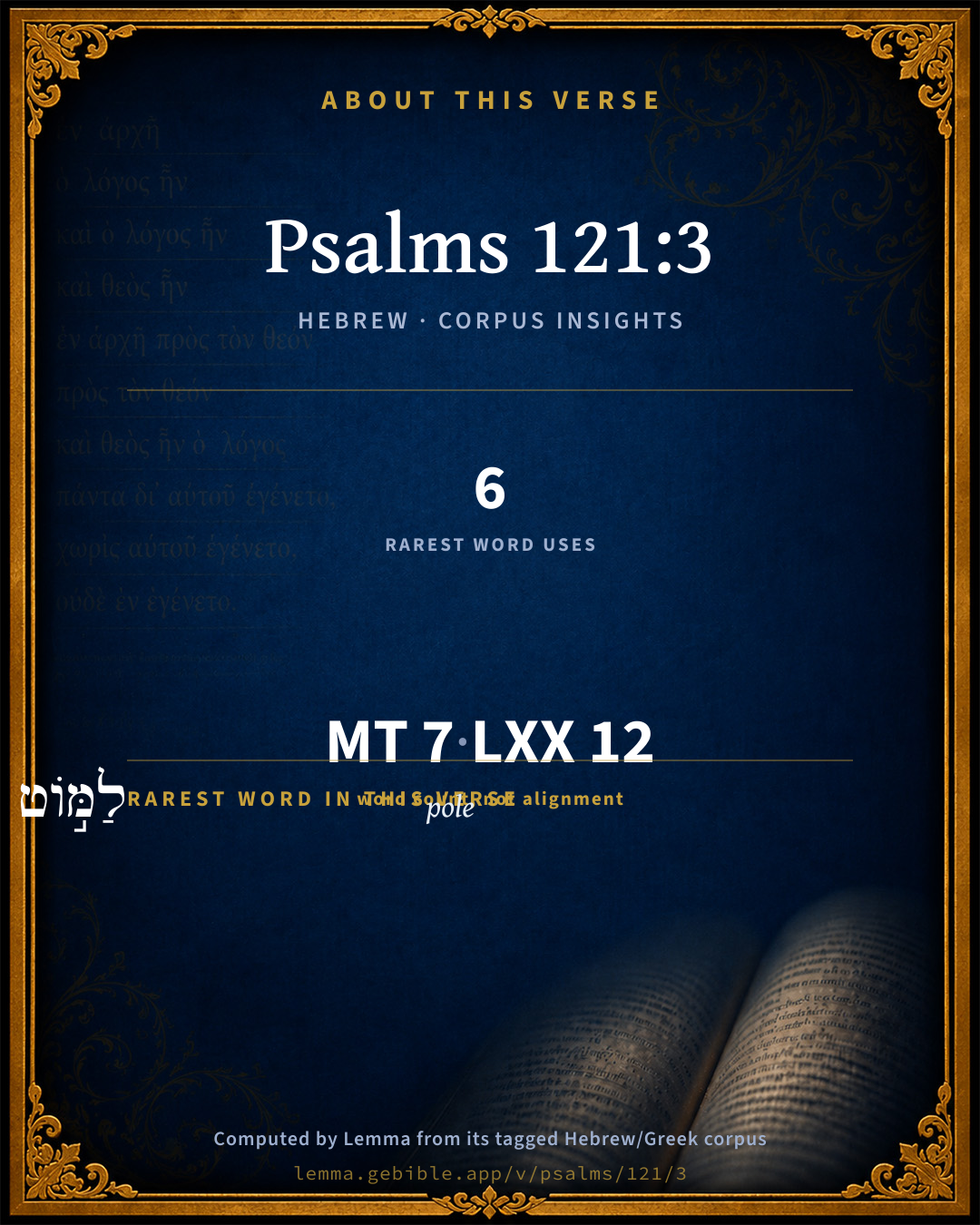
The rarest word here is לַמּ֣וֹט pole H4132 — appearing just 6 times in the whole Hebrew Bible.

Shared distinctive vocabulary

לַמּ֣וֹט pole H4132 occurs in 6 verses of the Hebrew Bible. Also found in:

Grammatical profile

  • 4 verbs
  • 1 noun
  • 2 particles

Verb forms

  • יִתֵּ֣ן Qal · Jussive
  • לַמּ֣וֹט Qal · Infinitive Construct
  • יָ֝נ֗וּם Qal · Jussive
  • שֹֽׁמְרֶֽךָ Qal · Participle Active

Repetition

A word recurs within this verse — often emphatic in Hebrew:

  • אַל not H408 ×2

Hebrew & Septuagint length

In English translation the verse runs 16 words from the Hebrew and 12 from the Septuagint (LXX English) — closely comparable.

A rough comparison of the two English renderings, which tokenize alike — not a word-level alignment.

Word counts can differ between the Hebrew and the Greek without any difference in meaning — e.g. the Hebrew direct-object marker אֵת has no separate Greek word, and Greek often adds the article ὁ.

In the original languages it is 7 Hebrew tokens and 12 Greek tokens — but the two are counted differently (Hebrew bundles its prefixes and suffixes into one token; the Greek is in lemma form), so that isn’t a like-for-like length.

Cross-references

10

Topical passages linked to Psalms 121:3 in the Treasury of Scripture Knowledge — connected by theme and wording, ordered by reader-vote popularity; previews shown in the World English Bible.

  • Proverbs 3:26 For Yahweh will be your confidence, And will keep your foot from being taken.
  • Proverbs 3:23 Then you shall walk in your way securely. Your foot won't stumble.
  • 1 Samuel 2:9 He will keep the feet of his holy ones; But the wicked shall be put to silence in darkness; For by strength shall no man prevail.
  • Psalms 91:12 They will bear you up in their hands, So that you won't dash your foot against a stone.
  • Psalms 66:9 Who preserves our life among the living, And doesn't allow our feet to be moved.
  • Psalms 127:1 Unless Yahweh builds the house, They labor in vain who build it. Unless Yahweh watches over the city, The watchman guards it in vain.
  • Isaiah 27:3 I Yahweh am its keeper; I will water it every moment: lest any hurt it, I will keep it night and day.
  • 1 Peter 1:5 who by the power of God are guarded through faith for a salvation ready to be revealed in the last time.
  • Psalms 41:2 Yahweh will preserve him, and keep him alive, He shall be blessed on the earth, And he will not surrender him to the will of his enemies.
  • Proverbs 2:8 That he may guard the paths of justice, And preserve the way of his saints.

Cross-references courtesy of OpenBible.info (CC BY 4.0).

Hebrew and Greek witnesses Masoretic Hebrew ↔ Greek Septuagint

The same verse in the two great witnesses to the Old Testament, shown verse-for-verse.

You’re reading Greek Psalm 120 (Hebrew Psalm 121). The Septuagint counts the superscription, so verse numbers can differ from the Hebrew — chapter-level alignment, not verse-by-verse. Numbering follows Rahlfs.

These are two independent witnesses, not word-aligned to each other, and the Septuagint is shown in lemma (dictionary) form.

Hebrew Psalms 121:3 Masoretic · Westminster Leningrad Codex

אַל יִתֵּ֣ן לַמּ֣וֹט רַגְלֶ֑ךָ אַל יָ֝נ֗וּם שֹֽׁמְרֶֽךָ

He will not allow your foot to be moved. He who keeps you will not slumber.

World English Bible · Public Domain

Greek LXX Greek Psalm 120:3 Septuagint · lemma form

μή δίδωμι εἰς σάλος ὁ πούς σύ μηδέ νυστάζω ὁ φυλάσσω σύ

Let not your foot be moved; and let not your keeper slumber.

LXX2012 (modern English Septuagint) · Public Domain

On this verse, Ellicott's Commentary for English Readers discusses the Septuagint’s reading. Read the note in Commentary ↓

Hebrew: Westminster Leningrad Codex (CC BY 4.0). Greek: Septuagint (public domain); English from LXX2012 (modern English Septuagint) (Public Domain). How the Septuagint differs from the Hebrew →

Commentary

Notes on Psalms 121:3 from classic Christian and Jewish commentators (each source and its license shown beneath its notes). The classic Christian expositions comment on the surrounding passage and are grouped to its opening verse, so a note may address several verses; the Jewish commentaries on the Tanakh (Rashi and others) are per-verse, so they appear only where the commentator wrote on this verse.

Lemma curates 59 commentaries, every one of them public domain or Creative Commons licensed, each selected and text-cleaned for this edition rather than reprinted as found. About our sources →

The Cambridge Bible for Schools and Colleges

gen. ed. J. J. S. Perowne

3. It is maintained by some grammarians that the negative particle ’al “sometimes expresses merely the subjective feeling and sympathy of the speaker with the act” (Davidson, Syntax, § 128, R. 2), and consequently the rendering of the A.V. is retained in the R.V. Psa_121:4 will then repeat the ‘subjective feeling’ of Psa_121:3 as a categorical assertion. But here at any rate it is preferable, with R.V. marg., to retain the usual deprecative meaning of ’al; May he not suffer thy foot to be moved; may he that keepeth thee not slumber! and in Psa_121:4 the speaker as it were corrects himself, or possibly another speaker chimes in: ‘Nay, there is no need for such a prayer, for Israel’s keeper never sleeps.’ Israel’s watchman is not like a human sentinel, liable to be overcome by sleep upon his watch; He is not such as the heathen suppose their gods to be (1Ki_18:27), but unceasing in His vigilance. He that keepeth Israel may be an allusion to Gen_28:15.

3, 4. It is possible to suppose that the speaker of Psa_121:1-2. addresses himself, but it is more natural to hear in these verses the voice of another speaker, answering the first with words of encouragement.

The Cambridge Bible for Schools and Colleges (gen. ed. J. J. S. Perowne; Cambridge University Press, 1878–1918) — public domain. Text from a community e-Sword module.

Trapp's Complete Commentary

John Trapp

Psa 121:3 He will not suffer thy foot to be moved: he that keepeth thee will not slumber.

Ver. 3. He will not suffer thy foot to be moved] Not greatly moved, Psa 62:2, an utter prolapsion.

He that keepeth thee will not slumber] And if King Philip could say that he could sleep securely because his friend Antipater watched by him, may not we be much more confident who have God to keep us?

John Trapp, A Commentary or Exposition upon All the Books of the Old and New Testament (1647–1656) — public domain. Text from a community e-Sword module.

The Biblical Illustrator

Joseph S. Exell

Psa_121:3

He will not suffer thy foot to be moved.

He will not suffer thy foot to be moved

Any of you who have tried to climb the hills know that that is just the great danger of it. One slip, and you may go sheer down hundreds of feet, and be dashed to pieces. Do we not use this expression to cover the idea of safety? We talk about the sure-footed guide, and the sure-footed mountaineer, the man of keen eye and cool nerve, and of muscles like iron all over his body; a man who can be depended on. If he gets a foothold for his foot, he will put his foot there, and keep it there, until he gets another as good. So is the Christian. Why, in one sense, we are engaged in a perilous journey. We are going up. We are climbing. To brace yourself to climb the Matterhorn is a small thing compared with this girding of your mind to be sober and climbing right up from hell to heaven. And that is the climb for every one of us. (John McNeill)

The Christians stability

The North Pole is perpetually roving within the limits of a circle sixty feet in diameter. What is the North Pole to-day is not the North Pole to-morrow. The true North Pole has been known to travel more than four feet in a week, while sometimes it has required more than a month to cover a yard. Suppose that you and I were to sail from opposite points to discover this turning-point. We will say that you, with your astronomical instruments, planted your flag upon the exact North Pole six months ago, and then went away. I, arriving to-day, make equally accurate calculations and plant my flag also upon the true North Pole. My flag is probably forty feet from yours, yet neither of us is in error. To-morrow the elusive little tip-top of the earth will have slipped away from both of us. And if I were to claim a building site the corner-stone of which was marked by this North Pole, a strange predicament would follow. I should have to place my fences upon castors, and keep them continually moving in order to mark strictly my own reservation. So it is with too many Christian lives. Want of stability in the Christian faith and life is one of the great--one might say the greatest--hindrances to the true development of Christianity among us. We are constantly veering round in our faith and life, following the latest new belief, accepting every modern faith, or doubting some established Christian doctrine. Let us be more stable in our religion. (Signal.)

The Biblical Illustrator, edited by Joseph S. Exell (c. 1880s–1900s) — public domain. Text from a community e-Sword module.

Joseph Benson's Commentary

Psa 121:3-8. He will not suffer thy foot to be moved — To wit, so as to fall into mischief. He speaks, as it were, from God to himself, but, withal, to the encouragement of all good men. He that keepeth thee will not slumber — Will not overlook nor neglect any thing which is necessary for thy preservation. The Lord is thy shade upon thy right hand — Both to refresh thee, and keep thee from the burning heat of the sun. In those countries where the heat of the sun was intolerable, shady places were esteemed not only very refreshing, but likewise salutary, and necessary to the preservation of health and life. When, therefore, the psalmist styles God his shade, he means that he protected him from danger, and refreshed him with comforts. The sun shall not smite thee by day — With excessive heat; nor the moon by night — With that cold and damp which come into the air by it. Intemperate heats and colds are the springs of many diseases. And, “as the heat of the sun by day, so the copious dews, which fall most abundantly in the moonshine, were very pernicious in those countries.” The sense is, He shall protect thee from all evils, both day and night. The Lord shall preserve thy going out and coming in — Shall guard and assist thee in all thy expeditions, journeys, and affairs, both at home and abroad; from this time forth, and even for evermore — He will be thy guide even unto death, and then bring thee to his heavenly kingdom. God will protect his church and his saints always, even to the end of the world; the Spirit, which is their preserver and comforter, shall abide with them for ever.

Joseph Benson's Commentary on the Old and New Testaments (1811–1818) — public domain. Text from a community e-Sword module.

J. A. Alexander on Psalms

Joseph Addison Alexander

3. (Psa 121:3) May he not suffer to be moved thy foot; may he not slumber—thy keeper. This is the expression of a wish, the only sense consistent with the form of the orignal. Let him not give up to moving thy foot. See above, Psa 38:16; Psa 66:8. The figure is peculiarly appropriate in the mouth of pilgrims, making their way among the hills and rocks of Palestine. The same thing is true of the figures in the subsequent verses.

Joseph Addison Alexander, The Psalms Translated and Explained (1850) — public domain. Text from a community e-Sword module.

Geneva Bible (1599)

Geneva Bible translators

He showeth that God’s providence not only watcheth over his Church in general: but also over every member thereof.

Geneva Bible (1599) marginal notes — public domain. Text via Bolls.life.

Adam Clarke's Commentary

Verse 3. He will not suffer thy foot to be moved] The foundation, God's infinite power and goodness, on which thou standest, cannot be moved; and whilst thou standest on this basis, thy foot cannot be moved.

Adam Clarke's Commentary on the Bible (1810–1826) — public domain. Text from a community e-Sword/MySword module.

John Calvin's Commentaries

3 He will not suffer thy foot to stumble. Here the Prophet, in order to recall the faithful to the right path, and to defeat the influence of all the allurements which are wont to distract their minds, affirms that whatever advantages worldly men are accustomed to desire or hope for from the world, true believers will find abundantly and at hand in God alone. He not only attributes power to God, but also teaches that He is so affectioned towards us, that he will preserve us in all respects in perfect safety. As often as the power of God is extolled, there are many who immediately reply, It is very true that he can do such and such things if he is so inclined, but we do not certainly know what is his intention. In this passage, therefore, God is exhibited to the faithful as their guardian, that they may rest with assured confidence on his providence. As the Epicureans, in imagining that God has no care whatever about the world, extinguish all piety, so those who think that the world is governed by God only in a general and confused manner, and believe not that he cherishes with special care each of his believing people, leave men’s minds in suspense, and are themselves kept in a state of constant fluctuation and anxiety. In short, never will the hearts of men be led in good earnest to call upon God, until a persuasion of the truth of this guardianship is deeply fixed in their minds. The Psalmist declares that the purpose for which God is our keeper, is, that he may hold us up. The Hebrew word, מוט, mot, which is here used, signifies both a sliding or falling, and a trembling or staggering. Now, although it often happens that the faithful stagger, yea, are even ready to fall altogether, yet as God sustains them by his power, they are said to stand upright. And as amidst the many dangers which every moment threaten us, it is difficult for us to get rid of all anxiety and fear, the Prophet at the same time testifies, that God keeps watch unceasingly over our safety.

John Calvin's Commentaries (1540-1563) — public domain. Text from the Calvin Translation Society English edition (1840s-50s) via the Christian Classics Ethereal Library (ccel.org). Calvin's coverage is partial (roughly two-thirds of the Bible); uncommented books and verses are honest gaps, never fabricated. The 19th-century editor's footnotes and remarks are omitted so the notes are faithfully Calvin's own voice.

Ellicott's Commentary for English Readers

(3) He will not.—The LXX. and Vulg. rightly, “may He not suffer,” &c. The Hebrew cannot be a simple negative. That it is Israel which is addressed the next verse seems to prove.

A Bible Commentary for English Readers, edited by Charles John Ellicott (1878–1897) — public domain. Text from a community e-Sword module.

John Gill's Exposition

Behold, he that keepeth Israel shall neither slumber nor sleep. He that kept Israel or Jacob, when asleep, and appeared to him in a dream, and promised to keep him in all places, and did; who found his posterity in the wilderness, and kept them as the apple of his eye: he keeps his spiritual Israel, whom he has chosen, redeemed, and calls; and he that is in general their keeper, is the keeper of every particular believer, who may promise themselves the utmost safety under his care; since, though he may sometimes seem to sleep, when he withdraws his gracious presence, defers help, and does not arise so soon to the assistance of his people as they wish for and expect; yet does not in reality sleep, nor is any ways negligent of them; no, not so much as slumber, nor is in the least indifferent about them, and careless of them; see Gen 28:15. So Homer (k) represents Jupiter as not held by sleep, while other gods and men slept all night; and hence Milton (l) has the phrase of "the unsleeping eyes of God": but the Phrygians had a notion that their god slept in winter, and was awake in summer (m).

(k) Iliad. 2. v. 1, 2. (l) Paradise Lost, B. 5. v. 647. (m) Plutarch. de Iside & Osir. prope finem.

John Gill's Exposition of the Whole Bible (1746–1763) — public domain (CC PDM 1.0). Text via the HelloAO Bible API.

Albert Barnes' Notes on the Bible

He will not suffer thy foot to be moved - He will enable you to stand firm. You are safe in his protection. Compare the notes at Psa 38:16. This, with the remainder of the psalm, seems to be of the nature of an answer to the anxious question in Psa 121:1 - an answer which the author of the psalm, in danger and trouble, makes to his own soul, imparting confidence to himself.

He that keepeth thee will not slumber - He will be ever watchful and wakeful. Compare Isa 27:3. All creatures, as far as we know, sleep; God never sleeps. Compare Psa 139:11-12. His eyes are upon us by day, and in the darkness of the night - the night literally; and also the night of calamity, woe, and sorrow.

Albert Barnes' Notes on the Bible (1834–1885) — public domain. Text from a community e-Sword/MySword module.

Matthew Poole's English Annotations

He speaketh as it were from God to himself, but withal to the encouragement of his followers and of all good men.

To be moved, to wit, so as fall into mischief.

Will not slumber; will not overlook nor neglect any thing which is necessary for thy preservation.

Matthew Poole's English Annotations on the Holy Bible (1683–1685) — public domain. Text from a community e-Sword/MySword module.

The Treasury of David

Charles H. Spurgeon

Ver. 3. He will not suffer thy foot to be moved. Though the paths of life are dangerous and difficult, yet we shall stand fast, for Jehovah will not permit our feet to slide; and if he will not suffer it we shall not suffer it. If our foot will be thus kept we may be sure that our head and heart will be preserved also. In the original the words express a wish or prayer, "May he not suffer thy foot to be moved." Promised preservation should be the subject of perpetual prayer; and we may pray believing; for those who have God for their keeper shall be safe from all the perils of the way. Among the hills and ravines of Palestine the literal keeping of tim feet is a great mercy; but in the slippery ways of a tried and afflicted life, the boon of upholding is of priceless value, for a single false step might cause us a fall fraught with awful danger. To stand erect and pursue the even tenor of our way is a blessing which only God can give, which is worthy of the divine hand, and worthy also of perennial gratitude. Our feet shall move in progress, but they shall not be moved to their overthrow.

He that keepeth thee will not slumber, or "thy keeper shall not slumber". We should not stand a moment if our keeper were to sleep; we need him by day and by night; not a single step can be safely taken except under his guardian eye. This is a choice stanza in a pilgrim song. God is the convoy and body guard of his saints. When dangers are awake around us we are safe, for our Preserver is awake also, and will not permit us to be taken unawares. No fatigue or exhaustion can cast our God into sleep; his watchful eyes are never closed.

Ver. 3. He will not suffer thy foot to be moved. The sliding of the foot is a frequent description of misfortune, for example, Ps 38:16, Ps 66:9, and a very natural one in mountainous Canaan. Where a single slip of the foot was often attended with great danger. The language here naturally refers to complete, lasting misfortune. E.W. Hengstenberg.

Ver. 3. He will not suffer thy foot to be moved. A man cannot go without moving of his feet; and a man cannot stand whose feet are moved. The foot by a synechdoche is put for the whole body, and the body for the whole outward estate; so that, "He will not suffer thy foot to be moved", is, he will not suffer thee or thine to be moved or violently cast down. The power of thine opposers shall not prevail over thee, for the power of God sustains thee. Many are striking at thy heels, but they cannot strike them up while God holds thee up. If the will of thine enemies might stand, thou shouldest quickly fall; but God "will not suffer thy foot to be moved". Joseph Caryl.

Ver. 3-8. There is something very striking in the assurance that the Lord with not suffer the foot even of the most faint and wearied one to be moved. The everlasting mountains stand fast, and we feel as if, like Mount Zion, they could not be removed for ever; but the step of manhow feeble in itself, how liable to stumble or trip even against a pebble in the way! Yet that foot is as firm and immoveable in God's protection as the hills themselves. It is one of his own sweet promises, that he will give his angels charge over every child Of his, that lie come to no harm by the way. But, oh, how immeasurably beyond even the untiring wings of angels is the love promised here! that love which engages to protect from every danger, as a hen gathereth her chickens under her wings. In the hours of occupation and hurry, in the conflicts and perils of the day, in the helplessness of sleep, in the glare and heat of the noonday, amid the damps and dews of night, that wakeful eye is still over every child for his good. Man, indeed, goeth forth to his work and to his labour till the evening; but alike as he goes forth in the morning, and as he returns in the evening, the Lord still holds him up in all his goings forth and his comings in; no manner of evil shall befall him. And oh! what a sweet addition is it to the promise, "He shall preserve thy soul". It is the very argument of the apostle, and the very inference he draws, "The eyes of the Lord are upon the righteous, and his ears are open unto their cry", "He neither slumbereth nor sleepeth", and then he asks, "Who is he that will harm you, if ye be followers of that which is good?" From the very dawn of life to its latest close, even for evermore, "He will preserve thee from all evil; he will preserve thy soul." Barton Bouchier.

Ver. 3,4,5. A great practical difficulty is to find a keeper who will remain awake during the whole night. The weariness of those who keen a faithful watch, and their longing for day during the tedious lonely hours of darkness, is alluded to in a graphic and beautiful figure of the Psalmist

"My soul waiteth for the Lord

More than keepers for the morning,

More than keepers for the morning."

The usual method adopted to secure due vigilance is to require the man to call out loudly, or to blow a whistle, every quarter of an hour... Yet, notwithstanding all precautions, as soon as sleep falls on the tired camp, it is too often the case that the hireling keeper lies down on the ground, wraps around him his thick "abaiyeh", or cloak, and, careless of his charge, or overcome with weariness yields himself up to his drowsy propensities.

Viewed in the light of these facts, how full of condescension and cheer is the assurance of God's never ceasing care

"He who keepeth thee will not slumber.

Behold, he who keepeth Israel

Doth not slumber or sleep.

Jehovah is thy keeper."

While the services of the keeper constitute at all times a marked feature of life in Palestine, they are perhaps more needed when travelling through the country than at any other time. Then, when the moving camp is nightly pitched in strange fields, it becomes absolutely necessary to apply to the nearest authorities for a nocturnal guardian, before one can safely lie down to rest. Now this Psalm 121 being one of "the Songs of Degrees, "was probably composed to be sung on the way to Jerusalem, as a pilgrim hymn, when the Israelites were coming up annually to keep the three great feasts. As a journeying psalm, it would therefore have peculiar significance in its allusion to the keeper by night. James Neil, in "Palestine Explored", 1882.

Ver. 3,4. When one asked Alexander how he could sleep so soundly and securely in the midst of danger, he told him that Parmenlo watched, Oh, how securely may they sleep over whom he watcheth that never slumbers nor sleeps! From "The Dictionary of Illustrations", 1873.

Ver. 3,4. A poor woman, as the Eastern story has it, came to the Sultan one day, and asked compensation for the loss of some property. "How did you lose it?" said the monarch. "I fell asleep", was the reply, "and a robber entered my dwelling". "Why did you fall asleep?" "I fell asleep because I believed that you were awake". The Sultan was so much delighted with the answer of the woman, that he ordered her loss to be made up. But what is true, only by a legal fiction, of human governments, that they never sleep is true in the most absolute sense with reference to the divine government. We can sleep in safety because our God is ever awake. We are safe because he never slumbers. Jacob had a beautiful picture of the ceaseless care of Divine Providence on the night when he fled from his father's house. The lonely traveller slept on the ground, with the stones for his pillow, and the sky for his canopy. He had a wondrous vision of a ladder stretching from earth to heaven, and on which angels were seen ascending and descending. And he heard Jehovah saying to him, "Behold, I am with thee, and will keep thee in all places whither thou goest." N. McMichael.

Ver. 3 (First clause). The preservation of saintly character the care of the Creator.

Ver. 3. Comfort for a pilgrim along the 'mauvais pas' of life. We have a Guide omniscient, omnipotent, never slumbering, unchanging.

Ver. 3. He that keepeth thee will not slumber.

1. The Lord's care is personal in its objects. The keeper of Israel is the keeper of the individual. God deals with us individually.

(a) This is implied in his care of the church, which is

composed of individuals.

(b) It is involved in the nature of our religion, which

is a personal thing.

(c) It is affirmed in Scripture. Examples; promises;

experiences. "He loved me, "etc., etc.

(d) It is confirmed by experience.

2. The Lord's care is unwearied in its exercise: "Will not slumber."

(a) He is never unacquainted with our condition.

(b) He is never indifferent to it.

(c) He is never weary of helping us. We sometimes think

he sleeps, but this is our folly.

Frederick J. Benskin, of Reading, 1882.

Psalms 121:4*

Charles H. Spurgeon's The Treasury of David (1869–1885) — public domain. Psalms only. Text from a community e-Sword/MySword module.

Whedon's Commentary on the Bible

Daniel D. Whedon

3. Thy foot to be moved—The word “moved” may signify to slip, slide, or to tremble, totter, or even to fall. An insecure foot-hold is a casualty specially incident to the pilgrim on a long journey, and is an emblem of disaster and defeat. Psa_38:16; Psa_94:18. The statement is equal to saying, that God would give to the true pilgrim a prosperous journey.

Daniel D. Whedon (gen. ed.), Commentary on the Old and New Testaments (1874–1909) — public domain. Text from a community e-Sword module.

The Pulpit Commentary

He will not suffer thy foot to be moved. The psalmist addresses himself with consolatory assurances. God will not allow any evil to approach him, so as to do him hurt. He that keepeth thee will not slumber. God does not sleep his vigilance is unceasing. (comp. Isa_27:3)

The Pulpit Commentary (1880–1919), ed. H.D.M. Spence-Jones & Joseph S. Exell — public domain. Text from a community e-Sword module.

unfoldingWord translationNotes

Door43 World Missions Community

General Information:

There is a shift here to the second person. This may mean 1) the writer begins speaking to the people of Israel or 2) the writer is quoting another person speaking to the writer. (See: First, Second, or Third Person)

your foot to slip

The slipping of a foot is associated with falling. AT: "you to fall" (See: Metonymy)

he who protects ... the guardian

These two phrases means the same thing, and emphasize God's role as a protector. (See: Parallelism)

he who protects you will not slumber

Here to "slumber" means he would stop protecting. The negative form strengthens the statement. AT: "God will not fall asleep and stop protecting you" or "God will always protect you" (See: Metonymy and Double Negatives)

will not slumber ... never slumbers or sleeps

These two phrases have similar meanings. The second one strengthens the thought in the first. (See: Parallelism)

See

This word alerts us to pay attention to the important information that follows.

never slumbers or sleeps

These two words mean the same thing. Here to "slumber" means to stop protecting. The negative form strengthens the statement. AT: "will not sleep and stop protecting you" or "will always protect you" (See: Doublet and Metonymy and Double Negatives)

translationWords

Israel

unfoldingWord translationNotes — © Distant Shores Media and the Door43 World Missions Community, licensed CC BY-SA 4.0. Source: git.door43.org/Door43/en_tn.

Lesson kit

Teaching starters — assembled from the data on this page, not authored interpretation. Every prompt links to the verse data it draws on. Edit before teaching.

Psalms, in the Wisdom, opens this verse with 7 words (6 distinct Hebrew lemmas). Its most distinctive word is môwṭ (“pole”). A historical commentator’s framing appears above. Read the whole chapter for the surrounding context.

Discussion questions

  1. How does “pole” (môwṭ) shape what this verse is saying?
  2. How does Numbers 4:10, which shares the word «pole», read alongside this verse?
  3. What does the repetition of “not” (2× in this one verse) do in this verse?
  4. These translations render this verse differently. What is at stake in choosing one wording over another?
  5. «יִתֵּ֣ן» is a Qal Jussive verb. How does that grammatical form shape the action described?
  6. Compare how The Cambridge Bible for Schools and Colleges and Trapp's Complete Commentary read this verse. Where do they agree or differ?

Things to notice

Reading settings

Reading text

Shown beneath each verse's original-language words.

Old Testament
Old Testament edition

Read the OT as the Masoretic Hebrew (MT) or the Greek Septuagint (LXX).

English shown for the Greek Septuagint (in the Hebrew ↔ Greek comparison).

Comparing translations? Open the Compare panel on any verse page to stack up to four side by side.