Zechariah 1:10

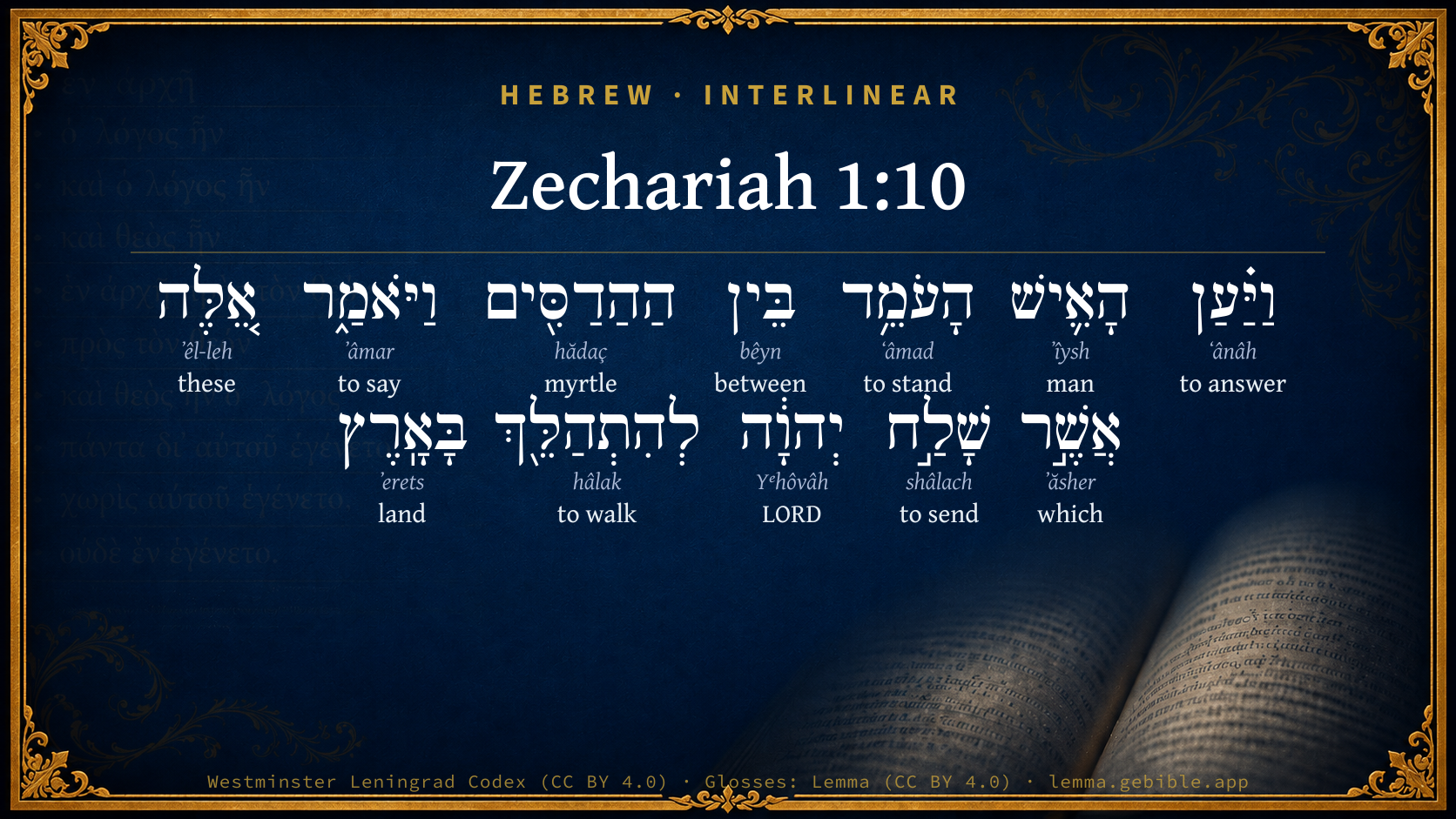
Hebrew (Westminster Leningrad Codex) Zechariah 1:10 appears in the Hebrew Old Testament. The text above is from the Westminster Leningrad Codex. Each word links to its Strong’s number, a concise gloss, and parsing drawn from the Open Scriptures Hebrew Bible morphology. Click any word for its full Brown-Driver-Briggs (BDB) entry.
Download image
Cite this verse

Zechariah 1:10 (World English Bible). Public Domain. Lemma interlinear Bible study tool, https://lemma.gebible.app/v/zechariah/1/10.

Show BibTeX & RIS
BibTeX
RIS
English Translation
The man who stood among the myrtle trees answered, "They are the ones Yahweh has sent to go back and forth through the earth."
World English Bible · Public Domain
Download a study sheet

One document with this verse’s original text, its word-by-word gloss line, the meaning frame, cross-references with their text, attributed commentary, and full source and license credits — printable, and it pastes into notes with its structure intact.

This verse Autodidact and up

Study sheet (.html) Plain text (.txt)

A passage Seminary Student

Up to 50 verses in one chapter. A passage sheet keeps up to 6 commentary sources and 12 cross-references per verse, in the order this page ranks them, and says so on the sheet whenever that leaves anything out. Ask for a single verse and you get the Autodidact verse sheet above.

Everything on this page stays free to read, with no account — the sheet is a download of what is already on screen, not access to it.

Want to remove ads? Support Godless Engineer
Compare translations 3

The same verse in 3 English versions, stacked beneath the original-language interlinear above. Click any original word for its lexicon entry.

Each is an independent rendering of the whole verse — the interlinear is not word-aligned to these translations.

Highlighted words mark where these versions differ — a whole-verse word diff, not a word-by-word alignment.

  • World English Bible Public Domain
    The man who stood among the myrtle trees answered, "They are the ones Yahweh has sent to go back and forth through the earth."
  • King James Version Public Domain
    And the man that stood among the myrtle trees answered and said, These are they whom the LORD hath sent to walk to and fro through the earth.
  • unfoldingWord Literal Text CC BY-SA 4.0
    And the man who was standing among the myrtle trees answered and said, “These the ones whom Yahweh has sent to walk about in the earth.”

unfoldingWord Literal Text — © unfoldingWord, licensed CC BY-SA 4.0. Word-aligned USFM3 via Door43 (git.door43.org/unfoldingWord/en_ult).

Versions to compare (up to 4)

3 of 4 selected

Show all 18 translations

Every available English version of this verse, each an independent rendering of the whole verse.

  • World English Bible Public Domain
    The man who stood among the myrtle trees answered, "They are the ones Yahweh has sent to go back and forth through the earth."
  • Berean Standard Bible Public Domain
    Then the man standing among the myrtle trees explained, “They are the ones the LORD has sent to patrol the earth.”
  • Majority Standard Bible Public Domain
    Then the man standing among the myrtle trees explained, “They are the ones the LORD has sent to patrol the earth.”
  • King James Version Public Domain
    And the man that stood among the myrtle trees answered and said, These are they whom the LORD hath sent to walk to and fro through the earth.
  • American Standard Version (1901) Public Domain
    And the man that stood among the myrtle-trees answered and said, These are they whom Jehovah hath sent to walk to and fro through the earth.
  • Revised Version (1885) Public Domain
    And the man that stood among the myrtle trees answered and said, These are they whom the LORD hath sent to walk to and fro through the earth.
  • Geneva Bible (1599) Public Domain
    And the man that stood among the mirre trees, answered, and sayd, These are they whome the Lord hath sent to go through the world.
  • Douay-Rheims (1899) Public Domain
    And the man that stood among the myrtle trees answered, and said: These are they, whom the Lord hath sent to walk through the earth.
  • Young's Literal Translation Public Domain
    And the one who is standing between the myrtles doth answer and say, `These `are' they whom Jehovah hath sent to walk up and down in the land.'
  • Literal Standard Version CC BY-SA 4.0
    And the one who is standing between the myrtles answers and says, “These [are] they whom YHWH has sent to walk up and down in the land.”
  • Unlocked Literal Bible CC BY-SA 4.0
    Then the man who stood among the myrtle trees answered and said, “These are those Yahweh has sent out to roam throughout the earth.”
  • unfoldingWord Literal Text CC BY-SA 4.0
    And the man who was standing among the myrtle trees answered and said, “These the ones whom Yahweh has sent to walk about in the earth.”
  • Darby Bible Public Domain
    And the man that stood among the myrtle-trees answered and said, These are they whom Jehovah hath sent to walk to and fro through the earth.
  • World Messianic Bible Public Domain
    The man who stood among the myrtle trees answered, “They are the ones the LORD has sent to go back and forth through the earth.”
  • Webster's Bible Public Domain
    And the man that stood among the myrtle-trees answered and said, These are they whom the LORD hath sent to walk to and fro through the earth.
  • Free Bible Version CC BY-SA 4.0
    The man who was there among the myrtle trees said, “These are the ones the Lord has sent out to patrol the earth.”
  • Bible in Basic English Public Domain
    And the man who was between the mountains, answering me, said, These are those whom the Lord has sent to go up and down through the earth.
  • JPS Tanakh (1917) Public Domain
    And the man that stood among the myrtle-trees answered and said: 'These are they whom the LORD hath sent to walk to and fro through the earth.'

Literal Standard Version (2020), Covenant Press — licensed CC BY-SA 4.0. Text via the HelloAO Bible API (eBible.org). Unlocked Literal Bible (unfoldingWord) — licensed CC BY-SA 4.0. Text via the HelloAO Bible API (eBible.org). unfoldingWord Literal Text — © unfoldingWord, licensed CC BY-SA 4.0. Word-aligned USFM3 via Door43 (git.door43.org/unfoldingWord/en_ult). Free Bible Version, Dr. Jonathan Gallagher — licensed CC BY-SA 4.0. Text via the HelloAO Bible API (eBible.org).

Word by word

More ways to search: Search by grammar → Find every occurrence → Compare this word →

Practice this passage: Drill this verse → Learn its vocabulary →

הַהַדַסִּ֖ים
hădaç
H1918
“the · myrtles”
Particle, Definite Article + Noun, Common, Masculine, Plural, Absolute
Part of Speech
Particle + Noun
Type
Common
Gender
Masculine
Number
Plural
State
Absolute
Full BDB Definition

Origin: of uncertain derivation

TWOT: 475

myrtle (tree)
  1. וַיַּ֗עַן ʻânâh H6030 “and · to answer” Conjunction + Verb, Qal, Sequential Imperfect, 3rd Person, Masculine, Singular
  2. הָאִ֛ישׁ ʼîysh H376 “the · man” Particle, Definite Article + Noun, Common, Masculine, Singular, Absolute
  3. הָעֹמֵ֥ד ʻâmad H5975 “the · standing” Particle, Definite Article + Verb, Qal, Participle Active, Masculine, Singular, Absolute
  4. בֵּין bêyn H996 “between” Preposition
  5. וַיֹּאמַ֑ר ʼâmar H559 “and · to say” Conjunction + Verb, Qal, Sequential Imperfect, 3rd Person, Masculine, Singular
  6. אֵ֚לֶּה ʼêl-leh H428 “these” Pronoun, Demonstrative, Common, Plural
  7. אֲשֶׁ֣ר ʼăsher H834 “which” Particle, Relative
  8. שָׁלַ֣ח shâlach H7971 “to send” Verb, Qal, Perfect, 3rd Person, Masculine, Singular
  9. יְהוָ֔ה Yᵉhôvâh H3068 “LORD” Noun, Proper
  10. לְהִתְהַלֵּ֖ךְ hâlak H1980 “to walk” Preposition + Verb, Hithpael, Infinitive Construct
  11. בָּאָֽרֶץ ʼerets H776 “in/at the · land” Preposition, Determined + Noun, Common, Both, Singular, Absolute

About this verse

These counts appear in no published source. They are computed here, from the morphology-tagged text and Lemma’s own curated glosses. What Lemma adds →

12
words
12
distinct lemmas
Prophets
section

Notable vocabulary

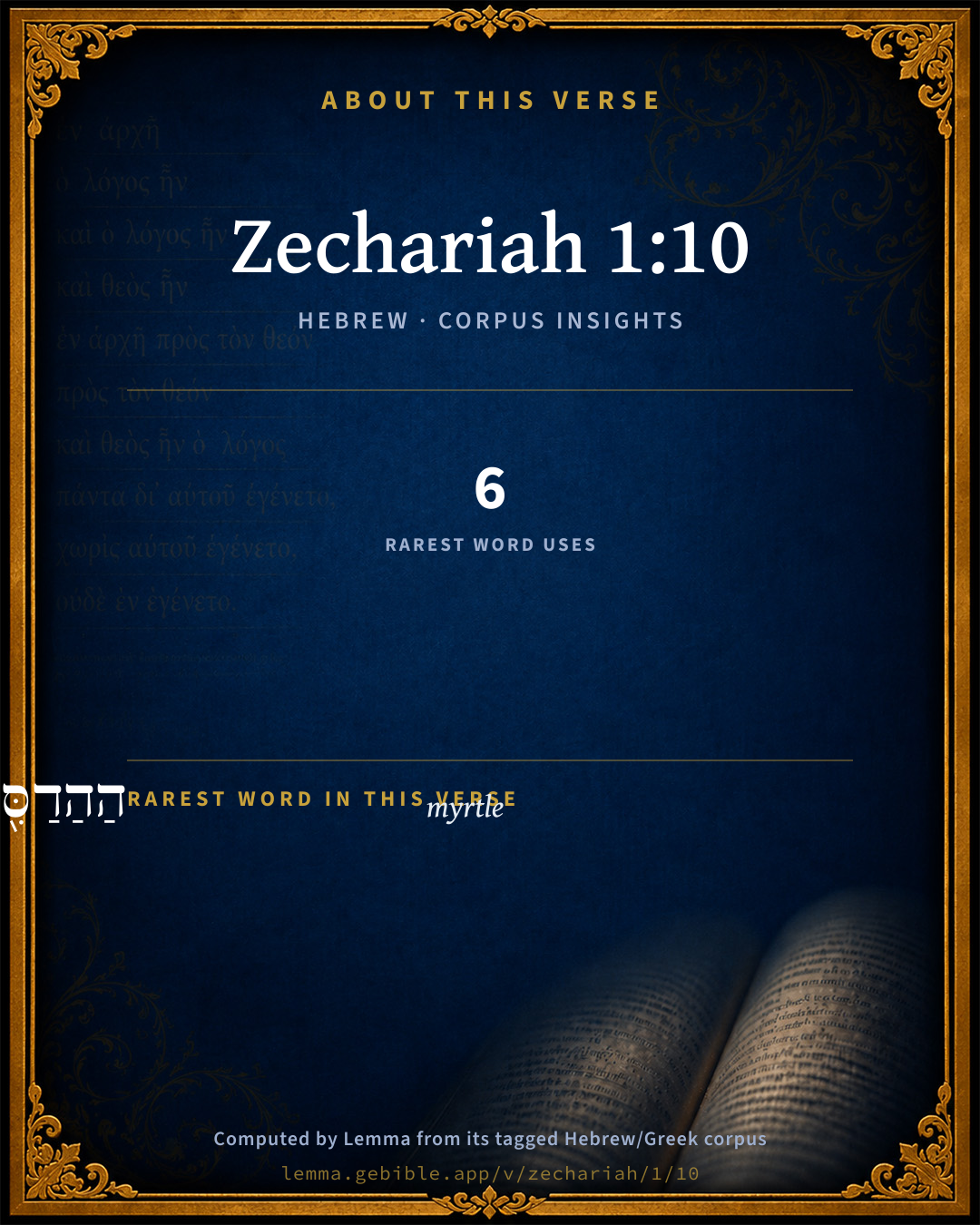
The rarest word here is הַהַדַסִּ֖ים myrtle H1918 — appearing just 6 times in the whole Hebrew Bible.

Shared distinctive vocabulary

הַהַדַסִּ֖ים myrtle H1918 occurs in 6 verses of the Hebrew Bible. Also found in:

Grammatical profile

  • 5 verbs
  • 4 nouns
  • 1 pronoun
  • 1 preposition
  • 1 particle

Verb forms

  • וַיַּ֗עַן Qal · Sequential Imperfect
  • הָעֹמֵ֥ד Qal · Participle Active
  • וַיֹּאמַ֑ר Qal · Sequential Imperfect
  • שָׁלַ֣ח Qal · Perfect
  • לְהִתְהַלֵּ֖ךְ Hithpael · Infinitive Construct

Hebrew & Septuagint length

In English translation the verse runs 24 words from the Hebrew and 27 from the Septuagint (LXX English) — closely comparable.

A rough comparison of the two English renderings, which tokenize alike — not a word-level alignment.

Word counts can differ between the Hebrew and the Greek without any difference in meaning — e.g. the Hebrew direct-object marker אֵת has no separate Greek word, and Greek often adds the article ὁ.

Cross-references

12

Topical passages linked to Zechariah 1:10 in the Treasury of Scripture Knowledge — connected by theme and wording, ordered by reader-vote popularity; previews shown in the World English Bible.

  • Zechariah 1:11 They reported to the angel of Yahweh who stood among the myrtle trees, and said, "We have walked back and forth through the earth, and, behold, all the earth is at rest and in peace."
  • Zechariah 6:5–8 The angel answered me, "These are the four winds of the sky, which go forth from standing before the Lord of all the earth.
  • Hebrews 1:14 Aren't they all ministering spirits, sent out to do service for the sake of those who will inherit salvation?
  • Job 1:7 Yahweh said to Satan, "Where have you come from?" Then Satan answered Yahweh, and said, "From going back and forth in the earth, and from walking up and down in it."
  • Job 2:1–2 Again it happened on the day when the sons of God came to present themselves before Yahweh, that Satan came also among them to present himself before Yahweh.
  • Psalms 103:20–21 Praise Yahweh, you angels of his, Who are mighty in strength, who fulfill his word, Obeying the voice of his word.
  • Zechariah 1:8 "I had a vision in the night, and, behold, a man riding on a red horse, and he stood among the myrtle trees that were in a ravine; and behind him there were red, brown, and white horses.
  • Zechariah 4:10 Indeed, who despises the day of small things? For these seven shall rejoice, and shall see the plumb line in the hand of Zerubbabel. These are the eyes of Yahweh, which run back and forth through the whole earth."
  • Genesis 32:24–31 Jacob was left alone, and wrestled with a man there until the breaking of the day.
  • Ezekiel 1:5–14 Out of the midst of it came the likeness of four living creatures. This was their appearance: they had the likeness of a man.
  • Hosea 12:3–5 In the womb he took his brother by the heel; And in his manhood he had power with God.
  • Zechariah 13:7 "Awake, sword, against my shepherd, And against the man who is close to me," says Yahweh of Hosts. Strike the shepherd, and the sheep will be scattered; And I will turn my hand against the little ones.

Cross-references courtesy of OpenBible.info (CC BY 4.0).

Hebrew and Greek witnesses Masoretic Hebrew ↔ Greek Septuagint

The same verse in the two great witnesses to the Old Testament, shown verse-for-verse.

These are two independent witnesses, not word-aligned to each other, and the Septuagint is shown in lemma (dictionary) form.

Hebrew Zechariah 1:10 Masoretic · Westminster Leningrad Codex

וַיַּ֗עַן הָאִ֛ישׁ הָעֹמֵ֥ד בֵּין הַהַדַסִּ֖ים וַיֹּאמַ֑ר אֵ֚לֶּה אֲשֶׁ֣ר שָׁלַ֣ח יְהוָ֔ה לְהִתְהַלֵּ֖ךְ בָּאָֽרֶץ

The man who stood among the myrtle trees answered, "They are the ones Yahweh has sent to go back and forth through the earth."

World English Bible · Public Domain

Greek LXX Zechariah 1:10 Septuagint · lemma form

καί ἀποκρίνω ὁ ἀνήρ ὁ ἐπιἵστημι ἀνά μέσος ὁ ὄρος καί εἶπον πρός ἐγώ οὗτος εἰμί ὅς ἐκ ἀποστέλλω κύριος ὁ περιὁδεύω ὁ γῆ

And the man that stood between the mountains answered, and said to me, These are they whom the Lord has sent forth to go round the earth.

LXX2012 (modern English Septuagint) · Public Domain

Hebrew: Westminster Leningrad Codex (CC BY 4.0). Greek: Septuagint (public domain); English from LXX2012 (modern English Septuagint) (Public Domain). How the Septuagint differs from the Hebrew →

Targum (Aramaic paraphrase)

1

The Targum is the ancient Jewish Aramaic paraphrase of the Hebrew Scriptures — an interpretive translation, not the Hebrew text itself. Onkelos (literal) and Pseudo-Jonathan (expansive) render the Torah, and Jonathan the Prophets. Coverage is partial: where no permissively-licensed English translation exists for a verse, only the Aramaic is shown. This is verse-level text, not a word-by-word alignment to the Hebrew.

  1. Targum Jonathan Prophets (Joshua–Malachi)
    וַאֲתִיב גַבְרָא דְקָאֵים בֵּין אִילָנֵי הֲדַסַיָא וַאֲמַר אִלֵין דִי שְׁלַח יְיָ לְהַלְכָא בְּאַרְעָא:

    (no public-domain English translation for this verse)

    Targum Jonathan — Aramaic: “Mikraot Gedolot” (public domain). English: “Sefaria Community Translation” (CC0 1.0 (public-domain dedication)); “London "Chaldee Paraphrase," 1871” (public domain). Text via Sefaria.

Commentary

Notes on Zechariah 1:10 from classic Christian and Jewish commentators (each source and its license shown beneath its notes). The classic Christian expositions comment on the surrounding passage and are grouped to its opening verse, so a note may address several verses; the Jewish commentaries on the Tanakh (Rashi and others) are per-verse, so they appear only where the commentator wrote on this verse.

Lemma curates 59 commentaries, every one of them public domain or Creative Commons licensed, each selected and text-cleaned for this edition rather than reprinted as found. About our sources →

Trapp's Complete Commentary

John Trapp

Zec 1:10 And the man that stood among the myrtle trees answered and said, These [are they] whom the LORD hath sent to walk to and fro through the earth.

Ver. 10. And the man that stood among the myrtle trees] The man Christ Jesus, that is ever with the Church, and in the midst of his people, that feedeth among the lilies, and walketh in the midst of the seven golden candlesticks. He, being asked by the foresaid angel, answered him (in Zechariah’s hearing), for he is Palmoni hammedabber, that excellent speaker, as Daniel calleth him, and therefore asketh him of the vision, Dan 8:13.

These are they whom the Lord hath sent] As his εποπται, or overseers and intelligencers. Not that God needeth them, as princes need the counsel and aid of their subjects. The holy angels receive more from God than they perform or bring to him. But he maketh use of their service about us. 1. For the honour of his majesty, and comfort of our infirmity. 2. To make out his love unto us, by employing such noble creatures for our good. 3. To make and maintain love and correspondence between us and angels, till we come to walk arm in arm with angels, as Zec 3:7, and to be like unto them, yea, their equals (ισαγγελοι), Luk 20:36, if not more, Eph 1:23.

John Trapp, A Commentary or Exposition upon All the Books of the Old and New Testament (1647–1656) — public domain. Text from a community e-Sword module.

Tyndale Open Study Notes

Tyndale Open Resources

1:10 Patrol suggests the angelic riders’ ongoing scrutiny of the earth.

Tyndale Open Study Notes — © Tyndale Open Resources, licensed CC BY-SA 4.0. Text via the HelloAO Bible API.

Jamieson, Fausset & Brown

Robert Jamieson, A. R. Fausset & David Brown

answered--The "angel of the covenant" here gives the reply instead of the interpreting angel, to imply that all communications through the interpreting angel come from Him as their source.

Lord hath sent to walk to and fro through the earth--If "Satan walks to and fro in the earth" (implying restless activity) on errands of mischief to God's people (Job 1:7), the Lord sends other angels to "walk to and fro" with unceasing activity everywhere to counterwork Satan's designs, and to defend His people (Psa 34:7; Psa 91:11; Psa 103:20-21; Heb 1:14).

Jamieson, Fausset & Brown — Commentary Critical and Explanatory on the Whole Bible (1871) — public domain (CC PDM 1.0). Text via the HelloAO Bible API.

Adam Clarke's Commentary

Verse 10. The man that stood among the myrtle trees] The angel of the Covenant, as above, Zec 1:11.

Whom the Lord hath sent] Who are constituted guardians of the land.

Adam Clarke's Commentary on the Bible (1810–1826) — public domain. Text from a community e-Sword/MySword module.

Ellicott's Commentary for English Readers

(10) Answered.—The question which Zechariah had put to the angel-interpreter.

The earth—i.e., the world, “all the earth” (Zec_1:11), not merely “the land of Israel,” as is often the meaning of the word (e.g., Zec_13:8).

A Bible Commentary for English Readers, edited by Charles John Ellicott (1878–1897) — public domain. Text from a community e-Sword module.

The Cambridge Bible for Schools and Colleges

gen. ed. J. J. S. Perowne

10. the man] i.e. the rider on the red horse of Zec_1:8, who, in answer it may be to a look or sign from the interpreting angel, takes upon himself to “shew” the prophet “what these be.”

The Cambridge Bible for Schools and Colleges (gen. ed. J. J. S. Perowne; Cambridge University Press, 1878–1918) — public domain. Text from a community e-Sword module.

John Gill's Exposition

And the man that stood among the myrtle trees answered and said,.... And so prevented the angel from giving the account he was about to give; and who was more capable of it, and which to do was great condescension in him, and was doing the prophet a singular honour:

these are they whom the Lord hath sent to walk to and fro through the earth; which is a description of the angels, the ministering spirits sent forth by God to take their tour throughout the earth; not to do mischief, as Satan does; but to do good to kingdoms, nations, and men in general, and to the heirs of salvation in particular; for which they are commissioned and empowered of God; see Heb 1:14.

John Gill's Exposition of the Whole Bible (1746–1763) — public domain (CC PDM 1.0). Text via the HelloAO Bible API.

Albert Barnes' Notes on the Bible

And the man answered - To the question addressed to the attendant-angel. He himself took the word.

These are they whom the Lord sent to walk up and down - Satan says of himself that he came “from going to and fro in the earth and from walking up and down in it” Job 2:2. As he for evil, so these for good. Their office was not a specific or passing duty, as when God sent His angels with some special commission, such as those recorded in Holy Scripture. It was a continuous conversation with the affairs of people, a minute course of visiting, inspecting our human deeds and ways, a part of the “wonderful order” , in which God has “ordained and constituted the services of angels and men.” Nor is it said that the angels were limited, each to his own special province, as we learn through Daniel, that certain great angels, princes among them, had the charge of empires or nations, even of the pagan . These angels had apparently only the office of inspecting and reporting to angels of a higher order, themselves a subordinate order in the heavenly Hierarchy. Nor are they spoken of, as executing any judgments of God, or as pacifying the earth; they may have been so employed; but they are only said to have reported the state in which they found it.

These answered the unexpressed inquiry of the angel of the Lord, as he had answered the unuttered question of the angel, attendant on Zechariah.

Albert Barnes' Notes on the Bible (1834–1885) — public domain. Text from a community e-Sword/MySword module.

Haydock's Catholic Bible Commentary

These are they, &c. The guardian angels of provinces and nations. (Challoner) --- The Jews believed that each nation had such an angel, who had to give an account to one in higher authority. God proportions his revelation to their ideas.

George Leo Haydock (1774–1849), Haydock's Catholic Family Bible and Commentary, 1859 edition — public domain. Excludes Psalms (Douay-Rheims chapter numbering differs from Protestant) and Deuterocanonical books (Catholic canon only).

Matthew Poole's English Annotations

The man that stood among the myrtle trees: see Zec 1:8.

Answered; gave answer to what I asked.

These; horsemen.

They whom the Lord hath sent; a periphrasis of angels, who are servants and ministers of the Divine Providence in the government of the world.

To walk to and fro through the earth: God is pleased after the manner of men to speak of his managing the affairs of the world; men must employ others, because they need them, God will employ angels, though he needs them not.

The earth; the empires which his churches were either helped or injured by: these were, partly by the pride of their emperors, partly by the flattery of their servants and ministers, and partly by the ignorance of the world at that time in matters of geography, thought to be the whole earth; and the Scripture sometimes useth phrases used and well known among men, though there be some impropriety in them.

Matthew Poole's English Annotations on the Holy Bible (1683–1685) — public domain. Text from a community e-Sword/MySword module.

Whedon's Commentary on the Bible

Daniel D. Whedon

10. This explanation is supplied by the further unfolding of the vision. The man among the myrtles (Zec_1:8) is the first to speak.

Answered — The Hebrew verb does not mean necessarily to reply to a question, sometimes it is used in the sense of begin to speak; so here. The words are not intended as a reply to Zechariah; they are addressed to the “angel of Jehovah” (Zec_1:11), to whom the man presents his followers, that they may report the result of their investigations. The prophet, as an interested bystander, could learn the significance of the vision from this report and from the dialogue which took place subsequently between the angel and Jehovah.

These — The men upon the horses of different colors, who are introduced as messengers of Jehovah, commissioned to “walk to and fro through the earth.” Their duty seems to have been purely to find out conditions and report on them; there is no indication that they were to interfere in any way with “terrestrial matters.”

Daniel D. Whedon (gen. ed.), Commentary on the Old and New Testaments (1874–1909) — public domain. Text from a community e-Sword module.

The Pulpit Commentary

The man that stood, etc. The rider upon the red horse of ver. 8, the leader of the company of horsemen. Answered the question which the prophet had proposed, or answered in response to a sign from the interpreting angel. They whom the Lord hath sent, etc. These angelic ministers had been sent to traverse the earth and to report its condition, (comp. Job_1:7 Job_2:2 Heb_1:14) and to guide it to the carrying out of God"s purposes.

The Pulpit Commentary (1880–1919), ed. H.D.M. Spence-Jones & Joseph S. Exell — public domain. Text from a community e-Sword module.

John Wesley's Explanatory Notes

These - Horsemen, are angels, who are ministers of the Divine Providence in the government of the world.

John Wesley, Explanatory Notes Upon the Whole Bible (1754–1765) — public domain. Text via the GEBible commentary corpus.

unfoldingWord translationNotes

Door43 World Missions Community

the man who stood among the myrtle trees ... the angel of Yahweh who stood among the myrtle trees

These phrases refer to the man who "was riding on a red horse" in Zechariah 1:8. Possible meanings are 1) the man dismounted his horse and stood or 2) the word "stood" is an idiom that means he was located in that position. AT: "the man who was among the myrtle trees ... the angel of Yahweh who was among the myrtle trees" (See: Idiom)

These are those ... They answered ... they said

The words "these" and "they" refer to the red, reddish-brown, and white horses that were behind the man who was among the myrtle trees. Possible meanings are 1) it is implicit that there were other men who were riding the horses, and that these phrases refer to the riders or 2) the horses are personified as being able to speak like people. (See: Assumed Knowledge and Implicit Information and Personification)

to roam throughout the earth

It is implicit that Yahweh sent these out to walk about in order to patrol the earth. This does not suggest that they were wandering or lost. (See: Assumed Knowledge and Implicit Information)

all the earth sits still and is at rest

There being peace and quiet in the world is spoken of as if the earth were a person who is still and resting. Possible meanings are 1) this is a good thing that means that there is peace between nations or 2) this is a bad thing that means that there is no war because nations are helpless to fight against a stronger nation that has subdued them. (See: Metaphor)

translationWords

Yahweh

angel

earth

rest

unfoldingWord translationNotes — © Distant Shores Media and the Door43 World Missions Community, licensed CC BY-SA 4.0. Source: git.door43.org/Door43/en_tn.

Rashi

Rabbi Shlomo Yitzchaki (Rashi)

to walk to and fro on the earth To see the tranquility of the nations.

Rashi on the Tanakh — English translations: “The Judaica Press complete Tanach with Rashi, translated by A. J. Rosenberg” (CC BY 4.0); “Pentateuch with Rashi's commentary by M. Rosenbaum and A.M. Silbermann, 1929-1934” (public domain); “The Metsudah Tanach series, Lakewood, N.J” (CC BY 4.0); and “The Book of Joshua, Metsudah Publications, 1997” (CC BY 4.0). Text via Sefaria.

Lesson kit

Teaching starters — assembled from the data on this page, not authored interpretation. Every prompt links to the verse data it draws on. Edit before teaching.

Zechariah, in the Prophets, opens this verse with 12 words (12 distinct Hebrew lemmas). Its most distinctive word is hădaç (“myrtle”). A historical commentator’s framing appears above. Read the whole chapter for the surrounding context.

Discussion questions

  1. What does “myrtle” (hădaç) contribute to the verse as a whole?
  2. How does Nehemiah 8:15, which shares the word «myrtle», read alongside this verse?
  3. The translations on this page render this verse differently — a whole-verse word diff, not a word-by-word alignment. What might account for the different wordings?
  4. «וַיַּ֗עַן» is a Qal Sequential Imperfect verb. How does that grammatical form shape the action described?
  5. Compare how Trapp's Complete Commentary and Tyndale Open Study Notes read this verse. Where do they agree or differ?

Things to notice

Reading settings

Reading text

Shown beneath each verse's original-language words.

Old Testament
Old Testament edition

Read the OT as the Masoretic Hebrew (MT) or the Greek Septuagint (LXX).

English shown for the Greek Septuagint (in the Hebrew ↔ Greek comparison).

Comparing translations? Open the Compare panel on any verse page to stack up to four side by side.