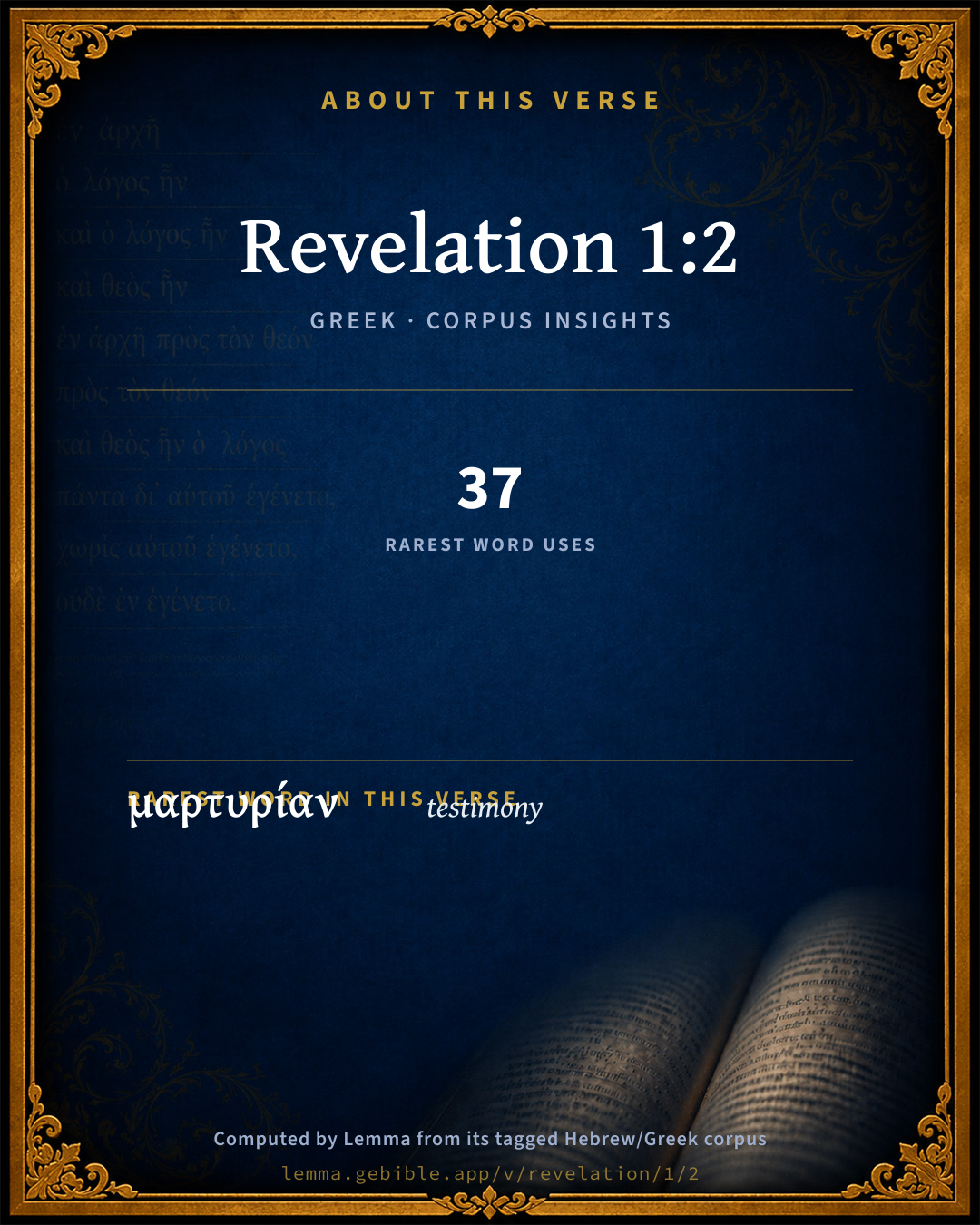
Revelation 1:2

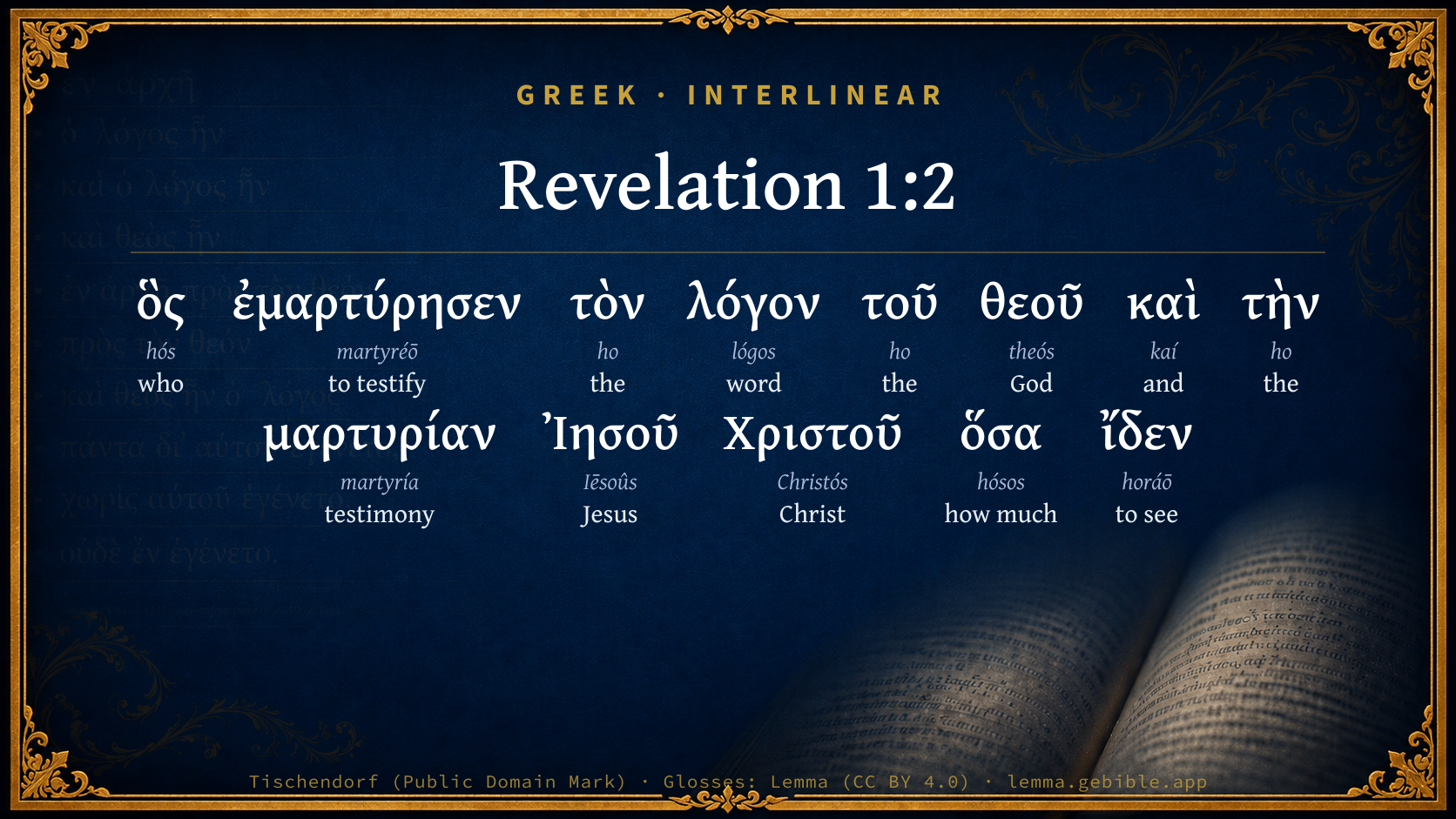
Greek (Tischendorf 8th ed.) Revelation 1:2 appears in the Greek New Testament. The text above is from the Tischendorf 8th edition. Each word links to its Strong’s number and a concise gloss. Click any word for its full Thayer’s Greek Lexicon entry.
Download image
Cite this verse

Revelation 1:2 (World English Bible). Public Domain. Lemma interlinear Bible study tool, https://lemma.gebible.app/v/revelation/1/2.

Show BibTeX & RIS
BibTeX
RIS
English Translation
who testified to God's word, and of the testimony of Jesus Christ, about everything that he saw.
World English Bible · Public Domain
Download a study sheet

One document with this verse’s original text, its word-by-word gloss line, the meaning frame, cross-references with their text, attributed commentary, and full source and license credits — printable, and it pastes into notes with its structure intact.

This verse Autodidact and up

Study sheet (.html) Plain text (.txt)

A passage Seminary Student

Up to 50 verses in one chapter. A passage sheet keeps up to 6 commentary sources and 12 cross-references per verse, in the order this page ranks them, and says so on the sheet whenever that leaves anything out. Ask for a single verse and you get the Autodidact verse sheet above.

Everything on this page stays free to read, with no account — the sheet is a download of what is already on screen, not access to it.

Want to remove ads? Support Godless Engineer
Compare translations 3

The same verse in 3 English versions, stacked beneath the original-language interlinear above. Click any original word for its lexicon entry.

Each is an independent rendering of the whole verse — the interlinear is not word-aligned to these translations.

Highlighted words mark where these versions differ — a whole-verse word diff, not a word-by-word alignment.

  • World English Bible Public Domain
    who testified to God's word, and of the testimony of Jesus Christ, about everything that he saw.
  • King James Version Public Domain
    Who bare record of the word of God, and of the testimony of Jesus Christ, and of all things that he saw.
  • unfoldingWord Literal Text CC BY-SA 4.0
    who attested the word of God and the testimony of Jesus Christ, as much as he saw.

unfoldingWord Literal Text — © unfoldingWord, licensed CC BY-SA 4.0. Word-aligned USFM3 via Door43 (git.door43.org/unfoldingWord/en_ult).

Versions to compare (up to 4)

3 of 4 selected

Show all 19 translations

Every available English version of this verse, each an independent rendering of the whole verse.

  • World English Bible Public Domain
    who testified to God's word, and of the testimony of Jesus Christ, about everything that he saw.
  • Berean Standard Bible Public Domain
    who testifies to everything he saw. This is the word of God and the testimony of Jesus Christ.
  • Majority Standard Bible Public Domain
    who testifies to everything he saw. This is the word of God and the testimony of Jesus Christ.
  • King James Version Public Domain
    Who bare record of the word of God, and of the testimony of Jesus Christ, and of all things that he saw.
  • American Standard Version (1901) Public Domain
    who bare witness of the word of God, and of the testimony of Jesus Christ, `even' of all things that he saw.
  • Revised Version (1885) Public Domain
    who bare witness of the word of God, and of the testimony of Jesus Christ, even of all things that he saw.
  • Geneva Bible (1599) Public Domain
    Who bare record of ye word of God, and of the testimonie of Iesus Christ, and of all things that he saw.
  • Douay-Rheims (1899) Public Domain
    Who hath given testimony to the word of God, and the testimony of Jesus Christ, what things soever he hath seen.
  • Young's Literal Translation Public Domain
    who did testify the word of God, and the testimony of Jesus Christ, as many things also as he did see.
  • Literal Standard Version CC BY-SA 4.0
    who testified [to] the word of God, and the testimony of Jesus Christ, as many things as he also saw.
  • Unlocked Literal Bible CC BY-SA 4.0
    John testified about the word of God and the testimony of Jesus Christ, all the things that he saw.
  • unfoldingWord Literal Text CC BY-SA 4.0
    who attested the word of God and the testimony of Jesus Christ, as much as he saw.
  • Darby Bible Public Domain
    who testified the word of God, and the testimony of Jesus Christ, all things that he saw.
  • World Messianic Bible Public Domain
    who testified to God’s word and of the testimony of Yeshua the Messiah, about everything that he saw.
  • Webster's Bible Public Domain
    Who bore testimony of the word of God, and of the testimony of Jesus Christ, and of all things that he saw.
  • Free Bible Version CC BY-SA 4.0
    who confirmed everything he saw concerning the word of God and the testimony of Jesus Christ.
  • Bible in Basic English Public Domain
    Who gave witness of the word of God, and of the witness of Jesus Christ, even of all the things which he saw.
  • Text-Critical English NT CC BY 4.0
    who testified to the word of God and the testimony of Jesus Christ, even to all that he saw.
  • Tyndale New Testament (1534) Public Domain
    which bare recorde of the worde of god and of the testimony of Iesus Christe and of all thinges that he sawe.

Literal Standard Version (2020), Covenant Press — licensed CC BY-SA 4.0. Text via the HelloAO Bible API (eBible.org). Unlocked Literal Bible (unfoldingWord) — licensed CC BY-SA 4.0. Text via the HelloAO Bible API (eBible.org). unfoldingWord Literal Text — © unfoldingWord, licensed CC BY-SA 4.0. Word-aligned USFM3 via Door43 (git.door43.org/unfoldingWord/en_ult). Free Bible Version, Dr. Jonathan Gallagher — licensed CC BY-SA 4.0. Text via the HelloAO Bible API (eBible.org).

Word by word

More ways to search: Search by grammar → Find every occurrence → Compare this word →

Practice this passage: Drill this verse → Learn its vocabulary →

μαρτυρίαν
martyría
G3141
“testimony”
Noun, Accusative, Singular, Feminine
Part of Speech
Noun
Case
Accusative
Number
Singular
Gender
Feminine
Full Thayer's Definition

Origin: from G3144

TDNT: 11:54,6

1. a testifying a. the office committed to the prophets of testifying concerning future events 2. what one testifies, testimony, i.e. before a judge
  1. ὃς hós G3739 “who” Relative pronoun, Nominative, Singular, Masculine
  2. ἐμαρτύρησεν martyréō G3140 “to testify” Verb, Aorist, Active, Indicative, 3rd person, Singular
  3. τὸν ho G3588 “the” Article, Accusative, Singular, Masculine
  4. λόγον lógos G3056 “word” Noun, Accusative, Singular, Masculine
  5. τοῦ ho G3588 “the” Article, Genitive, Singular, Masculine
  6. θεοῦ theós G2316 “God” Noun, Genitive, Singular, Masculine
  7. καὶ kaí G2532 “and” Conjunction
  8. τὴν ho G3588 “the” Article, Accusative, Singular, Feminine
  9. Ἰησοῦ Iēsoûs G2424 “Jesus” Noun, Genitive, Singular, Masculine
  10. Χριστοῦ Christós G5547 “Christ” Noun, Genitive, Singular, Masculine
  11. ὅσα hósos G3745 “how much” Correlative pronoun, Accusative, Plural, Neuter
  12. ἴδεν horáō G3708 “to see” Verb, Aorist, Active, Indicative, 3rd person, Singular

About this verse

These counts appear in no published source. They are computed here, from the morphology-tagged text and Lemma’s own curated glosses. What Lemma adds →

13
words
11
distinct lemmas
Revelation
section

Shared distinctive vocabulary

μαρτυρίαν testimony G3141 occurs in 33 verses of the Greek New Testament. Also found in:

Repetition

A word recurs within this verse:

Cross-references

19

Topical passages linked to Revelation 1:2 in the Treasury of Scripture Knowledge — connected by theme and wording, ordered by reader-vote popularity; previews shown in the World English Bible.

  • John 19:35 He who has seen has testified, and his testimony is true. He knows that he tells the truth, that you may believe.
  • 1 Corinthians 1:6 even as the testimony of Christ was confirmed in you:
  • John 21:24 This is the disciple who testifies about these things, and wrote these things. We know that his witness is true.
  • 1 John 1:1 That which was from the beginning, that which we have heard, that which we have seen with our eyes, that which we saw, and our hands touched, concerning the Word of life
  • Revelation 1:19 Write therefore the things which you have seen, and the things which are, and the things which will happen hereafter;
  • Revelation 1:9 I John, your brother and partner with you in oppression, Kingdom, and perseverance in Christ Jesus, was on the isle that is called Patmos because of God's Word and the testimony of Jesus Christ.
  • Revelation 12:17 The dragon grew angry with the woman, and went away to make war with the rest of her seed, who keep God's commandments and hold Jesus' testimony.
  • Acts 26:16 But arise, and stand on your feet, for I have appeared to you for this purpose: to appoint you a servant and a witness both of the things which you have seen, and of the things which I will reveal to you;
  • Revelation 6:9 When he opened the fifth seal, I saw underneath the altar the souls of those who had been killed for the Word of God, and for the testimony of the Lamb which they had.
  • John 12:17 The multitude therefore that was with him when he called Lazarus out of the tomb, and raised him from the dead, was testifying about it.
  • Acts 4:20 for we can't help telling the things which we saw and heard."
  • 1 Corinthians 2:1 When I came to you, brothers, I didn't come with excellence of speech or of wisdom, proclaiming to you the testimony of God.
  • 1 John 4:14 We have seen and testify that the Father has sent the Son as the Savior of the world.
  • 1 John 5:7–11 For there are three who testify:
  • John 1:32 John testified, saying, "I have seen the Spirit descending like a dove out of heaven, and it remained on him.
  • John 3:11 Most assuredly I tell you, we speak that which we know, and testify of that which we have seen, and you don't receive our witness.
  • Acts 22:15 For you will be a witness for him to all men of what you have seen and heard.
  • Revelation 12:11 They overcame him because of the Lamb's blood, and because of the word of their testimony. They didn't love their life, even to death.
  • 3 John 1:12 Demetrius has the testimony of all, and of the truth itself; yes, we also testify, and you know that our testimony is true.

Cross-references courtesy of OpenBible.info (CC BY 4.0).

Commentary

Notes on Revelation 1:2 from classic Christian and Jewish commentators (each source and its license shown beneath its notes). The classic Christian expositions comment on the surrounding passage and are grouped to its opening verse, so a note may address several verses; the Jewish commentaries on the Tanakh (Rashi and others) are per-verse, so they appear only where the commentator wrote on this verse.

Lemma curates 59 commentaries, every one of them public domain or Creative Commons licensed, each selected and text-cleaned for this edition rather than reprinted as found. About our sources →

Albert Barnes' Notes on the Bible

Who bare record of the word of God - Who bore witness to, or testified of ἐμαρτύρησεν emarturēsen the Word of God. He regarded himself merely as a “witness” of what he had seen, and claimed only to make a fair and faithful “record” of it. “This is the disciple which “testifieth” (ὁ μαρτυρῶν ho marturōn) of these things, and wrote these things,” Joh 21:24. “And he that saw it bare record” - μεμαρτύρηκε memarturēke Joh 19:35. Compare also the following places, where the apostle uses the same word of himself: 1Jo 1:2; 1Jo 4:14. The expression here, “the word of God,” is one the meaning of which has been much controverted, and is important in its bearing on the question who was the author of the Book of Revelation. The main inquiry is, whether the writer refers to the “testimony” which he bears in this book respecting the “word of God”; or whether he refers to some testimony on that subject in some other book with which those to whom he wrote were so familiar that they would at once recognize him as the author; or whether he refers to the fact that he had borne his testimony to the great truths of religion, and especially respecting Jesus Christ, as a preacher who was well known, and who would be characterized by this expression.

The phrase “the word of God” - τὸν λόγον τοῦ Θεοῦ ton logon tou Theou - occurs frequently in the New Testament (compare Joh 10:35; Act 4:31; Act 6:2, Act 6:7; Act 11:1; Act 12:24); and may either mean the Word or doctrine respecting God - that which teaches what God is - or what he speaks or teaches. It is more commonly used in the latter sense (compare the passages referred to above), and especially refers to what God speaks or commands in the gospel. The fair meaning of this expression would be, that John had borne faithful witness to, or testimony of, the truth which God had spoken to man in the gospel of Christ. So far as the “language” used here is concerned, this might apply either to a written or an oral testimony; either to a treatise like that of his gospel, to his preaching, or to the record which he was then making. Vitringa and others suppose that the reference here is to the gospel which he had published, and which now bears his name; Lucke and others, to the revelation made to him in Patmos, the record of which he now makes in this book; Prof. Stuart and others, to the fact that he was a teacher or preacher of the gospel, and that (compare Rev 1:9) the allusion is to the testimony which he had borne to the gospel, and for which he was an exile in Patmos. Is it not possible that these conflicting opinions may be to some extent harmonized, by supposing that in the use of the aorist tense - ἐμαρτύρησε emarturēse - the writer meant to refer to a characteristic of himself, to wit, that he was a faithful witness of the Word of God and of Jesus Christ whenever and however made known to him?

With an eye, perhaps, to the record which he was about to make in this book, and intending to include that may he not also refer to what had been and was his well-known character as a witness of what God communicated to him? He had always borne this testimony. He always regarded himself as such a witness. He had been an eyewitness of what had occurred in the life and at the death of the Saviour (see the notes on 2Pe 1:17-18), and had, in all his writings and public administrations, horne witness to what he had seen and heard; for that Rev 1:9 he had been banished to Patmos: and he was now about to carry out the same characteristic of himself by bearing witness to what he saw in these new revelations. This would be much in the manner of John, who often refers to this characteristic of himself (compare Joh 19:35; Joh 21:24; 1Jo 1:2), as well as harmonize the different opinions. The meaning, then, of the expression, “who bare record of the word of God,” as I understand it, is, that it was a characteristic of the writer to bear simple but faithful testimony to the truth which God communicated to people in the gospel. If this be the correct interpretation, it may be remarked:

(a)That this is such language as John the apostle would be likely to use, and yet

(b)That it is not such language as an author would be likely to adopt if there was an attempt to forge a book in his name.

The artifice would be too refined to occur probably to anyone, for although perfectly natural for John, it would not be so natural for a forger of a book to select this circumstance and weave it thus unostentatiously into his narrative.

And of the testimony of Jesus Christ - That is, in accordance with the interpretation above, of the testimony “which Jesus Christ bore for the truth”; not of a testimony “respecting” Jesus Christ. The idea is, that Jesus Christ was himself “a witness” to the truth, and that the writer of this book was a witness merely of the testimony which Christ had borne. Whether the testimony of Jesus Christ was borne in his preaching when in the flesh, or whether made known to the writer by him at any subsequent period, it was his office to make a faithful record of that testimony. As he had always before done that, so he was about to do it now in the new revelation made to him in Patmos, which he regarded as a new testimony of Jesus Christ to the truth, Rev 1:1. It is remarkable that, in confirmation of this view, John so often describes the Lord Jesus as a witness, or represents him as having come to hear his faithful testimony to the truth. Thus, in Rev 1:5; “And from Jesus Christ, who is the faithful and true witness.” “I am one that bear witness - ὁ μαρτυρῶν ho marturōn - of myself,” Joh 8:18. “To this end was I born, and for this cause came I into the world, that I should bear witness - ἵνα μαρτυρήσω hina marturēsō - to the truth,” Joh 18:37. “These things saith the Amen, the faithful and true witness” - ὁ μάρτυς ὁ πιστὸς ho martus ho pistos, ... Rev 3:14. Of this testimony which the Lord Jesus came to bring to man respecting eternal realities, the writer of this book says that he regarded himself as a witness. To the office of bearing such testimony he had been dedicated; that testimony he was now to bear, as he had always done.

And of all things that he saw - Ὅσα τε εἰδεν Hosa te eiden. This is the common reading in the Greek, and according to this reading it would properly mean, “and whatsoever he saw”; that is, it would imply that he bore witness to “the Word of God,” and to “the testimony of Jesus Christ,” and to “whatever he saw” - meaning that the things which he saw, and to which he refers, were things additional to those to which he had referred by “the Word of God,” and the “testimony of Christ.” From this it has been supposed that in the former part of the verse he refers to some testimony which he had formerly borne, as in his gospel or in his preaching, and that here he refers to what he “saw” in the visions of the Revelation as additional to the former. But it should be remembered that the word rendered “and” - τε te - is missing in a large number of manuscripts (see Wetstein), and that it is now omitted in the best editions of the Greek Testament - as by Griesbach, Tittmann and Hahn. The evidence is clear that it should be omitted; and if so omitted, the reference is to whatever he had at any time borne his testimony to, and not particularly to what passed before him in the visions of this book.

It is a general affirmation that he had always borne a faithful testimony to whatever he had seen respecting the Word of God and the testimony of Christ. The correct rendering of the whole passage then would be, “And sending by his angel, he signifies it to his servant John, who bare record of” (that is, whose character and office it was to bear his testimony to) “the word of God” (the message which God has sent to me), “and the testimony of Jesus Christ” (the testimony which Christ bore to the truth), “whatsoever he saw.” He concealed nothing; he held nothing back; he made it known precisely as it was seen by him. Thus interpreted, the passage refers to what was a general characteristic of the writer, and is designed to embrace all that was made known to him, and to affirm that he was a faithful witness to it. There were doubtless special reasons why John was employed as the medium through which this communication was to be made to the church and the world. Among these reasons may have been the following:

That he was the “beloved disciple.” That he was the only surviving apostle. That his character was such that his statements would be readily received. Compare Joh 19:35; Joh 21:24; 3Jo 1:12. It may be that his mind was better suited to be the medium of these communications than that of any other of the apostles - even if they had been then alive.

There is almost no one whose mental characteristics are less correctly understood than those of the apostle John. Among the most gentle and amiable of people; with a heart so suited for love as to be known as “the beloved disciple” - he yet had mental characteristics which made it proper that he should be called “a son of thunder” Mar 3:17; a mind suited to preserve and record the profound thoughts in his gospel; a mind of high poetic order, suited for the magnificent conceptions in this book.

Albert Barnes' Notes on the Bible (1834–1885) — public domain. Text from a community e-Sword/MySword module.

Matthew Poole's English Annotations

Who bare record of the word of God: this phrase determines the controversy about the penman of this part of holy writ, and puts it out of doubt that it was John the apostle and evangelist; the phrase so agrees to Joh 1:19,32,34; 19:35. The word in the Greek signifies, bare testimony to, or of, the word of God. Some understand Christ, so called, 1Jo 1:2. Some would have the gospel meant by it; and if any think this the more probable sense, because, though Christ be elsewhere called the Word, yet he is not called the word of God; and it is not here in the dative, but the accusative case; I see no reason to contradict them.

And of the testimony of Jesus Christ: by the testimony of Christ is to be understood the doctrine of Christ, called so, because it is a testimony concerning him; or rather, that which he testified, who is elsewhere called the true and faithful witness.

And of all things that he saw: this may be understood with reference to what went before; so it agreeth with 1Jo 1:1-10; or to what followeth in this Revelation, made to him in visions in a great measure.

Matthew Poole's English Annotations on the Holy Bible (1683–1685) — public domain. Text from a community e-Sword/MySword module.

Joseph Benson's Commentary

Rev 1:2-3. Who bare record of, or testified, the word of God — That is, who, being honoured with so important a message, did not fail faithfully to declare it; and the testimony of Jesus — That which Jesus, as the faithful and true Witness, appointed to be declared; and all things that he saw — Was made acquainted with in such a manner as was attended with the fullest and most satisfactory evidences of their truth and importance. Blessed — Μακαριος, happy; is he that readeth — Some have miserably handled this book. Hence others are afraid to touch it. And while they desire to know all things else, reject only the knowledge of those which God hath shown. They inquire after any thing rather than this; as if it were written, Happy is he that doth not read this prophecy. Nay, but happy is he that readeth, and they that hear and keep the words thereof — Especially at this time, when so considerable a part of them is on the point of being fulfilled. Nor are helps wanting, whereby any sincere and diligent inquirer may understand what he reads therein. The book itself is written in the most accurate manner possible; it distinguishes the several things whereof he treats by seven epistles, seven seals, seven trumpets, seven vials, each of which sevens is divided into four and three. Many things the book itself explains, as the seven stars, the seven candlesticks, the lamb, his seven horns and seven eyes, the incense, the dragon, the heads and horns of the beasts, the fine linen, the testimony of Jesus. And much light arises from comparing it with the ancient prophecies, and the predictions in the other books of the New Testament. In this book our Lord has comprised what was wanting in those prophecies, touching the time which followed his ascension, and the end of the Jewish polity. Accordingly, it reaches from the Old Jerusalem to the New, reducing all things into one sum in the exactest order, and with a near resemblance to the ancient prophets. The introduction and conclusion agree with Daniel; the description of the man-child, and the promises to Sion, with Isaiah; the judgment of Babylon, with Jeremiah; again, the determination of times, with Daniel; the architecture of the holy city, with Ezekiel; the emblems of the horses, candlesticks, &c., with Zechariah. Many things, largely described by the prophets, are here summarily repeated, and frequently in the same words. To them we may, then, usefully have recourse. Yet the Revelation suffices for the explaining itself, even if we do not yet understand those prophecies; yea, it casts much light upon them. Frequently, likewise, where there is a resemblance between them, there is a difference also; the Revelation, as it were, taking a stock from one of the old prophets, and inserting a new graft into it. Thus Zechariah speaks of two olive-trees; and so does St. John, but with a different meaning. Daniel has a beast with ten horns; so has St. John. And here the difference of words, emblems, things, times, ought studiously to be observed. Our Lord foretold many things before his passion; but not all things, for it was not yet seasonable. Many things, likewise, his Spirit foretold, in the writings of the apostles, so far as the necessities of those times required; now he comprises them all in one short book, therein presupposing all the other prophecies, and at the same time explaining, continuing, and perfecting them in one thread. It is right, therefore, to compare them; but not to measure the fulness of these by the scantiness of those preceding. Christ, when on earth, foretold what would come to pass in a short time; adding a brief description of the last things. Here he foretels the intermediate things; so that both put together constitute one complete chain of prophecy. This book is therefore not only the sum and the key of all the prophecies which preceded, but likewise a supplement to all, the seals being closed before; of consequence, it contains many particulars not revealed in any other part of Scripture. They have, therefore, little gratitude to God for such a Revelation, reserved for the exaltation of Christ, who boldly reject whatever they find here, which was not revealed, or not so clearly, in other parts of Scripture. He that readeth and they that hear — The distinction here made of him that readeth and of them that hear, is remarkable; for books, being then in manuscript, were in few hands, and it was a much easier way to publish a prophecy, or any thing, by public reading, than by transcribing copies. It was also the custom of that age to read all the apostolical writings in the congregations of the faithful. And perhaps John sent this book by a single person into Asia, who read it in the churches, while many heard. But this likewise, in a secondary sense, refers to all that shall duly read or hear it in all ages. The words of this prophecy — It is a revelation with regard to Christ, who gives it; a prophecy with regard to John, who delivers it to the churches. And keep the things which are written therein — In such a manner as the nature of them requires; namely, with repentance, faith, patience, prayer, obedience, watchfulness, constancy. It behooves every Christian, at all opportunities, to read what is written in the oracles of God; and to read this precious book, in particular, frequently, reverently, and attentively. For the time —

Of its beginning to be accomplished; is near — Even when St. John wrote. How much nearer to us is even the full accomplishment of this weighty prophecy!

Joseph Benson's Commentary on the Old and New Testaments (1811–1818) — public domain. Text from a community e-Sword module.

Tyndale Open Study Notes

Tyndale Open Resources

1:2 reported (Greek martureō) . . . testimony (Greek marturia): These closely related Greek words indicate an authentic witness and emphasize that the sacrificial witness of Jesus and the authentic testimony of John are the basis for the revelation.

Tyndale Open Study Notes — © Tyndale Open Resources, licensed CC BY-SA 4.0. Text via the HelloAO Bible API.

Bengel's Gnomon

Johann Albrecht Bengel

Rev 1:2. Ὅσα εἶδε, whatever things he saw) See App. Crit., on this passage, Ed. ii.[4] Ὅσα εἶδε, whatever things he saw), John bare record of, since in this very book he bare record of all things which he saw, and nothing but what he saw. He does not, however, say that he bears record, but that he bare record: because at that time, when the book was read in Asia, he had now completed the writing of it. Lampe ought not, on account of the tense of the verb ἐμαρτύρησε, bare record, to have doubted whether John was the writer of Rev 1:1-3.—Medit. auecd. in Apoc., pp. 255, 257. Comp. Rev 1:9, note. The particle τὲ, which does not belong to this place, has influenced him and other interpreters, who refer the verb bare record to the Gospel and Epistles of John. Moreover, as in the Apocalypse seeing and record (testimony) are commensurate, so are the measure of faith and prophecy (Rom 12:3; Rom 12:6), or, in other words, knowledge and interpretation, in the case of those who rightly handle this book. D. Antonius, in the same college, wisely discusses the Last things, especially from the Apocalypse, in such a manner as at once to check the antiprophetical disease, and the itching for one’s own interpretation of prophecy.

[4] ABC read ὅσα only. Rec. Text adds τε without good authority.—E.

Bengel's Gnomon of the New Testament — English translation (T&T Clark, Edinburgh, 1860) — public domain. Text from a community e-Sword module.

Meyer's Critical & Exegetical Commentary

Heinrich August Wilhelm Meyer

Rev_1:2. What Christ showed the seer, and what the latter beheld (ὅσα εἰδε), that he has testified[504] as a revelation of God through Christ (τ. λογ. τ. θ. κ. τ. μαρ. Ἰης. Χρ.; cf. Rev_1:1) in this book, in order that it may be read and kept.[505] According to the connection borne by the clear correspondence of the individual parts, the entire Rev_1:2 belongs to no other than the present book.[506] But not a few expositors have referred the entire Rev_1:2 to the Gospel of John.[507] Others understand τ. λογ. τ. θ. as referring to the Gospel, and τ. μαρτ. Ἰησ. Χρ. to the Epistles of John; and, finally, the ὅσα (τε) εἷδε to the present revelation.[508] To the former, then, the εἱδε is understood in the sense of 1Jn_1:1, as referring to the immediate eye-witness of the apostle who had seen the miracles, death, resurrection, and ascension of Christ. With this false view of the whole are connected particular errors; viz., that τ. μαρτ. Ἰης. Χρ. is explained as the testimony concerning Christ,[509] or when the correct recognition of the subjective genitive is applied to a special testimony,[510] and τ. λογ. τ. θ. is understood[511] of the hypostatic Logos.[512] The occasion for referring Rev_1:2 not, or not exclusively, to the present book, lies in the aor. ἐμαρτυρ. and the false reading ὄσα τε εἰδε. So formerly by Ewald: who professed the Christian religion, and declared the visions which he saw. He must thus regard the ἐμαρτ. repeated by a species of zeugma, in order to be able to refer the ὅσα (τε) εἷδε, according to Rev_1:19, to the present revelation; while he must interpret the preceding words, as he cannot properly refer to the Fourth Evangelist,[513] in an entirely general sense. But the connection between Rev_1:1-3, is decisive against Ebrard, while the aor. ἐμαρτυρ. is very easily explained by the fact that John pictures his readers[514] to himself.[515] Besides, that the revelation of Jesus Christ[516] belongs to the Christians who are to hear it,[517] is necessary, from the fact that John by his testimony[518] brings it to them; this occurs in the present book,[519] whose contents he therefore charges them to hear and keep. Against Ebrard and Klief, who acknowledge the correct reading, ὅσα εἶδε, testimony is given especially by the indubitable significance of the expression in Rev_1:19, and all other passages in which John designates his reception of the vision of the revelation by εἶδον. But if the ὅσα εἶδε belongs to the visions here described, and yet cannot designate the position of the writer as an apostolic eye-and-ear witness,[520] and if the τε is false, then these words must form a suitable apposition to τ. λογ. τ. θ. κ. τ. μαρτ. Ἰησ. Χρ. These two expressions are, however, perfectly clear already from Rev_1:1. The entire revelation, as here published in writing[521] in various λόγοι τ. προφ.,[522] is a λόγος τ. θεοῦ, because it was originally given by God;[523] it is further a μαρτυρία Ἰησ. Χρ., since Christ, the faithful witness,[524] shows it.[525] Discrepant with this is Ewald, ii.: The testimony of Jesus Christ to the truth of this word. The ἐμαρτύρησε, according to its meaning, finally can be said as well of the Prophet John[526] as of the angel,[527] who in like manner interprets to the gazing prophet the revelation made in the visions, as the latter interprets it to Christians.[528] Even to Christ, as the communicator of the revelation, is the μαρτυρεῖν to be ascribed.

[504] In writing, Rev_1:3.

[505] Rev_1:3.

[506] So Andr., Areth., C. a Lap., Beza, Beng., Züll., Bleek (Beitr., p. 192), Hofmann (Weiss, u. Erf., ii. 308), De Wette, Lücke (Einl., p. 510 sqq.), Stern, Ewald, ii.

[507] Ambrosiast., Beda, Nic. de Lyra, Aretius, Grot., Wolf., Eichh., Ebrard (who at the same time refers to the apostolic activity of John in other respects), Klief.

[508] Coccej., Vitr. Cf., besides, Hengstb.

[509] N. de Lyra.

[510] Joh_18:37. Oeder in Wolf.

[511] Ribera, Ebrard.

[512] Cf. Rev_19:13.

[513] Who did not blush to publicly confess and defend the Christian religion.

[514] Cf. Rev_1:3.

[515] Because, when the book was read in Asia, he already had written it (Beng.).

[516] Rev_1:1.

[517] Rev_1:3.

[518] Rev_1:2. Cf. Rev_1:11.

[519] Rev_1:3.

[520] Act_1:21 sqq. Klief.

[521] Cf. Rev_21:5, Rev_22:10.

[522] Rev_1:3; Rev_22:18.

[523] Cf. Rev_22:6.

[524] Rev_1:5. Cf. Rev_22:20.

[525] Rev_1:1.

[526] Against Ebrard.

[527] Rev_22:16.

[528] Cf. Rev_19:10.

Meyer — Critical and Exegetical Commentary on the New Testament — English translation by Peter Christie, edited by Frederick Crombie (T&T Clark, 1880) — public domain. Text from a community e-Sword module.

Expositor's Greek Testament

ed. W. Robertson Nicoll

Rev 1:2 . ἐμαρτ . (epistol. aor., cf. Phm 1:19 , cf. further Thuc. i. 1 ξυνέγραψε ). λόγ . τ . θ ., like דבר יהוה (LXX λόγος τοῦ θεοῦ , e.g. , Jer 1:2 ), a collective term for God’s disclosures to men ( τοὺς λόγους , 3), or as here for some specific revelation more exactly defined in ὅσα εἶδεν , all that was seen or even heard (Amo 1:1 ) in visions being described by this generic term. The double expression the word of God and the testimony borne by Jesus Christ (Rev 22:16 ; Rev 22:20 ; cf. Rev 19:10 ) is an amplified phrase for the gospel. The subject upon which Jesus assures men of truth is the revelation of God’s mind and heart, and the gospel is that utterance of God that expression of His purpose which Jesus unfolds and attests. The book itself is the record of John’s evidence; he testifies to Christ, and Christ testifies of the future as a divine plan. For the revelation of God, in the specific form of prophecy, requires a further medium between Jesus and the ordinary Christian; hence the role of the prophets. On the prophetic commission to write, cf. Asc. Isa. i. 4 5 and i. 2, παρέδωκεν αὐτῷ τοὺς λόγους τῆς προφητείας οὓς αὐτὸς εἶδεν , κ . τ . λ . The primitive sense of μαρτ . (= oral confession and proclamation of Jesus by his adherents) thus expands into a literary sense (as here) and into the more sombre meaning of martyrdom (Rev 2:13 , Joh 18:37-39 ; Joh 19:19 ; cf. Lightfoot on Clem. Rom. v.). It is significant that the λόγος τ . θ . of Judaism was not adequate to the Christian consciousness without the μαρτυρία Ἰησοῦ .

The Expositor's Greek Testament, edited by W. Robertson Nicoll (1897–1910) — public domain. Text from a community e-Sword module.

Jamieson, Fausset & Brown

Robert Jamieson, A. R. Fausset & David Brown

bare record of--"testified the word of God" in this book. Where we would say "testifies," the ancients in epistolary communications use the past tense. The word of God constitutes his testimony; Rev 1:3, "the words of this prophecy."

the testimony of Jesus--"the Spirit of prophecy" (Rev 19:10).

and of all things that, &c.--The oldest manuscripts omit "and." Translate, "whatsoever things he saw," in apposition with "the word of God and the testimony of Jesus Christ."

Jamieson, Fausset & Brown — Commentary Critical and Explanatory on the Whole Bible (1871) — public domain (CC PDM 1.0). Text via the HelloAO Bible API.

Adam Clarke's Commentary

Verse 2. Who bare record of the word of God] Is there a reference here to the first chapter of John's gospel, In the beginning was the Word, and the Word was with God, &c.? Of this Word John did bear record. Or, does the writer mean the fidelity with which he noted and related the word-doctrines or prophecies, which he received at this time by revelation from God? This seems more consistent with the latter part of the verse.

Adam Clarke's Commentary on the Bible (1810–1826) — public domain. Text from a community e-Sword/MySword module.

Ellicott's Commentary for English Readers

(2) Who bare record.—Elsewhere as well as here. And he tells us of what he bore record—of the Word of God. The writer declares that the substance of his testimony and witness had been this Word of God. We have here an indication of what the general character of his teaching had been. It evidently had been a teaching laying stress on that aspect of truth which is so forcibly set before us in the Fourth Gospel and the Epistles bearing the name of John. (Comp. Rev_19:11; Joh_1:1; Joh_1:14; 1Jn_1:1, et al. Note also that the words “record,” “testimony,” “witness,” found in this verse, recur in the Gospel and Epistles. Comp. Joh_5:31-40; Joh_19:35; Joh_21:24.)

A Bible Commentary for English Readers, edited by Charles John Ellicott (1878–1897) — public domain. Text from a community e-Sword module.

The Cambridge Bible for Schools and Colleges

gen. ed. J. J. S. Perowne

2. who bare record] i.e. who bears witness in the present work. The past tense is used, as constantly in Greek—e.g. in St John’s own Epistle, I. Rev_2:14—of the act of a writer which will be past when his work comes to be read. The “witness” John is said to bear is that contained in this Book—not, as some have imagined, in his Gospel.

There is, however, some evidence to the identity of authorship of the two, in the resemblance between the attestations to the authority of this Book in these three verses, and to that of the Gospel in Rev_21:24. The two may be presumed to proceed from the same persons, probably the elders of the Church of Ephesus.

the word of God] His word made known to man, especially as revealed to St John himself; not the personal Word of God of St John’s Gospel Rev_1:1 and Rev_19:13, as He is immediately mentioned under another name.

the testimony of Jesus Christ] See Rev_22:16 for a similar description of the special Revelation of this book. Both ‘the word’ and ‘the testimony’ are repeated in Rev_1:9 where they refer to the general Revelation of Christian truth for which the Seer was in exile.

The Cambridge Bible for Schools and Colleges (gen. ed. J. J. S. Perowne; Cambridge University Press, 1878–1918) — public domain. Text from a community e-Sword module.

John Gill's Exposition

Who bore record of the word of God,.... Of the essential and eternal Word of God, his only begotten Son; as John the apostle did in his Gospel, and in his epistles, and also in this book; and which is a clear evidence of his being the writer of it,

And of the testimony of Jesus Christ; that is, the Gospel, which testifies of the person of Christ, of the truth of his divinity, and reality of his human nature; of the union of the two natures, divine and human, his person: of his several offices, of prophet, priest and King; of what he did and suffered for his people; and of the blessings of grace which they receive by him:

and of all things that he saw; with his bodily eyes, as the human body of Christ, the miracles he wrought in it, the transfiguration of it on the mount, the crucifixion of it, and the piercing of it with a spear, and the resurrection of it from the dead; and also the visions recorded in this book; and such a faithful witness serves greatly to confirm the authority of this book, and to recommend the perusal of it. The Complutensian edition and the Arabic version read, "which are, and which shall", or "must be hereafter", as in Rev 1:19.

John Gill's Exposition of the Whole Bible (1746–1763) — public domain (CC PDM 1.0). Text via the HelloAO Bible API.

Trapp's Complete Commentary

John Trapp

2 Who bare record of the word of God, and of the testimony of Jesus Christ, and of all things that he saw.

Ver. 2. Who bare record of the word] This John the divine, then, was John the Evangelist, whatever Dennis of Alexandria dispute to the contrary. It was Moses’s honour (saith one), who was God’s peculiar favourite, to be penman of the first book of the Old Testament; and it was John’s honour, Christ’s peculiar favourite, to be the penman of the last book of the New Testament.

John Trapp, A Commentary or Exposition upon All the Books of the Old and New Testament (1647–1656) — public domain. Text from a community e-Sword module.

Whedon's Commentary on the Bible

Daniel D. Whedon

2. Bare record—An obsolete phrase used elsewhere in translating John for testified.

Word of God… testimony of Jesus—The Apocalypse (as affirmed by the first words of Rev_1:1) comes first from God as his revealing word; it is then the testimony of Christ, as to the character and final results (eschatology) of his Messianic age.

All things—Literally, whatsoever things.

Saw—The unveiling and exhibition of the predictive moving panorama was what John saw. And hence repeatedly verbs of seeing are used in regard to it both by John and the earliest Christian writers.

Daniel D. Whedon (gen. ed.), Commentary on the Old and New Testaments (1874–1909) — public domain. Text from a community e-Sword module.

The Pulpit Commentary

Who bare record. "To bear witness" (marturein) and "witness," or "testimony" (marturia), are characteristic of St. John"s writings, and serve to connect together his Gospel, the First Epistle, and the Apocalypse. Such words should be carefully noted, and, so far as possible, uniformly translated, in order to mark their frequency in the English Version. The Authorized Version rings the changes on "bear witness," "bear record," "give record," and "testify," for marturein ; and on "witness," "record," and "testimony," for marturia . The Revised Version has here made great improvements. To bear witness to the truth and the Word of God was St. John"s special function throughout his long life, and to this fact he calls attention in all his chief writings. (see Haupt on 1Jn_5:6) The testimony of Jesus Christ, like "the Revelation of Jesus Christ" (ver. 1), means that which he gave, not that which tells about him. And of all things that he saw; better, as in the Revised Version, even of all things that he saw, taking dsa eiden in apposition with what precedes. The seer is here speaking of the visions of the Apocalypse, not of the events in Christ"s life. The aorists, emarturhsen and eiden , are rightly compared to the sunegraqe of Thucydides (1:1; 6:7, 93).

The Pulpit Commentary (1880–1919), ed. H.D.M. Spence-Jones & Joseph S. Exell — public domain. Text from a community e-Sword module.

John Wesley's Explanatory Notes

Who hath testified - In the following book. The word of God - Given directly by God. And the testimony of Jesus - Which he hath left us, as the faithful and true witness. Whatsoever things he saw - In such a manner as was a full confirmation of the divine original of this book.

John Wesley, Explanatory Notes Upon the Whole Bible (1754–1765) — public domain. Text via the GEBible commentary corpus.

The People's New Testament

B. W. Johnson

2. Who bare record. John is meant, who made the record of all he saw and heard.

B. W. Johnson's The People's New Testament with Notes (1889–1891) — public domain. Electronic text from the Christian Classics Ethereal Library (CCEL) ThML edition.

Cambridge Greek Testament for Schools and Colleges

2. ὂς ἐμαρτύρησεν, i.e. who bears witness in the piesent work. The past tense is used, as constantly in Greek—e.g. in St John’s own Epistle, I. Rev 2:14—of the act of a writer which will be past when his work comes to be read. The “witness “John is said to bear is that contained in this book—not, as some have imagined, in his Gospel.

There is, however, some evidence to the identity of authorship of the two, in the resemblance between the attestations to the authority of this book in these three verses, and to that of the Gospel in Rev 21:24. The two may be conceivably presumed to proceed from the same persons, probably the elders of the Church of Ephesus.

τὸν λόγον τοῦ θεοῦ. His Word made known to man, especially as revealed to St John himself; not the personal Word of God of St John’s Gospel Rev 1:1 and Rev 19:13, as He is immediately mentioned under another name.

τὴν μαρτυρίαν Ἰησοῦ Χριστοῦ. See Rev 22:16 for a similar description of the special Revelation of this book. Both “the Word “and “the testimony “are repeated in Rev 1:9, and here they refer to the general Revelation of Christian truth for which the Seer was in exile.

ὅσα εἶδεν. These words exclude two possible senses of ἐμαρτύρησεν, that the writer bare witness by writing a gospel, or by suffering for the truth: possibly also they imply a limitation of what goes before, as if all “the Word” and “the testimony” were too great to be told, and the Seer had done what was possible in recording all he saw.

Cambridge Greek Testament for Schools and Colleges (Cambridge University Press, 1896; 21 vols, various authors incl. Carr, Maclear, Plummer, Farrar, Lumby, Moule, M. R. James, Simcox) — public domain. Text from a community e-Sword module.

Alford’s Greek Testament

Henry Alford

2.] who testified of the word of God and the testimony of Jesus Christ, whatsoever things he saw (these words must, in all fairness of construction, be referred to this present book, and not, as by some of the older Expositors, and recently by Ebrard, to the Gospel of St. John. The reasons given by Ebrard for such reference will not hold. He objects to ἐμαρτύρησεν being taken of this book, that such a use of the aor. would be peculiar to the Epistolary style, whereas this book, though containing Epistles, is not itself an Epistle. Even were the usage thus confined, it might be answered from verse 4, that the whole is in an Epistolary form. But the usage is not thus confined, as every scholar knows. Witness Thucyd. i. 1, Θουκυδίδης Ἀθηναῖος ξυνέγραψε τὸν πόλεμον κ.τ.λ. Again, Ebrard objects that the sense thus obtained would be a strange one: “God gave the Revelation to Christ; He signified it by His angel to John, which last hereby makes it known.” But I own I am unable to see any strangeness in it. It seems to me the obvious way in which a faithful account of this Revelation would be prefaced by its Writer. On the other side, the objections to Ebrard’s reference are to me insuperable. First, as to its introduction with the simple relative ὅς. We may safely say that had any previous writing or act been intended, we should have had ὃς καί, or in St. John’s simple style, even more than this, ὃς καὶ τὸ πρότερον, or ὃς καὶ ἐν ἄλλῳ βιβλίῳ. The ὅς as it stands, I submit, carries on the action, and does not identify John as the same who at a previous time did some other action. Next, as to the things witnessed. The words ὁ λόγος τοῦ θεοῦ κ. ἡ μαρτυρία Ἰ. χρ. cannot with any likelihood be taken to mean “the (personal) Word of God, and the testimony of Jesus Christ;” for why, if the former term refer to Christ personally, should He be introduced in the second member under a different name? Besides, the words occur again below, ver. 9, as indicating the reason why John was in the island Patmos; and there surely they cannot refer to his written Gospel, but must be understood of his testimony for Christ in life and words: moreover, ἡ μαρτυρία Ἰησοῦ is itself otherwise explained in this very book, ch. 19:10. But there is yet another objection to the supposed reference to the Gospel, arising from the last words, ὅσα εἶδεν. First, the very adjective ὅσα refutes it. For the Evangelist distinctly tells us, Joh 20:30, that in writing his Gospel, he did not set down ὅσα εἶδεν, but only a portion of the things which Jesus did in the presence of His disciples, whereas in the case of this Revelation it was otherwise: he set down all which he saw, as a faithful transmitter of the Apocalyptic vision to the churches. But still more does the verb εἶδεν carry this refutation. In no place in the Gospel does St. John use this verb of his eye-witnessing as the foundation of his testimony; indeed he only uses it of himself at all on two occasions, Joh 1:40, and 20:8. But in this book, it is the word in regular and constant use, of the seeing of the Apocalyptic visions; being thus used in it no less than 55 times. And some of these usages are such that there can be no doubt this place is connected with them; e. g., ver. 19, γράψον οὖν ἃ εἶδες, and the repetition itself so frequently occurring καὶ εἶδον καὶ ἰδού. Taken then as representing the present book, τὸν λόγον here will be the aggregate of οἱ λόγοι ver. 3: ἡ μαρτυρία Ἰης. χρ. will be the πνεῦμα τῆς προφητείας, embodied in writing for the Church in all ages).

Henry Alford, The Greek Testament (1849–1861) — public domain. Text from a community e-Sword module.

Vincent's Word Studies in the New Testament

Marvin R. Vincent

Bare record [εμαρτυρησεν] . See on Joh 1:7. Rev., bear witness. The reference is to the present book and not to the Gospel. The aorist tense is the epistolary aorist. See on 1Jo 2:13, and compare the introduction to Thucydides' "History :" " Thucydides, an Athenian, wrote [ξυνεγραψε] the history of the war, " etc.; placing himself at the reader's stand point, who will regard the writing as occurring in the past.

Word of God. Not the personal Word, but the prophetic contents of this book. See Rev 22:6.

Testimony [μαρτυριαν] . For the phrase to witness a witness see Joh 4:32. For the peculiar emphasis on the idea of witness in John, see on Joh 1:7. The words and the ides are characteristic of Revelation as of the Gospel and Epistles.

And [τε] Omit. The clause all things that he saw is in apposition with the Word of God and the testimony of Jesus Christ, marking these as seen by him. Rev. adds even.

All things that he saw (osa eiden). Lit., as many things as he saw. In the Gospel John uses the word eiden saw, only twice of his own eye - witness (i. 40; Rev 20:8). In Apoc. it is constantly used of the seeing of visions. Compare Rev 1:19. For the verb as denoting the immediate intuition of the seer, see on Joh 2:24.

Marvin R. Vincent, Word Studies in the New Testament (1887–1900) — public domain. Text from a community e-Sword/MySword module.

Lesson kit

Teaching starters — assembled from the data on this page, not authored interpretation. Every prompt links to the verse data it draws on. Edit before teaching.

Revelation, in the Revelation, opens this verse with 13 words (11 distinct Greek lemmas). Its most distinctive word is martyría (“testimony”). A historical commentator’s framing appears above. Read the whole chapter for the surrounding context.

Discussion questions

  1. What does “testimony” (martyría) contribute to the verse as a whole?
  2. Mark 14:55 shares the word «testimony» with this verse. How do the two illuminate each other?
  3. “the” occurs 3× in this one verse. What is the effect of the repetition?
  4. The translations on this page render this verse differently — a whole-verse word diff, not a word-by-word alignment. What might account for the different wordings?
  5. Reading how Albert Barnes' Notes on the Bible and Matthew Poole's English Annotations read this verse, where do the two commentators agree and where do they part?

Things to notice

Reading settings

Reading text

Shown beneath each verse's original-language words.

Old Testament
Old Testament edition

Read the OT as the Masoretic Hebrew (MT) or the Greek Septuagint (LXX).

English shown for the Greek Septuagint (in the Hebrew ↔ Greek comparison).

Comparing translations? Open the Compare panel on any verse page to stack up to four side by side.