1 John 5:12

Greek (Tischendorf 8th ed.) 1 John 5:12 appears in the Greek New Testament. The text above is from the Tischendorf 8th edition. Each word links to its Strong’s number and a concise gloss. Click any word for its full Thayer’s Greek Lexicon entry.
Download image
Cite this verse

1 John 5:12 (World English Bible). Public Domain. Lemma interlinear Bible study tool, https://lemma.gebible.app/v/1-john/5/12.

Show BibTeX & RIS
BibTeX
RIS
English Translation
He who has the Son has the life. He who doesn't have God's Son doesn't have the life.
World English Bible · Public Domain
Download a study sheet

One document with this verse’s original text, its word-by-word gloss line, the meaning frame, cross-references with their text, attributed commentary, and full source and license credits — printable, and it pastes into notes with its structure intact.

This verse Autodidact and up

Study sheet (.html) Plain text (.txt)

A passage Seminary Student

Up to 50 verses in one chapter. A passage sheet keeps up to 6 commentary sources and 12 cross-references per verse, in the order this page ranks them, and says so on the sheet whenever that leaves anything out. Ask for a single verse and you get the Autodidact verse sheet above.

Everything on this page stays free to read, with no account — the sheet is a download of what is already on screen, not access to it.

Want to remove ads? Support Godless Engineer
Compare translations 3

The same verse in 3 English versions, stacked beneath the original-language interlinear above. Click any original word for its lexicon entry.

Each is an independent rendering of the whole verse — the interlinear is not word-aligned to these translations.

Highlighted words mark where these versions differ — a whole-verse word diff, not a word-by-word alignment.

  • World English Bible Public Domain
    He who has the Son has the life. He who doesn't have God's Son doesn't have the life.
  • King James Version Public Domain
    He that hath the Son hath life; and he that hath not the Son of God hath not life.
  • unfoldingWord Literal Text CC BY-SA 4.0
    The one having the Son has life. The one not having the Son of God does not have life.

unfoldingWord Literal Text — © unfoldingWord, licensed CC BY-SA 4.0. Word-aligned USFM3 via Door43 (git.door43.org/unfoldingWord/en_ult).

Versions to compare (up to 4)

3 of 4 selected

Show all 19 translations

Every available English version of this verse, each an independent rendering of the whole verse.

  • World English Bible Public Domain
    He who has the Son has the life. He who doesn't have God's Son doesn't have the life.
  • Berean Standard Bible Public Domain
    Whoever has the Son has life; whoever does not have the Son of God does not have life.
  • Majority Standard Bible Public Domain
    Whoever has the Son has life; whoever does not have the Son of God does not have life.
  • King James Version Public Domain
    He that hath the Son hath life; and he that hath not the Son of God hath not life.
  • American Standard Version (1901) Public Domain
    He that hath the Son hath the life; he that hath not the Son of God hath not the life.
  • Revised Version (1885) Public Domain
    He that hath the Son hath the life; he that hath not the Son of God hath not the life.
  • Geneva Bible (1599) Public Domain
    He that hath that Sonne, hath that life: and he that hath not that Sonne of God, hath not that life.
  • Douay-Rheims (1899) Public Domain
    He that hath the Son, hath life. He that hath not the Son, hath not life.
  • Young's Literal Translation Public Domain
    he who is having the Son, hath the life; he who is not having the Son of God -- the life he hath not.
  • Literal Standard Version CC BY-SA 4.0
    he who is having the Son has life; he who is not having the Son of God does not have life.
  • Unlocked Literal Bible CC BY-SA 4.0
    The one who has the Son has life. The one who does not have the Son of God does not have life.
  • unfoldingWord Literal Text CC BY-SA 4.0
    The one having the Son has life. The one not having the Son of God does not have life.
  • Darby Bible Public Domain
    He that has the Son has life: he that has not the Son of God has not life.
  • World Messianic Bible Public Domain
    He who has the Son has the life. He who doesn’t have God’s Son doesn’t have the life.
  • Webster's Bible Public Domain
    He that hath the Son, hath life; and he that hath not the Son of God, hath not life.
  • Free Bible Version CC BY-SA 4.0
    Whoever has the Son has life; whoever doesn't have the Son of God doesn't have life.
  • Bible in Basic English Public Domain
    He who has the Son has the life; he who has not the Son of God has not the life.
  • Text-Critical English NT CC BY 4.0
    Whoever has the Son has life; whoever does not have the Son of God does not have life.
  • Tyndale New Testament (1534) Public Domain
    He that hath the sonne hath lyfe: and he that hath not the sonne of god hath not lyfe.

Literal Standard Version (2020), Covenant Press — licensed CC BY-SA 4.0. Text via the HelloAO Bible API (eBible.org). Unlocked Literal Bible (unfoldingWord) — licensed CC BY-SA 4.0. Text via the HelloAO Bible API (eBible.org). unfoldingWord Literal Text — © unfoldingWord, licensed CC BY-SA 4.0. Word-aligned USFM3 via Door43 (git.door43.org/unfoldingWord/en_ult). Free Bible Version, Dr. Jonathan Gallagher — licensed CC BY-SA 4.0. Text via the HelloAO Bible API (eBible.org).

Word by word

More ways to search: Search by grammar → Find every occurrence → Compare this word →

Practice this passage: Drill this verse → Learn its vocabulary →

ζωήν
zōḗ
G2222
“life”
Noun, Accusative, Singular, Feminine
Part of Speech
Noun
Case
Accusative
Number
Singular
Gender
Feminine
Full Thayer's Definition

Origin: from G2198

TDNT: 15:52,3

1. life a. the state of one who is possessed of vitality or is animate b. every living soul 2. life a. of the absolute fulness of life, both essential and ethical, which belongs to God, and through him both to the hypostatic "logos" and to Christ in whom the "logos" put on human nature b. life real and genuine, a life active and vigorous, devoted to God, blessed, in the portion even in this world of those who put their trust in Christ, but after the resurrection to be consummated by new accessions (among them a more perfect body), and to last for ever.
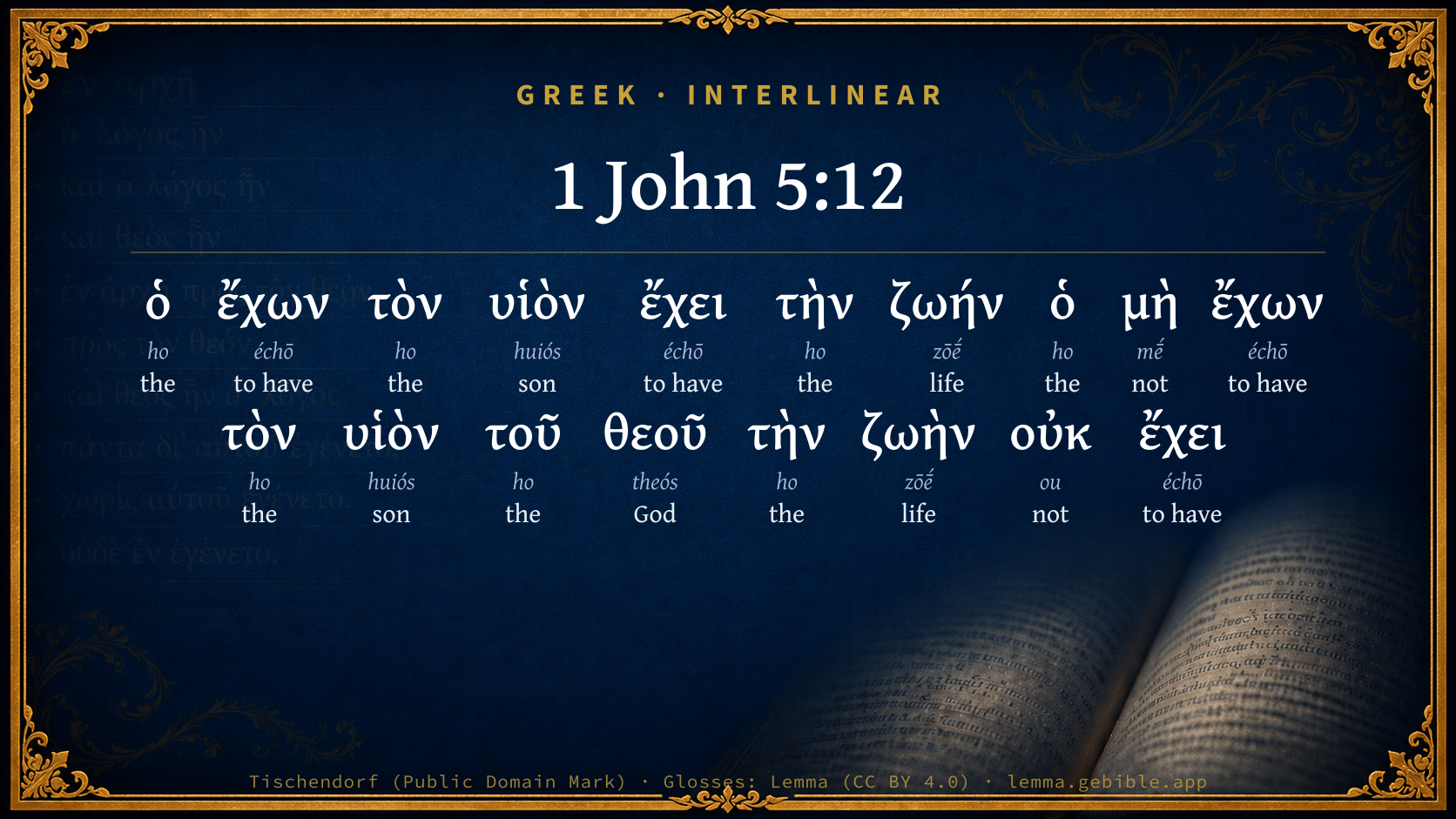
  1. ὁ ho G3588 “the” Article, Nominative, Singular, Masculine
  2. ἔχων échō G2192 “to have” Verb, Present, Active, Participle, Nominative, Singular, Masculine
  3. τὸν ho G3588 “the” Article, Accusative, Singular, Masculine
  4. υἱὸν huiós G5207 “son” Noun, Accusative, Singular, Masculine
  5. ἔχει échō G2192 “to have” Verb, Present, Active, Indicative, 3rd person, Singular
  6. τὴν ho G3588 “the” Article, Accusative, Singular, Feminine
  7. ὁ ho G3588 “the” Article, Nominative, Singular, Masculine
  8. μὴ mḗ G3361 “not” Particle, Negative
  9. ἔχων échō G2192 “to have” Verb, Present, Active, Participle, Nominative, Singular, Masculine
  10. τὸν ho G3588 “the” Article, Accusative, Singular, Masculine
  11. υἱὸν huiós G5207 “son” Noun, Accusative, Singular, Masculine
  12. τοῦ ho G3588 “the” Article, Genitive, Singular, Masculine
  13. θεοῦ theós G2316 “God” Noun, Genitive, Singular, Masculine
  14. τὴν ho G3588 “the” Article, Accusative, Singular, Feminine
  15. ζωὴν zōḗ G2222 “life” Noun, Accusative, Singular, Feminine
  16. οὐκ ou G3756 “not” Particle, Negative
  17. ἔχει échō G2192 “to have” Verb, Present, Active, Indicative, 3rd person, Singular

About this verse

These counts appear in no published source. They are computed here, from the morphology-tagged text and Lemma’s own curated glosses. What Lemma adds →

18
words
7
distinct lemmas
General Epistles
section

Repetition

Words recur within this verse:

Cross-references

10

Topical passages linked to 1 John 5:12 in the Treasury of Scripture Knowledge — connected by theme and wording, ordered by reader-vote popularity; previews shown in the World English Bible.

  • John 3:36 One who believes in the Son has eternal life, but one who disobeys the Son won't see life, but the wrath of God remains on him."
  • John 5:24 "Most assuredly I tell you, he who hears my word, and believes him who sent me, has eternal life, and doesn't come into judgment, but has passed out of death into life.
  • John 1:12 But as many as received him, to them he gave the right to become God's children, to those who believe in his name:
  • 1 Corinthians 1:30 But of him, you are in Christ Jesus, who was made to us wisdom from God, and righteousness and sanctification, and redemption:
  • Mark 16:16 He who believes and is baptized will be saved; but he who disbelieves will be condemned.
  • John 3:15 that whoever believes in him should not perish, but have eternal life.
  • 2 John 1:9 Whoever transgresses and doesn't remain in the teaching of Christ, doesn't have God. He who remains in the teaching, the same has both the Father and the Son.
  • Galatians 2:20 I have been crucified with Christ, and it is no longer I that live, but Christ living in me. That life which I now live in the flesh, I live by faith in the Son of God, who loved me, and gave himself up for me.
  • Hebrews 3:14 For we have become partakers of Christ, if we hold fast the beginning of our confidence firm to the end:
  • 1 John 2:23–24 Whoever denies the Son, the same doesn't have the Father. He who confesses the Son has the Father also.

Cross-references courtesy of OpenBible.info (CC BY 4.0).

Commentary

Notes on 1 John 5:12 from classic Christian and Jewish commentators (each source and its license shown beneath its notes). The classic Christian expositions comment on the surrounding passage and are grouped to its opening verse, so a note may address several verses; the Jewish commentaries on the Tanakh (Rashi and others) are per-verse, so they appear only where the commentator wrote on this verse.

Lemma curates 59 commentaries, every one of them public domain or Creative Commons licensed, each selected and text-cleaned for this edition rather than reprinted as found. About our sources →

The Biblical Illustrator

Joseph S. Exell

1Jn_5:12

He that hath the Son hath life; and he that hath not the Son of God hath not life

To have Christ is to have life

We may be said to have or receive the Son in these three modes--as a teacher, an example, and a Saviour; and in each of these He is life to those who have Him.

I. Christ is life in His instructions. He is so, because His instructions are truth, and truth brings life. In another, and yet a kindred sense, is Christ life by His word. He teaches us how to live, and for what ends. Honour, happiness, respect, love, usefulness, those things without which life is only animal, or worse, are most easily and completely to be secured by adopting the principles and obeying the precepts of the gospel. It is life, by eminence, to live temperately, soberly, justly, kindly, peacefully, doing good actions, exercising good affections, gaining good opinions. It is the only proper life of a moral, intellectual, accountable creature of God. He then lives as his Maker would have him live; lives most acceptably in the sight of heaven, and most profitably to himself and to the world. He lives, answering the best purposes of life; contributing to the means of human advancement; making his actions to be counted in the sum of human felicity. In a moral sense he protracts his life, because he employs it fully and well.

II. He who has or receives Christ as an example has life. The life-giving word is not only taught, but embodied and made incarnate in the teacher; it is not only didactic, but possesses the merit and charm of historical interest. The Son not only points the way to the Father, but He precedes the disciple, and guides him in it and through it. Whoever walks as Christ walked, lives; and in proportion to the exactness of his imitation is the vigour and health of his life. To know that we are, in any degree, sharing the life and spirit of our Master, is enough to give us an increase of vital warmth, to cause the pulse of our spirit to beat firmer and more true, because it beats in happy and honoured union with the heart of Jesus. If His life was true and eternal, then that which is borrowed from His is so too. The seeds of corruption are not in it. The process of dissolution cannot commence in it. It is a sound and pure and heavenly life, for it is the very life of the Son of God.

III. He who hath the Son by faith, he who receives Him as the Christ of God and the Saviour of men, by this faith also, as well as by obedience and imitation, hath life. And why? Because the hope and assurance of eternal life is contained and perfected in such faith. (F. W. P. Greenwood, D. D.)

Alive or dead--which?

I. Concerning the living. He that hath the Son hath life.

1. I shall remark, in the first place, that having the Son is good evidence of eternal life, from the fact that faith by which a man receives Christ is in itself a living act. Furthermore, faith in Jesus is good evidence of life, because of the things which accompany it. No soul asks for pardon or obtains it till he has felt that sin is an evil for which pardon is necessary; that is to say, repentance always conies with faith. Where there is faith, again, there is always prayer. So might I say that the consequences of receiving Christ are also good evidences of heavenly life; for when a man receives the Son of God he obtains a measure of peace and joy; and peace with God and joy in the Holy Ghost are not to be found in the sepulchres of dead souls.

2. The possession of the Lord Jesus Christ is the evidence of faith in many ways. It is Gods mark upon a living soul. Whatever else we cannot see, if a simple trust in Jesus is discernible in a convert, we need feel no suspicions, but receive him at once as a brother beloved. Moreover, the possession of the Lord Jesus Christ becomes a clear evidence of life, because, indeed, it is in some sense the source, fountain, and nourishment of life. While the branch is vitally in the stem it will have life; if it is not always bearing fruit, yet it always has life; and thus the fact of having the Son becomes an evidence of life, because it is the source of life. In another aspect of it, having the Son is not only the source of life, but the result of life. Now, when a man receives Jesus into his soul as life from the dead, his faith is the sure indicator of a spiritual and mysterious life within him, in the power of which he is able to receive the Lord. Jesus is freely preached to you, His grace is free as the air, but the dead do not breathe that air--those who breathe it are, beyond all doubt, alive.

3. Let me further remark that the possession of the Lord Jesus Christ by faith is sufficient evidence of eternal life. I do not know, says one, when I was converted. Have you the Son of God? Do you trust in Jesus Christ? That is quite enough.

4. It is a great mercy that having the Son is abiding evidence. He that hath the Son hath life. I know what it is to see every other evidence I ever gloried in go drifting down the stream far out of sight.

5. I may close this first head by saying that having the Son is infallible evidence of life. He that hath the Son hath life. It is not said that he may perhaps have it, or that some who have the Son have life, but there is no exception to the rule.

II. Concerning the dead. He that hath not the Son of God hath not life--that is, he hath not spiritual life, sentence of death is recorded against him in the book of God. His natural life is spared him in this world, but he is condemned already. Now observe that the not having the Son of God is clear evidence of the absence of spiritual life; for the man who has not trusted in Jesus has made God a liar. Shall pure spiritual life make God a liar? Shall he receive life from God who persists in denying Gods testimony? Let me tell you that for a hearer of the gospel not to believe on the Son of God must be, in the judgment of angels, a very astounding, crime. Recollect, if you have never received Christ, that this is overwhelming evidence that you are dead in sin. I tell thee, moralist, what thou art: thou art a corpse well washed and decently laid out, daintily robed in fair white linen, sprinkled plenteously with sweet perfumes, and wrapped in myrrh and cassia and aloes, with flowers wreathed about thy brow and thy bosom bedecked by the hand of affection with sweetly blushing roses; but thou hast no life, and therefore thy destiny is the grave, corruption is thy heritage.

III. Concerning the living as they dwell among the dead. As the living are constrained to live among the dead, as the children of God are mixed up by Providence with the heirs of wrath, what manner of persons ought they to be?

1. In the first place, let us take care that we do not become contaminated by the corruption of the dead. You who have the Son of God, mind that you are not injured by those who have not the Son.

2. If we must in this life, in a measure, mingle with the dead, let us take care that we never suffer the supremacy of the dead to be acknowledged over the living. It would be a strange thing if the dead were to rule the living. Yet sometimes I have seen the dead have the dominion of this world; that is to say, they have set the fashion and living Christians have followed.

3. What I think we should do towards dead souls is this--we should pity them. The most of these I meet with are dead in sin. Ought not this to make us pray for them: Eternal Spirit, quicken them! They cannot have life unless they have the Son of God. Oh, bring them to receive the Son of God! (C. H. Spurgeon.)

The sublimest possession

Deep in the soul of man is a desire to appropriate something outside of itself--the instinct for getting, what phrenologists call the acquisitive faculty. But what is the good it really wants, the chief good, that without which it will never be satisfied?

I. The highest possession of man is the possession of Christ.

1. It is something more than to possess an intellectual knowledge of Him.

2. It is something more than to admire His character and to sympathise with His enterprise.

3. It is to possess His ruling disposition, or, in other words, the moral inspiration of His soul. It is to have His spirit.

II. The possession of Christ involves the highest life. Eternal life does not mean eternal existence, but eternal goodness; and eternal goodness is the highest paradise of the soul.

1. The life of supremacy. He will be in the highest sense a king.

2. The life of self-oblivious devotion. Not my will, but Thine be done.

3. The life of the highest knowledge. (Homilist.)

The natural man and the spiritual man

The natural man belongs to the present order of things. He is endowed simply with a high quality of the natural animal life. But it is life of so poor a quality that it is not life at all. He that hath not the Son hath not life; but he that hath the Son hath life--a new, distinct, and supernatural endowment. He is not of this world. He is of the timeless state, of eternity. The difference, then, between the spiritual man and the natural man is not a difference of development, but of generation. The distinction is one of quality, not of quantity. The scientific classification of men would be to arrange all natural men, moral or immoral, educated or vulgar, as one family. One higher than another in the family group, yet all marked by the same set of characteristics--they eat, sleep, work, think, live, die. But the spiritual man is removed from this family so utterly by the possession of an additional characteristic that a biologist would not hesitate to classify him elsewhere, not in another family, but in another kingdom. It is an old-fashioned theology which divides men into the living and the dead, lost and saved--a stern phraseology all but fallen into disuse. This difference, so startling as a doctrine, has been ridiculed or denied. Nevertheless the grim distinction must be retained. It is a scientific distinction. He that hath not the Son hath not life. (Prof. H. Drummond.)

Christ the life of the soul

He, who has a right to speak, has said that there is a certain thing, the possession of which constitutes life, and so constitutes it that he who has it has life, and he who has it not has not life. There is a life, dependent upon the possession of a certain thing, so much worthier than anything else of the name of life, that, compared to it, nothing besides is real life. Could you at this moment do it by a word, would you immortalise the life you are now living? The real Christian would. To him the change which he wishes is not one of kind, but of degree. He has that which he only wants purified and increased a thousand fold. The life he lives is what he wishes to be the germ of a life which he shall live forever and ever. Now this possession of Christ appears to me to be made up of three things. Properly speaking, the life which Christ lived upon this earth before His Cross was not the life which He came to communicate to His people. All that life He lived simply that He might purchase the life which He was going to give. The resurrection life is the life which Christ imparts to man. It is a life springing out of death. It is a life out of which the element of death has been altogether extracted. It is a life as essential as the Godhead of the Christ--as the life in which that Godhead resides is essential life. Life is not what we live, but how we live it. To live indeed you must live livingly. To this end, then, if a man would live indeed, a mans soul must be always, in some way, receiving Christ. (J. Vaughan, M. A.)

Christ in man

Before proceeding to analyse this passage, contemplate for one moment the mysterious grandeur of human natures position through the Incarnation; for it is obviously through the Incarnation that we have the Son. Think, then, that in all other works of Deity communication is the distinction. When God creates, He communicates being to nothing; in nature, God communicates beauty, form, and harmony to materialism; in providence, God communicates wisdom, truth, power, responsibility, and so forth, to agents and agencies; in legislation God communicates will and law to moral nature; and in revelation God communicates grace and truth to mankind; but in the Incarnation God does not communicate, but He assumes. Observe the words, He that hath the Son hath life. There is no man named. God Almighty, when He speaks from the throne of revelation, speaks to human nature. He does not by tits word lay hold on the conventional, the local, the chronological, or the transitory in man. Now mark the decisive grandeur of this; for it intimates a connection between our nature now and our condition hereafter. Christianity now is Christianity forever; every stone which is now laid to your spiritual fabric is to form part of an ascending structure of conscious humanity, which is to rise higher and higher towards perfection throughout the everlasting ages. He, therefore, that hath the Son hath life, and the same life that he will have hereafter.

I. What is it to have the Son? We say, then, in the first place, every human being on Gods earth hath the Son. There is not a pulse in your body but proclaims Calvary; there is not a drop in your veins but preaches Christ. You are not to imagine creation proceeding by one principle, providence administered by another, and grace acting by a third; the same God who acts in creation and rules in providence bestows in grace. And therefore I charge it upon every unconverted man, with this truth bound upon his heart, Verily Christ is in me, and I knew it not. But more particularly, to take the words spiritually: a man may be said to have the Son when He is the sovereign of his intellect. He will ascertain upon clear grounds and through an honest logic whether this book be or be not Divine; but the moment the man has come to the conclusion, Verily God is in this thing, verily God is in these syllables, then all that he has to do is to submit his intellect to Christ, then he has the Son. Secondly, a man may be said to have the Son when he hath Him as the ruler of his desires. If we have the Son our desires are submitted to Christ even as our intellect. Thirdly, Jesus Christ may be said to be ours, or we have the Son, when He is the pacifier of our conscience. Lastly, a man may be said to have the Son when Jesus Christ is the centre of his affections. The worldlings centre is the world; the sensualists centre is the enjoyment of the passions; the rationalists is the cultivation of the intellect; the politicians the progress of his party. But the Christian hath one centre and one circumference--Jesus Christ in the beginning and the middle and without end. His supreme attractor is Christ.

II. The possession of Christ is tantamount to the possession of life. In the first place, then, this connection contains (though not here stated) three marvellous views. First, it is the unfathomable mystery of heaven; secondly, it is the infinite mercy of earth; and, thirdly, it is the unrivalled miracle of all eternity. Lastly, we go on to show you the right connection between having Christ and having life. It is to be drawn from the contrast to the fall. The fall of man was the death of man through the first Adam; the rise of man is the life of man in the second Adam. (R. Montgomery, M. A.)

The Biblical Illustrator, edited by Joseph S. Exell (c. 1880s–1900s) — public domain. Text from a community e-Sword module.

Bengel's Gnomon

Johann Albrecht Bengel

1Jn 5:12. Ὁ ἔχων) he who has, in faith.—τὸν Υἱὸν, the Son) The verse has two clauses: in the former, the Son only is mentioned, without the addition, of God; for the faithful know the Son: in the other this addition is made, that unbelievers may know at length what a serious thing it is not to have Him.—ἔχει, has) In the former part of the sentence, the word has is to be pronounced with emphasis; in the second, the emphatic word is life.

Bengel's Gnomon of the New Testament — English translation (T&T Clark, Edinburgh, 1860) — public domain. Text from a community e-Sword module.

Meyer's Critical & Exegetical Commentary

Heinrich August Wilhelm Meyer

1Jn_5:12 states the inference from the immediately preceding thought. If the ζωή is originally in the Son, then he who has the Son has with him also the ζωή. With ὁ ἔχων τὸν υἱόν, comp. chap. 1Jn_2:23. Changing and weakening the sense, Grotius puts for τὸν υἱόν: verba ilia quae Pater Filio mandavit; even ἔχει τὴν ζωήν he erroneously explains by: jus certum ad vitam aeternam. Whilst John in the first clause says simply τὸν υἱόν, in the second he adds τοῦ Θεοῦ; on this Bengel remarks: habet versus duo cola; in priore non additur Dei, nam fideles norunt Filium; in altero additur, ut demum sciant fideles, quanti sit, non habere.

Meyer — Critical and Exegetical Commentary on the New Testament — English translation by Peter Christie, edited by Frederick Crombie (T&T Clark, 1880) — public domain. Text from a community e-Sword module.

Expositor's Greek Testament

ed. W. Robertson Nicoll

1Jn 5:12 . μή with the participle does not necessarily make the case hypothetical ( cf. note on 1Jn 2:4 ). St. John would have only too many actual instances before him in those days of doctrinal unsettlement.

The Expositor's Greek Testament, edited by W. Robertson Nicoll (1897–1910) — public domain. Text from a community e-Sword module.

Jamieson, Fausset & Brown

Robert Jamieson, A. R. Fausset & David Brown

the Son . . . life--Greek, "THE life." BENGEL remarks, The verse has two clauses: in the former the Son is mentioned without the addition "of God," for believers know the Son: in the second clause the addition "of God" is made, that unbelievers may know thereby what a serious thing it is not to have Him. In the former clause "has" bears the emphasis; in the second, life. To have the Son is to be able to say as the bride, "I am my Beloved's, and my Beloved is mine" [Sol 6:3]. Faith is the mean whereby the regenerate HAVE Christ as a present possession, and in having Him have life in its germ and reality now, and shall have life in its fully developed manifestation hereafter. Eternal life here is: (1) initial, and is an earnest of that which is to follow; in the intermediate state (2) partial, belonging but to a part of a man, though that is his nobler part, the soul separated from the body; at and after the resurrection (3) perfectional. This life is not only natural, consisting of the union of the soul and the body (as that of the reprobate in eternal pain, which ought to be termed death eternal, not life), but also spiritual, the union of the soul to God, and supremely blessed for ever (for life is another term for happiness) [PEARSON, Exposition of the Creed].

Jamieson, Fausset & Brown — Commentary Critical and Explanatory on the Whole Bible (1871) — public domain (CC PDM 1.0). Text via the HelloAO Bible API.

Adam Clarke's Commentary

Verse 12. He that hath the Son hath life] As the eternal life is given IN the Son of God, it follows that it cannot be enjoyed without him. No man can have it without having Christ; therefore he that hath the Son hath life, and he that hath not the Son hath not life. It is in vain to expect eternal glory, if we have not Christ in our heart. The indwelling Christ gives both a title to it, and a meetness for it. This is God's record. Let no man deceive himself here. An indwelling Christ and GLORY; no indwelling Christ, NO glory. God's record must stand.

Adam Clarke's Commentary on the Bible (1810–1826) — public domain. Text from a community e-Sword/MySword module.

John Calvin's Commentaries

12 He that hath not the Son This is a confirmation of the last sentence. It ought, indeed, to have been sufficient, that God made life to be in none but in Christ, that it might be sought in him; but lest any one should turn away to another, he excludes all from the hope of life who seek it not in Christ. We know what it is to have Christ, for he is possessed by faith. He then shews that all who are separated from the body of Christ are without life.

But this seems inconsistent with reason; for history shews that there have been great men, endued with heroic virtues, who yet were wholly unacquainted with Christ; and it seems unreasonable that men of so great eminence had no honor. To this I answer, that we are greatly mistaken if we think that whatever is eminent in our eyes is approved by God; for, as it is said in Luke,

“What is highly esteemed by men is an abomination with God.” (Luke 16:15)

For as the filthiness of the heart is hid from us, we are satisfied with the external appearance; but God sees that under this is concealed the foulest filth. It is, therefore, no wonder if specious virtues, flowing from an impure heart, and tending to no right end, have an ill odor to him. Besides, whence comes purity, whence a genuine regard for religion, except from the Spirit of Christ? There is, then, nothing worthy of praise except in Christ.

There is, further, another reason which removes every doubt; for the righteousness of men is in the remission of sins. If you take away this, the sure curse of God and eternal death awaits all. Christ alone is he who reconciles the Father to us, as he has once for all pacified him by the sacrifice of the cross. It hence follows, that God is propitious to none but in Christ, nor is there righteousness but in him.

Were any one to object and say, that Cornelius, as mentioned by Luke, (Acts 10:2,) was accepted of God before he was called to the faith of the gospel: to this I answer shortly, that God sometimes so deals with us, that the seed of faith appears immediately on the first day. Cornelius had no clear and distinct knowledge of Christ; but as he had some perception of God’s mercy, he must at the same time understand something of a Mediator. But as God acts in ways hidden and wonderful, let us disregard those speculations which profit nothing, and hold only to that plain way of salvation, which he has made known to us.

John Calvin's Commentaries (1540-1563) — public domain. Text from the Calvin Translation Society English edition (1840s-50s) via the Christian Classics Ethereal Library (ccel.org). Calvin's coverage is partial (roughly two-thirds of the Bible); uncommented books and verses are honest gaps, never fabricated. The 19th-century editor's footnotes and remarks are omitted so the notes are faithfully Calvin's own voice.

The Cambridge Bible for Schools and Colleges

gen. ed. J. J. S. Perowne

12. A deduction from the preceding clause. If the Son has the life in Himself, then whoever has the Son has the life, and no man can have the one without the other. ‘To have the Son’ must be compared with ‘to have the Father’ in 1Jn_2:23. In both cases ‘have’ signifies possession in living union through faith.

hath life] Better, as R.V., hath the life; not merely ‘the life just mentioned’, ‘the life which God has given’, but ‘the life which in the full sense of the word is such’.

he that hath not] As in 1Jn_5:10, the negative alternative is stated generally and indefinitely (ὁ μὴ ἔχων). The addition of ‘of God’ is neither fortuitous nor pleonastic. Those who possess Him know that He is the Son of God; those who do not, need to be reminded Whose Son it is that they reject.

The verse constitutes another close parallel with the Gospel: comp. the last words of the Baptist (Joh_3:36).

The Cambridge Bible for Schools and Colleges (gen. ed. J. J. S. Perowne; Cambridge University Press, 1878–1918) — public domain. Text from a community e-Sword module.

John Gill's Exposition

He that hath the Son,.... Has a spiritual and experimental knowledge of him, true faith in him; who has him dwelling in his heart, and living in him:

hath life: not only spiritual life, being quickened by him, and living by faith on him, but eternal life; the knowledge he has of him is eternal life; he has it in faith and hope, and has a right unto it, and the earnest of it, as well as has it in Christ his representative, whom he has, and in whom this life is:

and he that hath not the Son of God; no knowledge of him, nor faith in him, nor enjoyment of him:

hath not life; he is dead in sin, he is alienated from the life of God, has no title to eternal life, nor meetness for it, nor shall enjoy it, but shall die the second death.

John Gill's Exposition of the Whole Bible (1746–1763) — public domain (CC PDM 1.0). Text via the HelloAO Bible API.

Trapp's Complete Commentary

John Trapp

12 He that hath the Son hath life; and he that hath not the Son of God hath not life.

Ver. 12. Hath life] For he is the prince and principle of life; and all out of him are dead while they live. Non ille diu vixit, sed diu fuit, saith Seneca of one; non multum navigavit, sed multum iactatus est, of another at sea; he was long, but lived little; he was much tossed, but not much furthered; he moved much, but removed not at all, as a horse in a mill, as a dog in a wheel, &c. {See Trapp on "Joh 1:4"}

And he that hath not the Son hath not life] Negatio contrarii auget vim affirmationis. 1Ki 20:1; Deu 33:6; Pro 30:11; 1Sa 1:11. {See Trapp on "Joh 1:20"}

John Trapp, A Commentary or Exposition upon All the Books of the Old and New Testament (1647–1656) — public domain. Text from a community e-Sword module.

Albert Barnes' Notes on the Bible

He that hath the Son, hath life - See the notes at Joh 5:24. John evidently designs to refer to that passage in the verse before us, and to state a principle laid down by the Saviour himself. This is the sense of all the important testimony that had ever been borne by God on the subject of salvation, that he who believes in the Lord Jesus already has the elements of eternal life in his soul, and will certainly obtain salvation. Compare the notes at Joh 17:3.

And he that hath not the Son of God, hath not life - He that does not believe on him will not attain to eternal life. See the Joh 3:36 note; Mar 16:16 note.

Albert Barnes' Notes on the Bible (1834–1885) — public domain. Text from a community e-Sword/MySword module.

Matthew Poole's English Annotations

And therefore, that we partake this life, or partake it not, as by faith we are united with him, or not united.

Matthew Poole's English Annotations on the Holy Bible (1683–1685) — public domain. Text from a community e-Sword/MySword module.

The Pulpit Commentary

Eternal life is not granted to the whole world, or even to all Christians en masse; it is given to individuals, soul by soul, according as each does or does not accept the Son of God. The order of the Greek is noteworthy in the first half of the verse the emphasis is on "hath," in the second on "life." Here, as in Joh_1:4, the article before zwh should be translated, "hath the life hath not the life." The insertion of tou Qeou in the second half of the verse points to the magnitude of the loss: the possessor has no need to be told whose Son he has.

The supreme possession.

that hath the Son hath the life," etc. In our text the apostle expresses

I A SPECIAL RELATIONSHIP TO THE LORD JESUS CHRIST. "He that hath the Son." What are we to understand by these words? What is involved in them?

1. R ealizing faith in him.

(1) In his existence. Saving faith in Christ is faith, not in his historic reality only, but in his present existence that he is. "He ever liveth.

(2) In his perfection. It will profit me nothing to believe in Jesus as an ordinary Man, having the imperfections, weaknesses, and sins of our human nature. Faith in such a being would not result in any accession of strength. Faith must be exercised m him as "holy, harmless, undefiled," etc. Thus believing in him we are, as it seems to us, necessarily led on to faith in his proper Divinity Jesus is the Son of God" (verse 5).

(3) In his interest in us. Faith in his existence and perfection and Divinity will not benefit us unless we believe in his regard for us that he cares for us, desires to bless and save us. Now, we need what I have called a realizing faith in him. The faith of which St. John and St. Paul wrote, and which our Lord required in himself, is a far greater and deeper thing than intellectual assent. "With the heart man believeth unto righteousness." "When the soul in very truth responds to the message of God," says Canon Liddon, "the complete responsive act of faith is threefold. This act proceeds simultaneously from the intelligence, from the heart, and from the will of the believer. His intelligence recognizes the unseen object as a fact. His heart embraces the object thus present to the understanding; his heart opens instinctively and unhesitatingly to receive a ray of heavenly light. And his will, too, resigns itself to the truth before it; it places the soul at the disposal of the object which thus rivets its eye and conquers its affections." With a faith like this, the Christian apprehends Jesus Christ as a grand, living, spiritual, Divine Person; enshrines him in the heart"s innermost and holiest temple; and offers to him humblest and deepest reverence. Thus the Christian "hath the Son.

1. Acceptance of his teaching. The Christian is intellectually and practically loyal to the teaching of Jesus Christ. In a very true and important sense Plato may be said to have had Socrates. He had so studied his utterances, so mastered his method, so thoroughly acquainted himself with his views and theories and principles; moreover, he held him in such high esteem, regarded him with such reverence, that we may, without exaggeration, say that he possessed Socrates. "We have the mind of Christ." By means of his teaching we have intellectual communion with him. His precious utterances, his glorious revelations, we believe; they are ours. All that he spake we receive as true; so his mind becomes ours; and in this sense we have him.

2. Supreme sympathy with him. He gave himself for us, and in return we give ourselves to him. "We love him, because he first loved us." By reciprocal affection we have him. This is the trust, completest, highest way in which one person can have another. He by whom I am truly loved, and whom I truly love, is mine indeed. Thus we have the Son. He dwells in us by his Spirit. His teaching, his presence, his love, his life, his Spirit, are ours; himself is ours, inalienably and for ever. St. John frequently represents this relationship to Christ as conditioned simply by faith in him. (verse 13; Joh_3:14-16, Joh_3:34) In his vocabulary "faith" is a comprehensive word. It "is not merely a perception of the understanding; it is a kindling of the heart, and a resolve of the will; it is, in short, an act of the whole soul, which, by one simultaneous complex movement, sees, feels, and obeys the truth presented to it." He who thus believes on the Lord Jesus Christ "hath the Son.

II THEY WHO HOLD THIS RELATIONSHIP ARE POSSESSORS OF THE HIGHEST LIFE. "He that hath the Son hath the life." What are we to understand by "the life" thn?

1. Not mere existence. The most wicked among men have this. Fallen angels have existed through thousands of years (2Pe_2:4; Jud_1:6) To argue for either the perpetuity or the non-perpetuity of existence from the teaching of the apostle concerning "the life" is a gross perversion of his teaching.

2. Not mere intellectual life. Voltaire, Byron, et al., possessed this in a high degree; but who would affirm that they had "the Son" and "the life"?

3. Not mere emotional life. There are many whose sympathies are abundant and active, who sincerely pity the wretched, who have often been moved to tears as they have contemplated the woes of the Man of sorrows, who yet have neither" the Son" nor "the life." The life of which St. John writes is "the new life of God in humanity." This new life may be viewed as a new reigning affection. By faith in Christ man is regenerated, his ruling love is changed. His deepest and strongest affection is no longer earthly, selfish, or sinful, but heavenly, self-abnegating, holy; he loves God supremely. He is thus brought into vital and blessed relationship with God. Holy love is life. "The mind of the Spirit is life". (Rom_8:6) He who has the Son has this life. He has it now, not in its most glorious development, but really and increasingly. (Gal_2:20) Under the influence of this supreme love to God all the faculties of the spiritual nature advance towards perfection in blessed harmony with his holy will.

III THIS LIFE IS ATTAINABLE ONLY THROUGH CHRIST. "He that hath not the Son of God hath not the life." What is essential to this life? That man"s strongest and deepest love shall be fixed on God. And we have no revelation of God adequate to inspire this affection save that which is given unto us in Jesus Christ. On viewing the life as consisting of the union of the soul of man with God, we affirm that it is only through the mediation of Jesus Christ that this union can be effected. Man is estranged from God by sin, "alienated from the life of God," and under condemnation because of sin. "The Son of man has power to forgive sins." "There is no condemnation to them that are in Christ Jesus." By the manifestation of the love of God in his life, and especially in his death, he destroys the enmity of the sinful heart, and reconciles man unto God. "When we were enemies, we were reconciled to God by the death of his Son." Christ reveals God as a Being possessing in infinite degree those attributes which are necessary to command the soul"s supreme love. He manifests the perfect righteousness of God. The cross of Jesus Christ is the grand declaration of God"s unappeasable hatred of sin, and his zeal for the maintenance of rectitude. It is the perfect revelation of religious truth for man"s intellect and heart. He is "the Truth." In him truth was incarnate. In him the love of God is most perfectly expressed. Divine love toiling, sorrowing, suffering, dying, to save the unlovely, the unworthy, the ill deserving, is manifest in him. He shows us the ineffable mystery of God in self-sacrifice for us. He reveals, as fully as is possible to our dim vision, the transcendent beauty of the Divine character, for our admiration and reverence. In a word, taking holiness as expressing the summation of the Divine perfections, he reveals the infinite holiness of God. Hero in him we have such a revelation of the Supreme Being as is perfectly fitted to command the homage of conscience, to quicken and strengthen the intellect, to expel all enmity, and beget in the soul the purest, deepest, intensest love, and to call forth the reverent devotion of our being. Such a revelation believed in and brought home to our spirit by the Holy Spirit, is life-giving; and such a revelation we have in Christ alone. Only through him can we attain the highest life. (cf Joh_3:36 Joh_14:6; Act_4:12)

CONCLUSION.

1. This relationship may be attained by every one. (Joh_3:16)

2. God seeks to bring all men into this relationship. He invites, exhorts, entreats, etc.

3. If any have not this life, it is because they refuse to comply with the condition of its bestowment. "Ye will not come unto me, that ye might have life. W.J.

Vers. 14, 15.

The Christian"s confidence toward God in relation to prayer.

this is the confidence that we have in him," etc. We have in our text.

I AN ASSURANCE THAT GOD HEARS PRAYER. "This is the boldness that we have toward him, that, if we ask anything according to his will, he heareth us." Prayer is much more than petition. Canon Liddon admirably defines it: "Prayer is the act by which man, conscious at once of his weakness and of his immortality, puts himself into real and effective communication with the Almighty, the Eternal, the self-existent God. Prayer is not only perhaps in some of the holiest souls it is not even chiefly a petition for something that we want and do not possess. In the larger sense of the word, as the spiritual language of the soul, prayer is intercourse with God, often seeking no end beyond the pleasure of such intercourse. It is praise; it is congratulation; it is adoration of the Infinite Majesty; it is a colloquy in which the soul engages with the All-wise and the All-holy; it is a basking in the sunshine, varied by ejaculations of thankfulness to the Sun of Righteousness for his light and his warmth Prayer is not, as it has been scornfully described, "only a machine warranted by theologians to make God do what his clients want;" it is a great deal more than petition, which is only one department of it: it is nothing less than the whole spiritual action of the soul turned towards God as its true and adequate Object. It is the action whereby we men, in all our frailty and defilement, associate ourselves with our Divine Advocate on high, and realize the sublime bond which in him, the one Mediator between God and man, unites us in our utter unworthiness to the strong and all-holy God." Such is prayer in its highest and largest significance. But in our text prayer is viewed simply as petition. "If we ask anything; whatsoever we ask. the petitions which we have asked of him." Notice:

1. The offering of prayer. This implies

(1) consciousness of need. How many are man"s wants! Regular supplies for the requirements of the body, forgiveness of sin, daily guidance and grace, reliable hope as to our future, etc. We are creatures of constant and countless necessities. Every moment we are dependent upon the power and grace of the Supreme. The exercise of prayer implies

(2) belief that God is able and willing to supply our needs. Without this faith man would never address himself in his times of need to God. Moreover, the "we" of our text refers to Christians, even unto them "that believe on the Name of the Son of God" (verse 13). Their belief in the reality of prayer springs out of their faith in Christ. And the exercise of prayer is an expression of their spiritual life.

2. The hearing of prayer. How marvelous is the fact that God hears the innumerable prayers that are ever being presented unto him! None but an Infinite Being could hear them. And a Being of infinite intelligence cannot fail to observe every longing which is directed towards him. No utterance whatever escapes the Divine ear. None but a gracious Being would regard the prayers which are offered by such unworthy suppliants. Great is the condescension of God in attending to our requests. That he does graciously hear and attend to them is repeatedly declared in the sacred Scriptures (see 2Sa_22:7; Psa_22:4, Psa_22:5, 24 30:2, 8-12 31:22 34:4-6 50:15; Mat_7:7-11; Luk_18:1-8; Joh_16:23, Joh_16:24; Jam_1:5 Jam_5:16)

II AN IMPORTANT LIMITATION OF THE SCOPE OF ACCEPTABLE PRAYER. "If we ask anything according to his will, he heareth us.

1. This limitation is necessary. God"s will is supreme. The well-being of the universe is bound up with the execution of his will. Therefore he cannot grant the petitions which are not in harmony therewith. This limitation is necessary also, inasmuch as different suppliants may be seeking from him at the same time things which are thoroughly opposed to each other. Thus in time of war between two Christian nations, prayer is presented to God for the success of each of the contending armies. The requests of both cannot be granted.

2. This limitation is beneficial. The judicious and kind parent does not give to his child the thing which he asks for, if it will prove hurtful or perilous to him. In our ignorance we may pray to God for such things as would be injurious to us, in which case it is well for us to be denied. Thus the request of St. Paul was not granted, though his prayer was graciously answered. (2Co_12:7-9) On the other hand, the clamorous cry of the unbelieving and self-willed Israelites for flesh was acceded to, to their sore injury (Num_11:4-6, Num_11:31-34; Psa_106:15)

3. This limitation allows a large sphere for the exercise of prayer. There are many things which we know are "according to his will," and these are the most important things; e.g., supplies for bodily and temporal needs, forgiveness of sins, grace to enable us to do or to bear his will, guidance in our quest of truth and in our way of life, the sanctification of our being, and possession of an inheritance in heaven. We may seek the salvation of others, the extension of the Redeemer"s kingdom, and the final triumph of his cause throughout the world. These and other things we know accord with his will.

III AN ASSURANCE THAT THE THINGS SOLICITED IN SUCH PRAYERS WILL BE GRANTED. "And if we know that he heareth us whatsoever we ask, we know that we have the petitions which we have asked of him." Alford calls attention to the present, "we have the petitions," with the perfect, "which we have asked of him." "The perfect reaches through all our past prayers to this moment. All these "we have;" not one of them is lost: he has heard, he has answered them all: we know that we have them in the truest sense, in possession." It is important to bear in mind here the character of those to whom St. John writes. They are genuine Christians; possessors of Jesus Christ, and of eternal life in him. Their will is that God"s will may be done. In them is fulfilled the inspiring assurance of the sacred psalmist: "Delight thyself in the Lord; and he shall give thee the desires of thine heart." In whomsoever this character is realized, the desires are in harmony with the will of God, and the things solicited in prayer are such as God takes pleasure in bestowing and man is blessed in receiving. And this assurance which the apostle expresses is confirmed by the experience of the godly in all ages. (cf Exo_32:11-14, Exo_32:31-34; Num_11:1, Num_11:2; 1Ki_17:17-24 1Ki_18:42-45; 2Ki_4:28-36; Psa_116:1-8; Isa_38:1-8; Dan_9:20-23; Act_12:1-17) Let us seek a character like that indicated by the apostle (verses 11-13), and then this inspiring and strengthening "confidence toward God" may be ours also. W.J.

The Pulpit Commentary (1880–1919), ed. H.D.M. Spence-Jones & Joseph S. Exell — public domain. Text from a community e-Sword module.

John Wesley's Explanatory Notes

It plainly follows, he that hath the Son - Living and reigning in him by faith. Hath this life; he that hath not the Son of God hath not this life - Hath no part or lot therein. In the former clause, the apostle says simply, the Son; because believers know him: in the latter, the Son of God; that unbelievers may know how great a blessing they fall short of.

John Wesley, Explanatory Notes Upon the Whole Bible (1754–1765) — public domain. Text via the GEBible commentary corpus.

The People's New Testament

B. W. Johnson

12. He that hath the Son hath life. We lay hold of the Son by faith in him and thus come to life.

B. W. Johnson's The People's New Testament with Notes (1889–1891) — public domain. Electronic text from the Christian Classics Ethereal Library (CCEL) ThML edition.

Cambridge Greek Testament for Schools and Colleges

12. A deduction from the preceding clause. If the Son has the life in Himself, then whoever has the Son has the life, and no man can have the one without the other. ‘To have the Son’ must be compared with ‘to have the Father’ in 1Jn 2:23. In both cases ‘have’ signifies possession in living union through faith.

ἔχει τὴν ζωήν. As R.V., hath the life; not merely ‘the life just mentioned’, or ‘the life which God gave us’, but the life which in the full sense of the word is such.

ὁ μὴ ἔχων. As in 1Jn 5:10, the negative alternative is stated generally and indefinitely (μή not οὐ). The addition of τοῦ θεοῦ is neither fortuitous nor pleonastic. Those who possess Him know that He is the Son of God; those who do not, need to be reminded Whose Son it is that they reject.

The verse constitutes another close parallel with the Gospel: comp. the last words of the Baptist (Joh 3:36).

Cambridge Greek Testament for Schools and Colleges (Cambridge University Press, 1896; 21 vols, various authors incl. Carr, Maclear, Plummer, Farrar, Lumby, Moule, M. R. James, Simcox) — public domain. Text from a community e-Sword module.

Alford’s Greek Testament

Henry Alford

12.] Conclusion of the whole argument from ver. 6: dependent on the last clause of ver. 11, and carrying it on a step farther, even to the absolute identity as matter of possession for the believer, of the Son of God, and eternal life. He that hath the Son, hath the life: he that hath not the Son of God, the life hath he not. First notice the diction and arrangement, on which Bengel has well remarked, “Habet versus duo cola: in priore non additur Dei, nam fideles norunt Filium: in altero additur, ut demum sciantinfid eles, quanti sit non habere. Priore hemistichio cum emphasi pronunciandum est habet: in altero, vitam.” This latter furnishes a simple and beautiful example of the laws of emphasis in arrangement: ἔχει τὴν ζωήν—τὴν ζωὴν οὐκ ἔχει.

Next, the ἔχειν τὸν υἱόν must not be explained away with Grotius by “verba illa retinere quæ Pater Filio mandavit,” nor ἔχειν τὴν ζωήν, with the same, by “jus certum habere ad vitam æternam.” The having the Son is the possession of Christ by faith testified by the Spirit, the water, and the blood: and the having the life is the actually possessing it, not indeed in its most glorious development, but in all its reality and vitality.

Thirdly, it must be remarked that the question as to whether eternal salvation is altogether confined to those who in the fullest sense have the Son (to the exclusion, e. g., of those who have never heard of Him), does not belong here, but must be entertained on other grounds. See note on 1Pe 3:19. Düsterd. has remarked that the use of ὁ μὴ ἔχων, not ὁ οὐκ ἔχων (cf. οἱ οὐκ ἠλεημένοι 1Pe 2:10), shews that the Apostle is contemplating, at all events primarily, rather a possible contingency than an actual fact: and thus is, primarily again, confining his saying to those to whom the divine testimony has come. To them, according as they receive or do not receive it, according as they are οἱ ἔχοντες or οἱ μὴ ἔχοντες τὸν υἱὸν τοῦ θεοῦ, it is a savour of life unto life, or of death unto death.

Henry Alford, The Greek Testament (1849–1861) — public domain. Text from a community e-Sword module.

International Critical Commentary

12. This verse explains more fully the last clause of the preceding verse. It is probably of the nature of an appeal to the reader’s experience. Those who lived with Christ on earth found that they gained from Him a new power which transformed their life into a new and higher life. And the later generations had similar experience by which to judge, though they had not actually companied with Him during His life on earth.

ὁ μὴ ἔχων κ.τ.λ.] In the negative statement there are two slight changes which have their significance: (1) The addition of τοῦ θεοῦ to τὸν υἱόν. God is the source of life. The Son of God alone can give it to men. He that cannot gain it from that source cannot find it. (2) The position of τὴν ζωήν, which is placed before the verb, and thus becomes more emphatic. Whatever else the man may have in the way of higher endowments, spiritual life is not within his grasp. In the positive statement the emphasis was laid on the actual possession (ἔχει τὴν ζωήν). We have here another close parallel with the Gospel (see Joh 3:36).

ὁ μὴ ἔχων] The negative (μή) generalizes the statement. A class of men is described who are distinguished by this characteristic.

τον υιον 1 o] + του θεου 8. 25. 34. 69 ascr boh-codd. | την ζωην 1o] τον υιον 31: ζωην αιωνιον Ia δ459 (489): + αυτου O46 (154) Ic 364 (137) | om. του θεου vg. (am. demid.) arm-codd. Aug. Tert. | την ζωην 2o] post εχει 2o Ib δ370 (1149): + αυτου O46 Ic 364.

International Critical Commentary — older volumes (1896–1929), various authors — public domain. Text from a community e-Sword module.

Vincent's Word Studies in the New Testament

Marvin R. Vincent

Hath life [εχει την ζωην] . More strictly, as Rev., the life; i e., the life which God gave (ver. 11). See on Joh 16:22. Compare Christ who is our life (Col 3:4).

The Son of God. Hath the Son, hath not the Son of God, pointing back to God as the giver of life in His Son. Bengel observes : "The verse has two clauses : in the former, of God is not added, because believers know the Son; in the other it is added, that unbelievers may know at length how serious it is not to have Him."

Hath not life. Note the inversion "He that hath the Son hath the life. He that hath not the Son of God, the life hath he not."

Marvin R. Vincent, Word Studies in the New Testament (1887–1900) — public domain. Text from a community e-Sword/MySword module.

Westcott on Hebrews & the Epistles of John

Brooke Foss Westcott

12. ὁ ἔχων... The variations from exact parallelism in the two members of the verse are significant. In the second member τὸν υἱὸν rod θεοῦ stands for τὸν υἱόν, and the position of τὴν ζωήν is changed.

ὁ ἔχων τὸν υἱόν] He that hath the Son, in Whom the Father is known. Comp. 6. ii. 23; 2 John 9; and for

ἔχει τὴν ¢.] hath life, or rather the life which God has given. Contrast Ὁ. 13; lit. 15; John v. 26; Xx. 10; xx. 31. Comp. Col. iii. 4.

In the spirit of these words Ignatius speaks of Jesus Christ as ro ἀδιάκριτον ἡμῶν ζῆν, ‘our inseparable (nv, ‘our true life’ (Smyrn. 4). Comp. Magn. 5; Trail. 9.

ὁ μὴ ἔχων τ. vi. τοῦ θ.] he that hath not the Son of God. The fuller title seems to mark emphatically the necessity of failure in such a case. God is the only source of life.

For the combination of the positive and negative see c. i. 5; Il. 4, 27; John i. 3; iii. 16.

III. Tue Activity anp ConFiDENOE OF THE CHRISTIAN LIFE: EpILOGUE.

This last section of the Epistle is symmetrical in structure : ; 1. The aim re-stated (13). 2. The confidence of spiritual action (14—17). 3. The certainty of spiritual knowledge (18—20).

13 Ταῦτα ἔγραψα αὕτη ἐστὶν ἡ ζ. AL

4. A final warning (21).

The progress of thought is clear. Having reached the close of his writing St John recals the main purpose of writing it (i. 4), which he has fulfilled (7. 13); and then illus-

_ trates the confidence of the Christian

life under two aspects, (1) as it finds expression in spiritual action (14—17), and (2) as it is realised in inward conviction (18—-20). He concludes by a warning against everything which usurps the place of God (21).

1. The aim of the Epistle restated (13).

13 These things have I written, that ye may know that ye have eternal life, to you who believe on the name of the Son of God.

Brooke Foss Westcott (1825–1901), The Epistle to the Hebrews (1889) and The Epistles of St John (1883) — public domain (pre-1929). Text recovered from Internet Archive / Google Books OCR scans. Westcott’s Gospel of John commentary is not included (its OCR lost the chapter running-heads required for reliable verse-keying). Some Greek quoted in the Hebrews volume is imperfectly rendered by the OCR.

Lesson kit

Teaching starters — assembled from the data on this page, not authored interpretation. Every prompt links to the verse data it draws on. Edit before teaching.

1 John, in the General Epistles, opens this verse with 18 words (7 distinct Greek lemmas). Its most distinctive word is zōḗ (“life”). A historical commentator’s framing appears above. Read the whole chapter for the surrounding context.

Discussion questions

  1. What does “life” (zōḗ) contribute to the verse as a whole?
  2. John 3:36 shares this passage’s theme. How do the two illuminate each other?
  3. “to have” occurs 4× in this one verse. What is the effect of the repetition?
  4. These translations render this verse differently. What is at stake in choosing one wording over another?
  5. Reading how The Biblical Illustrator and Bengel's Gnomon read this verse, where do the two commentators agree and where do they part?

Things to notice

  • These translations choose different wording for 9 words in this verse.
  • “to have” occurs 4× in this single verse.
  • 7 distinct Greek lemmas span 18 words in this verse.

Reading settings

Reading text

Shown beneath each verse's original-language words.

Old Testament
Old Testament edition

Read the OT as the Masoretic Hebrew (MT) or the Greek Septuagint (LXX).

English shown for the Greek Septuagint (in the Hebrew ↔ Greek comparison).

Comparing translations? Open the Compare panel on any verse page to stack up to four side by side.