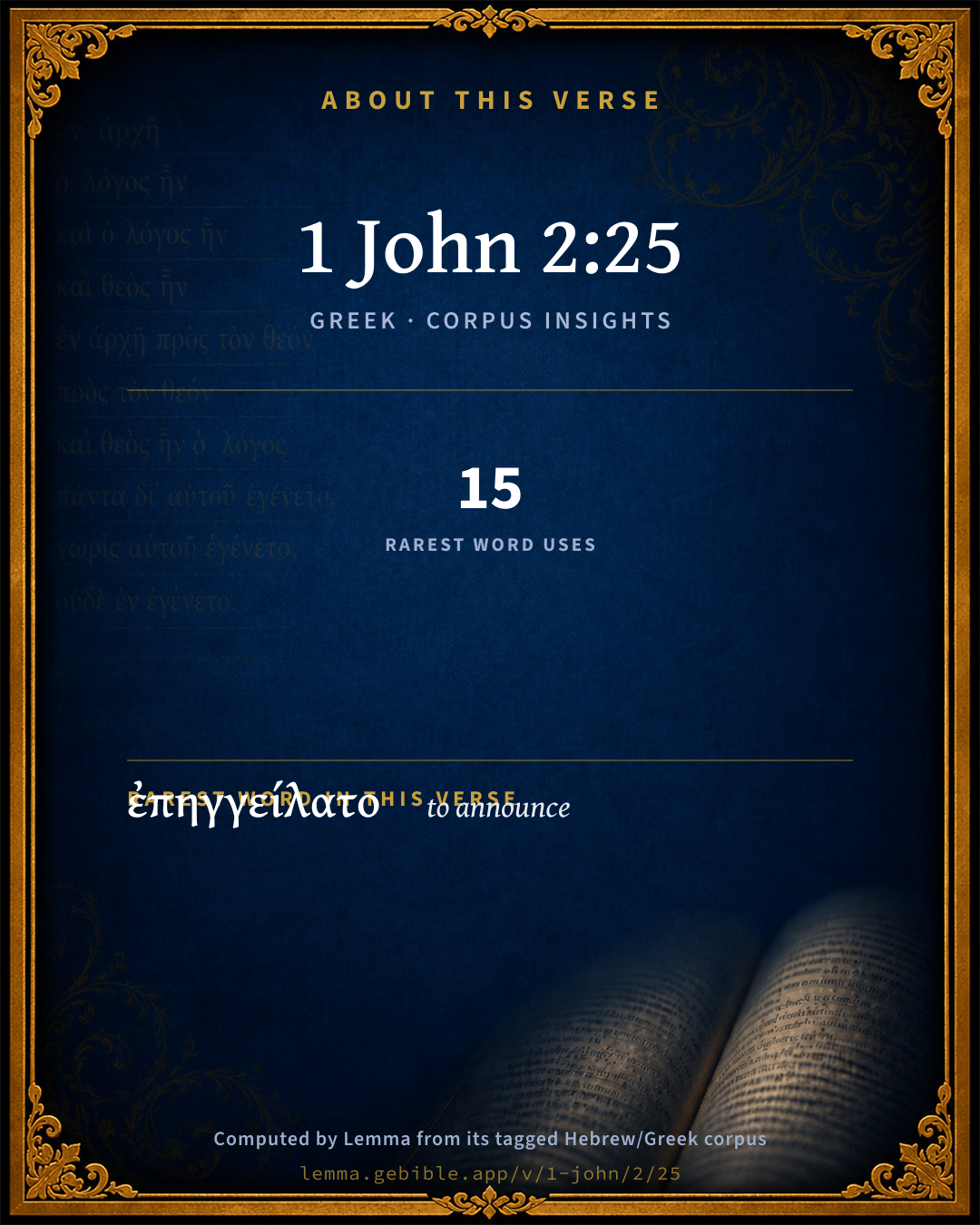
1 John 2:25

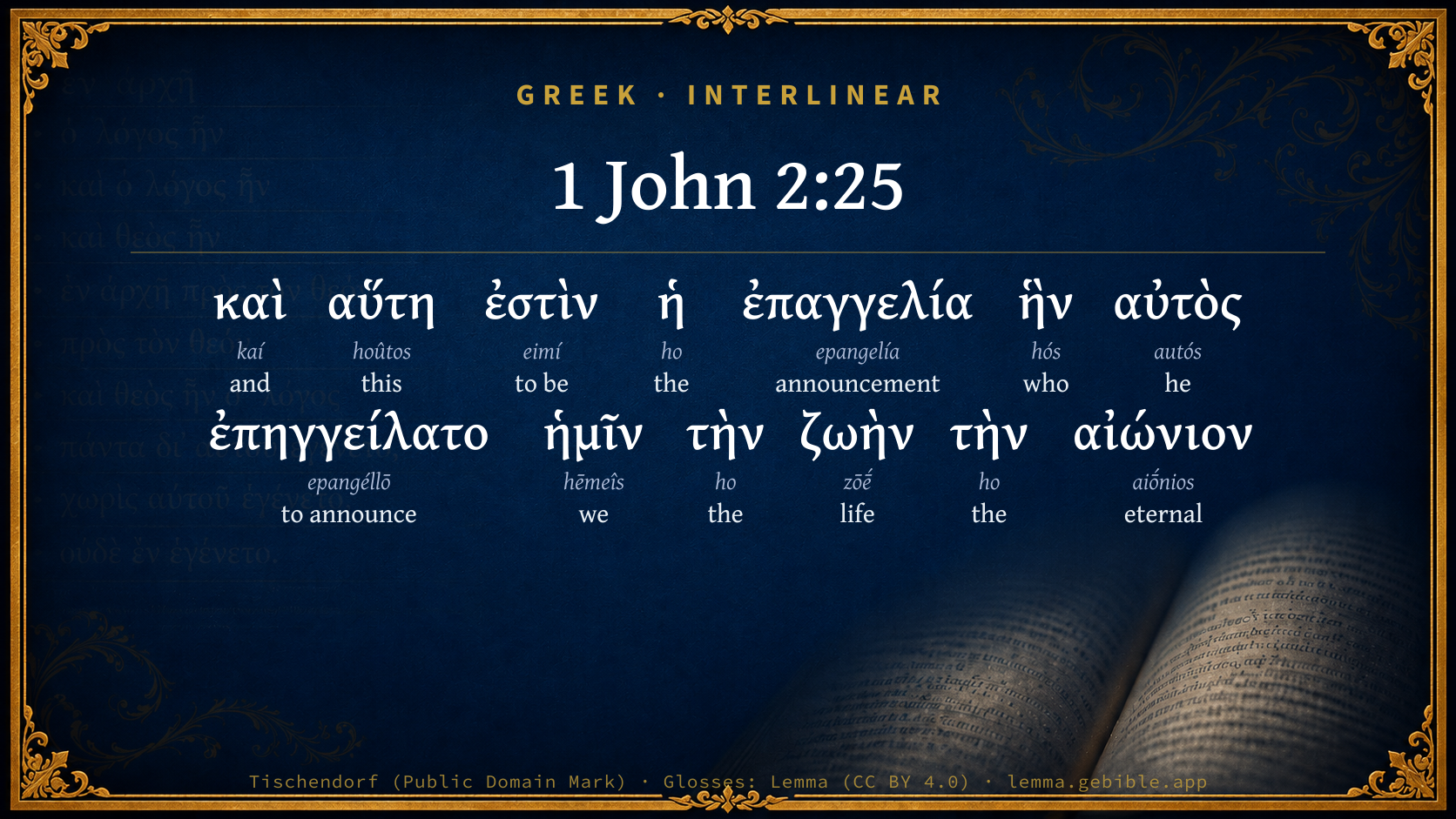
Greek (Tischendorf 8th ed.) 1 John 2:25 appears in the Greek New Testament. The text above is from the Tischendorf 8th edition. Each word links to its Strong’s number and a concise gloss. Click any word for its full Thayer’s Greek Lexicon entry.
Download image
Cite this verse

1 John 2:25 (World English Bible). Public Domain. Lemma interlinear Bible study tool, https://lemma.gebible.app/v/1-john/2/25.

Show BibTeX & RIS
BibTeX
RIS
English Translation
This is the promise which he promised us, the eternal life.
World English Bible · Public Domain
Download a study sheet

One document with this verse’s original text, its word-by-word gloss line, the meaning frame, cross-references with their text, attributed commentary, and full source and license credits — printable, and it pastes into notes with its structure intact.

This verse Autodidact and up

Study sheet (.html) Plain text (.txt)

A passage Seminary Student

Up to 50 verses in one chapter. A passage sheet keeps up to 6 commentary sources and 12 cross-references per verse, in the order this page ranks them, and says so on the sheet whenever that leaves anything out. Ask for a single verse and you get the Autodidact verse sheet above.

Everything on this page stays free to read, with no account — the sheet is a download of what is already on screen, not access to it.

Want to remove ads? Support Godless Engineer
Compare translations 3

The same verse in 3 English versions, stacked beneath the original-language interlinear above. Click any original word for its lexicon entry.

Each is an independent rendering of the whole verse — the interlinear is not word-aligned to these translations.

Highlighted words mark where these versions differ — a whole-verse word diff, not a word-by-word alignment.

  • World English Bible Public Domain
    This is the promise which he promised us, the eternal life.
  • King James Version Public Domain
    And this is the promise that he hath promised us, even eternal life.
  • unfoldingWord Literal Text CC BY-SA 4.0
    And this is the promise that he promised to us—eternal life.

unfoldingWord Literal Text — © unfoldingWord, licensed CC BY-SA 4.0. Word-aligned USFM3 via Door43 (git.door43.org/unfoldingWord/en_ult).

Versions to compare (up to 4)

3 of 4 selected

Show all 19 translations

Every available English version of this verse, each an independent rendering of the whole verse.

  • World English Bible Public Domain
    This is the promise which he promised us, the eternal life.
  • Berean Standard Bible Public Domain
    And this is the promise that He Himself made to us: eternal life.
  • Majority Standard Bible Public Domain
    And this is the promise that He Himself made to us: eternal life.
  • King James Version Public Domain
    And this is the promise that he hath promised us, even eternal life.
  • American Standard Version (1901) Public Domain
    And this is the promise which he promised us, `even' the life eternal.
  • Revised Version (1885) Public Domain
    And this is the promise which he promised us, even the life eternal.
  • Geneva Bible (1599) Public Domain
    And this is the promise that he hath promised vs, euen that eternall life.
  • Douay-Rheims (1899) Public Domain
    And this is the promise which he hath promised us, life everlasting.
  • Young's Literal Translation Public Domain
    and this is the promise that He did promise us -- the life the age-during.
  • Literal Standard Version CC BY-SA 4.0
    and this is the promise that He promised us—the continuous life.
  • Unlocked Literal Bible CC BY-SA 4.0
    This is the promise he gave to us—eternal life.
  • unfoldingWord Literal Text CC BY-SA 4.0
    And this is the promise that he promised to us—eternal life.
  • Darby Bible Public Domain
    And this is the promise which *he* has promised us, life eternal.
  • World Messianic Bible Public Domain
    This is the promise which he promised us, the eternal life.
  • Webster's Bible Public Domain
    And this is the promise that he hath promised us, even eternal life.
  • Free Bible Version CC BY-SA 4.0
    Eternal life—this is what he has promised us!
  • Bible in Basic English Public Domain
    And this is the hope which he gave you, even eternal life.
  • Text-Critical English NT CC BY 4.0
    And this is what he has promised us—eternal life.
  • Tyndale New Testament (1534) Public Domain
    And this is the promes that he hath promysed vs even eternall lyfe.

Literal Standard Version (2020), Covenant Press — licensed CC BY-SA 4.0. Text via the HelloAO Bible API (eBible.org). Unlocked Literal Bible (unfoldingWord) — licensed CC BY-SA 4.0. Text via the HelloAO Bible API (eBible.org). unfoldingWord Literal Text — © unfoldingWord, licensed CC BY-SA 4.0. Word-aligned USFM3 via Door43 (git.door43.org/unfoldingWord/en_ult). Free Bible Version, Dr. Jonathan Gallagher — licensed CC BY-SA 4.0. Text via the HelloAO Bible API (eBible.org).

Word by word

More ways to search: Search by grammar → Find every occurrence → Compare this word →

Practice this passage: Drill this verse → Learn its vocabulary →

ἐπηγγείλατο
epangéllō
G1861
“to announce”
Verb, Aorist, Middle deponent, Indicative, 3rd person, Singular
Part of Speech
Verb
Tense
Aorist
Voice
Middle deponent
Mood
Indicative
Person
3rd person
Number
Singular
Full Thayer's Definition

Origin: from G1909 and the base of G32

TDNT: 11:36,2

1. to announce that one is about to do or furnish something a. to promise (of one's own accord) to engage voluntarily 2. to profess a. an art, to profess one's skill in something
  1. καὶ kaí G2532 “and” Conjunction
  2. αὕτη hoûtos G3778 “this” Demonstrative pronoun, Nominative, Singular, Feminine
  3. ἐστὶν eimí G1510 “to be” Verb, Present, Active, Indicative, 3rd person, Singular
  4. ἡ ho G3588 “the” Article, Nominative, Singular, Feminine
  5. ἐπαγγελία epangelía G1860 “announcement” Noun, Nominative, Singular, Feminine
  6. ἣν hós G3739 “who” Relative pronoun, Accusative, Singular, Feminine
  7. αὐτὸς autós G846 “he” Personal pronoun, Nominative, Singular, Masculine
  8. ἡμῖν hēmeîs G2249 “we” Personal pronoun, 1st person, Dative, Plural
  9. τὴν ho G3588 “the” Article, Accusative, Singular, Feminine
  10. ζωὴν zōḗ G2222 “life” Noun, Accusative, Singular, Feminine
  11. τὴν ho G3588 “the” Article, Accusative, Singular, Feminine
  12. αἰώνιον aiṓnios G166 “eternal” Adjective, Accusative, Singular, Feminine

About this verse

These counts appear in no published source. They are computed here, from the morphology-tagged text and Lemma’s own curated glosses. What Lemma adds →

13
words
11
distinct lemmas
General Epistles
section

Notable vocabulary

The rarest word here is ἐπηγγείλατο to announce G1861 — appearing just 15 times in the whole Greek New Testament.

Shared distinctive vocabulary

ἐπηγγείλατο to announce G1861 occurs in 15 verses of the Greek New Testament. Also found in:

Repetition

A word recurs within this verse:

Cross-references

23

Topical passages linked to 1 John 2:25 in the Treasury of Scripture Knowledge — connected by theme and wording, ordered by reader-vote popularity; previews shown in the World English Bible.

  • John 10:28 I give eternal life to them. They will never perish, and no one will snatch them out of my hand.
  • Titus 3:7 that, being justified by his grace, we might be made heirs according to the hope of eternal life.
  • Jude 1:21 Keep yourselves in the love of God, looking for the mercy of our Lord Jesus Christ to eternal life.
  • John 17:2–3 even as you gave him authority over all flesh, he will give eternal life to all whom you have given him.
  • Titus 1:2 in hope of eternal life, which God, who can't lie, promised before eternal times;
  • 1 Timothy 6:12 Fight the good fight of faith. Lay hold of the eternal life to which you were called, and you confessed the good confession in the sight of many witnesses.
  • Romans 5:21 that as sin reigned in death, even so might grace reign through righteousness to eternal life through Jesus Christ our Lord.
  • 1 John 1:2 (and the life was revealed, and we have seen, and testify, and declare to you the life, the eternal life, which was with the Father, and was revealed to us);
  • Romans 2:7 to those who by patience in well-doing seek for glory and honor and incorruptibility, eternal life;
  • John 6:68 Simon Peter answered him, "Lord, to whom would we go? You have the words of eternal life.
  • John 12:50 I know that his commandment is eternal life. The things therefore which I speak, even as the Father has said to me, so I speak."
  • John 6:47 Most assuredly, I tell you, he who believes in me has eternal life.
  • 1 John 5:11–13 The testimony is this, that God gave to us eternal life, and this life is in his Son.
  • 1 John 5:20 We know that the Son of God has come, and has given us an understanding, that we know him who is true, and we are in him who is true, in his Son Jesus Christ. This is the true God, and eternal life.
  • Daniel 12:2 Many of those who sleep in the dust of the earth shall awake, some to everlasting life, and some to shame and everlasting contempt.
  • Luke 18:30 who will not receive many times more in this time, and in the world to come, eternal life."
  • John 5:39 "You search the Scriptures, because you think that in them you have eternal life; and these are they which testify about me.
  • John 6:27 Don't work for the food which perishes, but for the food which remains to eternal life, which the Son of Man will give to you. For God the Father has sealed him."
  • John 6:54 He who eats my flesh and drinks my blood has eternal life, and I will raise him up at the last day.
  • 1 Timothy 6:19 laying up in store for themselves a good foundation against the time to come, that they may lay hold of eternal life.
  • Galatians 6:8 For he who sows to his own flesh will from the flesh reap corruption. But he who sows to the Spirit will from the Spirit reap eternal life.
  • 1 Timothy 1:16 However, for this cause I obtained mercy, that in me first, Jesus Christ might display all his patience, for an example of those who were going to believe in him for eternal life.
  • Romans 6:23 For the wages of sin is death, but the free gift of God is eternal life in Christ Jesus our Lord.

Cross-references courtesy of OpenBible.info (CC BY 4.0).

Commentary

Notes on 1 John 2:25 from classic Christian and Jewish commentators (each source and its license shown beneath its notes). The classic Christian expositions comment on the surrounding passage and are grouped to its opening verse, so a note may address several verses; the Jewish commentaries on the Tanakh (Rashi and others) are per-verse, so they appear only where the commentator wrote on this verse.

Lemma curates 59 commentaries, every one of them public domain or Creative Commons licensed, each selected and text-cleaned for this edition rather than reprinted as found. About our sources →

The Biblical Illustrator

Joseph S. Exell

1Jn_2:25

And this is the promise that He hath promised us, even eternal life.

Eternal life

I. Consider the blessing promised--eternal life. Life is used as the illustration, because of all blessings it is the most desired, and eternal is appended to it, because that is the highest and best form of life.

1. The first great element in eternal life is freedom from condemnation. So taught our Saviour Himself (Joh_5:24).

2. Another element of eternal life is the renewal of the heart in righteousness by the grace of the Divine Spirit. There is a double death of the sinner in this present life, and there is a double life corresponding to it. He is dead under the sentence of the law, and also under the power of sin. The former is removed when he is forgiven, the latter when he is renewed in the spirit of his mind.

3. It is in eternity, however, it shall be consummated. The principles by which it is now produced and maintained shall then be perfected.

II. What is implied in its being represented as a promise?

1. If eternal life be a promise, this implies that it is a free gift.

2. While a promise supposes a free gift on the part of God, it implies its acceptance on our part. If it be not accepted it can never be enjoyed.

3. If eternal life be the promise of God it is sure. He is not a man that He should lie, etc.

4. Finally, since eternal life is the promise of God, it ought to exercise a powerful influence over us, in engaging us wholly for Him who has so provided for us. (James Morgan, D. D.)

The promise of eternal life

I. Gods promise of salvation is the expression of His heart of love to the needy and to the lost. This is Gods promise, even eternal life.

II. The Promiser.

1. First, we must think of Gods purpose in the promise. He had a purpose in making the promise.

2. Then we must think of the Word of God, in which the promise is revealed as well as recorded; and the promise being in Gods Word, will never be repealed.

3. Then we must think of Christ, in whom all the promises of God are Yea, and in Him Amen. God says, My covenant shall stand fast with Him. There is no change in all this.

4. And then there is another point we have to think about, and that is the believers faith in order to realise the promise; and this is often very weak, and often fails.

III. The persons to whom the promise is made. This is the promise which He hath promised us. The us here means those who had an unction from the Holy One, and knew the truth, as distinguished from those who held the various errors the apostle had been speaking of. It refers to all the children of God, Christs Holy Church throughout the world; for, as the work was done for them, so the promise by which that work was made theirs is addressed to them. (J. W. Reeve, M. A.)

The Biblical Illustrator, edited by Joseph S. Exell (c. 1880s–1900s) — public domain. Text from a community e-Sword module.

Bengel's Gnomon

Johann Albrecht Bengel

1Jn 2:25. Αὐτὸς, He) The Son: 1Jn 2:27-28.—ἡμῖν) to us, if we abide in Him.—τὴν ζωὴν, life) The construction follows the verb going before, He hath promised. The sense is, the promise is life eternal.

Bengel's Gnomon of the New Testament — English translation (T&T Clark, Edinburgh, 1860) — public domain. Text from a community e-Sword module.

Meyer's Critical & Exegetical Commentary

Heinrich August Wilhelm Meyer

1Jn_2:25. Καὶ αὕτη ἐστὶν ἡ ἐπαγγελία κ.τ.λ.] αὕτη may be referred either to what precedes, or to the concluding words of this verse: τὴν ζωὴν τὴν αἰώνιον. In the first case the meaning is: and this remaining is what He has promised, namely, eternal life. Gagnejus: Manere in filio et patre promissio est, quam nobis pollicitus est orans pro nobis patrem Dominus Joh_17:20. Bene ergo ait de hoc Johannes: haec est promissio, quam pollicitus est nobis, quae quidem est vita aeterna; vita enim aeterna est manere in Deo eoque frui hic per gratiam, in futuro per gloriam; τὴν ζωὴν τὴν αἰώνιον then forms an apposition, by which that very remaining is described as happiness; this view in Oecumenius, and among modern commentators in Sander, Besser, Weiss. In the second case the thought is: and eternal life is the promise which He has given us; taking this view, a new thought, it is true, enters with 1Jn_2:25, and it requires something to be supplied to connect it with the preceding, perhaps what a Lapide gives: si in ipso maneamus (Spener: that is the promise if we remain in the Word, and consequently in the Father and the Son); but nevertheless it is, in accordance with the analogy of Johns mode of expression, to be preferred; comp. chap. 1Jn_1:5, 1Jn_5:14; similarly also chap. 1Jn_3:23, 1Jn_5:11; in the last two passages the connection with what precedes appears clearly enough by both being connected with the same idea, whereas here there is no previous mention of the ἐπαγγελία; but even here the connection is not to be mistaken, because the ζωὴ αἰώνιος is directly connected with the μένειν ἐν τῷ υἱῷ κ.τ.λ. This second interpretation in a Lapide, Grotius, Lorinus, Russmeyer, Spener, Lücke, de Wette, Düsterdieck, Erdmann, Myrberg, Ebrard, Braune, and others.

καί is not used here αἰτιολογικῶς (Oecumenius), but is the simple copula.

ἡ ἐπαγγελία: the promise. Lücke unnecessarily conjectures that instead of this perhaps ἀπαγγελία is probably to be read, or that ἐπαγγελία has here the meaning: proclamation, for neither is it the case that the idea of the promise refers only to the distant future life, nor, according to John, that Christ does not bestow any promise.[178]

αὐτός is Christ, who in this whole passage forms the centre round which all the statements of the apostle move.

On the accusative τὴν ζωήν, which has occurred through the attraction of the verb in the relative clause, comp. Winer, p. 552; VII. p. 583; Buttmann, p. 68.

[178] From this passage it is clear that with John ζωὴ αἰώνιος and the knowledge of God are not by any means, as Weiss thinks, identical ideas, for if John here, according to the view of Weiss, describes the abiding in the Son and in the Father as the ζωὴ αἰώνιος, he then mentions what this consists in, as something plainly transcending the idea of knowledge; but if αὕτη is directly connected with τὴν ζ. τ. αἰών., then the abiding in the Son and the Father is considered as the condition of the ζωή; it is impossible, however, for it to be the condition of knowledge, for it rather presupposes the latter.

Meyer — Critical and Exegetical Commentary on the New Testament — English translation by Peter Christie, edited by Frederick Crombie (T&T Clark, 1880) — public domain. Text from a community e-Sword module.

Expositor's Greek Testament

ed. W. Robertson Nicoll

1Jn 2:25 . ἐπαγγελία , repromissio , “promise”; only here in the Johannine writings (see note on 1Jn 1:5 ). αὐτός , i.e. , the Father. God is the Promiser, and His promises are made in Christ ( cf. 2Co 1:20 ).

The Expositor's Greek Testament, edited by W. Robertson Nicoll (1897–1910) — public domain. Text from a community e-Sword module.

Jamieson, Fausset & Brown

Robert Jamieson, A. R. Fausset & David Brown

this is the promise--Eternal life shall be the permanent consummation of thus abiding in the Son and in the Father (Jo1 2:24).

he--Greek, "Himself," Christ, "the Son" (compare Jo1 1:1).

promised-- (Joh 3:15, Joh 3:36; Joh 6:40, Joh 6:47, Joh 6:57; Joh 17:2-3).

Jamieson, Fausset & Brown — Commentary Critical and Explanatory on the Whole Bible (1871) — public domain (CC PDM 1.0). Text via the HelloAO Bible API.

Adam Clarke's Commentary

Verse 25. This is the promise] God has promised eternal life to all who believe on Christ Jesus. So they who receive his doctrine, and continue in communion with the Father and the Son, shall have this eternal life.

Adam Clarke's Commentary on the Bible (1810–1826) — public domain. Text from a community e-Sword/MySword module.

John Calvin's Commentaries

In the last place, he reminds us that it is real happiness when God dwells in us. The words he uses are ambiguous. They may be rendered, “This is the promise which he has promised to us, even eternal life.” You may, however, adopt either of these renderings, for the meaning is still the same. The sum of what is said is, that we cannot live otherwise than by nourishing to the end the seed of life sown in our hearts. John insists much on this point, that not only the beginning of a blessed life is to be found in the knowledge of Christ, but also its perfection. But no repetition of it can be too much, since it is well known that it has ever been a cause of ruin to men, that being not content with Christ, they have had a hankering to wander beyond the simple doctrine of the gospel.

John Calvin's Commentaries (1540-1563) — public domain. Text from the Calvin Translation Society English edition (1840s-50s) via the Christian Classics Ethereal Library (ccel.org). Calvin's coverage is partial (roughly two-thirds of the Bible); uncommented books and verses are honest gaps, never fabricated. The 19th-century editor's footnotes and remarks are omitted so the notes are faithfully Calvin's own voice.

The Cambridge Bible for Schools and Colleges

gen. ed. J. J. S. Perowne

25. And this is the promise that he hath promised us] Or, and the promise which He promised us is this: the aorist had better be retained, and ‘this’ is probably the predicate, referring to what follows (comp. Joh_5:22, 1Jn_1:5, 1Jn_5:14) and not the subject, referring to what precedes. This view is confirmed by 1Jn_3:23 and 1Jn_5:11. The connexion with what precedes is close, ‘eternal life’ being only another view of ‘abiding in the Father and the Son’. The ‘He’ is emphatic, and perhaps ‘He Himself would not be too strong as a rendering. Of course Christ is meant, “who in this whole passage forms the centre round which all the statements of the Apostle move” (Huther). For the promise see Joh_3:15; Joh_4:14; Joh_6:40, &c. &c. The best MS. (B) reads ‘promised you’, for ‘promised us’.

The Cambridge Bible for Schools and Colleges (gen. ed. J. J. S. Perowne; Cambridge University Press, 1878–1918) — public domain. Text from a community e-Sword module.

John Gill's Exposition

And this is the promise that he hath promised us,.... Either God the Father, who is that God that cannot lie, who in the covenant of his grace, before the world began, made this promise unto his people,

even eternal life; which promise, with all others, was put into the hands of Christ, where, with them, it is yea and amen; and also the thing itself promised, where it is hid, and lies safe and secure: or the Son, the Lord Jesus Christ, who has promised it in the Gospel; for this is the sum of the Gospel declaration, that whoever believes in him shall have everlasting life; and this lies in the knowledge of the Father, and of the Son, and in the enjoyment of them, and conformity to them; wherefore the doctrine respecting them ought to be retained, and firmly adhered to.

John Gill's Exposition of the Whole Bible (1746–1763) — public domain (CC PDM 1.0). Text via the HelloAO Bible API.

Trapp's Complete Commentary

John Trapp

25 And this is the promise that he hath promised us, even eternal life.

Ver. 25. Even eternal life] Hold therefore the doctrine of faith sound and entire by the hand of faith, that ye may receive the end of your faith, the salvation of your souls.

John Trapp, A Commentary or Exposition upon All the Books of the Old and New Testament (1647–1656) — public domain. Text from a community e-Sword module.

Albert Barnes' Notes on the Bible

And this is the promise that he hath promised us, even eternal life - This is evidently added to encourage them in adhering to the truths which they had embraced respecting the Son of God. In maintaining these truths they had the promise of eternal life; in departing from them they had none, for the “promise” of heaven in our world is made only to those who embrace one class of doctrines or opinions. No one can show that any “promise” of heaven is made to the mere possessor of beauty, or wealth, or talent; to the accomplished or the “happy”; to those who are distinguished for science, or skill in the arts; to rank, or birth, or blood; to courage or strength. Whatever expectation of heaven anyone may entertain on account of any of these things, must be traced to something else than a “promise,” for there is none in the Bible to that effect. The “promise” of heaven to people is limited to those who repent of their sins, who believe in the Lord Jesus Christ, and who lead a holy life; and if anyone will base his hope of heaven on a “promise,” it must be limited to these things. And yet what well-founded hope of heaven “can” there be, except that which is based “on a promise?” How does anyone know that he can be saved, unless he has some assurance from God that it may and shall be so? Is not heaven his home? How does anyone know that he may dwell there, without some assurance from Him that he may? Is not the crown of life His gift? How can anyone know that he will possess it, unless he has some promise from Him? However people may reason, or conjecture, or hope, the only “promise” of eternal life is found in the Bible; and the fact that we have such promise should surely be a sufficient inducement to us to hold fast the truth. On the promise of life in the gospel, see Joh 17:2; Rom 2:6-7; Mar 16:16; Mat 25:46.

Albert Barnes' Notes on the Bible (1834–1885) — public domain. Text from a community e-Sword/MySword module.

Matthew Poole's English Annotations

Which perseverance they are highly encouraged to by the promise of so great a thing as eternal life at length.

Matthew Poole's English Annotations on the Holy Bible (1683–1685) — public domain. Text from a community e-Sword/MySword module.

Whedon's Commentary on the Bible

Daniel D. Whedon

25. Eternal life—The final and endless blessing coming down upon the faithful from the Father through the Son. Their attaining it depends upon the abide, 1Jn_2:24.

Daniel D. Whedon (gen. ed.), Commentary on the Old and New Testaments (1874–1909) — public domain. Text from a community e-Sword module.

The Pulpit Commentary

And the promise which he promised us is this, even the eternal life. Aujtov is Christ; auth looks forward to "the eternal life," not backwards to the abiding in the Father. (Joh_3:16 Joh_5:24 Joh_6:40, Joh_6:54) Thn zwhn thnion is in the accusative by attraction to hn. "What St. John would have us feel is this, that there can be no promise to compare with this that we should share the eternal life, the life of God. We often speak as if people were to be paid for being good; not as if the being good were itself God"s highest gift and blessing" (Maurice). The reading uJmin (B) for hJmin is worthy of notice. In verses 16, 17 St. John gives two reasons for shunning the world: because

(1) the world is alien to the Father;

(2) it is passing away.

So here he gives two for holding fast the truth originally delivered to them: because the truth leads

(1) to fellowship with God;

(2) to eternal life.

Eternal life. Connecting link:

Whatever may be the arts used and the temptations set before us by antichrist to draw us away from the Father by tempting us to apostatize from the Son, there can be offered to us by antichrist nothing so great as, yea, nothing to compare with, the vast promise left us on record by our own gracious Lord and Master; for "this is the promise which he himself hath given us, even the life, the eternal life." Whence our topicThe greatest of all promises from the greatest of all Promisers.

I LET US FIRST INQUIRE INTO THE CONTENT AND MEANING OF THE PROMISE. "The eternal life." The phrase is so expressively worded as to indicate that there is one well-understood kind of life which forms the sum and substance of the hope put before Christian believers. It had been, indeed, very clearly defined by our Lord himself (cf. Joh_17:2, 3). So that on the highest possible grounds we are precluded from any warrant for confounding the phrase "eternal life" with continuity of existence. The latter, indeed, is postulated thereby; but it might be, quite apart from the former. The eternal life is that state of being in which the highest part of man"s nature is in communion with the Highest One, and in which a perfect organization that can never be impaired is in perfect correspondence with a perfect environment that can never change (Drummond, pages 203, et seq. ). O r, to reset this definition in scriptural phraseology, it is an unbroken and unending enjoyment of God by perfected natures in a perfected world. But there is this difference between the two definitions the one lies in the region of science, and declares in what it must consist if it could be secured; the other lies in the region of revelation, and declares in what it does consist as Divine love secures it! There are three factors in the making of this life.

1. God, and the riches of his love as the sustaining energy of the soul.

2. A nature ripened in holiness, and divested of all decaying tendencies inits bodily enswathement, as the developed life of the soul.

3. A world of undecaying fitness and beauty as the sphere of activity of the soul. Now, the first is precisely that which is the delight and the food of the soul even here. God! God in Christ! The second, so far as concerns the ripening the nature in holiness, is now being secured by the sanctification of the Spirit; and as concerns the freeing of the soul from decaying elements, it is ensured by the body being left behind as a worn-out vesture. The third is revealed as the ensuing outcome of God"s plan in preparing a new heavens and a new earth, wherein dwelleth righteousness. The work already done upon the globe is a prophecy that God is preparing it for something higher. The work already wrought on the soul of the believer is a prediction that it will be carried on to completion (1Co_2:9; Php_1:6; 1Jn_3:1, 1Jn_3:2; cf. chapter 1:3, in which Jesus Christ himself is spoken of as "that Eternal Life," etc.). But the main point now to be insisted on is this not only that all the elements which go to make up eternal life are even now in existence and action, but also that the consummation, the perfection, and the perpetuity of the life which now exists in germ and develops in growth, are all matter of distinct and definite promise; yea, that this is the promise in which all lesser ones are contained. That we have not to be tantalized with a vision of glory, saying, "That is it if it could be attained," but that we may live under the inspiration of a promise which says It is the Father"s will that you should be kept from failing, and presented "faultless before the presence of his glory with exceeding joy"!

II THIS, THE GREATEST OF ALL PROMISES, COMES FROM THE GREATEST OF ALL PROMISERS. Not all the conclaves of the wisest philosophers could create or sustain the lowly life of a blade of grass! Yet, somehow or other, there is a promise on record of a girt of life, of the highest life, to men of all nations, and kindreds, and peoples, and tongues, to a great multitude which no man can number; and that that life shall be sustained forever! Well may the apostle lay stress on the personal pronoun he; for assuredly none but a Divine Being could have the right to make such a promise, for no one but he who is Lord of life could possibly guarantee its fulfillment! The promise, indeed, was first made long before Christ came. (Tit_1:2) But in and by The Lord Jesus Christ has it been again vouchsafed.

1. Where and how has Christ promised eternal life? (Cf. Joh_6:37-40, 54 10:27, 28 11:26 12:26 14:3, 19; see also Joh_17:2, Joh_17:3) But such words as these do not stand alone. Christ bids us "eat his flesh, and drink his blood;" i.e., he gives us himself to live upon he nourishes us with his own life. All his pledges, moreover, were confirmed by his resurrection and ascension, and by the gift of the Holy Ghost, by whom he now imparts and nourishes the life which he promises eternally to sustain.

2. What are the qualifications of Christ for making such a promise as this?

(1) He has all authority, and therefore may make such a promise (Joh_17:2, 3).

(2) He is the Almighty, therefore can fulfill it (Heb_7:25; Rev_1:8)

(3) He is himself the Life-giver. (1Co_15:45)

(4) He is the Life-sustainer (Heb_1:3)

(5) His love leads him to long that his people should be with him. (Joh_17:24)

(6) His love changes not. (Joh_13:1)

(7) His being changes not. (Heb_13:8)

(8) As far as the experience of believers this side the grave informs us, they find that in and by Christ they have already this very life; and up to the close of his earthly career he proves himself faithful to his own. (chapter 5:12 (Greek), first part; Gal_2:20; 2Ti_1:12) Let each of these seven lines of illustration be followed out, and they will prove abundantly that Jesus is and ever will be equal to fulfill the promise he has made.

III ARE THESE THINGS SO? Then:

1. Let us see that, since the objective ground of the good hope of thebeliever is found in the word of promise, there is just one point to which the test of validity needs to be applied, viz. the person of him who promises. If he is true, it is! How clear and yet how pure the ground on which we stand!

2. It should never trouble us to find that neither science nor philosophy can either light us or help us in this matter. We never have looked to them as guides to immortality, and never will.

3. The ground on which the promise is given removes all improbability of its fulfillment. "Grace;" "love;" "The riches of his grace;" "Herein is love!

4. Both objectively and subjectively, the enjoyment of the first-fruits makes us sure of the harvest. Objectively. (Rom_5:10) Subjectively. (Php_1:6)

1. This clear and definite goal to human existence gives to theories of advance, development, evolution, an intelligible meaning, a crowning glory.

2. The reason of life is thus magnificently told it! It is that we may become like unto the Son of God, conformed to the type of all goodness, and that forever!

3. How guilty shall we be, and how miserably poor, if we miss this life! "Except a man be born again, he cannot see the kingdom of God!" Oh! if there be a higher life spoken of by others and experienced by them, and if any have not this higher life, and know they have not, ought they not to cry mightily to its Lord and Giver, saying, "Lord, give me this higher life"? They will not cry in vain. God never deserts the imploring soul.

Lastly: The theme prepares us for an answer to the charge of unbelievers, and for a retort upon them likewise. We are told that the Christian aims are selfish in cherishing the hope of eternal life, and in being inspired thereby. What? Is it selfish to find an inspiration in the hope of being free from all selfishness, and of becoming more and more God-like for ever in benevolence and love? We reply that not to desire eternal life is base ingratitude. It is like saying to the eternal Father, "Father, I know quite enough of thee already, and do not wish to know more; nor do I desire time to grow that I may become more grateful to the goodness and mercy which have crowned my days." The truly loyal son will long to do something to recompense his Father"s care, and to fulfill the words, "As a bridegroom rejoiceth over a bride, so shall thy God rejoice over thee!"

The Pulpit Commentary (1880–1919), ed. H.D.M. Spence-Jones & Joseph S. Exell — public domain. Text from a community e-Sword module.

John Wesley's Explanatory Notes

He - The Son. Hath promised us - If we abide in him.

John Wesley, Explanatory Notes Upon the Whole Bible (1754–1765) — public domain. Text via the GEBible commentary corpus.

Burkitt's Expository Notes on the New Testament

William Burkitt

Observe here, 1. How gracious Almighty God is to enforce his commands with promises of reward; he required of us adherence to the truth, and perseverance in it, in the former verse; here he promises eternal life, by way of encouragement, in this verse.

Observe, 2. The benefit promised, life, eternal life; the greatness of this life is immeasurable,, the worth of this life is inestimable; the joys of this life innumerable, the duration of it is interminable.

Observe, 3. The certainty of the conveyance; this is, the promise promised.

Mark, he doth not say purposed, but promised. A purpose is a secret and a hidden intention of the mind, but a promise is a revelation of that intention; yea, it is more than a declaration. A promise makes sure, as well as makes manifest; especially God’s promise, which has his oath for the confirmation of it, Heb 6:17.

Observe, 4. The peculiarity of the persons to whom the promise is made, he hath promised us; not to us as apostles only, but to us as Christians: all that are born of God are begotten to a lively hope of an inheritance incorruptible and undefiled, and that fadeth not away: Again, he has promised us, not promised all eternal life, but us, who are thus and thus qualified, who keep his commandments, and walk as he walked.

Observe, 5. The eminency of the author by whom this promise is made, in the relative he; This is the promise which he hath promised us.

Here note, That eternal life was promised by God to good men under the Old Testament; Heb 11:16 tells us, that the Old Testament saints desired a better country, to wit, an heavenly; now how could they have desired it, if they had not known it? And how could they have known it, if God had not revealed it? And Christ bade the Jews search the scriptures , for in them ye think ye have eternal life; intimating, that in the writings of Moses, eternal life was made known typically and darkly, not so clearly and fully as by the gospel, 2Ti 1:10 He is holy, and cannot lie; righteous, and cannot deceive; immutable, and cannot repent.

William Burkitt's Expository Notes on the New Testament (1700–1703) — public domain. Text from a community e-Sword module.

The People's New Testament

B. W. Johnson

25. And this is the promise. This promise is made to all who abide in the Son and in the Father.

B. W. Johnson's The People's New Testament with Notes (1889–1891) — public domain. Electronic text from the Christian Classics Ethereal Library (CCEL) ThML edition.

Cambridge Greek Testament for Schools and Colleges

25. καὶ αὕτη ἐστὶν ἡ ἐπ. ἣν αὐτὸς ἐπ. ἡμῖν. And the promise which He Himself promised us is this. As in 1Jn 1:5; 1Jn 3:23; 1Jn 5:11; 1Jn 5:14, αὕτη is the predicate and refers to what follows, not to what precedes: comp. 1Jn 2:22. ‘This is what His promise amounted to—no less than eternal life’. But the connexion with what precedes is close; for eternal life is only another name for abiding in the Son and the Father. Ἐπαγγελία, frequent in the Acts, S. Paul, and Hebrews, occurs here only in S. John: ἐπαγγέλλεσθαι also is used nowhere else by him. For the promise itself see Joh 3:15; Joh 4:14; Joh 6:40; Joh 6:51; Joh 6:54; Joh 6:58, &c. Αὐτός, as commonly in the nominative, is emphatic: et haec est repromissio quam ipse pollicitus est nobis (New Vulgate). Augustine has pollicitatio; the Old Vulgate promissio and vobis. Comp. 1Jn 2:2. Of course αὐτός means Christ, “who in this passage forms the centre round which the statements of the Apostle move” (Huther). [577] reads ὑμῖν for ἡμῖν, but the other Uncials and almost all Versions are unanimous for ἡμῖν, which has internal evidence strongly on its side. Note the double article, τὴν ζ. τὴν αἰών., as in 1Jn 1:2 and nowhere else in this phrase: but see on 1Jn 1:3. Note also that the substantive placed after a relative clause is attracted to the case of the relative: comp. Act 21:16; Php 3:18; Phm 1:10.

[577] 4th century. Brought to Rome about 1460. It is entered in the earliest catalogue of the Vatican Library, 1475. All three Epistles.

Cambridge Greek Testament for Schools and Colleges (Cambridge University Press, 1896; 21 vols, various authors incl. Carr, Maclear, Plummer, Farrar, Lumby, Moule, M. R. James, Simcox) — public domain. Text from a community e-Sword module.

Alford’s Greek Testament

Henry Alford

25.] Exhortation to perseverance in the truth delivered to them, and statement of the promise connected with it: connected with the foregoing by the ὁμολογεῖν, as involving an ἀκοῦσαι: see the concluding sentence of Düsterd. above.

Ye (the ὑμεῖς stands alone, serving to mark more distinctly the change of person. We have a similar anacoluthon in ver. 27. Kühner, Gram. ii. p. 156, says: “The word which exceeds in significance the other members of the sentence, is sometimes with rhetorical emphasis not only put at the beginning of the sentence, but also expressed in a form calculated to shew that it is the subject underlying the whole sentence, although the grammatical structure would require another and dependent case. So Plato, Cratyl. p. 403, a, ὁ δὲ Ἅιδης, οἱ πολλοὶ μέν μοι δοκοῦσιν ἀπολαμβάνειν τὸ ἀειδὲς προσευρῆσθαι τῷ ὀνόματι τούτῳ: and ib. p. 404, Περσέφαττα δέ, πολλοὶ μὲν καὶ τοῦτο φοβοῦνται τὸ ὄνομα.” Some however explain the position of ὑμεῖς here by a trajection: so Bengel, “antitheton est in pronomine, ideo adhibetur trajectio;” and so Beza, Socinus, and even De Wette. But the other is more probable),—let that which ye heard from the beginning, abide in you (i. e. not merely as Thl., φυλάττετε παρʼ ἑαυτοῖς, but as in ch. 3:9, σπέρμα αὐτοῦ ἐν αὐτῷ μένει, the truth respecting the Father and the Son once heard is regarded as a seed, dropt in and abiding in the man. ἀπʼ ἀρχῆς, necessarily bound here to the subjects of ἠκούσατε, just as it is necessarily bound in ch. 1:1, to the subject of ἦν,—as Beza, “Ex quo institui cœpistis in primis christianæ religionis rudimentis”). If that which ye heard from the beginning abide (aor. in the sense of the futurus exactus, “shall have abode.” The result in the apodosis will be brought about by the accumulative accomplishment of the supposition) in you, ye also (on your part; vicissim, as Bengel. If it abide in you, ye too shall abide.…) shall abide in the Son and in the Father (here again the rationalizing Commentators, Socinus, Grotius, Hammond, Semler, have endeavoured to explain away the close personal relation and immanence in God expressed by the Apostle’s words: “ita cum Patre et Filio conjunctum esse, ut bonorum ab utroque proficiscentium quis sit particeps,” Socinus,—and similarly Semler: “summo eorum favore et amicitia fruemini,” Grot., Hamm. But here as every where else, they entirely miss the sense. He in whom abides the message of life in Christ which he has heard, not only has received the tidings of that life, but is transformed into the likeness of Him whose seed he has taken into him: is become a new creation: and the element in which and by which he lives and acts is even He in whom and by whom this new lite comes, even Christ the Son of God. And thus living in the Son, he lives in the Father also: for Christ the Son of God is the manifestation and effulgence of the Father, himself abiding ever in the Father, as His people abide in Him. See the same truth declared Joh 6:56; Joh 15:1 ff.; Joh 17:23 (Eph 3:17; 1Co 3:16; 1Co 6:17)). And (καί is the simple copula: not put αἰτιολογικῶς, as Œc., Thl.) the promise (the preceding μενεῖτε naturally carried the mind onwards into the future. The result of that abiding will be the fulfilment, not only in partial present possession but in complete future accomplishment, of Christ’s promise to us. This taking up again and explaining of something expressed (see ch. 3:23, 5:11) or implied (see ch. 1:5, 4:21, 5:14) before, is often found in our Apostle’s style) which He Himself (Christ; cf. ὃ ἀκηκόαμεν περὶ τοῦ λόγου τῆς ζωῆς, ch. 1:1: cf. αὐτῷ, ver. 8; αὐτοῦ, ver. 27; αὐτῷ, ver. 28) promised to us (in many passages of the Gospel: e. g., Joh 3:15; Joh 4:14; Joh 6:40, Joh 6:47, Joh 6:57; Joh 11:25, Joh 11:26; Joh 17:2, Joh 17:3) is this, (even) eternal life (accus. instead of nom., by a common attraction of the subject of the sentence into the case of the relative clause: “urbem quam statuo vestra est.” The fact of ζωὴν αἰώνιον being put in logical apposition with ἐπαγγελία must not make us suppose, that ἐπαγγελία means the thing promised. The aor. ἐπηγγείλατο plainly enough shews that ἐπαγγ. is to be taken in its usual sense of a spoken promise. Then, when the purport of this promise comes to be explained, it is not “that we should inherit eternal life,” but, instead, the subject of the spoken promise is expressed, as very commonly in ordinary discourse. “He promised me such or such a price” is a case in point).

26,

Henry Alford, The Greek Testament (1849–1861) — public domain. Text from a community e-Sword module.

International Critical Commentary

25. αὕτη] has been interpreted as referring either backward, to the abiding in the Son and in the Father; or forward, to the eternal life. In favour of the former it has been urged that the Gospels contain no definite promise by Christ of eternal life which would justify the latter interpretation. But there are many passages in the Fourth Gospel which clearly imply such a promise. And the reference forward is in accordance with the writer’s style. Cf. 1:5, etc. In either case the meaning is much the same, whether the promise is of eternal life, or of abiding communion with the Father and the Son. In the writer’s view, eternal life “consists in union with God by that knowledge which is sympathy” (Westcott). Cf. Joh 17:3.

αὐτός] Christ. Cf. 3:3, and other passages.

αυτος] om. boh-codd. sah.

ημιν] υμιν B 31* am. fu.

αιωνιαν B

(4) 26, 27. Repeated assurance of the readers’ knowledge of the Truth26. ταῦτα] What has been said about the false teachers, and how the danger can be detected and met (18-25). The reference to the whole section is far more natural than to the exhortation to “abide” only (ver. 24 f., cf. Weiss). The words are not aimless. They serve to close the subject, and in connection with what follows to account for the brevity of his treatment of it. The writer has only to call to their remembrance the essential features of their own faith, and the grave issues raised by the antichristian teaching. The chrism which they have received will enable them to do the rest for themselves. They are in possession of all that is necessary for self-defence, if they use the power which has been given to them.

ἔγραψα] Cf. ver. 14. The clearness of the reference here points to the most probable meaning of that verse. There is no need to suppose (with Karl) that there is a reference to a former Epistle, which had been misunderstood, through the readers applying to the whole Church what had been said with reference only to the guilty members, who had now “gone forth.”

πλανώντων] The danger is present and real, but the use of the present tense does not determine the extent to which the opponent’s efforts had met with success. Cf. Rev 12:9.

ταυτα] + δε א syrsch.

πλανουντων A

περι … υμας] ne quis uos seducat arm.; de eo qui uos seducit boh-cod.

International Critical Commentary — older volumes (1896–1929), various authors — public domain. Text from a community e-Sword module.

Westcott on Hebrews & the Epistles of John

Brooke Foss Westcott

25. καὶ αὕτη ἐστίν... And this is... The pronoun may refer either to that which precedes or to that which follows. The promise may be that of abiding communion with the Father and the Son (John xvii. 21), which is explained by the words added in apposition ‘ the life eternal’; or it may be simply ‘the life eternal.’ In either case ‘the life eternal’ consists in union with God by that knowledge which is sympathy (John xvii. 3), so that there is no real difference of sense in the two interpretations. The usage of St John in the Epistle is decidedly in favour of the second view (i. 5, iii. 23, v. 11, 14), nor is there ary sufficient reason for departing from it.

ἐπαγγελία) repromissio V., pollicttatio Aug. This is the only place where the word occurs in the writings of St John (not c. i. 5). Contrast lil, 13.

nv αὐτός... that He... He himself, Christ our Master. The nom. (αὐτός) is always emphatic: see »v. 2 note. There is not any special saying of the Lord recorded in which this promise is expressly contained (yet comp. James i. 12; Apoc. ii. 10); but it was ‘the whole aim and scope of His teaching to lead men to seek ‘life.’ And a divine charge is a divine promise.

τὴν ¢. τὴν αἰ.) Seec. i. 2 note. For the attraction compare Phil. iii. 18. Winer, p. 665.

3. Abiding in the Truth (ii.26—29).

The view which St John has given of the nature and power of the Truth is followed by a fresh application of the teaching to the readers of the Epistle. An affirmation (μένετε, indic.,

*Tavta ἔγραψα ὑμῖν περὶ τῶν πλα-

46 ταῦτα + δέ δὲ syrvg.

Ὁ. 27) leads to a command (μένετε, imper., Ὁ. 28). Thus the paragraph falls into two parts which deal (1) with the divine teaching as permanent and progressive (ve. 26 f.) and (2) with human effort directed to the future (oz. 28 f.).

26 These things have I written to you concerning them that would lead you astray. 77 And as for you, the unction which ye received from him abideth in you, and ye have no need that any one teach you; but as his unction teacheth you of all things (and tt is true and ts no lie), and even as it taught you, ye abide in him.

2 And now, little children, abide in him, that, if he shall be manvfested, we may have boldness and not shrink in shame from him at his presence. 29 Tf ye know that he is righteous, know (notice) that every one that doeth righteousness hath been begotten of him.

26 f. In the preceding verses (vv. 24 f.) St John had appealed to the original apostolic message which his readers had received (6 ἠκούσατε) in contrast with all false teaching. He now appeals to the inward voice of the Spirit whose first teaching (ἐδίδαξεν) and whose present teaching (διδάσκει) is one. ᾿

Brooke Foss Westcott (1825–1901), The Epistle to the Hebrews (1889) and The Epistles of St John (1883) — public domain (pre-1929). Text recovered from Internet Archive / Google Books OCR scans. Westcott’s Gospel of John commentary is not included (its OCR lost the chapter running-heads required for reliable verse-keying). Some Greek quoted in the Hebrews volume is imperfectly rendered by the OCR.

Lesson kit

Teaching starters — assembled from the data on this page, not authored interpretation. Every prompt links to the verse data it draws on. Edit before teaching.

1 John, in the General Epistles, opens this verse with 13 words (11 distinct Greek lemmas). Its most distinctive word is epangéllō (“to announce”). A historical commentator’s framing appears above. Read the whole chapter for the surrounding context.

Discussion questions

  1. How does “to announce” (epangéllō) shape what this verse is saying?
  2. How does Mark 14:11, which shares the word «to announce», read alongside this verse?
  3. What does the repetition of “the” (3× in this one verse) do in this verse?
  4. These translations render this verse differently. What is at stake in choosing one wording over another?
  5. Compare how The Biblical Illustrator and Bengel's Gnomon read this verse. Where do they agree or differ?

Things to notice

Reading settings

Reading text

Shown beneath each verse's original-language words.

Old Testament
Old Testament edition

Read the OT as the Masoretic Hebrew (MT) or the Greek Septuagint (LXX).

English shown for the Greek Septuagint (in the Hebrew ↔ Greek comparison).

Comparing translations? Open the Compare panel on any verse page to stack up to four side by side.