1 Timothy 2:13

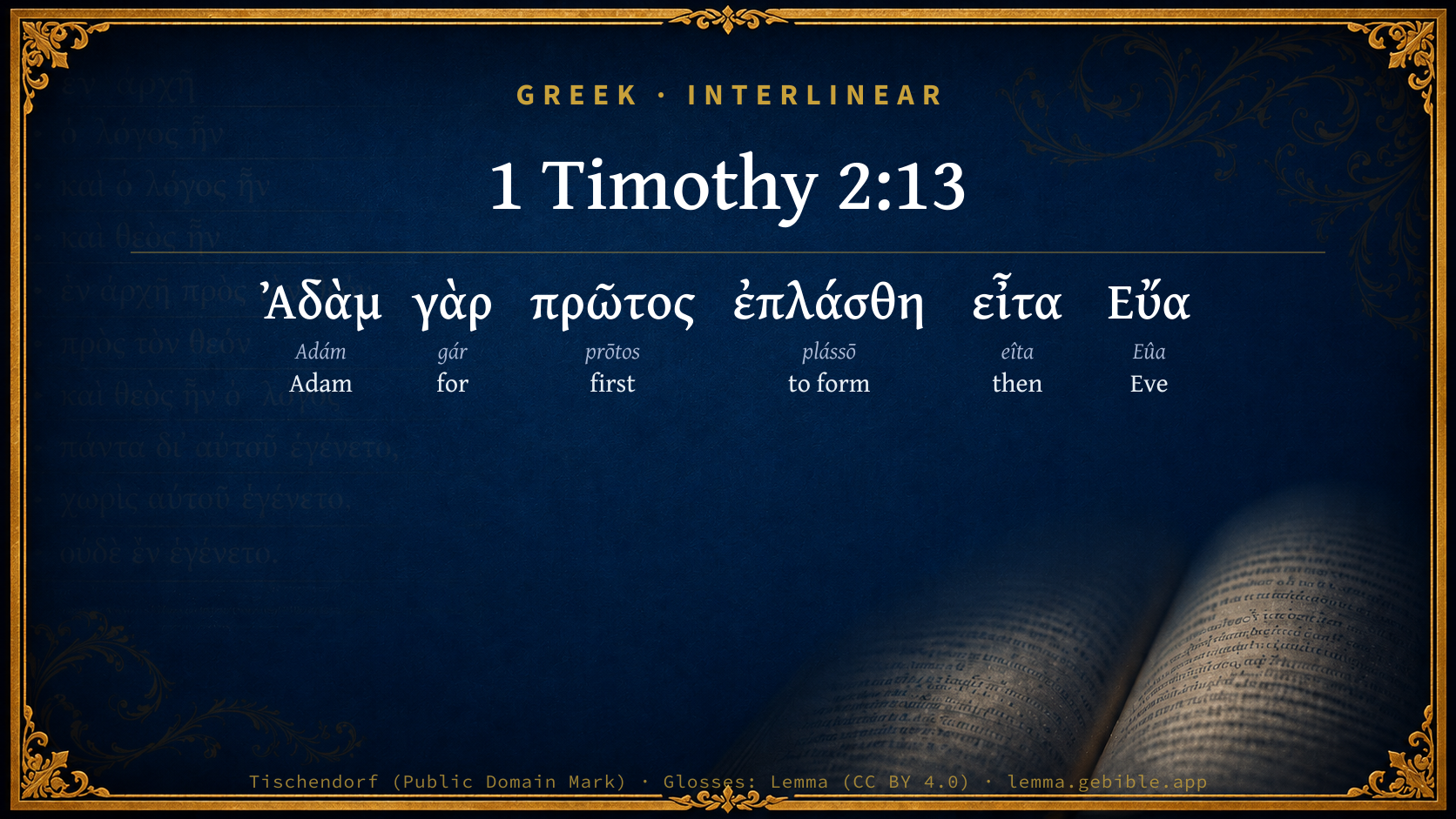
Greek (Tischendorf 8th ed.) 1 Timothy 2:13 appears in the Greek New Testament. The text above is from the Tischendorf 8th edition. Each word links to its Strong’s number and a concise gloss. Click any word for its full Thayer’s Greek Lexicon entry.
Download image
Cite this verse

1 Timothy 2:13 (World English Bible). Public Domain. Lemma interlinear Bible study tool, https://lemma.gebible.app/v/1-timothy/2/13.

Show BibTeX & RIS
BibTeX
RIS
English Translation
For Adam was first formed, then Eve.
World English Bible · Public Domain
Download a study sheet

One document with this verse’s original text, its word-by-word gloss line, the meaning frame, cross-references with their text, attributed commentary, and full source and license credits — printable, and it pastes into notes with its structure intact.

This verse Autodidact and up

Study sheet (.html) Plain text (.txt)

A passage Seminary Student

Up to 50 verses in one chapter. A passage sheet keeps up to 6 commentary sources and 12 cross-references per verse, in the order this page ranks them, and says so on the sheet whenever that leaves anything out. Ask for a single verse and you get the Autodidact verse sheet above.

Everything on this page stays free to read, with no account — the sheet is a download of what is already on screen, not access to it.

Want to remove ads? Support Godless Engineer
Compare translations 3

The same verse in 3 English versions, stacked beneath the original-language interlinear above. Click any original word for its lexicon entry.

Each is an independent rendering of the whole verse — the interlinear is not word-aligned to these translations.

Highlighted words mark where these versions differ — a whole-verse word diff, not a word-by-word alignment.

  • World English Bible Public Domain
    For Adam was first formed, then Eve.
  • King James Version Public Domain
    For Adam was first formed, then Eve.
  • unfoldingWord Literal Text CC BY-SA 4.0
    For Adam was formed first, then Eve,

unfoldingWord Literal Text — © unfoldingWord, licensed CC BY-SA 4.0. Word-aligned USFM3 via Door43 (git.door43.org/unfoldingWord/en_ult).

Versions to compare (up to 4)

3 of 4 selected

Show all 19 translations

Every available English version of this verse, each an independent rendering of the whole verse.

  • World English Bible Public Domain
    For Adam was first formed, then Eve.
  • Berean Standard Bible Public Domain
    For Adam was formed first, and then Eve.
  • Majority Standard Bible Public Domain
    For Adam was formed first, and then Eve.
  • King James Version Public Domain
    For Adam was first formed, then Eve.
  • American Standard Version (1901) Public Domain
    For Adam was first formed, then Eve;
  • Revised Version (1885) Public Domain
    For Adam was first formed, then Eve;
  • Geneva Bible (1599) Public Domain
    For Adam was first formed, then Eue.
  • Douay-Rheims (1899) Public Domain
    For Adam was first formed; then Eve.
  • Young's Literal Translation Public Domain
    for Adam was first formed, then Eve,
  • Literal Standard Version CC BY-SA 4.0
    for Adam was formed first, then Eve,
  • Unlocked Literal Bible CC BY-SA 4.0
    For Adam was formed first, then Eve.
  • unfoldingWord Literal Text CC BY-SA 4.0
    For Adam was formed first, then Eve,
  • Darby Bible Public Domain
    for Adam was formed first, then Eve:
  • World Messianic Bible Public Domain
    For Adam was formed first, then Havah.
  • Webster's Bible Public Domain
    For Adam was first formed, then Eve.
  • Free Bible Version CC BY-SA 4.0
    For Adam was made first, and then Eve.
  • Bible in Basic English Public Domain
    For Adam was first formed, then Eve;
  • Text-Critical English NT CC BY 4.0
    For Adam was formed first, then Eve.
  • Tyndale New Testament (1534) Public Domain
    For Adam was fyrst formed and then Eve.

Literal Standard Version (2020), Covenant Press — licensed CC BY-SA 4.0. Text via the HelloAO Bible API (eBible.org). Unlocked Literal Bible (unfoldingWord) — licensed CC BY-SA 4.0. Text via the HelloAO Bible API (eBible.org). unfoldingWord Literal Text — © unfoldingWord, licensed CC BY-SA 4.0. Word-aligned USFM3 via Door43 (git.door43.org/unfoldingWord/en_ult). Free Bible Version, Dr. Jonathan Gallagher — licensed CC BY-SA 4.0. Text via the HelloAO Bible API (eBible.org).

Word by word

More ways to search: Search by grammar → Find every occurrence → Compare this word →

Practice this passage: Drill this verse → Learn its vocabulary →

About this verse

These counts appear in no published source. They are computed here, from the morphology-tagged text and Lemma’s own curated glosses. What Lemma adds →

6
words
6
distinct lemmas
Pauline Epistles
section

Notable vocabulary

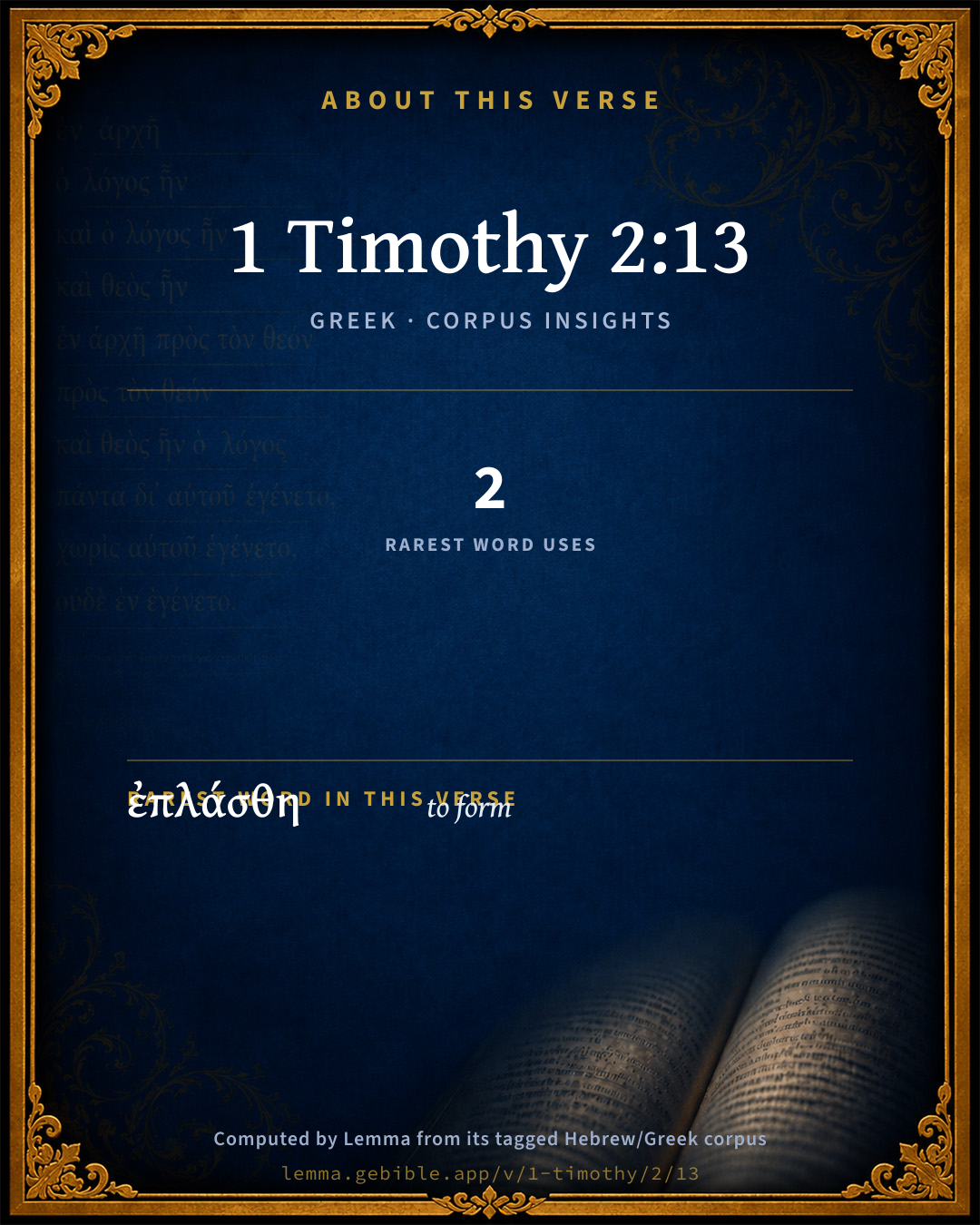
The rarest word here is ἐπλάσθη to form G4111 — appearing just 2 times in the whole Greek New Testament.

Shared distinctive vocabulary

ἐπλάσθη to form G4111 occurs in 2 verses of the Greek New Testament. Also found in:

Cross-references

5

Topical passages linked to 1 Timothy 2:13 in the Treasury of Scripture Knowledge — connected by theme and wording, ordered by reader-vote popularity; previews shown in the World English Bible.

  • Genesis 2:18 Yahweh God said, "It is not good that the man should be alone; I will make him a helper suitable for him."
  • 1 Corinthians 11:8–9 For man is not from woman, but woman from man;
  • Genesis 1:27 God created man in his own image. In God's image he created him; male and female he created them.
  • Genesis 2:22 He made the rib, which Yahweh God had taken from the man, into a woman, and brought her to the man.
  • Genesis 2:7 Yahweh God formed man from the dust of the ground, and breathed into his nostrils the breath of life; and man became a living soul.

Cross-references courtesy of OpenBible.info (CC BY 4.0).

Commentary

Notes on 1 Timothy 2:13 from classic Christian and Jewish commentators (each source and its license shown beneath its notes). The classic Christian expositions comment on the surrounding passage and are grouped to its opening verse, so a note may address several verses; the Jewish commentaries on the Tanakh (Rashi and others) are per-verse, so they appear only where the commentator wrote on this verse.

Lemma curates 59 commentaries, every one of them public domain or Creative Commons licensed, each selected and text-cleaned for this edition rather than reprinted as found. About our sources →

The Biblical Illustrator

Joseph S. Exell

1Ti_2:13

For Adam was first formed.

Man and woman: their relative work

As to the question, Which is the most important, man or woman? if I may be allowed to speak in editorial style, I should say, the discussion must now stop. Let those who like it sit apart upon a hill retired and discuss the kindred questions, which is the most important, convex or concave, night or morning, east or west, green land or glancing water? For ourselves we are, I hope, content to take Florence Nightingales advice--Keep clear of all jargons about mans work and womans work, and go your way straight to Gods work in simplicity and singleness of heart, each one to do what each one can do best. Now, we know that, as a rule, some things that women can do right nobly at a crisis, are not best for them to do when men are to be had. As a rule, I think it is not best for women to man a lifeboat; but one black night at Teignmouth last year, when the men were all out of the way, or else were not sharp enough, the women got the lifeboat out. With shrill, quivering cheers they carried it through the battling breakers, dragged a vessel off the sand-bar, and saved precious life. When we hear that they did all this without any help from the unfair sex, who can help saying, Well done! I go farther and say that, as a rule, in my private opinion, it is not best for women to preach in public, but where, in exceptional cases and with extra ordinary gifts, women like Mary Fletcher and Priscilla Gurney go out of their way, and all by themselves publicly launch the lifeboat of the gospel to snatch souls from the sea of sin and from the rocks of death, again I say to the praise of grace, Well done! They remind me of the Roman who said, I have broken the law, but I have saved the State! They are under a higher law than the law they violate, and I am no more able to doubt the validity of their orders than I can doubt the sanity of the New Testament. (C. Stanford, D. D.)

Punishment no hindrance to salvation

1. The punishment of the woman--in child-bearing.

2. The comfort of the woman--she shall be saved.

3. The condition of the salvation--if they continue. Wherein is implied an exhortation to continue in faith, etc.

Many observations might be raised.

1. The pain in childbearing is a punishment inflicted upon the woman for the first sin.

2. The continuance of this punishment after redemption by Christ, doth not hinder the salvation of the woman, if there be the gospel-conditions requisite.

3. The exercise of faith, with other Christian graces, is a peculiar means for the preservation of believers under Gods afflicting hand. I shall sum them up into this one. The continuance of the punishment inflicted upon the woman for the first sin doth not prejudice her eternal salvation, nor her preservation in child-bearing, where there are the conditions of faith and other graces.

I. Concerning the punishment. Child-bearing itself is not the punishment, but the pain in it. For the blessing, Increase and multiply, was given in innocency. And because this punishment is the greater, it is disputed in the schools whether Adams or Eves sin were the greater. We may, I think, safely make these conclusions.

1. In regard of the kind of sin, it was equal in both. They both had an equal pride, an equal aspiring to be like God.

2. In regard of the first motion to this sin, Eves sin was the greater. She was the seducer of Adam, which the apostle expresseth in the verse before the text.

3. In regard of the womans condition, the sin was greater on Adams part.

(1) Because he, being the man, had more power to resist, more strength to argue the case.

(2) Eve had a stronger and craftier adversary to deal with, the subtlest of all the beasts of the field (Gen_3:1), animated and inspired by a craftier devil. The stronger the tempter, the more excusable the sin.

(3) Eve had the command of not eating immediately from her husband, which laid not altogether so strong a tie upon her as it did upon him, who had it immediately from the mouth of God, and therefore was more certain of the verity of the precept.

II. Of what nature is this punishment?

1. It is not a punishment in a rigid sense, nor continued as such.

(1) Because it is not commensurate to the nature of the sin, neither is it that penalty which the law required. Death was due, and death immediately upon the offence; but death was kept off by the interposition of the mediator, and this which is less than death inflicted at present. Where death is deserved, and a lighter punishment inflicted, it is rather an act of clemency than strict justice, and may be called by the name of a partial pardon or reprieve, as well as a punishment.

(2) It is not a reparation of the injury done to God. One reason of the institution of punishment is to repair the damage the person offended sustains by the malefactor, as far as he is capable.

(3) It is not continued as a part of satisfaction to the justice of God; as though Christ needed the sufferings of the creature to make up the sum which He was to pay for us, and which He hath already paid. These punishments are to awaken men to a sight of their first sin.

(4) The proper impulsive cause of punishment is wrath. In inflicting it He preserves the authority of a Judge; in preserving under it, and pardoning the sin for which it was inflicted, He evidenceth the affection of a Father.

2. Yet it is in some sort a punishment, and something more than an affliction.

(1) In respect of the meritorious cause, sin. This is not inflicted as an act of absolute sovereignty, but a judicial legal act upon the demerit of sin.

(2) Because if man had stood in innocency, neither this grief, nor indeed any other, had been.

III. This punishment doth not hinder salvation though it be continued.

1. God intended not in the acceptance of Christs mediation to remove in this life all the punishments denounced after the Fall. God takes away the eternal, but not the temporal. Some parts of Christs purchase are only payable in another life, and some fruits of redemption God intends for growth only in another soil; such are freedom from pain, diseases, death, and sin. But the full value of Christs satisfaction will appear when there shall be a new heaven and a new earth, when the day of redemption shall dawn, and all tears be wiped from believers eyes. But God never promised the total removal of them in this life to any saint; no, though he should have all the faith and holiness of all the catalogue of saints in the Book of Life centred in him.

2. Christ never intended, in the payment of the price of our redemption, the present removal of them. He sent, after His ascension, the Spirit to be our Comforter, which supposeth a state wherein we should need comfort; and when are we under a greater necessity of comfort than when the punishment of sin is actually inflicted on us?

3. Christ intended, and did actually take away the curse of those punishments from every believer.

4. Hence it will follow that to a believer the very nature of these punishments is altered. In the one the sting remains; in the other it is pulled out. The cord that binds a malefactor and a patient may be made of the same hemp, and a knife only go between; but it binds the malefactor to execution, the other to a cure.

5. Therefore all temporal punishments of original sin, though they remain, do not prejudice a believers present interest.

(1) They cut not off his relation to God.

(2) They debar not from the presence of God. God may be and is as near to us in supporting as He is in punishing.

(3) They break not the covenant. His rod and His stripes, though they seem to break ore, backs, make no breaches in His covenant (Psa_89:32-34).

6. Add to all this, that the first promise secures a believer under the sufferings of those punishments. Gods affection in the promise of bruising the serpents head was more illustrious in His wrath than the threatening. There are the bowels of a father in the promise before there was the voice of a judge in the sentence. But it may be asked, What is the reason these punishments are continued since the redemption wrought by Christ? There are reasons--

(1) On Gods part.

(a) It is congruous to the wisdom of God to leave them upon us while we are in the world.

(b) It is congruous to the holiness of God. God keeps up those punishments as the Rector and Governor of the world, to show His detestation of that sin which brought a disorder and deformity upon the creation, and was the first act of dishonour to God, and the first pollution of the creature.

(c) It is a declaration of His justice.

(d) It is useful to magnify His love. We should not be sensible of what our Saviour suffered, nor how transcendently He loved us if the punishment of sin had been presently removed upon the first promise.

(2) On our parts. It is useful to us

(a) To make us abhor our first defection and sin.

(b) To make us fear to sin and to purge it out. Sin hath riveted itself so deep that easy medicines will not displace it. It hath so much of our affections that gentle means will not divorce us from it. We shall hate it most when we reap the punishment of it.

(c) To exercise grace.

1. Faith and trust--She that is desolate trusts in God (1Ti_5:5). The lower the state, the greater necessity and greater obligation to trust; such exercises manifest that the condition we are in is sanctified to us.

2. Obedience in a believer hath a greater lustre by them. It was the glory of Job that he preserved his integrity under the smartest troubles.

3. Humility. These punishments are left upon us to allay our pride, and be our remembrancers of our deplorable miscarriage.

4. Patience. Were there no punishments there would be but little occasion for patience. (S. Charnock.)

.

The Biblical Illustrator, edited by Joseph S. Exell (c. 1880s–1900s) — public domain. Text from a community e-Sword module.

Tyndale Open Study Notes

Tyndale Open Resources

2:13 The most common understanding of this verse is that Paul believes social roles are attached to the man being created first (Gen 2:7, 22; 1 Cor 11:8-12). Paul’s logic has usually been tied to the leading role of the firstborn son in the Old Testament. However, there are exceptions to the rule of firstborn even in Scripture (see Gen 27–28). And while gender retains its distinctions in the New Testament, there is also an element of equality in Christ (Gal 3:28; see also 1 Cor 11:11-12; 12:13; Eph 5:21; Col 3:11). • It is also possible that the heretics asserted a reversal of gender status in Christ relative to the surrounding culture, giving what would have been viewed as objectionable dominance to women. Paul’s allusion would then function to discredit this assertion and reestablish balance.

Tyndale Open Study Notes — © Tyndale Open Resources, licensed CC BY-SA 4.0. Text via the HelloAO Bible API.

Bengel's Gnomon

Johann Albrecht Bengel

1Ti 2:13. Ἀδὰμ γὰρ, for Adam) The reason which applies to the first man, holds good for all men; and that which applies to Eve, holds good for all women. Again, what is said of the salvability [safety] of the woman, 1Ti 2:15, is also appropriate to be understood of the first woman.—πρῶτος) first; so that the woman was created for him, 1Co 11:8-9.

Bengel's Gnomon of the New Testament — English translation (T&T Clark, Edinburgh, 1860) — public domain. Text from a community e-Sword module.

Meyer's Critical & Exegetical Commentary

Heinrich August Wilhelm Meyer

1Ti_2:13. First reason for the previous prohibition, taken from the history of the creation.1Ti_2:14. The second reason, taken from the history of the fall. Elsewhere in the Pauline Epistles we find proofs that the historical facts of the O. T. are to the apostle full of meaning as symbols of higher, universal truths. So here, the facts that Adam was first created, and that Eve, not Adam, was tempted by the serpent, are to him prototypes and proofs that it is becoming for the wife not αὐθεντεῖν ἀνδρός, but to be meekly subordinate to the husband. Hence he says: Ἀδὰμ γὰρ πρῶτος ἐπλάσθη, εἶτα Εὔα. The verb πλάσσειν occurs in the N. T. only here and in Rom_9:20, both times in its original meaning. The meaning create, here appropriate to the word, is, however, found in the LXX. Gen_2:7, from which passage the apostle here has drawn (comp. also 2Ma_7:23 : ὁ πλάσας ἀνθρώπου γένεσιν). Compare 1Co_11:2 ff., where the apostle says that the husband is εἴκων καὶ δόξα Θεοῦ, and the wife δόξα ἀνδρός, because the husband is not ἐκ γυναικός, but the wife ἐξ ἀνδρός. De Wette, without reason, thinks that the author of this Epistle to Timothy had that passage in mind.

Meyer — Critical and Exegetical Commentary on the New Testament — English translation by Peter Christie, edited by Frederick Crombie (T&T Clark, 1880) — public domain. Text from a community e-Sword module.

Expositor's Greek Testament

ed. W. Robertson Nicoll

1Ti 2:13 . It would not be fair to say that St. Paul’s judgment about the relative functions of men and women in the church depended on his belief as to the historicity of the Biblical story of the Creation. He certainly uses this account in support of his conclusions; yet supposing the literal truth of the early chapters of Genesis, it would be possible to draw quite other inferences from it. The first specimen produced of a series is not always the most perfect. The point in which Adam’s superiority over Eve comes out in the narrative of the Fall is his greater strength of intellect; therefore men are better fitted for the work of public instruction. “The woman taught once, and ruined all” (Chrys.). Eve’s reasoning faculty was at once overcome by the allegation of jealousy felt by God, an allegation plausible to a nature swayed by emotion rather than by reflection. The Tempter’s statement seemed to be supported by the appearance of the fruit, as it was rendered attractive by hopes of vanity to be gratified. Adam’s better judgment was overcome by personal influence (Gen 3:17 , “Thou hast hearkened unto the voice of thy wife”); he was not deceived. But the intellectual superior who sins against light may be morally inferior to him who stumbles in the dusk.

Ἀδὰμ πρῶτος ἐπλάσθη : The elder should rule. A more profound statement of this fact is found in 1Co 11:9 , οὐκ ἐκτίσθη ἀνὴρ διὰ τὴν γυναῖκα , ἀλλὰ γυνὴ διὰ τὸν ἄνδρα .

πλάσσειν is the term used in Gen 2:7 and expresses the notion of God as a potter, Rom 9:20 . ( am here has figuratus .)

The Expositor's Greek Testament, edited by W. Robertson Nicoll (1897–1910) — public domain. Text from a community e-Sword module.

Geneva Bible (1599)

Geneva Bible translators

He proveth this ordinance of God, whereby the woman is subject to man, first by that, that God made the woman after man, for man’s sake.

Geneva Bible (1599) marginal notes — public domain. Text via Bolls.life.

Jamieson, Fausset & Brown

Robert Jamieson, A. R. Fausset & David Brown

For--reason of the precept; the original order of creation.

Adam . . . first--before Eve, who was created for him (Co1 11:8-9).

Jamieson, Fausset & Brown — Commentary Critical and Explanatory on the Whole Bible (1871) — public domain (CC PDM 1.0). Text via the HelloAO Bible API.

Adam Clarke's Commentary

Verse 13. For Adam was first formed, then Eve.] And by this very act God designed that he should have the pre-eminence. God fitted man, by the robust construction of his body, to live a public life, to contend with difficulties, and to be capable of great exertions. The structure of woman's body plainly proves that she was never designed for those exertions required in public life. In this the chief part of the natural inferiority of woman is to be sought.

Adam Clarke's Commentary on the Bible (1810–1826) — public domain. Text from a community e-Sword/MySword module.

John Calvin's Commentaries

13 For Adam was first created He assigns two reasons why women ought to be subject to men; because not only did God enact this law at the beginning, but he also inflicted it as a punishment on the woman. (Genesis 3:16.) He accordingly shews that, although mankind had stood in their first and original uprightness, the true order of nature, which proceeded from the command of God, bears that women shall be subject. Nor is this inconsistent with the fact, that Adam, by falling from his first dignity, deprived himself of his authority; for in the ruins, which followed sin, there still linger some remains of the divine blessing, and it was not proper that woman, by her own fault, should make her condition better than before.

Yet the reason that Paul assigns, that woman was second in the order of creation, appears not to be a very strong argument in favor of her subjection; for John the Baptist was before Christ in the order of time, and yet was greatly inferior in rank. But although Paul does not state all the circumstances which are related by Moses, yet he intended that his readers should take them into consideration. Now Moses shews that the woman was created afterwards, in order that she might be a kind of appendage to the man; and that she was joined to the man on the express condition, that she should be at hand to render obedience to him. (Genesis 2:21.) Since, therefore, God did not create two chiefs of equal power, but added to the man an inferior aid, the Apostle justly reminds us of that order of creation in which the eternal and inviolable appointment of God is strikingly displayed.

John Calvin's Commentaries (1540-1563) — public domain. Text from the Calvin Translation Society English edition (1840s-50s) via the Christian Classics Ethereal Library (ccel.org). Calvin's coverage is partial (roughly two-thirds of the Bible); uncommented books and verses are honest gaps, never fabricated. The 19th-century editor's footnotes and remarks are omitted so the notes are faithfully Calvin's own voice.

Ellicott's Commentary for English Readers

(13) For Adam was first formed, then Eve.—The Holy Spirit seems often (comp. especially Gal_3:16 and following verses, and 4:22 and following verses, and 1Co_10:1-10) to have moved St. Paul to weave into the tapestry of his arguments and exhortations to the different churches, facts and principles drawn from Old Testament history. His early training in the great Rabbinical schools of Jerusalem had well supplied him with a vast store of this Old Testament learning.

The argument here based on priority of creation is much assisted by the additional statement of 1Co_11:9, “neither was the man created for the woman, but the woman for the man.” This teaching of St. Paul’s respecting the public position of woman as regards man, in which he shows that she is to hold a subordinate place—is based upon no arbitrary human speculation, but upon God’s original order in creation—that divine order which first created man, and after man’s creation, formed woman as his helpmeet.

A Bible Commentary for English Readers, edited by Charles John Ellicott (1878–1897) — public domain. Text from a community e-Sword module.

The Cambridge Bible for Schools and Colleges

gen. ed. J. J. S. Perowne

13. ‘The Apostle appeals to the original order and course of things. By inverting this relative position and calling—the helpmate assuming the place of the head or guide, and the head facilely yielding to her governance—was the happy constitution of Paradise overthrown.’ Fairbairn.

The Cambridge Bible for Schools and Colleges (gen. ed. J. J. S. Perowne; Cambridge University Press, 1878–1918) — public domain. Text from a community e-Sword module.

John Gill's Exposition

And Adam was not deceived,.... There is no need to say with interpreters, that he was not deceived first; and that he was not deceived immediately by the serpent, but by Eve; and that he is never said in Scripture to be deceived, as Melchizedek is never said to have a father or mother. The apostle's positive assertion is to be taken without any such limitations or qualifications; Adam never was deceived at all; neither by the serpent, with whom he never conversed; nor by his wife, he knew what he did, when he took the fruit of her, and ate; he ate it not under any deception, or vain imagination, that they should not die, but should be as gods, knowing good and evil. He took and ate out of love to his wife, from a fond affection to her, to bear her company, and that she might not die alone; he knew what he did, and he knew what would be the consequence of it, the death of them both; and inasmuch as he sinned wilfully, and against light and knowledge, without any deception, his sin was the greater: and hereby death came in, and passed on all men, who sinned in him:

but the woman being deceived was in the transgression: and the serpent really beguiled her; she owned it herself, Gen 3:13. And this is elsewhere said of her, Co2 11:3 which never is of Adam. She really thought the serpent spoke truth, that she and her husband should not die, if they ate of the fruit; but that it was good to make them wise; and that, upon eating it, they should be as gods, knowing good and evil; and under this deception she fell into the transgression, and was the cause and means, by her persuasions and example, of bringing her husband into the same sin; which involved him and all his posterity in ruin and destruction. And therefore she is called by the Jews (p) , "the mother of iniquity and sin"; to which they refer, Psa 51:5. And they say, (q) she was the cause of death to Adam, and to all the world: See Gill on Rom 5:12. And they observe (r) the order of the punishment of the serpent, Eve, and Adam, as of their sin; the serpent was first accursed, then Eve, and last of all Adam. They say

"(s) Samael (the devil) could not subvert Adam, till the serpent came and turned the heart of Eve, and Eve turned his heart, and they both sinned; wherefore it is said, "the woman which thou gavest me"; Samael had no power to turn him, till Eve came, and she was the cause of his eating.''

Now inasmuch as the serpent did not attack Adam, he being the stronger and more knowing person, and less capable of being managed and seduced; but made his attempt on Eve, in which he succeeded; and since not Adam, but Eve, was deceived, it appears that the man is the more proper person to bear rule and authority, as in civil and domestic, so in ecclesiastic affairs; and it is right for the woman to learn, and the man to teach: and seeing that Eve was the cause of transgression to Adam, and of punishment to him and his posterity, the subjection of the woman to the man was confirmed afresh: and she was brought into a more depressed state of dependence on him, and subjection to him; see Gen 3:16. The Ethiopic version renders the text, "Adam hath not deceived, the woman hath deceived and prevaricated".

(p) Tzeror Hammor, fol. 141. 3. (q) T. Hieros. Sabbat, fol. 5. 2. Zohar in Gcn. fol. 27. 3. Caphtor, fol. 37. 2. (r) T. Bab. Erubin, fol. 18. 1. & Taanith, fol. 15. 2. Bereshit Rabba, sect. 20. fol. 17. 1. (s) Midrash Ruth in Zohar in Gen. fol. 27. 3.

John Gill's Exposition of the Whole Bible (1746–1763) — public domain (CC PDM 1.0). Text via the HelloAO Bible API.

Trapp's Complete Commentary

John Trapp

13 For Adam was first formed, then Eve.

Ver. 13. For Adam was first formed] επλασθη. As the vessel is formed by the potter out of the clay. See Gen 2:7. The common opinion is, that the very same day επλασθη και εξηλασθη, he was formed and driven out; that he lodged not one night in Paradise; so sudden was the serpent’s seducing, his wife’s consenting, his yielding, God’s execution.

Then Eve] For Adam’s use and help, therefore she must not take upon her. Howbeit the Jews are out, that hold women to be of a lower creation, made only for the propagation and pleasure of man; also that they have not so divine a soul as men, and therefore they suffer them not to enter into the synagogue, but appoint them a gallery without. Their Rabbis (who have as many foolish dreams about the Old Testament as the Friars have about the New) conceive both Adam and Eve to be created without the use of reason; and that the tree of knowledge was to accelerate it. Socinians also say (but falsely) that they were as simple and weak as little children; otherwise they would not have so sinned. Cuius contrarium verum est.

John Trapp, A Commentary or Exposition upon All the Books of the Old and New Testament (1647–1656) — public domain. Text from a community e-Sword module.

Albert Barnes' Notes on the Bible

For Adam was first formed, then Eve - The apostle, in this verse, and the following, gives reasons why a woman should occupy a subordinate situation, and not usurp authority. The first is, that she was second in the act of creation, or was made subsequent to man. The reason here assigned cannot be understood to be merely that of priority of existence - for then it would give every old person authority over a younger one; but it must refer to the circumstances of the case as detailed in the history of the creation; Gen. 1–2. Man was made as the lord of this lower creation and placed in the garden, and then the woman was made of a rib taken from his side, and given to him, not as a lord, but as a companion. All the circumstances combine to show the subordinate nature of her rank, and to prove that she was not designed to exert authority over the man; compare notes on 1Co 11:8-9.

Albert Barnes' Notes on the Bible (1834–1885) — public domain. Text from a community e-Sword/MySword module.

Haydock's Catholic Bible Commentary

Adam was first formed....and was not seduced. That is, was not at least seduced first, as the woman. (Witham)

George Leo Haydock (1774–1849), Haydock's Catholic Family Bible and Commentary, 1859 edition — public domain. Excludes Psalms (Douay-Rheims chapter numbering differs from Protestant) and Deuterocanonical books (Catholic canon only).

Matthew Poole's English Annotations

The man had the priority of the woman in his creation, he was not made for her, but she was made for a help-mate mate for him; therefore she, being made for him, ought to usurp no authority over him.

Matthew Poole's English Annotations on the Holy Bible (1683–1685) — public domain. Text from a community e-Sword/MySword module.

Whedon's Commentary on the Bible

Daniel D. Whedon

13. This law of nature our apostle authenticates by the sacred history of the creation.

Adam was first formed—And Eve added as the “help meet” for the original man.

Daniel D. Whedon (gen. ed.), Commentary on the Old and New Testaments (1874–1909) — public domain. Text from a community e-Sword module.

The Pulpit Commentary

Was formed (ejplasqh). The word used in the LXX in Gen_2:7. Eplasen oJ Qeov ton anqrwpon k.t.l., "The Lord God formed man out of the dust of the ground;" and inplastov, Gen_2:19 of the beasts of the field; whence the word prwto (RAPC Wis 7:1 10:1) "first made;" "first formed," A.V So insav, Rom_9:20 man is called tosma, "the thing made;" and God is oJ Pla "he that made it." "Plaster," "plastic," "protoplasm," are, of course, from the same root. For the argument, see the very similar one in 1Co_11:8, 1Co_11:9.

The Pulpit Commentary (1880–1919), ed. H.D.M. Spence-Jones & Joseph S. Exell — public domain. Text from a community e-Sword module.

John Wesley's Explanatory Notes

First - So that woman was originally the inferior.

John Wesley, Explanatory Notes Upon the Whole Bible (1754–1765) — public domain. Text via the GEBible commentary corpus.

Burkitt's Expository Notes on the New Testament

William Burkitt

Here St. Paul offers a double argument to enforce the duty of subjection upon the woman, and to prevent her usurping of authority over the man; namely, because the man was first in the creation: Adam was first formed, then Eve, and the woman was first in the transgression. Adam was not deceived, that is, first and immediately deceived, but the woman being deceived, was first in the transgression; she was therefore guilty of her own and her husband’s transgression; and accordingly, not only by the law of her creation, but as a punishment for her transgression, God has placed her in a state of subjection, and given the man authority over her; which authority she usurps over him, whenever she undertakes to be a public teacher of him.

These two considerations doth the apostle make use of, to humble the woman, and to keep her within the sphere of her proper duty.

William Burkitt's Expository Notes on the New Testament (1700–1703) — public domain. Text from a community e-Sword module.

The People's New Testament

B. W. Johnson

13. Some reasons drawn from the story of man in Eden are given for these rules. It will be seen that Paul regards these events as shadowing forth spiritual lessons. Adam was first formed. Man came in order before woman.

B. W. Johnson's The People's New Testament with Notes (1889–1891) — public domain. Electronic text from the Christian Classics Ethereal Library (CCEL) ThML edition.

unfoldingWord translationNotes

Door43 World Missions Community

Adam was formed first

This can be stated in active form. AT: "Adam is the one God formed first" or "God created Adam first" (See: Active or Passive)

then Eve

The understood information can be stated clearly. AT: "and then God formed Eve" or "then God created Eve" (See: Ellipsis)

Adam was not deceived

This can be stated in active form. AT: "And Adam was not the one whom the serpent deceived" (See: Active or Passive)

but the woman was deceived and became a transgressor

This can be stated in active form. AT: "but it was the woman who disobeyed God when the serpent deceived her" (See: Active or Passive)

she will be saved through bearing children

Here "she" refers to women in general. Possible meanings are 1) God will keep women physically safe as they give birth to children, or 2) God will save women from their sins through their role as child bearers.

she will be saved

This can be stated in active form. AT: "God will save her" or "God will save women" (See: Active or Passive)

if they continue

"if they remain" or "if they continue living." Here "they" refers to women.

in faith and love and sanctification

The abstract nouns here can be translated with verbal phrases. AT: "in trusting Jesus and loving others and living a holy life" (See: Abstract Nouns)

with soundness of mind

Possible meanings for this idiom are 1) "with good judgment," 2) "with modesty," or 3) "with self-control." (See: Idiom)

soundness of mind

If the idiom is retained in translation, the abstract noun "soundness" can be translated with an adjective. AT: "a sound mind" (See: Abstract Nouns)

translationWords

Adam

Eve

deceive

transgress

faith

love

sanctify

unfoldingWord translationNotes — © Distant Shores Media and the Door43 World Missions Community, licensed CC BY-SA 4.0. Source: git.door43.org/Door43/en_tn.

Cambridge Greek Testament for Schools and Colleges

13, 14. FROM THE HISTORY OF HUMAN ORIGINS TWO REASONS ARE ASSIGNED FOR THE PROHIBITION TO WOMEN TO TEACH AND EXERCISE AUTHORITY OVER MEN

(i.) The first of these is derived from the order of creation.

13. Ἀδὰμ γὰρ πρῶτος ἐπλάσθη, εἶτα Εὔα. There is a somewhat similar argument in 1Co 11:9, which see. That Adam was created first implies a certain superiority; such at least seems to be the Apostle’s thought.

The word πλάσσειν is specifically used for the creation of man; see e.g. Gen 2:7; the usual rendering of the Latins for ἐπλάσθη is formatus est, but am has figuratus.

(ii.) The second reason is based on the history of the Fall; the woman was deceived, not the man, and this suggests that she will be an unfit guide. ‘From a woman was the beginning of sin’ said the Son of Sirach (Sir 25:24). Facilius decepta, facilius decipit, as Bengel tersely puts it.

Cambridge Greek Testament for Schools and Colleges (Cambridge University Press, 1896; 21 vols, various authors incl. Carr, Maclear, Plummer, Farrar, Lumby, Moule, M. R. James, Simcox) — public domain. Text from a community e-Sword module.

Alford’s Greek Testament

Henry Alford

13.] Reason of this precept, in the original order of creation. For Adam was first (not of all men, which is not here under consideration, and would stultify the subsequent clause:—but first in comparison with Eve) made (see ref. Gen., from which the word ἐπλάσθη seems to be taken: cf. 1Co 11:8, 1Co 11:9, and indeed that whole passage, which throws light on this), then Eve.

Henry Alford, The Greek Testament (1849–1861) — public domain. Text from a community e-Sword module.

International Critical Commentary

13. ἐξαπατηθεῖσα: so 2Co 11:8 ἐξηπάτησεν, though the LXX has ἠπάτησεν.

International Critical Commentary — older volumes (1896–1929), various authors — public domain. Text from a community e-Sword module.

Vincent's Word Studies in the New Testament

Marvin R. Vincent

Was formed [επλασθη] . Comp. Rom 9:20. Strictly of one working in soft substances, as a potter in clay; moulding or shaping. Often in Class. and LXX

Marvin R. Vincent, Word Studies in the New Testament (1887–1900) — public domain. Text from a community e-Sword/MySword module.

Lesson kit

Teaching starters — assembled from the data on this page, not authored interpretation. Every prompt links to the verse data it draws on. Edit before teaching.

1 Timothy, in the Pauline Epistles, opens this verse with 6 words (6 distinct Greek lemmas). Its most distinctive word is plássō (“to form”). A historical commentator’s framing appears above. Read the whole chapter for the surrounding context.

Discussion questions

  1. The word plássō carries the sense “to form.” How does it shape the verse?
  2. How does Romans 9:20, which shares the word «to form», read alongside this verse?
  3. Compare how The Biblical Illustrator and Tyndale Open Study Notes read this verse. Where do they agree or differ?

Reading settings

Reading text

Shown beneath each verse's original-language words.

Old Testament
Old Testament edition

Read the OT as the Masoretic Hebrew (MT) or the Greek Septuagint (LXX).

English shown for the Greek Septuagint (in the Hebrew ↔ Greek comparison).

Comparing translations? Open the Compare panel on any verse page to stack up to four side by side.