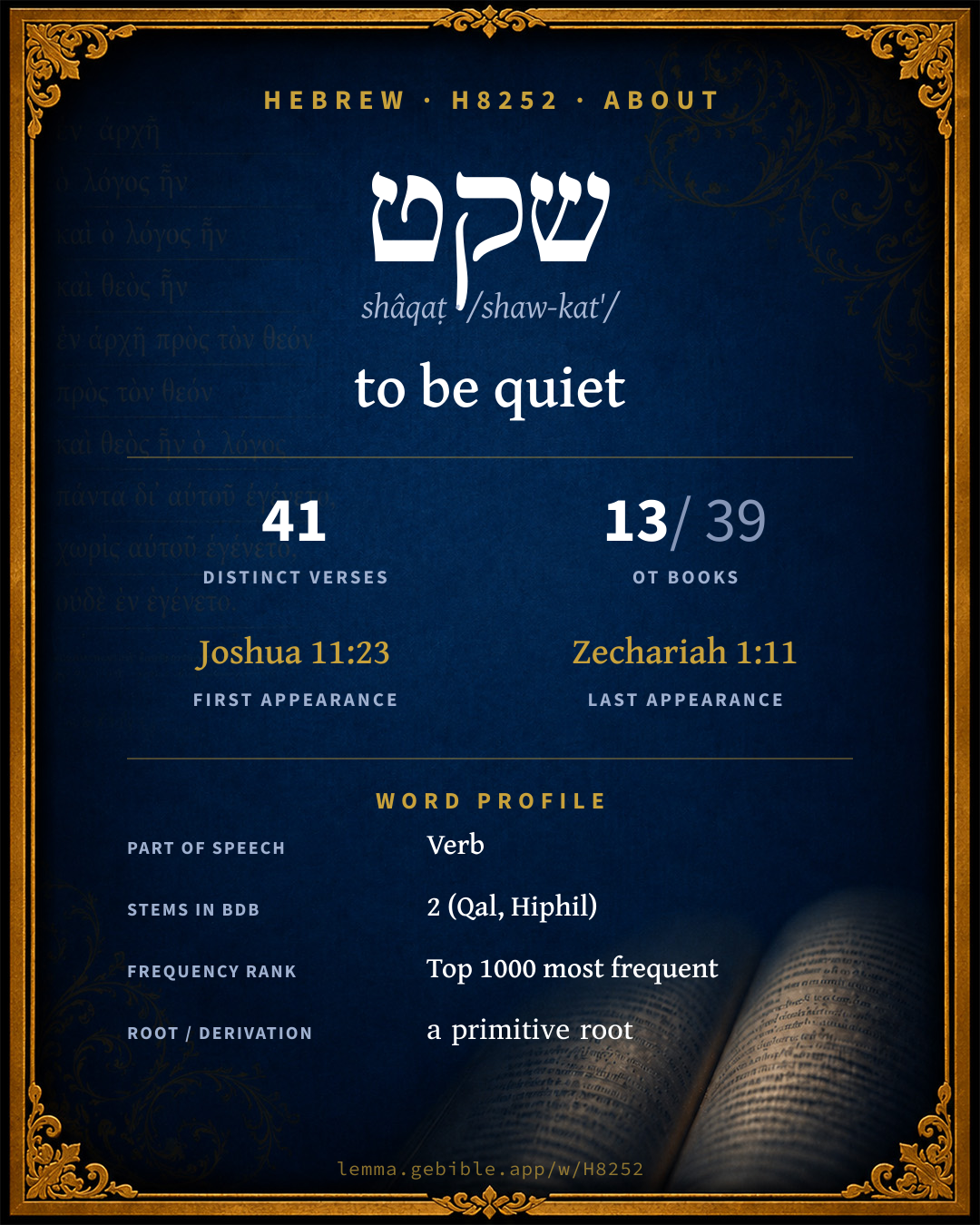
שָׁקַט
to be quiet
also: be tranquil, be at peace, be quiet, rest fuller range ↓
Full lexicon entry — Brown-Driver-Briggs (BDB)
From Brown-Driver-Briggs (BDB)
Where this word appears
See every Qal verb in the Hebrew Bible →
Grammar key — what these labels mean
Part of speech
- Verb
- An action or state-of-being word.
Stem
- Qal
- The basic, simple active stem — the plain form of the verb (“he wrote”). Here: ‘of land’
- Hiphil
- The causative active stem (“he caused / brought about”). Here: ‘shew quietness’
Form
- Perfect
- A completed action or state — Hebrew marks aspect (completeness) more than strict tense (“he wrote”).
- Sequential Imperfect
- An imperfect with prefixed waw — the standard past-narrative form (waw-consecutive imperfect).
- Infinitive Absolute
- An unbound verbal noun, often intensifying or standing in for a finite verb.
- Infinitive Construct
- A bound verbal noun, frequently with prepositions (“to write / in writing”).
- Sequential Perfect
- A perfect with prefixed waw continuing a preceding imperfect or command (waw-consecutive perfect).
- Participle Active
- A verbal adjective expressing ongoing or characteristic action (“writing / one who writes”).
- Imperfect
- An incomplete, ongoing, or future action (“he will / would write”).
- Cohortative
- A first-person volitional form expressing wish or resolve (“let me / let us write”).
- Imperative
- A direct command (“write!”).
- Jussive
- A third- or second-person volitional form expressing wish or command (“let him write”).
State
- Absolute
- The independent form of a noun, not bound to a following word.
Person
- 3rd Person
- The one spoken about (“he / she / it / they”).
- 1st Person
- The speaker (“I / we”).
- 2nd Person
- The one addressed (“you”).
Gender
- Feminine
- Grammatically feminine.
- Masculine
- Grammatically masculine.
- Common
- Either gender — not distinguished for this form.
Number
- Singular
- One.
- Plural
- More than one (in Hebrew, generally three or more).
Grammatical forms 17 distinct
- Verb, Qal, Perfect, 3rd Person, Feminine, Singular 8 times (19%)
- Verb, Qal, Sequential Imperfect, 3rd Person, Feminine, Singular 6 times (14%)
- Verb, Hiphil, Infinitive Absolute 4 times (10%)
- Verb, Hiphil, Infinitive Construct 3 times (7%)
- Verb, Qal, Participle Active, Masculine, Singular, Absolute 3 times (7%)
- Verb, Qal, Sequential Perfect, 3rd Person, Masculine, Singular 2 times (5%)
- Verb, Qal, Participle Active, Feminine, Singular, Absolute 2 times (5%)
- Verb, Hiphil, Imperfect, 3rd Person, Masculine, Singular 2 times (5%)
+9 more forms (12 occurrences)
Parsed forms decoded from the imported morphology (morphhb / Westminster Leningrad Codex — WLC text public domain, morphhb tagging CC BY 4.0), counted across 42 parsed occurrences — not distinct verses.
Every verse where H8252 appears — 41 distinct verses across 13 books. Click any verse to open its interlinear word-by-word view. Verse text shown in the World English Bible for context — . Each verse’s Hebrew form is shown with its reference; the English is not keyword-highlighted, since the data carries no word-level English alignment. Use “Compare translations” on any verse to read it across multiple English versions. This concordance covers the Hebrew Bible; Septuagint (Greek Old Testament) occurrences are not indexed here.
Joshua 2 verses
- Joshua 11:23 שָׁקְטָ֖ה Qal pf 3fs So Joshua took the whole land, according to all that Yahweh spoke to Moses; and Joshua gave it for an inheritance to Israel according to their divisions by their tribes. The land had rest from war.
- Joshua 14:15 שָׁקְטָ֖ה Qal pf 3fs Now the name of Hebron before was Kiriath Arba; [which Arba was] the greatest man among the Anakim. The land had rest from war.
Judges 6 verses
- Judges 3:11 וַ/תִּשְׁקֹ֥ט conj + Qal wimpf 3fs The land had rest forty years. Othniel the son of Kenaz died.
- Judges 3:30 וַ/תִּשְׁקֹ֥ט conj + Qal wimpf 3fs So Moab was subdued that day under the hand of Israel. The land had rest eighty years.
- Judges 5:31 וַ/תִּשְׁקֹ֥ט conj + Qal wimpf 3fs So let all your enemies perish, Yahweh: But let those who love him be as the sun when he goes forth in his might. The land had rest forty years.
- Judges 8:28 וַ/תִּשְׁקֹ֥ט conj + Qal wimpf 3fs So Midian was subdued before the children of Israel, and they lifted up their heads no more. The land had rest forty years in the days of Gideon.
- Judges 18:7 שֹׁקֵ֣ט Qal ptcp.act ms Then the five men departed, and came to Laish, and saw the people who were therein, how they lived in security, after the manner of the Sidonians, quiet and secure; for there was none in the land, possessing authority, that might put [them] to shame in anything, and they were far from the Sidonians, and had no dealings with any man.
- Judges 18:27 שֹׁקֵ֣ט Qal ptcp.act ms They took that which Micah had made, and the priest whom he had, and came to Laish, to a people quiet and secure, and struck them with the edge of the sword; and they burnt the city with fire.
Ruth 1 verse
2 Kings 1 verse
1 Chronicles 1 verse
2 Chronicles 5 verses
- 2 Chronicles 14:1 שָׁקְטָ֥ה Qal pf 3fs So Abijah slept with his fathers, and they buried him in the city of David; and Asa his son reigned in his place. In his days the land was quiet ten years.
- 2 Chronicles 14:5 וַ/תִּשְׁקֹ֥ט conj + Qal wimpf 3fs Also he took away out of all the cities of Judah the high places and the sun-images: and the kingdom was quiet before him.
- 2 Chronicles 14:6 שָׁקְטָ֣ה Qal pf 3fs He built fortified cities in Judah; for the land was quiet, and he had no war in those years, because Yahweh had given him rest.
- 2 Chronicles 20:30 וַ/תִּשְׁקֹ֖ט conj + Qal wimpf 3fs So the realm of Jehoshaphat was quiet; for his God gave him rest round about.
- 2 Chronicles 23:21 שָׁקָ֑טָה Qal pf 3fs So all the people of the land rejoiced, and the city was quiet. Athaliah they had slain with the sword.
Job 4 verses
- Job 3:13 וְ/אֶשְׁק֑וֹט conj + Qal impf 1cs For now should I have lain down and been quiet. I should have slept, then I would have been at rest,
- Job 3:26 שָׁקַ֥טְתִּי Qal pf 1cs I am not at ease, neither am I quiet, neither have I rest; But trouble comes."
- Job 34:29 יַשְׁקִ֨ט Hiphil impf 3ms When he gives quietness, who then can condemn? When he hides his face, who then can see him? Alike whether to a nation, or to a man:
- Job 37:17 בְּ/הַשְׁקִ֥ט prep + Hiphil inf.cs You whose clothing is warm, When the earth is still by reason of the south wind?
Psalms 3 verses
- Psalms 76:8 וְ/שָׁקָֽטָה conj + Qal pf 3fs You pronounced judgment from heaven. The earth feared, and was silent,
- Psalms 83:1 תִּשְׁקֹ֣ט Qal juss 2ms God, don't keep silent. Don't keep silent, And don't be still, God.
- Psalms 94:13 לְ/הַשְׁקִ֣יט prep + Hiphil inf.cs That you may give him rest from the days of adversity, Until the pit is dug for the wicked.
Proverbs 1 verse
Isaiah 7 verses
- Isaiah 7:4 וְ/הַשְׁקֵ֜ט conj + Hiphil impv 2ms Tell him, 'Be careful, and keep calm. Don't be afraid, neither let your heart be faint because of these two tails of smoking firebrands, for the fierce anger of Rezin and Syria, and of the son of Remaliah.
- Isaiah 14:7 שָׁקְטָ֖ה Qal pf 3fs The whole earth is at rest, [and] is quiet: they break forth into singing.
- Isaiah 18:4 אשקוטה אֶשְׁקֳטָ֖ה Qal coh 1cs Qal coh 1cs For thus has Yahweh said to me, I will be still, and I will see in my dwelling-place, like clear heat in sunshine, like a cloud of dew in the heat of harvest.
- Isaiah 30:15 בְּ/הַשְׁקֵט֙ prep + Hiphil inf.cs For thus said the Lord Yahweh, the Holy One of Israel, In returning and rest shall you be saved; in quietness and in confidence shall be your strength. You would not:
- Isaiah 32:17 הַשְׁקֵ֥ט Hiphil inf.abs The work of righteousness shall be peace; and the effect of righteousness, quietness and confidence forever.
- Isaiah 57:20 הַשְׁקֵט֙ Hiphil inf.abs But the wicked are like the troubled sea; for it can't rest, and its waters cast up mire and dirt.
- Isaiah 62:1 אֶשְׁק֑וֹט Qal impf 1cs For Zion's sake will I not hold my peace, and for Jerusalem's sake I will not rest, until her righteousness go forth as brightness, and her salvation as a lamp that burns.
Jeremiah 6 verses
- Jeremiah 30:10 וְ/שָׁקַ֥ט conj + Qal wpf 3ms Therefore don't you be afraid, O Jacob my servant, says Yahweh; neither be dismayed, Israel: for, behold, I will save you from afar, and your seed from the land of their captivity; and Jacob shall return, and shall be quiet and at ease, and none shall make him afraid.
- Jeremiah 46:27 וְ/שָׁקַ֥ט conj + Qal wpf 3ms But don't be afraid you, Jacob my servant, neither be dismayed, Israel: for, behold, I will save you from afar, and your seed from the land of their captivity; and Jacob shall return, and shall be quiet and at ease, and none shall make him afraid.
- Jeremiah 47:6 תִשְׁקֹ֑טִי Qal impf 2fs You sword of Yahweh, how long will it be before you be quiet? put up yourself into your scabbard; rest, and be still.
- Jeremiah 47:7 תִּשְׁקֹ֔טִי Qal impf 2fs How can you be quiet, seeing Yahweh has given you a charge? Against Ashkelon, and against the sea-shore, there has he appointed it.
- Jeremiah 48:11 וְ/שֹׁקֵ֥ט conj + Qal ptcp.act ms Moab has been at ease from his youth, and he has settled on his lees, and has not been emptied from vessel to vessel, neither has he gone into captivity: therefore his taste remains in him, and his scent is not changed.
- Jeremiah 49:23 הַשְׁקֵ֖ט Hiphil inf.abs Of Damascus. Hamath is confounded, and Arpad; for they have heard evil news, they are melted away: there is sorrow on the sea; it can't be quiet.
Ezekiel 3 verses
- Ezekiel 16:42 וְ/שָׁ֣קַטְתִּ֔י conj + Qal wpf 1cs So will I cause my wrath toward you to rest, and my jealousy shall depart from you, and I will be quiet, and will be no more angry.
- Ezekiel 16:49 הַשְׁקֵ֗ט Hiphil inf.abs Behold, this was the iniquity of your sister Sodom: pride, fullness of bread, and prosperous ease was in her and in her daughters; neither did she strengthen the hand of the poor and needy.
- Ezekiel 38:11 הַ/שֹּׁ֣קְטִ֔ים ptcl def.art + Qal ptcp.act mp and you shall say, I will go up to the land of unwalled villages; I will go to those who are at rest, who dwell securely, all of them dwelling without walls, and having neither bars nor gates;
Zechariah 1 verse
About this entry
At a glance — auto-summarized from this page’s data, not written by a person. Every figure links to its source below. This summary describes the numbers; it doesn’t interpret them.
“to be quiet” is the headline sense of the Hebrew verb שקט (shâqaṭ). First canonically at Joshua 11:23, it enters the text early. It turns up in 41 verses across 13 books, a moderately common footprint. Different stems carry different senses — BDB groups them under 2 stems, among them Qal and Hiphil. From the same root come שקט. The sections below give every sense, occurrence, and version rendering.
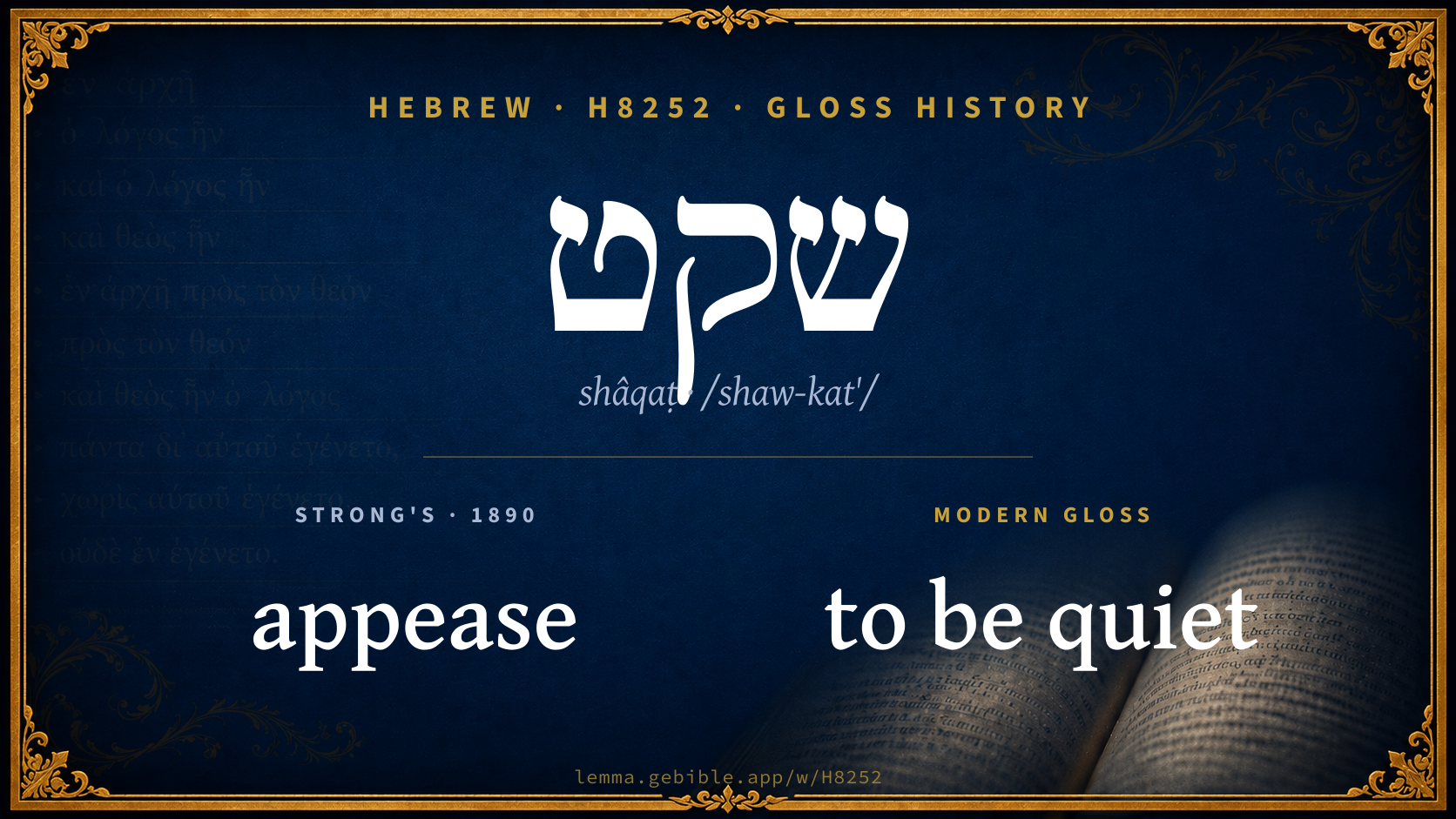
Gloss history
Strong's 1890 vs modern scholarship
About this word
Strong's H8252 catalogs a Hebrew word from the Hebrew Old Testament.
These counts are not copied from any lexicon or concordance. They are computed here, from the morphology-tagged Hebrew Old Testament. What Lemma adds →
- 41
- distinct verses
- The word appears in 41 distinct verses.
- 13 / 39
- OT books
- The word appears in 13 of 39 Old Testament books.
- #864
- by frequency
- Top 1000 most frequent Hebrew words (rank 864 of 8,640 Hebrew words by occurrence).
View all 41 occurrences in the concordance →
By section of the Old Testament
By traditional corpus
Conventional, traditional groupings — biblical authorship is debated, so this is a traditional corpus grouping, not an authorship claim. Each share is this word’s portion of its verses in that division of the Hebrew canon. Each figure is a share of the word’s 41 distinct verses.
- Prophets (Nevi'im) 26 verses · 63%
- Writings (Ketuvim) 15 verses · 37%
How translations render this word
Counts come from each version’s own published word-to-Strong’s tagging or interlinear alignment — an approximate guide to how each version renders this word, not a word-level alignment the data otherwise carries. Because each total is that version’s own tagged count, the per-version totals vary from one another and need not match the appearance or distinct-verse counts above. These counts may also differ from a printed concordance because Lemma counts each distinctly tagged rendering and does not collapse phrase taggings into a single head-word total. This is a fixed set of word-tagged versions (KJV, ASV, BSB, ULT) and does not change with the reading translation you choose elsewhere. Each version’s license is shown beside its name below (and on Sources).
- King James Version: Had rest 5×, Was quiet 4×, Be quiet 2×
- American Standard Version: Had rest 6×, Was quiet 6×, Quiet 3×
- Berean Standard Bible: Had rest 6×, Quiet 5×, Was at peace 4×
- unfoldingWord Literal Text: Was quiet 7×, Rested 6×, And 5×
King James Version Public Domain
Renders H8252 across 41 tagged occurrences — most commonly:
Plus 26 renderings that appear only once — usually multi-word phrases or single function words the recovered tagging swept in, not distinct renderings.
American Standard Version Public Domain
Renders H8252 across 44 tagged occurrences — most commonly:
Plus 25 renderings that appear only once — usually multi-word phrases or single function words the recovered tagging swept in, not distinct renderings.
Berean Standard Bible Public Domain
Renders H8252 across 40 tagged occurrences — most commonly:
Plus 23 renderings that appear only once — usually multi-word phrases or single function words the recovered tagging swept in, not distinct renderings. Not rendered by a distinct English word in 1 further occurrence.
unfoldingWord Literal Text CC BY-SA 4.0
Renders H8252 across 44 tagged occurrences — most commonly:
Plus 19 renderings that appear only once — usually multi-word phrases or single function words the recovered tagging swept in, not distinct renderings.
Senses in the full BDB
Hebrew verbs can shift meaning by stem (binyan): Qal is the basic action, Niphal is often passive or reflexive, Piel often intensifies or makes it factitive, and Hiphil is typically causative. The senses below are grouped under the stem BDB assigns to each.
What do BDB’s symbols mean?
BDB uses these scholarly abbreviations:
| Symbol | Meaning |
|---|---|
| 𝔊 | the Septuagint (the ancient Greek translation, LXX) |
| 𝔙 | the Vulgate (the Latin translation) |
| 𝔖 | the Syriac version (the Peshitta) |
| 𝔗 | the Targum (the Aramaic translation) |
| ψ | the Psalms |
| √ | root (the underlying root or stem) |
| ‖ | parallel passage (a synonymous or contrasted parallel) |
| † | the dagger: every passage where the word occurs is cited |
The 6 senses and sub-senses the full Brown-Driver-Briggs lexicon distinguishes for this word, in lexicon order (not ranked by frequency), with BDB’s own verbatim wording and sub-sense lettering. Shown in Hebrew script with BDB’s own scholarly abbreviations. The condensed entry is in the Lexicon Entry tab. See also the Forms in the corpus table below.
Qal
- Pf. 3 ms. consec. וְשׁ׳ Je 30:10; 46:27, 3 fs. שָֽׁקְטָה Jos 11:23 +, שָׁקָ֑טָה 2 K 11:20 +; 1 s. שָׁקַ֫טְתִּי Jb 3:26, וְשָׁקַטְתִּ֫י Ez 16:42; Impf. 3 ms. יִשְׁקֹט Ru 3:18; 2 fs. תְּשְׁקֹ֑טִי Je 47:6, 7; 1 s. אֶשְׁקוֹט Is 62:1; Jb 3:13, אשׁקוטה Is 18:4 Kt, Qr אֶשָׁקֳטָה (Ges§§ 10h, 48c); Pt. שֹׁקֵט Ju 18:7 +, fs. שֹׁקֶ֫טֶת 1 Ch 4:40, שֹׁקָ֑טֶת Zc 1:11; pl. הַשֹּׁקְטִים Ez 38:11;—be quiet, undisturbed: e.g. Jeremiah 30:10
- 1. of land, at peace, abs. Ju 3:11, 30; 5:31; 8:28; Is 14:7 (+ נָ֫חָה), 2 Ch 13:23; 14:5; + מִמִּלְחָמָה Jos 11:23; 14:15 (D?), cf. v 5 (P); וּשְׁלֵוָה וְשׁ׳ 1 Ch 4:40; of earth ψ 76:9 Zc 1:11 (ישֶׁבֶת ושׁ׳); abs. of city 2 K 11:20 = 2 Ch 23:21, kingdom 2 Ch 20:30, + לִפְנֵי pers. 14:4; of people, שׁ׳ וּבֹטֵחַ in peace and security Ju 18:7, 27, הַשֹּׁקְטִים ישְׁבֵי לָבֶ֑טַח Ez 38:11; + שַׁאֲנַן Je 30:10 = 46:27; of Moab, שַׁאֲנַן … וְשֹׁקִט אֶל־שְׁמָרָיו 48:11 undisturbed upon its less (fig. of wine); of Job, quiet in death Jb 3:13, be at rest (from apprehensions of evil) v 26 (+ שָׁלַוְתִּי, נָחְ֑תִּי). e.g. Judges 3:11
- 2. be quiet, inactive: of י׳ + וְאַבִּיטָה Is 18:4 I will be quiet and gaze, i.e. gaze as an inactive spectator, ψ 83:2 (‖ דמה, חרשׁ be silent); = be pacified Ez 16:42; of sword of י׳ Je 47:6, 7; of Boaz Ru 3:18 he will not be quiet until he has finished the matter; of prophet Is 62:1 (‖ חָשָׁה be silent). e.g. Isaiah 18:4
Hiphil
- Impf. 3 ms. יַשְׁקִיט Pr 15:18, יַשְׁקִט Jb 34:29; Imv. ms. הַשְׁקֵט Is 7:4; Inf. abs. חַשְׁקֵט Is 32:17 +; cstr. הַשְׁקִיט ψ 94:13, -קִט Jb 37:17, -קֵט Is 57:20; Je 49:23;— e.g. Proverbs 15:18
- 1. shew quietness (inner causat.), of men Is 7:4 (+ אַל־תִּירָא), of sea Is 57:20 = Je 49:23, earth Jb 37:17 (+ מִדָּרוֹם); hence Inf. abs. = subst., quietness, display of quietness Is 30:15, עֲבֹדַת הַצְּדָקָה הַשְׁקֵט וָבֶ֫טַח 32:17 the product of righteousness is quietness and security (Du CheHpt Marti del. הַצּ׳ as dittogr. from v a, read הַמִּשְׁפָּט for הַשְׁקֵט, and del. וָ: the product of justice is security); (presumptuous) security, שַׁלְוַת הַשְׁקֵט Ez 16:49 (of Sodom). e.g. Isaiah 7:4
- 2. cause quietness: subj. י׳ Jb 34:29, לְהַשְׁקִיט לוֹ מִימֵי רָ֑ע ψ 94:13; pacify, allay, obj. רִיב Pr 15:18. e.g. Job 34:29
Senses from the full Brown-Driver-Briggs lexicon (Brown, Driver, Briggs; Oxford 1906 — public domain), digitized via Sefaria, supplemented by the OpenScriptures HebrewLexicon (CC BY 4.0). Full attribution on Sources.
Word origin
vb. be quiet, undisturbed (𝔗 שְׁקַט (rare); NH שׁקט is sink down; Arabic سَقَطَ is drop down);—
— Brown-Driver-Briggs (Oxford 1906, public domain), digitized via Sefaria, supplemented by the OpenScriptures HebrewLexicon (CC BY 4.0). See Sources.
Origin: a primitive root
Jastrow Dictionary
A second Hebrew/Aramaic lexicon for comparison, covering Aramaic and post-biblical (Talmudic, Targumic, Midrashic) usage that the biblical-Hebrew BDB does not. Matched by lemma rather than by Strong’s number, so a lemma may carry more than one Jastrow headword (shown separately below), and the entries cover usage well beyond the Bible.
שָׁקַט I
- to cut off, shorten, v. שָׁקוּט.
שָׁקַט II
- (b. h.) to settle, be at rest, at ease. Sabb. 88ᵃ למה שָׁקְטָה, v. יָרֵא; Ab. Zar. 3ᵃ; Yalk. Ps. 811. Yalk. Hab. 563 ש׳ העולם the world remained undisturbed; Tanḥ. ed. Bub., Sh’mini 10 שקטה הארץ; a. e.
- 1. to be quiet, careless (cmp. שָׁלֵו). Gen. R. s. 36, beg. (ref. to Job XXXIV, 29) והוא יַשְׁקִיט מעולמו and he (the Lord) is unconcerned about his world; Lev. R. s. 5 (not בעולמו). e.g. Job 34:29
- 2. to give rest, ease. Gitt. 31ᵇ (ref. to Job XXXVII, 17) אימתי … בשעה שה׳ וכ׳ (Rashi בשׁמַשְׁקִיט) when are thy clothes warm? When he makes the world rest from the south (when the south wind abates); Yalk. Job 922.—[Tosef. Erub. IX (VI), 26 המשקטין Var., v. קָשַׁט.] e.g. Job 37:17
שְׁקַט
- Targ. Jud. XVIII, 7; 27. Targ. Ex. XXIII, 12 (h. text וינפש). Targ. Jer. XXX, 10; a. fr.
- to give rest. Targ. Is. LXII, 1.
שֶׁקֶט
- preced.) rest, ease. Snh. VIII, 5 ש׳ לרשעים וכ׳ the ease of the wicked is bad for them and bad for the world.
A Dictionary of the Targumim, the Talmud Babli and Yerushalmi, and the Midrashic Literature (Marcus Jastrow; London, Luzac, 1903) — Public Domain. Digitized via Sefaria. Digitized via Sefaria. Full attribution on Sources.
Forms in the corpus
The 33 distinct written forms H8252 takes in the Hebrew Bible, most frequent first — each parse links to that stem’s occurrences in the concordance. Hebrew forms include their vowel points and cantillation, so a single lemma takes many written forms.
Same root — word family
Other BDB entries built from the same root as H8252, grouped by Strong’s listed origin. These share a root / origin per the lexicon — not necessarily a shared meaning. Each links to that word’s own entry.
Derived from this word
Compare all same-root words → They share a root, not necessarily a meaning.
Septuagint verse parallels
This word appears in 38 verses that also exist in the Greek Old Testament (Septuagint), out of the 41 Hebrew verses it occurs in. You can read those verses in Greek by switching the Old Testament edition to the Septuagint.
Read these verses in the Septuagint
- Joshua 11:23
- Judges 3:11
- Ruth 3:18
- 2 Kings 11:20
- 1 Chronicles 4:40
- 2 Chronicles 14:1
- Job 3:13
- Psalms 76:8
- Proverbs 15:18
- Isaiah 7:4
- Jeremiah 30:10
- Ezekiel 16:42
This is a verse-level parallel only — the same verses exist in both the Hebrew and Greek Old Testaments. No word-level Hebrew↔Greek correspondence is claimed: the data carries no such alignment, so no Greek word is shown as this Hebrew word’s translation. Coverage is not total — the Septuagint omits the deuterocanon and renumbers the Psalms, so some Hebrew verses have no direct Greek parallel.