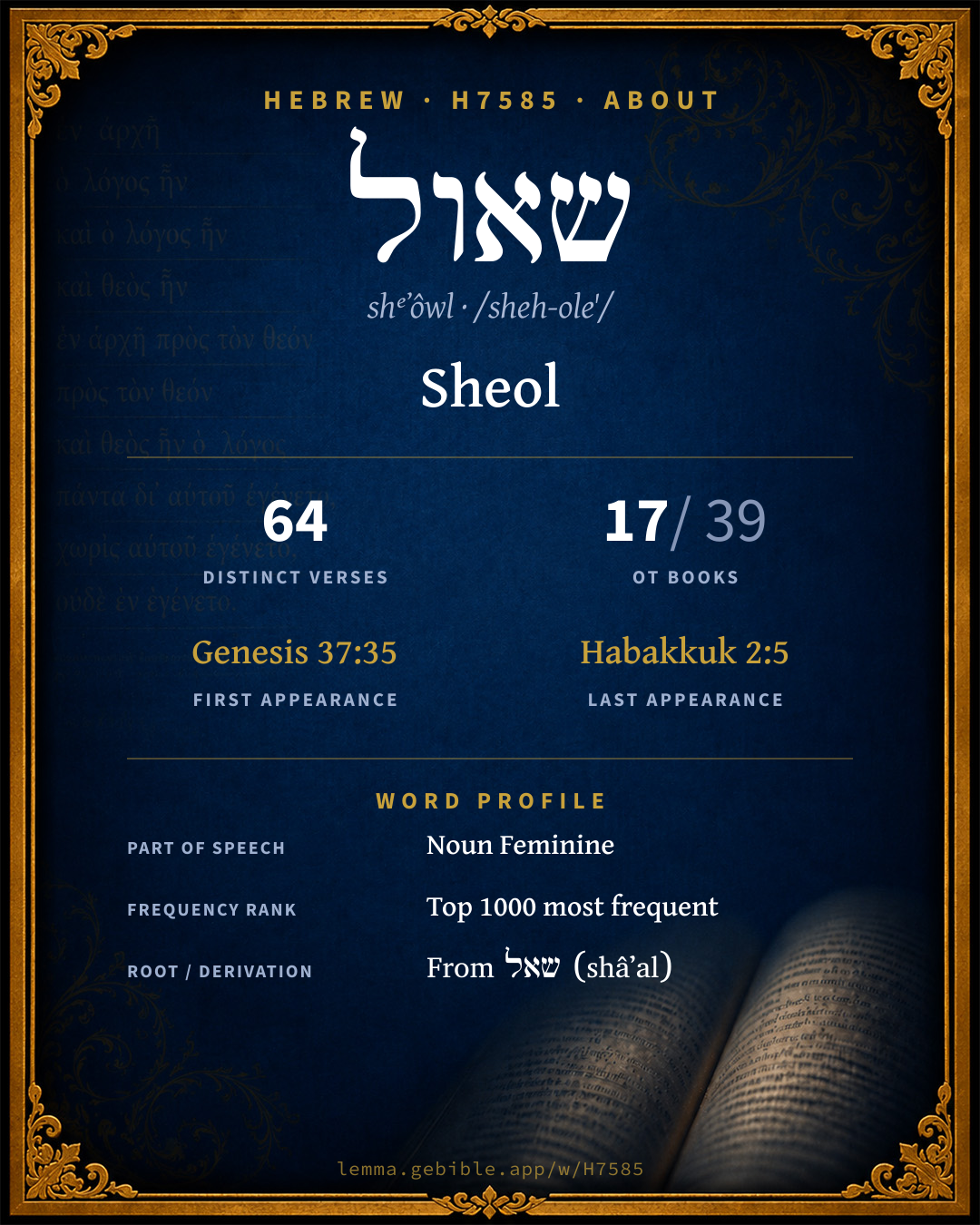
שְׁאוֹל
Sheol
also: underworld, grave, hell, pit fuller range ↓
Full lexicon entry — Brown-Driver-Briggs (BDB)
From Brown-Driver-Briggs (BDB)
Where this word appears
Grammar key — what these labels mean
Part of speech
- Noun
- A naming word — a person, place, thing, or idea.
- Verb
- An action or state-of-being word.
Noun type
- Proper
- A name of a specific person, place, or people (e.g. Abraham, Zion, Israel).
- Common
- A common noun — a general class of person, place, or thing (“king,” “city,” “water”), not a specific name.
Stem
- Qal
- The basic, simple active stem — the plain form of the verb (“he wrote”).
Form
- Infinitive Construct
- A bound verbal noun, frequently with prepositions (“to write / in writing”).
State
- Absolute
- The independent form of a noun, not bound to a following word.
Gender
- Masculine
- Grammatically masculine.
Number
- Singular
- One.
Every verse where H7585 appears in the Book of Ezekiel — 5 distinct verses. Click any verse to open its interlinear word-by-word view. Verse text shown in the World English Bible for context — . Each verse’s Hebrew form is shown with its reference; the English is not keyword-highlighted, since the data carries no word-level English alignment. Use “Compare translations” on any verse to read it across multiple English versions. This concordance covers the Hebrew Bible; Septuagint (Greek Old Testament) occurrences are not indexed here.
Ezekiel
- Ezekiel 31:15 שְׁא֨וֹלָ/ה֙ n Proper + sfx dem Thus says the Lord Yahweh: In the day when he went down to Sheol I caused a mourning: I covered the deep for him, and I restrained the rivers of it; and the great waters were stayed; and I caused Lebanon to mourn for him, and all the trees of the field fainted for him.
- Ezekiel 31:16 שְׁא֖וֹלָ/ה n Proper + sfx dem I made the nations to shake at the sound of his fall, when I cast him down to Sheol with those who descend into the pit; and all the trees of Eden, the choice and best of Lebanon, all that drink water, were comforted in the lower parts of the earth.
- Ezekiel 31:17 שְׁא֖וֹלָ/ה n Proper + sfx dem They also went down into Sheol with him to those who are slain by the sword; yes, those who were his arm, [that] lived under his shadow in the midst of the nations.
- Ezekiel 32:21 שְׁא֖וֹל n Proper The strong among the mighty shall speak to him out of the midst of Sheol with those who help him: they are gone down, they lie still, even the uncircumcised, slain by the sword.
- Ezekiel 32:27 שְׁא֣וֹל n Proper They shall not lie with the mighty who are fallen of the uncircumcised, who are gone down to Sheol with their weapons of war, and have laid their swords under their heads, and their iniquities are on their bones; for [they were] the terror of the mighty in the land of the living.
About this entry
At a glance — auto-summarized from this page’s data, not written by a person. Every figure links to its source below. This summary describes the numbers; it doesn’t interpret them.
At its core, שאול (shᵉʼôwl) means “Sheol.” Scripture first uses it in Genesis 37:35. It appears 64 verses across 17 books of the Hebrew Bible, among its moderately common vocabulary. Each statement above links to its evidence; the full detail follows below.
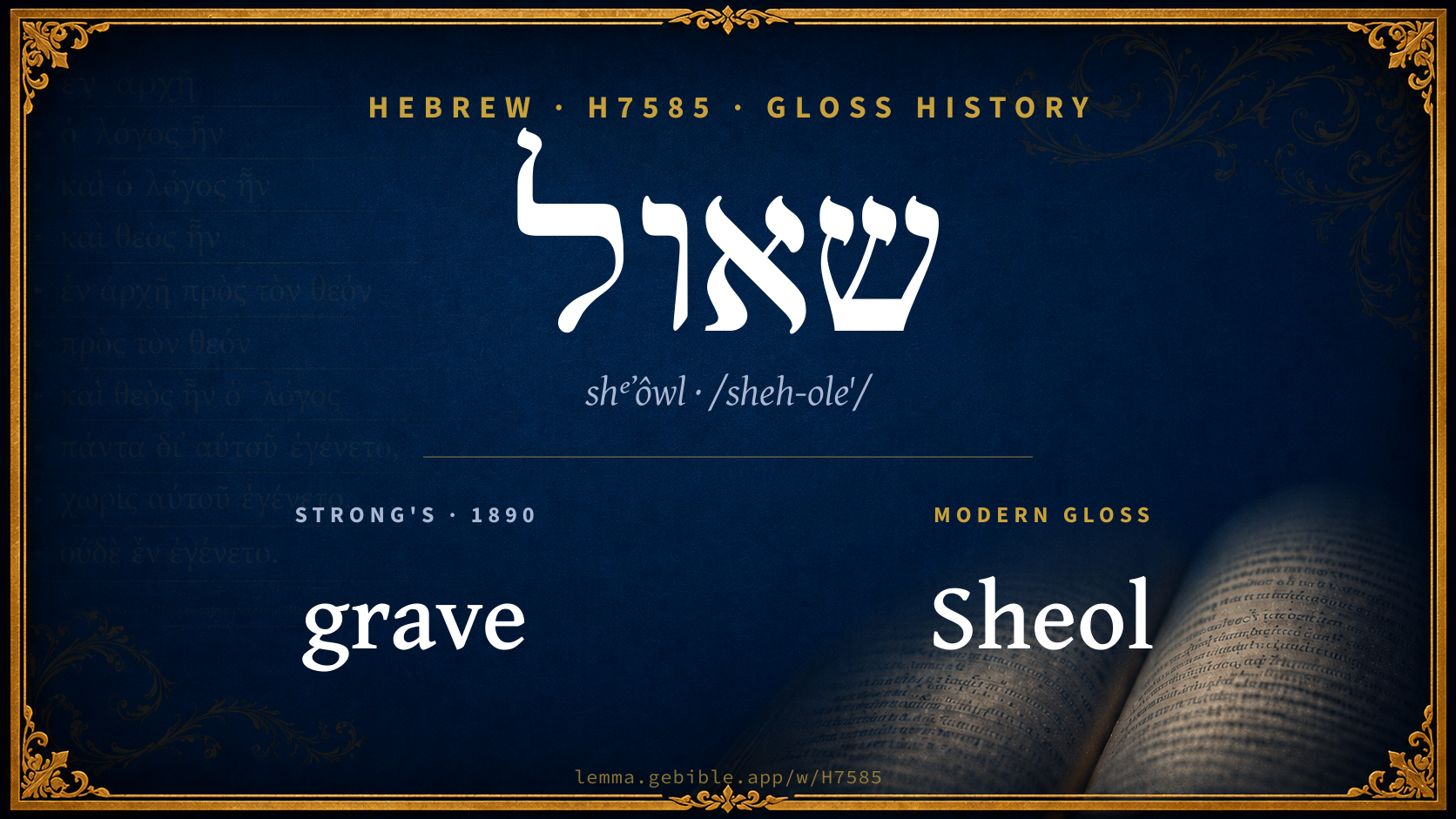
Gloss history
Strong's 1890 vs modern scholarship
About this word
Strong's H7585 catalogs a Hebrew word from the Hebrew Old Testament.
These counts are not copied from any lexicon or concordance. They are computed here, from the morphology-tagged Hebrew Old Testament. What Lemma adds →
- 64
- distinct verses
- The word appears in 64 distinct verses.
- 17 / 39
- OT books
- The word appears in 17 of 39 Old Testament books.
- #594
- by frequency
- Top 1000 most frequent Hebrew words (rank 594 of 8,640 Hebrew words by occurrence).
View all 64 occurrences in the concordance →
By section of the Old Testament
By traditional corpus
Conventional, traditional groupings — biblical authorship is debated, so this is a traditional corpus grouping, not an authorship claim. Each share is this word’s portion of its verses in that division of the Hebrew canon. Each figure is a share of the word’s 64 distinct verses.
- Writings (Ketuvim) 34 verses · 53%
- Prophets (Nevi'im) 23 verses · 36%
- Torah (Pentateuch) 7 verses · 11%
How translations render this word
Counts come from each version’s own published word-to-Strong’s tagging or interlinear alignment — an approximate guide to how each version renders this word, not a word-level alignment the data otherwise carries. Because each total is that version’s own tagged count, the per-version totals vary from one another and need not match the appearance or distinct-verse counts above. These counts may also differ from a printed concordance because Lemma counts each distinctly tagged rendering and does not collapse phrase taggings into a single head-word total. This is a fixed set of word-tagged versions (KJV, ASV, BSB, ULT) and does not change with the reading translation you choose elsewhere. Each version’s license is shown beside its name below (and on Sources).
- King James Version: Grave 28×, Hell 28×, Pit 3×
- American Standard Version: Sheol 55×
- Berean Standard Bible: Sheol 61×, Like sheol 2×
- unfoldingWord Literal Text: Sheol 62×, Like sheol 3×
King James Version Public Domain
Renders H7585 across 65 tagged occurrences — most commonly:
Plus 6 renderings that appear only once — usually multi-word phrases or single function words the recovered tagging swept in, not distinct renderings.
American Standard Version Public Domain
Renders H7585 across 65 tagged occurrences — most commonly:
Plus 10 renderings that appear only once — usually multi-word phrases or single function words the recovered tagging swept in, not distinct renderings.
Berean Standard Bible Public Domain
Renders H7585 across 66 tagged occurrences — most commonly:
Plus 3 renderings that appear only once — usually multi-word phrases or single function words the recovered tagging swept in, not distinct renderings.
unfoldingWord Literal Text CC BY-SA 4.0
Renders H7585 across 67 tagged occurrences — most commonly:
Plus 2 renderings that appear only once — usually multi-word phrases or single function words the recovered tagging swept in, not distinct renderings.
8 senses and sub-senses in the full BDB
What do BDB’s symbols mean?
BDB uses these scholarly abbreviations:
| Symbol | Meaning |
|---|---|
| 𝔊 | the Septuagint (the ancient Greek translation, LXX) |
| 𝔙 | the Vulgate (the Latin translation) |
| 𝔖 | the Syriac version (the Peshitta) |
| 𝔗 | the Targum (the Aramaic translation) |
| ψ | the Psalms |
| √ | root (the underlying root or stem) |
| ‖ | parallel passage (a synonymous or contrasted parallel) |
| † | the dagger: every passage where the word occurs is cited |
The 8 senses and sub-senses the full Brown-Driver-Briggs lexicon distinguishes for this word, in lexicon order (not ranked by frequency), with BDB’s own verbatim wording and sub-sense lettering. Shown in Hebrew script with BDB’s own scholarly abbreviations. The condensed entry is in the Lexicon Entry tab. See also the Forms in the corpus table below.
- 1. the underworld, שׁ׳ תַּחְתִּית Dt 32:22, מִתַּחַת Is 14:9; מִשּׁ׳ מָ֑טָּה Pr 15:24; ‖ מָוֶת 5:5; 7:27; Ct 8:6 ψ 89:49; whither men descend at death, Gn 37:35 (E), 42:38; 44:29, 31 (J), 1 S 2:6; 1 K 2:6, 9; Jb 7:9; 21:13; Is 14:11, 15 ψ 88:4, and Ḳoraḥ and associates go down alive by י׳’s judgment, Nu 16:30, 33 (J), cf. ψ 55:16; under mts. and sea Jb 26:6 (cf. v 5), בֶּטֶן שׁ׳ Jon 2:3 (cf. v 7); with bars Jb 17:16 (si vera l.: v. 𝔊 Du); פִּי שׁ׳ ψ 141:7; שַׁעֲרֵי שׁ׳ Is 38:10; personif. Is 28:15, 18 (‖ מות) as insatiable monster 5:14; Hb 2:5; Pr 1:12; 27:20; 30:16; as said (fig.) to have snares, חֶבְלֵי שׁ׳, ψ 18:6 = 2 S 22:6, cf. מְצָרֵי שׁ׳ ψ 116:3; opp. (height of) שָׁמַיִם Am 9:2; Jb 11:8 ψ 139:8 + (opp. לְמָ֑עְלָה) Is 7:11 (v. supra); dark, gloomy, without return Jb 17:13 (cf. v 16; 7:9; 10:21; 16:22; all being alike 3:17–19; 21:23–26); without work or knowledge or wisdom according to Ec 9:5, 6, 10 (cf. Jb 14:21, and v. רְפָאִים sub רפה; yet cf. Is 14:9 f.). e.g. Deuteronomy 32:22
- 2. condition of righteous and wicked disting. in שׁ׳ (later than 1 S 28, especially in WisdLt):
- a. wicked יָשׁוּבוּ לִשְׁא֑וֹלָה ψ 9:18, יִדְּמוּ לִשׁ׳ 31:18; death is their shepherd, without power and honour they waste away 49:15(×2); שׁ׳ consumes them as drought water Jb 24:19; righteous dread it because no praise or presence of God there (as in temple) ψ 6:6 (cf. 88:6), Is 38:18; deliverance from it a blessing ψ 30:4; 86:13; Pr 23:14. In Ezek. שׁ׳ is land below, place of reproach, abode of uncircumcised Ez 31:15, 16, 17; 32:21, 27. e.g. Psalms 9:18
- b. righteous shall not be abandoned, לשׁ׳ ψ 16:10 (‖ שַׁחַת q.v.; opp. אֹרַח הַיִּים, etc., v 11, cf. 17:15), is ransomed from שׁ׳ 49:16 (cf. 73:23, 25; Is 57:1, 2); cf. Job’s expectation and desire Jb 14:13; 17:13 (cf. 10:21; 19:25 f.). e.g. Psalms 16:10
- 3. later distinction of places in שׁ׳:
- a. depths of שׁ׳ for sensualist Pr 9:18. e.g. Proverbs 9:18
- b. שׁ׳ וַאֲבַדּוֹן Pr 15:11, v. אֲבַדּוֹן. [שַׁחַת and בּוֹר, q.v., when ‖ שׁ׳, are usually in bad sense (ψ 88:4); prob. = pit in שׁ׳, > שׁ׳ itself as pit; words at least prepare for local distinctions of postB. Judaism and NT.] e.g. Proverbs 15:11
- 4. שׁ׳ fig. of extreme degradation in sin Is 57:9; as place of exile for Israel Ho 13:14(×2) (cf. Is 26:19). e.g. Isaiah 57:9
Senses from the full Brown-Driver-Briggs lexicon (Brown, Driver, Briggs; Oxford 1906 — public domain), digitized via Sefaria, supplemented by the OpenScriptures HebrewLexicon (CC BY 4.0). Full attribution on Sources.
Word origin
n.f. ψ 86:13 (appar. m. Jb 26:6 cf. Is 14:9, v. AlbrZAW xvi (1896), 51) Sheʾôl, underworld (√ dub.; שׁאל, i.e. place of inquiry (ref. to necromancy) JastrAm. J. Sem. Lang. xiv. 170, cf. JBL xix (1900), 88 ff. (JeremLeben n. d. Tode 109 ‘Ort der Entscheidung’); Thes BöDe Inf. § 158 Di al. cp. √ שׁעל, whence שֹׁעַל hollow hand, etc.; שׁ׳ then = hollow place, ‘Hölle’, hell; other conj. v. Hup Ps. 6:6; De Is. 5:14 BeerBibl. Hades in HoltzmannFestgabe, 1902, 15; most now refrain from positive etymology (e.g. Buhl); Old Aramaic שאול, Syriac ܫܝܽܘܠ; Assyrian šu-alu is dub.: so read and interpr. DlPa 121; Prol. 47, 145 JastrAm. J. Sem. Lang. xiv. 165 ff. Ency. Bib.s.v.; opp. by BertinTSBA viii. 269 JenKosmol. 223 ff. ZimKAT 3. 636 al.; v. also Muss-ArnoltJBL xi (1892), 169 and reff.);—always abs., שְׁאוֹל Dt 32:22 + 52 times, ה—ָ Gn 42:38 ψ 9:18; שְׁאֹל 1 K 2:6; Jb 17:16, ה—ָ Gn 37:35 + 7 times; + Is 7:11 (so read for שְׁאָ֫לָה Aq Σ Θ Du Che and now most);—
— Brown-Driver-Briggs (Oxford 1906, public domain), digitized via Sefaria, supplemented by the OpenScriptures HebrewLexicon (CC BY 4.0). See Sources.
Derived from שאל (shâʼal) (H7592) — to ask.
Jastrow Dictionary
A second Hebrew/Aramaic lexicon for comparison, covering Aramaic and post-biblical (Talmudic, Targumic, Midrashic) usage that the biblical-Hebrew BDB does not. Matched by lemma rather than by Strong’s number, so a lemma may carry more than one Jastrow headword (shown separately below), and the entries cover usage well beyond the Bible.
שָׁאוּל
- (b. h.) pr. n. m. Shaul, Saul,
- 1. king of Israel. Meg. 14ᵃ ש׳ ויהוא וכ׳ Saul and Jehu, who were anointed out of a flask. Yoma 22ᵇ; Yalk. Sam. 117, v. עָנָה II. Sot. 10ᵃ ש׳ בצוארו Saul (bore a divine appearance) by reason of his neck (high stature); a. fr.
- 2. אַבָּא שָׁ׳ Abba Shaul, a Tannai (v. Fr. Darkhé, p. 176 sq.). Tosef. Ter. VII, 2. Tosef. Kil. IV, 10. Yeb. 3ᵃ. Sabb. 133ᵇ; a. fr.
- 3. Gen. R. s. 94 ר׳ יוחנן בר ש׳ ed. Wil. (oth. ed. שְׁאוּלָה).
שְׁאוֹל
- c. (b. h.) nether world, grave, depth. Erub. 54ᵃ (fr. Ben Sira) שאין בש׳ תענוג וכ׳ for there is no pleasure in the grave, and death knows no tarrying. Ib. ואם תאמר … בש׳ מי יודה לך Ms. M. (ed. יגיד) and if you will say, I will leave my children a settlement: who will thank thee for it in the grave? Y. Yeb. I, 3ᵃ bot., v. דְּיֵיטָא. Yalk. Is. 261 ואם … שנפל עד ש׳ וכ׳ and when he (the Lord) sees a man fallen even to the grave, he raises him up (ref. to Ps. CXIII, 7 מקימי מעפר). Sot. 10ᵇ נבקע ש׳ מתחתיו the deep burst open under him (Absalom). Ab. IV, 22 ואל … שהש׳ בית מנוס לך let not thy passion reassure thee that the grave is a house of refuge (from responsibility) to thee; a. fr. e.g. Psalms 113:7
שְׁאוֹל ²
- Targ. Is. XIV, 9; 11; 15. Targ. O. Deut. XXXII, 22; a. e.—V. שְׁיוֹל
A Dictionary of the Targumim, the Talmud Babli and Yerushalmi, and the Midrashic Literature (Marcus Jastrow; London, Luzac, 1903) — Public Domain. Digitized via Sefaria. Digitized via Sefaria. Full attribution on Sources.
Forms in the corpus
The 34 distinct written forms H7585 takes in the Hebrew Bible, most frequent first — each parse links to that state’s occurrences in the concordance. Hebrew forms include their vowel points and cantillation, so a single lemma takes many written forms.
| Form | Parsing | Example | Uses |
|---|---|---|---|
| שְׁא֣וֹל | Noun, Proper | Deuteronomy 32:22 | 15 |
| שְׁא֖וֹל | Noun, Proper | Ezekiel 32:21 | 5 |
| שְׁא֛וֹל | Noun, Proper | Isaiah 14:11 | 4 |
| שְׁאֹ֑לָ/ה | Noun, Proper | Numbers 16:30 | 3 |
| מִ/שְּׁא֥וֹל | Noun, Proper | Proverbs 15:24 | 3 |
| שְׁאֽוֹל | Noun, Proper | 1 Kings 2:9 | 3 |
| שְׁ֝א֗וֹל | Noun, Proper | Job 7:9 | 2 |
| שְׁא֑וֹל | Noun, Proper | Isaiah 38:10 | 2 |
| שְׁא֖וֹלָ/ה | Noun, Proper | Ezekiel 31:16 | 2 |
| שְׁא֗וֹל | Noun, Proper | Isaiah 14:9 | 2 |
| שְׁאֹֽלָ/ה | Noun, Proper | Genesis 44:29 | 2 |
| בִ/שְׁא֔וֹל | Noun, Proper | Amos 9:2 | 1 |
| בִּ/שְׁא֕וֹל | Noun, Proper | Ecclesiastes 9:10 | 1 |
| בִּ/שְׁא֬וֹל | Noun, Proper | Job 14:13 | 1 |
| בִּ֝/שְׁא֗וֹל | Noun, Proper | Psalms 6:5 | 1 |
| כִ/שְׁא֖וֹל | Noun, Proper | Song of Solomon 8:6 | 1 |
| כִּ/שְׁא֜וֹל | Noun, Proper | Habakkuk 2:5 | 1 |
| כִּ/שְׁא֣וֹל | Noun, Proper | Proverbs 1:12 | 1 |
| לִ/שְׁא֑וֹל | Noun, Proper | Psalms 16:10 | 1 |
| לִ/שְׁא֑וֹלָ/ה | Noun, Proper | Psalms 9:17 | 1 |
| לִ/שְׁא֥וֹל | Noun, Proper | Psalms 88:3 | 1 |
| לִ/שְׁאֽוֹל | Noun, Proper | Psalms 31:17 | 1 |
| לִֽ/שְׁא֣וֹל | Noun, Proper | Psalms 49:14 | 1 |
| מִ֝/שְּׁא֗וֹל | Noun, Proper | Job 11:8 | 1 |
| שְׁא֔וֹל | Noun, Proper | Hosea 13:14 | 1 |
| שְׁא֨וֹלָ/ה֙ | Noun, Proper | Ezekiel 31:15 | 1 |
| שְׁאָ֔לָה | Verb, Qal, Infinitive Construct | Isaiah 7:11 | 1 |
| שְׁאֹ֣ל | Noun, Proper | Job 17:16 | 1 |
| שְׁאֹֽל | Noun, Proper | 1 Kings 2:6 | 1 |
| שְׁאֽוֹלָ/ה | Noun, Proper | Genesis 42:38 | 1 |
| שְׁאוֹל֙ | Noun, Proper | Hosea 13:14 | 1 |
| שְׁאוֹל֮ | Noun, Proper | Proverbs 30:16 | 1 |
| שְּׁא֣וֹל | Noun, Proper | Psalms 139:8 | 1 |
| שְּׁאוֹל֙ | Noun, Proper | Isaiah 5:14 | 1 |
Same root — word family
Other BDB entries built from the same root as H7585, grouped by Strong’s listed origin. These share a root / origin per the lexicon — not necessarily a shared meaning. Each links to that word’s own entry.
Derives from
Shares the same root
Proper names from this root
People and places named from this root — a name, not an additional meaning of the word.
- אשתאל ʼEshtâʼôl H847 Eshtaol
- משאל Mishʼâl H4861 Misheal
- שאול Shâʼûwl H7586 Saul
- שאל Shᵉʼâl H7594 Sheal
- שאלתיאל Shᵉʼaltîyʼêl H7597 Shealtiel
Compare all same-root words → Showing 4 of 10 — not the complete family. 5 of the same-root words are proper names (people or places). They share a root, not necessarily a meaning.
Bible dictionary
Public-domain dictionary articles matched to this entry by name (Sheol). A biblical name can be shared by more than one person or place, so an article may treat several.
Easton's Bible Dictionary · M. G. Easton, 1897
(Heb., "the all-demanding world" = Gr. Hades, "the unknown region"), the invisible world of departed souls. (See HELL.)
Classic public-domain reference works; full attribution on Sources.
Septuagint verse parallels
This word appears in 59 verses that also exist in the Greek Old Testament (Septuagint), out of the 64 Hebrew verses it occurs in. You can read those verses in Greek by switching the Old Testament edition to the Septuagint.
Read these verses in the Septuagint
- Genesis 37:35
- Numbers 16:30
- Deuteronomy 32:22
- 1 Samuel 2:6
- 2 Samuel 22:6
- 1 Kings 2:6
- Job 7:9
- Psalms 6:5
- Proverbs 1:12
- Ecclesiastes 9:10
- Song of Solomon 8:6
- Isaiah 5:14
This is a verse-level parallel only — the same verses exist in both the Hebrew and Greek Old Testaments. No word-level Hebrew↔Greek correspondence is claimed: the data carries no such alignment, so no Greek word is shown as this Hebrew word’s translation. Coverage is not total — the Septuagint omits the deuterocanon and renumbers the Psalms, so some Hebrew verses have no direct Greek parallel.