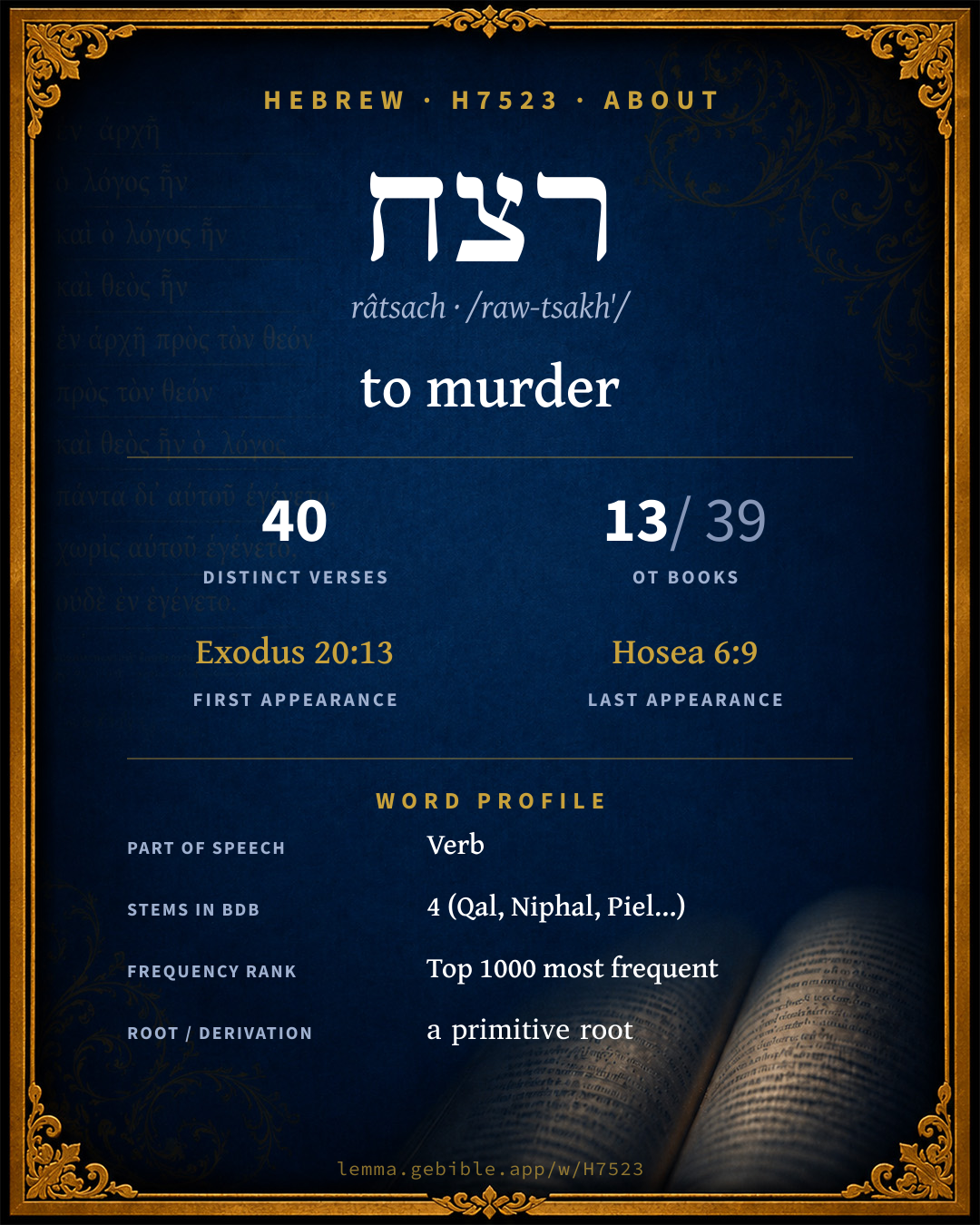
רָצַח
to murder
also: slay, kill fuller range ↓
Full lexicon entry — Brown-Driver-Briggs (BDB)
From Brown-Driver-Briggs (BDB)
Where this word appears
See every Qal verb in the Hebrew Bible →
Grammar key — what these labels mean
Part of speech
- Verb
- An action or state-of-being word.
Stem
- Qal
- The basic, simple active stem — the plain form of the verb (“he wrote”).
- Piel
- An intensive or resultative active stem.
- Niphal
- Usually the simple passive or reflexive of the Qal (“he was written”).
Form
- Participle Active
- A verbal adjective expressing ongoing or characteristic action (“writing / one who writes”).
- Imperfect
- An incomplete, ongoing, or future action (“he will / would write”).
- Infinitive Absolute
- An unbound verbal noun, often intensifying or standing in for a finite verb.
- Sequential Perfect
- A perfect with prefixed waw continuing a preceding imperfect or command (waw-consecutive perfect).
- Perfect
- A completed action or state — Hebrew marks aspect (completeness) more than strict tense (“he wrote”).
State
- Absolute
- The independent form of a noun, not bound to a following word.
Person
- 3rd Person
- The one spoken about (“he / she / it / they”).
- 2nd Person
- The one addressed (“you”).
- 1st Person
- The speaker (“I / we”).
Gender
- Masculine
- Grammatically masculine.
- Feminine
- Grammatically feminine.
- Common
- Either gender — not distinguished for this form.
Number
- Singular
- One.
- Plural
- More than one (in Hebrew, generally three or more).
Grammatical forms 12 distinct
- Verb, Qal, Participle Active, Masculine, Singular, Absolute 31 times (66%)
- Verb, Piel, Imperfect, 3rd Person, Masculine, Plural 2 times (4%)
- Verb, Qal, Imperfect, 2nd Person, Masculine, Singular 2 times (4%)
- Verb, Qal, Imperfect, 3rd Person, Masculine, Singular 2 times (4%)
- Verb, Qal, Infinitive Absolute 2 times (4%)
- Verb, Qal, Sequential Perfect, 3rd Person, Masculine, Singular 2 times (4%)
- Verb, Niphal, Participle Active, Feminine, Singular, Absolute 1 time (2%)
- Verb, Piel, Participle Active, Masculine, Singular, Absolute 1 time (2%)
+4 more forms (4 occurrences)
Parsed forms decoded from the imported morphology (morphhb / Westminster Leningrad Codex — WLC text public domain, morphhb tagging CC BY 4.0), counted across 47 parsed occurrences — not distinct verses.
Every verse where H7523 appears — 40 distinct verses across 13 books. Click any verse to open its interlinear word-by-word view. Verse text shown in the World English Bible for context — . Each verse’s Hebrew form is shown with its reference; the English is not keyword-highlighted, since the data carries no word-level English alignment. Use “Compare translations” on any verse to read it across multiple English versions. This concordance covers the Hebrew Bible; Septuagint (Greek Old Testament) occurrences are not indexed here.
Exodus 1 verse
Numbers 14 verses
- Numbers 35:6 הָ/רֹצֵ֑חַ ptcl def.art + Qal ptcp.act ms The cities which you shall give to the Levites, they shall be the six cities of refuge, which you shall give for the manslayer to flee to: and besides them you shall give forty-two cities.
- Numbers 35:11 רֹצֵ֔חַ Qal ptcp.act ms then you shall appoint you cities to be cities of refuge for you, that the manslayer who kills any person unwittingly may flee there.
- Numbers 35:12 הָ/רֹצֵ֔חַ ptcl def.art + Qal ptcp.act ms The cities shall be to you for refuge from the avenger, that the manslayer not die, until he stands before the congregation for judgment.
- Numbers 35:16 רֹצֵ֣חַֽ הָ/רֹצֵֽחַ Qal ptcp.act ms ptcl def.art + Qal ptcp.act ms But if he struck him with an instrument of iron, so that he died, he is a murderer: the murderer shall surely be put to death.
- Numbers 35:17 רֹצֵ֣חַֽ הָ/רֹצֵֽחַ Qal ptcp.act ms ptcl def.art + Qal ptcp.act ms If he struck him with a stone in the hand, by which a man may die, and he died, he is a murderer: the murderer shall surely be put to death.
- Numbers 35:18 רֹצֵ֣חַֽ הָ/רֹצֵֽחַ Qal ptcp.act ms ptcl def.art + Qal ptcp.act ms Or if he struck him with a weapon of wood in the hand, by which a man may die, and he died, he is a murderer: the murderer shall surely be put to death.
- Numbers 35:19 הָ/רֹצֵ֑חַ ptcl def.art + Qal ptcp.act ms The avenger of blood shall himself put the murderer to death: when he meets him, he shall put him to death.
- Numbers 35:21 רֹצֵ֣חַֽ הָ/רֹצֵ֖חַ Qal ptcp.act ms ptcl def.art + Qal ptcp.act ms or in enmity struck him with his hand, so that he died; he who struck him shall surely be put to death; he is a murderer: the avenger of blood shall put the murderer to death, when he meets him.
- Numbers 35:25 הָ/רֹצֵ֗חַ ptcl def.art + Qal ptcp.act ms and the congregation shall deliver the manslayer out of the hand of the avenger of blood, and the congregation shall restore him to his city of refuge, where he was fled: and he shall dwell therein until the death of the high priest, who was anointed with the holy oil.
- Numbers 35:26 הָ/רֹצֵ֑חַ ptcl def.art + Qal ptcp.act ms But if the manslayer shall at any time go beyond the border of his city of refuge, where he flees,
- Numbers 35:27 וְ/רָצַ֞ח הָ֣/רֹצֵ֔חַ conj + Qal wpf 3ms ptcl def.art + Qal ptcp.act ms and the avenger of blood find him outside of the border of his city of refuge, and the avenger of blood kill the manslayer; he shall not be guilty of blood,
- Numbers 35:28 הָ/רֹצֵ֔חַ ptcl def.art + Qal ptcp.act ms because he should have remained in his city of refuge until the death of the high priest: but after the death of the high priest the manslayer shall return into the land of his possession.
- Numbers 35:30 יִרְצַ֖ח הָ/רֹצֵ֑חַ Qal impf 3ms ptcl def.art + Qal ptcp.act ms Whoever kills any person, the murderer shall be slain at the mouth of witnesses: but one witness shall not testify against any person that he die.
- Numbers 35:31 רֹצֵ֔חַ Qal ptcp.act ms Moreover you shall take no ransom for the life of a murderer who is guilty of death; but he shall surely be put to death.
Deuteronomy 6 verses
- Deuteronomy 4:42 רוֹצֵ֗חַ יִרְצַ֤ח Qal ptcp.act ms Qal impf 3ms that the manslayer might flee there, who kills his neighbor unawares, and didn't hate him in time past; and that fleeing to one of these cities he might live:
- Deuteronomy 5:17 תִּרְצָֽח Qal impf 2ms "You shall not murder.
- Deuteronomy 19:3 רֹצֵֽחַ Qal ptcp.act ms You shall prepare you the way, and divide the borders of your land, which Yahweh your God causes you to inherit, into three parts, that every manslayer may flee there.
- Deuteronomy 19:4 הָ/רֹצֵ֔חַ ptcl def.art + Qal ptcp.act ms This is the case of the manslayer, that shall flee there and live: whoever kills his neighbor unawares, and didn't hate him in time past;
- Deuteronomy 19:6 הָ/רֹצֵ֗חַ ptcl def.art + Qal ptcp.act ms lest the avenger of blood pursue the manslayer, while his heart is hot, and overtake him, because the way is long, and strike him mortally; whereas he was not worthy of death, inasmuch as he didn't hate him in time past.
- Deuteronomy 22:26 וּ/רְצָח֣/וֹ conj + Qal wpf 3ms + sfx pers 3ms but to the lady you shall do nothing; there is in the lady no sin worthy of death: for as when a man rises against his neighbor, and kills him, even so is this matter;
Joshua 8 verses
- Joshua 20:3 רוֹצֵ֔חַ Qal ptcp.act ms that the manslayer who kills any person unwittingly [and] unawares may flee there: and they shall be to you for a refuge from the avenger of blood.
- Joshua 20:5 הָ/רֹצֵ֖חַ ptcl def.art + Qal ptcp.act ms If the avenger of blood pursue after him, then they shall not deliver up the manslayer into his hand; because he struck his neighbor unawares, and didn't hate him before.
- Joshua 20:6 הָ/רוֹצֵ֗חַ ptcl def.art + Qal ptcp.act ms He shall dwell in that city, until he stand before the congregation for judgment, until the death of the high priest that shall be in those days: then shall the manslayer return, and come to his own city, and to his own house, to the city from whence he fled.
- Joshua 21:13 הָ/רֹצֵ֔חַ ptcl def.art + Qal ptcp.act ms To the children of Aaron the priest they gave Hebron with its suburbs, the city of refuge for the manslayer, and Libnah with its suburbs,
- Joshua 21:21 הָ/רֹצֵ֛חַ ptcl def.art + Qal ptcp.act ms They gave them Shechem with its suburbs in the hill-country of Ephraim, the city of refuge for the manslayer, and Gezer with its suburbs,
- Joshua 21:27 הָ/רֹצֵ֔חַ ptcl def.art + Qal ptcp.act ms To the children of Gershon, of the families of the Levites, out of the half-tribe of Manasseh [they gave] Golan in Bashan with its suburbs, the city of refuge for the manslayer, and Be-eshterah with its suburbs; two cities.
- Joshua 21:32 הָֽ/רֹצֵ֗חַ ptcl def.art + Qal ptcp.act ms Out of the tribe of Naphtali, Kedesh in Galilee with its suburbs, the city of refuge for the manslayer, and Hammothdor with its suburbs, and Kartan with its suburbs; three cities.
- Joshua 21:38 הָ/רֹצֵ֔חַ ptcl def.art + Qal ptcp.act ms Out of the tribe of Gad, Ramoth in Gilead with its suburbs, the city of refuge for the manslayer, and Mahanaim with its suburbs,
Judges 1 verse
1 Kings 1 verse
2 Kings 1 verse
Job 1 verse
Psalms 2 verses
Proverbs 1 verse
Isaiah 1 verse
Jeremiah 1 verse
Hosea 2 verses
- Hosea 4:2 וְ/רָצֹ֥חַ conj + Qal inf.abs There is cursing, lying, murder, stealing, and committing adultery; They break boundaries, and bloodshed causes bloodshed.
- Hosea 6:9 יְרַצְּחוּ Piel impf 3mp As gangs of robbers wait to ambush a man, So the company of priests murder in the way toward Shechem, Committing shameful crimes.
About this entry
At a glance — auto-summarized from this page’s data, not written by a person. Every figure links to its source below. This summary describes the numbers; it doesn’t interpret them.
“to murder” is the headline sense of the Hebrew verb רצח (râtsach). Its English rendering has broadened — “slayer” classically, “manslayer” (Berean Standard Bible) and “one who kills” (unfoldingWord Literal Text) in modern versions; see the renderings breakdown. The Hebrew Bible uses it across 40 verses — moderately common. More than a third of its appearances fall in Numbers. Different stems carry different senses — BDB groups them under 4 stems, among them Qal and Niphal. See the sense tree, 40-verse concordance, and the renderings breakdown below.
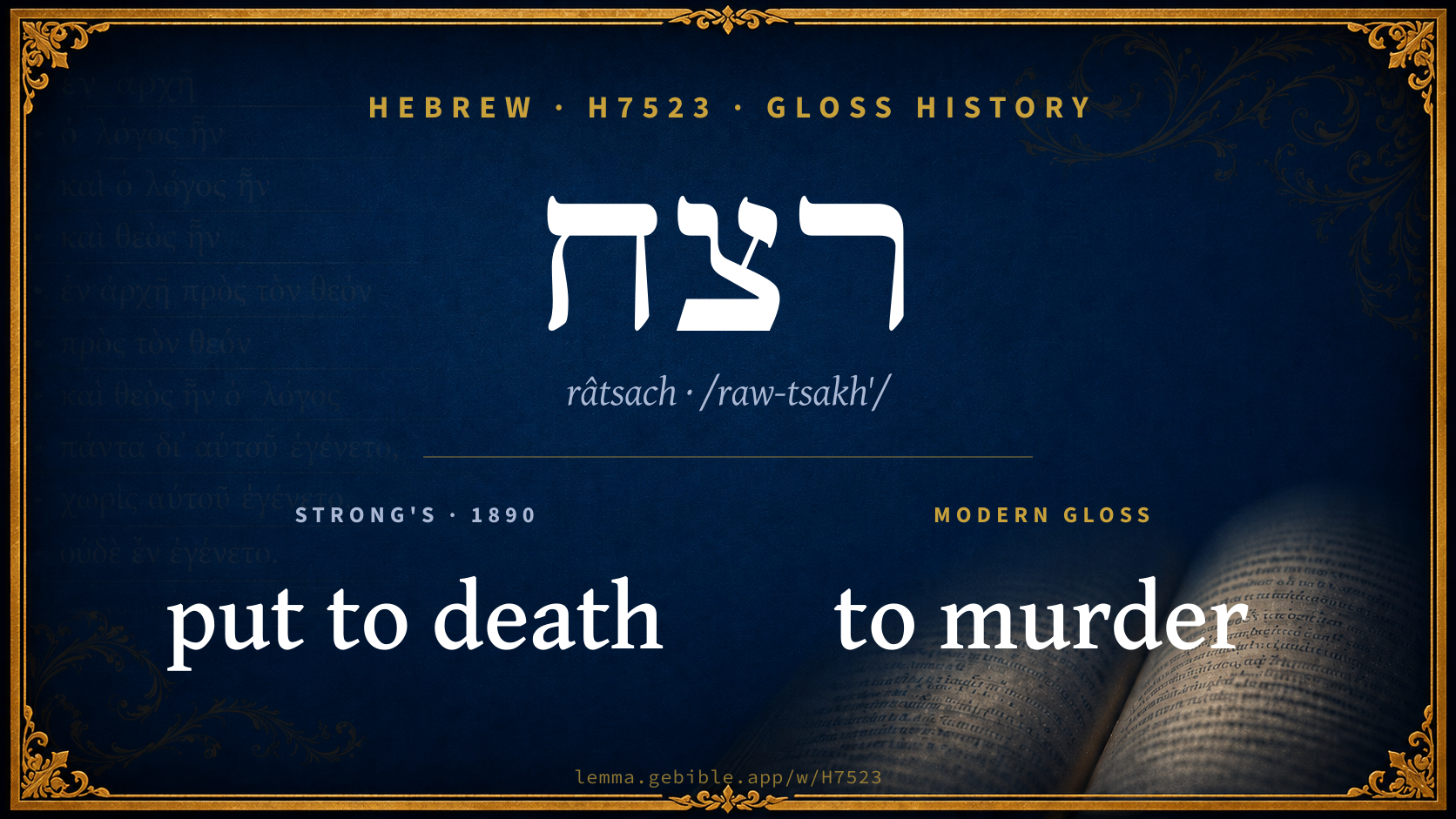
Gloss history
Strong's 1890 vs modern scholarship
About this word
Strong's H7523 catalogs a Hebrew word from the Hebrew Old Testament.
These counts are not copied from any lexicon or concordance. They are computed here, from the morphology-tagged Hebrew Old Testament. What Lemma adds →
- 40
- distinct verses
- The word appears in 40 distinct verses.
- 13 / 39
- OT books
- The word appears in 13 of 39 Old Testament books.
- #783
- by frequency
- Top 1000 most frequent Hebrew words (rank 783 of 8,640 Hebrew words by occurrence).
View all 40 occurrences in the concordance →
Most concentrated in
- Numbers 14 verses 35%
- Joshua 8 verses 20%
- Deuteronomy 6 verses 15%
By section of the Old Testament
By traditional corpus
Conventional, traditional groupings — biblical authorship is debated, so this is a traditional corpus grouping, not an authorship claim. Each share is this word’s portion of its verses in that division of the Hebrew canon. Each figure is a share of the word’s 40 distinct verses.
- Torah (Pentateuch) 21 verses · 53%
- Prophets (Nevi'im) 15 verses · 38%
- Writings (Ketuvim) 4 verses · 10%
How translations render this word
Counts come from each version’s own published word-to-Strong’s tagging or interlinear alignment — an approximate guide to how each version renders this word, not a word-level alignment the data otherwise carries. Because each total is that version’s own tagged count, the per-version totals vary from one another and need not match the appearance or distinct-verse counts above. These counts may also differ from a printed concordance because Lemma counts each distinctly tagged rendering and does not collapse phrase taggings into a single head-word total. This is a fixed set of word-tagged versions (KJV, ASV, BSB, ULT) and does not change with the reading translation you choose elsewhere. Each version’s license is shown beside its name below (and on Sources).
- King James Version: Slayer 13×, Murderer 9×, He is a murderer 4×
- American Standard Version: Manslayer 14×, Murderer 7×, He is a murderer 4×
- Berean Standard Bible: Manslayer 14×, Murderer 7×, Murder 4×
- unfoldingWord Literal Text: One who kills 9×, One having killed 7×, One who murders 5×
King James Version Public Domain
Renders H7523 across 46 tagged occurrences — most commonly:
Plus 13 renderings that appear only once — usually multi-word phrases or single function words the recovered tagging swept in, not distinct renderings. Not rendered by a distinct English word in 1 further occurrence.
American Standard Version Public Domain
Renders H7523 across 46 tagged occurrences — most commonly:
Plus 16 renderings that appear only once — usually multi-word phrases or single function words the recovered tagging swept in, not distinct renderings.
Berean Standard Bible Public Domain
Renders H7523 across 45 tagged occurrences — most commonly:
Plus 14 renderings that appear only once — usually multi-word phrases or single function words the recovered tagging swept in, not distinct renderings. Not rendered by a distinct English word in 2 further occurrences.
unfoldingWord Literal Text CC BY-SA 4.0
Renders H7523 across 50 tagged occurrences — most commonly:
Plus 17 renderings that appear only once — usually multi-word phrases or single function words the recovered tagging swept in, not distinct renderings.
Senses in the full BDB
Hebrew verbs can shift meaning by stem (binyan): Qal is the basic action, Niphal is often passive or reflexive, Piel often intensifies or makes it factitive, and Hiphil is typically causative. The senses below are grouped under the stem BDB assigns to each. This entry also uses Pual (the passive of Piel).
What do BDB’s symbols mean?
BDB uses these scholarly abbreviations:
| Symbol | Meaning |
|---|---|
| 𝔊 | the Septuagint (the ancient Greek translation, LXX) |
| 𝔙 | the Vulgate (the Latin translation) |
| 𝔖 | the Syriac version (the Peshitta) |
| 𝔗 | the Targum (the Aramaic translation) |
| ψ | the Psalms |
| √ | root (the underlying root or stem) |
| ‖ | parallel passage (a synonymous or contrasted parallel) |
| † | the dagger: every passage where the word occurs is cited |
The 4 senses and sub-senses the full Brown-Driver-Briggs lexicon distinguishes for this word, in lexicon order (not ranked by frequency), with BDB’s own verbatim wording and sub-sense lettering. Shown in Hebrew script with BDB’s own scholarly abbreviations. The condensed entry is in the Lexicon Entry tab. See also the Forms in the corpus table below.
Qal
- Pf. 3 ms. consec. זְר׳ Nu 35:27, וּרְצָחוֹ Dt 22:26; 2 ms. (הֲ)רָצַחְתָּ 1 K 21:19; Impf. 3 ms. יִרְצַח Nu 35:30; Dt 4:42; 2 ms. (-צַח) תִּרְצָ֑ח Ex 20:13 = Dt 5:17; inf. abs. רָצֹחַ Ho 4:2; Je 7:9; Pt. act. רֹצֵחַ Dt 19:3 +, רוֹ׳ 4:42 +;—murder, slay, with premeditation, Ex 20:13 (E) = Dt 5:17; Ho 4:2; Je 7:9; 1 K 21:19 (all abs.); c. acc. pers. Dt 22:26, unawares Dt 4:42; slay as avenger Nu 35:27, 30 (P; ‖ הֵמִית v 19, 21); especially pt. as subst. = slayer, manslayer, without intent, Dt 4:42; 19:3, 4, 6; also in P: Nu 35:6, 11, 12, 25, 26, 27, 28; Jos 20:3, 5, 6; 21:13, 21, 27, 32, 26 (van d. H., Baer, v 33 Gi; all P); murderer, with intent, Nu 35:16(×2), 17(×2), 18(×2), 19, 21(×2), 30, 31; also Jb 24:14. e.g. Numbers 35:27
Niphal
- Impf. 1 s. אֵרָצֵחַ Pr 22:13 I shall be slain; Pt. fs. as adj. אִשָּׁה הַנִּרְצָחָה Ju 20:4 the murdered woman. e.g. Proverbs 22:13
Piel
- (intens.) murder, assassinate: 3 mpl. יְרַצְּחוּ Ho 6:9 (abs.), יְרַצֵּ֑חוּ ψ 94:6 (acc. pers., ‖ הָרַג); ψ 62:4 v. infr.; Pt. מְרַצֵּחַ, as subst. 2 K 6:32 murderer, assassin; pl. מְרַצְּחִים Is 1:21 assassins. e.g. Hosea 6:9
Pual
- Impf., 2 mpl. תְּרָצְּחוּ ψ 62:4, so Baer Gi, van d. H. תְּרָצְהוּ, but Ben Napht. Pi. תְּרַצְּחוּ (Baer 143), so Vrss Hup-Now De Che Bae al. ye murder (or batter, shatter). e.g. Psalms 62:4
Senses from the full Brown-Driver-Briggs lexicon (Brown, Driver, Briggs; Oxford 1906 — public domain), digitized via Sefaria, supplemented by the OpenScriptures HebrewLexicon (CC BY 4.0). Full attribution on Sources.
Word origin
vb. murder, slay (NH (rare, also in deriv.) = BH; cf. Arabic رَضَحَ, رَضَخَ break, bruise, crush);—
— Brown-Driver-Briggs (Oxford 1906, public domain), digitized via Sefaria, supplemented by the OpenScriptures HebrewLexicon (CC BY 4.0). See Sources.
Origin: a primitive root
Jastrow Dictionary
A second Hebrew/Aramaic lexicon for comparison, covering Aramaic and post-biblical (Talmudic, Targumic, Midrashic) usage that the biblical-Hebrew BDB does not. Matched by lemma rather than by Strong’s number, so a lemma may carry more than one Jastrow headword (shown separately below), and the entries cover usage well beyond the Bible.
רָצַח
- [to perforate, cmp. הרג; חָלָל,] to slay, murder. Midr. Till. to Ps. III (ref. to ארבעתים, II Sam. XII, 6) אתה רָצַחְתָּ אחד שש עשרה נִרְצָחִים יהיו לך thou hast murdered one: there shall be sixteen of thine murdered; Yalk. Sam. 148. Macc. 12ᵃ מי כתיב אם ר׳ it reads not (Num. XXXV, 27), ‘if he slew’ (but, ‘he shall slay’); ib. מי כתיב יִרְצַח it reads not, ‘he shall slay’ (but, if he slays he is not punished); a. e.—Part. רוֹצֵחַ manslayer, murderer. Shebi. X, 8; Macc. II, 8 ר׳ שגלה … ר׳ אני when an involuntary manslayer comes to his place of refuge, and the citizens desire to honor him, he must say, I am a manslayer. Snh. 73ᵃ (ref. to Deut. XXII, 26) מקיש ר׳ … אף ר׳ ניתן להצילו בנפשו the text draws an analogy between the case of one pursued by a murderer and that of the betrothed woman threatened with assault: as it is permitted to save the woman at the cost of the assailant’s life, so it is permitted to save the pursued at the cost of the would-be murderer’s life; Pes. 25ᵇ; a. fr.—[Tosef. Sot. XV, 7, read: רוֹצְעָן.]—Pl. רוֹצְחִים, רוֹצְחִין. Macc. 10ᵃ, v. זָרַח. Ib. 9ᵇ בגלעד שכיחי ר׳ in Gilead cases of manslaughter are frequent; a. fr. e.g. 2 Samuel 12:6
- to be slain, murdered. Midr. Till. to Ps. III; v. supra; a. e.
- to commit suicide(?). Pesik. R. s. 24 (ref. to לא תרצח Ex. XX, 13) לא תִתְרַצֵּחַ thou shalt not murder thyself; [prob. to be read: לא תִצָּרֵחַ לא תעשה הדם צוֹרֵחַ עליך thou shalt not be cried about, make no blood cry out against thee]. e.g. Exodus 20:13
A Dictionary of the Targumim, the Talmud Babli and Yerushalmi, and the Midrashic Literature (Marcus Jastrow; London, Luzac, 1903) — Public Domain. Digitized via Sefaria. Digitized via Sefaria. Full attribution on Sources.
Forms in the corpus
The 29 distinct written forms H7523 takes in the Hebrew Bible, most frequent first — each parse links to that stem’s occurrences in the concordance. Hebrew forms include their vowel points and cantillation, so a single lemma takes many written forms.
Same root — word family
Other BDB entries built from the same root as H7523, grouped by Strong’s listed origin. These share a root / origin per the lexicon — not necessarily a shared meaning. Each links to that word’s own entry.
Derived from this word
Compare all same-root words → They share a root, not necessarily a meaning.
Septuagint verse parallels
This word appears in 40 verses that also exist in the Greek Old Testament (Septuagint), out of the 40 Hebrew verses it occurs in. You can read those verses in Greek by switching the Old Testament edition to the Septuagint.
Read these verses in the Septuagint
- Exodus 20:13
- Numbers 35:6
- Deuteronomy 4:42
- Joshua 20:3
- Judges 20:4
- 1 Kings 21:19
- 2 Kings 6:32
- Job 24:14
- Psalms 62:3
- Proverbs 22:13
- Isaiah 1:21
- Jeremiah 7:9
This is a verse-level parallel only — the same verses exist in both the Hebrew and Greek Old Testaments. No word-level Hebrew↔Greek correspondence is claimed: the data carries no such alignment, so no Greek word is shown as this Hebrew word’s translation. Coverage is not total — the Septuagint omits the deuterocanon and renumbers the Psalms, so some Hebrew verses have no direct Greek parallel.