Numbers 35:30

Hebrew (Westminster Leningrad Codex) Numbers 35:30 appears in the Hebrew Old Testament. The text above is from the Westminster Leningrad Codex. Each word links to its Strong’s number, a concise gloss, and parsing drawn from the Open Scriptures Hebrew Bible morphology. Click any word for its full Brown-Driver-Briggs (BDB) entry.
Download image
Cite this verse

Numbers 35:30 (World English Bible). Public Domain. Lemma interlinear Bible study tool, https://lemma.gebible.app/v/numbers/35/30.

Show BibTeX & RIS
BibTeX
RIS
English Translation
Whoever kills any person, the murderer shall be slain at the mouth of witnesses: but one witness shall not testify against any person that he die.
World English Bible · Public Domain
Download a study sheet

One document with this verse’s original text, its word-by-word gloss line, the meaning frame, cross-references with their text, attributed commentary, and full source and license credits — printable, and it pastes into notes with its structure intact.

This verse Autodidact and up

Study sheet (.html) Plain text (.txt)

A passage Seminary Student

Up to 50 verses in one chapter. A passage sheet keeps up to 6 commentary sources and 12 cross-references per verse, in the order this page ranks them, and says so on the sheet whenever that leaves anything out. Ask for a single verse and you get the Autodidact verse sheet above.

Everything on this page stays free to read, with no account — the sheet is a download of what is already on screen, not access to it.

Want to remove ads? Support Godless Engineer
Compare translations 3

The same verse in 3 English versions, stacked beneath the original-language interlinear above. Click any original word for its lexicon entry.

Each is an independent rendering of the whole verse — the interlinear is not word-aligned to these translations.

Highlighted words mark where these versions differ — a whole-verse word diff, not a word-by-word alignment.

  • World English Bible Public Domain
    Whoever kills any person, the murderer shall be slain at the mouth of witnesses: but one witness shall not testify against any person that he die.
  • King James Version Public Domain
    Whoso killeth any person, the murderer shall be put to death by the mouth of witnesses: but one witness shall not testify against any person to cause him to die.
  • unfoldingWord Literal Text CC BY-SA 4.0
    Every one who strikes down a person, according to the mouth of witnesses he shall kill the one who kills. And one witness shall not testify against a person to put to death.

unfoldingWord Literal Text — © unfoldingWord, licensed CC BY-SA 4.0. Word-aligned USFM3 via Door43 (git.door43.org/unfoldingWord/en_ult).

Versions to compare (up to 4)

3 of 4 selected

Show all 18 translations

Every available English version of this verse, each an independent rendering of the whole verse.

  • World English Bible Public Domain
    Whoever kills any person, the murderer shall be slain at the mouth of witnesses: but one witness shall not testify against any person that he die.
  • Berean Standard Bible Public Domain
    If anyone kills a person, the murderer is to be put to death on the testimony of the witnesses. But no one is to be put to death based on the testimony of a lone witness.
  • Majority Standard Bible Public Domain
    If anyone kills a person, the murderer is to be put to death on the testimony of the witnesses. But no one is to be put to death based on the testimony of a lone witness.
  • King James Version Public Domain
    Whoso killeth any person, the murderer shall be put to death by the mouth of witnesses: but one witness shall not testify against any person to cause him to die.
  • American Standard Version (1901) Public Domain
    Whoso killeth any person, the murderer shall be slain at the mouth of witnesses: but one witness shall not testify against any person that he die.
  • Revised Version (1885) Public Domain
    Whoso killeth any person, the manslayer shall be slain at the mouth of witnesses: but one witness shall not testify against any person that he die.
  • Geneva Bible (1599) Public Domain
    Whosoeuer killeth any person, the Iudge shall slay the murtherer, through witnesses: but one witnesse shall not testifie against a person to cause him to die.
  • Douay-Rheims (1899) Public Domain
    The murderer shall be punished by witnesses: none shall be condemned upon the evidence of one man.
  • Young's Literal Translation Public Domain
    whoso smiteth a person, by the mouth of witnesses doth `one' slay the murderer; and one witness doth not testify against a person -- to die.
  • Literal Standard Version CC BY-SA 4.0
    Whoever strikes a person, by the mouth of witnesses [one] slays the murderer; and one witness does not testify against a person to cause [him] to die.
  • Unlocked Literal Bible CC BY-SA 4.0
    Whoever kills any person, the murderer must be killed, as testified to by the words of witnesses. But one witness' word alone may not cause any person to be put to death.
  • unfoldingWord Literal Text CC BY-SA 4.0
    Every one who strikes down a person, according to the mouth of witnesses he shall kill the one who kills. And one witness shall not testify against a person to put to death.
  • Darby Bible Public Domain
    Whoever shall smite a person mortally, at the mouth of witnesses shall the murderer be put to death; but one witness shall not testify against a person to cause him to die.
  • World Messianic Bible Public Domain
    “‘Whoever kills any person, the murderer shall be slain based on the testimony of witnesses; but one witness shall not testify alone against any person so that he dies.
  • Webster's Bible Public Domain
    Whoever killeth any person, the murderer shall be put to death by the mouth of witnesses: but one witness shall not testify against any person to cause him to die.
  • Free Bible Version CC BY-SA 4.0
    If anyone kills a person, the murderer is to be executed based on the evidence given by witnesses, plural. No one is to be executed based on the evidence given by a single witness.
  • Bible in Basic English Public Domain
    Anyone causing the death of another is himself to be put to death on the word of witnesses: but the word of one witness is not enough.
  • JPS Tanakh (1917) Public Domain
    Whoso killeth any person, the murderer shall be slain at the mouth of witnesses; but one witness shall not testify against any person that he die.

Literal Standard Version (2020), Covenant Press — licensed CC BY-SA 4.0. Text via the HelloAO Bible API (eBible.org). Unlocked Literal Bible (unfoldingWord) — licensed CC BY-SA 4.0. Text via the HelloAO Bible API (eBible.org). unfoldingWord Literal Text — © unfoldingWord, licensed CC BY-SA 4.0. Word-aligned USFM3 via Door43 (git.door43.org/unfoldingWord/en_ult). Free Bible Version, Dr. Jonathan Gallagher — licensed CC BY-SA 4.0. Text via the HelloAO Bible API (eBible.org).

Word by word

More ways to search: Search by grammar → Find every occurrence → Compare this word →

Practice this passage: Drill this verse → Learn its vocabulary →

יִרְצַ֖ח
râtsach
H7523
“to murder”
Verb, Qal, Imperfect, 3rd Person, Masculine, Singular
Part of Speech
Verb
Stem
Qal
Form
Imperfect
Person
3rd Person
Gender
Masculine
Number
Singular
Full BDB Definition

Origin: a primitive root

TWOT: 2208

to murder, slay, kill - (Qal) to murder, slay - premeditated - accidental - as avenger - slayer (intentional) (participle) - (Niphal) to be slain - (Piel) - to murder, assassinate - murderer, assassin (participle) (substantive) - (Pual) to be killed
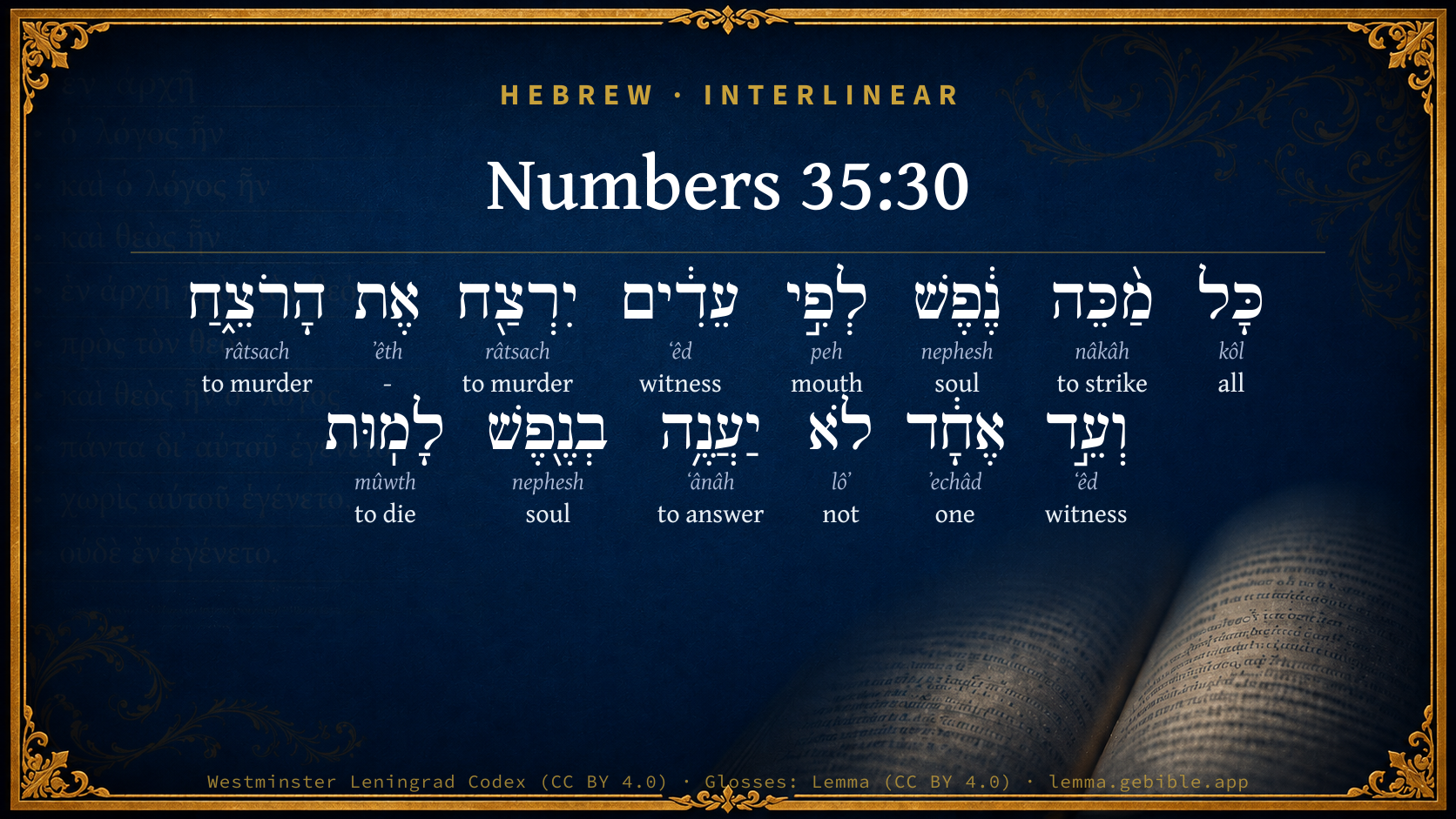
  1. כָּל kôl H3605 “all of” Noun, Common, Masculine, Singular, Construct
  2. מַ֨כֵּה nâkâh H5221 “striking” Verb, Hiphil, Participle Active, Masculine, Singular, Construct
  3. נֶ֔פֶשׁ nephesh H5315 “soul” Noun, Common, Both, Singular, Absolute
  4. לְפִ֣י peh H6310 “to/for · mouth of” Preposition + Noun, Common, Masculine, Singular, Construct
  5. עֵדִ֔ים ʻêd H5707 “witnesses” Noun, Common, Masculine, Plural, Absolute
  6. אֶת ʼêth H853 “-” Particle, Direct Object
  7. הָרֹצֵ֑חַ râtsach H7523 “the · murdering” Particle, Definite Article + Verb, Qal, Participle Active, Masculine, Singular, Absolute
  8. וְעֵ֣ד ʻêd H5707 “and · witness” Conjunction + Noun, Common, Masculine, Singular, Absolute
  9. אֶחָ֔ד ʼechâd H259 “one” Adjective, Cardinal number, Masculine, Singular, Absolute
  10. לֹא lôʼ H3808 “not” Particle, Negative
  11. יַעֲנֶ֥ה ʻânâh H6030 “to answer” Verb, Qal, Imperfect, 3rd Person, Masculine, Singular
  12. בְנֶ֖פֶשׁ nephesh H5315 “in/at · soul” Preposition + Noun, Common, Both, Singular, Absolute
  13. לָמֽוּת mûwth H4191 “to die” Preposition + Verb, Qal, Infinitive Construct

About this verse

These counts appear in no published source. They are computed here, from the morphology-tagged text and Lemma’s own curated glosses. What Lemma adds →

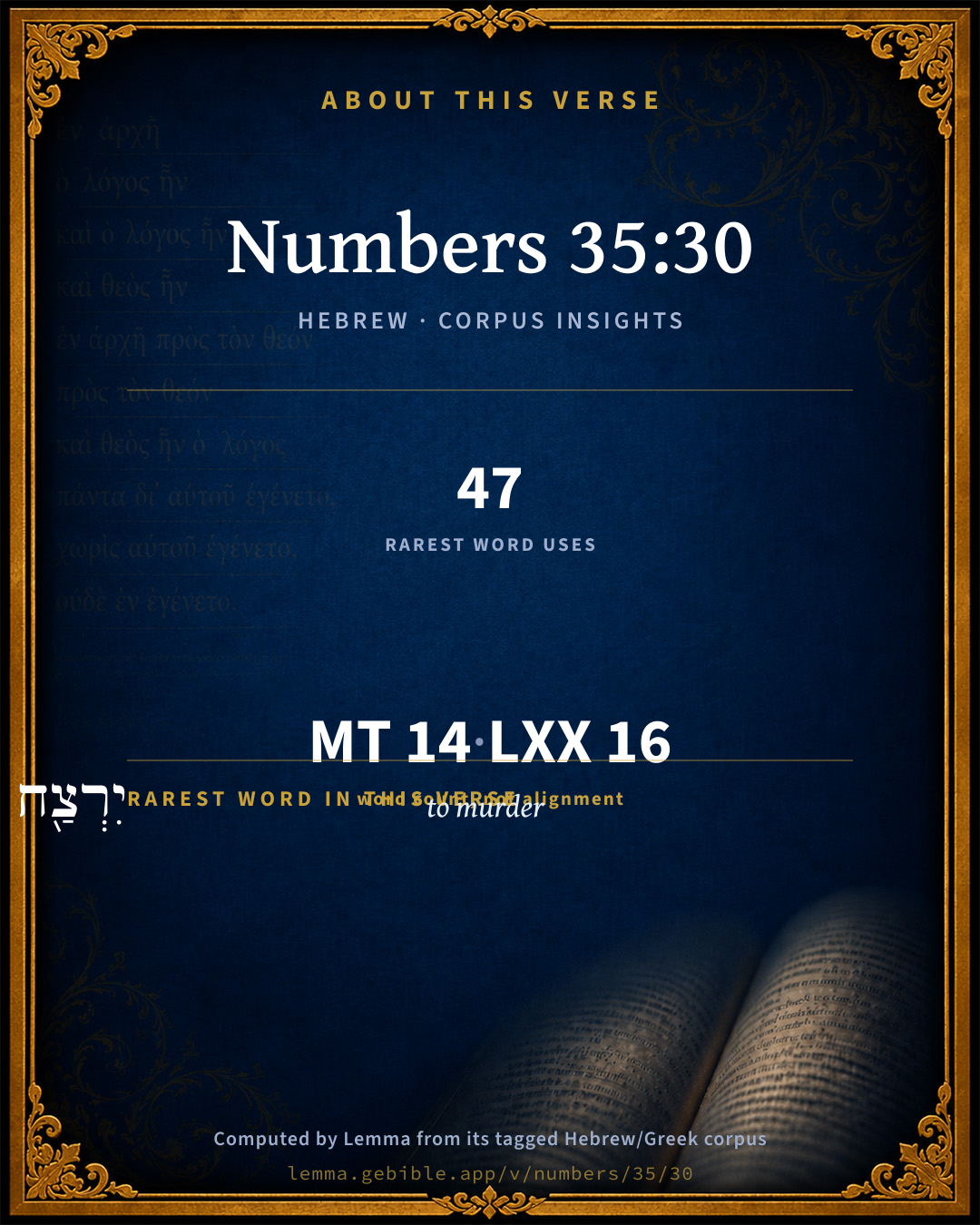
14
words
11
distinct lemmas
Pentateuch
section

Shared distinctive vocabulary

יִרְצַ֖ח to murder H7523 occurs in 40 verses of the Hebrew Bible. Also found in:

Grammatical profile

  • 5 verbs
  • 6 nouns
  • 1 adjective
  • 2 particles

Verb forms

  • מַ֨כֵּה Hiphil · Participle Active
  • יִרְצַ֖ח Qal · Imperfect
  • הָרֹצֵ֑חַ Qal · Participle Active
  • יַעֲנֶ֥ה Qal · Imperfect
  • לָמֽוּת Qal · Infinitive Construct

Repetition

Words recur within this verse — often emphatic in Hebrew:

  • נֶ֔פֶשׁ soul H5315 ×2
  • עֵדִ֔ים witness H5707 ×2
  • יִרְצַ֖ח to murder H7523 ×2

Hebrew & Septuagint length

In English translation the verse runs 26 words from the Hebrew and 27 from the Septuagint (LXX English) — closely comparable.

A rough comparison of the two English renderings, which tokenize alike — not a word-level alignment.

Word counts can differ between the Hebrew and the Greek without any difference in meaning — e.g. the Hebrew direct-object marker אֵת has no separate Greek word, and Greek often adds the article ὁ.

In the original languages it is 14 Hebrew tokens and 16 Greek tokens — but the two are counted differently (Hebrew bundles its prefixes and suffixes into one token; the Greek is in lemma form), so that isn’t a like-for-like length.

Cross-references

10

Topical passages linked to Numbers 35:30 in the Treasury of Scripture Knowledge — connected by theme and wording, ordered by reader-vote popularity; previews shown in the World English Bible.

  • Hebrews 10:28 A man who disregards Moses' law dies without compassion on the word of two or three witnesses.
  • Deuteronomy 19:15 One witness shall not rise up against a man for any iniquity, or for any sin, in any sin that he sins: at the mouth of two witnesses, or at the mouth of three witnesses, shall a matter be established.
  • Matthew 18:16 But if he doesn't listen, take one or two more with you, that at the mouth of two or three witnesses every word may be established.
  • 2 Corinthians 13:1 This is the third time I am coming to you. "At the mouth of two or three witnesses shall every word established."
  • John 8:17–18 It's also written in your law that the testimony of two people is valid.
  • 1 Timothy 5:19 Don't receive an accusation against an elder, except at the word of two or three witnesses.
  • Numbers 35:16 But if he struck him with an instrument of iron, so that he died, he is a murderer: the murderer shall surely be put to death.
  • Deuteronomy 17:6–7 At the mouth of two witnesses, or three witnesses, shall he who is to die be put to death; at the mouth of one witness he shall not be put to death.
  • John 7:51 "Does our law judge a man, unless it first hears from him personally and knows what he does?"
  • Revelation 11:3 I will give power to my two witnesses, and they will prophesy one thousand two hundred sixty days, clothed in sackcloth."

Cross-references courtesy of OpenBible.info (CC BY 4.0).

Hebrew and Greek witnesses Masoretic Hebrew ↔ Greek Septuagint

The same verse in the two great witnesses to the Old Testament, shown verse-for-verse.

These are two independent witnesses, not word-aligned to each other, and the Septuagint is shown in lemma (dictionary) form.

Hebrew Numbers 35:30 Masoretic · Westminster Leningrad Codex

כָּל מַ֨כֵּה נֶ֔פֶשׁ לְפִ֣י עֵדִ֔ים יִרְצַ֖ח אֶת הָרֹצֵ֑חַ וְעֵ֣ד אֶחָ֔ד לֹא יַעֲנֶ֥ה בְנֶ֖פֶשׁ לָמֽוּת

Whoever kills any person, the murderer shall be slain at the mouth of witnesses: but one witness shall not testify against any person that he die.

World English Bible · Public Domain

Greek LXX Numbers 35:30 Septuagint · lemma form

πᾶς πατάσσω ψυχή διά μάρτυς φονεύω ὁ φονεύω καί μάρτυς εἷς οὐ μαρτυρέω ἐπί ψυχή ἀποθνήσκω

Whoever kills a man, you shall kill the murderer on the testimony of witnesses; and one witness shall not testify against a soul that he should die.

LXX2012 (modern English Septuagint) · Public Domain

Hebrew: Westminster Leningrad Codex (CC BY 4.0). Greek: Septuagint (public domain); English from LXX2012 (modern English Septuagint) (Public Domain). How the Septuagint differs from the Hebrew →

Targum (Aramaic paraphrase)

2

The Targum is the ancient Jewish Aramaic paraphrase of the Hebrew Scriptures — an interpretive translation, not the Hebrew text itself. Onkelos (literal) and Pseudo-Jonathan (expansive) render the Torah, and Jonathan the Prophets. Coverage is partial: where no permissively-licensed English translation exists for a verse, only the Aramaic is shown. This is verse-level text, not a word-by-word alignment to the Hebrew.

  1. Targum Onkelos Torah (Genesis–Deuteronomy)
    כָּל דְיִקְטוֹל נַפְשָׁא לְפוּם סַהֲדִין יִקְטוֹל יָת קָטוֹלָא וְסָהִיד חַד לָא יַסְהִד בֶּאֱנַשׁ לְמִקְטָל

    (no public-domain English translation for this verse)

    Targum Onkelos — Aramaic: “Onkelos Genesis” (public domain); “Onkelos Exodus” (public domain); “Onkelos Leviticus” (public domain); “Onkelos Numbers” (public domain); “Onkelos Deuteronomy” (public domain). English: “Sefaria Community Translation” (CC0 1.0 (public-domain dedication)); “J.W. Etheridge. The Targums of Onkelos and Jonathan Ben Uzziel on the Pentateuch. London: Longmans, Green, 1862” (public domain). Text via Sefaria.

  2. Targum Pseudo-Jonathan Torah (Genesis–Deuteronomy)
    כָּל דְיִקְטוֹל בַּר נְשָׁא עַל מֵימַר סַהֲדִין דְחַמְיַין לְמִסְהַד עֲלוֹי יִקְטוֹל תְּבַע אַדְמָא אוֹ בֵי דִינָא יַת קָטוֹלָא וְסָהִיד חַד לָא יִסְהַד בְּבַר נַשׁ לִמְמָת

    Whosoever killeth a man, according to the word of witnesses fit to give testimony against him, the avenger of blood, or the house of judgment, shall put him to death. But one witness only shall not testify against a man to put him to death.

    Targum Pseudo-Jonathan — Aramaic: “Targum Jonathan on Genesis” (public domain); “Targum Jonathan on Exodus” (public domain); “Targum Jonathan on Leviticus” (public domain); “Targum Jonathan on Numbers” (public domain); “Targum Jonathan on Deuteronomy” (public domain). English: “The Targum of Jonathan ben Uzziel, trans. J. W. Etheridge, London, 1862” (public domain). Text via Sefaria.

Commentary

Notes on Numbers 35:30 from classic Christian and Jewish commentators (each source and its license shown beneath its notes). The classic Christian expositions comment on the surrounding passage and are grouped to its opening verse, so a note may address several verses; the Jewish commentaries on the Tanakh (Rashi and others) are per-verse, so they appear only where the commentator wrote on this verse.

Lemma curates 59 commentaries, every one of them public domain or Creative Commons licensed, each selected and text-cleaned for this edition rather than reprinted as found. About our sources →

Joseph Benson's Commentary

Num 35:30-31. By the mouth of witnesses — A wise precaution to prevent the shedding of innocent blood. If we may credit the Jews, where there was but one witness, and the person accused of murder could not, therefore, be put to death, yet he did not escape without punishment, but was thrown into a very strait prison, and there fed with bread and water. Ye shall take no satisfaction — This rigid severity of the law served to impress the minds of the people with a deep sense of the heinousness of the crime of murder, since nothing less than the blood of the murderer could compensate for the crime, and cleanse the land from its pollution. And it is but just in itself that life should pay for life.

Joseph Benson's Commentary on the Old and New Testaments (1811–1818) — public domain. Text from a community e-Sword module.

Tyndale Open Study Notes

Tyndale Open Resources

35:30 All murderers were condemned to death, but their conviction required a high standard of evidence—the testimony of two or more witnesses (cp. Deut 17:6; 19:15).

Tyndale Open Study Notes — © Tyndale Open Resources, licensed CC BY-SA 4.0. Text via the HelloAO Bible API.

Adam Clarke's Commentary

Verse 30. But one witness shall not testify against any] This was a just and necessary provision. One may be mistaken, or so violently prejudiced as to impose even on his own judgment, or so wicked as to endeavour through malice to compass the life of his neighbour: but it is not likely that two or more should be of this kind; and even were they, their separate examination would lead to a discovery of the truth, and to their conviction.

Adam Clarke's Commentary on the Bible (1810–1826) — public domain. Text from a community e-Sword/MySword module.

Ellicott's Commentary for English Readers

(30) By the mouth of witnesses.—The number of witnesses is not here specified. In Deu_17:6 it is ordained that the crime of idolatry should be punished with death “at the mouth of two witnesses, or of three witnesses;” and in Deu_19:15 it is ordained in general terms that “one witness shall not rise up against a man for any iniquity, or for any sin that he sinneth: at the mouth of two witnesses, or at the mouth of three witnesses, shall the matter be established.”

A Bible Commentary for English Readers, edited by Charles John Ellicott (1878–1897) — public domain. Text from a community e-Sword module.

The Cambridge Bible for Schools and Colleges

gen. ed. J. J. S. Perowne

30. one witness shall not testify &c.] This re-enforces the law of Deu_17:6. In Deu_19:15 three, or at least two, witnesses are required to substantiate any charge (cf. Mat_18:16).

The Cambridge Bible for Schools and Colleges (gen. ed. J. J. S. Perowne; Cambridge University Press, 1878–1918) — public domain. Text from a community e-Sword module.

John Gill's Exposition

Whoso killeth any person,.... Willingly, and through enmity and malice:

the murderer shall be put to death by the mouth of two witnesses; which is repeated partly to show, that this law concerning the cities of refuge was not designed to screen a murderer, who was guilty through malice prepense; and partly for the sake of what is added to it, that two witnesses are required in such a case, where a man's life is at stake, to prove the fact against him; which shows how careful the Lord is, and men should be, of the lives of his creatures, that no man suffer wrongfully; which is repeated again and again, that it might be observed, see Deu 17:6 but one witness shall not testify against any person, to cause him to die; which looks as if in other cases, in pecuniary matters, and the like, where life is not concerned, one witness may be sufficient; though it is always best and safest to have more if they can be had, that at the mouth of two or three witnesses everything may be established, Deu 19:15.

John Gill's Exposition of the Whole Bible (1746–1763) — public domain (CC PDM 1.0). Text via the HelloAO Bible API.

Albert Barnes' Notes on the Bible

By the mouth of witnesses - i. e. two witnesses, at the least (compare the marginal references). The provisions of this and the following verses protect the enactments of this chapter from abuse. The cities of refuge were not intended to exempt a criminal from deserved punishment.

Albert Barnes' Notes on the Bible (1834–1885) — public domain. Text from a community e-Sword/MySword module.

Haydock's Catholic Bible Commentary

Man. A person might be tried on such evidence, Deuteronomy xix. 15.

George Leo Haydock (1774–1849), Haydock's Catholic Family Bible and Commentary, 1859 edition — public domain. Excludes Psalms (Douay-Rheims chapter numbering differs from Protestant) and Deuterocanonical books (Catholic canon only).

Matthew Poole's English Annotations

No judge shall condemn any man to death upon a single testimony.

Matthew Poole's English Annotations on the Holy Bible (1683–1685) — public domain. Text from a community e-Sword/MySword module.

Whedon's Commentary on the Bible

Daniel D. Whedon

30. By the mouth of witnesses — It required two to convict of a capital crime, (Deu_17:6,) and two or three to convict of other crimes. Deu_19:15; 1Ti_5:19, notes. The Jews here literally followed this statute, and insisted that the testimony be given by the mouth and not by writing.

Daniel D. Whedon (gen. ed.), Commentary on the Old and New Testaments (1874–1909) — public domain. Text from a community e-Sword module.

The Pulpit Commentary

By the mouth of witnesses, i.e., of two at least. (cf. Deu_17:6)

Vers. 30-34. Why the murderer must be put to death.

This passage brings up a subject not often discussed in the pulpit. Yet it surely is a subject which comes home to the business of us all. In a country like ours the administration of justice, the execution of vengeance on evildoers, is a duty in which every one has to bear a part. We may not all be officers of justice, but we must all act as informers, or witnesses, or jurymen. It is of high importance, therefore, that every member of the community should be well instructed regarding the principles which lie at the foundation of the criminal law, and, in particular, should know why and on what authority the community lays hold upon evil-doers and inflicts on them the punishment of their crimes.

I Observe THE OCCASION of the statute here delivered. It is an appendix to the law regarding the cities of refuge. That law was designed to shield the involuntary homicide from the avenger of blood. The intention was good; but good intentions do not always prevent dangerous mistakes. It often happens that good men in labouring to cast out one evil open the door to a greater evil. A follower of John Howard may so press the duty of humanity towards prisoners as to deprive the prison of its deterrent power. So in Israel there was a danger that the care taken to restrain the avenger of blood from touching the involuntary manslayer might have the effect of deadening the public sense of the enormity of murder, and weakening men"s resentment against the murderer. The design of the statute before us is to prevent so mischievous a result.

II What then are THE PROVISIONS OF THE STATUTE?

1. The ancient law which condemned the murderer to death is solemnly reaffirmed. (verse 30; compare with verses 16-21 and Gen_9:6) To be sure, the extreme penalty ought not to be executed without extreme circumspection. The unsupported testimony of one witness is not to be held sufficient to sustain a charge of murder. Nevertheless, if there is sufficient evidence, the sword must strike, the murderer must not be suffered to go free.

2. The death penalty may not be commuted into a fine (verse 31). In regard to this point the Mosaic law dithers from many, perhaps from most other primitive codes; for they suffered the murderer to compound with the kinsmen of his victim by paying a fine in cattle or in money. The law of Moses suffered no such composition. The murderer must be put to death. Even the restraint to which the law subjected the involuntary manslayer was not suffered to be relaxed by a money payment. In all cases affecting the sanctity of life pecuniary compositions are utterly forbidden.

III THE REASON OF THIS STATUTE is carefully explained (verses 33, 34). The reason lies in these three principles:

1. "Blood defileth the land. (cf. Psa_106:38) That sin defiles the sinner, that murder especially defiles the conscience of the murderer these are facts patent to all. It is not so often observed that crime perpetrated in a city defiles the whole city. The whole community has a share in the guilt. Hence the remarkable law laid down in Deu_21:1-9 for the expiation of an uncertain murder.

2. The proper expiation of murder is by the death of the murderer. "The land cannot be cleansed of the blood that is shed therein but by the blood of him that shed it." Justice is satisfied, the honour of the law vindicated, when the murderer is put to death, and not otherwise. To accept a pecuniary satisfaction for blood is simply to pollute the land.

3. In this whole matter the paramount consideration ought to be the honour of God. Murder is criminal beyond all other offences, because it is the defacement of the image of God in man. Murder must not go unavenged, because it defiles the laud before God. Let these principles be carefully weighed. They set in a clear light the true and adequate reason for inflicting punishment on evil-doers. The true reason is neither the reformation of the criminal (for the sword must strike although there should be no hope of reformation) nor the protection of society. These are important objects, and not to be overlooked; but the proper reason of punishment is the vindication of righteousness, the executing of vengeance on the man who doeth evil. (Rom_13:4)

IV In conclusion, DOES NOT ALL THIS SHED WELCOME" LIGHT ON THE ATONEMENT OF OUR BLESSED LORD? The death of Christ for our sins accomplished many great and precious purposes. It was an affecting proof of his sympathy with us. it was a revelation of the Father"s love. But these purposes do not contain the proper and adequate reason of our Lord"s sufferings. He died for our sins. It was necessary that our sins should be cleansed, that expiation or atonement should be made for them. (N.B. It is the same Hebrew word, commonly translated atonement elsewhere in the Old Testament, which in this passage is translated cleansing in the text and expiation in the margin.) They might have been expiated in our blood. But, blessed be God, his mercy has found out another way. By a blessed exchange Christ has become sin for us; he has borne our sins and made atonement for them. This was the end of his sufferings to satisfy the justice of the Father for our sins, so that his righteousness might not be dishonoured although we should go free. B.

The Pulpit Commentary (1880–1919), ed. H.D.M. Spence-Jones & Joseph S. Exell — public domain. Text from a community e-Sword module.

Rashi

Rabbi Shlomo Yitzchaki (Rashi)

כל מכה נפש וגו׳ HE WHO KILLETH A PERSON, etc. — This means: He who proposes to kill him because he had killed a person,

לפי עדים ירצח BY THE EVIDENCE OF WITNESSES ONE SHALL SLAY [THE MURDERER] — who testify that intentionally and after due warning he killed him.

Rashi on the Tanakh — English translations: “The Judaica Press complete Tanach with Rashi, translated by A. J. Rosenberg” (CC BY 4.0); “Pentateuch with Rashi's commentary by M. Rosenbaum and A.M. Silbermann, 1929-1934” (public domain); “The Metsudah Tanach series, Lakewood, N.J” (CC BY 4.0); and “The Book of Joshua, Metsudah Publications, 1997” (CC BY 4.0). Text via Sefaria.

Lesson kit

Teaching starters — assembled from the data on this page, not authored interpretation. Every prompt links to the verse data it draws on. Edit before teaching.

Numbers, in the Pentateuch, opens this verse with 14 words (11 distinct Hebrew lemmas). Its most distinctive word is râtsach (“to murder”). A historical commentator’s framing appears above. Read the whole chapter for the surrounding context.

Discussion questions

  1. How does “to murder” (râtsach) shape what this verse is saying?
  2. How does Exodus 20:13, which shares the word «to murder», read alongside this verse?
  3. What does the repetition of “soul” (2× in this one verse) do in this verse?
  4. These translations render this verse differently; the difference is in the English rendering, not the original. What questions does that raise?
  5. «מַ֨כֵּה» is a Hiphil Participle Active verb. How does that grammatical form shape the action described?
  6. Compare how Joseph Benson's Commentary and Tyndale Open Study Notes read this verse. Where do they agree or differ?

Things to notice

Reading settings

Reading text

Shown beneath each verse's original-language words.

Old Testament
Old Testament edition

Read the OT as the Masoretic Hebrew (MT) or the Greek Septuagint (LXX).

English shown for the Greek Septuagint (in the Hebrew ↔ Greek comparison).

Comparing translations? Open the Compare panel on any verse page to stack up to four side by side.