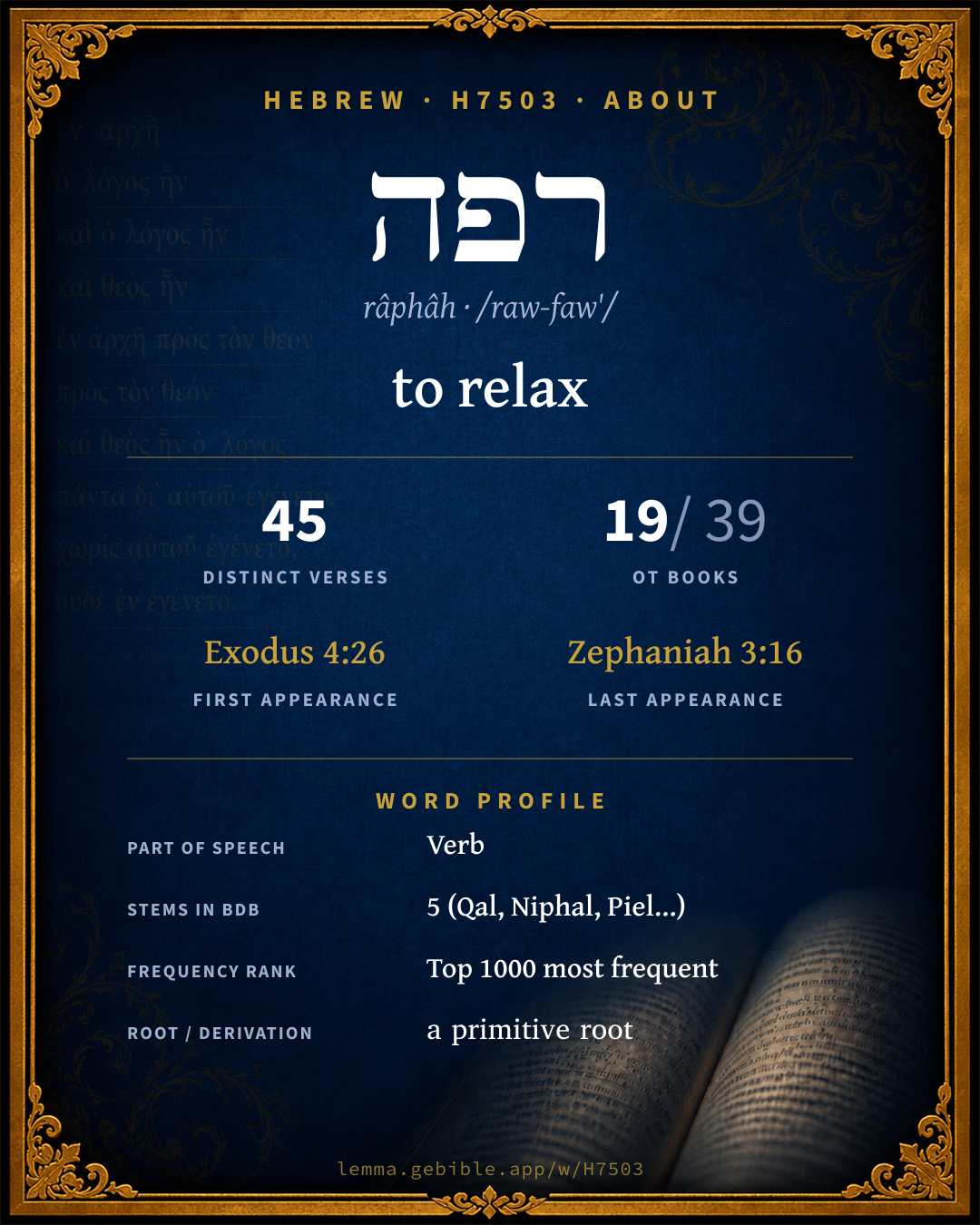
רָפָה
to relax
‘to relax’ is one of 4 main senses fuller range ↓
Full lexicon entry — Brown-Driver-Briggs (BDB)
From Brown-Driver-Briggs (BDB)
Where this word appears
See every Hiphil verb in the Hebrew Bible →
Grammar key — what these labels mean
Part of speech
- Verb
- An action or state-of-being word.
Stem
- Hiphil
- The causative active stem (“he caused / brought about”). Here: ‘let drop’
- Niphal
- Usually the simple passive or reflexive of the Qal (“he was written”). Here: ‘pl.’
- Piel
- An intensive or resultative active stem.
- Qal
- The basic, simple active stem — the plain form of the verb (“he wrote”). Here: ‘sink down’
- Hithpael
- The reflexive or reciprocal stem (the subject acts on itself).
Form
- Imperative
- A direct command (“write!”).
- Imperfect
- An incomplete, ongoing, or future action (“he will / would write”).
- Participle Active
- A verbal adjective expressing ongoing or characteristic action (“writing / one who writes”).
- Jussive
- A third- or second-person volitional form expressing wish or command (“let him write”).
- Perfect
- A completed action or state — Hebrew marks aspect (completeness) more than strict tense (“he wrote”).
- Sequential Perfect
- A perfect with prefixed waw continuing a preceding imperfect or command (waw-consecutive perfect).
- Sequential Imperfect
- An imperfect with prefixed waw — the standard past-narrative form (waw-consecutive imperfect).
State
- Absolute
- The independent form of a noun, not bound to a following word.
Person
- 2nd Person
- The one addressed (“you”).
- 3rd Person
- The one spoken about (“he / she / it / they”).
- 1st Person
- The speaker (“I / we”).
Gender
- Masculine
- Grammatically masculine.
- Common
- Either gender — not distinguished for this form.
- Feminine
- Grammatically feminine.
Number
- Singular
- One.
- Plural
- More than one (in Hebrew, generally three or more).
Every verse where H7503 appears in the Book of 2 Samuel — 2 distinct verses. Click any verse to open its interlinear word-by-word view. Verse text shown in the World English Bible for context — . Each verse’s Hebrew form is shown with its reference; the English is not keyword-highlighted, since the data carries no word-level English alignment. Use “Compare translations” on any verse to read it across multiple English versions. This concordance covers the Hebrew Bible; Septuagint (Greek Old Testament) occurrences are not indexed here.
2 Samuel
- 2 Samuel 4:1 וַ/יִּרְפּ֖וּ conj + Qal wimpf 3mp When [Ish-bosheth], Saul's son, heard that Abner was dead in Hebron, his hands became feeble, and all the Israelites were troubled.
- 2 Samuel 24:16 הֶ֣רֶף Hiphil impv 2ms When the angel stretched out his hand toward Jerusalem to destroy it, Yahweh repented him of the evil, and said to the angel who destroyed the people, It is enough; now stay your hand. The angel of Yahweh was by the threshing floor of Araunah the Jebusite.
About this entry
At a glance — auto-summarized from this page’s data, not written by a person. Every figure links to its source below. This summary describes the numbers; it doesn’t interpret them.
“to relax” is the headline sense of the Hebrew verb רפה (râphâh). As a verb its force shifts by stem, across 5 stems (Qal, Niphal, and more). It turns up in 45 verses across 19 books, a moderately common footprint. Its earliest occurrence is Exodus 4:26. It clusters with רפה, רפיון and רפת under a shared root. See the sense tree, 45-verse concordance, and the renderings breakdown below.
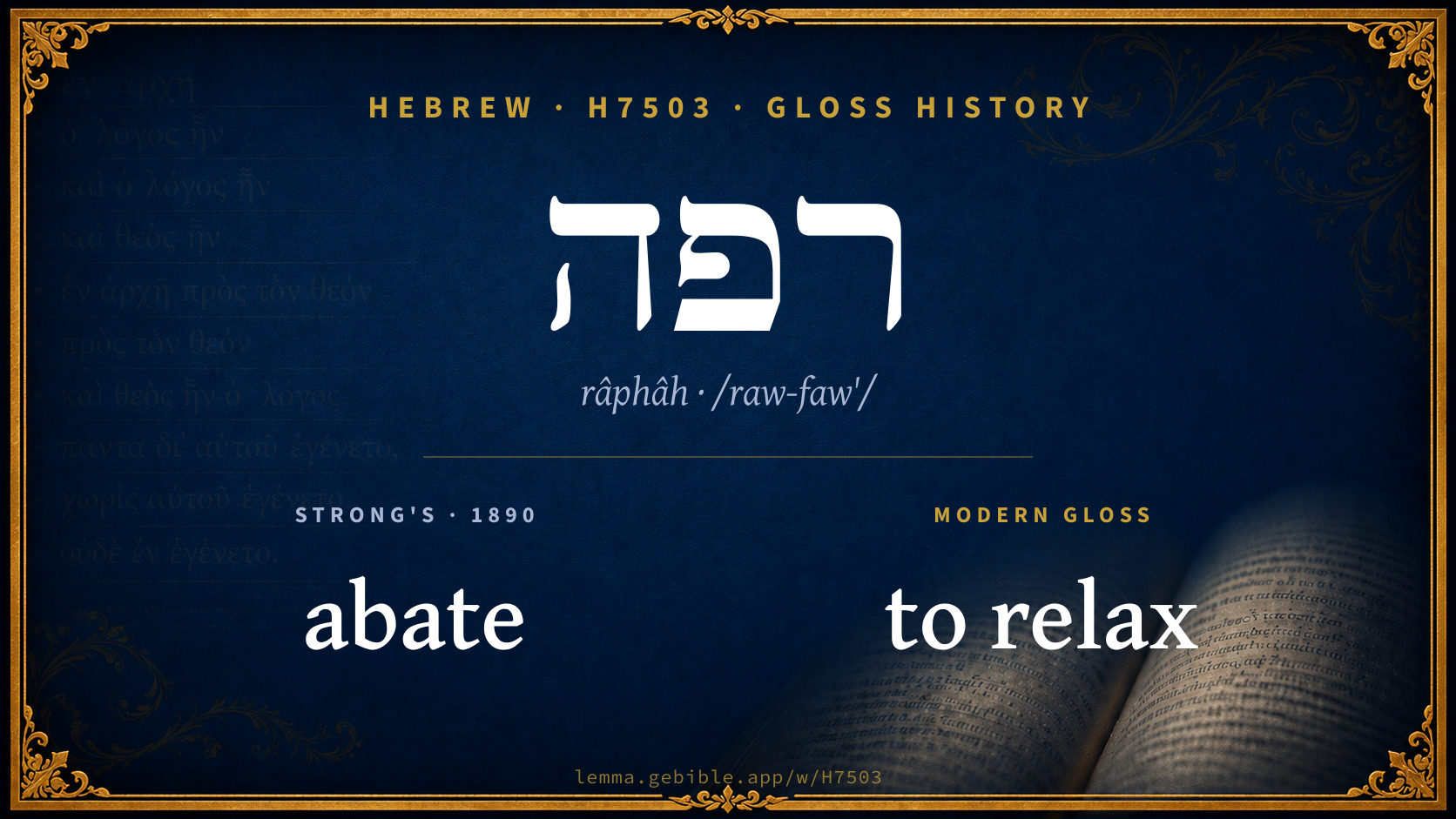
Gloss history
Strong's 1890 vs modern scholarship
About this word
Strong's H7503 catalogs a Hebrew word from the Hebrew Old Testament.
These counts are not copied from any lexicon or concordance. They are computed here, from the morphology-tagged Hebrew Old Testament. What Lemma adds →
- 45
- distinct verses
- The word appears in 45 distinct verses.
- 19 / 39
- OT books
- The word appears in 19 of 39 Old Testament books.
- #796
- by frequency
- Top 1000 most frequent Hebrew words (rank 796 of 8,640 Hebrew words by occurrence).
View all 45 occurrences in the concordance →
Most concentrated in
- Deuteronomy 4 verses 9%
- Jeremiah 4 verses 9%
- Ezekiel 4 verses 9%
By section of the Old Testament
By traditional corpus
Conventional, traditional groupings — biblical authorship is debated, so this is a traditional corpus grouping, not an authorship claim. Each share is this word’s portion of its verses in that division of the Hebrew canon. Each figure is a share of the word’s 45 distinct verses.
- Prophets (Nevi'im) 22 verses · 49%
- Writings (Ketuvim) 16 verses · 36%
- Torah (Pentateuch) 7 verses · 16%
How translations render this word
Counts come from each version’s own published word-to-Strong’s tagging or interlinear alignment — an approximate guide to how each version renders this word, not a word-level alignment the data otherwise carries. Because each total is that version’s own tagged count, the per-version totals vary from one another and need not match the appearance or distinct-verse counts above. These counts may also differ from a printed concordance because Lemma counts each distinctly tagged rendering and does not collapse phrase taggings into a single head-word total. This is a fixed set of word-tagged versions (KJV, ASV, BSB, ULT) and does not change with the reading translation you choose elsewhere. Each version’s license is shown beside its name below (and on Sources).
BDB lists this Strong’s number as 3 distinct words (homographs). Each count above pools all of them and is not split by sense — see the Senses section below. A low-frequency rendering may belong to a different one of those words, not the primary meaning.
- King James Version†: Let me alone 3×, Stay 3×, Shall be feeble 2×
- American Standard Version†: Be slack 2×, Hands wax feeble 2×, Me 2×
- Berean Standard Bible†: Leave you 3×, Let go 3×, Abandon 2×
- unfoldingWord Literal Text†: Do 5×, He will 4×, Fail you 3×
King James Version Public Domain
Renders H7503 across 46† tagged occurrences — most commonly:
Plus 36 renderings that appear only once — usually multi-word phrases or single function words the recovered tagging swept in, not distinct renderings.
American Standard Version Public Domain
Renders H7503 across 46† tagged occurrences — most commonly:
Plus 30 renderings that appear only once — usually multi-word phrases or single function words the recovered tagging swept in, not distinct renderings.
Berean Standard Bible Public Domain
Renders H7503 across 44† tagged occurrences — most commonly:
Plus 28 renderings that appear only once — usually multi-word phrases or single function words the recovered tagging swept in, not distinct renderings. Not rendered by a distinct English word in 2 further occurrences.
unfoldingWord Literal Text CC BY-SA 4.0
Renders H7503 across 63† tagged occurrences — most commonly:
Plus other, less common renderings. Plus 31 renderings that appear only once — usually multi-word phrases or single function words the recovered tagging swept in, not distinct renderings.
12 senses and sub-senses in the full BDB
Hebrew verbs can shift meaning by stem (binyan): Qal is the basic action, Niphal is often passive or reflexive, Piel often intensifies or makes it factitive, and Hiphil is typically causative. The senses below are grouped under the stem BDB assigns to each. This entry also uses Hithpael (reflexive or reciprocal).
What do BDB’s symbols mean?
BDB uses these scholarly abbreviations:
| Symbol | Meaning |
|---|---|
| 𝔊 | the Septuagint (the ancient Greek translation, LXX) |
| 𝔙 | the Vulgate (the Latin translation) |
| 𝔖 | the Syriac version (the Peshitta) |
| 𝔗 | the Targum (the Aramaic translation) |
| ψ | the Psalms |
| √ | root (the underlying root or stem) |
| ‖ | parallel passage (a synonymous or contrasted parallel) |
| † | the dagger: every passage where the word occurs is cited |
The 12 senses and sub-senses the full Brown-Driver-Briggs lexicon distinguishes for this word, in lexicon order (not ranked by frequency), with BDB’s own verbatim wording and sub-sense lettering. Shown in Hebrew script with BDB’s own scholarly abbreviations. The condensed entry is in the Lexicon Entry tab. See also the Forms in the corpus table below.
רפה I m. in Saul’s line 1 Ch 8
רפה II sink, relax (NH id., so Aramaic רפא (der. spec.), Zinj. רפה Aph., ܪܦܳܐ
Qal
- Pf. 3 ms. Ju 19:9 (yet v. infr.); 3 fs. רָֽפְתָה Ju 8:3 Je 49:24, etc.; Impf. 3 ms. יִרְפֶּה Is 5:24, וַיִּ֫רֶף Ex 4:26 (v. infr.), etc.;— e.g. Judges 19:9
- 1. sink down, of hay in flame Is 5:24; sink, decline, of day Ju 19:9 (si vera l.; 𝔊L κέκλικεν, GFM נָטָה [but how expl. the difficult רפה?]). Usually e.g. Isaiah 5:24
- 2. sink, drop (of wings, v. Pi.), of hands, c. מִן Ne 6:9 their hands will drop from the work (in fear); elsewhere abs. fig. = lose heart, energy, 2 S 4:1; Is 13:7; Je 6:24; 50:43; Ez 7:17; 21:12; Zp 3:16; 2 Ch 15:7; יָדַיִם om. Je 49:24. e.g. Nehemiah 6:9
- 3. relax, abate, of temper Ju 8:3 (+ מֵעַל pers.). e.g. Judges 8:3
- 4. relax, withdraw, subj. י׳, מִן pers. Ex 4:26 (J), i.e. let one alone (but read perhaps וַיֶּרֶף, v Hiph.). e.g. Exodus 4:26
Niphal
- Pt. pl. נִרְפִּים idle Ex 5:18, 17 (J). e.g. Exodus 5:18
Piel
- Pf. 3 ms. רִפָּה Jb 12:21; Impf. 3 fpl.; תְּרַפֶּינָה Ez 1:24, 25; Pt. מְרַפֵּא (Ges§ 75 rr) Je 38:4; pl. מְרַפִּים Ezr 4:4;—causat.: let wings drop Ez 1:24, 25 (read Qal, כנפיהם subj., 𝔊 Co Toy Krae al., who del. in v 25); loosen and let drop, girdle of mighty, fig. for weaken them Jb 12:21; c. acc. hands, fig. for enfeeble, dishearten Je 38:4; Ezr 4:4. e.g. Job 12:21
Hiphil
- Impf., 3 ms. sf. יַרְפְּךָ Dt 4:31 +; juss. 2 ms. תֶּ֫רֶף Jos 10:6 +, etc.; Imv. ms. הַרְפֵּה Ju 11:37; 2 K 4:27; הֶ֫רֶף Dt 9:14 +; mpl. הַרְפּוּ ψ 46:11;—causat., e.g. Deuteronomy 4:31
- 1. let drop, the hand 2 S 24:16 = 1 Ch 21:15; fig., + מִן pers., = abandon, Jos 10:6 (JE); perhaps also (יָד om.) = relax, refrain Ex 4:26 (reading וַיֶּרֶף, v Qal.); acc. rei, = abandon, forsake, Ne 6:3, so (subj. י׳) ψ 138:8; subj. י׳, c. acc. pers., Dt 4:31; 31:6, 8; Jos 1:5 (D), 1 Ch 28:20. e.g. 2 Samuel 24:16
- 2. let go, sf. pers., Ct 3:4 (opp. אחז); fig., acc. (om.) מוּסָר, Pr 4:13 (opp. החזיק), צְדָקָה Jb 27:6 (opp. id.). e.g. Song of Solomon 3:4
- 3. refrain, c. מִן pers., = let one alone Ju 11:37; Dt 9:14, מִן of anger ψ 37:8; c. ל pers. 1 S 11:3; 2 K 4:27; acc. pers. Jb 7:19; abs. let alone, i.e. do nothing, be quiet, 1 S 15:16 ψ 46:11 (cf. Weir in Dr 18 15, 16).—Je 3:22; Jb 5:18 ψ 60:4 v. רָפָא. e.g. Judges 11:37
Hithpael
- Pf. 2 ms. הִתְרַפִּית Pr 24:10 hast shewn thyself slack; Pt. מִתְרַפֶּה 18:9 one shewing himself slack, pl. מִתְרַפִּים Jos 18:3.—Vid. also רָפָא heal. e.g. Proverbs 24:10
רפה III II. רָפָא as n.pr.m., always c. art. Hā-Rāphā (perhaps der. from n.pr.gent. II. רְפָאִים, q.v.)
Senses from the full Brown-Driver-Briggs lexicon (Brown, Driver, Briggs; Oxford 1906 — public domain), digitized via Sefaria, supplemented by the OpenScriptures HebrewLexicon (CC BY 4.0). Full attribution on Sources.
Word origin
I. n.pr.m. in Saul’s line 1 Ch 8:37, Ραφαι(α), 𝔊L Αραχα; v. רְפָיָה.—II. ר׳ v. רפה.
II. vb. sink, relax (NH id., so Aramaic רפא (der. spec.), Zinj. רפה Aph., ܪܦܳܐ; Arabic رَفَاهَة an easy life is perhaps akin);—
III. II. רָפָא as n.pr.m., always c. art. Hā-Rāphā (perhaps der. from n.pr.gent. II. רְפָאִים, q.v.);—הָֽרָפָה 2 S 21:16, 18, c. prep. לְהָ׳ v 20:22 = לְהָרָפָא 1 Ch 20:6, 8;—only as parent, בִּילִידֵי הָר׳ 2 S 21:16, 18 (= מִילִידֵי הָֽרְפָאִים 1 Ch 20:4); יֻלַּד לְהָר׳ v 20, 22 ‖ I Ch 20:6, 8.—1. רָפָה v. sub רָפָא.
— Brown-Driver-Briggs (Oxford 1906, public domain), digitized via Sefaria, supplemented by the OpenScriptures HebrewLexicon (CC BY 4.0). See Sources.
Origin: a primitive root
Jastrow Dictionary
A second Hebrew/Aramaic lexicon for comparison, covering Aramaic and post-biblical (Talmudic, Targumic, Midrashic) usage that the biblical-Hebrew BDB does not. Matched by lemma rather than by Strong’s number, so a lemma may carry more than one Jastrow headword (shown separately below), and the entries cover usage well beyond the Bible.
רָפָה
- , v. רפי
רָפֶה
- preced.) lax, loose. Gen. R. s. 100 מיד היא ר׳ it (the threatening sword of death) becomes at once loose (in the hands of the angel); a. e.—שפה ר׳, v. שָׂפָה.—Pl. רָפִים, רָפִין; רָפוֹת. Lev. R. s. 19 (ref. to Is. XXXV, 3) ידים … כאילו ר׳ the hands (of God) which appear as if they were lax; a. e. e.g. Isaiah 35:3
רפי ²
- preced.) to be or make lax. Lev. R. s. 19 רָפוּ ידיהן their hands became lax (they lost their energy).—Part. pass. רָפוּי; f. רְפוּיָה. Sabb. 141ᵇ בר׳ when the shoe on the block is loose (can be taken off without moving the block). Ib. 130ᵃ, v. infra.
- 1. to loosen, let go. Mikv. VIII, 5 יְרַפֶּה כדי וכ׳ he must loosen his hold of the objects, so that the water can come in contact with them; Y. Ḥag. III, beg. 78ᵈ יְרַפֵּם עד וכ׳ he must let them go until &c.
- 2. to let hang down; to make lax, weaken. Tanḥ. K’dosh. 6 מְרַפִּין כנפיהם they let their wings hang down. Lev. R. l. c. (ref. to Is. XXXV, 3) שרִפִּיתֶם עצמיכם וכ׳ you weakened yourselves through your evil doings. Bekh. 5ᵇ; Snh. 106ᵃ (play on ר̇פ̇י̇ד̇י̇ם̇) שרִֹיפּ֗וּ י̇ד̇יהן מדברי תורה (not עצמן) they let their hands drop from (holding) the words of the Law; Tanḥ. B’shall. 25 שרִפּוּ ידיהן מן התורה (or שרָפוּ, v. supra); a. e.—Part. pass. מְרוּפּה; f. מְרוּפָּה. Sabb. 130ᵃ עדיין היא מר׳ בידם (not הוא; Ms. O. רְפוּיָה) it is still lax in their hands (they treat the ceremony with laxity), opp. מוחזקת held fast.—3) to soften, teach good manners. Ruth R. to II, 5 רבתה רִפְּתָה לה (or רָפְתָה) her mistress (Naomi) had taught her good manners; Yalk. ib. 601 חמותה מאלפא לה. e.g. Isaiah 35:3
A Dictionary of the Targumim, the Talmud Babli and Yerushalmi, and the Midrashic Literature (Marcus Jastrow; London, Luzac, 1903) — Public Domain. Digitized via Sefaria. Digitized via Sefaria. Full attribution on Sources.
Forms in the corpus
The 39 distinct written forms H7503 takes in the Hebrew Bible, most frequent first — each parse links to that stem’s occurrences in the concordance. Hebrew forms include their vowel points and cantillation, so a single lemma takes many written forms.
Same root — word family
Other BDB entries built from the same root as H7503, grouped by Strong’s listed origin. These share a root / origin per the lexicon — not necessarily a shared meaning. Each links to that word’s own entry.
Derived from this word
Compare all same-root words → They share a root, not necessarily a meaning.
Septuagint verse parallels
This word appears in 41 verses that also exist in the Greek Old Testament (Septuagint), out of the 45 Hebrew verses it occurs in. You can read those verses in Greek by switching the Old Testament edition to the Septuagint.
Read these verses in the Septuagint
- Exodus 4:26
- Deuteronomy 4:31
- Joshua 1:5
- Judges 8:3
- 1 Samuel 11:3
- 2 Samuel 4:1
- 2 Kings 4:27
- 1 Chronicles 21:15
- 2 Chronicles 15:7
- Ezra 4:4
- Job 7:19
- Psalms 37:8
This is a verse-level parallel only — the same verses exist in both the Hebrew and Greek Old Testaments. No word-level Hebrew↔Greek correspondence is claimed: the data carries no such alignment, so no Greek word is shown as this Hebrew word’s translation. Coverage is not total — the Septuagint omits the deuterocanon and renumbers the Psalms, so some Hebrew verses have no direct Greek parallel.