
Joshua 18:3

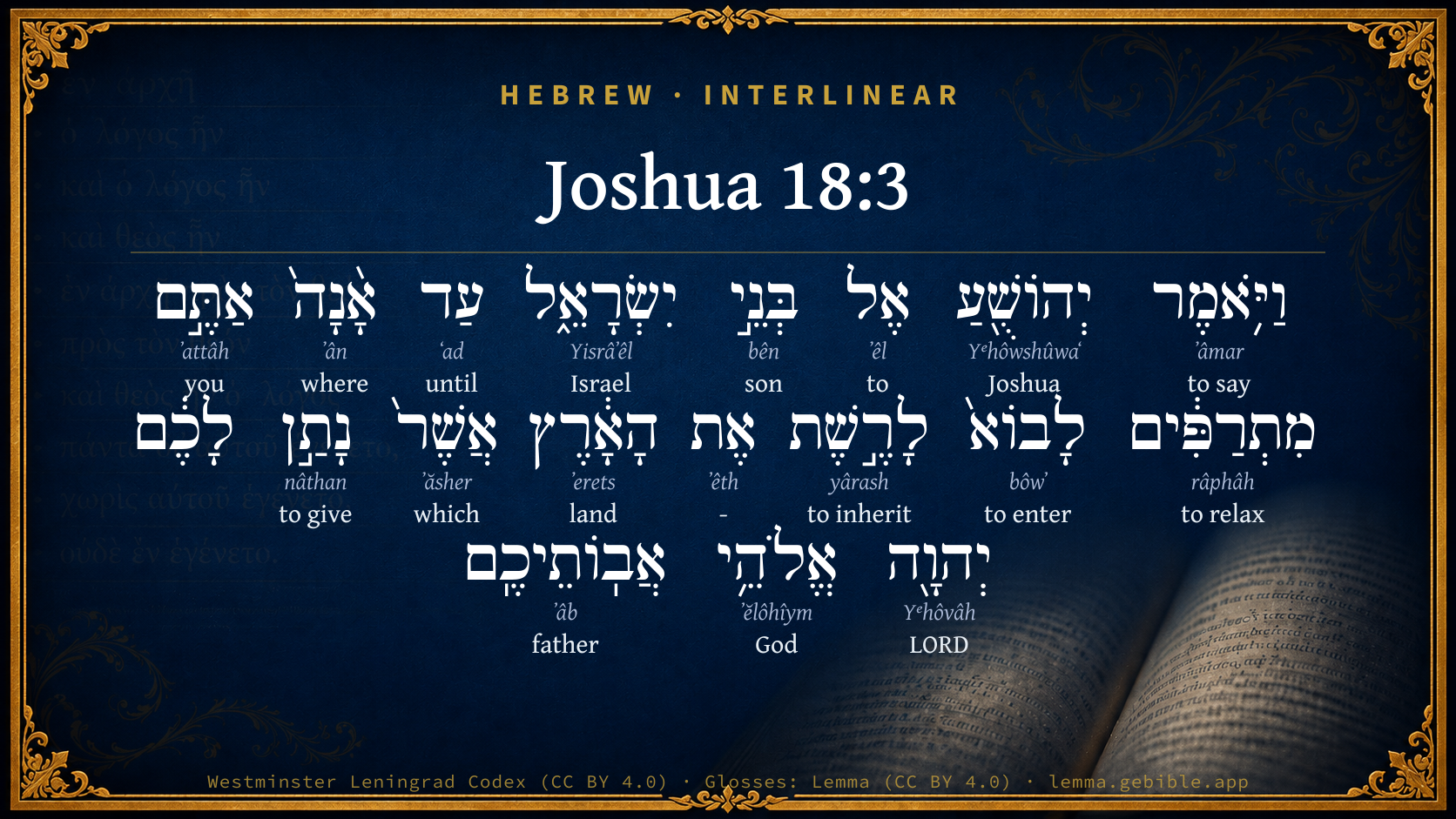
Hebrew (Westminster Leningrad Codex) Joshua 18:3 appears in the Hebrew Old Testament. The text above is from the Westminster Leningrad Codex. Each word links to its Strong’s number, a concise gloss, and parsing drawn from the Open Scriptures Hebrew Bible morphology. Click any word for its full Brown-Driver-Briggs (BDB) entry.
Download image
Cite this verse

Joshua 18:3 (World English Bible). Public Domain. Lemma interlinear Bible study tool, https://lemma.gebible.app/v/joshua/18/3.

Show BibTeX & RIS
BibTeX
RIS
English Translation
Joshua said to the children of Israel, How long are you slack to go in to possess the land, which Yahweh, the God of your fathers, has given you?
World English Bible · Public Domain
Download a study sheet

One document with this verse’s original text, its word-by-word gloss line, the meaning frame, cross-references with their text, attributed commentary, and full source and license credits — printable, and it pastes into notes with its structure intact.

This verse Autodidact and up

Study sheet (.html) Plain text (.txt)

A passage Seminary Student

Up to 50 verses in one chapter. A passage sheet keeps up to 6 commentary sources and 12 cross-references per verse, in the order this page ranks them, and says so on the sheet whenever that leaves anything out. Ask for a single verse and you get the Autodidact verse sheet above.

Everything on this page stays free to read, with no account — the sheet is a download of what is already on screen, not access to it.

Want to remove ads? Support Godless Engineer
Compare translations 3

The same verse in 3 English versions, stacked beneath the original-language interlinear above. Click any original word for its lexicon entry.

Each is an independent rendering of the whole verse — the interlinear is not word-aligned to these translations.

Highlighted words mark where these versions differ — a whole-verse word diff, not a word-by-word alignment.

  • World English Bible Public Domain
    Joshua said to the children of Israel, How long are you slack to go in to possess the land, which Yahweh, the God of your fathers, has given you?
  • King James Version Public Domain
    And Joshua said unto the children of Israel, How long are ye slack to go to possess the land, which the LORD God of your fathers hath given you?
  • unfoldingWord Literal Text CC BY-SA 4.0
    And Joshua said to the sons of Israel, “Unto when will you slacken yourselves to enter to possess the land that Yahweh, the God of your fathers, has given to you?

unfoldingWord Literal Text — © unfoldingWord, licensed CC BY-SA 4.0. Word-aligned USFM3 via Door43 (git.door43.org/unfoldingWord/en_ult).

Versions to compare (up to 4)

3 of 4 selected

Show all 17 translations

Every available English version of this verse, each an independent rendering of the whole verse.

  • World English Bible Public Domain
    Joshua said to the children of Israel, How long are you slack to go in to possess the land, which Yahweh, the God of your fathers, has given you?
  • Berean Standard Bible Public Domain
    So Joshua said to the Israelites, “How long will you put off entering and possessing the land that the LORD, the God of your fathers, has given you?
  • Majority Standard Bible Public Domain
    So Joshua said to the Israelites, “How long will you put off entering and possessing the land that the LORD, the God of your fathers, has given you?
  • King James Version Public Domain
    And Joshua said unto the children of Israel, How long are ye slack to go to possess the land, which the LORD God of your fathers hath given you?
  • American Standard Version (1901) Public Domain
    And Joshua said unto the children of Israel, How long are ye slack to go in to possess the land, which Jehovah, the God of your fathers, hath given you?
  • Revised Version (1885) Public Domain
    And Joshua said unto the children of Israel, How long are ye slack to go in to possess the land, which the LORD, the God of your fathers, hath given you?
  • Geneva Bible (1599) Public Domain
    Therefore Ioshua said vnto the children of Israel, Howe long are ye so slacke to enter and possesse the land which the Lord God of your fathers hath giuen you?
  • Young's Literal Translation Public Domain
    and Joshua saith unto the sons of Israel, `Till when are ye remiss to go in to possess the land which He hath given to you, Jehovah, God of your fathers?
  • Literal Standard Version CC BY-SA 4.0
    and Joshua says to the sons of Israel, “Until when are you remiss to go in to possess the land which He, YHWH, God of your fathers, has given to you?
  • Unlocked Literal Bible CC BY-SA 4.0
    Joshua said to the people of Israel, “How long will you put off going into the land that Yahweh, the God of your ancestors, has given you?
  • unfoldingWord Literal Text CC BY-SA 4.0
    And Joshua said to the sons of Israel, “Unto when will you slacken yourselves to enter to possess the land that Yahweh, the God of your fathers, has given to you?
  • Darby Bible Public Domain
    And Joshua said to the children of Israel, How long will ye shew yourselves slack to go to take possession of the land which Jehovah the God of your fathers hath given you?
  • World Messianic Bible Public Domain
    Joshua said to the children of Israel, “How long will you neglect to go in to possess the land, which the LORD, the God of your fathers, has given you?
  • Webster's Bible Public Domain
    And Joshua said to the children of Israel, How long are ye slack to go to possess the land which the LORD God of your fathers hath given you?
  • Free Bible Version CC BY-SA 4.0
    So Joshua asked the Israelites, “How long will you go on being reluctant to go and take possession of the land that the Lord gave your forefathers?
  • Bible in Basic English Public Domain
    Then Joshua said to the children of Israel, Why are you so slow to go in and take up your heritage in the land which the Lord, the God of your fathers, has given you?
  • JPS Tanakh (1917) Public Domain
    And Joshua said unto the children of Israel: 'How long are ye slack to go in to possess the land, which the LORD, the God of your fathers, hath given you?

Literal Standard Version (2020), Covenant Press — licensed CC BY-SA 4.0. Text via the HelloAO Bible API (eBible.org). Unlocked Literal Bible (unfoldingWord) — licensed CC BY-SA 4.0. Text via the HelloAO Bible API (eBible.org). unfoldingWord Literal Text — © unfoldingWord, licensed CC BY-SA 4.0. Word-aligned USFM3 via Door43 (git.door43.org/unfoldingWord/en_ult). Free Bible Version, Dr. Jonathan Gallagher — licensed CC BY-SA 4.0. Text via the HelloAO Bible API (eBible.org).

Word by word

More ways to search: Search by grammar → Find every occurrence → Compare this word →

Practice this passage: Drill this verse → Learn its vocabulary →

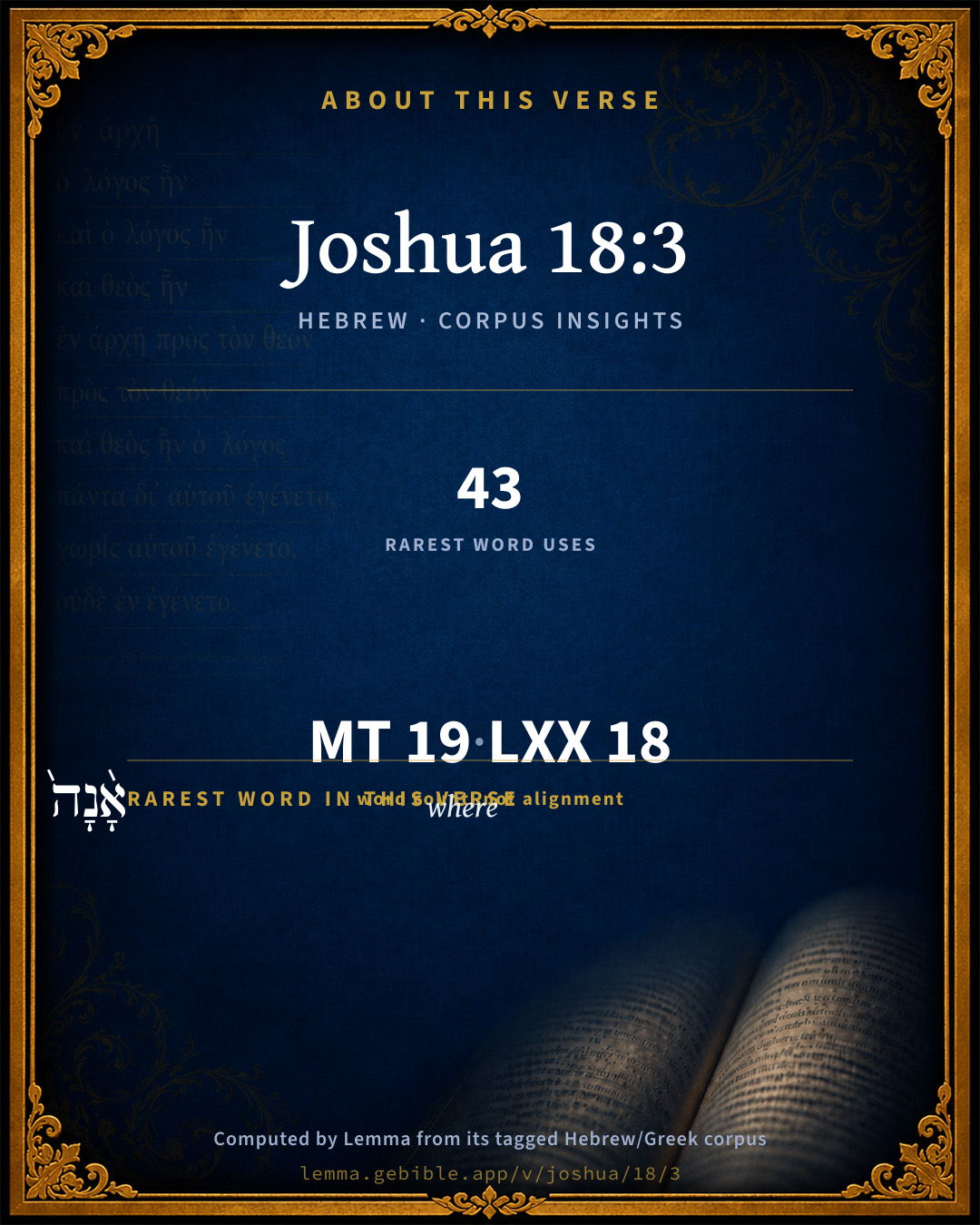
אָ֨נָה֙
ʼân
H575
“where”
Adverb
Part of Speech
Adverb
Full BDB Definition

Origin: contracted from H370

TWOT: 75g

where?, whither? (of place) - when?, until when?, how long? (of time)
  1. וַיֹּ֥אמֶר ʼâmar H559 “and · to say” Conjunction + Verb, Qal, Sequential Imperfect, 3rd Person, Masculine, Singular
  2. יְהוֹשֻׁ֖עַ Yᵉhôwshûwaʻ H3091 “Joshua” Noun, Proper
  3. אֶל ʼêl H413 “to” Preposition
  4. בְּנֵ֣י bên H1121 “sons of” Noun, Common, Masculine, Plural, Construct
  5. יִשְׂרָאֵ֑ל Yisrâʼêl H3478 “Israel” Noun, Proper
  6. עַד ʻad H5704 “until” Preposition
  7. אַתֶּ֣ם ʼattâh H859 “you” Pronoun, Personal, 2nd Person, Masculine, Plural
  8. מִתְרַפִּ֔ים râphâh H7503 “relaxing” Verb, Hithpael, Participle Active, Masculine, Plural, Absolute
  9. לָבוֹא֙ bôwʼ H935 “to enter” Preposition + Verb, Qal, Infinitive Construct
  10. לָרֶ֣שֶׁת yârash H3423 “to inherit” Preposition + Verb, Qal, Infinitive Construct
  11. אֶת ʼêth H853 “-” Particle, Direct Object
  12. הָאָ֔רֶץ ʼerets H776 “the · land” Particle, Definite Article + Noun, Common, Both, Singular, Absolute
  13. אֲשֶׁר֙ ʼăsher H834 “which” Particle, Relative
  14. נָתַ֣ן nâthan H5414 “to give” Verb, Qal, Perfect, 3rd Person, Masculine, Singular
  15. יְהוָ֖ה Yᵉhôvâh H3068 “LORD” Noun, Proper
  16. אֱלֹהֵ֥י ʼĕlôhîym H430 “God(s) of” Noun, Common, Masculine, Plural, Construct
  17. אֲבֽוֹתֵיכֶֽם ʼâb H1 “fathers · your” Noun, Common, Masculine, Plural, Construct + Suffix, Personal, 2nd Person, Masculine, Plural

About this verse

These counts appear in no published source. They are computed here, from the morphology-tagged text and Lemma’s own curated glosses. What Lemma adds →

19
words
18
distinct lemmas
Historical
section

Shared distinctive vocabulary

אָ֨נָה֙ where H575 occurs in 33 verses of the Hebrew Bible. Also found in:

Grammatical profile

  • 5 verbs
  • 7 nouns
  • 1 pronoun
  • 3 prepositions
  • 1 adverb
  • 2 particles

Verb forms

  • וַיֹּ֥אמֶר Qal · Sequential Imperfect
  • מִתְרַפִּ֔ים Hithpael · Participle Active
  • לָבוֹא֙ Qal · Infinitive Construct
  • לָרֶ֣שֶׁת Qal · Infinitive Construct
  • נָתַ֣ן Qal · Perfect

Hebrew & Septuagint length

In English translation the verse runs 29 words from the Hebrew and 26 from the Septuagint (LXX English) — closely comparable.

A rough comparison of the two English renderings, which tokenize alike — not a word-level alignment.

Word counts can differ between the Hebrew and the Greek without any difference in meaning — e.g. the Hebrew direct-object marker אֵת has no separate Greek word, and Greek often adds the article ὁ.

In the original languages it is 19 Hebrew tokens and 18 Greek tokens — but the two are counted differently (Hebrew bundles its prefixes and suffixes into one token; the Greek is in lemma form), so that isn’t a like-for-like length.

Cross-references

11

Topical passages linked to Joshua 18:3 in the Treasury of Scripture Knowledge — connected by theme and wording, ordered by reader-vote popularity; previews shown in the World English Bible.

  • Proverbs 13:4 The soul of the sluggard desires, and has nothing, But the desire of the diligent shall be fully satisfied.
  • Judges 18:9 They said, Arise, and let us go up against them; for we have seen the land, and, behold, it is very good: and are you still? don't be slothful to go and to enter in to possess the land.
  • Proverbs 15:19 The way of the sluggard is like a thorn patch, But the path of the upright is a highway.
  • Proverbs 10:4 He becomes poor who works with a lazy hand, But the hand of the diligent brings wealth.
  • Matthew 20:6 About the eleventh hour he went out, and found others standing idle. He said to them, 'Why do you stand here all day idle?'
  • Zephaniah 3:16 In that day, it will be said to Jerusalem, "Don't be afraid, Zion. Don't let your hands be slack."
  • Philippians 3:13–14 Brothers, I don't regard myself as yet having taken hold, but one thing I do. Forgetting the things which are behind, and stretching forward to the things which are before,
  • Proverbs 2:2–6 So as to turn your ear to wisdom, And apply your heart to understanding;
  • Ecclesiastes 9:10 Whatever your hand finds to do, do it with your might; for there is no work, nor device, nor knowledge, nor wisdom, in Sheol, where you are going.
  • John 6:27 Don't work for the food which perishes, but for the food which remains to eternal life, which the Son of Man will give to you. For God the Father has sealed him."
  • 2 Peter 1:10–11 Therefore, brothers, be more diligent to make your calling and election sure. For if you do these things, you will never stumble.

Cross-references courtesy of OpenBible.info (CC BY 4.0).

Hebrew and Greek witnesses Masoretic Hebrew ↔ Greek Septuagint

The same verse in the two great witnesses to the Old Testament, shown verse-for-verse.

These are two independent witnesses, not word-aligned to each other, and the Septuagint is shown in lemma (dictionary) form.

Hebrew Joshua 18:3 Masoretic · Westminster Leningrad Codex

וַיֹּ֥אמֶר יְהוֹשֻׁ֖עַ אֶל בְּנֵ֣י יִשְׂרָאֵ֑ל עַד אָ֨נָה֙ אַתֶּ֣ם מִתְרַפִּ֔ים לָבוֹא֙ לָרֶ֣שֶׁת אֶת הָאָ֔רֶץ אֲשֶׁר֙ נָתַ֣ן לָכֶ֔ם יְהוָ֖ה אֱלֹהֵ֥י אֲבֽוֹתֵיכֶֽם

Joshua said to the children of Israel, How long are you slack to go in to possess the land, which Yahweh, the God of your fathers, has given you?

World English Bible · Public Domain

Greek LXX Joshua 18:3 Septuagint · lemma form

καί εἶπον ἰησοῦς ὁ υἱός ἰσραήλ ἕως τίς ἐκλύω κληρονομέω ὁ γῆ ὅς δίδωμι κύριος ὁ θεός ἐγώ

And Joshua said to the sons of Israel, How long will you⌃ be slack to inherit the land, which the Lord our God has given you?

LXX2012 (modern English Septuagint) · Public Domain

Hebrew: Westminster Leningrad Codex (CC BY 4.0). Greek: Septuagint (public domain); English from LXX2012 (modern English Septuagint) (Public Domain). How the Septuagint differs from the Hebrew →

Targum (Aramaic paraphrase)

1

The Targum is the ancient Jewish Aramaic paraphrase of the Hebrew Scriptures — an interpretive translation, not the Hebrew text itself. Onkelos (literal) and Pseudo-Jonathan (expansive) render the Torah, and Jonathan the Prophets. Coverage is partial: where no permissively-licensed English translation exists for a verse, only the Aramaic is shown. This is verse-level text, not a word-by-word alignment to the Hebrew.

  1. Targum Jonathan Prophets (Joshua–Malachi)
    וַאֲמַר יְהוֹשֻׁעַ לִבְנֵי יִשְׂרָאֵל עַד אֵימָתַי אַתּוּן מִתְרַשְׁלִין לְמֵיעַל לְמֵירַת יַת אַרְעָא דִיהַב לְכוֹן יְיָ אֱלָהָא דְאַבְהַתְכוֹן:

    (no public-domain English translation for this verse)

    Targum Jonathan — Aramaic: “Mikraot Gedolot” (public domain). English: “Sefaria Community Translation” (CC0 1.0 (public-domain dedication)); “London "Chaldee Paraphrase," 1871” (public domain). Text via Sefaria.

Commentary

Notes on Joshua 18:3 from classic Christian and Jewish commentators (each source and its license shown beneath its notes). The classic Christian expositions comment on the surrounding passage and are grouped to its opening verse, so a note may address several verses; the Jewish commentaries on the Tanakh (Rashi and others) are per-verse, so they appear only where the commentator wrote on this verse.

Lemma curates 59 commentaries, every one of them public domain or Creative Commons licensed, each selected and text-cleaned for this edition rather than reprinted as found. About our sources →

Trapp's Complete Commentary

John Trapp

Jos 18:3 And Joshua said unto the children of Israel, How long [are] ye slack to go to possess the land, which the LORD God of your fathers hath given you?

Ver. 3. How long are you slack?] Quousque estis cessatores? Lata negligentia dolus est, saith the Civilian: Remissness is a kind of perfidiousness. Their posterity were infamous for their idleness, and are to this day a lazy, nasty people. A certain emperor marching through Jewry, and beholding it to be a goodly land, but without culture and tillage, through the slothfulness of the people, cried out, O Marcomanni, O Sarmatae, O Quadi, &c, :O lazy Germans, I have found a people more lazy than any of you!

John Trapp, A Commentary or Exposition upon All the Books of the Old and New Testament (1647–1656) — public domain. Text from a community e-Sword module.

Joseph Benson's Commentary

Jos 18:3-4. How long are ye slack? — It is probable, that being weary of war, and now having sufficient plenty of all things, they were unwilling to run into new hazards. Give out three men — Three, not one, for the more exact observation both of the measure and quality of the several portions, and for greater assurance of their care and faithfulness in giving in their account. Of each tribe — For each one of the tribes which were yet unprovided for. They shall describe it — Set down, not only the dimensions of it, but its condition and quality, whether barren or fruitful, mountainous or plain. According to the inheritance of them — Distributing the geographical description into as many parts as there remain tribes unprovided with an inheritance.

Joseph Benson's Commentary on the Old and New Testaments (1811–1818) — public domain. Text from a community e-Sword module.

Jamieson, Fausset & Brown

Robert Jamieson, A. R. Fausset & David Brown

How long are ye slack to go to possess the land, which the Lord God of your fathers hath given you--This reproof conveys an impression that the seven tribes were dilatory to a criminal extent.

Jamieson, Fausset & Brown — Commentary Critical and Explanatory on the Whole Bible (1871) — public domain (CC PDM 1.0). Text via the HelloAO Bible API.

Adam Clarke's Commentary

Verse 3. How long are ye slack to go to possess the land] We find an unaccountable backwardness in this people to enter on the inheritance which God had given them! They had so long been supported by miracle, without any exertions of their own, that they found it difficult to shake themselves from their inactivity. When it was necessary that all the people should go out to battle, they went with a measure of confidence, expecting miraculous help from God, and confiding in their numbers, but when each tribe found it necessary to fight for itself, in order to its establishment and the extension of its borders, it was discouraged, and chose rather a life of inglorious ease than the possession of an inheritance which would cost it much labour to conquer.

Adam Clarke's Commentary on the Bible (1810–1826) — public domain. Text from a community e-Sword/MySword module.

Ellicott's Commentary for English Readers

(3) And Joshua said . . .—Joshua, who took no inheritance for himself until all the tribes had received their portions, was free from the selfishness of the other leaders. He could not rest until he had finished the work that was given him to do. He therefore ordered that the rest of the territory should be surveyed, and divided, according to the number of the cities, into seven portions, which were then to be allotted according to the instructions given by Moses.

A Bible Commentary for English Readers, edited by Charles John Ellicott (1878–1897) — public domain. Text from a community e-Sword module.

The Cambridge Bible for Schools and Colleges

gen. ed. J. J. S. Perowne

3. And Joshua said] No particulars are given of the solemn and impressive ceremonies which doubtless marked the setting up of the time-honoured monument of the wanderings, and the resumption of the regular sacrifices and other ceremonies, which must have been imperfectly observed during the years of warfare now ended. The history passes on to the distribution of the yet unoccupied territory.

How long are you slack] These seven tribes appear to have been backward and indolent not only in conquering the land still unsubdued, but even in sharing it out amongst them.

The Cambridge Bible for Schools and Colleges (gen. ed. J. J. S. Perowne; Cambridge University Press, 1878–1918) — public domain. Text from a community e-Sword module.

John Gill's Exposition

And Joshua said unto the children of Israel,.... To those of the seven tribes:

how long are you slack to go to possess the land which the Lord God of your fathers hath given you? not that they might have taken possession of it of themselves, without having it assigned to them by lot; that they did not do this, is not what is complained of, and they stand reproved for; but that when two tribes and a half had received their inheritance, these seemed indifferent to it, showed no inclination and disposition towards it, and much less eagerness to have a settlement, and did not apply to the court for it; which dilatoriness might arise from the present affluence of all good things they enjoyed through the spoils of the enemy; and partly through slothfulness, being tired of the war, and perceiving that they must be involved in it again to dispossess the Canaanites of some of the cities that would fall to their lot; and, perhaps, their slackness might be the more increased, by observing the dissatisfaction of the tribes with the lot they had received, and therefore waited till things were adjusted to greater satisfaction.

John Gill's Exposition of the Whole Bible (1746–1763) — public domain (CC PDM 1.0). Text via the HelloAO Bible API.

Albert Barnes' Notes on the Bible

This backwardness probably arose from the indisposition of the people to abandon the nomad life in which they had been born and bred, and to settle in fixed abodes, and perhaps also from a dislike of the exterminating warfare incidental to a complete dispossessing of the Canaanites.

Albert Barnes' Notes on the Bible (1834–1885) — public domain. Text from a community e-Sword/MySword module.

Haydock's Catholic Bible Commentary

Slack. These seven tribes had been accustomed to live in indolence, having their food provided for them in a miraculous manner. They were perhaps afraid lest, if the army of Israel should be divided, the different tribes would be too weak to make head against the enemy. (Calmet) --- Josue had, however, made all things easy, and they might at their leisure conquer the few towns which yet remained in the hands of the Chanaanites, if they had not cherished this indolent disposition, which was so displeasing to God, and brought upon them so many evils. (Haydock)

George Leo Haydock (1774–1849), Haydock's Catholic Family Bible and Commentary, 1859 edition — public domain. Excludes Psalms (Douay-Rheims chapter numbering differs from Protestant) and Deuterocanonical books (Catholic canon only).

Matthew Poole's English Annotations

This slackness is supposed to arise, partly, from their dissatisfaction in the portions already allotted, Judah’s being too large, as it appeared, and Joseph’s too narrow as they complained; partly, from an opinion of the impossibility of making any regular and equal distribution of the parts, till the whole were better known, and more exactly surveyed, which accordingly is here done; and partly, because being weary of war, and having sufficient plenty of all things in their present condition, they grew slothful and secure, and were unwilling to run into new hazards and wars, as they perceived, by Joshua’s answer to the tribe of Joseph, Jos 17:15, &c., they were likely to do when they entered upon their several possessions.

Matthew Poole's English Annotations on the Holy Bible (1683–1685) — public domain. Text from a community e-Sword/MySword module.

The Pulpit Commentary

How long are ye slack? This "slackness" (the translation is a literal one) in the arduous conflict against the powers of evil is not confined to Jews. The exhortation needs repeating to every generation, and not less to our own than any other, since the prevalence of an external decency and propriety blinds our eyes to the impiety and evil which still lurks amid us unsubdued.

HOMILIES BY S.R. ALDRIDGE Ver. 3. An exhortation to advance.

In Jos_13:1 we find an address delivered to Joshua by Jehovah, in which he was reminded how much remained to be done ere his work was finished, and his age forbade the belief that many years would intervene before his death. To the assembled tribes of Israel the exhortation of the text was consequently given. The tribes of Manasseh, Reuben, and Gad had received their inheritance on the east of the Jordan, Judah occupied the south of Palestine, and Ephraim a domain in the centre, Levi was to have no special territory assigned, and seven tribes waited for the determination of their settlements.

I THE POSITION OF THESE ISRAELITES. After years of wandering they were permitted at last to tread the soil of the land of promise. They might well indulge feelings of gratification at the thought of their surroundings, that the wilderness was passed, and their eyes beheld the country which their fathers had in vain desired to see. A spot had been selected where the tabernacle should remain, being, according to the promise and prophecy of God, "in the midst of all their tribes." Still the Israelites had only attained to a half-way position. The rest of arrival must be succeeded by the warfare of acquisition before they could reach the rest of enjoyment. Jehovah had granted to them the land of the enemy, had conducted them safely thither; now let them grasp the privilege placed so near. Few of God"s gifts but necessitate effort on the part of the recipients, efforts to appropriate and improve. According to the old fable, treasures are buried in the fields, and only diligent search and cultivation will bring them to light and make us master of them. What men pay for or have a hand in securing, they value; what they strive after, they esteem; hence the necessity laid upon us to labour in order to receive is a beneficial law.

II WHAT THE REPROOF OF THE TEXT ARGUES UPON THE PART OF THE REPROVED.

(1) Indolence of disposition. It was doubtless pleasing to the Israelites to indulge for a season their love of ease. They could live for a time on the bounty of their brethren and on the fertile produce of the land which had cost them no trouble to till. They were "slack to go in to possess the land." Indolence is one of the most difficult foes to overcome. The great majority evince a decided disinclination to energetic exercise of their powers. Indolence is not only a state of privative loss in respect both of character and happiness, it is also a dangerous state, leaving man open to any incursion of the arch enemy. History abounds in instances of failure on the part of men to become great because they relaxed their efforts and progress ceased. A little longer struggling and the summit of ambition and fame had been scaled. "Idleness," says Seneca, "is the burying of a living man.

(2) Insensibility to the privileges possible to be acquired. Desire of gaining an end in view is the chief incentive to exertion, and the strength of the desire depends upon the amount of appreciation of the advantages which will be thereby secured. He who is not attracted by the pictures drawn of heaven will not manifest any resolute endeavours to get there. That kind of exhortation is most successful which causes hearers to glow within them at the thought of the precious jewels which may be obtained by seeking. Emotions are regulated by the keenness or dulness of our perceptions.

(3) Forgetfulness of direct command. Sloth was, in fact, disobedience. The very purpose for which God had preserved the tribes was, that they might, in obedience to His behests, occupy their respective territories, and drive out the inhabitants who had defiled the land. Many persons excuse their dilatoriness in complying with the precepts of Scripture by various pleas which discover an insufficient acknowledgment of the obligation resting upon them not merely to leave undone what ought not to be done, but to do at once what they ought to do. In this they are verily guilty. We must not be oblivious of the sins of omission as well as of commission. Woe to us if we know our Lord"s will and do it not! Constantly let the inquiry be made, "Lord, what wilt thou have me to do?

III THE APPLICATION OF THE FOREGOING. To Christian attainments. The Christian life is described in many terms, nearly all of which represent it as a progress, a "reaching forth unto things that are before." It is called a warfare, a race, a pilgrimage, a building, etc., denoting continuous effort, in the shape of assault or resistance to assault. There are strongholds to be taken, plains to be seized, fountains and woods and rivers to be gained, trophies to be won. The followers of Christ are expected to advance in faith, hope, and love, in knowledge, purity and holiness, in gifts and graces, in self discipline and improvement, and in usefulness to others and to the Church. To secret discipleship. There was a time when you were under the servile yoke of sin, and being released entered the wilderness of doubt to be affrighted by the thunders of the law. But you have found a High Priest, a Mediator, who has also been a Deliverer to lead you into the land of rest. You have believed in Christ, and are rejoicing in your condition. But you have not taken your rightful position among your brethren. Some are engaged in tending the ground, planting and sowing, erecting houses and expelling the enemy, whilst you are content to remain by the tabernacle of the Lord. You do not enjoy the privileges of communion at the table of the Lord, and of occupying your station in the Church of Christ. To stay where you are is an injury to yourselves, it is a loss to the Church, and dishonours the Redeemer. A.

The Pulpit Commentary (1880–1919), ed. H.D.M. Spence-Jones & Joseph S. Exell — public domain. Text from a community e-Sword module.

John Wesley's Explanatory Notes

How long are you slack - This slackness is supposed to arise from an opinion of the impossibility of making any regular distribution of the parts, 'till the whole were more exactly surveyed, which accordingly is here done. Likewise, being weary of war, and having sufficient plenty of all things, they were unwilling to run into new hazards.

John Wesley, Explanatory Notes Upon the Whole Bible (1754–1765) — public domain. Text via the GEBible commentary corpus.

unfoldingWord translationNotes

Door43 World Missions Community

How long will you put off ... has given you?

Joshua asks this question in order to encourage the Israelites to take possession of the land. AT: "For long enough, you have put off ... has given you." (See: Rhetorical Question)

the land up and down

The words "up and down" mean in every direction. AT: "the land in every direction" or "throughout the land" (See: Idiom)

write out a description of it with a view to their inheritances

This means that they will describe the portions of land that each tribe would like to receive for an inheritance.

their inheritances

The land that they are to survey is spoken of as if it were an inheritance that each of the tribes would receive as a permanent possession. (See: Metaphor)

translationWords

Joshua

Yahweh

God

appoint

send

unfoldingWord translationNotes — © Distant Shores Media and the Door43 World Missions Community, licensed CC BY-SA 4.0. Source: git.door43.org/Door43/en_tn.

Rashi

Rabbi Shlomo Yitzchaki (Rashi)

Timid—weak.

Rashi on the Tanakh — English translations: “The Judaica Press complete Tanach with Rashi, translated by A. J. Rosenberg” (CC BY 4.0); “Pentateuch with Rashi's commentary by M. Rosenbaum and A.M. Silbermann, 1929-1934” (public domain); “The Metsudah Tanach series, Lakewood, N.J” (CC BY 4.0); and “The Book of Joshua, Metsudah Publications, 1997” (CC BY 4.0). Text via Sefaria.

Lesson kit

Teaching starters — assembled from the data on this page, not authored interpretation. Every prompt links to the verse data it draws on. Edit before teaching.

Joshua, in the Historical, opens this verse with 19 words (18 distinct Hebrew lemmas). Its most distinctive word is ʼân (“where”). A historical commentator’s framing appears above. Read the whole chapter for the surrounding context.

Discussion questions

  1. The word ʼân carries the sense “where.” How does it shape the verse?
  2. Genesis 16:8 shares the word «where» with this verse. How do the two illuminate each other?
  3. These translations render this verse differently. What is at stake in choosing one wording over another?
  4. The verb «וַיֹּ֥אמֶר» is Qal Sequential Imperfect. How does its form color the action?
  5. Reading how Trapp's Complete Commentary and Joseph Benson's Commentary read this verse, where do the two commentators agree and where do they part?

Things to notice

Reading settings

Reading text

Shown beneath each verse's original-language words.

Old Testament
Old Testament edition

Read the OT as the Masoretic Hebrew (MT) or the Greek Septuagint (LXX).

English shown for the Greek Septuagint (in the Hebrew ↔ Greek comparison).

Comparing translations? Open the Compare panel on any verse page to stack up to four side by side.