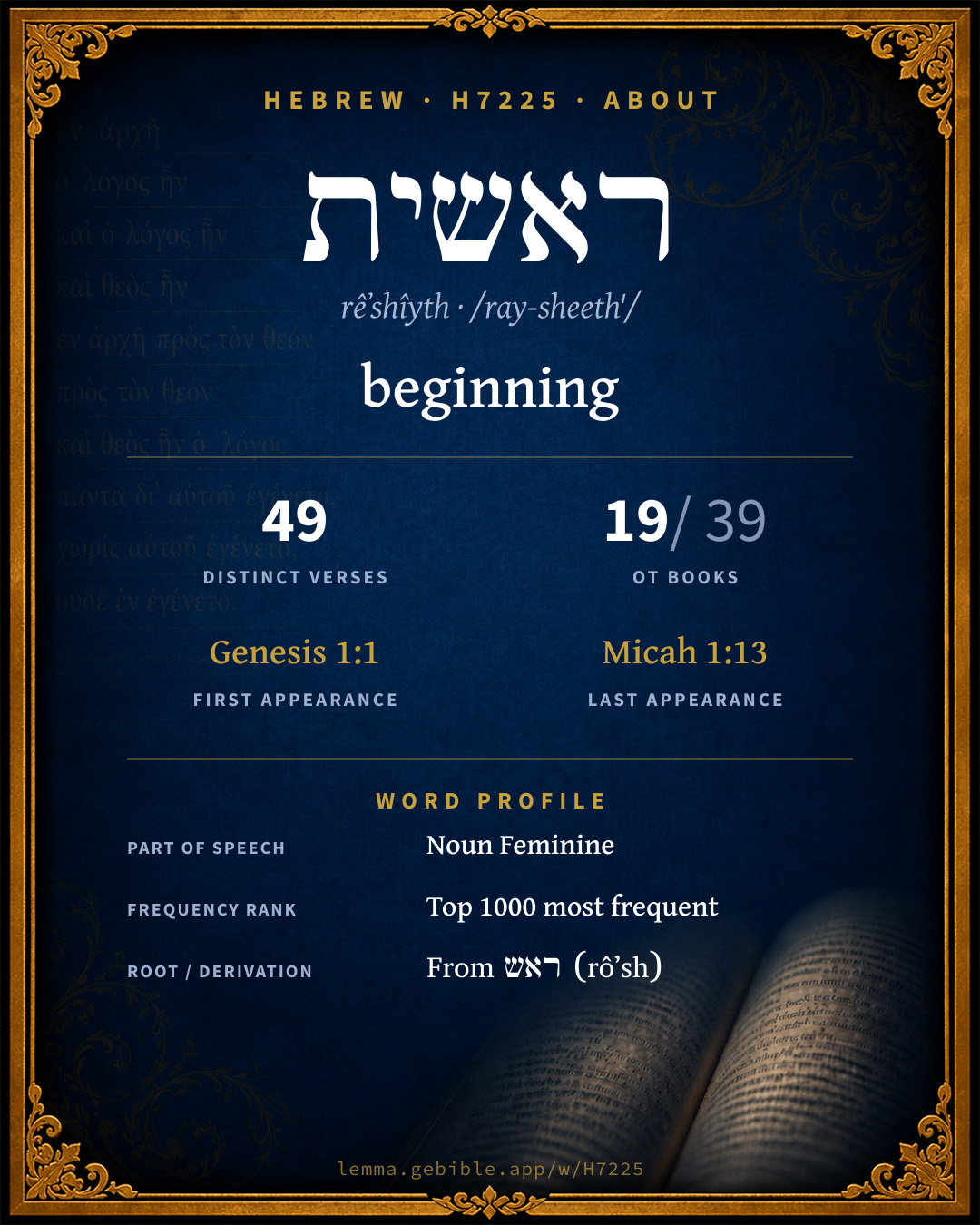
רֵאשִׁית
beginning
also: first, best, chief fuller range ↓
Full lexicon entry — Brown-Driver-Briggs (BDB)
From Brown-Driver-Briggs (BDB)
Where this word appears
See every Construct-state word in the Hebrew Bible →
Grammar key — what these labels mean
Part of speech
- Noun
- A naming word — a person, place, thing, or idea.
Noun type
- Common
- A common noun — a general class of person, place, or thing (“king,” “city,” “water”), not a specific name.
State
- Construct
- A noun bound to a following noun in a possessive / “of” relationship (the construct chain).
- Absolute
- The independent form of a noun, not bound to a following word.
Gender
- Feminine
- Grammatically feminine.
Number
- Singular
- One.
Grammatical forms
- Noun, Common, Feminine, Singular, Construct 45 times (88%)
- Noun, Common, Feminine, Singular, Absolute 6 times (12%)
Parsed forms decoded from the imported morphology (morphhb / Westminster Leningrad Codex — WLC text public domain, morphhb tagging CC BY 4.0), counted across 51 parsed occurrences — not distinct verses.
Every verse where H7225 appears — 49 distinct verses across 19 books. Click any verse to open its interlinear word-by-word view. Verse text shown in the World English Bible for context — . Each verse’s Hebrew form is shown with its reference; the English is not keyword-highlighted, since the data carries no word-level English alignment. Use “Compare translations” on any verse to read it across multiple English versions. This concordance covers the Hebrew Bible; Septuagint (Greek Old Testament) occurrences are not indexed here.
Genesis 3 verses
- Genesis 1:1 בְּ/רֵאשִׁ֖ית prep + n c fs In the beginning God created the heavens and the earth.
- Genesis 10:10 רֵאשִׁ֤ית n c fs cs The beginning of his kingdom was Babel, Erech, Accad, and Calneh, in the land of Shinar.
- Genesis 49:3 וְ/רֵאשִׁ֣ית conj + n c fs cs "Reuben, you are my firstborn, my might, and the beginning of my strength; The pre-eminence of dignity, and the pre-eminence of power.
Exodus 2 verses
- Exodus 23:19 רֵאשִׁ֗ית n c fs cs The first of the first fruits of your ground you shall bring into the house of Yahweh your God. "You shall not boil a kid in its mother's milk.
- Exodus 34:26 רֵאשִׁ֗ית n c fs cs You shall bring the first of the first fruits of your ground to the house of Yahweh your God. You shall not boil a young goat in its mother's milk."
Leviticus 2 verses
- Leviticus 2:12 רֵאשִׁ֛ית n c fs As an offering of firstfruits you shall offer them to Yahweh: but they shall not come up for a sweet savor on the altar.
- Leviticus 23:10 רֵאשִׁ֥ית n c fs cs "Speak to the children of Israel, and tell them, 'When you have come into the land which I give to you, and shall reap its the harvest, then you shall bring the sheaf of the first fruits of your harvest to the priest:
Numbers 4 verses
- Numbers 15:20 רֵאשִׁית֙ n c fs cs Of the first of your dough you shall offer up a cake for a heave-offering: as the heave-offering of the threshing floor, so shall you heave it.
- Numbers 15:21 מֵ/רֵאשִׁית֙ prep + n c fs cs Of the first of your dough you shall give to Yahweh a heave-offering throughout your generations.
- Numbers 18:12 רֵאשִׁיתָ֛/ם n c fs cs + sfx pers 3mp All the best of the oil, and all the best of the vintage, and of the grain, the first fruits of them which they give to Yahweh, to you have I given them.
- Numbers 24:20 רֵאשִׁ֤ית n c fs cs He looked at Amalek, and took up his parable, and said, Amalek was the first of the nations; But his latter end shall come to destruction.
Deuteronomy 6 verses
- Deuteronomy 11:12 מֵֽ/רֵשִׁית֙ prep + n c fs cs a land which Yahweh your God cares for: the eyes of Yahweh your God are always on it, from the beginning of the year even to the end of the year.
- Deuteronomy 18:4 רֵאשִׁ֨ית וְ/רֵאשִׁ֛ית n c fs cs conj + n c fs cs The first fruits of your grain, of your new wine, and of your oil, and the first of the fleece of your sheep, shall you give him.
- Deuteronomy 21:17 רֵאשִׁ֣ית n c fs cs but he shall acknowledge the firstborn, the son of the hated, by giving him a double portion of all that he has; for he is the beginning of his strength; the right of the firstborn is his.
- Deuteronomy 26:2 מֵ/רֵאשִׁ֣ית prep + n c fs cs that you shall take of the first of all the fruit of the ground, which you shall bring in from your land that Yahweh your God gives you; and you shall put it in a basket, and shall go to the place which Yahweh your God shall choose, to cause his name to dwell there.
- Deuteronomy 26:10 רֵאשִׁית֙ n c fs cs Now, behold, I have brought the first of the fruit of the ground, which you, Yahweh, have given me. You shall set it down before Yahweh your God, and worship before Yahweh your God:
- Deuteronomy 33:21 רֵאשִׁית֙ n c fs He provided the first part for himself, For there was the lawgiver's portion reserved; He came [with] the heads of the people; He executed the righteousness of Yahweh, His ordinances with Israel.
1 Samuel 2 verses
- 1 Samuel 2:29 מֵ/רֵאשִׁ֛ית prep + n c fs cs Why kick you at my sacrifice and at my offering, which I have commanded in [my] habitation, and honor your sons above me, to make yourselves fat with the best of all the offerings of Israel my people?
- 1 Samuel 15:21 רֵאשִׁ֣ית n c fs cs But the people took of the spoil, sheep and oxen, the chief of the devoted things, to sacrifice to Yahweh your God in Gilgal.
2 Chronicles 1 verse
Nehemiah 2 verses
- Nehemiah 10:37 רֵאשִׁ֣ית n c fs cs and that we should bring the first fruits of our dough, and our heave-offerings, and the fruit of all manner of trees, the new wine and the oil, to the priests, to the chambers of the house of our God; and the tithes of our ground to the Levites; for they, the Levites, take the tithes in all the cities of our tillage.
- Nehemiah 12:44 לָ/רֵאשִׁ֣ית prep det + n c fs On that day were men appointed over the chambers for the treasures, for the heave-offerings, for the first fruits, and for the tithes, to gather into them, according to the fields of the cities, the portions appointed by the law for the priests and Levites: for Judah rejoiced for the priests and for the Levites who waited.
Job 3 verses
- Job 8:7 רֵאשִׁיתְ/ךָ֣ n c fs cs + sfx pers 2ms Though your beginning was small, Yet your latter end would greatly increase.
- Job 40:19 רֵאשִׁ֣ית n c fs cs He is the chief of the ways of God. He who made him gives him his sword.
- Job 42:12 מֵ/רֵאשִׁת֑/וֹ prep + n c fs cs + sfx pers 3ms So Yahweh blessed the latter end of Job more than his beginning. He had fourteen thousand sheep, six thousand camels, one thousand yoke of oxen, and a thousand female donkeys.
Psalms 3 verses
- Psalms 78:51 רֵאשִׁ֥ית n c fs cs And struck all the firstborn in Egypt, The chief of their strength in the tents of Ham.
- Psalms 105:36 רֵ֝אשִׁ֗ית n c fs He struck also all the firstborn in their land, The first fruits of all their manhood.
- Psalms 111:10 רֵ֘אשִׁ֤ית n c fs cs The fear of Yahweh is the beginning of wisdom. All those who do his work have a good understanding. His praise endures forever!
Proverbs 5 verses
- Proverbs 1:7 רֵאשִׁ֣ית n c fs cs The fear of Yahweh is the beginning of knowledge; But the foolish despise wisdom and instruction.
- Proverbs 3:9 וּ֝/מֵ/רֵאשִׁ֗ית conj + prep + n c fs cs Honor Yahweh with your substance, With the first fruits of all your increase:
- Proverbs 4:7 רֵאשִׁ֣ית n c fs cs Wisdom is supreme. Get wisdom. Yes, though it costs all your possessions, get understanding.
- Proverbs 8:22 רֵאשִׁ֣ית n c fs cs "Yahweh possessed me in the beginning of his work, Before his deeds of old.
- Proverbs 17:14 רֵאשִׁ֣ית n c fs cs The beginning of strife is like breaching a dam, Therefore stop contention before quarreling breaks out.
Ecclesiastes 1 verse
Isaiah 1 verse
Jeremiah 6 verses
- Jeremiah 2:3 רֵאשִׁ֖ית n c fs cs Israel [was] holiness to Yahweh, the first fruits of his increase: all who devour him shall be held guilty; evil shall come on them, says Yahweh.
- Jeremiah 26:1 בְּ/רֵאשִׁ֗ית prep + n c fs cs In the beginning of the reign of Jehoiakim the son of Josiah, king of Judah, came this word from Yahweh, saying,
- Jeremiah 27:1 בְּ/רֵאשִׁ֗ית prep + n c fs cs In the beginning of the reign of Jehoiakim the son of Josiah, king of Judah, came this word to Jeremiah from Yahweh, saying,
- Jeremiah 28:1 בְּ/רֵאשִׁית֙ prep + n c fs cs It happened the same year, in the beginning of the reign of Zedekiah king of Judah, in the fourth year, in the fifth month, that Hananiah the son of Azzur, the prophet, who was of Gibeon, spoke to me in the house of Yahweh, in the presence of the priests and of all the people, saying,
- Jeremiah 49:34 בְּ/רֵאשִׁ֗ית prep + n c fs cs The word of Yahweh that came to Jeremiah the prophet concerning Elam, in the beginning of the reign of Zedekiah king of Judah, saying,
- Jeremiah 49:35 רֵאשִׁ֖ית n c fs cs Thus says Yahweh of Hosts: Behold, I will break the bow of Elam, the chief of their might.
Ezekiel 3 verses
- Ezekiel 20:40 רֵאשִׁ֛ית n c fs cs For in my holy mountain, in the mountain of the height of Israel, says the Lord Yahweh, there shall all the house of Israel, all of them, serve me in the land: there will I accept them, and there will I require your offerings, and the first fruits of your offerings, with all your holy things.
- Ezekiel 44:30 וְ/רֵאשִׁית֩ וְ/רֵאשִׁ֤ית conj + n c fs cs conj + n c fs cs The first of all the first fruits of every thing, and every offering of everything, of all your offerings, shall be for the priest: you shall also give to the priests the first of your dough, to cause a blessing to rest on your house.
- Ezekiel 48:14 רֵאשִׁ֣ית n c fs cs They shall sell none of it, nor exchange it, nor shall the first fruits of the land be alienated; for it is holy to Yahweh.
Daniel 1 verse
Hosea 1 verse
Amos 2 verses
- Amos 6:1 רֵאשִׁ֣ית n c fs cs Woe to those who are at ease in Zion, And to those who are secure on the mountain of Samaria, The notable men of the chief of the nations, To whom the house of Israel come!
- Amos 6:6 וְ/רֵאשִׁ֥ית conj + n c fs cs Who drink wine in bowls, And anoint themselves with the best oils; But they are not grieved for the affliction of Joseph.
Micah 1 verse
About this entry
At a glance — auto-summarized from this page’s data, not written by a person. Every figure links to its source below. This summary describes the numbers; it doesn’t interpret them.
The Hebrew noun ראשית centers on the idea of “beginning.” Its English rendering has broadened — “beginning” classically, “first of” (unfoldingWord Literal Text) in modern versions; see the renderings breakdown. The Hebrew Bible uses it across 49 verses — moderately common. Its earliest occurrence is Genesis 1:1. Alongside “beginning” the lexicon also lists “first”, “best”, and “chief” — part of its full sense range. For the data behind this summary, explore the sense tree and the renderings breakdown below.
Gloss history
Strong's 1890 vs modern scholarship
About this word
Strong's H7225 catalogs a Hebrew word from the Hebrew Old Testament.
These counts are not copied from any lexicon or concordance. They are computed here, from the morphology-tagged Hebrew Old Testament. What Lemma adds →
- 49
- distinct verses
- The word appears in 49 distinct verses.
- 19 / 39
- OT books
- The word appears in 19 of 39 Old Testament books.
- #723
- by frequency
- Top 1000 most frequent Hebrew words (rank 723 of 8,640 Hebrew words by occurrence).
View all 49 occurrences in the concordance →
Most concentrated in
- Deuteronomy 6 verses 12%
- Jeremiah 6 verses 12%
- Proverbs 5 verses 10%
By section of the Old Testament
By traditional corpus
Conventional, traditional groupings — biblical authorship is debated, so this is a traditional corpus grouping, not an authorship claim. Each share is this word’s portion of its verses in that division of the Hebrew canon. Each figure is a share of the word’s 49 distinct verses.
- Torah (Pentateuch) 17 verses · 35%
- Prophets (Nevi'im) 16 verses · 33%
- Writings (Ketuvim) 16 verses · 33%
How translations render this word
Counts come from each version’s own published word-to-Strong’s tagging or interlinear alignment — an approximate guide to how each version renders this word, not a word-level alignment the data otherwise carries. Because each total is that version’s own tagged count, the per-version totals vary from one another and need not match the appearance or distinct-verse counts above. These counts may also differ from a printed concordance because Lemma counts each distinctly tagged rendering and does not collapse phrase taggings into a single head-word total. This is a fixed set of word-tagged versions (KJV, ASV, BSB, ULT) and does not change with the reading translation you choose elsewhere. Each version’s license is shown beside its name below (and on Sources).
- King James Version: Beginning 12×, Firstfruits 10×, First 8×
- American Standard Version: Beginning 11×, First 9×, First-fruits 9×
- Berean Standard Bible: Firstfruits 10×, Beginning 9×, Best 6×
- unfoldingWord Literal Text: First of 15×, Beginning of 7×, Beginning 4×
King James Version Public Domain
Renders H7225 across 50 tagged occurrences — most commonly:
Plus 12 renderings that appear only once — usually multi-word phrases or single function words the recovered tagging swept in, not distinct renderings. Not rendered by a distinct English word in 1 further occurrence.
American Standard Version Public Domain
Renders H7225 across 49 tagged occurrences — most commonly:
Plus 13 renderings that appear only once — usually multi-word phrases or single function words the recovered tagging swept in, not distinct renderings.
Berean Standard Bible Public Domain
Renders H7225 across 49 tagged occurrences — most commonly:
Plus 19 renderings that appear only once — usually multi-word phrases or single function words the recovered tagging swept in, not distinct renderings.
unfoldingWord Literal Text CC BY-SA 4.0
Renders H7225 across 51 tagged occurrences — most commonly:
Plus 9 renderings that appear only once — usually multi-word phrases or single function words the recovered tagging swept in, not distinct renderings.
Senses in the full BDB
What do BDB’s symbols mean?
BDB uses these scholarly abbreviations:
| Symbol | Meaning |
|---|---|
| 𝔊 | the Septuagint (the ancient Greek translation, LXX) |
| 𝔙 | the Vulgate (the Latin translation) |
| 𝔖 | the Syriac version (the Peshitta) |
| 𝔗 | the Targum (the Aramaic translation) |
| ψ | the Psalms |
| √ | root (the underlying root or stem) |
| ‖ | parallel passage (a synonymous or contrasted parallel) |
| † | the dagger: every passage where the word occurs is cited |
The 3 senses and sub-senses the full Brown-Driver-Briggs lexicon distinguishes for this word, in lexicon order (not ranked by frequency), with BDB’s own verbatim wording and sub-sense lettering. Shown in Hebrew script with BDB’s own scholarly abbreviations. The condensed entry is in the Lexicon Entry tab. See also the Forms in the corpus table below.
- 1.
- a. beginning, of kingdom Gn 10:10 (J), year Dt 11:12, reign Je 26:1; 27:1; 28:1; 49:34; = first phase, step, or element in course of events Is 46:10 (opp. אַחֲרִית); of a thing (דָּבָר) Ec 7:8 (opp. id.); of sin Mi 1:13, strife Pr 17:14, wisdom ψ 111:10, knowledge Pr 1:7; thy beginning Jb 8:7 = thine early life, so his beginning 42:12 (both opp. אַחֲרִית); ר׳ before cl., בְּר׳ בָּרָא א׳ Gn 1:1 in the beginning when God created (> abs. in the beginning God created); ר׳ אֹנִי 49:3 (poem) beginning (first product) of my manly vigour (‖ בְּכֹרִי, כֹּחִי), so Dt 21:17 ψ 78:51 (both ‖ בְּכוֹר), 105:36; cf. ר׳ דַּרְכֵי אֵל Jb 40:19 (of hippopot.), ר׳ דַּרְכּוֹ Pr 8:22 (of wisdom); = first season (of a tree) Ho 9:10; ר׳ גּוֹיִם Nu 24:20 (JE), first, earliest, of nations. e.g. Genesis 10:10
- b. first of fruits Ex 23:19 (E), 34:26 (JE), Dt 26:2, 10; Ez 44:30a, of harvest Lv 23:10 (H), grain Dt 18:4; 2 Ch 31:5, dough Nu 15:20, 21 (P), Ez 44:30b; Ne 10:38, wool Dt 18:4; of כָּל־תְּבוּאָחֶ֑ךָ Pr 3:9; Israel is ר׳ תְּבוּאָתֹה Je 2:3 (i.e. of י׳’s increase); ר׳ = first-fruits Lv 2:12 (P), Nu 18:12 (P), Ne 12:44; ר׳ הָאָרֶץ Ez 48:14. e.g. Exodus 23:19
- 2. first, chief, Am 6:1; ר׳ גְּבוּרָתָם Je 49:35 (of bows); so appar. ר׳ בְּנֵי עַמּוֹן Dn 11:41, i.e. the principal part of them (Buhl Marti conj. שְׁאֵרִית, after 𝔖); ר׳ מַשְׂאוֹתֵיכֶם Ez 20:40, i.e. your chief oblations; ר׳ שְׁמָנִים Am 6:6, i.e. choice oils; = choice part, of land Dt 33:21, offering 1 S 2:29, הַחֵרֶם 15:21; abs. chief thing Pr 4:7 (of wisdom). e.g. Amos 6:1
Senses from the full Brown-Driver-Briggs lexicon (Brown, Driver, Briggs; Oxford 1906 — public domain), digitized via Sefaria, supplemented by the OpenScriptures HebrewLexicon (CC BY 4.0). Full attribution on Sources.
Word origin
n.f. beginning, chief (for רְאֵשִׁית NöGGA 1884, 1019, cf. HolzHex 465; Syriac ܪܺܝܫܺܝܬܳܐ );—abs. ר׳ Dt 33:21 +, cstr. ר׳ Gn 10:10 +, רֵשִׁית Dt 11:12; sf. רֵאשִׁיתוֹ Ec 7:8, רֵאשִׁתוֹ Jb 42:12, etc.;—
— Brown-Driver-Briggs (Oxford 1906, public domain), digitized via Sefaria, supplemented by the OpenScriptures HebrewLexicon (CC BY 4.0). See Sources.
Derived from ראש (rôʼsh) (H7218) — head.
Jastrow Dictionary
A second Hebrew/Aramaic lexicon for comparison, covering Aramaic and post-biblical (Talmudic, Targumic, Midrashic) usage that the biblical-Hebrew BDB does not. Matched by lemma rather than by Strong’s number, so a lemma may carry more than one Jastrow headword (shown separately below), and the entries cover usage well beyond the Bible.
רֵאשִׁית
- 1. beginning; firstling, first gift.—בר׳, v. בְּרֵאשִׁית.—Ḥull. XI, 1, a. e., v. גֵּז. Ib. 136ᵇ ר׳ ששיריה ניכרין a first gift the remainder of which is distinguishable (not the entire mass); ib. כל גזיי ר׳ all my shorn wool be dedicated as priest’s gift; a. e.
- 2. magistracy, office. Y. R. Hash. I, 57ᵇ bot. והעכירו מרֵאשִׁיתוֹ he removed him (the chief magistrate of Gadara) from his office; (Bab. ib. 22ᵃ מגדולתו).
A Dictionary of the Targumim, the Talmud Babli and Yerushalmi, and the Midrashic Literature (Marcus Jastrow; London, Luzac, 1903) — Public Domain. Digitized via Sefaria. Digitized via Sefaria. Full attribution on Sources.
Forms in the corpus
The 31 distinct written forms H7225 takes in the Hebrew Bible, most frequent first — each parse links to that state’s occurrences in the concordance. Hebrew forms include their vowel points and cantillation, so a single lemma takes many written forms.
Same root — word family
Other BDB entries built from the same root as H7225, grouped by Strong’s listed origin. These share a root / origin per the lexicon — not necessarily a shared meaning. Each links to that word’s own entry.
Derives from
Shares the same root
- מראשה marʼâshâh H4761 dominion
- ראש rêʼsh H7217 chief
- ראש rôʼsh H7219 gall
- ראשה riʼshâh H7221 early time
- ראשה rôʼshâh H7222 top
- ראשת raʼăshôth H7226 head place
Proper names from this root
People and places named from this root — a name, not an additional meaning of the word.
Compare all same-root words → Showing 4 of 9 — not the complete family. 1 of the same-root words is a proper name (a person or place). They share a root, not necessarily a meaning.
Septuagint verse parallels
This word appears in 42 verses that also exist in the Greek Old Testament (Septuagint), out of the 49 Hebrew verses it occurs in. You can read those verses in Greek by switching the Old Testament edition to the Septuagint.
Read these verses in the Septuagint
- Genesis 1:1
- Exodus 23:19
- Leviticus 2:12
- Numbers 15:20
- Deuteronomy 11:12
- 1 Samuel 2:29
- 2 Chronicles 31:5
- Job 8:7
- Psalms 105:36
- Proverbs 1:7
- Ecclesiastes 7:8
- Isaiah 46:10
This is a verse-level parallel only — the same verses exist in both the Hebrew and Greek Old Testaments. No word-level Hebrew↔Greek correspondence is claimed: the data carries no such alignment, so no Greek word is shown as this Hebrew word’s translation. Coverage is not total — the Septuagint omits the deuterocanon and renumbers the Psalms, so some Hebrew verses have no direct Greek parallel.