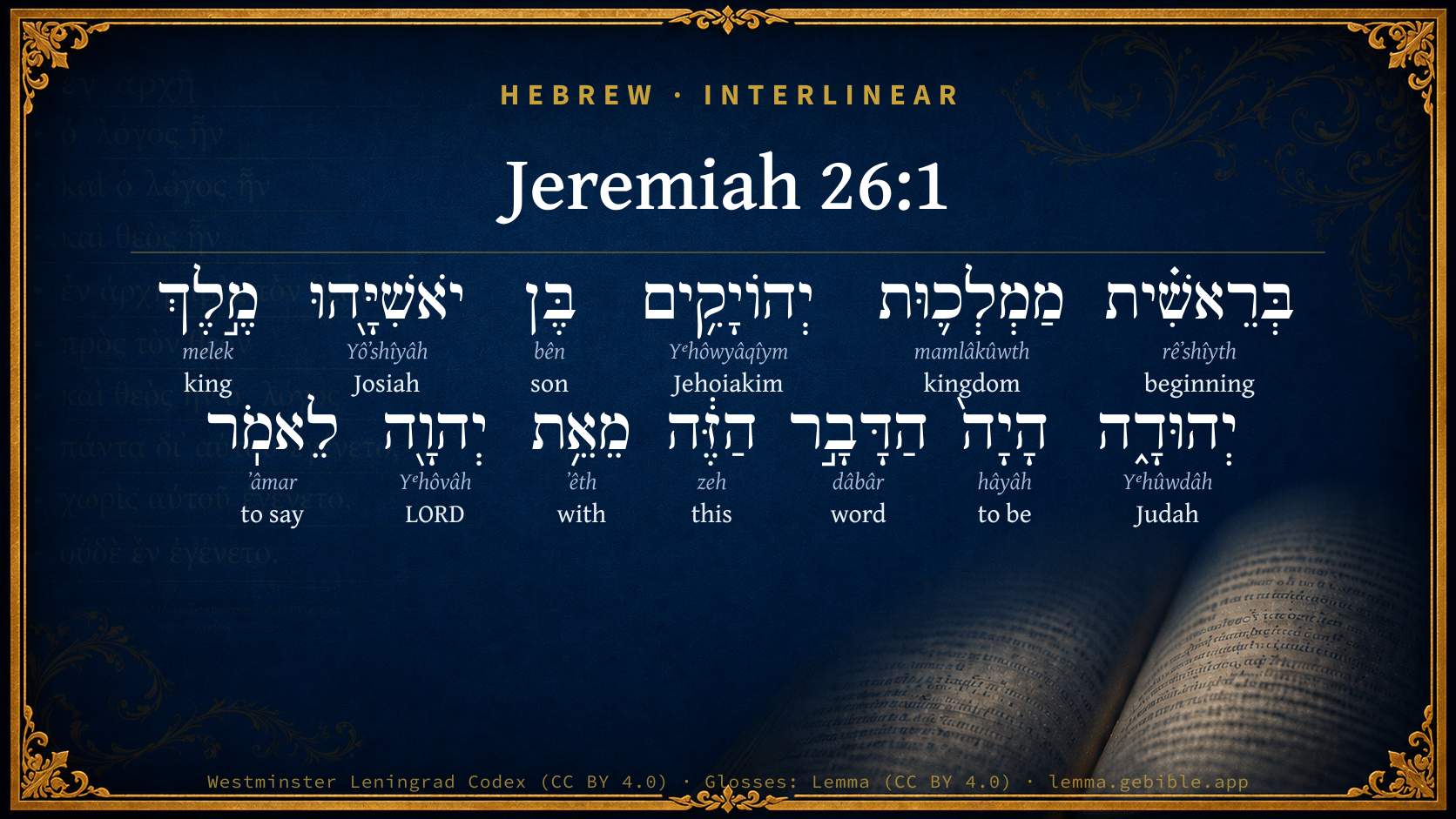
Jeremiah 26:1

Hebrew (Westminster Leningrad Codex) Jeremiah 26:1 appears in the Hebrew Old Testament. The text above is from the Westminster Leningrad Codex. Each word links to its Strong’s number, a concise gloss, and parsing drawn from the Open Scriptures Hebrew Bible morphology. Click any word for its full Brown-Driver-Briggs (BDB) entry.
Download image
Cite this verse

Jeremiah 26:1 (World English Bible). Public Domain. Lemma interlinear Bible study tool, https://lemma.gebible.app/v/jeremiah/26/1.

Show BibTeX & RIS
BibTeX
RIS
English Translation
In the beginning of the reign of Jehoiakim the son of Josiah, king of Judah, came this word from Yahweh, saying,
World English Bible · Public Domain
Download a study sheet

One document with this verse’s original text, its word-by-word gloss line, the meaning frame, cross-references with their text, attributed commentary, and full source and license credits — printable, and it pastes into notes with its structure intact.

This verse Autodidact and up

Study sheet (.html) Plain text (.txt)

A passage Seminary Student

Up to 50 verses in one chapter. A passage sheet keeps up to 6 commentary sources and 12 cross-references per verse, in the order this page ranks them, and says so on the sheet whenever that leaves anything out. Ask for a single verse and you get the Autodidact verse sheet above.

Everything on this page stays free to read, with no account — the sheet is a download of what is already on screen, not access to it.

Want to remove ads? Support Godless Engineer
Compare translations 3

The same verse in 3 English versions, stacked beneath the original-language interlinear above. Click any original word for its lexicon entry.

Each is an independent rendering of the whole verse — the interlinear is not word-aligned to these translations.

Highlighted words mark where these versions differ — a whole-verse word diff, not a word-by-word alignment.

  • World English Bible Public Domain
    In the beginning of the reign of Jehoiakim the son of Josiah, king of Judah, came this word from Yahweh, saying,
  • King James Version Public Domain
    In the beginning of the reign of Jehoiakim the son of Josiah king of Judah came this word from the LORD, saying,
  • unfoldingWord Literal Text CC BY-SA 4.0
    In the beginning of the reign of Jehoiakim son of Josiah, king of Judah, this word was from Yahweh, saying,

unfoldingWord Literal Text — © unfoldingWord, licensed CC BY-SA 4.0. Word-aligned USFM3 via Door43 (git.door43.org/unfoldingWord/en_ult).

Versions to compare (up to 4)

3 of 4 selected

Show all 18 translations

Every available English version of this verse, each an independent rendering of the whole verse.

  • World English Bible Public Domain
    In the beginning of the reign of Jehoiakim the son of Josiah, king of Judah, came this word from Yahweh, saying,
  • Berean Standard Bible Public Domain
    At the beginning of the reign of Jehoiakim son of Josiah king of Judah, this word came from the LORD:
  • Majority Standard Bible Public Domain
    At the beginning of the reign of Jehoiakim son of Josiah king of Judah, this word came from the LORD:
  • King James Version Public Domain
    In the beginning of the reign of Jehoiakim the son of Josiah king of Judah came this word from the LORD, saying,
  • American Standard Version (1901) Public Domain
    In the beginning of the reign of Jehoiakim the son of Josiah, king of Judah, came this word from Jehovah, saying,
  • Revised Version (1885) Public Domain
    In the beginning of the reign of Jehoiakim the son of Josiah, king of Judah, came this word from the LORD, saying,
  • Geneva Bible (1599) Public Domain
    In the beginning of the reigne of Iehoiakim the sonne of Iosiah King of Iudah, came this worde from the Lord, saying,
  • Douay-Rheims (1899) Public Domain
    In the beginning of the reign of Joakim the son of Josias king of Juda, came this word from the Lord, saying:
  • Young's Literal Translation Public Domain
    In the beginning of the reign of Jehoiakim son of Josiah, king of Judah, hath this word been from Jehovah, saying:
  • Literal Standard Version CC BY-SA 4.0
    In the beginning of the reign of Jehoiakim son of Josiah, king of Judah, this word has been from YHWH, saying,
  • Unlocked Literal Bible CC BY-SA 4.0
    In the beginning of the reign of Jehoiakim son of Josiah, this word came from Yahweh, saying,
  • unfoldingWord Literal Text CC BY-SA 4.0
    In the beginning of the reign of Jehoiakim son of Josiah, king of Judah, this word was from Yahweh, saying,
  • Darby Bible Public Domain
    In the beginning of the reign of Jehoiakim the son of Josiah, the king of Judah, came this word from Jehovah, saying,
  • World Messianic Bible Public Domain
    In the beginning of the reign of Jehoiakim the son of Josiah, king of Judah, this word came from the LORD:
  • Webster's Bible Public Domain
    In the beginning of the reign of Jehoiakim the son of Josiah king of Judah came this word from the LORD, saying,
  • Free Bible Version CC BY-SA 4.0
    This message came from the Lord at the beginning of the reign of Jehoiakim, son of Josiah king of Judah,
  • Bible in Basic English Public Domain
    When Jehoiakim, the son of Josiah, king of Judah, first became king, this word came from the Lord, saying,
  • JPS Tanakh (1917) Public Domain
    In the beginning of the reign of Jehoiakim the son of Josiah, king of Judah, came this word from the LORD, saying:

Literal Standard Version (2020), Covenant Press — licensed CC BY-SA 4.0. Text via the HelloAO Bible API (eBible.org). Unlocked Literal Bible (unfoldingWord) — licensed CC BY-SA 4.0. Text via the HelloAO Bible API (eBible.org). unfoldingWord Literal Text — © unfoldingWord, licensed CC BY-SA 4.0. Word-aligned USFM3 via Door43 (git.door43.org/unfoldingWord/en_ult). Free Bible Version, Dr. Jonathan Gallagher — licensed CC BY-SA 4.0. Text via the HelloAO Bible API (eBible.org).

Word by word

More ways to search: Search by grammar → Find every occurrence → Compare this word →

Practice this passage: Drill this verse → Learn its vocabulary →

מַמְלְכ֛וּת
mamlâkûwth
H4468
“kingdom of”
Noun, Common, Feminine, Singular, Construct
Part of Speech
Noun
Type
Common
Gender
Feminine
Number
Singular
State
Construct
Full BDB Definition

Origin: a form of H4467 and equiv. to it

TWOT: 1199g

kingdom, dominion, reign, sovereignty - kingdom - dominion, royal power - reign
  1. בְּרֵאשִׁ֗ית rêʼshîyth H7225 “in/at · beginning of” Preposition + Noun, Common, Feminine, Singular, Construct
  2. יְהוֹיָקִ֥ים Yᵉhôwyâqîym H3079 “Jehoiakim” Noun, Proper
  3. בֶּן bên H1121 “son of” Noun, Common, Masculine, Singular, Construct
  4. יֹאשִׁיָּ֖הוּ Yôʼshîyâh H2977 “Josiah” Noun, Proper
  5. מֶ֣לֶךְ melek H4428 “king of” Noun, Common, Masculine, Singular, Construct
  6. יְהוּדָ֑ה Yᵉhûwdâh H3063 “Judah” Noun, Proper
  7. הָיָה֙ hâyâh H1961 “to be” Verb, Qal, Perfect, 3rd Person, Masculine, Singular
  8. הַדָּבָ֣ר dâbâr H1697 “the · word” Particle, Definite Article + Noun, Common, Masculine, Singular, Absolute
  9. הַזֶּ֔ה zeh H2088 “the · this” Particle, Definite Article + Pronoun, Demonstrative, Masculine, Singular
  10. מֵאֵ֥ת ʼêth H854 “from · with” Preposition + Preposition
  11. יְהוָ֖ה Yᵉhôvâh H3068 “LORD” Noun, Proper
  12. לֵאמֹֽר ʼâmar H559 “to say” Preposition + Verb, Qal, Infinitive Construct

About this verse

These counts appear in no published source. They are computed here, from the morphology-tagged text and Lemma’s own curated glosses. What Lemma adds →

13
words
13
distinct lemmas
Prophets
section

Notable vocabulary

The rarest word here is מַמְלְכ֛וּת kingdom H4468 — appearing just 9 times in the whole Hebrew Bible.

Shared distinctive vocabulary

מַמְלְכ֛וּת kingdom H4468 occurs in 9 verses of the Hebrew Bible. Also found in:

Grammatical profile

  • 2 verbs
  • 9 nouns
  • 1 pronoun
  • 1 preposition

Verb forms

  • הָיָה֙ Qal · Perfect
  • לֵאמֹֽר Qal · Infinitive Construct

Cross-references

7

Topical passages linked to Jeremiah 26:1 in the Treasury of Scripture Knowledge — connected by theme and wording, ordered by reader-vote popularity; previews shown in the World English Bible.

  • 2 Chronicles 36:4–5 The king of Egypt made Eliakim his brother king over Judah and Jerusalem, and changed his name to Jehoiakim. Neco took Joahaz his brother, and carried him to Egypt.
  • Jeremiah 27:1 In the beginning of the reign of Jehoiakim the son of Josiah, king of Judah, came this word to Jeremiah from Yahweh, saying,
  • 2 Kings 23:34–36 Pharaoh Necoh made Eliakim the son of Josiah king in the room of Josiah his father, and changed his name to Jehoiakim: but he took Jehoahaz away; and he came to Egypt, and died there.
  • Jeremiah 1:3 It came also in the days of Jehoiakim the son of Josiah, king of Judah, to the end of the eleventh year of Zedekiah, the son of Josiah, king of Judah, to the carrying away of Jerusalem captive in the fifth month.
  • Jeremiah 25:1 The word that came to Jeremiah concerning all the people of Judah, in the fourth year of Jehoiakim the son of Josiah, king of Judah (the same was the first year of Nebuchadrezzar king of Babylon),
  • Jeremiah 35:1 The word which came to Jeremiah from Yahweh in the days of Jehoiakim the son of Josiah, king of Judah, saying,
  • Jeremiah 36:1 It happened in the fourth year of Jehoiakim the son of Josiah, king of Judah, that this word came to Jeremiah from Yahweh, saying,

Cross-references courtesy of OpenBible.info (CC BY 4.0).

Hebrew and Greek witnesses Masoretic Hebrew ↔ Greek Septuagint

The same verse in the two great witnesses to the Old Testament, shown verse-for-verse.

These are two independent witnesses, not word-aligned to each other, and the Septuagint is shown in lemma (dictionary) form.

Hebrew Jeremiah 26:1 Masoretic · Westminster Leningrad Codex

בְּרֵאשִׁ֗ית מַמְלְכ֛וּת יְהוֹיָקִ֥ים בֶּן יֹאשִׁיָּ֖הוּ מֶ֣לֶךְ יְהוּדָ֑ה הָיָה֙ הַדָּבָ֣ר הַזֶּ֔ה מֵאֵ֥ת יְהוָ֖ה לֵאמֹֽר

In the beginning of the reign of Jehoiakim the son of Josiah, king of Judah, came this word from Yahweh, saying,

World English Bible · Public Domain

Greek LXX Structure differs

In the Septuagint, Jeremiah is about an eighth shorter than the Hebrew and arranges its material differently — the Oracles Against the Nations (Hebrew chapters 46–51) appear in the middle of the Greek book, after 25:13. Because the chapter and verse boundaries do not line up, a verse-for-verse comparison with the Hebrew is not shown.

A verse-for-verse comparison isn’t shown here because the chapters and verses don’t line up. Switch to the LXX edition with the MT / LXX toggle above to read the Greek directly.

Hebrew: Westminster Leningrad Codex (CC BY 4.0). Greek: Septuagint (public domain); English from a public-domain English Septuagint. How the Septuagint differs from the Hebrew →

Targum (Aramaic paraphrase)

1

The Targum is the ancient Jewish Aramaic paraphrase of the Hebrew Scriptures — an interpretive translation, not the Hebrew text itself. Onkelos (literal) and Pseudo-Jonathan (expansive) render the Torah, and Jonathan the Prophets. Coverage is partial: where no permissively-licensed English translation exists for a verse, only the Aramaic is shown. This is verse-level text, not a word-by-word alignment to the Hebrew.

  1. Targum Jonathan Prophets (Joshua–Malachi)
    בְּרֵישׁ מַלְכוּת יְהוֹיָקִים בַּר יֹאשִׁיָה מְלַךְ שִׁבְטָא דְבֵית יְהוּדָה הֲוָה פִּתְגָמָא הָדֵין מִן קֳדָם יְיָ לְמֵימָר:

    (no public-domain English translation for this verse)

    Targum Jonathan — Aramaic: “Mikraot Gedolot” (public domain). English: “Sefaria Community Translation” (CC0 1.0 (public-domain dedication)); “London "Chaldee Paraphrase," 1871” (public domain). Text via Sefaria.

Commentary

Notes on Jeremiah 26:1 from classic Christian and Jewish commentators (each source and its license shown beneath its notes). The classic Christian expositions comment on the surrounding passage and are grouped to its opening verse, so a note may address several verses; the Jewish commentaries on the Tanakh (Rashi and others) are per-verse, so they appear only where the commentator wrote on this verse.

Lemma curates 59 commentaries, every one of them public domain or Creative Commons licensed, each selected and text-cleaned for this edition rather than reprinted as found. About our sources →

Trapp's Complete Commentary

John Trapp

Jer 26:1 In the beginning of the reign of Jehoiakim the son of Josiah king of Judah came this word from the LORD, saying,

Ver. 1. In the beginning of the reign of Jehoiakim.] What a sudden change was here, soon after the death of good Josiah! And was there not the like in England after the death of that English Josiah, Edward VI? Within a very few days of Queen Mary’s reign were various learned and godly men in various parts committed to prison for religion, and Mr Rogers, the proto-martyr, put to death, as was that holy prophet of God, Uriah the son of Shemaiah of Kirjathjearim, not many weeks before Jeremiah was apprehended and questioned for his life, as is here related, his adversaries being pricked on by pride and malice.

John Trapp, A Commentary or Exposition upon All the Books of the Old and New Testament (1647–1656) — public domain. Text from a community e-Sword module.

The Biblical Illustrator

Joseph S. Exell

Jer_26:1-24

In the beginning of the reign of Jehoiakim son of Josiah king of Judah.

Afflictions, distresses, tumults

Jehoiakim was, perhaps, the most despicable of the kings of Judah. Josephus says that he was unjust in disposition, an evil-doer; neither pious towards God nor just towards men. Something of this may have been due to the influence of his wife, Nehushta, whose father, Elnathan, was an accomplice in the royal murder of Urijah. Jeremiah appears to have been constantly in conflict with this king; and probably the earliest manifestation of the antagonism that could not but subsist between two such men occurred in connection with the building of Jehoiakims palace. Though his kingdom was greatly impoverished with the heavy fine of between forty and fifty thousand pounds, imposed by Pharaoh-Necho afar the defeat and death of Josiah, and though the times were dark with portents of approaching disaster, yet he began to rear a splendid palace for himself, with spacious chambers and large windows, floors of cedar, and decorations of vermilion. Clearly, such a monarch must have entertained a mortal hatred towards the man who dared to raise his voice in denunciation of his crimes; and, like Herod with John the Baptist, he would not have scrupled to quench in blood the light that cast such strong condemnation upon his oppressive and cruel actions. An example of this had been recently afforded in the death of Urijah, who had uttered solemn words against Jerusalem and its inhabitants in the same way that Jeremiah had done. But it would appear that this time, at least, his safety was secured by the interposition of influential friends amongst the aristocracy, one of whom was Ahikam, the son of Shaphan (Jer_26:20-24).

I. The divine commission. Beneath the Divine impulse, Jeremiah went up to the court of the Lords house, and took his place on some great occasion when all the cities of Judah had poured their populations to worship there. Not one word was to be kept back. We are all more or less conscious of these inward impulses; and it often becomes a matter of considerable difficulty to distinguish whether they originate in the energy of our own nature or are the genuine outcome of the Spirit of Christ. It is only in the latter ease that such service can be fruitful. There is no greater enemy of the highest usefulness than the presence of the flesh in our activities. There is no department of life or service into which its subtle, deadly influence does not penetrate. We meet it after we have entered upon the new life, striving against the Spirit, and restraining His gracious energy. We are most baffled when we find it prompting to holy resolutions and efforts after a consecrated life. And lastly, it confronts us in Christian work, because there is so much of it that in our quiet moments we are bound to trace to a desire for notoriety, to a passion to excel, and to the restlessness of a nature which evades questions in the deeper life, by flinging itself into every avenue through which it may exert its activities. There is only one solution to these difficulties. By the way of the cross and the grave we can alone become disentangled and discharged from the insidious domination of this evil principle, which is accursed by God, and hurtful to holy living, as blight to the tender fruit.

II. The message and its reception. On the one side, by his lips, God entreated His people to repent and turn from their evil ways; on the other, He bade them know that their obduracy would compel Him to make their great national shrine as complete a desolation as the site of Shiloh, which for five hundred years had been in ruins. It is impossible to realise the intensity of passion which such words evoked. They seemed to insinuate that Jehovah could not defend His own, or that their religion had become so heartless that He would not. So it came to pass, when Jeremiah had made, an end of speaking all that the Lord commanded him to speak unto all the people, that he found himself suddenly in the vortex of a whirlpool of popular excitement. There is little doubt that Jeremiah would have met his death had it not been for the prompt interposition of the princes. Such is always the reception given on the part of man to the words of God. We may gravely question how far our words are Gods, when people accept them quietly and as a matter of course. That which men approve and applaud may lack the Kings seal, and be the substitution on the part of the messenger of tidings which he deems more palatable, and therefore more likely to secure for himself a larger welcome.

III. Welcome interposition. The princes were seated in the palace, and instantly on receiving tidings of the outbreak came up to the temple. Their presence stilled the excitement, and prevented the infuriated people from carrying out their designs upon the life of the defenceless prophet. They hastily constituted themselves into a court of appeal, before which prophet and people were summoned. Then Jeremiah stood on his defence. His plea was that he could not but utter the words with which the Lord had sent him, and that he was only re-affirming the predictions of Micah in the darts of Hezekiah. He acknowledged that he was in their hands, but he warned them that innocent blood would bring its own Nemesis upon them all; and at the close of his address he re-affirmed his certain embassage from Jehovah. This bold and ingenuous defence seems to have turned the scale in hie favour. The princes gave their verdict: This man is not worthy of death, for he hath spoken to us in the name of the Lord our God. And the fickle populace, swept hither and thither by the wind, appear to have passed over en masse to the same conclusion; so that princes and people stood confederate against the false prophets and priests. Thus does God hide His faithful servants in the hollow of His hand. No weapon that is formed against them prospers. They are hidden in the secret of His pavilion from the strife of tongues. (F. B. Meyer, B. A.)

The Biblical Illustrator, edited by Joseph S. Exell (c. 1880s–1900s) — public domain. Text from a community e-Sword module.

Joseph Benson's Commentary

Jer 26:1. In the beginning of the reign of Jehoiakim, &c. — The preceding chapter is dated in the fourth year of the reign of Jehoiakim, but ascribed, with probability, to the early part of that year. This chapter is dated in the beginning of the same reign. Hence it has been concluded, that this must have preceded the former in order of time. “But the conclusion,” says Blaney, “will not hold, if we consider that, (Jer 28:1,) the beginning of Zedekiah’s reign is expressly declared to mean the fourth year and the fifth month of it. The same therefore may be the case here,” and this chapter may be allowed to speak of events subsequent to those of the foregoing one, though taking place immediately after them.

Joseph Benson's Commentary on the Old and New Testaments (1811–1818) — public domain. Text from a community e-Sword module.

Dummelow's Commentary on the Holy Bible

J. R. Dummelow

Jeremiah's Fifteenth Prophecy (Early in the Reign of Jehoiakim)

For Jer_26:1-8 see intro. to Jeremiah 7-10. This chapter gives us a sketch of the difficulties and dangers under which Jeremiah had spoken the preceding prophecies.

1-6. The prophet warns the people.

6. Like Shiloh] see on Jer_7:12. A curse] i.e. a subject of their cursing, as being contemptible.

8. A prophet speaking without God's command was to be put to death (Deu_18:20). This was the charge against Jeremiah, and the alleged proof was that God could not permit such a calamity to fall on Jerusalem.

7-15. The charge against Jeremiah, and his defence.

10. The princes] apparently heads of prominent houses, who had taken up their quarters in Jerusalem.

16-24. The princes and people, not being prejudiced against Jeremiah, as were the prophets and priests, gave a fair decision.

17. The elders] for their action in criminal procedure cp. Deu_21:2. in civil, Rth_4:2.

18. Micah] the minor prophet: see Mic_3:12. The king and the people listened to his warnings.

20-23. An instance of the illtreatment of a prophet. This part of the narrative was probably introduced later. It would have been dangerous for any of those present to have made such an attack upon the reigning king.

24. Ahikam] father of Gedaliah, who, when appointed governor by Nebuchadnezzar, stood the prophet's friend (Jer_39:14; Jer_40:5).

J. R. Dummelow, A Commentary on the Holy Bible (Macmillan, 1909) — public domain. Text from a community e-Sword module.

Whedon's Commentary on the Bible

Daniel D. Whedon

DESTRUCTION THREATENED, Jer_26:1-7.

This chapter adds some historical details to the prophecies which are given more at length in chapters 7-9. It more definitely marks the time, gives the language, and narrates the circumstances. It is distinguished by a special heading which separates it from the prophecies preceding and following. But in subject-matter it is closely joined to what follows, and has the same note of time as the next chapter. Chapters 27-29 are closely related to chapter 25, being a fuller treatment of the subject of the captivity, and especially a counter assertion to Hananiah’s false prophecy, which promised a speedy release and return to their own land. Between these comes chapter 26 as an interesting historical interlude, bringing out the position of Jeremiah and his relations to the people, and also their temper at this time, immediately preceding their downfall.

1. In the beginning, etc. — This phrase clearly indicates a time before the memorable fourth year of this king, in which, took place the first deportation to Babylon.

Daniel D. Whedon (gen. ed.), Commentary on the Old and New Testaments (1874–1909) — public domain. Text from a community e-Sword module.

The Preacher's Complete Homiletical Commentary

Joseph S. Exell (gen. ed.)

CRITICAL AND EXEGETICAL NOTES.—1. Chronology of the Chapter. About three years earlier than the prophecy of preceding chapter. Cf. chapter 7 with this, and it is evident that they are synchronous. Evidently this narrative records the dangers to which Jeremiah exposed himself by the delivery of that faithful protest against his nation’s iniquity. Jehoiakim had just ascended the throne, and forthwith inaugurated a course of public apostasy which called forth from Jeremiah this pungent and fearless remonstrance. Naturally enough it greatly incensed the “priests and the prophets” (Jer_26:8); though the “princes” spoke out boldly for his defence (Jer_26:16); and through the interposition of Ahikam, Jeremiah escaped violence (Jer_26:24). Cf. critical notes to chapter 7.

For—2. Contemporary Scriptures; 3. National Affairs; and 4. Contemporaneous History, cf. chap. 7, in loc.

5. Geographical References.—Jer_26:6. “Shiloh:” cf. note, chap. Jer_7:12, in loc. Jer_26:10. “The entry of the new gate:” i.e., the gate originally erected by Jotham (2Ki_15:35), “the higher gate,” and now recently restored. The Targum reads, the new gate. Jer_26:20. “Kirjath-jearim:” cir. nine miles north west of Jerusalem, where the ark rested after the destruction of Shiloh, on its return from Philistia.

6. Personal Allusions.—Jer_26:18. “Micah the Morasthite:” cf. Mic_1:1; Mic_3:12. The text here is מִכָיָה Michayah; the full form of his name meaning, Who is like Jah? But many MSS. omit the Yod, and read simply, מִכָה, Micah. His native village, Moresheth [Heb. Morashti], near Elutheropolis, in Philistia (Jerome). He was contemporary with Isaiah in Judah, and with Amos and Hosea in Israel.

Jer_26:20. “Urijah the son of Shemaiah:” nothing more is known of Urijah than is here recorded.

Jer_26:22. “Elnathan the son of Achbor:” Achbor was one of the princes sent to Huldah by Josiah (2Ki_22:12). Elnathan was father of Nehushta, the mother of King Jehoiachin, therefore Jehoiakim’s father-in-law.

Jer_26:24. “Ahikam the son of Shaphan:” one of Josiah’s messengers to Huldah after the discovery of the copy of the law in the Temple by Hilkiah the priest (2Ki_22:12-14). Hilkiah made known the discovery to Shaphan the scribe, most probably this Shaphan. Ahikam was father to Gemariah, who lent Jeremiah his room for the public reading of the prophet’s roll; and of Gedaliah, whom Nebuchadnezzar afterwards made governor of the land (chap. Jer_39:14), indicating that the attachment of the father, Ahikam, to Jeremiah was inherited by his sons.

7. Manners and Customs.—Jer_26:2. “Stand in the gate of the Lord’s house:” see Homiletic Outlines, preliminary note, p. 149. “Unto all the cities of Judah which come to worship:” at one of the three great yearly festivals, perhaps that of Tabernacles, which was the greatest.

Jer_26:9. “All the people were gathered together against Jeremiah:” properly, “unto Jeremiah,” forming themselves into a court or congregation to take part in his trial. Jer_26:23. “Graves of the sons of the people:” see chap. Jer_17:19 : “common people.” Some have thought the Jews had a cemetery for the prophets separate from that of the people. The place of burial for the common people was in the Kidron valley.

8. Literary Criticisms.—Jer_26:19. “Besought the Lord,” lit., Soothed by prayer the face of the Lord. חִלָּה אֶת־פְּנֵי, Stroke the face [Keil]. Cf. Exo_32:11.

General topic of the chapter: “SO PERSECUTED THEY THE PROPHETS.”

This present life is often one of severity and suffering to God’s servants. Yet it is astonishing to find earnest and holy men persecuted and slain for no offence other than that of calling the wicked to desert their sins and care for their spiritual good! We may well ask, “Why, what evil hath he done?” For “a good work” surely men should not rise in hostility to a man of God. Wrong may deserve punishment; but too often right is persecuted and wrong is condoned. So perverse is the human heart.

I. Prevalent sin called for faithful rebuke. There was enough wrongdoing and corruption in Zion to constrain a godly soul to vehement protestation. God sent the prophet to remonstrate.

1. The rebuke of a prophet, therefore, should be accepted as an appeal from God (Jer_26:2-5).

2. Such faithful rebukes are designed to avert heavy and threatening judgments (Jer_26:6; Jer_26:12-13).

II. Faithful rebuke aroused violent resentment. In Jeremiah’s protest there was no element of provocation. His message was delivered in no rancorous and vexing words, yet it awoke resentment.

1. Sinners love their sins too well to desire disturbance, even though such disturbance is essential to their salvation (Jer_26:7-9).

2. Warnings of impending doom created violent hostility to God’s messenger (Jer_26:10-11). Angry men must have a victim on whom to expend their hatred. Incensed at God’s message, they would avenge themselves on His innocent messenger! This explains persecution. Men cling to their sins, and hate the prophet, as Ahab did Elijah, whose faithful words—“trouble Israel”—disturb them in their evil ways.

III. Violent resentment faced with courageous fidelity. The prophet did not quail before their violence. “The righteous is bold as a lion.” Yet withal there was no corresponding violence; rather “in meekness he instructed those that opposed” (2Ti_2:25).

1. He used the hour of his arraignment for one more appeal to his erring persecutors (Jer_26:12-13).

2. He resigned himself to the consequences of his fidelity, knowing that God would requite their deeds (Jer_26:14-15).

Even so, when our Lord “suffered, He threatened not; but committed Himself to Him who judgeth righteously.” “Vengeance is Mine.”

IV. Godly fidelity incurring persecution and death. Jeremiah’s renewed appeal proved effective with the “princes” (Jer_26:16) and “elders” (Jer_26:17), and won him their protection. Yet—

1. Fidelity imperilled Jeremiah’s life (Jer_26:24); and he would have lost it but for Ahikam’s befriending. Faithful work is always done amid peril. Men become our enemies when we tell them the truth. So Jeremiah found it. Micah was a rare exception (Jer_26:18-19).

2. Fidelity cost Urijah his life (Jer_26:20-23). Such unrighteous and iniquitous deeds against God’s servants assuredly will be punished. “The dead shall be raised;” and then, confronted by those they have killed, the wicked shall be judged. There is a judgment to come. Men may silence God’s messengers in death now, but God will be heard in the day of judgment.

HOMILIES AND COMMENTS ON VERSES OF CHAPTER 26

Jer_26:1-2. See Homily on chap. Jer_7:1-2.

Jer_26:2. Theme: PREACH THE WHOLE TRUTH. “Diminish not a word,”

Neither preacher nor prophet is the author of what he teaches. If his “commands” are his own, they should never be uttered; for he has no right to speak aught which God has not commanded, and no permission to silence aught which God has commanded. “Speak all the words that I command thee to speak unto them; diminish not a word.”

I. Inspired commands are the outcome of Divine Wisdom and human necessity. Much in Scripture we do not care to hear, or do not think wise to teach. Doctrines over which critics stumble. Some severe doctrines do not seem concordant with the gospel of love, &c. But—

1. God’s wisdom frames the messages. That ought to check our solicitude for the integrity of Revelation. Critics should learn that “the foolishness of God is wiser than men.”

2. Man’s necessity calls forth the message. God sees our case, our need, our sins, our perils, and sends the commands which are suitable.

Hence every word of God is important and imperative.

II. Preachers have no liberty of silence or selection. If any haste to preach without a Divine commission, God will put them to silence. But if God has sent a prophet or preacher, He must “speak all,” &c., and “not diminish a word.”

1. God’s messenger may not silence Divine commands.

2. God’s messenger may not select Divine commands. He has no liberty allowed to forbear speaking; neither has he liberty allowed to choose and discriminate between the commands, taking out one from among the rest, and speaking only such as he deems fit and right. He has to “declare all the counsel of God.”

III. God’s messages may not be minimised either in quantity or emphasis. “Diminish not a word.”

A preacher may indeed go through all the commands, and yet by frequent reiteration of a few may give them a prominence which overshadows the rest, and thus “diminishing” those he overshadows.

Or, he may preach some with more emphasis and eloquence than others, thereby “diminishing” the others.

1. This may be through prejudice or preference. Then he makes his own limited mental bias the test of the comparative value and importance of revealed truths!

2. He may do this through mistaken solicitude or sentimental charity. There are preachers who cannot allow themselves to speak the stern teachings of Scripture; because (in their poor fancy) they disagree with the tender love of God, and the sweet grace of the Gospel of Christ; because, also, they wound the gentle hearts of their hearers, and make appeal to fears in men rather than filial trust and love.

3. He may do this for fear or favour of men. Then he prostrates God’s truth before the time-serving spirit which seeks to “please men.” This is sacrilegious! But we may not suppress nor soften any teaching or command for fear of giving offence; neither may we set forth coldly and indirectly what can only by forcible statement do good.

God says: “Speak all” … “diminish not a word.” Compare Deu_4:2; Deu_12:32; Pro_30:6; Act_20:27; 2Co_2:17; 2Co_4:2; Rev_22:19.

See Addenda: PREACH THE WHOLE TRUTH.

Jer_26:3-6. Compare Homily on chap. Jer_18:7-10. Theme: CONDITIONAL COVENANTS.

Jer_26:6. “THIS HOUSE LIKE SHILOH.” Comp. Homily on chap. Jer_7:12-14. “Violated sanctuaries doomed.”

Jer_26:8. “THOU SHALT SURELY DIE.” The charge against Jeremiah was that of uttering falsehood in Jehovah’s name, an act punishable with death (Deu_18:20). The tumult against him was raised by the priests and false prophets.

Jer_26:11. “SPAKE THE PRIESTS AND THE PROPHETS UNTO THE PRINCES.” Jeremiah was both a priest and a prophet, and should therefore have received generous treatment at the hands of “priests and prophets;” but “a man’s foes are they of his own household,” while “jealousy is as cruel as the grave.”

The “princes” were members of the king’s household, and formed part of the Council of State. Jeremiah is careful to discriminate here, and to record that he received acts of kindness from the “princes” and also from the “elders” (Jer_26:17), who were rulers of the whole land. In like manner Luke discriminates between the generous conduct of Gamaliel and the injustice of other members of the Sanhedrim (Act_5:34).

Jer_26:12-15. Theme: HOW TO ANSWER CAVILLERS AND ACCUSERS. The prophet was arraigned before the highest tribunal, charged with a political offence—he had “prophesied against this city.” Here it will be noticeable that our Lord was similarly indicted before Pilate. See how Jeremiah bore himself in this scene of great excitement and irritation.

I. His unfaltering assurance of a Divine commission. Cavil though they might against his message, and threaten him with death for delivering it, yet—

1. He knew that God had sent him to them with this message. “The Lord sent,” &c. (Jer_26:12); “Of a truth the Lord hath sent me,” &c. (Jer_26:15).

2. He knew that his prophecy had been faithfully delivered. He had uttered nought in malice, nor suppressed aught through timidity; but “all the words ye have heard” (Jer_26:12) were literally God’s words through him to them. Thus he was sustained by—

(a.) Assured authority from Jehovah.

(b.) Conscious integrity in his work.

II. His importunate earnestness in pleading with his accusers. Having thus far vindicated himself, Jeremiah now—

1. Seizes the opportunity to plead with his hearers (Jer_26:13). It might be his final chance of a direct appeal to his sinning nation. What ardour of religious feeling! what godly patriotism is thus manifested!

2. Fearlessly exhorts his audience to repentance and reformation. He was arraigned because he had charged their sins upon them. Yet now even, before this angry assembly, he appeals again to them to desert their sins, and thus avert God’s displeasure. “Reform your life, and hearken to the voice of the Lord, and it will be better for you.” “You do not wish me to thunder away at you; reform, then, and I can let it alone.”—(Zinzendorf.)

III. His grand resignation to the consequences of fidelity. His faithful pleading might incense them the more; yet—

1. He is ready to die rather than keep silence (Jer_26:14).

2. He dare not let any concern for self hinder him in his witness. “As for me”—as if what became of him were wholly unimportant in the presence of his nation’s perils. It equals Paul’s martyrlike spirit: “I am ready to die also at Jerusalem;” “I could wish myself accursed for my brethren.” Note—

(a.) His splendid indifference to life and policy. It argues possession of highest religious assurance, conscious safety in God, and blessed hopes of a future world.

(b.) His all-absorbing eagerness for his people. Self cannot have a thought when his people are nearing destruction. Such all-consuming seal naturally impresses and conquers hearts. It did so here (Jer_26:16).

IV. His solemn warnings against criminal conduct (Jer_26:15).

1. Knowing God was with him in his work, he realised then that Jehovah would avenge any violence done to him.

2. Knowing that he was innocent of any crime, having only faithfully discharged a Divine commission, he reminded them that on them would fall the curse of his blood.

Note: Men do not escape the punishment of sin by silencing God’s preacher, or by getting rid of the obnoxious witness against their sins. They double the crime by such conduct.

There was a yearning pathos in Jeremiah’s warning: no anger, no menacing; but “knowing the terror of the Lord, he persuaded men.” Thus may cavillers be silenced and adversaries won.

See Addenda: FEARLESSNESS.

On “AMEND YOUR WAYS,” see Homily on chap. Jer_7:3.

Jer_26:16. “THIS MAN IS NOT WORTHY TO DIE.” Jeremiah’s address secured—

(i.) THEIR CONVICTION: for they recognised that he had “spoken to them in the name of the Lord.” Instead of convicting Jeremiah. “the princes and people” unanimously convicted the “priests and prophets” of falsely charging him.

(ii.) HIS OWN ACQUITTAL. “This man is not worthy of death.” Instead of condemning Jeremiah, they sent him forth from the tribunal freed from all charges.

Matthew Henry here reflects thus—

“And are they willing to own that he did indeed speak to them ‘in the name of the Lord,’ and that that Lord was their God? Why then did they not amend their ways and doings, and take the method he prescribed to prevent the ruin of their country? (Mat_21:25.) Note: It is a pity that those who are so far convinced of the Divine original of gospel preaching as to protect it from the malice of others, do not submit to the power and influence of it themselves.”

Jer_26:17-19. Theme: A PRECEDENT JUSTIFYING THE PROPHET’S ACQUITTAL. Certain elders arose and put the audience in mind of a former case, as is usual with us in going to judgment; for the wisdom of our predecessors is a direction to us.

(i.) Was it thought strange that Jeremiah prophesied against this city and the temple? Micah did so before him, even in the reign of Hezekiah, that reign of reformation. (See Mic_3:12.)

By this it appears that a man may be, as Micah was, a true prophet of the Lord, and yet may prophesy the destruction of Zion. When we threaten secure sinners with the taking the Spirit of God and the kingdom of heaven away from them, and declining Churches with the removal of the candlestick, we say no more than what has many a time been said before, and what we have the warrant of God’s Word to say.

(ii.) Was it thought fit by the princes to justify Jeremiah in what he had done? It was what Hezekiah had done in like case.

(a.) Was Micah impeached for his prophecy? No; the king and nation took the warning he gave them.

(b.) Hezekiah got good by the preaching, and therefore certainly could do no harm to the preacher.

(c.) It is good to deter ourselves from sin, by the consideration of the mischief we shall incur thereby. “Thus might we procure great evil against our souls.” Comp. Matthew Henry.

Jer_26:20-23. Theme: URIJAH’S PERSECUTION AND DEATH. Doubtless this Urijah came some time after Jeremiah; this incident is added to the foregoing to show the ferocity of Jehoiakim against faithful prophets.

Note: Urijah re-uttered Jeremiah’s words (Jer_26:20); he “prophesied,” &c., “according to the words of Jeremiah;” and this repetition determined the king to silence the prophets at any cost.

I. Guilty men hate to hear Divine denunciations. Jehoiakim grew uncontrollably violent when Jeremiah’s words were repeated (Jer_26:20).

II. Earnest preachers of God fulfil their work amid dangers (Jer_26:21). They expose their lives to the violence of those they denounce. He who proclaims against men’s sins provokes their antagonism. “Genuine ministers of God have no favour to expect from those who are His enemies.”—(Clark.)

III. The courage which defies perils is not always possessed by even faithful witnesses of God. Urijah fled to Egypt (Jer_26:21). Jeremiah did not flee, and was spared; Urijah hastened to protect himself, and was slain. Our running and anxiety are of no use. It is better to act faithfully and fearlessly, risking the result.

IV. Angry men, incensed against God’s witness, will take great trouble to avenge themselves (Jer_26:22). Comp. Ahab’s efforts to find Elijah.

V. Death and degradation may prove the earthly penalty of godly work (Jer_26:23). It was so with the Christian martyrs; and is now sometimes the penalty of missionary devotion. But such sufferers for truth and righteousness are canonised in God’s martyrology, and “great is their reward in heaven.”

See Addenda: PERSECUTION.

Jer_26:24. Theme: HEROIC FRIENDSHIP. On “Ahikam” see Personal References at head of chapter.

Note 1. Since Ahikam’s son, Gedaliah, showed attention to the prophet, and another son of the same name was afterwards made governor of the land by the Chaldeans (chap. Jer_39:14), we may suppose this family agreed with Jeremiah’s political policy and counsels.

Note 2. The son’s friendship for the prophet was the result of the father’s (Ahikam’s) attachment. Good parents hand down a patrimony of generous sympathy to their children, which provokes them to “love and good works.” Thus the good deeds of the father reappeared in his sons.

I. Valorous allegiance with a persecuted prophet. “The hand of Ahikam was with Jeremiah.” This friendship was—

1. Open and avowed: it was well known in the land that Ahikam befriended Jeremiah. Obadiah (1 Kings 18) secreted his friendship.

2. Influential. For Ahikam had sufficient influence at court and in the country to counter-check Jehoiakim’s malicious designs against the prophet. God’s servants have not been without powerful friends.

3. Resolute. He resisted the clamour of “the people.” Thus he faced king and country fearlessly as Jeremiah’s friend. All this showed—(a) great heroism; (b) noble piety; (c) fearless fidelity. Such friendship is not frequent, but it is worthy highest praise.

II. Valuable attachment to God’s servant. Ahikam’s friendship proved specially helpful to Jeremiah.

1. It asserted itself in a perilous hour. He who flees in adversity is not a true friend.

2. It prevailed against popular clamour. It is not easy to become unpopular for our friends. But Christ’s servants have to face popular contumely for His sake; and many disciples have had to brave public scorn and hate for their attachment to Christ’s followers.

3. It preserved to the nation its truest benefactor. Had the people put Jeremiah to death, they would have slain the man who gave wisest counsels, and proved at last its noblest leader. We impoverish and harm ourselves by antagonism to God’s messengers. So, in withstanding the people’s clamour, Ahikam acted as the nation’s friend, as well as Jeremiah’s champion.

Application.—Matthew Henry suggests that God can raise up great men to protect good men; and this should encourage us amid the dangers incident to duty.

ADDENDA TO CHAPTER 26: ILLUSTRATIONS AND SUGGESTIVE EXTRACTS

Jer_26:2. PREACH THE WHOLE TRUTH. “Luther, of whom Richter has said that ‘his words were half battles,’ when he first began to preach, suffered unheard agony. ‘O Dr. Staupitz, Dr. Staupitz!’ said he to the Vicar General of his order, ‘I cannot do it, I shall die in three months; indeed I cannot do it.’ Dr. Staupitz replied, ‘Well, Sir Martin, if you must die, you must; preach, man, preach; and then live or die as it happens.’ So Luther preached, and lived; and he became one great whirlwind of energy to work without resting in this world.”—Spurgeon.

“An iron key is better than one made of gold if it will better open the door, for that is all the use of a key.”—Augustine.

“The words of a preacher ought purgere non palpare, to prick the heart, not smooth and coax.”—Jerome.

Somerfield, just before his death, speaking of his recovery, said, “Oh, if I might be raised again! How I could preach! I could preach as I never preached before. I have taken a look into eternity!”

Jer_26:12-15. FEARLESSNESS. “What can I fear?” asked Chrysostom before the Pro-consul. “Will it be death? but you know that ‘Christ is my life,’ and that I shall gain by death. Will it be exile? but ‘the earth with all its fulness is the Lord’s.’ Will it be the loss of wealth? but ‘we brought nothing into this world, and we can carry nothing out.’ Thus, all the terrors of the world are contemptible in my eyes, and I smile at all its good things. Poverty I do not fear; riches I do not sigh for; from death I do not shrink; and life I do not desire except for the progress of your souls.”

Jer_26:20-23. PERSECUTION. Seeing a Christian woman go cheerfully to prison, an observer said to her, “Oh, you have not yet tasted of the bitterness of death.” She as cheerfully replied, “No, nor ever shall; for Christ hath promised that those who keep His sayings shall not see death.”

Jer_26:24. NOBLE FRIENDSHIP.

“Great souls by instinct to each other turn,

Demand allegiance, and in Friendship burn.”

—ADDISON.

“Friendship hath a power

To soothe affliction in her darkest hour.”

—H. KIRKE WHITE.

“Deliberate in all things with thy friend.

But, since friends grow not thick on every bough,

Nor every friend unrotten at the core,

First on thy friend deliberate with thyself;

Pause, ponder, sift; not eager in the choice,

Nor jealous of the chosen; fixing, fix;

Judge before friendship, then confide till death.

Well for thy friend, but nobler far for thee:

How gallant danger for earth’s highest prize!

A friend is worth all hazards we can run.”

—YOUNG.

The Preacher's Complete Homiletical Commentary (gen. ed. Joseph S. Exell; Funk & Wagnalls, c. 1892) — public domain (pre-1929). A full-Bible homiletical/sermon-outline anthology covering 65 of 66 books (2 John is absent from the source module). Text from a community e-Sword module.

Keil & Delitzsch

C. F. Keil & F. Delitzsch

Accusation and Acquittal of Jeremiah. - Jer 26:1-7. His prophecy that temple and city would be destroyed gave occasion to the accusation of the prophet. - Jer 26:1. "In the beginning of the reign of Jehoiakim, the son of Josiah king of Judah, came this word from Jahveh, saying: Jer 26:2. Thus said Jahveh: Stand in the court of the house of Jahveh, and speak to all the cities of Judah which come to worship in Jahveh's house, all the words that I have commanded thee to speak to them; take not a word therefrom. Jer 26:3. Perchance they will hearken and turn each from his evil way, that I may repent me of the evil which I purpose to do unto them for the evil of their doings. Jer 26:4. And say unto them: Thus saith Jahveh: If ye hearken not to me, to walk in my law which I have set before you, Jer 26:5. To hearken to the words of my servants the prophets whom I sent unto you, from early morning on sending, but ye have not hearkened. Jer 26:6. Then I make this house like Shiloh, and this city a curse to all the peoples of the earth. Jer 26:7. And the priests and the prophets and all the people heard Jeremiah speaking these words in the house of Jahveh."

In the discourse of Jer 7, where he was combating the people's false reliance upon the temple, Jeremiah had already threatened that the temple should share the fate of Shiloh, unless the people turned from its evil ways. Now, since that discourse was also delivered in the temple, and since Jer 26:2-6 of the present chapter manifestly communicate only the substance of what the prophet said, several comm. have held these discourses to be identical, and have taken it for granted that the discourse here referred to, belonging to the beginning of Jehoiakim's reign, was given in full in Jer 7, while the history of it has been given in the present chapter by way of supplement (cf. the introductory remarks to Jer 7). But considering that it is a peculiarity of Jeremiah frequently to repeat certain of the main thoughts of his message, the saying of God, that He will do to the temple as He has done to Shiloh, is not sufficient to warrant this assumption. Jeremiah frequently held discourses in the temple, and more than once foretold the destruction of Jerusalem; so that it need not be surprising if on more than one occasion he threatened the temple with the fate of Shiloh. Between the two discourses there is further this distinction: Whereas in Jer 7 the prophet speaks chiefly of the spoliation or destruction of the temple and the expulsion of the people into exile, here in brief incisive words he intimates the destruction of the city of Jerusalem as well; and the present chapter throughout gives the impression that by this, so to speak, peremptory declaration, the prophet sought to move the people finally to decide for Jahveh its God, and that he thus so exasperated the priests and prophets present, that they seized him and pronounced him worthy of death. - According to the heading, this took place in the beginning of the reign of Jehoiakim. The like specification in the heading of Jer 27 does not warrant us to refer the date to the fourth year of this king. "The beginning" intimates simply that the discourse belongs to the earlier period of Jehoiakim's reign, without minuter information as to year and day. "To Jeremiah" seems to have been dropped out after "came this word," Jer 26:1. The court of the house of God is not necessarily the inner or priests' court of the temple; it may have been the outer one where the people assembled; cf. Jer 19:14. All the "cities of Judah" for their inhabitants, as in Jer 11:12. The addition: "take not a word therefrom," cf. Deu 4:2; Deu 13:1, indicates the peremptory character of the discourse. In full, without softening the threat by the omission of anything the Lord commanded him, i.e., he is to proclaim the word of the Lord in its full unconditional severity, to move the people, if possible, to repentance, acc. to Jer 26:3. With Jer 26:3, cf. Jer 18:8, etc. - In Jer 26:4-6 we have the contents of the discourse. If they hearken not to the words of the prophet, as has hitherto been the case, the Lord will make the temple as Shiloh, and this city, i.e., Jerusalem, a curse, i.e., an object of curses (cf. Jer 24:9), for all peoples. On this cf. Jer 7:12. But ye have not hearkened. The Chet. הזּאתה Hitz. holds to be an error of transcription; Ew. 173, g, and Olsh. Gramm. 101, c, and 133, a paragogically lengthened form; Bttcher, Lehrb. 665. iii. and 897, 3, a toneless appended suffix, strengthening the demonstrative force: this (city) here.

Jer 26:8-9

The behaviour of the priests, prophets, and princes of the people towards Jeremiah on account of this discourse. - Jer 26:7-9. When the priests and prophets and all the people present in the temple had heard this discourse, they laid hold of Jeremiah, saying, "Thou must die. Wherefore prophesiest thou in the name of Jahveh, saying, Like Shiloh shall this house become, and this city shall be desolate, without inhabitant? And all the people gathered to Jeremiah in the house of Jahveh." This last remark is not so to be understood, when compared with Jer 26:7 and Jer 26:8, as that all the people who, according to Jer 26:7, had been hearing the discourse, and, according to Jer 26:8, had with the priests and prophets laid hold on Jeremiah, gathered themselves to him now. It means, that after one part of the people present had, along with the priests and prophets, laid hold on him, the whole people gathered around him. "All the people," Jer 26:9, is accordingly to be distinguished from "all the people," Jer 26:8; and the word כּל, all, must not be pressed, in both cases meaning simply a great many. When it is thus taken, there is no reason for following Hitz., and deleting "all the people" in Jer 26:8 as a gloss. Jeremiah's special opponents were the priests and prophets after their own hearts. But to them there adhered many from among the people; and these it is that are meant by "all the people," Jer 26:8. But since these partisans of the priests and pseudo-prophets had no independent power of their own to pass judgment, and since, after Jeremiah was laid hold of, all the rest of the people then in the temple gathered around him, it happens that in Jer 26:11 the priests and prophets are opposed to "all the people," and are mentioned as being alone the accusers of Jeremiah. - When the princes of Judah heard what had occurred, they repaired from the king's house (the palace) to the temple, and seated themselves in the entry of the new gate of Jahve, sc. to investigate and decide the case. The new gate was, according to Jer 36:10, by the upper, i.e., inner court, and is doubtless the same that Jotham caused to be built (Kg2 15:35); but whether it was identical with the upper gate of Benjamin, Jer 20:2, cannot be decided. The princes of Judah, since they came up into the temple from the palace, are the judicial officers who were at that time about the palace. the judges were chosen from among the heads of the people; cf. my Bibl. Archol. ii. 149.

Jer 26:10-16

Before these princes, about whom all the people gathered, Jeremiah is accused by the priests and prophets: "This man is worthy of death;" literally: a sentence of death (cf. Deu 19:6), condemnation to death, is due to this man; "for he hath prophesied against this city, as ye have heard with your ears." With these last words they appeal to the people standing round who had heard the prophecy, for the princes had not reached the temple till after Jeremiah had been apprehended. Jer 26:12. To this Jeremiah answered in his own defence before the princes and all the people: "Jahveh hath sent me to prophesy against (אל for על) this house and against this city all the words which ye have heard. Jer 26:13. And now make your ways good and your doings, and hearken to the voice of Jahveh your God, and Jahveh will repent Him of the evil that He hath spoken against you. Jer 26:14. But I, behold, I am in your hand; do with me as seemeth to you good and right. Jer 26:15. Only ye must know, that if ye put me to death, ye bring innocent blood upon you, and upon this city, and upon her inhabitants; for of a truth Jahveh hath sent me to you to speak in your ears all these words." - As to "make your ways good," cf. Jer 7:3. This defence made an impression on the princes and on all the people. From the intimation that by reform it was possible to avert the threatened calamity, and from the appeal to the fact that in truth Jahveh had sent him and commanded him so to speak, they see that he is a true prophet, whose violent death would bring blood-guiltiness upon the city and its inhabitants. They therefore declare to the accusers, Jer 26:16 : "This man is not worthy of death, for in the name of Jahveh our God hath he spoken unto us."

Jer 26:17-19

To justify and confirm this sentence, certain of the elders of the land rise and point to the like sentence passed on the prophet Micah of Moresheth-Gath, who had foretold the destruction of the city and temple under King Hezekiah, but had not been put to death by the king; Hezekiah, on the contrary, turning to prayer to the Lord, and thus succeeding in averting the catastrophe. The "men of the elders of the land" are different from "all the princes," and are not to be taken, as by Graf, for representatives of the people in the capacity of assessors at judicial decisions, who had to give their voice as to guilt or innocence; nor are they necessarily to be regarded as local authorities of the land. They come before us here solely in their character as elders of the people, who possessed a high authority in the eyes of the people. The saying of the Morasthite Micah which they cite in Jer 26:18 is found in Mic 3:12, verbally agreeing with Jer 26:18; see the exposition of that passage. The stress of what they say lies in the conclusion drawn by them from Micah's prophesy, taken in connection with Hezekiah's attitude towards the Lord, Jer 26:19 : "Did Hezekiah king of Judah and all Judah put him to death? Did he not fear Jahveh and entreat Jahveh, and did not Jahveh repent Him of the evil which He had spoken concerning them? and we would commit a great evil against our souls?" Neither in the book of Micah, nor in the accounts of the books of Kings, nor in the chronicle of Hezekiah's reign are we told that, in consequence of that prophecy of Micah, Hezekiah entreated the Lord and so averted judgment from Jerusalem. There we find only that during the siege of Jerusalem by the Assyrians, Hezekiah besought the help of the Lord and protection from that mighty enemy. The elders have combined this fact with Micah's prophecy, and thence drawn the conclusion that the godly king succeeded by his prayer in averting the mischief. Cf. the remarks on this passage at Mic 4:10. 'חלּה , lit., stroke the face of Jahveh, i.e., entreat Him, cf. Exo 32:11. "And we would commit," are thinking of doing, are on the point of doing a great evil against our souls; inasmuch as by putting the prophet to death they would bring blood-guiltiness upon themselves and hasten the judgment of God. - The acquittal of Jeremiah is not directly related; but it may be gathered from the decision of the princes: This man is not worthy of death.

Keil & Delitzsch — Biblical Commentary on the Old Testament (1861–1891) — public domain (CC PDM 1.0). Text via the HelloAO Bible API. (Old Testament only.)

Lange's Commentary on the Holy Scriptures

B. The Three Historical Appendices

The Prophet Of The Lord And The False Prophets

Jeremiah 26-29

It has been already shown in the introduction to the ninth discourse that these chapters stand here together, because their common topic is the conflict of the true prophet with the false prophets. Their position just here, however, is occasioned by the close historical connection of chh. 27, 28, with Jeremiah 25. There is thus a double connection, (1) that of chh. 27, 28, with Jeremiah 25 (Cup of wrath and yoke); (2) that of chh. 26–29 with each other (false prophets). Before Jeremiah 27, however, stands Jeremiah 26, and thus separates the connected passages, Jeremiah 25, and chh. 27, 28, because it is the oldest in time. It comes before the fourth year of Jehoiakim. Perhaps also the four chapters were found in this order, and transposed here as a whole. Chh. 27, 28 belong to the fourth year of Zedekiah (Comp. Comm. on Jer_27:1). Ch. 29 is somewhat earlier in date (Comp. the Introd. to this chapter). The arrangement of these four chapters is thus not consistently chronological. Perhaps first, the struggle of the prophet with the false prophets in their home (Jeremiah 26-28), then his struggle with those also who had emigrated to Babylon is represented. [“Jeremiah goes back here from the mention of the fourth year of Jehoiakim to the beginning of that king’s reign, in order to suggest to his readers an evidence, a fortiori, of God’s mercy and forbearance to Jerusalem. God gave solemn denunciations to Jehoiakim and Jerusalem in Jehoiakim’s fourth year. But He did more than this: He had sent a prophetic message of warning to him even at the beginning of his reign. Such considerations as these will suggest the reasons for which Jeremiah’s prophecies are not placed in chronological order.” Wordsworth.—S. R. A.]

1. THE CONFLICT OF JEREMIAH WITH, THE FALSE PROPHETS BEFORE THE FOURTH YEAR OF JEHOIAKIM

Jer_26:1-24

1In the beginning of the reign of Jehoiakim the son of Josiah, king of Judah, 2came this word from the Lord [Jehovah] saying, Thus saith the Lord [Jehovah]: Stand in the court of the Lord’s [Jehovah’s] house and speak unto all the cities of Judah, which come to worship in the Lord’s house, all the words that I command 3thee to speak unto them; diminish [omit] not a word. If so be [perhaps] they will hearken, and turn every man from his evil way, that I may repent me of the evil, 4which I purpose to do unto them because of the evil of their doings. And thou shalt say unto them: Thus saith the Lord [Jehovah]: If ye will not hearken to 5me, to walk in my law, which I have set before you, to hearken to the words of my servants the prophets, whom I sent unto you, both1 rising up early, and sending 6them, but ye have not hearkened: then will I make this house like Shiloh, and 7will make this2 city a curse to all the nations of the earth. So the priests and prophets and all the people heard Jeremiah speaking these words in the house of the 8Lord [Jehovah]. Now it came to pass, when Jeremiah had made an end of speaking all that the Lord had commanded him to speak unto all the people, that the priests and the prophets, and all the people took him, saying, Thou shalt surely die. 9Why hast thou prophesied in the name of the Lord [Jehovah] saying, This house shall be like Shiloh, and this city shall be desolate without an inhabitant? And all the people were gathered against Jeremiah in the house of the Lord [Jehovah]. 10When the princes of Judah heard those things, then they came up from the king’s house into the house of the Lord [Jehovah] and sat down in the entry of the 11new gate3 of the Lord’s [Jehovah’s] house. Then spake the priests and the prophets unto the princes and to all the people, saying, this man is worthy to die; for 12he hath prophesied against this city, as ye have heard with your ears. Then spake Jeremiah unto all the princes and to all the people, saying, The Lord [Jehovah] sent me to prophesy against this house and against this city all the words that ye 13have heard. Therefore now amend your ways and your doings, and obey the voice of the Lord [Jehovah] your God, and the Lord will repent him of the evil that 14he hath pronounced against you. As for me, behold, I am in your hand: do with 15me as seemeth good and meet unto you. But know ye for certain, that if ye put me to death, ye shall surely bring innocent blood upon yourselves, and upon this city and upon the inhabitants thereof: for of a truth the Lord hath sent me unto you to speak all these words in your ears.

16Then said the princes and all the people unto the priests and unto the prophets: This man is not worthy to die: for he hath spoken to us in the name of the Lord 17[Jehovah] our God Then rose up certain of the elders of the land, and spake to 18all the assembly of the people, saying, Micah 4 the Morasthite prophesied in the days of Hezekiah, king of Judah, and spake to all the people of Judah, saying,

Thus saith Jehovah Zebaoth:

Zion shall be plowed as a field,

Jerusalem shall become a heap of stones,

And the mountain of the house woody heights.

19Did Hezekiah, king of Judah, and all Judah put him at all to death? did he not fear the Lord [Jehovah] and besought [propitiated]5 the Lord [Jehovah] and the Lord [Jehovah] repented him of the evil which he had pronounced against them. Thus might we procure great evil [We however are about to commit great wickedness] 20against our [own] souls. And there was also a man that prophesied in the name of the Lord [Jehovah], Urijah the son of Shemaiah of Kirjath-jearim, who prophesied against the city and against the land, according to all the words of 21Jeremiah. And [when] Jehoiakim, the king, with all his mighty men [warriors] and all the princes, heard his words [and] the king sought to put him to death: but [when] Urijah heard of it [and] he was afraid and fled, and went into Egypt. 22And Jehoiakim, the king, sent men into Egypt, Elnathan, the son of Achhor, and 23certain men with him into Egypt. And they fetched forth Urijah out of Egypt, and brought him unto Jehoiakim the king; who slew him with the sword, and 24cast his dead body into the graves of the common [sons of the] people. Nevertheless [But] the hand of Ahikam the son of Shaphan was with Jeremiah, that they should [did] not give him into the hands of the people to put him to death.

EXEGETICAL AND CRITICAL

It has been shown above that this chapter is not immediately connected with chap. 25, but mediately through chh. 27, 28. The assertion of Graf that “the narrative of this occurrence has no connection either with the preceding or with the following context” is incomprehensible. For if we do not agree with Ewald that each of the three supplements concludes with a glance at those prophets, who either prophesied what was directly false or did not defend the truth with becoming steadfastness (Proph. d. A. B., II., S. 137), it is yet indisputable that all these four chapters treat of the conflict of the prophet with false prophets, that they follow each other in chronological order, and that chh. 26–29 presuppose Jeremiah 25 as their basis. This explains the position of Jeremiah 26 here. I cannot accept the statement of Graf that as a record of personal experiences it ought to have stood before Jeremiah 34 : for here the narrative would stand quite isolated topically, and chh. 34–44, are not the only place for the prophet’s personal experiences, for they are inserted elsewhere, according to the connection of facts. Comp. chh. 20 and 30. And this is the case with chh. 26–29. We might rather expect that, on account of the relation of the facts, it would come after Jeremiah 23. But on the one hand it would disturb the plan of that group (against kings and prophets) by partial details, and on the other the principal matter of chh. 27 and 28 has too close an historical connection with Jeremiah 25 to be separated from it, or even only to be placed before it. The reason why this chapter does not stand after chh. 7 sqq., where it properly belongs in historical connection, is that the series of great discourses was not to be interrupted by a long historical section. As far as Jeremiah 18 are discourses only. From this point onwards the historical element is successively brought forward. Although thus separated in position, this Jeremiah 26 refers back to the great discourse in chh. 7–10, and describes the almost fatal consequences, which it had with respect to the person of the prophet (Jer_26:1-19). At the same time, however, the opportunity is afforded for the narrative concerning another prophet, Urijah, the son of Shemaiah, who had no such courageous patron as Ahikam, and really fell a sacrifice to his fidelity to his calling at the command of the ungodly king Jehoiakim.

Jer_26:1-6. In the beginning … all the nations of the earth. In the beginning of the reign of Jehoiakim, at any rate before the battle of Carchemish, since there is no mention made of the Chaldeans, Jeremiah receives the command to stand in the fore-court of the temple (comp. Jer_19:4, and Exeg. on Jer_7:2), and proclaim a revelation he has received to all the Jews who have come up to the feast. What feast this was we know not (comp. Comm. on Jer_7:2). The introductory formula in Jer_7:1 is: Go into the gate and proclaim as follows. Here it is said: Stand in the fore-court and proclaim all that I have commanded thee, without omitting anything. There the command to go into the gate precedes the revelation. Here the order is reversed. For here the words which I command thee, and omit not a word, point back to the revelation as one previously received. The latter especially would have no sense, if what is to be delivered by the prophet had not been already communicated. Still, however, in Jer_26:4 sqq., the chief contents of the discourse follow in a brief and pregnant recapitulation. There is no contradiction in this. It may have been that the prophet received the revelation of the great discourse in chh. 7–10, at the same time with the command to deliver it in the temple, and that afterwards, when the moment of performance came, the command was repeated with a reference on the one hand to the revelation received (Jer_26:2), and on the other with a brief recapitulation of its main import (Jer_26:4-6).—Omit not a word reminds us of Deu_4:2; Deu_13:1 coll. Rev_22:19.—If so be they will hearken, Jer_26:3. It is apparent that the assembly to the feast must have appeared a specially favorable opportunity for a decisive attempt.—Repent me of the evil. Comp. Jer_18:8; אל as in Jer_26:13; Jer_26:19; Jer_42:10; Jdg_21:6; 2Sa_24:16.—rising early. Comp. Jer_7:13; Jer_7:25; Jer_25:3-4.—But ye have not hearkened, retained as a reminiscence of the passage Jer_7:13, is to be regarded as a parenthesis; since the apodosis begins with Jer_26:6.—Like Shiloh. In these words the prophet reproduces most distinctly the main threatening of the great discourse in chap. 7 (comp. Jer_26:12; Jer_26:14, and the rems. thereon).—A curse. Comp. Jer_24:9; Jer_25:18.

Jer_26:7-11. So the priests … have heard with your ears. The priests and prophets here appear as the real opponents of Jeremiah. Very probably most of the false prophets were themselves priests. Comp. Comm. on Jer_20:6.—The people allow themselves to be carried away, though on the speech of the princes they are disposed to espouse the cause of Jeremiah against the priests and prophets (Jer_26:16), and in other circumstances would be ready to execute the sentence of death on him (Jer_26:24). The princes are not yet filled with that blood-thirsty hatred towards Jeremiah, which they afterwards manifest (Jeremiah 37 sqq.).—In the words like Shiloh they allude to Jer_7:12; Jer_7:14, as in the following without an inheritance to Jer_9:10.—On gate of the Lord’s house, comp. rems. on Jer_20:2.—Worthy to die. This expression (משׁפט מות) occurs also in Deu_19:6; Deu_21:22. As the first word in itself signifies judgment or condemnation, the phrase may from the connection denote judgment or condemnation to death. The expression in Jer_26:11 and Deu_19:6, may be taken in the first, in Jer_26:16 and Deu_21:22 in the second sense.

Jer_26:12-19. Then spake Jeremiah … our souls. In the words amend your ways the prophet repeats the chief requisition of his discourse in Jer_7:3; Jer_7:5. It is thus to be seen that he is neither terrified nor evilly disposed towards his people. On this condition, but on this condition only, does he promise salvation. If they do not like this they may do with him as they will. They are, however, at the same time to know that in killing him they would bring upon themselves the guilt of shedding innocent blood. This answer of Jeremiah’s, short and simple but firm and decided, appears to have made a deep impression on the judges and the people. For Jeremiah is acquitted. Some of the elders of the people (זקני הארץ, elders of the land, Jer_26:17, are distinguished from the שָׂרִים, princes, Jer_26:10, who are in the king’s house, at court and members of the government, while the former represent the local magistrates throughout the country, comp. Jer_37:15; Jer_38:5; Jer_38:25 sqq.) support this sentence by reference to a former occurrence. The prophet Micah, [of Moresheth near Eleutheropolis, in Philistia. Euseb., Jerome], had not been punished by Hezekiah on account of a similar utterance.—On the point, that the passage Jer_3:12 forms the climax of the minatory prophecies of Micah, and that Jeremiah quotes the book of Micah especially in the discourse in chh. Jer_7:9. comp. Caspari, passim. From the last mentioned circumstance it follows that Jeremiah himself reminds his hearers of Micah, and institutes a comparison between himself and this prophet. Caspari however errs in attributing the discourse in chh. Jer_7:9. to the reign of Josiah. [On the fulfilment of the prophecy of Micah and Jeremiah, comp. Thomson, The Land and the Book, II., 475.—S. R. A.]

Jer_26:20-24. And there was also a man … to put him to death. That this narrative about Urijah does not continue the words of Jeremiah’s friends, is clear from the circumstance that in this case a precedent would be referred to unfavorable to Jeremiah. It is evident that they are not the words of his opponents from the absence of any introductory formula. Others affirm that this story must have related to a later period than the commencement of Jehoiakim’s reign. This however depends on how far we extend the commencement. Apart then from the question, whether this occurred earlier or later, which it will be difficult to decide. I think, with Grotius, Schnurrer, Rosenmueller and others, that Jeremiah himself adds this story in order to show in how great danger he then was of his life. At all events the events narrated had happened when Jeremiah wrote his book, which he did the first time in the 4th and 5th years of Jehoiakim (Jer_36:1 sqq.; 9 sqq.), and the second time immediately after the destruction of the first book in the 9th month of the 5th year of Jehoiakim (Jer_36:28 sqq.) The events might have occurred up to this time; and even if they belong to a later period, the possibility is not excluded that they were inserted here by Jeremiah himself. Yet it is easier to explain the phrases this city and this land, in Jer_26:20, if we suppose that the prophet had these expressions, which strictly taken presuppose an oral address, still la remembrance from the preceding conversation. Nothing further is known either of Urijah, or his father Shemaiah.—Elnathan the son of Achhor is also mentioned in Jer_36:12; Jer_36:25 among the princes favorable to Jeremiah. Jehoiakim appears to have been his son-in-law, for Nehushta, the mother of Jehoiachin was, according to 2Ki_24:8, a daughter of Elnathan. Achhor is mentioned in 2Ki_22:12 as one of the princes, who were in personal attendance on Josiah.—The graves of the common people (Jer_26:23) appear elsewhere as an unhallowed place (2Ki_23:6). On the expression “sons of the people” comp. Comm. on Jer_17:19.

Jer_26:24. But the hand of Ahikam. The particle אך, only, but, presupposes a thought, which easily flows from the previous context, so would it have been with Jeremiah. From the mention of Ahikam alone it is plain that it was he who caused the decision to be favorable to Jeremiah, (Jer_26:16 sqq.) He is also mentioned in 2Ki_22:12-14, together with Achhor, and according to Jer_39:14; Jer_40:5, and other passages, he was the father of the governor Gedaliah.

Footnotes:

[1]Jer_26:5.—The ו before השׁכם=and, moreover, comp. Naegelsb. Gr., § 111, 1.

[2]Jer_26:6.—הזאתה. This form is found here only in the Chethibh. It is not a scriptural error, the ה being the so-called paragogic. Comp. Olsh. § 101, c, and § 133, S. 254.

[3]Jer_26:10.—[Targum: The east gate.]

[4]Jer_26:18.—The Masoretes alter מִיבָיָה into מִיכָה, not because they regard the former as correct, but to bring out clearly the identity of this Micah with him whose book is included in the canon (comp. Caspari, Micha der Moraschtite, S.12).—The passage quoted is found verbatim in Mic_3:12, except that there we read עִיִּין instead of עִיִּים. (Comp. Olsh., S. 207, 288.)

[5]Jer_26:19.—[Literally: Soothed by prayer the face of the Lord.—S. R. A.]

Lange's Commentary on the Holy Scriptures (Critical, Doctrinal, and Homiletical), ed. John Peter Lange, English translation edited by Philip Schaff (1864–1880) — public domain. Text from a community e-Sword module.

The Annotated Bible

Arno C. Gaebelein

CHAPTER 26

Threatened with Death and His Deliverance

1. The temple like Shiloh, and Jerusalem to be a curse (Jer 26:1-7)

2. Threatened with death (Jer 26:8-11)

3. Jeremiah’s defense (Jer 26:12-15)

4. History remembered and the prophet’s deliverance (Jer 26:16-24)

Jer 26:1-7. We are now taken back to the beginning of the reign of Jehoiakim. (Compare with chapter 7.) The Lord still waits in patience for their repentance. With holy boldness the prophet stands in a place where the worshippers pass to enter the temple and announces the message. The temple is to be like Shiloh, that is forsaken Psa 78:60. Jerusalem is to be a curse.

Jer 26:8-11. Then he was arrested for his faithfulness and threatened with death, “Thou shalt surely die.” The priests and the prophets were his accusers before the princes. How often this has been repeated in the history of God’s true witnesses! During pagan Rome as well as papal Rome, the false priests and false prophets hated and despised God’s witnesses and persecuted them. It is so in our times.

Jer 26:12-15. He makes his defense in a few dignified words. He tells them he is Jehovah’s messenger. He tells them that he is in their hands, but warns them if they kill him they shed innocent blood. This courage was born of faith. He knows that he is in His hands.

Jer 26:16-24. The princes and people were deeply impressed and declared that he was not worthy of death. This encouraged certain elders to speak, in whose heart some fear seems to have been left. They remembered the prophet Micah, the contemporary of Isaiah, who spoke similar words in the days of Hezekiah Mic 3:12. Hezekiah did not have Micah killed. They warned against so rash a deed. They also mentioned the case of the prophet Urijah, who had also prophesied, as Jeremiah did. He had fled to Egypt, but was brought back, then Jehoiakim killed him. We do not know why his case is mentioned in this connection, unless it is to show the difference between good Hezekiah and wicked Jehoiakim. Then Ahikam, the father of Gedaliah, who was governor under Nebuchadnezzar, stood by him, and he was delivered.

Arno C. Gaebelein, The Annotated Bible (1913–1922) — public domain. Text from a community e-Sword module.

Tyndale Open Study Notes

Tyndale Open Resources

26:1-24 Jeremiah was put on trial in the presence of the priests and prophets. The sanctity of the Temple was at issue, for Jeremiah declared that the Lord would destroy the Temple as well as Jerusalem.

Tyndale Open Study Notes — © Tyndale Open Resources, licensed CC BY-SA 4.0. Text via the HelloAO Bible API.

Matthew Henry's Commentary

We have here the sermon that Jeremiah preached, which gave such offence that he was in danger of losing his life for it. It is here left upon record, as it were, by way of appeal to the judgment of impartial men in all ages, whether Jeremiah was worthy to die for delivering such a message as this from God, and whether his persecutors were not very wicked and unreasonable men.

I. God directed him where to preach this sermon, and when, and to what auditory, v. 2. Let not any censure Jeremiah as indiscreet in the choice of place and time, nor say that he might have delivered his message more privately, in a corner, among his friends that he could confide in, and that he deserved to smart for not acting more cautiously; for God gave him orders to preach in the court of the Lord's house, which was within the peculiar jurisdiction of his sworn enemies the priests, and who would therefore take themselves to be in a particular manner affronted. He must preach this, as it should seem, at the time of one of the most solemn festivals, when persons had come from all the cities of Judah to worship in the Lord's house. These worshippers, we may suppose, had a great veneration for their priests, would credit the character they gave of men, and be exasperated against those whom they defamed, and would, consequently, side with them and strengthen their hands against Jeremiah. But none of these things must move him or daunt him; in the face of all this danger he must preach this sermon, which, if it were not convincing, would be very provoking. And because the prophet might be in some temptation to palliate the matter, and make it better to his hearers than God had made it to him, to exchange an offensive expression for one more plausible, therefore God charges him particularly not to diminish a word, but to speak all the things, nay, all the words, that he had commanded him. Note, God's ambassadors must keep closely to their instructions, and not in the least vary from them, either to please men or to save themselves from harm. They must neither add nor diminish, Deu 4:2.

II. God directed him what to preach, and it is that which could not give offence to any but such as were resolved to go on still in their trespasses. 1. He must assure them that if they would repent of their sins, and turn from them, though they were in imminent danger of ruin and desolating judgments were just at the door, yet a stop should be put to them, and God would proceed no further in his controversy with them, Jer 26:3. This was the main thing God intended in sending him to them, to try if they would return from their sins, that so God might turn from his anger and turn away the judgments that threatened them, which he was not only willing, but very desirous to do, as soon as he could do it without prejudice to the honour of his justice and holiness. See how God waits to be gracious, waits till we are duly qualified, till we are fit for him to be gracious to, and in the mean time tries a variety of methods to bring us to be so. 2. He must, on the other hand, assure them that if they continued obstinate to all the calls God gave them, and would persist in their disobedience, it would certainly end in the ruin of their city and temple, Jer 26:4-6. (1.) That which God required of them was that they should be observant of what he had said to them, both by the written word and by his ministers, that they should walk in all his law which he set before them, the law of Moses and the ordinances and commandments of it, and that they should hearken to the words of his servants the prophets, who pressed nothing upon them but what was agreeable to the law of Moses, which was set before them as a touchstone to try the spirits by; and by this they were distinguished from the false prophets, who drew them from the law, instead of drawing them to it. The law was what God himself set before them. The prophets were his own servants, and were immediately sent by him to them, and sent with a great deal of care and concern, rising early to send them, lest they should come too late, when their prejudices had got possession and become invincible. They had hitherto been deaf both to the law and to the prophets: You have not hearkened. All he expects now is that at length they should heed what he said, and make his word their rule - a reasonable demand. (2.) That which is threatened in case of refusal is that this city, and the temple in it, shall fare as their predecessors did, Shiloh and the tabernacle there, for a like refusal to walk in God's law and hearken to his prophets, then when the present dispensation of prophecy just began in Samuel. Now could a sentence be expressed more unexceptionably? Is it not a rule of justice ut parium par sit ratio - that those whose cases are the same be dealt with alike? If Jerusalem be like Shiloh in respect of sin, why should it not be like Shiloh in respect of punishment? Can any other be expected? This was not the first time he had given them warning to this effect; see Jer 7:12-14. When the temple, which was the glory of Jerusalem, was destroyed, the city was thereby made a curse; for the temple was that which made it a blessing. If the salt lose that savour, it is thenceforth good for nothing. It shall be a curse, that is, it shall be the pattern of a curse; if a man would curse any city, he would say, God make it like Jerusalem! Note, Those that will not be subject to the commands of God make themselves subject to the curse of God.

Matthew Henry's Commentary on the Whole Bible (1708–1710) — public domain (CC PDM 1.0). Text via the HelloAO Bible API.

Adam Clarke's Commentary

CHAPTER XXVI

Jeremiah, by the commend of God, goes into the court of the

Lord's house; and foretells the destruction of the temple and

city, if not prevented by the speedy repentance of the people,

1-7.

By this unwelcome prophecy his life was in great danger;

although saved by the influence of Ahikam, the son of Shaphan,

who makes a masterly defense for the prophet, 8-18.

Urijah is condemned, but escapes to Egypt; whence he is brought

back by Jehoiakim, and slain, 20-23.

Ahikam befriends Jeremiah, 24.

NOTES ON CHAP. XXVI

Verse 1. In the beginning of the reign of Jehoiakim] As this prophecy must have been delivered in the first or second year of the reign of Jehoiakim, it is totally out of its place here. Dr. Blayney puts it before chap. xxxvi. (Jer 36); and Dr. Dahler immediately after chap. ix. (Jer 9), and before chap. xlvi. (Jer 46)

Adam Clarke's Commentary on the Bible (1810–1826) — public domain. Text from a community e-Sword/MySword module.

John Calvin's Commentaries

This chapter contains a remarkable history, to which a very useful doctrine is annexed, for Jeremiah speaks of repentance, which forms one of the main points of true religion, and he shews at the same time that the people were rejected by God, because they perversely despised all warnings, and could by no means be brought to a right mind. We shall find these two things in this chapter.

He says that this word came to him at the beginning of the reign, of Jehoiakim, of which king we have spoken in other places, where Jeremiah related other discourses delivered in his reign. We hence conclude that this book was not put together in a regular order, but that the chapters were collected, and from them the volume was formed.

The time, however, is not here repeated in vain, for we know that the miserable derive some hope from new events. When men have been long afflicted and well-nigh have rotted in their evils, they yet think, when a change takes place, that they shall be happy, and they promise themselves vain hopes. Such was probably the confidence of the people when Jehoiakim began to reign; for they might have thought that things would be restored by him to a better state. There is also another circumstance to be noticed; though their condition was nigh past hope, they yet hardened themselves against God, so that they obstinately resisted the prophets. It hence appears that the reprobate were become more and more exasperated by the scourges of God, and had never been truly and really humbled. This was the reason why Jeremiah, according to God’s command, spoke so sharply.

I pass by other things and come to the words, that the word of Jehovah came to him. He thus arrogated nothing to himself; but he testifies how necessary it was, especially among a people so refractory, that he should bring nothing of his own, but announce a truth that came from heaven. A general subject might be here handled, which is, that God alone is to be heard in the Church, and also that no one ought to assume to himself the name of a prophet or teacher, except he whom the Lord has formed and appointed, and to whom he has committed his message; but these things have been treated elsewhere and often and much at large; and I do not willingly dwell long on general subjects. It is then enough to bear in mind the purpose for which Jeremiah says that the word of Jehovah came to him, even that he might secure authority to himself; he does not boast of his own wisdom nor of anything human or earthly, but says only that he spoke what the Lord had commanded him.

John Calvin's Commentaries (1540-1563) — public domain. Text from the Calvin Translation Society English edition (1840s-50s) via the Christian Classics Ethereal Library (ccel.org). Calvin's coverage is partial (roughly two-thirds of the Bible); uncommented books and verses are honest gaps, never fabricated. The 19th-century editor's footnotes and remarks are omitted so the notes are faithfully Calvin's own voice.

Ellicott's Commentary for English Readers

XXVI.

(1) In the beginning of the reign of Jehoiakim.—The section which follows is among the earlier fragments of the book, some three years before that of the preceding chapter. It will be noted that there is no mention of the Chaldaeans, and that Jehoiakim is on friendly terms with Egypt (Jer_26:22). This points to the very earliest period of his reign. The chapter that follows, though referred to the same period in the present Hebrew text, really belongs to the reign of Zedekiah. (See Note on Jer_27:1.) The common element that led the compiler of the book to bring the narratives together is the conflict of Jeremiah with the false prophets.

A Bible Commentary for English Readers, edited by Charles John Ellicott (1878–1897) — public domain. Text from a community e-Sword module.

The Cambridge Bible for Schools and Colleges

gen. ed. J. J. S. Perowne

1–6. For a discussion as to the relation of these vv. to chs. 7–10 see introductory note there.

Gi. points out that the use of the 3rd person with reference to Jeremiah as well as other features of the ch. indicate the probability that it is a compilation made by Baruch, upon which the following chs. also to 45 evidently draw considerably. We may note that owing to Baruch’s habit of dating the events which he mentions, a light is thrown upon them which is often lacking in regard to the prophet’s discourses.

The Cambridge Bible for Schools and Colleges (gen. ed. J. J. S. Perowne; Cambridge University Press, 1878–1918) — public domain. Text from a community e-Sword module.

John Gill's Exposition

In the beginning of the reign of Jehoiakim the son of Josiah king of Judah,.... So that the prophecy of this chapter, and the facts and events connected with it, were before the prophecy of the preceding chapter, though here related; that being in the fourth year, this in the beginning of Jehoiakim's reign. Josiah was lately dead; Jehoahaz his son reigned but three months, and then was deposed by Pharaohnecho king of Egypt; and this Jehoiakim, another son of Josiah, who before was called Eliakim, was set on the throne; and quickly after his coming to it

came this word from the Lord, saying; as follows, to the prophet. This was in the year of the world 3394, and before Christ 610, according to Bishop Usher (a); with whom agree Mr, Whiston (b), and the authors of the Universal History (c).

(a) Annales Vet. Test. p. 118. (b) Chronological Tables, cent. 9. (c) Vol. 21. p. 58.

John Gill's Exposition of the Whole Bible (1746–1763) — public domain (CC PDM 1.0). Text via the HelloAO Bible API.

Albert Barnes' Notes on the Bible

Jer. 26 is a narrative of the danger to which Jeremiah was exposed by reason of the prophecy contained in Jer. 7 and should be read in connection with it. Jer 26:4-6 contain a summary of the prediction contained in Jer. 7, and that again is but an outline of what was a long address.

Albert Barnes' Notes on the Bible (1834–1885) — public domain. Text from a community e-Sword/MySword module.

Haydock's Catholic Bible Commentary

Beginning, after Joakim had reigned some time, ver. 21.

George Leo Haydock (1774–1849), Haydock's Catholic Family Bible and Commentary, 1859 edition — public domain. Excludes Psalms (Douay-Rheims chapter numbering differs from Protestant) and Deuterocanonical books (Catholic canon only).

Matthew Poole's English Annotations

The prophecy, Jer 25, is said to have been revealed in the fourth year of Jehoiakim, this in the beginning of his reign, which makes learned men think it ought to have been placed before that. The affairs of the Jews were then in a very desperate condition; Pharaoh-nechoh king of Egypt had overcome Josiah, and killed him in battle, Jehoahaz or Shallum being made king in his stead, 2Ki 23:30; he had reigned but three months, and Pharaoh-nechoh taketh him, and imprisoned him, and lays a tribute upon the land of three hundred talents of silver, and a talent of gold, and makes Eliakim king, changing his name to Jehoiakim, 2Ki 23:33,34. Now in the beginning of this king’s reign cometh this word of God to Jeremiah, the people being still hardened and going on in their sinful practices.

Matthew Poole's English Annotations on the Holy Bible (1683–1685) — public domain. Text from a community e-Sword/MySword module.

The Pulpit Commentary

The prophecy in vers. 2-6 is a summary of that contained in Jer_7:1-15; the narrative, which stands in no connection either with Jer 24 or Jer 27, relates the consequences of that bold declaration of the word of the Lord. The present position of the chapter is only surprising to those who assume that the works of the prophets were necessarily arranged chronologically. How many violations of chronological order meet us in other books, e.g. in Isaiah. It is only reasonable to expect similar phenomena in the Book of Jeremiah. To estimate the circumstances of the prophecy aright, we must remember that in Jehoiakim"s reign a Chaldean invasion was the danger by which all minds were constantly preoccupied.

HOMILIES BY A.F. MUIR Vers. 1-3. God"s mercy shown in his messages.

I IN THEIR BEING REPEATED. It was substantially the same message as had been delivered before and been rejected. The question was not finally closed. Jehoiakim might show a disposition to repent and alter the policy of his father"s government. In any case a new chance is afforded him and his people. God is slow to anger. (Rom_10:21) The invitations of his love are still extended to us, notwithstanding the sins of the fathers and our own repeated violations of his Law. (Heb_4:6-9) Even the backslider is addressed with frequent warnings and appeals a proceeding which would have no meaning apart from God"s reserved purpose of grace.

II IN THEIR TIMELINESS. It was not only at the middle or end of Jehoiakim"s reign, when he might have thought himself involved too deeply to retrace his steps, but at the very beginning. With a new king a fresh opportunity is offered for the nation also to return to its allegiance. Similarly does he stand at the threshold of every life and the opening of every career. He has "risen up early" and anticipated the transgressor in his evil way, or guided his faithful child into the paths of peace. (cf. Joh_1:9)

III IN THEIR FAITHFULNESS. "Stand in the court of the Lord"s house, and speak unto all the cities of Judah... diminish not a word." To declare "all the words of this life" is the commission of Christ"s servants, and to do this "in season and out of season." The exact situation of men, and the relation into which sin has brought them with respect to God, must be plainly stated; there is no room for flattery. It is absurd to suppose that such a policy is clue to vindictiveness. It can only be explained on the hypothesis of an earnest and thorough-going scheme of salvation. Sinners require to be faithfully dealt with, in order to awaken their conscience and constrain them to take advantage of the means provided for their deliverance.

IV IN THEIR REVELATION OF HIS WILLINGNESS TO SAVE. It might almost appear weakness, yet is not Jehovah ashamed of this long-suffering. The attribute of mercy does not detract from the dignity or authority of Divine character; rather is it its glory. This forbearance and hesitation to inflict punishment can be attributed to no base motives. It is in harmony with his behavior at all times. How important is it that the repentant sinner should know the merciful disposition of him with whom he has to do l It is essential in every preaching of the gospel that this impression should be produced. The failure of one generation, again, is no reason for another being condemned before probation. God is "not willing that any should perish" (2Pe_3:9) M.

Vers. 1-17, 24. The prophet of God arraigned by the nation.

Jeremiah"s position, as that of all prophets, was necessarily a public one; to every man is he sent with the message. It is inadmissible for him to soften or lessen what he has to speak, which is nothing else than an indictment of the entire people (vers. 4-6). In default of their repentance his arraignment by them is, therefore, all but inevitable. Indifference could not well be feigned; words like his were certain to produce an effect.

I HIS RECEPTION. It is tumultuous and threatening. He is treated as a criminal. The people, under the influence of his enemies, the priests and the prophets, said, "Thou shalt surely die," and were "gathered together against" him (vers. 8, 9). It was to be expected that the priests and the prophets should have been his accusers (ver. 11), and they already anticipate an unfavorable verdict. It is the educated and influential amongst the laity who are his judges (ver. 10) a fortunate thing for him, as the event showed. They seem to have been more open to conviction, as they were probably better acquainted with the moral condition of the court and the political situation. The opposition of men is to be expected by the follower and witness of truth, for "the carnal mind is enmity against God". (Rom_8:7) But some will ever be found, if not convinced by him, yet, through the work of the Spirit, open to conviction. There is nothing which true religion demands in these crises but a fair hearing and an impartial judgment.

II HIS DEFENSE. He declares the reality of his mission Lord sent me" (vers. 12, 15); his faithfulness to his instructions, and the merciful aim which he had in view (ver. 13); his helplessness and indifference to personal consequences (ver. 14); and his own innocence of any evil design against the nation. God"s servants, when thus arraigned, ought to be gentle and yet faithful to their message; the issue is to be left to him. The fear of man is to be forgotten in the fear of God and the enthusiasm of salvation.

III HIS DELIVERANCE.

1. The verdict is sensible and wise (ver. 16), and receives the adhesion of the people. It is the false prophets who are most obstinately opposed, who would probably have aroused the popular prejudices, had it not been for the interference of certain elders who recalled previous instances in point (vers. 17-23); and the strong personal influence of Ahikam, son of Shaphan. We are reminded of our Savior"s experience at the bar of Pilate. (Mat_27:19-25)

2. The most prominent feature of the judgment is its consequence. God"s children must frequently be disappointed in their appeals to men and their expectation of results from his Word. His ways are hidden, inscrutable, and hard to acquiesce in. A clear and intelligent verdict is not to be expected from those who are not prepared to yield themselves to God"s authority. The clearest and most faithful expositions of truth will frequently appear to fail of immediate effect. The servant of God is to care chiefly to deliver his soul; his personal safety may be left to God. God can raise up influential friends for his people in critical times, but he will work out his schemes in his own way. M.

The Pulpit Commentary (1880–1919), ed. H.D.M. Spence-Jones & Joseph S. Exell — public domain. Text from a community e-Sword module.

John Wesley's Explanatory Notes

The prophet, by God's command, in the court of the temple, threatens that the temple shall be as Shiloh, and the land a curse: exhorts to repentance, ver. 1-7. He is apprehended and arraigned, ver. 8-11. His apology, ver. 12-15. The princes clear him by the example of Micah, ver. 16-19. and of Urijah, ver. 20- 23. and by the care of Ahikam, ver. 24.

John Wesley, Explanatory Notes Upon the Whole Bible (1754–1765) — public domain. Text via the GEBible commentary corpus.

Kretzmann's Popular Commentary

Paul E. Kretzmann

The First Prophecy and its Effect

v. 1. In the beginning of the reign of Jehoiakim, the son of Josiah, king of Judah, about 609 B. C. came this word from the Lord, saying,

v. 2. Thus saith the Lord, Stand in the court of the Lord’s house, the large outer court, where the people assembled for worship, and speak unto all the cities of Judah, the believers who still were found in the nation and those who made a pretense at serving the Lord, which come to worship in the Lord’s house, all the words that I command thee to speak unto them; diminish not a word, the threatening prophecy being proclaimed in all its ruthless severity,

v. 3. if so be they will hearken, His own goodness making another effort in their behalf and leaving them without excuse in the event of their refusing to listen, and turn every man from his evil way, for repentance on the part of the people was still the Lord’s object, that I may repent Me of the evil which I purpose to do unto them because of the evil of their doings.

v. 4. And thou shalt say unto them, Thus saith the Lord, If ye will not hearken to Me to walk in My Law, in complete agreement with its precepts, which I have set before you,

v. 5. to hearken to the words of My servants, the prophets, whom I sent unto you, both rising up early and sending them, thus showing the earnestness of His interest in them and their welfare—but ye have not hearkened, this having been their regular attitude throughout the centuries,—

v. 6. then will I make this house, the Temple of Solomon, like Shiloh, from which the Tabernacle had been removed and the city itself reduced to ruins, Cf. Jer 7:12-14, and will make this city, the rich and proud capital of Judah, a curse to all the nations of the earth, an object of execration.

v. 7. So the priests and the prophets and all the people heard Jeremiah speaking these words in the house of the Lord, for he brought his message to their attention in accordance with the command of the Lord.

v. 8. Now, it came to pass when Jeremiah had made an end of speaking all that the Lord had commanded him to speak unto all the people, that the priests, those whose division was on duty at that time, and the prophets, the men who assumed the dignity of this office without really being sent by the Lord or commissioned to act as His servants, and all the people, the assembly which was gathered in the Temple upon that occasion, took him, saying, Thou shalt surely die.

v. 9. Why hast thou prophesied in the name of the Lord, saying, This house shall be like Shiloh, and this city shall be desolate without an inhabitant? They not only regarded his message as an insult to their capital and country, but they charged him with uttering falsehoods in the name of Jehovah, which was an act punishable by death, Deu 18:20. And all the people were gathered against Jeremiah in the house of the Lord, an angry mob, carried away by its passions, ready to carry out the death sentence at once.

v. 10. When the princes of Judah, the rulers, the members of the Great Council, in whose hands alone was the authority to carry out sentences of death, heard these things, then they came up from the king’s house, the royal palace being situated at a lower level than the Temple court, unto the house of the Lord and sat down in the entry of the new gate of the Lord’s house, at the entrance to the inner court, 2Ki 15:35. Since they were members of the highest judicial tribunal in the nation, they proceeded to investigate the matter which was causing all the disturbance, to try the case.

v. 11. Then spake the priests and the prophets, whose, pride was injured by the message of Jeremiah, who were personally enraged against him, unto the princes and to all the people, saying, This man is worthy to die, literally, "A sentence of death upon this man"; for he hath prophesied against this city, as ye have heard with your ears. This expediency, that of appealing to a false patriotism, is resorted to by demagogs even in our day, when in reality they are merely trying to give vent to their own personal spite and grudge against the faithful citizens of a country.

Paul E. Kretzmann, Popular Commentary of the Bible (1921–1924) — public domain. Text from a community e-Sword module.

The Sermon Bible

William Robertson Nicoll (ed.)

Jer 26:11

Why were the Jews so angry with Jeremiah for simply telling them the plain fact of what they did, and what they did not, disguise? Why this unreasonable hatred of the man of God because he pointed to proceedings which were quite open, and which they did not deny? Now, in the first place, when bold, bad men do wicked things which they do not disguise, they do not thereby give the servants of God any permission at all to remind them of them, and make them sensible of the reproach. They will thrust their misdeeds before other people’s eyes, but they think their doing this is the very reason why they should not be thrust before their own.

I. This, then, was one chief office which the old prophets had to execute. They had to break down the pride of bold and open vice, where man thought himself privileged to sin; to do what he pleased to defy God. They had to bring down the haughtiness of man’s heart and to make it feel the yoke.

II. Besides the great truth that no man was privileged to sin, there was another great truth the old prophets had to declare, and one opposed to as mischievous an error, viz. the truth that no sin was excused by its commonness. The Jews saw no discord between the true God and idols, but worshipped both together. And so people see no discord or contrariety between the Christian belief and a worldly practice, simply because they are accustomed to both. A worldly life justifies itself in their eyes because it is common; they take it and the Gospel together and interpret the Gospel accordingly. The old prophets were witnesses against this slavery of men to what is common and customary; they recalled them to the purity of truth, they reminded them of the holiness of God’s law, and they put before them Almighty God as a jealous God, who disdained to be half-obeyed, and abhorred to be served in common with idols.

J. B. Mozley, Sermons Parochial and Occasional, p. 233.

Reference: Jer 28:13.—Spurgeon, Sermons, vol. xviii., No. 1032.

The Sermon Bible, ed. William Robertson Nicoll (1888–1900) — public domain. Text from a community e-Sword module.

The Expositor's Bible

CHAPTER II

A TRIAL FOR HERESY

Jeremiah 26; cf. Jeremiah 7-10

"When Jeremiah had made an end of speaking all that Jehovah had commanded him to speak unto all the people,

the priests and the prophets and all the people laid hold on him, saying,

Thou shalt surely die."- Jer_26:8

THE date of this incident is given, somewhat vaguely, as the beginning of the reign of Jehoiakim. It was, therefore, earlier than B.C. 605, the point reached in the previous chapter. Jeremiah could offer no political resistance to Jehoiakim and his Egyptian suzerain; yet it was impossible for him to allow Josiahs policy to be reversed without a protest. Moreover, something, perhaps much, might yet he saved for Jehovah. The king, with his court and prophets and priests, was not everything. Jeremiah was only concerned with sanctuaries, ritual, and priesthoods as means to an end. For him the most important result of the work he had shared with Josiah was a pure and holy life for the nation and individuals. Renan-in some passages, for he is not always consistent-is inclined to minimise the significance of the change from Josiah to Jehoiakim; in fact, he writes very much as a cavalier might have done of the change from Cromwell to Charles II. Both the Jewish kings worshipped Jehovah, each in his own fashion: Josiah was inclined to a narrow puritan severity of life; Jehoiakim was a liberal, practical man of the world. Probably this is a fair modern equivalent of the current estimate of the kings and their policy, especially on the part of Jehoiakims friends; but then, as unhappily still in some quarters, "narrow puritan severity" was a convenient designation for a decent and honourable life, for a scrupulous and self-denying care for the welfare of others. Jeremiah dreaded a relapse into the old half-heathen ideas that Jehovah would be pleased with homage and service that satisfied Baal, Moloch, and Chemosh. Such a relapse would lower the ethical standard, and corrupt or even destroy any beginnings of spiritual life. Our English Restoration is an object lesson as to the immoral effects of political and ecclesiastical reaction; if such things were done in sober England, what must have been possible to hot Eastern blood! In protesting against the attitude of Jehoiakim, Jeremiah would also seek to save the people from the evil effects of the kings policy. He knew from his own experience that a subject might trust and serve God with his whole heart, even when the king was false to Jehovah. What was possible for him was possible for others. He understood his countrymen too well to expect that the nation would continue to advance in paths of righteousness which its leaders and teachers had forsaken; but, scattered here and there through the mass of the people, was Isaiahs remnant, the seed of the New Israel, men and women to whom the Revelation of Jehovah had been the beginning of a higher life. He would not leave them without a word of counsel and encouragement.

At the command of Jehovah, Jeremiah appeared before the concourse of Jews, assembled at the Temple for some great fast or festival. No feast is expressly mentioned, but he is charged to address "all the cities of Judah"; all the outlying population would only meet at the Temple on some specially holy day. Such an occasion would naturally be chosen by Jeremiah for his deliverance, just as Christ availed Himself of the opportunities offered by the Passover and the Feast of Tabernacles, just as modern philanthropists seek to find a place for their favourite topics on the platform of May Meetings.

The prophet was to stand in the court of the Temple and repeat once more to the Jews his message of warning and judgment, "all that I have charged thee to speak unto them, thou shalt not keep back a single word." The substance of this address is found in the various prophecies which expose the sin and predict the ruin of Judah. They have been dealt with in the Prophecies of Jeremiah, and are also referred to in Book III under our present head.

According to the universal principle of Hebrew prophecy, the predictions of ruin were conditional; they were still coupled with the offer of pardon to repentance, and Jehovah did not forbid his prophet to cherish a lingering hope that "perchance they may hearken and turn every one from his evil way, so that I may repent Me of the evil I purpose to inflict upon them because of the evil of their doings." Probably the phrase every one from his evil way is primarily collective rather than individual, and is intended to describe a national reformation, which would embrace all the individual citizens; but the actual words suggest another truth, which must also have been in Jeremiahs mind. The nation is, after all, an aggregate of men and women; there can be no national reformation except through the repentance and amendment of individuals.

Jeremiahs audience, it must be observed, consisted of worshippers on the way to the Temple, and would correspond to an ordinary congregation of churchgoers, rather than to the casual crowd gathered round a street preacher, or to the throngs of miners and labourers who listened to Whitefield and Wesley. As an acknowledged prophet, he was well within his rights in expecting a hearer from the attendants at the feast, and men would be curious to see and hear one who had been the dominant influence in Judah during the reign of Josiah. Moreover, in the absence of evening newspapers and shop windows, a prophet was too exciting a distraction to be lightly neglected. From Jehovahs charge to speak all that He had commanded him to speak and not to keep back a word, we may assume that Jeremiahs discourse was long: it was also avowedly an old sermon; most of his audience had heard it before, all of them were quite familiar with its main topics. They listened in the various moods of a modern congregation "sitting under" a distinguished preacher. Jeremiahs friends and disciples welcomed the ideas and phrases that had become part of their spiritual life. Many enjoyed the speakers earnestness and eloquence, without troubling themselves about the ideas at all. There was nothing specially startling about the well known threats and warnings; they had become

"A tale of little meaning tho the words were strong."

Men hardened their hearts against inspired prophets as easily as they do against the most pathetic appeals of modern evangelists. Mingled with the crowd were Jeremiahs professional rivals, who detested both him and his teaching-priests who regarded him as a traitor to his own caste, prophets who envied his superior gifts and his force of passionate feeling. To these almost every word he uttered was offensive, but for a while there was nothing that roused them to very vehement anger. He was allowed to finish what he had to say, "to make an end of speaking all that Jehovah had commanded him." But in this peroration he had insisted on a subject that stung the indifferent into resentment and roused the priests and prophets to fury.

"Go ye now unto My place which was in Shiloh, where I caused My name to dwell at the first, and see what I did to it for the wickedness of My people Israel. And now, because ye have done all these works, saith Jehovah, and I spake unto you, rising up early and speaking, but ye heard not; and I called you, but ye answered not: therefore will I do unto the house, that is called by My name, wherein ye trust, and unto the place which I gave to you and to your fathers, as I have done to Shiloh."

The Ephraimite sanctuary of Shiloh, long the home of the Ark and its priesthood, had been overthrown in some national catastrophe. Apparently when it was destroyed it was no mere tent, but a substantial building of stone, and its ruins remained as a permanent monument of the fugitive glory of even the most sacred shrine.

The very presence of his audience in the place where they were met showed their reverence for the Temple: the priests were naturally devotees of their own shrine; of the prophets Jeremiah himself had said, "The prophets prophesy falsely, and the priests rule in accordance with their teaching." {Jer_5:31} Can we wonder that "the priests and the prophets and all the people laid hold on him, saying, Thou shalt surely die"? For the moment there was an appearance of religious unity in Jerusalem; the priests, the prophets, and the pious laity on one side, and only the solitary heretic on the other. It was, though on a small scale, as if the obnoxious teaching of some nineteenth century prophet of God had given an unexpected stimulus to the movement for Christian reunion; as if cardinals and bishops, chairmen of unions, presidents of conferences, moderators of assemblies, with great preachers and distinguished laymen, united to hold monster meetings and denounce the Divine message as heresy and blasphemy. In like manner Pharisees, Sadducees, and Herodians found a basis of common action in their hatred of Christ, and Pilate and Herod were reconciled by His cross.

Meanwhile the crowd was increasing; new worshippers were arriving, and others as they left the Temple were attracted to the scene of the disturbance. Doubtless too the mob, always at the service of persecutors, hurried up in hope of finding opportunities for mischief and violence. Some six and a half centuries later, history repeated itself on the same spot, when the Asiatic Jews saw Paul in the Temple and laid hands on him, crying out, Men of Israel, help: This is the man, that teacheth all men everywhere against the people and the law and this place and all the city was moved, and the people ran together and laid hold on Paul. {Act_21:27-30}

Our narrative, as it stands, is apparently incomplete: we find Jeremiah before the tribunal of the princes, but we are not told how he came there; whether the civil authorities intervened to protect him, as Claudius Lysias came down with his soldiers and centurions and rescued Paul, or whether Jeremiahs enemies observed legal forms, as Annas and Caiaphas did when they arrested Christ. But, in any case, "the princes of Judah, when they heard these things, came up from the palace into the Temple, and took their seats as judges at the entry of the new gate of the Temple." The "princes of Judah" play a conspicuous part in the last period of the Jewish monarchy: we have little definite information about them, and are left to conjecture that they were an aristocratic oligarchy or an official clique, or both; but it is clear that they were a dominant force in the state, with recognised constitutional status, and that they often controlled the king himself. We are also ignorant as to the "new gate"; it may possibly be the upper gate built by Jotham {2Ki_15:35} about a hundred and fifty years earlier.

Before these judges, Jeremiahs ecclesiastical accusers brought a formal charge; they said, almost in the very words which the high priest and the Sanhedrin used of Christ, "This man is worthy of death, for he hath prophesied against this city, as ye have heard with your ears"-i.e., when he said, "This house shall be like Shiloh, and this city shall be desolate without inhabitant." Such accusations have been always on the lips of those who have denounced Christ and His disciples as heretics. One charge against Himself was that He said, "I will destroy this Temple that is made with hands, and in three days I will build another that is made without hands." {Mar_14:58} Stephen was accused of speaking incessantly against the Temple and the Law, and teaching that Jesus of Nazareth would destroy the Temple and change the customs handed down from Moses. When he asserted that "the Most High dwelleth not in temples made with hands," the impatience of his audience compelled him to bring his defence to an abrupt conclusion. {Act_6:13-14; Act_7:48} Of Paul we have already spoken.

How was it that these priests and prophets thought that their princes might be induced to condemn Jeremiah to death for predicting the destruction of the Temple? A prophet would not run much risk nowadays by announcing that St. Pauls should be made like Stonehenge, or St. Peters like the Parthenon. Expositors of Daniel and the Apocalypse habitually fix the end of the world a few years in advance of the date at which they write, and yet they do not incur any appreciable unpopularity. It is true that Jeremiahs accusers were a little afraid that his predictions might be fulfilled, and the most bitter persecutors are those who have a lurking dread that their victims are right, while they themselves are wrong. But such fears could not very well be evidence or argument against Jeremiah before any court of law.

In order to realise the situation we must consider the place which the Temple held in the hopes and affections of the Jews. They had always been proud of their royal sanctuary at Jerusalem, but within the last hundred and fifty years it had acquired a unique importance for the religion of Israel. First Hezekiah, and then Josiah, had taken away the other high places and altars at which Jehovah was worshipped, and had said to Judah and Jerusalem, "Ye shall worship before this altar." {2Ki_18:4, 2 Kings 23; Isa_36:7} Doubtless the kings were following the advice of Isaiah and Jeremiah. These prophets were anxious to abolish the abuses of the local sanctuaries, which were a continual incentive to an extravagant and corrupt ritual. Yet they did not intend to assign any supreme importance to a priestly caste or a consecrated building. Certainly for them the hope of Israel and the assurance of its salvation did not consist in cedar and hewn stones, in silver and gold. And yet the unique position given to the Temple inevitably became the starting point for fresh superstition. Once Jehovah, could be worshipped not only at Jerusalem, but at Beersheba and Bethel and many other places where He had chosen to set His name. Even then, it was felt that the Divine Presence must afford some protection for His dwelling places. But now that Jehovah dwelt nowhere else but at Jerusalem, and only accepted the worship of His people at this single shrine, how could any one doubt that He would protect His Temple and His Holy City against all enemies, even the most formidable? Had He not done so already?

When Hezekiah abolished the high places, did not Jehovah set the seal of approval upon his policy by destroying the army of Sennacherib? Was not this great deliverance wrought to guard the Temple against desecration and destruction, and would not Jehovah work out a like salvation in any future time of danger? The destruction of Sennacherib was essential to the religious future of Israel and of mankind; but it had a very mingled influence upon the generations immediately following. They were like a man who has won a great prize in a lottery, or who has, quite unexpectedly, come into an immense inheritance. They ignored the unwelcome thought that the Divine protection depended on spiritual and moral conditions, and they clung to the superstitious faith that at any moment, even in the last extremity of danger and at the eleventh hour, Jehovah might, nay, even must, intervene. The priests and the inhabitants of Jerusalem could look on with comparative composure while the country was ravaged, and the outlying towns were taken and pillaged; Jerusalem itself might seem on the verge of falling into the hands of the enemy, but they still trusted in their Palladium. Jerusalem could not perish, because it contained the one sanctuary of Jehovah; they sought to silence their own fears and to drown the warning voice of the prophet by vociferating their watchword: "The Temple of Jehovah! the Temple of Jehovah! The Temple of Jehovah is in our midst!" {Jer_7:4}

In prosperous times a nation may forget its Palladium, and may tolerate doubts as to its efficacy; but the strength of the Jews was broken, their resources were exhausted, and they were clinging in an agony of conflicting hopes and fears to their faith in the inviolability of the Temple. To destroy their confidence was like snatching away a plank from a drowning man. When Jeremiah made the attempt, they struck back with the fierce energy of despair. It does not seem that at this time the city was in any immediate danger; the incident rather falls in the period of quiet submission to Pharaoh Necho that preceded the battle of Carchemish. But the disaster of Megiddo was fresh in mens memories, and in the unsettled state of Eastern Asia no one knew how soon some other invader might advance against the city. On the other hand, in the quiet interval, hopes began to revive, and men were incensed when the prophet made haste to nip these hopes in the bud, all the more so because their excited anticipations of future glory had so little solid basis. Jeremiahs appeal to the ill-omened precedent of Shiloh naturally roused the sanguine and despondent alike into frenzy.

Jeremiahs defence was simple and direct: "Jehovah sent me to prophesy all that ye have heard against this house and against this city. Now therefore amend your ways and your doings, and hearken unto the voice of Jehovah your God, that He may repent Him of the evil that He hath spoken against you. As for me, behold, I am in your hands: do unto me as it seems good and right unto you. Only know assuredly that, if ye put me to death, ye will bring the guilt of innocent blood upon yourselves, and upon this city and its inhabitants: for of a truth Jehovah sent me unto you to speak all these words in your ears." There is one curious feature in this defence. Jeremiah contemplates the possibility of two distinct acts of wickedness on the part of his persecutors: they may turn a deaf ear to his appeal that they should repent and reform, and their obstinacy will incur all the chastisements which Jeremiah had threatened; they may also put him to death and incur additional guilt. Scoffers might reply that his previous threats were so awful and comprehensive that they left no room for any addition to the punishment of the impenitent. Sinners sometimes find a grim comfort in the depth of their wickedness; their case is so bad that it cannot be made worse, they may now indulge their evil propensities with a kind of impunity. But Jeremiahs prophetic insight made him anxious to save his countrymen from further sin, even in their impenitence; the Divine discrimination is not taxed beyond its capabilities even by the extremity of human wickedness.

But to return to the main feature in Jeremiahs defence. His accusers contention was that his teaching was so utterly blasphemous, so entirely opposed to every tradition and principle of true religion-or, as we should say, so much at variance with all orthodoxy-that it could not be a word of Jehovah. Jeremiah does not attempt to discuss the relation of his teaching to the possible limits of Jewish orthodoxy. He bases his defence on the bare assertion of his prophetic mission-Jehovah had sent him. He assumes that there is no room for evidence or discussion; it is a question of the relative authority of Jeremiah and his accusers, whether he or they had the better right to speak for God. The immediate result seemed to justify him in this attitude. He was no obscure novice, seeking for the first time to establish his right to speak in the Divine name. The princes and people had been accustomed for twenty years to listen to him, as to the most fully acknowledged mouthpiece of Heaven; they could not shake off their accustomed feeling of deference, and once more succumbed to the spell of his fervid and commanding personality. "Then said the princes and all the people unto the priests and the prophets, This man is not worthy of death; for he hath spoken to us in the name of Jehovah our God." For the moment the people were won over and the princes convinced; but priests and prophets were not so easily influenced by inspired utterances: some of these probably thought that they had an inspiration of their own, and their professional experience made them callous.

At this point again the sequence of events is not clear; possibly the account was compiled from the imperfect recollections of more than one of the spectators. The pronouncement of the princes and the people seems, at first sight, a formal acquittal that should have ended the trial, and left no room for the subsequent intervention of "certain of the elders," otherwise the trial seems to have come to no definite conclusion and the incident simply terminated in the personal protection given to Jeremiah by Ahikam ben Shaphan. Possibly, however, the tribunal of the princes was not governed by any strict rules of procedure; and the force of the argument used by the elders does not depend on the exact stage of the trial at which it was introduced.

Either Jeremiah was not entirely successful in his attempt to get the matter disposed of on the sole ground of his own prophetic authority, or else the elders were anxious to secure weight and finality for the acquittal, by bringing forward arguments in its support. The elders were an ancient Israelite institution, and probably still represented the patriarchal side of the national life; nothing is said as to their relation to the princes, and this might not be very clearly defined. The elders appealed, by way of precedent, to an otherwise unrecorded incident of the reign of Hezekiah. Micah the Morasthite had uttered similar threats against Jerusalem and the Temple: "Zion shall be ploughed as a field, and Jerusalem shall become heaps, and the mountain of the house as the high places of the forest." But Hezekiah and his people, instead of slaying Micah, had repented, and the city had been spared. They evidently wished that the precedent could be wholly followed in the present instance; but, at any rate, it was clear that one of the most honoured and successful of the kings of Judah had accepted a threat against the Temple as a message from Jehovah. Therefore the mere fact that Jeremiah had uttered such a threat was certainly not prima facie evidence that he was a false prophet. We are not told how this argument was received, but the writer of the chapter, possibly Baruch, does not attribute Jeremiahs escape either to his acquittal by the princes or to the reasoning of the elders. The people apparently changed sides once more, like the common people in the New Testament, who heard Christ gladly and with equal enthusiasm clamoured for His crucifixion. At the end of the chapter we find them eager to have the prophet delivered into their hands that they may put him to death. Apparently the prophets and priests, having brought matters into this satisfactory position, had retired from the scene of action; the heretic was to be delivered over to the secular arm. The princes, like Pilate, seemed inclined to yield to popular pressure; but Ahikam, a son of the Shaphan who had to do with the finding of Deuteronomy, stood by Jeremiah, as John of Gaunt stood by Wyclif, and the Protestant Princes by Luther, and the magistrates of Geneva by Calvin; and Jeremiah could say with the Psalmist:-

I have heard the defaming of many,

Terror on every side:

While they took counsel together against me,

They devised to take away my life.

But I trusted in Thee, O Jehovah:

I said, Thou art my God.

My times are in Thy hand:

Deliver me from the hand of mine enemies, and from them that persecute me.

Let the lying lips be dumb,

Which speak against the righteous insolently.

With pride and contempt.

Oh, how great is Thy goodness, which Thou hast laid up for them that fear Thee,

Which Thou hast wrought for them that put their trust in Thee, before the sons of men.

We have here an early and rudimentary example of religious toleration, of the willingness, however reluctant, to hear as a possible Divine message unpalatable teaching, at variance with current theology; we see too the fountainhead of that freedom which since has "broadened down from precedent to precedent."

But unfortunately no precedent can bind succeeding generations, and both Judaism and Christianity have sinned grievously against the lesson of this chapter. Jehoiakim himself soon broke through the feeble restraint of this newborn tolerance. The writer adds an incident that must have happened somewhat later, to show how real was Jeremiahs danger, and how transient was the liberal mood of the authorities. A certain Uriah ben Shemaiah of Kirjath Jearim had the courage to follow in Jeremiahs footsteps and speak against the city "according to all that Jeremiah had said." With the usual meanness of persecutors, Jehoiakim and his captains and princes vented upon this obscure prophet the ill will which they had not dared to indulge in the case of Jeremiah, with his commanding personality and influential friends. Uriah fled into Egypt, but was brought back and slain, and his body cast out unburied into the common cemetery. We can understand Jeremiahs fierce and bitter indignation against the city where such things were possible.

This chapter is so full of suggestive teaching that we can only touch upon two or three of its more obvious lessons. The dogma which shaped the charge against Jeremiah and caused the martyrdom of Uriah was the inviolability of the Temple and the Holy City. This dogma was a perversion of the teaching of Isaiah, and especially of Jeremiah himself, which assigned a unique position to the Temple in the religion of Israel. The carnal man shows a fatal ingenuity in sucking poison out of the most wholesome truth. He is always eager to discover that something external, material, physical, concrete-some building, organisation, ceremony, or form of words-is a fundamental basis of the faith and essential to salvation. If Jeremiah had died with Josiah, the "priests and prophets" would doubtless have quoted his authority against Uriah. The teaching of Christ and His apostles, of Luther and Calvin and their fellow reformers, has often been twisted and forged into weapons to be used against their true followers. We are often tempted in the interest of our favourite views to lay undue stress on secondary and accidental statements of great teachers. We fail to keep the due proportion of truth which they themselves observed, and in applying their precepts to new problems we sacrifice the kernel and save the husk. The warning of Jeremiahs persecutors might often "give us pause." We need not be surprised at finding priests and prophets eager and interested champions of a perversion of revealed truth. Ecclesiastical office does not necessarily confer any inspiration from above. The hereditary priest follows the traditions of his caste, and even the prophet may become the mouthpiece of the passions and prejudices of those who accept and applaud him. When men will not endure sound doctrine, they heap to themselves teachers after their own lusts; having itching ears, they turn away their ears from the truth and turn unto fables. {2Ti_4:3} Jeremiahs experience shows that even an apparent consensus of clerical opinion is not always to be trusted. The history of councils and synods is stained by many foul and shameful blots; it was the Ecumenical Council at Constance that burnt Huss, and most Churches have found themselves, at some time or other, engaged in building the tombs of the prophets whom their own officials had stoned in days gone by. We forget that "Athanasius contra mundum" implies also "Athanasius contra ecclesiam."

William Robertson Nicoll, ed., The Expositor's Bible (London: Hodder & Stoughton, 1887–1910) — public domain. 65 of 66 books (1 Corinthians is not separately keyed, as that volume carries no machine-parseable verse references); section-level commentary keyed to the opening verse. Introductory and overview sections not keyed to a specific passage are excluded.

unfoldingWord translationNotes

Door43 World Missions Community

this word came from Yahweh, saying

This idiom is used to introduce a special message from God. See how you translated a similar phrase in Jeremiah 18:1, and make any changes as needed. AT: "This message came from Yahweh. He said" or "Yahweh spoke this message" (See: Idiom)

this word came from Yahweh, saying

It can be stated clearly who Yahweh gave this message to. AT: "this word came to Jeremiah from Yahweh, saying" or "Yahweh spoke this message to Jeremiah" (See: Assumed Knowledge and Implicit Information)

cities of Judah

The word "cities" is a metonym for the people who live in the city. AT: "people from the cities of Judah" (See: Metaphor)

Do not cut short any word!

"Do not leave anything out from what I have told you!"

each man will turn from his wicked ways

Yahweh speaks of a person's lifestyle as if it were a "way" or path along which the person walks. AT: "each man will stop his wicked way of living" (See: Metaphor)

so I will relent concerning the disaster

This is conditional destruction. If Judah repents, God will not destroy but heal them.

the wickedness of their practices

"the wicked way that they live" or "the wicked things that they do"

translationWords

reign

Jehoiakim

Josiah

king

kingdom of Judah

word

Yahweh

court

house of God

worship

preach

command

turn

evil

unfoldingWord translationNotes — © Distant Shores Media and the Door43 World Missions Community, licensed CC BY-SA 4.0. Source: git.door43.org/Door43/en_tn.

Rashi

Rabbi Shlomo Yitzchaki (Rashi)

In the beginning of the reign This chapter below preceded the above chapter by four years.

Rashi on the Tanakh — English translations: “The Judaica Press complete Tanach with Rashi, translated by A. J. Rosenberg” (CC BY 4.0); “Pentateuch with Rashi's commentary by M. Rosenbaum and A.M. Silbermann, 1929-1934” (public domain); “The Metsudah Tanach series, Lakewood, N.J” (CC BY 4.0); and “The Book of Joshua, Metsudah Publications, 1997” (CC BY 4.0). Text via Sefaria.

Lesson kit

Teaching starters — assembled from the data on this page, not authored interpretation. Every prompt links to the verse data it draws on. Edit before teaching.

Jeremiah, in the Prophets, opens this verse with 13 words (13 distinct Hebrew lemmas). Its most distinctive word is mamlâkûwth (“kingdom”). A historical commentator’s framing appears above. Read the whole chapter for the surrounding context.

Discussion questions

  1. The word mamlâkûwth carries the sense “kingdom.” How does it shape the verse?
  2. Joshua 13:12 shares the word «kingdom» with this verse. How do the two illuminate each other?
  3. These translations render this verse differently; the difference is in the English rendering, not the original. What questions does that raise?
  4. The verb «הָיָה֙» is Qal Perfect. How does its form color the action?
  5. Reading how Trapp's Complete Commentary and The Biblical Illustrator read this verse, where do the two commentators agree and where do they part?

Things to notice

Reading settings

Reading text

Shown beneath each verse's original-language words.

Old Testament
Old Testament edition

Read the OT as the Masoretic Hebrew (MT) or the Greek Septuagint (LXX).

English shown for the Greek Septuagint (in the Hebrew ↔ Greek comparison).

Comparing translations? Open the Compare panel on any verse page to stack up to four side by side.