
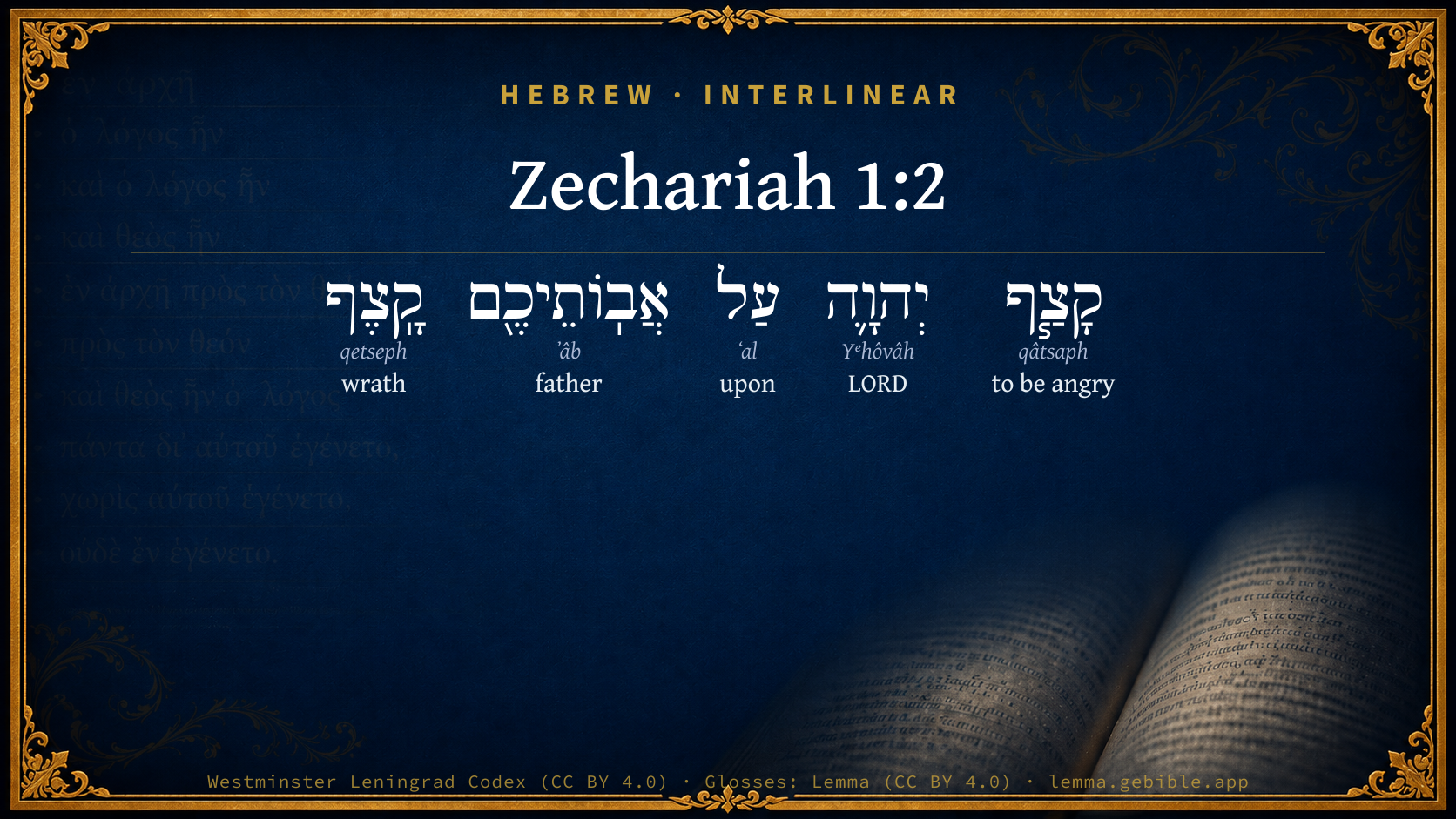
Zechariah 1:2

Hebrew (Westminster Leningrad Codex) Zechariah 1:2 appears in the Hebrew Old Testament. The text above is from the Westminster Leningrad Codex. Each word links to its Strong’s number, a concise gloss, and parsing drawn from the Open Scriptures Hebrew Bible morphology. Click any word for its full Brown-Driver-Briggs (BDB) entry.
Download image
Cite this verse

Zechariah 1:2 (World English Bible). Public Domain. Lemma interlinear Bible study tool, https://lemma.gebible.app/v/zechariah/1/2.

Show BibTeX & RIS
BibTeX
RIS
English Translation
"Yahweh was very displeased with your fathers.
World English Bible · Public Domain
Download a study sheet

One document with this verse’s original text, its word-by-word gloss line, the meaning frame, cross-references with their text, attributed commentary, and full source and license credits — printable, and it pastes into notes with its structure intact.

This verse Autodidact and up

Study sheet (.html) Plain text (.txt)

A passage Seminary Student

Up to 50 verses in one chapter. A passage sheet keeps up to 6 commentary sources and 12 cross-references per verse, in the order this page ranks them, and says so on the sheet whenever that leaves anything out. Ask for a single verse and you get the Autodidact verse sheet above.

Everything on this page stays free to read, with no account — the sheet is a download of what is already on screen, not access to it.

Want to remove ads? Support Godless Engineer
Compare translations 3

The same verse in 3 English versions, stacked beneath the original-language interlinear above. Click any original word for its lexicon entry.

Each is an independent rendering of the whole verse — the interlinear is not word-aligned to these translations.

Highlighted words mark where these versions differ — a whole-verse word diff, not a word-by-word alignment.

  • World English Bible Public Domain
    "Yahweh was very displeased with your fathers.
  • King James Version Public Domain
    The LORD hath been sore displeased with your fathers.
  • unfoldingWord Literal Text CC BY-SA 4.0
    “Yahweh was angry, angry with your fathers.

unfoldingWord Literal Text — © unfoldingWord, licensed CC BY-SA 4.0. Word-aligned USFM3 via Door43 (git.door43.org/unfoldingWord/en_ult).

Versions to compare (up to 4)

3 of 4 selected

Show all 18 translations

Every available English version of this verse, each an independent rendering of the whole verse.

  • World English Bible Public Domain
    "Yahweh was very displeased with your fathers.
  • Berean Standard Bible Public Domain
    “The LORD was very angry with your fathers.
  • Majority Standard Bible Public Domain
    “The LORD was very angry with your fathers.
  • King James Version Public Domain
    The LORD hath been sore displeased with your fathers.
  • American Standard Version (1901) Public Domain
    Jehovah was sore displeased with your fathers.
  • Revised Version (1885) Public Domain
    The LORD hath been sore displeased with your fathers.
  • Geneva Bible (1599) Public Domain
    The Lord hath bene sore displeased with your fathers.
  • Douay-Rheims (1899) Public Domain
    The Lord hath been exceeding angry with your fathers.
  • Young's Literal Translation Public Domain
    `Jehovah was wroth against your fathers -- wrath!
  • Literal Standard Version CC BY-SA 4.0
    “YHWH was angry against your fathers—wrath!
  • Unlocked Literal Bible CC BY-SA 4.0
    “Yahweh was exceedingly angry with your fathers!
  • unfoldingWord Literal Text CC BY-SA 4.0
    “Yahweh was angry, angry with your fathers.
  • Darby Bible Public Domain
    Jehovah hath been very wroth with your fathers.
  • World Messianic Bible Public Domain
    “The LORD was very displeased with your fathers.
  • Webster's Bible Public Domain
    The LORD hath been greatly displeased with your fathers.
  • Free Bible Version CC BY-SA 4.0
    The Lord was very angry with your forefathers.
  • Bible in Basic English Public Domain
    The Lord has been very angry with your fathers:
  • JPS Tanakh (1917) Public Domain
    'The LORD hath been sore displeased with your fathers.

Literal Standard Version (2020), Covenant Press — licensed CC BY-SA 4.0. Text via the HelloAO Bible API (eBible.org). Unlocked Literal Bible (unfoldingWord) — licensed CC BY-SA 4.0. Text via the HelloAO Bible API (eBible.org). unfoldingWord Literal Text — © unfoldingWord, licensed CC BY-SA 4.0. Word-aligned USFM3 via Door43 (git.door43.org/unfoldingWord/en_ult). Free Bible Version, Dr. Jonathan Gallagher — licensed CC BY-SA 4.0. Text via the HelloAO Bible API (eBible.org).

Word by word

More ways to search: Search by grammar → Find every occurrence → Compare this word →

Practice this passage: Drill this verse → Learn its vocabulary →

About this verse

These counts appear in no published source. They are computed here, from the morphology-tagged text and Lemma’s own curated glosses. What Lemma adds →

5
words
5
distinct lemmas
Prophets
section

Shared distinctive vocabulary

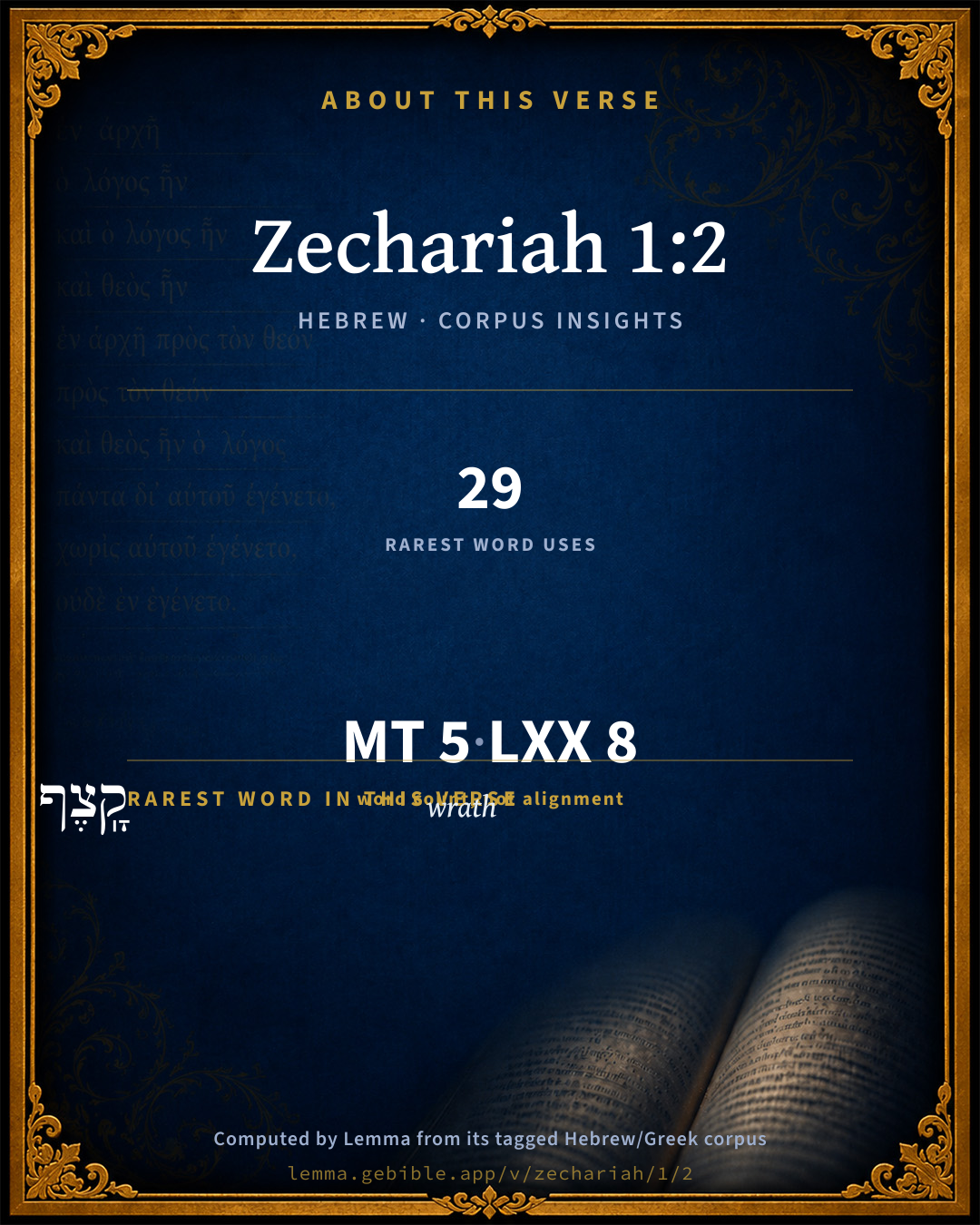
קָֽצֶף wrath H7110 occurs in 29 verses of the Hebrew Bible. Also found in:

Grammatical profile

  • 1 verb
  • 3 nouns
  • 1 preposition

Verb forms

  • קָצַ֧ף Qal · Perfect

Hebrew & Septuagint length

In English translation the verse runs 7 words from the Hebrew and 9 from the Septuagint (LXX English) — closely comparable.

A rough comparison of the two English renderings, which tokenize alike — not a word-level alignment.

Word counts can differ between the Hebrew and the Greek without any difference in meaning — e.g. the Hebrew direct-object marker אֵת has no separate Greek word, and Greek often adds the article ὁ.

In the original languages it is 5 Hebrew tokens and 8 Greek tokens — but the two are counted differently (Hebrew bundles its prefixes and suffixes into one token; the Greek is in lemma form), so that isn’t a like-for-like length.

Cross-references

19

Topical passages linked to Zechariah 1:2 in the Treasury of Scripture Knowledge — connected by theme and wording, ordered by reader-vote popularity; previews shown in the World English Bible.

  • Jeremiah 44:6 Therefore my wrath and my anger was poured forth, and was kindled in the cities of Judah and in the streets of Jerusalem; and they are wasted and desolate, as it is this day.
  • Psalms 79:5–6 How long, Yahweh? Will you be angry forever? Will your jealousy burn like fire?
  • Lamentations 5:7 Our fathers sinned, and are no more; We have borne their iniquities.
  • Ezekiel 22:31 Therefore have I poured out my indignation on them; I have consumed them with the fire of my wrath: their own way have I brought on their heads, says the Lord Yahweh.
  • Zephaniah 2:1–3 Gather yourselves together, yes, gather together, you nation that has no shame,
  • Matthew 23:30–32 and say, 'If we had lived in the days of our fathers, we wouldn't have been partakers with them in the blood of the prophets.'
  • Acts 7:52 Which of the prophets didn't your fathers persecute? They killed those who foretold the coming of the Righteous One, of whom you have now become betrayers and murderers.
  • 2 Kings 22:16–17 Thus says Yahweh, Behold, I will bring evil on this place, and on the inhabitants of it, even all the words of the book which the king of Judah has read.
  • 2 Kings 22:19 because your heart was tender, and you did humble yourself before Yahweh, when you heard what I spoke against this place, and against the inhabitants of it, that they should become a desolation and a curse, and have torn your clothes, and wept before me; I also have heard you, says Yahweh.
  • 2 Kings 23:26 Notwithstanding, Yahweh didn't turn from the fierceness of his great wrath, with which his anger was kindled against Judah, because of all the provocation with which Manasseh had provoked him.
  • 2 Chronicles 36:13–20 He also rebelled against king Nebuchadnezzar, who had made him swear by God: but he stiffened his neck, and hardened his heart against turning to Yahweh, the God of Israel.
  • Ezra 9:6–7 and I said, my God, I am ashamed and blush to lift up my face to you, my God; for our iniquities are increased over our head, and our guiltiness is grown up to the heavens.
  • Ezra 9:13 After all that is come on us for our evil deeds, and for our great guilt, seeing that you our God have punished us less than our iniquities deserve, and have given us such a remnant,
  • Nehemiah 9:26–27 Nevertheless they were disobedient, and rebelled against you, and cast your law behind their back, and killed your prophets that testified against them to turn them again to you, and they committed awful blasphemies.
  • Psalms 60:1 God, you have rejected us. You have broken us down. You have been angry. Restore us, again.
  • Lamentations 1:12–15 Is it nothing to you, all you who pass by? Look, and see if there be any sorrow like my sorrow, which is brought on me, With which Yahweh has afflicted [me] in the day of his fierce anger.
  • Lamentations 2:3–5 He has cut off in fierce anger all the horn of Israel; He has drawn back his right hand from before the enemy: He has burned up Jacob like a flaming fire, which devours round about.
  • Lamentations 3:42–45 We have transgressed and have rebelled; you have not pardoned.
  • Daniel 9:11–12 Yes, all Israel have transgressed your law, even turning aside, that they should not obey your voice: therefore has the curse been poured out on us, and the oath that is written in the law of Moses the servant of God; for we have sinned against him.

Cross-references courtesy of OpenBible.info (CC BY 4.0).

Hebrew and Greek witnesses Masoretic Hebrew ↔ Greek Septuagint

The same verse in the two great witnesses to the Old Testament, shown verse-for-verse.

These are two independent witnesses, not word-aligned to each other, and the Septuagint is shown in lemma (dictionary) form.

Hebrew Zechariah 1:2 Masoretic · Westminster Leningrad Codex

קָצַ֧ף יְהוָ֛ה עַל אֲבֽוֹתֵיכֶ֖ם קָֽצֶף

"Yahweh was very displeased with your fathers.

World English Bible · Public Domain

Greek LXX Zechariah 1:2 Septuagint · lemma form

ὀργίζω κύριος ἐπί ὁ πατήρ σύ ὀργή μέγας

The Lord has been very angry with your fathers.

LXX2012 (modern English Septuagint) · Public Domain

Hebrew: Westminster Leningrad Codex (CC BY 4.0). Greek: Septuagint (public domain); English from LXX2012 (modern English Septuagint) (Public Domain). How the Septuagint differs from the Hebrew →

Targum (Aramaic paraphrase)

1

The Targum is the ancient Jewish Aramaic paraphrase of the Hebrew Scriptures — an interpretive translation, not the Hebrew text itself. Onkelos (literal) and Pseudo-Jonathan (expansive) render the Torah, and Jonathan the Prophets. Coverage is partial: where no permissively-licensed English translation exists for a verse, only the Aramaic is shown. This is verse-level text, not a word-by-word alignment to the Hebrew.

  1. Targum Jonathan Prophets (Joshua–Malachi)
    הֲוָה רְגַז מִן קֳדָם יְיָ עַל אֲבָהַתְכוֹן עַל דְאַרְגִיזוּ קֳדָמוֹהִי:

    (no public-domain English translation for this verse)

    Targum Jonathan — Aramaic: “Mikraot Gedolot” (public domain). English: “Sefaria Community Translation” (CC0 1.0 (public-domain dedication)); “London "Chaldee Paraphrase," 1871” (public domain). Text via Sefaria.

Commentary

Notes on Zechariah 1:2 from classic Christian and Jewish commentators (each source and its license shown beneath its notes). The classic Christian expositions comment on the surrounding passage and are grouped to its opening verse, so a note may address several verses; the Jewish commentaries on the Tanakh (Rashi and others) are per-verse, so they appear only where the commentator wrote on this verse.

Lemma curates 59 commentaries, every one of them public domain or Creative Commons licensed, each selected and text-cleaned for this edition rather than reprinted as found. About our sources →

The Cambridge Bible for Schools and Colleges

gen. ed. J. J. S. Perowne

2. sore displeased] Lit. displeased with displeasure. The addition of the noun serves to give emphasis to the verb. Comp. Luk_22:15. What a commentary on this “sore displeasure” was the scene on which the prophet and his hearers gazed, in its contrast with the past: the House, which had once been “exceeding magnifical, of fame and of glory throughout all countries” (1Ch_22:5), now slowly rising above its foundations, the poor and feeble representative of its former self: the city, which had once been “beautiful for situation, the joy of the whole earth,” now such as Nehemiah some seventy-five years after saw it, on that memorable night when he “on his mule or ass, accompanied by a few followers on foot, descended into the ravine of Hinnom, and threaded his way in and out amongst the gigantic masses of ruin and rubbish …; the gate, outside of which lay the piles of the sweepings and offscourings of the streets; the masses of fallen masonry, extending as it would seem all along the western and northern side; the blackened gaps left where the gates had been destroyed by fire; till at last by the royal reservoir the accumulations became so impassable, that the animal on which he rode refused to proceed” (Stanley, Jewish Church, Vol. III. p. 125, Neh_2:12-15): the people, once “many as the sand which is by the sea in multitude, eating and drinking and making merry” (1Ki_4:20), now scattered among the heathen, represented on their native soil only by the poor and subject “remnant,” to whom the prophet addressed himself!

2. The company of horsemen and their Leader;

2–6. The call to Repentance. Zechariah’s first message is one of warning, by the example of their fathers and the earlier prophets. On their fathers, as they well knew, the displeasure of Almighty God had fallen heavily (Zec_1:2). Now, for the first time in this new era of their history, God is sending to them, as He did to their fathers of old, His servants the prophets, himself and Haggai, with a call to repentance and a promise of reconciliation, Zec_1:3. Let them not be like their fathers, who turned a deaf ear to the remonstrances of the prophets and refused to amend, Zec_1:4; lest, being like them in their sin, they should be like them in their punishment also, and should have with them to confess, in the bitter experience of their accomplishment, that God’s unheeded threatenings would surely take effect, Zec_1:5-6.

The Cambridge Bible for Schools and Colleges (gen. ed. J. J. S. Perowne; Cambridge University Press, 1878–1918) — public domain. Text from a community e-Sword module.

Trapp's Complete Commentary

John Trapp

Zec 1:2 The LORD hath been sore displeased with your fathers.

Ver. 2. The Lord hath been sore displeased with your fathers] Heb. He hath boiled against your fathers with foaming anger, with height of heat. There are degrees of anger, see Mat 5:22 Deu 29:28. The Lord rooted them out of their land in anger, and in wrath, and in great indignation. Surgit hic oratio: and the last of those three words is the same here used in the text; noting a higher degree than the two former, even such a fervour and fierceness of God’s wrath as maketh him ready to kill and cut off, {see 2Ki 6:6, and note the affinity of that word with this} like as he had much ado to forbear killing of Moses, when he met him in the inn, Exo 4:24, and as Nebuchadnezzar was not only angry, but very furious, and commanded to destroy all the wise men of Babylon, Dan 2:12. Now if the wrath of a king be as many messengers of death, Pro 16:14, what shall we think of the foaming and frothing wrath of God, which burns unto the lowest hell, and sets on fire the foundations of the mountains, Deu 32:22. After which followeth, in the next verse, "I will heap mischiefs upon them; I will spend mine arrows upon them," Deu 32:23. He had done so upon the ancestors of these refractory Jews, who had been saepius puncti et repuncti, minime tamen ad resipiscentiam compuncti, often punished, but could never be reclaimed; so incorrigibly flagitious, so shamelessly, so prodigiously wicked were they, till there was no remedy. This their vile stubbornness made him sore displeased with them; and put thunderbolts into his hands to destroy them; for though fury be not in God, Isa 27:5, to speak properly, he is free from any such passions as we are subject to, yet if briars and thorns set against him in battle, if a rabble of rebels conspire to cast him out of his throne, saying, "We will not have this man to rule over us," &c., "I would go through them, I would burn them together," saith he, in the same breath. Abused mercy turneth into fury. Nothing so cold as lead, and yet nothing so scalding, if molten. Nothing more blunt than iron; and yet nothing so keen, if sharpened. The air is soft and tender; yet out of it are engendered thunder and lightnings. The sea is calm and smooth; but if tossed with tempests, it is rough above measure. The Lord, as he is Father of mercies, so he is God of recompences: and it is a fearful thing to fall into his punishing hands, Heb 10:31. If his wrath be kindled, yea, but a little, woe be to all those upon whom it lights, Psa 2:12 : how much more when he is sore displeased with a people or person, as here! For "who knoweth the power of thine anger?" saith Moses; "even according to thy fear, so is thy wrath," Psa 90:11; that is, let a man fear thee never so much, he is sure to feel thee much more, if once he fall into thy fingers. And this is here urged by the prophet as a motive to true repentance; since by their fathers’ example they might see there was no way to escape the dint of the Divine displeasure but to submit to God’s justice, and to implore his mercy: men must either turn or burn, "For even our God is a consuming fire," Heb 12:29.

John Trapp, A Commentary or Exposition upon All the Books of the Old and New Testament (1647–1656) — public domain. Text from a community e-Sword module.

The Biblical Illustrator

Joseph S. Exell

Zec_1:2

The Lord hath been sore displeased with your fathers

A call to repentance

The prophet being to carry comfortable tidings to this people, begins with the doctrine of repentance, inviting them not to obstruct their own mercy by impenitency; and to make way for this doctrine, he points out to them the greatness of Gods displeasure against their fathers for their sin, as might be seen in the horrible calamities that did come upon them, which might teach their children not to expect exemption if they followed their way.

Doctrine--

1. A people are prepared and fitted for favourable manifestations of God by repentance, and mercies are sweetest and most comfortable unto penitents, therefore the Lord permits this doctrine to the following visions, as the only way to fit people for them, and make them truly comfortable to them.

2. No privilege bestowed on any people will exempt them from sharp corrections when they sin; for albeit the Jews were the only people of God at that time, yet the Lord hath been sore displeased with your fathers, which is also a warning to them.

3. Though the Lord do not chastise any of His chosen and regenerate people in pure wrath or beyond the bounds of moderation, yet His fatherly displeasure may be very hot and sad in its effects, and His displeasure against a visible Church, which hath abused mercy, very grievous, and therefore ought to be seriously laid to heart; therefore He calls them to consider how the Lord hath been sore displeased, or had displeasure on displeasure.

4. Albeit examples of Gods anger, especially when they are near, ought to be effectual documents to others, exciting to tremble and repent, yet such is the stupidity of men, that notwithstanding any such warnings, they will be ready to adventure on the same sins, which God hath so remarkably punished; therefore they need stirring up to see and make use of Gods anger against their fathers, the effects whereof were very visible to them. (George Hutcheson.)

The prophets exordium

Its object is to show the unchanging permanence of Gods Word, by contrasting it with the transitory nature of their fathers and the prophets, and it may thus be set forth more fully. Let the fate of your fathers be a warning to you that you avoid the disobedience to the word of Jehovah, which brought upon them evils so desolating. For where are they new? Once they ruled and worshipped here as you do. But where are they now? Some lie in slaughtered heaps, when the banner of Judah was trampled in the dust, and her bravest sons cut down like grass before the mowers scythe, by the fierce cohorts of the Assyrian. Some lie buried in the ruins of the holy city, which they sought to defend from the spoiler. Some are sleeping by the flashing waters of the Euphrates, after weeping out a weary life beneath the willows that bend in the land of the stranger. Whilst some, in the feebleness of tottering age, have returned to lay their bones in the soil that is hallowed by the memories and hopes of Israel. And why has this been their mournful history? Because they refused to listen to the warnings of the prophets. Hence even the prophets themselves were taken away. They warned, and wept, and prayed, but met only with stoning, reviling, and hate. They toiled on to stay the coming judgments, but when their efforts were disregarded by the people, God in mercy took them away from the evil to come. Then the last barrier was removed, and the torrent of wrath came dire and pitiless in its rush of fury and swept them away in its flood. Now as your fathers and the prophets alike have passed away according to My word; as neither the wickedness of the one, nor the piety of the other, could arrest My threatened judgments, beware lest a like evil come upon you, that your prophets, being disregarded, be also withdrawn, and the judgments you are daring come upon you for your disobedience. This appropriate introduction was probably followed with exhortations to build the temple, and restore the worship of God, that are not recorded, as their interest was local and temporary. Inferences--

1. Whilst God is love, and whilst the preachers of the Gospel must preach this glorious truth, they must not conceal the fact that God is a consuming fire, and angry with the wicked every day. It is a sign of sickly piety when men are willing to hear nothing of the wrath of God against sin (Zec_1:1-2).

2. If men expect God to return to them in prosperity, they must return to Him in penitence. The flower averted from the sun must turn toward it, to catch, its genial smile (Zec_1:3).

3. What we have to do for God in life should be done quickly, for life is rapidly passing; to evil and good alike come the swift shadows of the sunset (Zec_1:5).

4. What a man sows, he shall also reap, and the seedlings of life on earth shall be harvested in heaven or in hell (Zec_1:6). (T. V. Moore, D. D.)

The Biblical Illustrator, edited by Joseph S. Exell (c. 1880s–1900s) — public domain. Text from a community e-Sword module.

Geneva Bible (1599)

Geneva Bible translators

He speaketh this to fear them with God’s judgments, that they should not provoke him as their fathers had done, whom he so grievously punished.

Geneva Bible (1599) marginal notes — public domain. Text via Bolls.life.

Jamieson, Fausset & Brown

Robert Jamieson, A. R. Fausset & David Brown

God fulfilled His threats against your fathers; beware, then, lest by disregarding His voice by me, as they did in the case of former prophets, ye suffer like them. The special object Zechariah aims at is that they should awake from their selfish negligence to obey God's command to rebuild His temple (Hag 1:4-8).

sore displeased--Hebrew, "displeased with a displeasure," that is, vehemently, with no common displeasure, exhibited in the destruction of the Jews' city and in their captivity.

Jamieson, Fausset & Brown — Commentary Critical and Explanatory on the Whole Bible (1871) — public domain (CC PDM 1.0). Text via the HelloAO Bible API.

Adam Clarke's Commentary

Verse 2. The Lord hath been sore displeased with your fathers.] For their ingratitude idolatry, iniquity, and general rebellion.

Adam Clarke's Commentary on the Bible (1810–1826) — public domain. Text from a community e-Sword/MySword module.

John Calvin's Commentaries

Angry was Jehovah with anger against your fathers The Prophet here refers to the severity of the punishment with which the Jews had been visited, in order that posterity might know that God, who so rigidly punishes the despisers of his word and instruction, ought not to be provoked. For by saying that God was angry with anger, he means, that God was in no common measure offended with the Jews, and that the very grievousness of their punishment was a clear evidence how displeased God was with them. But the object of the Prophet was to rouse the Jews, that they might begin seriously to fear God on seeing how dreadful is his wrath. The Apostle states it as a general truth, that it is a dreadful thing to fall into the hands of the living God, (Hebrews 10:30:) so also the Scripture speaks everywhere. But Zechariah mentions here to his own people a signal evidence of God’s wrath, which ought to justly to have smitten all of them with terror. He does not then speak here of a thing unknown, but reminds them seriously to consider how terrible is God’s vengeance; as a proof of this, their fathers had been deprived of their perpetual inheritance, they had suffered many degradations, and had also been harassed and oppressed by tyrants; in short, they had been nearly sunk in the lowest depths. Since then God has so severely dealt with their fathers, the Prophet bids them to know that God ought to be feared, lest they should grow wanton or indulge themselves in their usual manner, but that they might from the heart repent, and not designedly provoke God’s wrath, of which their fathers had so severe an experience.

John Calvin's Commentaries (1540-1563) — public domain. Text from the Calvin Translation Society English edition (1840s-50s) via the Christian Classics Ethereal Library (ccel.org). Calvin's coverage is partial (roughly two-thirds of the Bible); uncommented books and verses are honest gaps, never fabricated. The 19th-century editor's footnotes and remarks are omitted so the notes are faithfully Calvin's own voice.

Ellicott's Commentary for English Readers

(2) Your fathers.—This verse contains the word of the Lord addressed directly to and through the prophet, who is included among those addressed in the pronoun “your fathers.” It gives the ground on which the exhortation to repentance is founded.

A Bible Commentary for English Readers, edited by Charles John Ellicott (1878–1897) — public domain. Text from a community e-Sword module.

John Gill's Exposition

The Lord hath been sore displeased with your fathers. Who lived before and at the time of the destruction of the city of Jerusalem, and which was manifest by their captivity; all which were occasioned by their sins, with which they provoked the Lord to sore displeasure against them; and this is mentioned as a caution to their children, that they might not follow their example, and incur the like displeasure.

The Lord hath been sore displeased with your fathers. Who lived before and at the time of the destruction of the city of Jerusalem, and which was manifest by their captivity; all which were occasioned by their sins, with which they provoked the Lord to sore displeasure against them; and this is mentioned as a caution to their children, that they might not follow their example, and incur the like displeasure.

Zechariah 1:3

zac 1:3

zac 1:3

zac 1:3Therefore say thou unto them,.... This is an order from the Lord to Zechariah, to say unto them, in the name of the Lord:

thus saith the Lord of hosts; of the hosts above and below, of angels and of men, of heaven and earth, and all that is therein: this is said, that the greater regard might be had to his words:

turn ye unto me, saith the Lord of hosts; by repentance, and acknowledgment of former sins; by reformation for the future; by attending to the worship and service of God, and seeking to glorify him. So the Targum, "return to my worship": this is not the condition of what follows, but what follows is the motive and encouragement to this:

and I will turn unto you, saith the Lord of hosts; to dwell among them, manifest himself unto and protect them. Three times the phrase, "the Lord of hosts", is used in this verse: it may be with respect to the three Persons in the Godhead, Father, Son, and Spirit; who manifest themselves unto, and take up their abode with, such as love the Lord, and keep his commandments; see Joh 14:21.

John Gill's Exposition of the Whole Bible (1746–1763) — public domain (CC PDM 1.0). Text via the HelloAO Bible API.

Albert Barnes' Notes on the Bible

Wroth was the Lord against your fathers with wrath - o, that is, a wrath which was indeed such, whose greatness he does not further express, but leaves to their memories to supply. Cyril: “Seest thou how he scares them, and, setting before the young what befell those before them, drives them to amend, threatening them with the like or more grievous ills, unless they would wisely reject their fathers’ ways, esteeming the pleasing of God worthy of all thought and care. He speaks of great wrath. For it indicates no slight displeasure that He allowed the Babylonians to waste all Judah and Samaria, burn the holy places and destroy Jerusalem, remove the elect Israel to a piteous slavery in a foreign land, severed from sacrifices, entering the holy court no more nor offering the thank-offering, or tithes, or first-fruits of the law, but precluded by necessity and, fear even from the duty of celebrating his prescribed and dearest festivals. The like we might address to the Jewish people, if we would apply it to the mystery of Christ. For after they had “killed the prophets” and had “crucified the Lord of glory” Himself, they were captured and destroyed; their famed temple was levelled, and Hosea’s words were fulfilled in them; “The children of Israel shall abide many days without a king and without a prince, without a sacrifice and without an image, without an ephod and without teraphim” .

Albert Barnes' Notes on the Bible (1834–1885) — public domain. Text from a community e-Sword/MySword module.

Haydock's Catholic Bible Commentary

Angry, as he has severely chastised them. (Calmet)

George Leo Haydock (1774–1849), Haydock's Catholic Family Bible and Commentary, 1859 edition — public domain. Excludes Psalms (Douay-Rheims chapter numbering differs from Protestant) and Deuterocanonical books (Catholic canon only).

Matthew Poole's English Annotations

The Lord, the holy, the mighty One, your God, the just Governor of the world, hath been sore displeased; so long provoked, that his displeasure at last enkindled within his breast, and broke out into that flame which hath consumed your land, city, and temple.

With your fathers; all that were progenitors, forefathers to the returned captives, from their entrance into Canaan, but especially since the apostacy in Jeroboam’s time; for many hundred years your predecessors have provoked God by their notorious sins, even to the days of their captivity.

Matthew Poole's English Annotations on the Holy Bible (1683–1685) — public domain. Text from a community e-Sword/MySword module.

Whedon's Commentary on the Bible

Daniel D. Whedon

2. At the beginning of his message the prophet places the statement that Jehovah was angry with the fathers.

Sore displeased — Literally, angry with anger. This should serve as a warning to the present generation.

Daniel D. Whedon (gen. ed.), Commentary on the Old and New Testaments (1874–1909) — public domain. Text from a community e-Sword module.

The Pulpit Commentary

Vers. 2-6. The prophet admonishes the people not to follow their forefathers" evil example, but to turn to the Lord with all their heart.

Hath been sore displeased; literally, displeased with displeasure, which the versions render, wrgisyh orghlhn : iratus iracundia (cf. ver. 15). Not only events connected with their earlier history proved that God had been incensed with their forefathers, but the ruin of their kingdom, and the late Captivity, and the desolation around them, were evidence of the same sad truth.

The Pulpit Commentary (1880–1919), ed. H.D.M. Spence-Jones & Joseph S. Exell — public domain. Text from a community e-Sword module.

Rashi

Rabbi Shlomo Yitzchaki (Rashi)

with your fathers who were in the generation of the destruction of the Temple.

Rashi on the Tanakh — English translations: “The Judaica Press complete Tanach with Rashi, translated by A. J. Rosenberg” (CC BY 4.0); “Pentateuch with Rashi's commentary by M. Rosenbaum and A.M. Silbermann, 1929-1934” (public domain); “The Metsudah Tanach series, Lakewood, N.J” (CC BY 4.0); and “The Book of Joshua, Metsudah Publications, 1997” (CC BY 4.0). Text via Sefaria.

Lesson kit

Teaching starters — assembled from the data on this page, not authored interpretation. Every prompt links to the verse data it draws on. Edit before teaching.

Zechariah, in the Prophets, opens this verse with 5 words (5 distinct Hebrew lemmas). Its most distinctive word is qetseph (“wrath”). A historical commentator’s framing appears above. Read the whole chapter for the surrounding context.

Discussion questions

  1. How does “wrath” (qetseph) shape what this verse is saying?
  2. Numbers 1:53 shares the word «wrath» with this verse. How do the two illuminate each other?
  3. These translations render this verse differently. What is at stake in choosing one wording over another?
  4. The verb «קָצַ֧ף» is Qal Perfect. How does its form color the action?
  5. Reading how The Cambridge Bible for Schools and Colleges and Trapp's Complete Commentary read this verse, where do the two commentators agree and where do they part?

Things to notice

Reading settings

Reading text

Shown beneath each verse's original-language words.

Old Testament
Old Testament edition

Read the OT as the Masoretic Hebrew (MT) or the Greek Septuagint (LXX).

English shown for the Greek Septuagint (in the Hebrew ↔ Greek comparison).

Comparing translations? Open the Compare panel on any verse page to stack up to four side by side.