
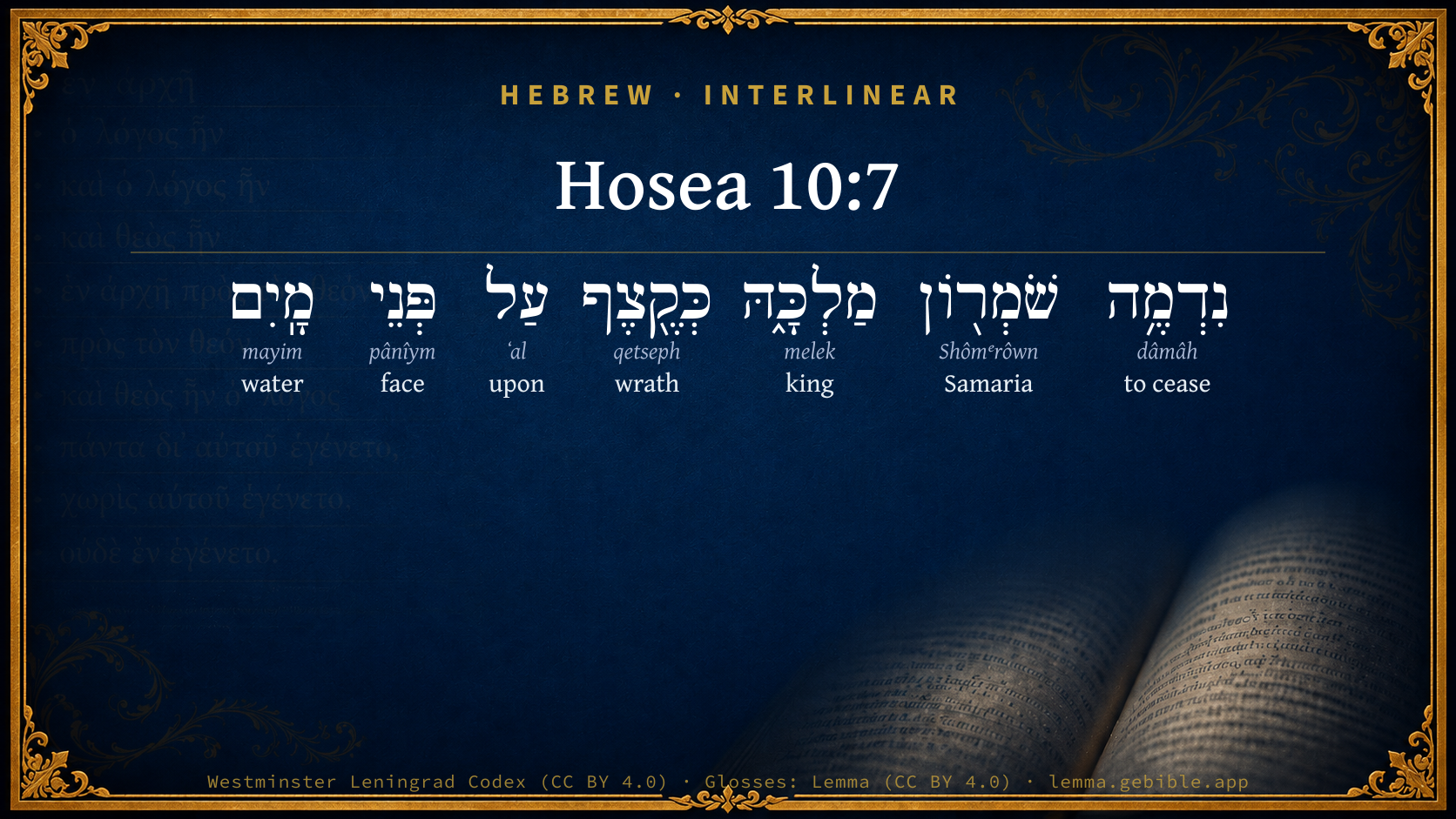
Hosea 10:7

Hebrew (Westminster Leningrad Codex) Hosea 10:7 appears in the Hebrew Old Testament. The text above is from the Westminster Leningrad Codex. Each word links to its Strong’s number, a concise gloss, and parsing drawn from the Open Scriptures Hebrew Bible morphology. Click any word for its full Brown-Driver-Briggs (BDB) entry.
Download image
Cite this verse

Hosea 10:7 (World English Bible). Public Domain. Lemma interlinear Bible study tool, https://lemma.gebible.app/v/hosea/10/7.

Show BibTeX & RIS
BibTeX
RIS
English Translation
Samaria and her king float away, Like a twig on the water.
World English Bible · Public Domain
Download a study sheet

One document with this verse’s original text, its word-by-word gloss line, the meaning frame, cross-references with their text, attributed commentary, and full source and license credits — printable, and it pastes into notes with its structure intact.

This verse Autodidact and up

Study sheet (.html) Plain text (.txt)

A passage Seminary Student

Up to 50 verses in one chapter. A passage sheet keeps up to 6 commentary sources and 12 cross-references per verse, in the order this page ranks them, and says so on the sheet whenever that leaves anything out. Ask for a single verse and you get the Autodidact verse sheet above.

Everything on this page stays free to read, with no account — the sheet is a download of what is already on screen, not access to it.

Want to remove ads? Support Godless Engineer
Compare translations 3

The same verse in 3 English versions, stacked beneath the original-language interlinear above. Click any original word for its lexicon entry.

Each is an independent rendering of the whole verse — the interlinear is not word-aligned to these translations.

Highlighted words mark where these versions differ — a whole-verse word diff, not a word-by-word alignment.

  • World English Bible Public Domain
    Samaria and her king float away, Like a twig on the water.
  • King James Version Public Domain
    As for Samaria, her king is cut off as the foam upon the water.
  • unfoldingWord Literal Text CC BY-SA 4.0
    Samaria—its king will be ended, like a splinter on the face of the waters.

unfoldingWord Literal Text — © unfoldingWord, licensed CC BY-SA 4.0. Word-aligned USFM3 via Door43 (git.door43.org/unfoldingWord/en_ult).

Versions to compare (up to 4)

3 of 4 selected

Show all 18 translations

Every available English version of this verse, each an independent rendering of the whole verse.

  • World English Bible Public Domain
    Samaria and her king float away, Like a twig on the water.
  • Berean Standard Bible Public Domain
    Samaria will be carried off with her king like a twig on the surface of the water.
  • Majority Standard Bible Public Domain
    Samaria will be carried off with her king like a twig on the surface of the water.
  • King James Version Public Domain
    As for Samaria, her king is cut off as the foam upon the water.
  • American Standard Version (1901) Public Domain
    `As for' Samaria, her king is cut off, as foam upon the water.
  • Revised Version (1885) Public Domain
    As for Samaria, her king is cut off, as foam upon the water.
  • Geneva Bible (1599) Public Domain
    Of Samaria, the King thereof is destroyed as the some vpon the water.
  • Douay-Rheims (1899) Public Domain
    Samaria hath made her king to pass as froth upon the face of the water.
  • Young's Literal Translation Public Domain
    Cut off is Samaria! Its king `is' as a chip on the face of the waters.
  • Literal Standard Version CC BY-SA 4.0
    Samaria is cut off! Its king [is] as wrath on the face of the waters.
  • Unlocked Literal Bible CC BY-SA 4.0
    Samaria's king will be destroyed, like a chip of wood on the surface of the water.
  • unfoldingWord Literal Text CC BY-SA 4.0
    Samaria—its king will be ended, like a splinter on the face of the waters.
  • Darby Bible Public Domain
    As for Samaria her king is cut off as chips upon the face of the waters.
  • World Messianic Bible Public Domain
    Samaria and her king float away like a twig on the water.
  • Webster's Bible Public Domain
    As for Samaria, her king is cut off as the foam upon the water.
  • Free Bible Version CC BY-SA 4.0
    Samaria and its king will be destroyed, swept away like a twig on the surface of the water.
  • Bible in Basic English Public Domain
    As for Samaria, her king is cut off, like mist on the water.
  • JPS Tanakh (1917) Public Domain
    As for Samaria, her king is cut off, as foam upon the water.

Literal Standard Version (2020), Covenant Press — licensed CC BY-SA 4.0. Text via the HelloAO Bible API (eBible.org). Unlocked Literal Bible (unfoldingWord) — licensed CC BY-SA 4.0. Text via the HelloAO Bible API (eBible.org). unfoldingWord Literal Text — © unfoldingWord, licensed CC BY-SA 4.0. Word-aligned USFM3 via Door43 (git.door43.org/unfoldingWord/en_ult). Free Bible Version, Dr. Jonathan Gallagher — licensed CC BY-SA 4.0. Text via the HelloAO Bible API (eBible.org).

Word by word

More ways to search: Search by grammar → Find every occurrence → Compare this word →

Practice this passage: Drill this verse → Learn its vocabulary →

About this verse

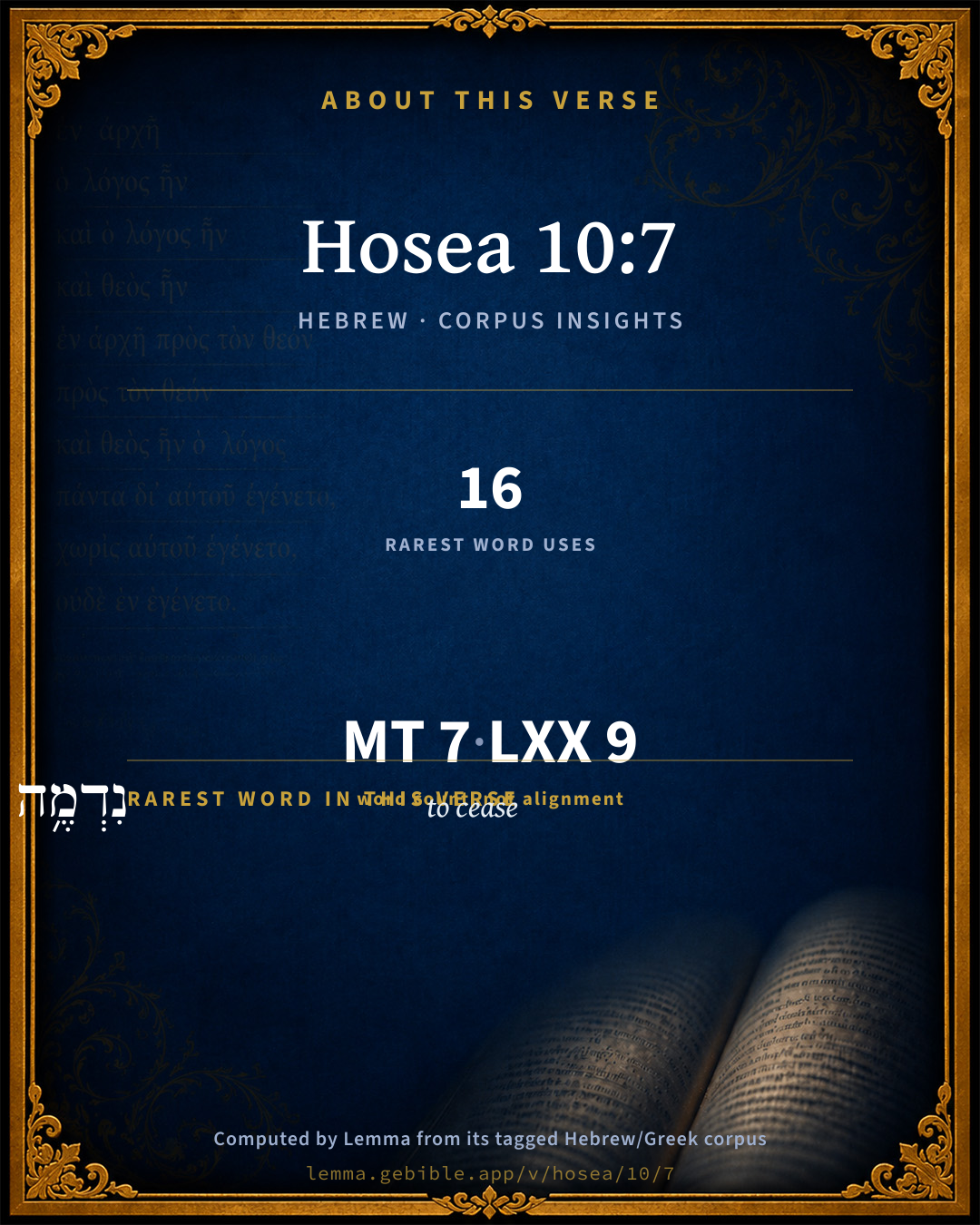
These counts appear in no published source. They are computed here, from the morphology-tagged text and Lemma’s own curated glosses. What Lemma adds →

7
words
7
distinct lemmas
Prophets
section

Notable vocabulary

The rarest word here is נִדְמֶ֥ה to cease H1820 — appearing just 16 times in the whole Hebrew Bible.

Shared distinctive vocabulary

נִדְמֶ֥ה to cease H1820 occurs in 14 verses of the Hebrew Bible. Also found in:

Grammatical profile

  • 1 verb
  • 5 nouns
  • 1 preposition

Verb forms

  • נִדְמֶ֥ה Niphal · Participle Passive

Hebrew & Septuagint length

In English translation the verse runs 12 words from the Hebrew and 15 from the Septuagint (LXX English) — closely comparable.

A rough comparison of the two English renderings, which tokenize alike — not a word-level alignment.

Word counts can differ between the Hebrew and the Greek without any difference in meaning — e.g. the Hebrew direct-object marker אֵת has no separate Greek word, and Greek often adds the article ὁ.

In the original languages it is 7 Hebrew tokens and 9 Greek tokens — but the two are counted differently (Hebrew bundles its prefixes and suffixes into one token; the Greek is in lemma form), so that isn’t a like-for-like length.

Cross-references

8

Topical passages linked to Hosea 10:7 in the Treasury of Scripture Knowledge — connected by theme and wording, ordered by reader-vote popularity; previews shown in the World English Bible.

  • Hosea 10:3 Surely now they will say, "We have no king; for we don't fear Yahweh; And the king, what can he do for us?"
  • 2 Kings 1:3 But the angel of Yahweh said to Elijah the Tishbite, Arise, go up to meet the messengers of the king of Samaria, and tell them, Is it because there is no God in Israel, that you go to inquire of Baal Zebub, the god of Ekron?
  • Jude 1:13 wild waves of the sea, foaming out their own shame; wandering stars, for whom the blackness of darkness has been reserved forever.
  • 1 Kings 21:1 It happened after these things, that Naboth the Jezreelite had a vineyard, which was in Jezreel, hard by the palace of Ahab king of Samaria.
  • 2 Kings 15:30 Hoshea the son of Elah made a conspiracy against Pekah the son of Remaliah, and struck him, and killed him, and reigned in his place, in the twentieth year of Jotham the son of Uzziah.
  • 2 Kings 17:4 The king of Assyria found conspiracy in Hoshea; for he had sent messengers to So king of Egypt, and offered no tribute to the king of Assyria, as he had done year by year: therefore the king of Assyria shut him up, and bound him in prison.
  • Hosea 10:15 So Bethel will do to you because of your great wickedness. At daybreak the king of Israel will be destroyed.
  • Hosea 13:11 I have given you a king in my anger, And have taken him away in my wrath.

Cross-references courtesy of OpenBible.info (CC BY 4.0).

Hebrew and Greek witnesses Masoretic Hebrew ↔ Greek Septuagint

The same verse in the two great witnesses to the Old Testament, shown verse-for-verse.

These are two independent witnesses, not word-aligned to each other, and the Septuagint is shown in lemma (dictionary) form.

Hebrew Hosea 10:7 Masoretic · Westminster Leningrad Codex

נִדְמֶ֥ה שֹׁמְר֖וֹן מַלְכָּ֑הּ כְּקֶ֖צֶף עַל פְּנֵי מָֽיִם

Samaria and her king float away, Like a twig on the water.

World English Bible · Public Domain

Greek LXX Hosea 10:7 Septuagint · lemma form

ἀποῥίπτω σαμαρία βασιλεύς αὐτός ὡς φρύγανον ἐπί πρόσωπον ὕδωρ

Samaria has cast off her king as a twig on the surface of the water.

LXX2012 (modern English Septuagint) · Public Domain

On this verse, The Cambridge Bible for Schools and Colleges discusses the Septuagint’s reading. Read the note in Commentary ↓

Hebrew: Westminster Leningrad Codex (CC BY 4.0). Greek: Septuagint (public domain); English from LXX2012 (modern English Septuagint) (Public Domain). How the Septuagint differs from the Hebrew →

Targum (Aramaic paraphrase)

1

The Targum is the ancient Jewish Aramaic paraphrase of the Hebrew Scriptures — an interpretive translation, not the Hebrew text itself. Onkelos (literal) and Pseudo-Jonathan (expansive) render the Torah, and Jonathan the Prophets. Coverage is partial: where no permissively-licensed English translation exists for a verse, only the Aramaic is shown. This is verse-level text, not a word-by-word alignment to the Hebrew.

  1. Targum Jonathan Prophets (Joshua–Malachi)
    בַּהֲתַת שֹׁמְרוֹן בְּמַלְכָּהּ כְּרוּתְחָא עַל אַפֵּי מַיָא:

    (no public-domain English translation for this verse)

    Targum Jonathan — Aramaic: “Mikraot Gedolot” (public domain). English: “Sefaria Community Translation” (CC0 1.0 (public-domain dedication)); “London "Chaldee Paraphrase," 1871” (public domain). Text via Sefaria.

Commentary

Notes on Hosea 10:7 from classic Christian and Jewish commentators (each source and its license shown beneath its notes). The classic Christian expositions comment on the surrounding passage and are grouped to its opening verse, so a note may address several verses; the Jewish commentaries on the Tanakh (Rashi and others) are per-verse, so they appear only where the commentator wrote on this verse.

Lemma curates 59 commentaries, every one of them public domain or Creative Commons licensed, each selected and text-cleaned for this edition rather than reprinted as found. About our sources →

Trapp's Complete Commentary

John Trapp

Hos 10:7 [As for] Samaria, her king is cut off as the foam upon the water.

Ver. 7. As for Samaria, her king is cut off, as the foam upon the waters] An apt simile (whereof this prophet is full). Her king (not her idols, as some sense it), though gotten into Samaria, a strong city, so well victualled and fortified as to hold out a siege of three years’ continuance, yet shall be cut off, or silenced, as Hos 4:7, "as the foam upon the waters," bulla evanida, more weak than water, whereof it ariseth, and whereby it is wherried away, and cannot resist; or, as a bubble blown up by every small wind, and as easily blown out again; it no sooner appears but it disappears. Lo, such are the greatest kings and kingdoms, when God taketh them in their wickedness. "He cuts off the spirit of princes," Psa 76:12, he slips them off (so the Hebrew is) as one would slip off a flower between one’s fingers; or as one would slip off a bunch of grapes. The kingdoms of the earth are like "foam upon the waters": 1. For their seeming brightness; 2. For their great eminence; 3. For their instability and inability to resist; 4. For their sudden fall and disappearance. The Turkish empire (which hath swallowed up so many glorious empires and renowned kingdoms) laboureth with nothing more than the weightiness of itself; and shall shortly be cut off as foam, and live no otherwise than by fame, as others now do; though for the present it be no whit inferior in greatness and strength to the greatest monarchies that ever yet were upon the face of the earth; the Roman empire only excepted.

John Trapp, A Commentary or Exposition upon All the Books of the Old and New Testament (1647–1656) — public domain. Text from a community e-Sword module.

Keil & Delitzsch

C. F. Keil & F. Delitzsch

With the carrying away of the golden calf the kingdom of Samaria also perishes, and desert plants will grow upon the places of idols. Hos 10:7, Hos 10:8. "Destroyed is Samaria; her king like a splinter on the surface of the water. And destroyed are the high places of Aven, the sin of Israel: thorn and thistle will rise up on their altars; and they will speak to the mountains, Cover us! and to the hills, Fall on us!" שׁמרון מלכּהּ is not an asyndeton, "Samaria and its king;" but Shōmerōn is to be taken absolutely, "as for Samaria," although, as a matter of fact, not only Samaria, the capital of the kingdom, but the kingdom itself, was destroyed. For malkâh does not refer to any particular king, but is used in a general sense for "the king that Samaria had," so that the destruction of the monarchy is here predicted (cf. Hos 10:15). The idea that the words refer to one particular king, is not only at variance with the context, which contains no allusion to any one historical occurrence, but does not suit the simile: like a splinter upon the surface of the water, which is carried away by the current, and vanishes without leaving a trace behind. Qetseph is not "foam" (Chald., Symm., Rabb.), but a broken branch, a fagot or a splinter, as qetsâphâh in Joe 1:7 clearly shows. Bâmōth 'âven are the buildings connected with the image-worship at Bethel ('âven = Bēth-'ēl, Hos 10:5), the temple erected there (bēth bâmōth), together with the altar, possibly also including other illegal places of sacrifice there, which constituted the chief sin of the kingdom of Israel. These were to be so utterly destroyed, that thorns and thistles would grow upon the ruined altars (cf. Gen 3:18). "The sign of extreme solitude, that there are not even the walls left, or any traces of the buildings" (Jerome). When the kingdom shall be thus broken up, together with the monarchy and the sacred places, the inhabitants, in their hopeless despair, will long for swift death and destruction. Saying to the mountains, "Cover us," etc., implies much more than hiding themselves in the holes and clefts of the rocks (Isa 2:19, Isa 2:21). It expresses the desire to be buried under the falling mountains and hills, that they may no longer have to bear the pains and terrors of the judgment. In this sense are the words transferred by Christ, in Luk 23:30, to the calamities attending the destruction of Jerusalem, and in Rev 6:16 to the terrors of the last judgment.

Keil & Delitzsch — Biblical Commentary on the Old Testament (1861–1891) — public domain (CC PDM 1.0). Text via the HelloAO Bible API. (Old Testament only.)

Jamieson, Fausset & Brown

Robert Jamieson, A. R. Fausset & David Brown

(Hos 10:3, Hos 10:15).

foam--denoting short-lived existence and speedy dissolution. As the foam, though seeming to be eminent raised on the top of the water, yet has no solidity, such is the throne of Samaria. MAURER translates, "a chip" or broken branch that cannot resist the current.

Jamieson, Fausset & Brown — Commentary Critical and Explanatory on the Whole Bible (1871) — public domain (CC PDM 1.0). Text via the HelloAO Bible API.

Adam Clarke's Commentary

Verse 7. Her king is cut off as the foam] As lightly as a puff of wind blows off the foam that is formed below by a fall of water, so shall the kings of Israel be cut off. We have already seen that not less than four of them died by assassination in a very short time. See on Ho 7:7.

Adam Clarke's Commentary on the Bible (1810–1826) — public domain. Text from a community e-Sword/MySword module.

John Calvin's Commentaries

The Prophet proceeds with the same subject, nor ought it to be deemed a useless prolixity. It would have indeed been sufficient by one word to threaten the Israelites, had they been pliable and obedient; but as they were stupid in their perverseness, it was necessary to stun their ears with continual threatening, that they might be at least less excusable before God. Hence the Prophet says now, that the king of Samaria shall be cut off like the foam: and he thus speaks of the king, because the Israelites thought their king, next to their idols, to be to them an invincible fortress. For thus ungodly men, as it has been mentioned before, always imagine their stronghold to be in the world and earthly things. Hence, the Lord denounces a just punishment, by saying that he would cut off the king; for the impious confidence, of which I have spoken, could not be otherwise corrected. Therefore “the king of Samaria shall be cut off” — in what manner? “Like a foam”. It is a most apt comparison; for the Prophet shows that the condition of the kingdom, which they imagined to be firm and perpetual, had nothing in it but an empty appearance, like the foam, which has nothing substantial. And further, he seems to me to point out another thing, that is, that the kingdom, though it showed itself to be above other kingdoms, was yet but an excrement. The foam floats above the waters of the sea, and by its height seems eminent; but what is the foam but the excrement of the water? for whatever is decayed in the waters passes into foam. So Israel thought, that as they were endued with power, and in every way excelled the tribe of Judah, they could ride, as it were, over their heads. The Prophet, on the contrary, says that they were foam, and also their king. “Your king,” he says, “though the king of Judah cannot be compared with him, is yet a foam. By his height he seems indeed wonderful, and hence has arisen your pride, for you are now become hardened against God; but the Lord will cut him off like a foam.” The Prophet then not only compares the king of Israel to a bubble or to foaming waters; but he says, that with respect to the king of Judah, he is an excrement. We now then understand the meaning of the Prophet.

John Calvin's Commentaries (1540-1563) — public domain. Text from the Calvin Translation Society English edition (1840s-50s) via the Christian Classics Ethereal Library (ccel.org). Calvin's coverage is partial (roughly two-thirds of the Bible); uncommented books and verses are honest gaps, never fabricated. The 19th-century editor's footnotes and remarks are omitted so the notes are faithfully Calvin's own voice.

Ellicott's Commentary for English Readers

(7) Foam . . . Water.—One of the most striking images in the prophecy. The word qetseph, rendered “foam”—Speaker’s Commentary reads “bubble”—properly signifies “chip” or “fragment.” Translate: Like a chip on the waters’ surface. The king is tossed on the raging seas of political life like a helpless fragment. Such was the instability of the throne of Israel at this period. (Comp. Hos_13:11.)

A Bible Commentary for English Readers, edited by Charles John Ellicott (1878–1897) — public domain. Text from a community e-Sword module.

The Cambridge Bible for Schools and Colleges

gen. ed. J. J. S. Perowne

7. her king] i. e. not merely the king who happened to be on the throne, but the monarchy itself (as Hos_10:15). Others, less probably, her idol-god (comp. Amo_5:26).

as the foam, &c.] A striking figure, and singled out for its beauty by so good a judge as Mr Ruskin, but Hosea’s is still more appropriate. Render, as a chip on the face of the water (following the Septuagint instead of the Targum), and note the contrast between the helpless fragment of wood and the irresistible power of the current.

The Cambridge Bible for Schools and Colleges (gen. ed. J. J. S. Perowne; Cambridge University Press, 1878–1918) — public domain. Text from a community e-Sword module.

John Gill's Exposition

As for Samaria,.... The metropolis of the ten tribes of Israel, and here put for the whole kingdom:

her king is cut off; which some understand of Pekah, who was killed by Hoshea; others of several of their kings cut off one after another, very suddenly and quickly, as the metaphor after used shows; or rather Hoshea the last king is meant, who was cut off by the king of Assyria; the present tense is used for the future, to denote the certainty of it. Aben Ezra thinks the verb "cut off" is to be repeated, Samaria is "cut off, her king is cut off"; both king and kingdom destroyed. So the Targum,

"Samaria is cut off with her king:''

as the foam upon the water; as any light thing flowing upon it; as the bark of a tree, as Kimchi and Abarbinel; or as the scum upon a boiling pot of water, as Jarchi, and the Targum; or as foam, which is an assemblage of bubbles upon the water; such are kings and kingdoms, swell, look big and high for a while; but are mere bubbles, empty things; and are often suddenly, quickly, and easily destroyed; so Samaria and her king were by the Assyrian army; the Lord of hosts, the King of kings, being against them.

John Gill's Exposition of the Whole Bible (1746–1763) — public domain (CC PDM 1.0). Text via the HelloAO Bible API.

Albert Barnes' Notes on the Bible

Her king is cut off like foam - (Or, more probably, “a straw) on the” (literally, “face of the) water.” A bubble, or one of those little shreds which float in countless numbers on the surface of the water, give the same image of lightness, emptiness, worthlessness, a thing too light to sink, but driven impetuously, and unresistingly, here and there, at the impulse of the torrent which hurries it along. Such was the king, whom Israel had set in the highest place, in whom it had trusted, instead of God. So easily was Hoshea, their last king, swept away by the flood, which broke in on Ephraim, from Assyria. Piety is the only solidity; apart from piety all is emptiness.

Albert Barnes' Notes on the Bible (1834–1885) — public domain. Text from a community e-Sword/MySword module.

Haydock's Catholic Bible Commentary

Pass. Hebrew, "As for Samaria, it is undone. Its king is like froth, or a bubble," &c., chap. xi. 1. The calf; (ver. 3.) Zacharias or Osee may be meant.

George Leo Haydock (1774–1849), Haydock's Catholic Family Bible and Commentary, 1859 edition — public domain. Excludes Psalms (Douay-Rheims chapter numbering differs from Protestant) and Deuterocanonical books (Catholic canon only).

Matthew Poole's English Annotations

As for Samaria, after three years’ siege she shall be cut off. Her king is cut off; for all the rest of the kingdom was lost, and now he is pent up there also; he that was once the confidence of the ten tribes, and king of a mighty people, is now spoiled of all but one only city, where he is rather a prisoner than a king, kept close till made a captive.

Is cut off; shortly will be cut off; it is not unlikely this prophecy should be delivered when Samaria was besieged.

As the foam upon the water; as a contemptible, weak, and light thing: it is a proverb, and foretells how contemptibly the Assyrians should use them.

Matthew Poole's English Annotations on the Holy Bible (1683–1685) — public domain. Text from a community e-Sword/MySword module.

The Pulpit Commentary

As for Samaria, her king is out off as the foam upon the water (face of the waters). Instead of the throne of Samaria being established, or the kingdom consolidated by the idolatrous measures which Jeroboam had adopted for the purpose, the king himself was cut off as foam upon the surface of the waters, or as a chip carried off by the current, and the kingdom ingloriously ruined. Though the sense is sufficiently plain, the sentence has been variously constructed. Thus

(1) one of the Hebrew commentators renders it, "In the city of Samaria her king has been made like foam on the surface of the water" (be being understood and hmdn taken in the sense of "being like").

(2) Rashi, understanding the verb to signify being "reduced to silence," explains, "The King of Samaria is brought to silence.

(3) The correct signification of the verb, however, is "cut off" or "annihilated," while the construction may be

(a) an asyndeton; thus: "Samaria (and) her king;" or

(b) Samaria taken as nominative absolute, thus in the Authorized Version, "(As for) Samaria, her king is cut off;" or

(c) supplying hmdn to the second noun, with Aben Ezra, "Samaria is cut off, her king is cut off." Some

(d) consider it simpler to translate as follows: "Samaria is cut off; her king is like literally, "as a chip on the surface of the waters." In this way the Massoretic punctuation is neglected. Sheraton is feminine, as the names of cities and countries usually are, and therefore the suffix to "king" is feminine, while the masculine form, hmdni, is justified by its position at the head of the sentence; for, according to Gesenius, the predicate at the beginning of a clause or sentence "often takes its simplest and readiest form, viz. the masculine singular, even when the subject," not yet expressed, but coming after, "is feminine or plural." pxq is explained either as "foam" or "splinter." The latter is, perhaps, preferable, as the verbal root cognate with the Arabic katsapha signifies "to break," "break off," "crack;" then "to be angry" (its most common meaning) from the sudden breaking out or breaking loose of passion, with which may be compared the Greek ohgnumi . The word hpxq in Joe_1:7, from the same root, is literally a" breaking or breaking off," "barking," The word hmd, again, has two principal meanings one "to be like," the other "to be silent" (connected, according to Gesenius, with a different root, darnam, dum, like the English "dumb"); or the meanings are traceable to one root, in the sense of "making flat," "plane," "smooth;" then "silent," and so "reduced to silence," "destroyed.

Foam upon the water.

A graphic and picturesque image is this, aptly setting forth the emptiness and transitoriness of that monarchy which was established at Samaria, in defiance of God"s will; and which was continued by vacillating or by wholly idolatrous kings, with no regard to God"s honor, to God"s ordinances, to God"s prophets and messengers.

I THE PRINCIPLE FIGURATIVELY ENUNCIATED. All persons and systems and principles which are opposed to God are doomed to perish. As the foam raised upon the surface of the torrent as it plunges over the rooks vanishes even whilst it is borne down by the swiftness of the current, so all persons, things, and institutions which God condemns as inimical to himself, as hostile to his authority and reign, are destined to disappear and sink into the dark depths of oblivion. As our Lord Jesus declared, making use of a different figure, "Every plant which my heavenly Father hath not planted shall be rooted up.

II ACTUAL EXEMPLIFICATIONS OF THIS PRINCIPLE.

1. The instance of the passage from which the text is taken. The godless and often idolatrous kingdom, established in Samaria as its capital, comes to naught.

2. National examples abound. Peoples who have been unfaithful to their trust, or negligent of their privileges, or wavering in their policy, have come to naught. And, like a snow-flake on the river, One moment seen, then gone forever.

3. How many cases of individuals known to us exemplify the principle thus figuratively set forth! Brilliant gifts, fine opportunities, glowing hopes, and, at the same time, want of true principle, of thorough consecration to God, who has not seen the combination? And who that has watched and followed such cases has not had occasion to remark that the laws of God cannot be violated with impunity, that the Lord reigneth, and that all which is not based upon a right relation with the supreme Lord and Savior must surely come to naught, and be no more seen? T.

The Pulpit Commentary (1880–1919), ed. H.D.M. Spence-Jones & Joseph S. Exell — public domain. Text from a community e-Sword module.

John Wesley's Explanatory Notes

Is cut off - Shortly will be cut off: this prophecy probably was delivered when Samaria was besieged.

John Wesley, Explanatory Notes Upon the Whole Bible (1754–1765) — public domain. Text via the GEBible commentary corpus.

unfoldingWord translationNotes

Door43 World Missions Community

Samaria's king will be destroyed

This can be stated in active form. AT: "The Assyrians will destroy the king of Samaria" (See: Active or Passive)

like a chip of wood on the surface of the water

This means the king of Samaria will be as helpless as a small piece of wood that waves of the water toss back and forth. (See: Simile)

The high places of wickedness will be destroyed

This can be stated in active form. AT: "The Assyrians will destroy Israel's high places, where the people acted very wickedly" (See: Active or Passive)

The people will say to the mountains, "Cover us!" and to the hills, "Fall on us!"

People do not normally speak to things that cannot think or hear them. Translators may choose to have a different format for this passage if their languages do not allow such speech. AT: "The people will say, 'We wish the mountains would cover us!' and 'We wish the hills would fall on us!'" (See: Apostrophe)

translationWords

Samaria

king

high place

evil

sin

Israel

thorn

altar

unfoldingWord translationNotes — © Distant Shores Media and the Door43 World Missions Community, licensed CC BY-SA 4.0. Source: git.door43.org/Door43/en_tn.

Rashi

Rabbi Shlomo Yitzchaki (Rashi)

The king of Samaria is silenced Heb. נִדְמֶה. The king of Samaria is silenced, and he is like foam on the surface of the water, which is eskoume (ecume) in Old French.

Rashi on the Tanakh — English translations: “The Judaica Press complete Tanach with Rashi, translated by A. J. Rosenberg” (CC BY 4.0); “Pentateuch with Rashi's commentary by M. Rosenbaum and A.M. Silbermann, 1929-1934” (public domain); “The Metsudah Tanach series, Lakewood, N.J” (CC BY 4.0); and “The Book of Joshua, Metsudah Publications, 1997” (CC BY 4.0). Text via Sefaria.

Lesson kit

Teaching starters — assembled from the data on this page, not authored interpretation. Every prompt links to the verse data it draws on. Edit before teaching.

Hosea, in the Prophets, opens this verse with 7 words (7 distinct Hebrew lemmas). Its most distinctive word is dâmâh (“to cease”). A historical commentator’s framing appears above. Read the whole chapter for the surrounding context.

Discussion questions

  1. How does “to cease” (dâmâh) shape what this verse is saying?
  2. Psalms 49:12 shares the word «to cease» with this verse. How do the two illuminate each other?
  3. These translations render this verse differently. What is at stake in choosing one wording over another?
  4. The verb «נִדְמֶ֥ה» is Niphal Participle Passive. How does its form color the action?
  5. Reading how Trapp's Complete Commentary and Keil & Delitzsch read this verse, where do the two commentators agree and where do they part?

Things to notice

Reading settings

Reading text

Shown beneath each verse's original-language words.

Old Testament
Old Testament edition

Read the OT as the Masoretic Hebrew (MT) or the Greek Septuagint (LXX).

English shown for the Greek Septuagint (in the Hebrew ↔ Greek comparison).

Comparing translations? Open the Compare panel on any verse page to stack up to four side by side.