

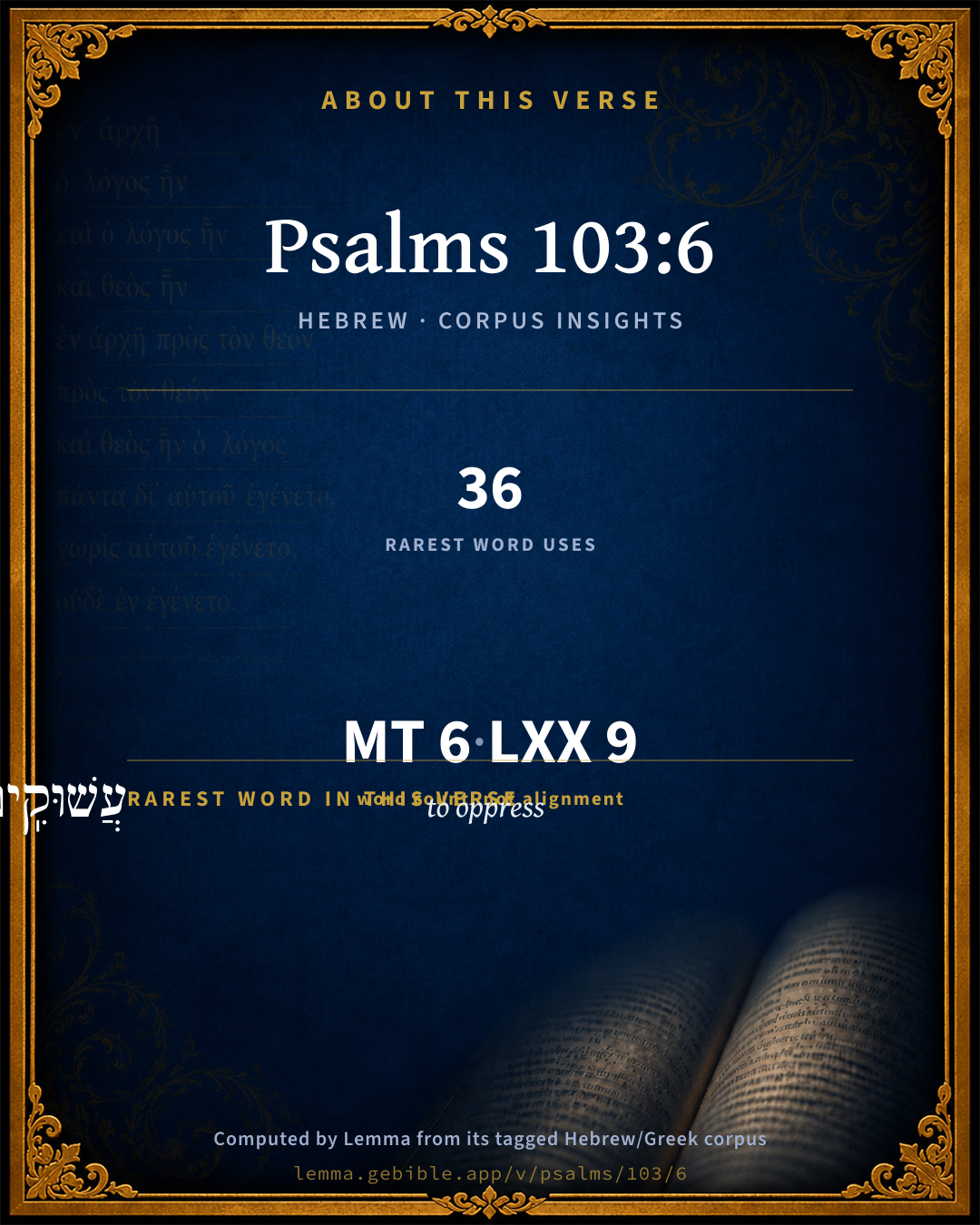
Psalms 103:6

Hebrew (Westminster Leningrad Codex) Psalms 103:6 appears in the Hebrew Old Testament. The text above is from the Westminster Leningrad Codex. Each word links to its Strong’s number, a concise gloss, and parsing drawn from the Open Scriptures Hebrew Bible morphology. Click any word for its full Brown-Driver-Briggs (BDB) entry.
Download image
Cite this verse

Psalms 103:6 (World English Bible). Public Domain. Lemma interlinear Bible study tool, https://lemma.gebible.app/v/psalms/103/6.

Show BibTeX & RIS
BibTeX
RIS
English Translation
Yahweh executes righteous acts, And justice for all who are oppressed.
World English Bible · Public Domain
Download a study sheet

One document with this verse’s original text, its word-by-word gloss line, the meaning frame, cross-references with their text, attributed commentary, and full source and license credits — printable, and it pastes into notes with its structure intact.

This verse Autodidact and up

Study sheet (.html) Plain text (.txt)

A passage Seminary Student

Up to 50 verses in one chapter. A passage sheet keeps up to 6 commentary sources and 12 cross-references per verse, in the order this page ranks them, and says so on the sheet whenever that leaves anything out. Ask for a single verse and you get the Autodidact verse sheet above.

Everything on this page stays free to read, with no account — the sheet is a download of what is already on screen, not access to it.

Want to remove ads? Support Godless Engineer
Compare translations 3

The same verse in 3 English versions, stacked beneath the original-language interlinear above. Click any original word for its lexicon entry.

Each is an independent rendering of the whole verse — the interlinear is not word-aligned to these translations.

Highlighted words mark where these versions differ — a whole-verse word diff, not a word-by-word alignment.

  • World English Bible Public Domain
    Yahweh executes righteous acts, And justice for all who are oppressed.
  • King James Version Public Domain
    The LORD executeth righteousness and judgment for all that are oppressed.
  • unfoldingWord Literal Text CC BY-SA 4.0
    Yahweh, doing righteousness and justice for all those being oppressed.

unfoldingWord Literal Text — © unfoldingWord, licensed CC BY-SA 4.0. Word-aligned USFM3 via Door43 (git.door43.org/unfoldingWord/en_ult).

Versions to compare (up to 4)

3 of 4 selected

Show all 18 translations

Every available English version of this verse, each an independent rendering of the whole verse.

  • World English Bible Public Domain
    Yahweh executes righteous acts, And justice for all who are oppressed.
  • Berean Standard Bible Public Domain
    The LORD executes righteousness and justice for all the oppressed.
  • Majority Standard Bible Public Domain
    The LORD executes righteousness and justice for all the oppressed.
  • King James Version Public Domain
    The LORD executeth righteousness and judgment for all that are oppressed.
  • American Standard Version (1901) Public Domain
    Jehovah executeth righteous acts, And judgments for all that are oppressed.
  • Revised Version (1885) Public Domain
    The LORD executeth righteous acts, and judgments for all that are oppressed.
  • Geneva Bible (1599) Public Domain
    The Lord executeth righteousnes and iudgement to all that are oppressed.
  • Douay-Rheims (1899) Public Domain
    The Lord doth mercies, and judgment for all that suffer wrong.
  • Young's Literal Translation Public Domain
    Jehovah is doing righteousness and judgments For all the oppressed.
  • Literal Standard Version CC BY-SA 4.0
    YHWH is doing righteousness and judgments || For all the oppressed.
  • Unlocked Literal Bible CC BY-SA 4.0
    Yahweh does what is fair and does acts of justice for all who are oppressed.
  • unfoldingWord Literal Text CC BY-SA 4.0
    Yahweh, doing righteousness and justice for all those being oppressed.
  • Darby Bible Public Domain
    Jehovah executeth righteousness and justice for all that are oppressed.
  • World Messianic Bible Public Domain
    The LORD executes righteous acts, and justice for all who are oppressed.
  • Webster's Bible Public Domain
    The LORD executeth righteousness and judgment for all that are oppressed.
  • Free Bible Version CC BY-SA 4.0
    The Lord does what is right, and vindicates those who are exploited.
  • Bible in Basic English Public Domain
    The Lord gives decisions in righteousness for all who are in trouble.
  • JPS Tanakh (1917) Public Domain
    The LORD executeth righteousness, and acts of justice for all that are oppressed.

Literal Standard Version (2020), Covenant Press — licensed CC BY-SA 4.0. Text via the HelloAO Bible API (eBible.org). Unlocked Literal Bible (unfoldingWord) — licensed CC BY-SA 4.0. Text via the HelloAO Bible API (eBible.org). unfoldingWord Literal Text — © unfoldingWord, licensed CC BY-SA 4.0. Word-aligned USFM3 via Door43 (git.door43.org/unfoldingWord/en_ult). Free Bible Version, Dr. Jonathan Gallagher — licensed CC BY-SA 4.0. Text via the HelloAO Bible API (eBible.org).

Word by word

More ways to search: Search by grammar → Find every occurrence → Compare this word →

Practice this passage: Drill this verse → Learn its vocabulary →

About this verse

These counts appear in no published source. They are computed here, from the morphology-tagged text and Lemma’s own curated glosses. What Lemma adds →

6
words
6
distinct lemmas
Wisdom
section

Shared distinctive vocabulary

עֲשׁוּקִֽים to oppress H6231 occurs in 35 verses of the Hebrew Bible. Also found in:

Grammatical profile

  • 2 verbs
  • 4 nouns

Verb forms

  • עֹשֵׂ֣ה Qal · Participle Active
  • עֲשׁוּקִֽים Qal · Participle Passive

Hebrew & Septuagint length

In English translation the verse runs 11 words from the Hebrew and 11 from the Septuagint (LXX English) — the same length.

A rough comparison of the two English renderings, which tokenize alike — not a word-level alignment.

Word counts can differ between the Hebrew and the Greek without any difference in meaning — e.g. the Hebrew direct-object marker אֵת has no separate Greek word, and Greek often adds the article ὁ.

In the original languages it is 6 Hebrew tokens and 9 Greek tokens — but the two are counted differently (Hebrew bundles its prefixes and suffixes into one token; the Greek is in lemma form), so that isn’t a like-for-like length.

Cross-references

20

Topical passages linked to Psalms 103:6 in the Treasury of Scripture Knowledge — connected by theme and wording, ordered by reader-vote popularity; previews shown in the World English Bible.

  • Psalms 12:5 "Because of the oppression of the weak and because of the groaning of the needy, I will now arise," says Yahweh; "I will set him in safety from those who malign him."
  • Psalms 9:9 Yahweh will also be a high tower for the oppressed; A high tower in times of trouble.
  • Psalms 146:7 Who executes justice for the oppressed; Who gives food to the hungry. Yahweh frees the prisoners.
  • Psalms 72:12 For he will deliver the needy when he cries; The poor, who has no helper.
  • Proverbs 14:31 He who oppresses the poor shows contempt for his Maker, But he who is kind to the needy honors him.
  • Deuteronomy 24:14–15 You shall not oppress a hired servant who is poor and needy, whether he be of your brothers, or of your foreigners who are in your land within your gates:
  • Psalms 109:31 For he will stand at the right hand of the needy, To save him from those who judge his soul.
  • Proverbs 22:22–23 Don't exploit the poor, because he is poor; And don't crush the needy in court;
  • Micah 2:1–3 Woe to those who devise iniquity And work evil on their beds! When the morning is light, they practice it, Because it is in the power of their hand.
  • James 2:6 But you have dishonored the poor man. Don't the rich oppress you, and personally drag you before the courts?
  • Micah 3:2–4 You who hate the good, And love the evil; Who tear off their skin, And their flesh from off their bones;
  • James 5:1–6 Come now, you rich, weep and howl for your miseries that are coming on you.
  • Job 27:13–23 "This is the portion of a wicked man with God, The heritage of oppressors, which they receive from the Almighty.
  • Psalms 10:14–18 But you do see trouble and grief; You consider it to take it into your hand. You help the victim and the fatherless.
  • Psalms 72:4 He will judge the poor of the people. He will save the children of the needy, And will break the oppressor in pieces.
  • Jeremiah 7:6–15 if you don't oppress the foreigner, the fatherless, and the widow, and don't shed innocent blood in this place, neither walk after other gods to your own hurt:
  • Ezekiel 22:7 In you have they set light by father and mother; in the midst of you have they dealt by oppression with the foreigner; in you have they wronged the fatherless and the widow.
  • Ezekiel 22:12–14 In you have they taken bribes to shed blood; you have taken interest and increase, and you have greedily gained of your neighbors by oppression, and have forgotten me, says the Lord Yahweh.
  • Isaiah 14:4–32 that you shall take up this parable against the king of Babylon, and say, How has the oppressor ceased! the golden city ceased!
  • Isaiah 58:6–7 Isn't this the fast that I have chosen: to loose the bonds of wickedness, to undo the bands of the yoke, and to let the oppressed go free, and that you break every yoke?

Cross-references courtesy of OpenBible.info (CC BY 4.0).

Hebrew and Greek witnesses Masoretic Hebrew ↔ Greek Septuagint

The same verse in the two great witnesses to the Old Testament, shown verse-for-verse.

You’re reading Greek Psalm 102 (Hebrew Psalm 103). The Septuagint counts the superscription, so verse numbers can differ from the Hebrew — chapter-level alignment, not verse-by-verse. Numbering follows Rahlfs.

These are two independent witnesses, not word-aligned to each other, and the Septuagint is shown in lemma (dictionary) form.

Hebrew Psalms 103:6 Masoretic · Westminster Leningrad Codex

עֹשֵׂ֣ה צְדָק֣וֹת יְהוָ֑ה וּ֝מִשְׁפָּטִ֗ים לְכָל עֲשׁוּקִֽים

Yahweh executes righteous acts, And justice for all who are oppressed.

World English Bible · Public Domain

Greek LXX Greek Psalm 102:6 Septuagint · lemma form

ποιέω ἐλεημοσύνη ὁ κύριος καί κρίμα πᾶς ὁ ἀδικέω

The Lord executes mercy and judgment for all that are injured.

LXX2012 (modern English Septuagint) · Public Domain

Hebrew: Westminster Leningrad Codex (CC BY 4.0). Greek: Septuagint (public domain); English from LXX2012 (modern English Septuagint) (Public Domain). How the Septuagint differs from the Hebrew →

Commentary

Notes on Psalms 103:6 from classic Christian and Jewish commentators (each source and its license shown beneath its notes). The classic Christian expositions comment on the surrounding passage and are grouped to its opening verse, so a note may address several verses; the Jewish commentaries on the Tanakh (Rashi and others) are per-verse, so they appear only where the commentator wrote on this verse.

Lemma curates 59 commentaries, every one of them public domain or Creative Commons licensed, each selected and text-cleaned for this edition rather than reprinted as found. About our sources →

Matthew Henry's Commentary

Hitherto the psalmist had only looked back upon his own experiences and thence fetched matter for praise; here he looks abroad and takes notice of his favour to others also; for in them we should rejoice and give thanks for them, all the saints being fed at a common table and sharing in the same blessings.

I. Truly God is good to all (Psa 103:6): He executes righteousness and judgment, not only for his own people, but for all that are oppressed; for even in common providence he is the patron of wronged innocency, and, one way or other, will plead the cause of those that are injured against their oppressors. It is his honour to humble the proud and help the helpless.

II. He is in a special manner good to Israel, to every Israelite indeed, that is of a clean and upright heart.

1. He has revealed himself and his grace to us (Psa 103:7): He made known his ways unto Moses, and by him his acts to the children of Israel, not only by his rod to those who then lived, but by his pen to succeeding ages. Note, Divine revelation is one of the first and greatest of divine favours with which the church is blessed; for God restores us to himself by revealing himself to us, and gives us all good by giving us knowledge. He has made known his acts and his ways (that is, his nature, and the methods of his dealing with the children of men), that they may know both what to conceive of him and what to expect from him; so Dr. Hammond. Or by his ways we may understand his precepts, the way which he requires us to walk in; and by his acts, or designs (as the word signifies), his promises and purposes as to what he will do with us. Thus fairly does God deal with us.

2. He has never been rigorous and severe with us, but always tender, full of compassion, and ready to forgive.

(1.) It is in his nature to be so (Psa 103:8): The Lord is merciful and gracious; this was his way which he made known unto Moses at Mount Horeb, when he thus proclaimed his name (Exo 34:6, Exo 34:7), in answer to Moses's request (Psa 33:13), I beseech thee, show me thy way, that I may know thee. It is my way, says God, to pardon sin. [1.] He is not soon angry, Psa 103:8. He is slow to anger, not extreme to mark what we do amiss nor ready to take advantage against us. He bears long with those that are very provoking, defers punishing, that he may give space to repent, and does not speedily execute the sentence of his law; and he could not be thus slow to anger if he were not plenteous in mercy, the very Father of mercies. [2.] He is not long angry; for (Psa 103:9) he will not always chide, though we always offend and deserve chiding. Though he signify his displeasure against us for our sins by the rebukes of Providence, and the reproaches of our own consciences, and thus cause grief, yet he will have compassion, and will not always keep us in pain and terror, no, not for our sins, but, after the spirit of bondage, will give the spirit of adoption. How unlike are those to God who always chide, who take every occasion to chide, and never know when to cease! What would become of us if God should deal so with us? He will not keep his anger for ever against his own people, but will gather them with everlasting mercies, Isa 54:8; Isa 57:16.

(2.) We have found him so; we, for our parts, must own that he has not dealt with us after our sins, Psa 103:10. The scripture says a great deal of the mercy of God, and we may all set to our seal that it is true, that we have experienced it. If he had not been a God of patience, we should have been in hell long ago; but he has not rewarded us after our iniquities; so those will say who know what sin deserves. He has not inflicted the judgments which we have merited, nor deprived us of the comforts which we have forfeited, which should make us think the worse, and not the better, of sin; for God's patience should lead us to repentance, Rom 2:4.

3. He has pardoned our sins, not only my iniquity (Psa 103:3), but our transgressions, Psa 103:12. Though it is of our own benefit, by the pardoning mercy of God, that we are to take the comfort, yet of the benefit others have by it we must give him the glory. Observe, (1.) The transcendent riches of God's mercy (Psa 103:11): As the heaven is high above the earth (so high that the earth is but a point to the vast expanse), so God's mercy is above the merits of those that fear him most, so much above and beyond them that there is no proportion at all between them; the greatest performances of man's duty cannot demand the least tokens of God's favour as a debt, and therefore all the seed of Jacob will join with him in owning themselves less than the least of all God's mercies, Gen 32:10. Observe, God's mercy is thus great towards those that fear him, not towards those that trifle with him. We must fear the Lord and his goodness. (2.) The fulness of his pardons, an evidence of the riches of his mercy (Psa 103:12): As far as the east is from the west (which two quarters of the world are of greatest extent, because all known and inhabited, and therefore geographers that way reckon their longitudes) so far has he removed our transgressions from us, so that they shall never be laid to our charge, nor rise up in judgment against us. The sins of believers shall be remembered no more, shall not be mentioned unto them; they shall be sought for, and not found. If we thoroughly forsake them, God will thoroughly forgive them.

4. He has pitied our sorrows, Psa 103:13, Psa 103:14. Observe, (1.) Whom he pities - those that fear him, that is, all good people, who in this world may become objects of pity on account of the grievances to which they are not only born, but born again. Or it may be understood of those who have not yet received the spirit of adoption, but are yet trembling at his word; those he pities, Jer 31:18, Jer 31:20. (2.) How he pities - as a father pities his children, and does them good as there is occasion. God is a Father to those that fear him and owns them for his children, and he is tender of them as a father. The father pities his children that are weak in knowledge and instructs them, pities them when they are froward and bears with them, pities them when they are sick and comforts them (Isa 66:13), pities them when they have fallen and helps them up again, pities them when they have offended, and, upon their submission, forgives them, pities them when they are wronged and gives them redress; thus the Lord pities those that fear him. (3.) Why he pities - for he knows our frame. He has reason to know our frame, for he framed us; and, having himself made man of the dust, he remembers that he is dust, not only by constitution, but by sentence. Dust thou art. He considers the frailty of our bodies and the folly of our souls, how little we can do, and expects accordingly from us, how little we can bear, and lays accordingly upon us, in all which appears the tenderness of his compassion.

5. He has perpetuated his covenant-mercy and thereby provided relief for our frailty, Psa 103:15-18. See here, (1.) How short man's life is and of what uncertain continuance. The lives even of great men and good men are so, and neither their greatness nor their goodness can alter the property of them: As for man, his days are as grass, which grows out of the earth, rises but a little way above it, and soon withers and returns to it again. See Isa 40:6, Isa 40:7. Man, in his best estate, seems somewhat more than grass; he flourishes and looks gay; yet then he is but like a flower of the field, which, though distinguished a little from the grass, will wither with it. The flower of the garden is commonly more choice and valuable, and, though in its own nature withering, will last the longer for its being sheltered by the garden wall and the gardener's care; but the flower of the field (to which life is here compared) is not only withering in itself, but exposed to the cold blasts, and liable to be cropped and trodden on by the beasts of the field. Man's life is not only wasting of itself, but its period may be anticipated by a thousand accidents. When the flower is in its perfection a blasting wind, unseen, unlooked for, passes over it, and it is gone; it hangs the head, drops the leaves, dwindles into the ground again, and the place thereof, which was proud of it, now knows it no more. Such a thing is man: God considers this, and pities him; let him consider it himself, and be humble, dead to this world and thoughtful of another. (2.) How long and lasting God's mercy is to his people (Psa 103:17, Psa 103:18): it will continue longer than their lives, and will survive their present state. Observe, [1.] The description of those to whom this mercy belongs. They are such as fear God, such as are truly religious, from principle. First, They live a life of faith; for they keep God's covenant; having taken hold of it, they keep hold of it, fast hold, and will not let it go. They keep it as a treasure, keep it as their portion, and would not for all the world part with it, for it is their life. Secondly, They live a life of obedience; they remember his commandments to do them, else they do not keep his covenant. Those only shall have the benefit of God's promises that make conscience of his precepts. See who those are that have a good memory, as well as a good understanding (Psa 111:10), those that remember God's commandments, not to talk of them, but to do them, and to be ruled by them. [2.] The continuance of the mercy which belongs to such as these; it will last them longer than their lives on earth, and therefore they need not be troubled though their lives be short, since death itself will be no abridgment, no infringement, of their bliss. God's mercy is better than life, for it will out-live it. First, To their souls, which are immortal; to them the mercy of the Lord is from everlasting to everlasting; from everlasting in the councils of it to everlasting in the consequences of it, in their election before the world was and their glorification when this world shall be no more; for they are predestinated to the inheritance (Eph 1:11) and look for the mercy of the Lord, the Lord Jesus, unto eternal life. Secondly, To their seed, which shall be kept up to the end of time (Psa 102:28): His righteousness, the truth of his promise, shall be unto children's children; provided they tread in the steps of their predecessors' piety, and keep his covenant, as they did, then shall mercy be preserved to them, even to a thousand generations.

Matthew Henry's Commentary on the Whole Bible (1708–1710) — public domain (CC PDM 1.0). Text via the HelloAO Bible API.

Trapp's Complete Commentary

John Trapp

Psa 103:6 The LORD executeth righteousness and judgment for all that are oppressed.

Ver. 6. The Lord executeth, &c.] The words are both plural, to show that God will execute omnimodam iustitiamet iudicium, all and all manner of justice and judgment, relieving the oppressed, and punishing the oppressor to the full.

John Trapp, A Commentary or Exposition upon All the Books of the Old and New Testament (1647–1656) — public domain. Text from a community e-Sword module.

The Biblical Illustrator

Joseph S. Exell

Psa_103:6-14

The Lord executeth righteousness and judgment for all that are oppressed.

Gods conduct towards mankind

In the preceding verses the hymnist exhorts himself to praise the Great God on account of the benefits conferred on himself. Here he strikes off into general reasons why he and all men should bless His holy name.

I. Gods conduct in relation to the socially oppressed. He executeth righteousness and judgment for all that are oppressed (Job_36:5-6; Isa_10:1-2; Pro_22:22-23; Psa_111:12; Amo_8:4-6; Deu_24:14-15; Mat_19:27; Jam_5:1-5).

1. To some extent in this life this is seen in the strength that is given the oppressed to bear up under all their trials, and in the unhappiness and the ruin that God brings upon their oppressors. Pharaoh, Nebuchadnezzar, Herod, Napoleon.

2. He does so fully in the life to come.

II. Gods conduct in relation to the methods of revealing Himself to mankind (verse 7). There is a great difference between the ways and the acts of any intelligent agent; as different as cause and effect. All men have their particular ways of doing a thing. God has His way, His method of action.

1. It is more difficult to know the ways of God than to know the acts of God. A child may understand many of the actions of a philosophic father, but not his ways or methods of action. Israel understood many of the acts of God; but Moses only rose to a knowledge of His ways, His principles, and manner of actions.

2. It is more important to know the ways of God than the acts of God.

(1) As a man knows His ways, he may forecast the future. Such and such events will occur in the future because it is in the order of the Divine procedure.

(2) As a man knows His ways he may acquiesce in His dispensations.

(3) As a man knows His ways he becomes exalted in thought and sympathy.

III. Gods conduct in relation to sinners in general (Psa_103:8-10).

1. His mercy is longsuffering. Slow to anger.

2. His mercy is abundant. Plenteous in mercy.

3. His mercy overcomes His resentment.

4. His mercy restrains punishment (verse 10).

IV. Gods conduct in relation to the genuinely pious (verses 11-14).

1. Immeasurable grace (verse 11).

2. Sin-removing grace (verse 12).

3. Fatherly considerateness (verses 13, 14). Our physical, intellectual, and moral constitutions are thoroughly understood by Him. If He thus knows us, we may infer two things--

(1) That He will not lay on us more trials than we are capable of enduring.

(2) That He will not demand of us more service than we are capable of rendering. (Homilist.)

Christianity and the penal code

A young exile in Siberia told me that during the first part of his imprisonment the only literature given him were the Bible and the Penal Code. The intention, doubtless, was to incite to virtue on the one hand, and to warn against crime on the other. But the effect produced was to lead only to a comparison between the laws of Russia and the laws of Christ, and not to the benefit of the former. (George Kenman.)

The Biblical Illustrator, edited by Joseph S. Exell (c. 1880s–1900s) — public domain. Text from a community e-Sword module.

Joseph Benson's Commentary

Psa 103:6-7. The Lord executeth judgment for all that are oppressed — Which, being a singular perfection, and one wherein most of the princes of the world were and are defective, is justly celebrated in God. He made known his ways unto Moses — His laws, often called his ways; or, the methods of his dealing with men, and especially with his people; his merciful and gracious nature and providence, which is particularly called God’s way, Exo 33:13, compared with Psa 103:18-19, and chap. Psa 34:6-7, and which is here described in the following verses. His acts, &c. — His marvellous and gracious works.

Joseph Benson's Commentary on the Old and New Testaments (1811–1818) — public domain. Text from a community e-Sword module.

Keil & Delitzsch

C. F. Keil & F. Delitzsch

His range of vision being widened from himself, the poet now in Psa 103:6 describes God's gracious and fatherly conduct towards sinful and perishing men, and that as it shines forth from the history of Israel and is known and recognised in the light of revelation. What Psa 103:6 says is a common-place drawn from the history of Israel. משׁפּטים is an accusative governed by the עשׂה that is to be borrowed out of עשׂה (so Baer after the Masora). And because Psa 103:6 is the result of an historical retrospect and survey, יודיע in Psa 103:7 can affirm that which happened in the past (cf. Psa 96:6.); for the supposition of Hengstenberg and Hitzig, that Moses here represents Israel like Jacob, Isaac, and Joseph in other instances, is without example in the whole Israelitish literature. It becomes clear from Psa 103:8 in what sense the making of His ways known is meant. The poet has in his mind Moses' prayer: "make known to me now Thy way" (Exo 33:13), which Jahve fulfilled by passing by him as he stood in the cleft of the rock and making Himself visible to him as he looked after Him, amidst the proclamation of His attributes. The ways of Jahve are therefore in this passage not those in which men are to walk in accordance with His precepts (Psa 25:4), but those which He Himself follows in the course of His redemptive history (Psa 67:3). The confession drawn from Exo 34:6. is become a formula of the Israelitish faith (Psa 86:15; Psa 145:8; Joe 2:13; Neh 9:17, and frequently). In Psa 103:9. the fourth attribute (ורב־חסד) is made the object of further praise. He is not only long (ארך from ארך, like כּבד from כּבד) in anger, i.e., waiting a long time before He lets His anger loose, but when He contends, i.e., interposes judicially, this too is not carried to the full extent (Psa 78:38), He is not angry for ever (נטר, to keep, viz., anger, Amo 1:11; cf. the parallels, both as to matter and words, Jer 3:5; Isa 57:16). The procedure of His righteousness is regulated not according to our sins, but according to His purpose of mercy. The prefects in Psa 103:10 state that which God has constantly not done, and the futures in Psa 103:9 what He continually will not do.

Keil & Delitzsch — Biblical Commentary on the Old Testament (1861–1891) — public domain (CC PDM 1.0). Text via the HelloAO Bible API. (Old Testament only.)

J. A. Alexander on Psalms

Joseph Addison Alexander

6. (Psa 103:6) Doing righteousnesses (is) Jehovah, and judgments for all oppressed. Thus far the reasons urged for praising God were personal, i.e. derived from individual experience. With these, from the very constitution of our nature, all our grateful exercises must begin. But if genuine they do not stop there, as the Psalmist, at this point, ascends from private causes of thanksgiving to more general views of God's administration, as a basis for the universal call with which the psalm concludes. The connection here may thus be stated: "Such have been the Lord's compassions to myself, but these are only samples of his goodness. He is not only merciful to me, but to all who are oppressed, and to deliver whom he executes his judgments." There is no contrast here intended between mercy and justice, with respect to different objects of the Lord's compassion. The meaning is, that man's injustice is redressed by God's mercy. The redemption of his people is often represented as coincident with the condign punishment of their oppressors. Doing, i.e. practising in general, and executing in particular cases. The participle (doing) signifies habitual and constant action; the plural form (righteousnesses) completeness and variety, adapted to all possible emergencies. Judgments, as usual, denotes judicial acts, as distinguished from mere attributes or principles.

Joseph Addison Alexander, The Psalms Translated and Explained (1850) — public domain. Text from a community e-Sword module.

Adam Clarke's Commentary

Verse 6. The Lord executeth] This shall be done because the Lord will avenge his elect who have cried unto him day and night for his deliverance: "He is slow to anger;" but he will punish. "He is plenteous in mercy," and he will save. The persevering sinner shall be destroyed; the humble penitent shall be saved.

Adam Clarke's Commentary on the Bible (1810–1826) — public domain. Text from a community e-Sword/MySword module.

John Calvin's Commentaries

6. Jehovah executeth righteousness David having recounted the Divine benefits bestowed upon himself, now passes from this personal consideration to take a wider view of the subject. There is, however, no doubt that when he declares God to be the succorer of the oppressed, he includes himself among the number, for he had enjoyed the Divine help under many persecutions; and, from his own experience, he describes the character in which God is accustomed to manifest himself towards all who are unrighteously afflicted. As the faithful, while in this world, are always living among wolves, by using the plural number, he celebrates a variety of deliverances, to teach us that it is God’s ordinary work to succor his servants whenever he sees them injuriously treated. Hence we are taught to exercise patience when we find that God takes it upon him to avenge our wrongs, and that he covers us with the shield of his justice, or defends us with the sword of his judgment, as often as we are assaulted wrongfully.

John Calvin's Commentaries (1540-1563) — public domain. Text from the Calvin Translation Society English edition (1840s-50s) via the Christian Classics Ethereal Library (ccel.org). Calvin's coverage is partial (roughly two-thirds of the Bible); uncommented books and verses are honest gaps, never fabricated. The 19th-century editor's footnotes and remarks are omitted so the notes are faithfully Calvin's own voice.

Ellicott's Commentary for English Readers

(6) Oppressed.—From individual the poet passes to national mercies, and goes back to the memorable manifestations of Divine favour vouchsafed to Moses.

A Bible Commentary for English Readers, edited by Charles John Ellicott (1878–1897) — public domain. Text from a community e-Sword module.

The Cambridge Bible for Schools and Colleges

gen. ed. J. J. S. Perowne

6. Jehovah executeth righteous acts,

And judgements for all that are oppressed.

Cp. Psa_146:7; Jdg_5:11. This general truth has been verified afresh in the deliverance from Babylon.

6–10. Jehovah’s gracious dealings with men illustrated from the experience of Israel.

The Cambridge Bible for Schools and Colleges (gen. ed. J. J. S. Perowne; Cambridge University Press, 1878–1918) — public domain. Text from a community e-Sword module.

John Gill's Exposition

The Lord executeth righteousness and judgment for all that are oppressed. Not only for the Israelites oppressed by the Egyptians, though the psalmist might have them in his view, by what follows; for whom the Lord did justice, by delivering them out of the hands of their oppressors, and by punishing Pharaoh and his people, and bringing down judgments upon them, both in Egypt and at the Red sea; but for all other oppressed ones in common, the poor, the widow, and the fatherless, who are often oppressed by the rich and mighty; the Lord judges their cause, and does them right, and frees them from their oppression; and so all good men who are oppressed by tyrannical princes and cruel persecutors, and all such whom the man of the earth, the man of sin, antichrist, oppresses, Psa 10:18 and all those who are oppressed by the devil, buffeted by Satan, and bore down with his temptations; the Lord rebukes him in his own time, and delivers his people out of his hands; which is matter of praise and thankfulness: the psalmist, in this verse and the following, passes to the consideration of the good things God did for others, in order to keep up a warm sense of divine goodness upon his heart.

and all those who are oppressed by the devil, buffeted by Satan, and bore down with his temptations; the Lord rebukes him in his own time, and delivers his people out of his hands; which is matter of praise and thankfulness: the psalmist, in this verse and the following, passes to the consideration of the good things God did for others, in order to keep up a warm sense of divine goodness upon his heart.

Psalms 103:7

psa 103:7

psa 103:7

psa 103:7He made known his ways unto Moses,.... The ways in which he himself walks, the steps and methods which he has taken to show forth his glory; his way in creation, and the order of it, as in Gen 1:1, for though, by the light of nature, it might be known that God created all things; yet, without a revelation from him, it could never have been known in what manner he made them, and the peculiar work of each of the six days, in which they were made; this was made known to Moses; as also his way in providence, which sometimes is in the deep, and past finding out: Moses was made acquainted with the methods of divine Providence, with many special instances of it, relating both to himself in his infancy and in riper years, and to the people of Israel in their march from Egypt to Canaan's land; and the Lord likewise made known unto him his way of grace and mercy, life and salvation, by Christ, which he desired to show him, and he did, Exo 33:13. Christ was made known to him, as the seed of the woman that should break the serpent's head, as God's salvation, old Jacob waited for: he was shown him in the types of the passover lamb, the brasen serpent, and the rock in the wilderness, and in other things; the way of atonement, by the sacrifice of Christ, was made known to him through the sacrifices which he from God enjoined the people of Israel: hence he wrote of Christ, and of what he should do and suffer; and so fully, that the Apostle Paul said no other things than what he did, Joh 5:46 moreover, the Lord made known to him the ways in which he would have him and the people of Israel to walk; the way of his commandments, his statutes and ordinances; which were made known to him, to deliver to them, and was a peculiar favour, Psa 147:19,

his acts unto the children of Israel; his works, his wonderful works; his plagues on their enemies the Egyptians; his redemption of them out of the house of bondage; his leading them through the Red sea as on dry land; his feeding them with manna in the wilderness, protecting them from their enemies, bringing them into the land of Canaan, and settling them there; see Psa 78:11.

John Gill's Exposition of the Whole Bible (1746–1763) — public domain (CC PDM 1.0). Text via the HelloAO Bible API.

Albert Barnes' Notes on the Bible

The Lord executeth righteousness and judgment - That is, “justice.” He sees that justice is done to the oppressed. He is on their side. His law, his commands, his judicial decisions, his providential interpositions, are in their favor. This does not mean that it will he done at once; or that there will never be any delay; or that they may not suffer even for a long time - for this occurs in fact; but the meaning is, that God has their true interest at heart; that at proper times, and whenever and whereever there are any dealings of his in the case, his acts are in favor of those that are oppressed; and that there will be sooner or later such interpositions in their behalf as shall entirely vindicate their cause.

For all that are oppressed - By harsh laws; by unjust governments; by slavery; by unrighteous decisions in courts; by the pride and power of wicked people. Compare the notes at Isa 1:17, notes at Isa 1:23-27.

Albert Barnes' Notes on the Bible (1834–1885) — public domain. Text from a community e-Sword/MySword module.

Matthew Poole's English Annotations

Which being a singular perfection, and that wherein most of the princes of the world were and are defective, is justly celebrated in God.

Matthew Poole's English Annotations on the Holy Bible (1683–1685) — public domain. Text from a community e-Sword/MySword module.

The Treasury of David

Charles H. Spurgeon

Ver. 6. The LORD executeth righteousness and judgment for all that are of oppressed. Our own personal obligations must not absorb our song; we must also magnify the Lord for his goodness to others. He does not leave the poor and needy to perish at the hands of their enemies, but interposes on their behalf, for he is the executor of the poor and the executioner of the cruel. When his people were in Egypt he heard their groanings and brought them forth, but he overthrew Pharaoh in the Red Sea. Man's injustice shall receive retribution at the hand of God. Mercy to his saints demands vengeance on their persecutors, and he will repay it. No blood of martyrs shall be shed in vain; no groans of confessors in prison shall be left without inquisition being made concerning them. All wrongs shall be righted, all the oppressed shall be avenged. Justice may at times leave the courts of man, but it abides upon the tribunal of God. For this every right-minded person will bless God. Were he careless of his creature's good, did he neglect the administration of justice, did he suffer high-handed oppressors finally to escape, we should have greater reason for trembling than rejoicing; it is not so, however, for our God is a God of justice, and by him actions are weighed; he will mete out his portion to the proud and make the tyrant bite the dust, yea, often he visits the haughty persecutor even in this life, so that "the Lord is known by the judgments which he executeth."

Ver. 6. The LORD executeth rghteousness, &c. Rising from personal blessings to general, the comprehensive fact, evermore to the glory of God, is his sympathy with the suffering and oppressed, and his ready and effective interposition in their ease. Who will not praise him that he careth so kindly and so gloriously for those who suffer cruel wrongs from wicked oppressors? Henry Cowles.

Psalms 103:7*

Charles H. Spurgeon's The Treasury of David (1869–1885) — public domain. Psalms only. Text from a community e-Sword/MySword module.

Whedon's Commentary on the Bible

Daniel D. Whedon

6. Righteousness and judgment—See note on Psa_72:1.

For all— For God is no respecter of persons.

Daniel D. Whedon (gen. ed.), Commentary on the Old and New Testaments (1874–1909) — public domain. Text from a community e-Sword module.

The Pulpit Commentary

The Lord executeth righteousness and judgment; literally, righteousnesses and judgments; i.e. "acts of righteousness and acts of judgment." For all that are oppressed. The care of God for the "oppressed" is a marked feature of Holy Scripture. (see Exo_2:23-25 Exo_3:9 Jud_1:2:18 6:9 Job_35:9-14 Psa_9:9 Psa_10:18 Psa_79:2 Psa_146:7 Isa_1:17, etc.)

Vers. 6-18. The confidence of God"s children.

These strong, sustaining words call us to consider

I TO WHOM THE DIVINE ASSURANCES ARE GIVEN. It is clear that they are given to the servants of God. The thought runs through the whole passage (see vers. 11, 13, 18). Where this is not explicitly stated, it is to be understood (see particularly ver. 12). Those may not claim the fulfilment of promises to whom they were not made. First enter the service of Christ, and then look up for all the blessings assured to those who believe in him.

II THESE DIVINE ASSURANCES THEMSELVES.

1. The overthrow of evil, and the consequent deliverance of the good (ver. 6). God "executes righteousness and judgment" in two ways sometimes by a Divine intervention, when he overturns the designs of the wicked, and at the same time redeems his people (e.g. the Jews from Pharaoh and from Haman and from Sanballat); more often by the constant outworking of those righteous laws which are always acting on behalf of rectitude against iniquity. (see Psa_34:15, Psa_34:16)

2. Divine patience. (Ver. 2) God is "slow to anger." It was said of a noble modern ruler that, under great provocation, he was "slow to smite, and swift to spare." Of how many might the opposite be said? Our God is "slow to anger." His displeasure is awakened, his condemnation uttered, only when it would be unrighteousness to remain unmoved and silent.

3. Divine mercy. (Vers. 10-12) Instead of inflicting pain, poverty, misery, death the wages of sin God has spared to us our life and our health; multiplied to us our comforts and our joys; offered to us, in Jesus Christ, a full restoration to his Divine favour; planted within our hearts the seeds of piety and holiness; made us heirs of eternal life. The mercy of God, in Christ Jesus, has such immeasurable heights and breadths (vers. 11, 12).

4. Divine pity. (Ver. 13) Nothing can exceed the pity of the parent for his or her child when in pain or trouble. Then the very tenderest and strongest as well as the purest emotions of the human heart are stirred. "As one whom his mother comforteth with such perfect sympathy, such exquisite tenderness does God comfort us. (Isa_66:13) God"s pity for his children is felt

(1) in their various distresses, and may be counted upon in all time of need; (see Heb_4:15, Heb_4:16)

(2) in their spiritual endeavours and struggles, when the work is hard, and the soul is weak, and the issue is uncertain. And here we have, as we may well rejoice to have, the assurance of:

5. Divine considerateness. (Ver. 14) Christian service is imperfect; our character is blemished, and our work is faulty; but it is sincere; it is rooted in faith; it is animated by love; it is purified by prayer. And he who accepted the service of his apostles in the garden, "knowing their frame" and the weakness of the flesh; (Mat_26:41) he who has owned and blessed the spiritual endeavour and the earnest labours of his people in every age and in every Church since then; will accept our service and crown our labours now, though in the one and in the other we fall far short even of our own ideal. Well, indeed, would it be if we made as generous allowance for one another as our Master makes for us all.

6. Divine continuance. (Vers. 15-17) With the brevity of all human things we contrast the continuance of the Divine. We ourselves pass away and are forgotten, but God"s mercy and his righteousness remain forever. We can always count on them. Men may be very true and very kind, but they pass to where they cannot reach and help us. Let us commit ourselves to the goodness and the faithfulness of God, for on that we may build with absolute security. This is the true confidence of the children of God. But we are reminded in one verse (7) of

III THE ONLY HOPE OF THE DISLOYAL. God revealed himself, "his ways, and his acts," to Moses, but grace and truth have come by Jesus Christ. (Joh_1:17) In the gospel God has revealed himself as the Divine Father, who waits to receive his wayward but penitent children. Those that are obdurate and impenitent may not plead his promises, may not appropriate to themselves the sustaining assurance which apply to other persons. But they may they must return in humility and in faith to the Father whom they have forsaken; and, once at home with him, they may rest in his loving favour and rejoice in his upholding Word.

The Lord of the oppressed.

The point set forth prominently is that God is actively engaged in securing the interests of the oppressed. That goes into the word used, "executeth." We might think of justice and judgment as the pillars of God"s throne, and yet conceive of him as only announcing his just decisions; leaving to others the work of carrying them out. To put it in a formal way, the legislative rights of God may be recognized, but the executive rights of God may be denied. We may fully hold both truths of fact. God does pronounce his own judgments; God does execute his own sentences. The figure for God is especially effective in Eastern countries, where justice is so often perverted, and the oppressed have no chance if they happen to be poor. Illustrate by our Lord"s parable of the unjust judge and the importunate widow. All the oppressed and poor may be absolutely sure that Jehovah will considerately hear their cases, deal with perfect uprightness in relation to their trouble, and carry out his decisions, whatever they may involve.

I THE LORD OF THE OPPRESSED HEEDS THE OPPRESSED. The poor often find it nearly impossible to get their cases brought before the magistrates, judges, or kings of earth. It is the righteousness of God that he is right towards every one; all may seek, and none ever seeks in vain. There is absolute freedom given to every man and woman under the sun to tell out the trouble to the Lord. And we may have absolute faith that no tale of human need was ever poured out before God, and disregarded by him. It is a beginning of hope, that the Lord surely heeds us.

II THE LORD OF THE OPPRESSED ACTS FOR THE OPPRESSED. God"s decisions never merely lie on a statute book, like many acts of earthly courts and parliaments. If God decides a thing, it has to be carried out; nay, he himself presides over the carrying it out. We are to have confidence in the Divine energy and activity. "Commit thy way unto the Lord, and he will bring it to pass." How, when, where, he will execute his judgments, we may not anticipate; it is enough for an oppressed soul to know that God is acting for him. "He will bring forth our righteousness as the light, and our judgment as the noon day.

III THE LORD OF THE OPPRESSED ACTS UPON THE OPPRESSORS. It is not merely that the oppressed are delivered or defended; it is that those who have injured them feel the weight of Divine indignation. Judgment is in one sense for the oppressed, and in another sense for the oppressors. R.T.

The Pulpit Commentary (1880–1919), ed. H.D.M. Spence-Jones & Joseph S. Exell — public domain. Text from a community e-Sword module.

unfoldingWord translationNotes

Door43 World Missions Community

does acts of justice for

"causes justice to happen to"

all who are oppressed

Who is doing the oppressing can be stated explicitly. AT: "all who are oppressed by men" (See: Assumed Knowledge and Implicit Information)

his deeds to the descendants of Israel

The words "he made known" are understood from the previous phrase. They may be repeated here. AT: "he made known his deeds to the descendants of Israel" (See: Ellipsis)

has great covenant loyalty

"is full of mercy and love"

translationWords

just

oppress

know

Moses

works

descend

Israel

Yahweh

mercy

grace

patient

covenant

unfoldingWord translationNotes — © Distant Shores Media and the Door43 World Missions Community, licensed CC BY-SA 4.0. Source: git.door43.org/Door43/en_tn.

Lesson kit

Teaching starters — assembled from the data on this page, not authored interpretation. Every prompt links to the verse data it draws on. Edit before teaching.

Psalms, in the Wisdom, opens this verse with 6 words (6 distinct Hebrew lemmas). Its most distinctive word is ʻâshaq (“to oppress”). A historical commentator’s framing appears above. Read the whole chapter for the surrounding context.

Discussion questions

  1. How does “to oppress” (ʻâshaq) shape what this verse is saying?
  2. Leviticus 6:2 shares the word «to oppress» with this verse. How do the two illuminate each other?
  3. The translations on this page render this verse differently — a whole-verse word diff, not a word-by-word alignment. What might account for the different wordings?
  4. The verb «עֹשֵׂ֣ה» is Qal Participle Active. How does its form color the action?
  5. Reading how Matthew Henry's Commentary and Trapp's Complete Commentary read this verse, where do the two commentators agree and where do they part?

Things to notice

Reading settings

Reading text

Shown beneath each verse's original-language words.

Old Testament
Old Testament edition

Read the OT as the Masoretic Hebrew (MT) or the Greek Septuagint (LXX).

English shown for the Greek Septuagint (in the Hebrew ↔ Greek comparison).

Comparing translations? Open the Compare panel on any verse page to stack up to four side by side.