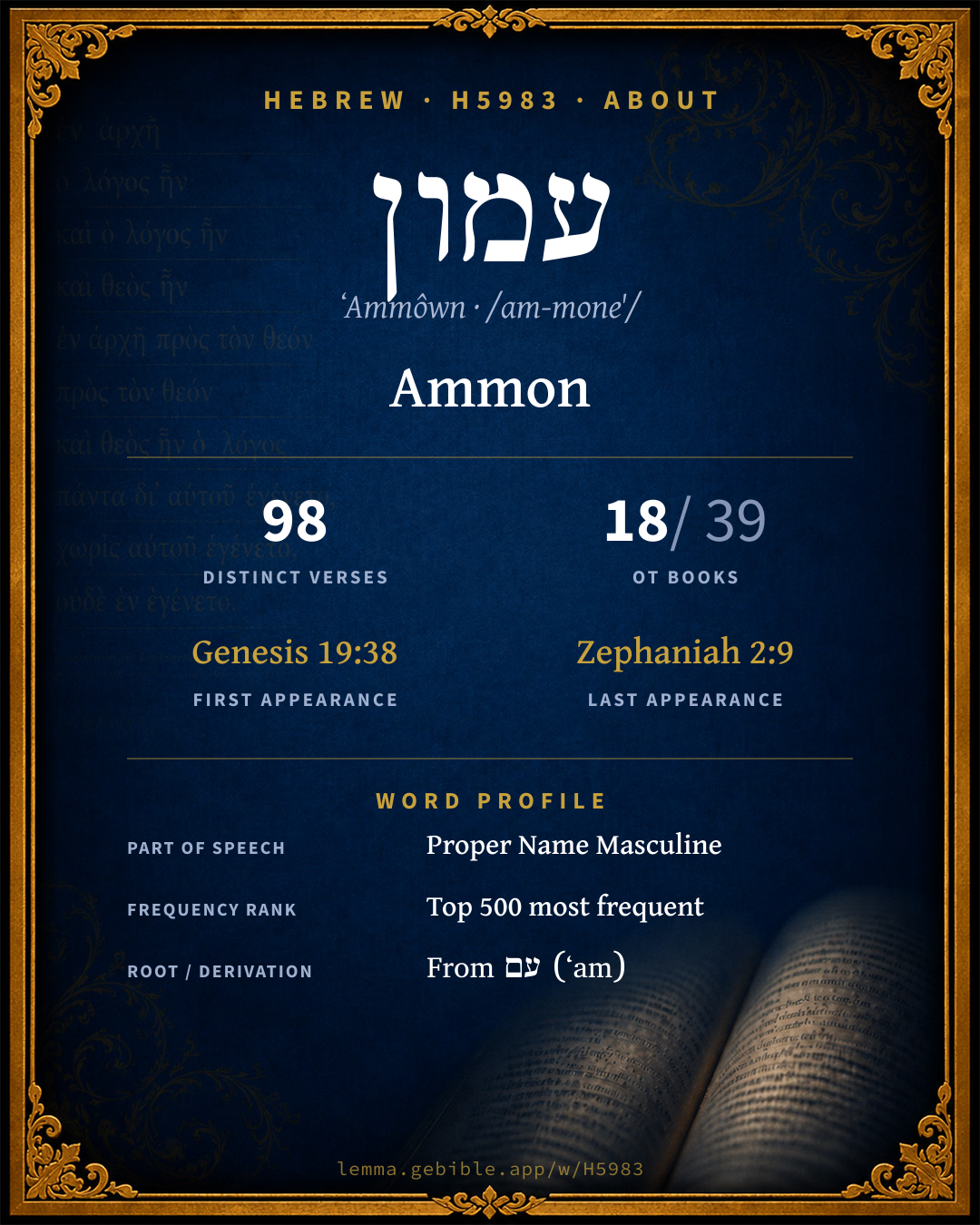
עַמּוֹן
Ammon
BDB lists 2 entries for ‘Ammon’ fuller range ↓
Full lexicon entry — Brown-Driver-Briggs (BDB)
From Brown-Driver-Briggs (BDB)
Where this word appears
Grammar key — what these labels mean
Part of speech
- Noun
- A naming word — a person, place, thing, or idea.
Noun type
- Proper
- A name of a specific person, place, or people (e.g. Abraham, Zion, Israel).
Every verse where H5983 appears in the Book of 2 Samuel — 15 distinct verses. Click any verse to open its interlinear word-by-word view. Verse text shown in the World English Bible for context — . Each verse’s Hebrew form is shown with its reference; the English is not keyword-highlighted, since the data carries no word-level English alignment. Use “Compare translations” on any verse to read it across multiple English versions. This concordance covers the Hebrew Bible; Septuagint (Greek Old Testament) occurrences are not indexed here.
2 Samuel
- 2 Samuel 8:12 עַמּ֔וֹן n Proper of Syria, and of Moab, and of the children of Ammon, and of the Philistines, and of Amalek, and of the spoil of Hadadezer, son of Rehob, king of Zobah.
- 2 Samuel 10:1 עַמּ֑וֹן n Proper It happened after this, that the king of the children of Ammon died, and Hanun his son reigned in his place.
- 2 Samuel 10:2 עַמּֽוֹן n Proper David said, I will show kindness to Hanun the son of Nahash, as his father shown kindness to me. So David sent by his servants to comfort him concerning his father. David's servants came into the land of the children of Ammon.
- 2 Samuel 10:3 עַמּ֜וֹן n Proper But the princes of the children of Ammon said to Hanun their lord, Do you think that David honors your father, in that he has sent comforters to you? Hasn't David sent his servants to you to search the city, and to spy it out, and to overthrow it?
- 2 Samuel 10:6 עַמּ֔וֹן עַמּ֡וֹן n Proper n Proper When the children of Ammon saw that they were become odious to David, the children of Ammon sent and hired the Syrians of Beth Rehob, and the Syrians of Zobah, twenty thousand footmen, and the king of Maacah with one thousand men, and the men of Tob twelve thousand men.
- 2 Samuel 10:8 עַמּ֔וֹן n Proper The children of Ammon came out, and put the battle in array at the entrance of the gate: and the Syrians of Zobah and of Rehob, and the men of Tob and Maacah, were by themselves in the field.
- 2 Samuel 10:10 עַמּֽוֹן n Proper The rest of the people he committed into the hand of Abishai his brother; and he put them in array against the children of Ammon.
- 2 Samuel 10:11 עַמּוֹן֙ n Proper He said, If the Syrians be too strong for me, then you shall help me; but if the children of Ammon be too strong for you, then I will come and help you.
- 2 Samuel 10:14 עַמּ֤וֹן עַמּ֔וֹן n Proper n Proper When the children of Ammon saw that the Syrians were fled, they likewise fled before Abishai, and entered into the city. Then Joab returned from the children of Ammon, and came to Jerusalem.
- 2 Samuel 10:19 עַמּֽוֹן n Proper When all the kings who were servants to Hadarezer saw that they were put to the worse before Israel, they made peace with Israel, and served them. So the Syrians feared to help the children of Ammon any more.
- 2 Samuel 11:1 עַמּ֔וֹן n Proper It happened, at the return of the year, at the time when kings go out [to battle], that David sent Joab, and his servants with him, and all Israel; and they destroyed the children of Ammon, and besieged Rabbah. But David stayed at Jerusalem.
- 2 Samuel 12:9 עַמּֽוֹן n Proper Why have you despised the word of Yahweh, to do that which is evil in his sight? You have struck Uriah the Hittite with the sword, and have taken his wife to be your wife, and have slain him with the sword of the children of Ammon.
- 2 Samuel 12:26 עַמּ֑וֹן n Proper Now Joab fought against Rabbah of the children of Ammon, and took the royal city.
- 2 Samuel 12:31 עַמּ֑וֹן n Proper He brought forth the people who were therein, and put them under saws, and under harrows of iron, and under axes of iron, and made them pass through the brick kiln: and thus did he to all the cities of the children of Ammon. David and all the people returned to Jerusalem.
- 2 Samuel 17:27 עַמּ֗וֹן n Proper It happened, when David was come to Mahanaim, that Shobi the son of Nahash of Rabbah of the children of Ammon, and Machir the son of Ammiel of Lodebar, and Barzillai the Gileadite of Rogelim,
About this entry
At a glance — auto-summarized from this page’s data, not written by a person. Every figure links to its source below. This summary describes the numbers; it doesn’t interpret them.
At its core, עמון (ʻAmmôwn) means “Ammon.” First canonically at Genesis 19:38, it enters the text early. It appears 98 verses across 18 books of the Hebrew Bible, among its moderately common vocabulary. The word gravitates to Judges (28%), then 2 Samuel and 1 Chronicles. Each statement above links to its evidence; the full detail follows below.
Gloss history
Strong's 1890 vs modern scholarship
About this word
Strong's H5983 catalogs a Hebrew word from the Hebrew Old Testament.
These counts are not copied from any lexicon or concordance. They are computed here, from the morphology-tagged Hebrew Old Testament. What Lemma adds →
- 98
- distinct verses
- The word appears in 98 distinct verses.
- 18 / 39
- OT books
- The word appears in 18 of 39 Old Testament books.
- #407
- by frequency
- Top 500 most frequent Hebrew words (rank 407 of 8,640 Hebrew words by occurrence).
View all 98 occurrences in the concordance →
Most concentrated in
- Judges 27 verses 28%
- 2 Samuel 15 verses 15%
- 1 Chronicles 13 verses 13%
By section of the Old Testament
By traditional corpus
Conventional, traditional groupings — biblical authorship is debated, so this is a traditional corpus grouping, not an authorship claim. Each share is this word’s portion of its verses in that division of the Hebrew canon. Each figure is a share of the word’s 98 distinct verses.
- Prophets (Nevi'im) 72 verses · 73%
- Writings (Ketuvim) 20 verses · 20%
- Torah (Pentateuch) 6 verses · 6%
How translations render this word
Counts come from each version’s own published word-to-Strong’s tagging or interlinear alignment — an approximate guide to how each version renders this word, not a word-level alignment the data otherwise carries. Because each total is that version’s own tagged count, the per-version totals vary from one another and need not match the appearance or distinct-verse counts above. These counts may also differ from a printed concordance because Lemma counts each distinctly tagged rendering and does not collapse phrase taggings into a single head-word total. This is a fixed set of word-tagged versions (KJV, ASV, BSB, ULT) and does not change with the reading translation you choose elsewhere. Each version’s license is shown beside its name below (and on Sources).
- King James Version: Ammon 90×
- American Standard Version: Ammon 83×, Children of ammon 4×, Ammon any more 2×
- Berean Standard Bible: Ammonites 5×, Ammon 4×
- unfoldingWord Literal Text: Ammon 97×
King James Version Public Domain
Renders H5983 across 92 tagged occurrences — most commonly:
Plus 2 renderings that appear only once — usually multi-word phrases or single function words the recovered tagging swept in, not distinct renderings. Not rendered by a distinct English word in 13 further occurrences.
American Standard Version Public Domain
Renders H5983 across 92 tagged occurrences — most commonly:
Plus 3 renderings that appear only once — usually multi-word phrases or single function words the recovered tagging swept in, not distinct renderings.
Berean Standard Bible Public Domain
Renders H5983 across 9 tagged occurrences — most commonly:
Not rendered by a distinct English word in 97 further occurrences.
unfoldingWord Literal Text CC BY-SA 4.0
Renders H5983 across 99 tagged occurrences — most commonly:
Plus 2 renderings that appear only once — usually multi-word phrases or single function words the recovered tagging swept in, not distinct renderings.
Senses in BDB
The 2 senses BDB distinguishes for this word, in lexicon order (not ranked by frequency or importance). The full entry — with sub-senses — is in the Lexicon Entry tab.
- Ammon = "tribal"
- a people dwelling in Transjordan descended from Lot through Ben-ammi
Word origin
n. pr. gent. Ammon, 𝔊 Αμμαν, Αμμων (Assyrian Bît Ammanu COTGloss.);—always (except 1 S 11:11 [where however 𝔊 reads בְּנֵי ע׳], ψ 83:8, which have ע׳ alone) בְּנֵי עַמּוֹן, connected by J with בֶּן־עַמִּי son of Lot Gn 19:38 (and meaning of name doubtless sought herein by J; cf. ii. עַם); people apparently akin to Isr., but usually hostile, dwelling E. of Jordan, NE. of Moab, between Arnon and Jabbok: Nu 21:24(×2) (JE), Dt 2:19(×2), 37; 3:11, 16; Jos 12:2; 13:10 (D), v 25 (P), Ju 3:13; 10:6 + 25 times Ju 10–12; 1 S 11:11; 12:12; 14:47; 2 S 8:12; 10:1 + 14 times 2 S 10–12, 17:27; 1 K 11:7, 33; 2 K 23:13; 24:2; 1 Ch 18:11 + 20 times Ch, Am 1:13; Is 11:14; Je 9:25 + 9 times Je, Zp 2:8, 9; Ez 21:25, 33 + 5 times Ez 25; Dn 11:41.—Vid. CheAmmon in Ency. Bib.
— Brown-Driver-Briggs (Oxford 1906, public domain), digitized via Sefaria, supplemented by the OpenScriptures HebrewLexicon (CC BY 4.0). See Sources.
Derived from עם (ʻam) (H5971) — people.
Jastrow Dictionary
A second Hebrew/Aramaic lexicon for comparison, covering Aramaic and post-biblical (Talmudic, Targumic, Midrashic) usage that the biblical-Hebrew BDB does not. Matched by lemma rather than by Strong’s number, so a lemma may carry more than one Jastrow headword (shown separately below), and the entries cover usage well beyond the Bible.
עַמּוֹן
- (b. h.) pr. n. gent. Ammon, a people descended from Ben Ammi, the son of Lot; mentioned chiefly in connection with Moab. Pes. 119ᵃ בני ע׳. Yad. IV, 3 ע׳ ומואב מעשרין וכ׳ Jewish inhabitants of the land of A. a. M. must give the poor man’s tithes in the Sabbatical years; Yeb. 16ᵃ; Ḥag. 3ᵇ. Gitt. 38ᵃ; Ḥull. 60ᵇ, v. סִיחוֹן; a. fr.
A Dictionary of the Targumim, the Talmud Babli and Yerushalmi, and the Midrashic Literature (Marcus Jastrow; London, Luzac, 1903) — Public Domain. Digitized via Sefaria. Digitized via Sefaria. Full attribution on Sources.
Forms in the corpus
The 14 distinct written forms H5983 takes in the Hebrew Bible, most frequent first — each parse links to that state’s occurrences in the concordance. Hebrew forms include their vowel points and cantillation, so a single lemma takes many written forms.
| Form | Parsing | Example | Uses |
|---|---|---|---|
| עַמּ֔וֹן | Noun, Proper | Amos 1:13 | 21 |
| עַמּֽוֹן | Noun, Proper | Daniel 11:41 | 21 |
| עַמּ֖וֹן | Noun, Proper | Deuteronomy 2:37 | 17 |
| עַמּ֑וֹן | Noun, Proper | Deuteronomy 3:11 | 16 |
| עַמּ֜וֹן | Noun, Proper | 1 Chronicles 19:3 | 8 |
| עַמּ֗וֹן | Noun, Proper | 1 Chronicles 19:7 | 6 |
| עַמּוֹן֙ | Noun, Proper | 2 Samuel 10:11 | 4 |
| עַמּ֤וֹן | Noun, Proper | Deuteronomy 2:19 | 3 |
| עַמּ֨וֹן | Noun, Proper | 1 Samuel 14:47 | 3 |
| עַמּ֛וֹן | Noun, Proper | 1 Chronicles 19:2 | 2 |
| עַמּוֹן֮ | Noun, Proper | 1 Samuel 12:12 | 2 |
| וְ֭/עַמּוֹן | Noun, Proper | Psalms 83:7 | 1 |
| עַמּ֡וֹן | Noun, Proper | 2 Samuel 10:6 | 1 |
| עַמּ֧וֹן | Noun, Proper | 2 Chronicles 20:23 | 1 |
Same root — word family
Other BDB entries built from the same root as H5983, grouped by Strong’s listed origin. These share a root / origin per the lexicon — not necessarily a shared meaning. Each links to that word’s own entry.
Derives from
Shares the same root
Proper names from this root
People and places named from this root — a name, not an additional meaning of the word.
- עמיאל ʻAmmîyʼêl H5988 Ammiel
- עמיהוד ʻAmmîyhûwd H5989 Ammihud
- עמיזבד ʻAmmîyzâbâd H5990 Ammizabad
- עמיחור ʻAmmîychûwr H5991 Ammihur
- עמינדב ʻAmmîynâdâb H5992 Amminadab
- עמי נדיב ʻAmmîy Nâdîyb H5993 Amminadib
- עמישדי ʻAmmîyshadday H5996 Ammishaddai
- עמעד ʻAmʻâd H6008 Amad
- עמרם ʻAmrâm H6019 Amram
- עמוני ʻAmmôwnîy H5984 Ammonite
Compare all same-root words → Showing 4 of 13 — not the complete family. 10 of the same-root words are proper names (people or places). They share a root, not necessarily a meaning.
Bible dictionary
Public-domain dictionary articles matched to this entry by name (Ammon). A biblical name can be shared by more than one person or place, so an article may treat several.
Easton's Bible Dictionary · M. G. Easton, 1897
Another form of the name Ben-ammi, the son of Lot (Gen. 19:38). This name is also used for his posterity (Ps. 83:7).
Smith's Bible Dictionary · William Smith, 1863
(sons of renown, mountaineers), Am'monites, Children of Ammon, A people descended from Ben-ammi, the son of Lot by his younger daughter. (Genesis 19:38) comp Psal 83:7,8 The Ammonites are frequently mentioned with the Moabites (descendants of Ben-ammi's half-brother), and sometimes under the same name. Comp. (Judges 10:6; 2 Chronicles 20:1; Zephaniah 2:8) etc. The precise position of the territory of the Ammonites is not ascertainable. In the earliest mention of them, (2:20) they are said to have dwelt in their place, Jabbok being their border. (Numbers 21:24; 2:37; 3:16) (i.e. Land or country is, however, but rarely ascribed to them. Their capital city was Rabbath, called also Rabbath Ammon on the Jabbok. We find everywhere traces of the fierce habits of maranders in their incursions.) (1 Samuel 11:2; Amos 1:13) and a very high degree of crafty cruelty to their toes. (Jeremiah 41:6,7; Judges 17:11,12) Moab was the settled and civilized half of the nation of Lot, and Ammon formed its predatory and Bedouin section. On the west of Jordan they never obtained a footing. The hatred in which the Ammonites were held by Israel is stated to have arisen partly from their denial of assistance, (23:4) to the Israelites on their approach to Canaan. But whatever its origin the animosity continued in force to the latest date. The tribe was governed by a king, (Judges 11:12) etc.; (1 Samuel 12:12; 2 Samuel 10:1; Jeremiah 40:14) and by "princes." (2 Samuel 10:3; 1 Chronicles 19:3) The divinity of the tribe was Molech [Molech], and they were gross idolaters.
Hitchcock's Bible Names Dictionary · Roswell D. Hitchcock, 1869
a people; the son of my people
Classic public-domain reference works; full attribution on Sources.
Septuagint verse parallels
This word appears in 94 verses that also exist in the Greek Old Testament (Septuagint), out of the 98 Hebrew verses it occurs in. You can read those verses in Greek by switching the Old Testament edition to the Septuagint.
Read these verses in the Septuagint
- Genesis 19:38
- Numbers 21:24
- Deuteronomy 2:19
- Joshua 12:2
- Judges 3:13
- 1 Samuel 11:11
- 2 Samuel 8:12
- 1 Kings 11:7
- 2 Kings 23:13
- 1 Chronicles 18:11
- 2 Chronicles 20:1
- Psalms 83:7
This is a verse-level parallel only — the same verses exist in both the Hebrew and Greek Old Testaments. No word-level Hebrew↔Greek correspondence is claimed: the data carries no such alignment, so no Greek word is shown as this Hebrew word’s translation. Coverage is not total — the Septuagint omits the deuterocanon and renumbers the Psalms, so some Hebrew verses have no direct Greek parallel.