
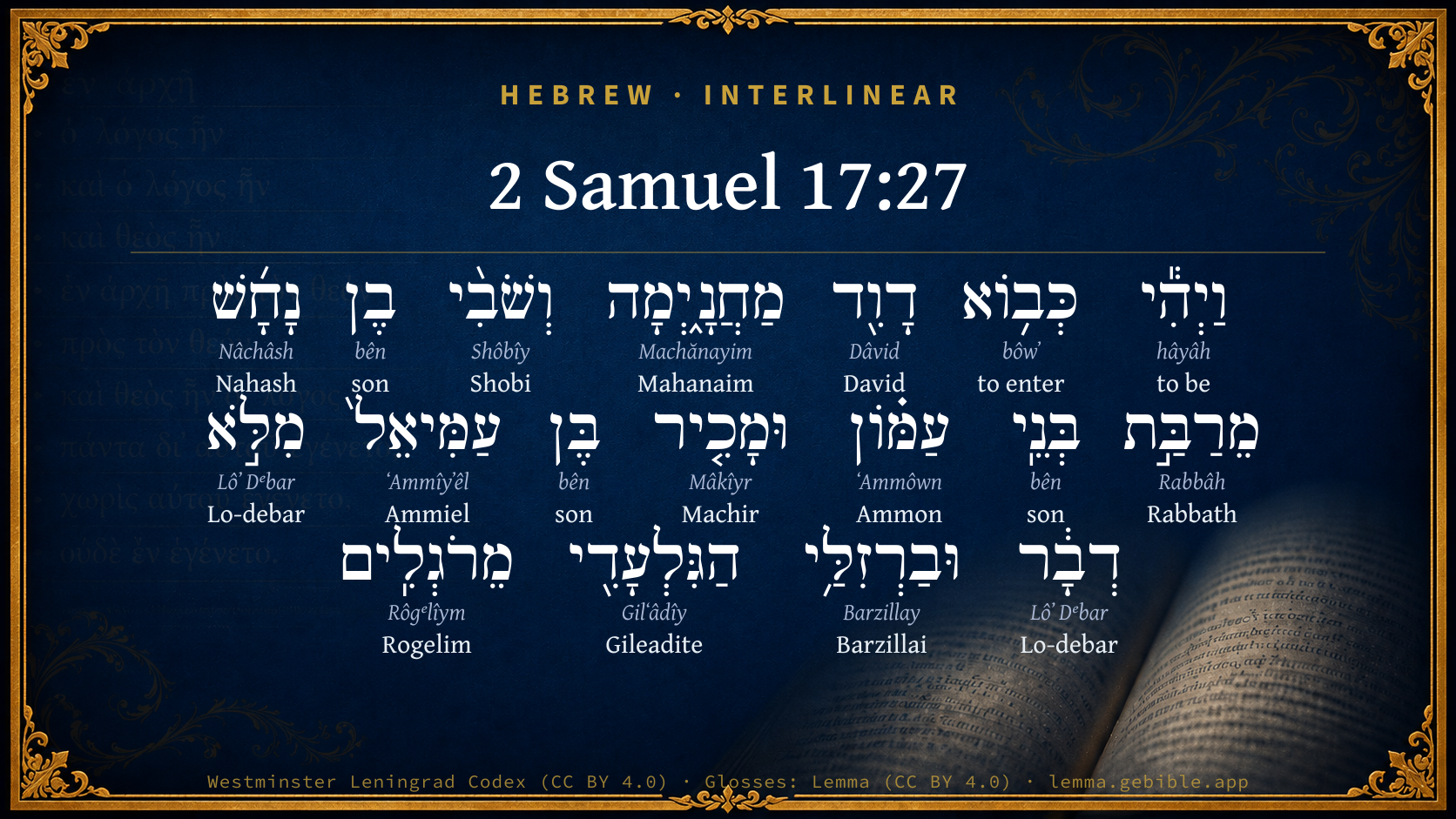
2 Samuel 17:27

Hebrew (Westminster Leningrad Codex) 2 Samuel 17:27 appears in the Hebrew Old Testament. The text above is from the Westminster Leningrad Codex. Each word links to its Strong’s number, a concise gloss, and parsing drawn from the Open Scriptures Hebrew Bible morphology. Click any word for its full Brown-Driver-Briggs (BDB) entry.
Download image
Cite this verse

2 Samuel 17:27 (World English Bible). Public Domain. Lemma interlinear Bible study tool, https://lemma.gebible.app/v/2-samuel/17/27.

Show BibTeX & RIS
BibTeX
RIS
English Translation
It happened, when David was come to Mahanaim, that Shobi the son of Nahash of Rabbah of the children of Ammon, and Machir the son of Ammiel of Lodebar, and Barzillai the Gileadite of Rogelim,
World English Bible · Public Domain
Highlights
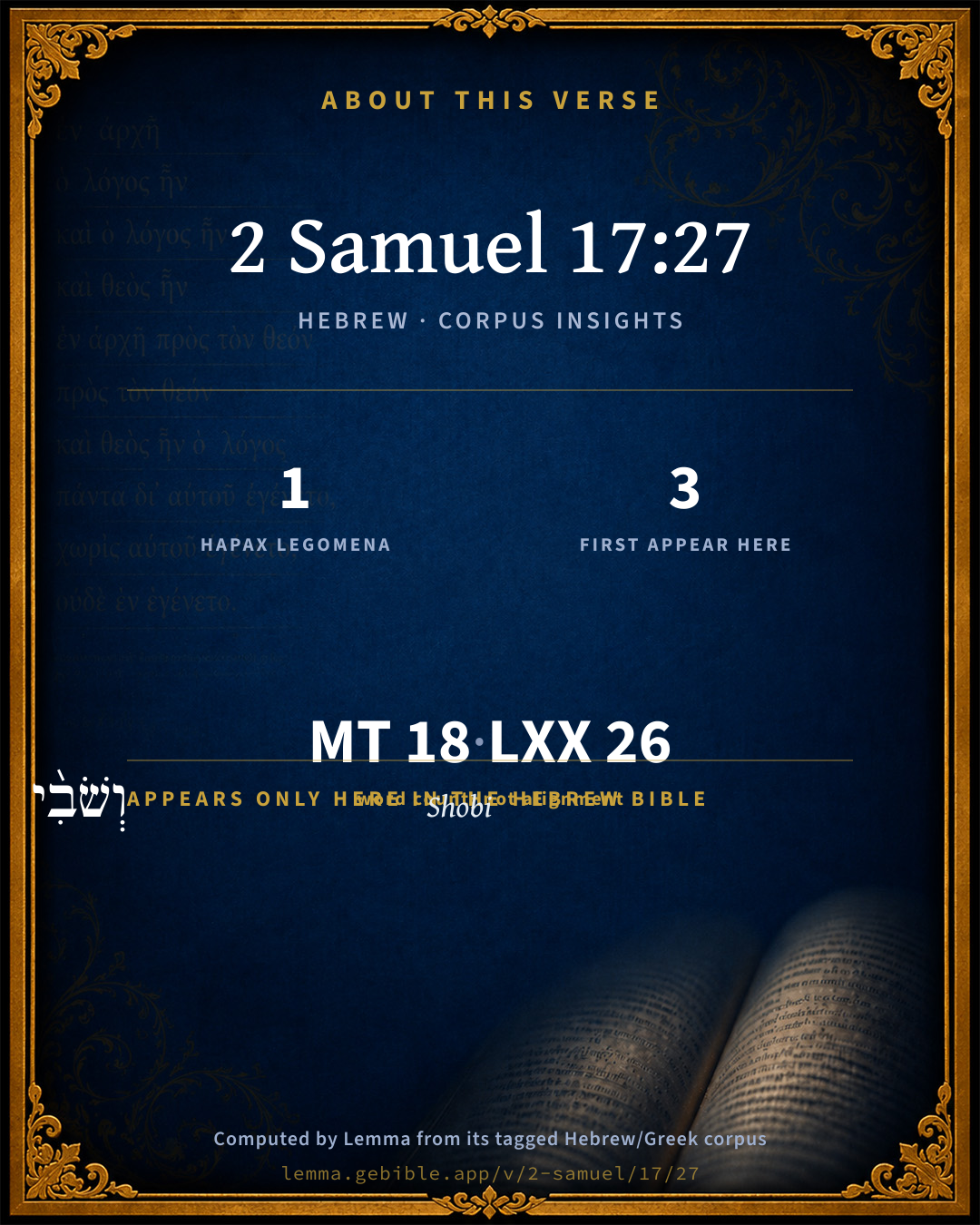
  • 1 hapax legomenon — only here in the Hebrew Bible
  • 3 first appearances in the Hebrew Bible
Full analysis ↓
Download a study sheet

One document with this verse’s original text, its word-by-word gloss line, the meaning frame, cross-references with their text, attributed commentary, and full source and license credits — printable, and it pastes into notes with its structure intact.

This verse Autodidact and up

Study sheet (.html) Plain text (.txt)

A passage Seminary Student

Up to 50 verses in one chapter. A passage sheet keeps up to 6 commentary sources and 12 cross-references per verse, in the order this page ranks them, and says so on the sheet whenever that leaves anything out. Ask for a single verse and you get the Autodidact verse sheet above.

Everything on this page stays free to read, with no account — the sheet is a download of what is already on screen, not access to it.

Want to remove ads? Support Godless Engineer
Compare translations 3

The same verse in 3 English versions, stacked beneath the original-language interlinear above. Click any original word for its lexicon entry.

Each is an independent rendering of the whole verse — the interlinear is not word-aligned to these translations.

Highlighted words mark where these versions differ — a whole-verse word diff, not a word-by-word alignment.

  • World English Bible Public Domain
    It happened, when David was come to Mahanaim, that Shobi the son of Nahash of Rabbah of the children of Ammon, and Machir the son of Ammiel of Lodebar, and Barzillai the Gileadite of Rogelim,
  • King James Version Public Domain
    And it came to pass, when David was come to Mahanaim, that Shobi the son of Nahash of Rabbah of the children of Ammon, and Machir the son of Ammiel of Lodebar, and Barzillai the Gileadite of Rogelim,
  • unfoldingWord Literal Text CC BY-SA 4.0
    And it happened, when David came to Mahanaim, that Shobi, the son of Nahash, from Rabbah of the sons of Ammon and Machir, the son of Ammiel, from Lo Debar and Barzillai the Gileadite from Rogelim,

unfoldingWord Literal Text — © unfoldingWord, licensed CC BY-SA 4.0. Word-aligned USFM3 via Door43 (git.door43.org/unfoldingWord/en_ult).

Versions to compare (up to 4)

3 of 4 selected

Show all 18 translations

Every available English version of this verse, each an independent rendering of the whole verse.

  • World English Bible Public Domain
    It happened, when David was come to Mahanaim, that Shobi the son of Nahash of Rabbah of the children of Ammon, and Machir the son of Ammiel of Lodebar, and Barzillai the Gileadite of Rogelim,
  • Berean Standard Bible Public Domain
    When David came to Mahanaim, he was met by Shobi son of Nahash from Rabbah of the Ammonites, Machir son of Ammiel from Lo-debar, and Barzillai the Gileadite from Rogelim.
  • Majority Standard Bible Public Domain
    When David came to Mahanaim, he was met by Shobi son of Nahash from Rabbah of the Ammonites, Machir son of Ammiel from Lo-debar, and Barzillai the Gileadite from Rogelim.
  • King James Version Public Domain
    And it came to pass, when David was come to Mahanaim, that Shobi the son of Nahash of Rabbah of the children of Ammon, and Machir the son of Ammiel of Lodebar, and Barzillai the Gileadite of Rogelim,
  • American Standard Version (1901) Public Domain
    And it came to pass, when David was come to Mahanaim, that Shobi the son of Nahash of Rabbah of the children of Ammon, and Machir the son of Ammiel of Lodebar, and Barzillai the Gileadite of Rogelim,
  • Revised Version (1885) Public Domain
    And it came to pass, when David was come to Mahanaim, that Shobi the son of Nahash of Rabbah of the children of Ammon, and Machir the son of Ammiel of Lo-debar, and Barzillai the Gileadite of Rogelim,
  • Geneva Bible (1599) Public Domain
    And when Dauid was come to Mahanaim, Shobi the sonne of Nahash out of Rabbah of the children of Ammon, and Machir the sonne of Ammiel out of Lo-debar, and Barzelai the Gileadite out of Rogel
  • Douay-Rheims (1899) Public Domain
    And when David was come to the camp, Sobi the son of Naas of Rabbath of the children of Ammon, and Machir the son of Ammihel of Lodabar, and Berzellai the Galaadite of Rogelim,
  • Young's Literal Translation Public Domain
    And it cometh to pass at the coming in of David to Mahanaim, that Shobi, son of Nahash, from Rabbah of the Bene-Ammon, and Machir son of Ammiel, from Lo-Debar, and Barzillai the Gileadite, from Rogelim,
  • Literal Standard Version CC BY-SA 4.0
    And it comes to pass at the coming in of David to Mahanaim, that Shobi son of Nahash, from Rabbah of the sons of Ammon, and Machir son of Ammiel, from Behold-Debar, and Barzillai the Gileadite, from Rogelim,
  • Unlocked Literal Bible CC BY-SA 4.0
    It came about when David had come to Mahanaim, that Shobi son of Nahash from Rabbah of the Ammonites, and Machir son of Ammiel from Lo Debar, and Barzillai the Gileadite from Rogelim,
  • unfoldingWord Literal Text CC BY-SA 4.0
    And it happened, when David came to Mahanaim, that Shobi, the son of Nahash, from Rabbah of the sons of Ammon and Machir, the son of Ammiel, from Lo Debar and Barzillai the Gileadite from Rogelim,
  • Darby Bible Public Domain
    And as soon as David came to Mahanaim, Shobi the son of Nahash of Rabbah of the children of Ammon, and Machir the son of Ammiel of Lo-debar, and Barzillai the Gileadite of Rogelim,
  • World Messianic Bible Public Domain
    When David had come to Mahanaim, Shobi the son of Nahash of Rabbah of the children of Ammon, and Machir the son of Ammiel of Lodebar, and Barzillai the Gileadite of Rogelim,
  • Webster's Bible Public Domain
    And it came to pass, when David had come to Mahanaim, that Shobi the son of Nahash of Rabbah of the children of Ammon, and Machir the son of Ammiel of Lo-debar, and Barzillai the Gileadite of Rogelim,
  • Free Bible Version CC BY-SA 4.0
    When David arrived at Mahanaim, he was welcomed by Shobi, son of Nahash, from Rabbah of the Ammonites, Machir, son of Ammiel, from Lo-debar, and Barzillai the Gileadite from Rogelim.
  • Bible in Basic English Public Domain
    Now when David had come to Mahanaim, Shobi, the son of Nahash of Rabbah, the Ammonite, and Machir, the son of Ammiel of Lo-debar, and Barzillai the Gileadite of Rogelim,
  • JPS Tanakh (1917) Public Domain
    And it came to pass, when David was come to Mahanaim, that Shobi the son of Nahash of Rabbah of the children of Ammon, and Machir the son of Ammiel of Lo-debar, and Barzillai the Gileadite of Rogelim,

Literal Standard Version (2020), Covenant Press — licensed CC BY-SA 4.0. Text via the HelloAO Bible API (eBible.org). Unlocked Literal Bible (unfoldingWord) — licensed CC BY-SA 4.0. Text via the HelloAO Bible API (eBible.org). unfoldingWord Literal Text — © unfoldingWord, licensed CC BY-SA 4.0. Word-aligned USFM3 via Door43 (git.door43.org/unfoldingWord/en_ult). Free Bible Version, Dr. Jonathan Gallagher — licensed CC BY-SA 4.0. Text via the HelloAO Bible API (eBible.org).

Word by word

More ways to search: Search by grammar → Find every occurrence → Compare this word →

Practice this passage: Drill this verse → Learn its vocabulary →

וְשֹׁבִ֨י
Shôbîy
H7629
“and · Shobi”
Conjunction + Noun, Proper
Part of Speech
Conjunction + Noun
Type
Proper
Full BDB Definition

Origin: from H7617

TWOT: None

Shobi = "glorious" - son of Nahash of Rabbah of the children of Ammon; supported David during Absalom's rebellion
  1. וַיְהִ֕י hâyâh H1961 “and · to be” Conjunction + Verb, Qal, Sequential Imperfect, 3rd Person, Masculine, Singular
  2. כְּב֥וֹא bôwʼ H935 “like/as · to enter” Preposition + Verb, Qal, Infinitive Construct
  3. דָוִ֖ד Dâvid H1732 “David” Noun, Proper
  4. מַחֲנָ֑יְמָה Machănayim H4266 “Mahanaim · toward” Noun, Proper + Suffix, Demonstrative
  5. בֶן bên H1121 “son of” Noun, Common, Masculine, Singular, Construct
  6. נָחָ֜שׁ Nâchâsh H5176 “Nahash” Noun, Proper
  7. מֵרַבַּ֣ת Rabbâh H7237 “from · Rabbath” Preposition + Noun, Proper
  8. בְּנֵֽי bên H1121 “sons of” Noun, Common, Masculine, Plural, Construct
  9. עַמּ֗וֹן ʻAmmôwn H5983 “Ammon” Noun, Proper
  10. וּמָכִ֤יר Mâkîyr H4353 “and · Machir” Conjunction + Noun, Proper
  11. בֶּן bên H1121 “son of” Noun, Common, Masculine, Singular, Construct
  12. עַמִּיאֵל֙ ʻAmmîyʼêl H5988 “Ammiel” Noun, Proper
  13. מִלֹּ֣א Lôʼ Dᵉbar H3810 “from · Lo-debar” Preposition + Noun, Proper
  14. דְבָ֔ר Lôʼ Dᵉbar H3810 “Lo-debar” Noun, Proper
  15. וּבַרְזִלַּ֥י Barzillay H1271 “and · Barzillai” Conjunction + Noun, Proper
  16. הַגִּלְעָדִ֖י Gilʻâdîy H1569 “the · Gileadite” Particle, Definite Article + Noun, Gentilic, Masculine, Singular, Absolute
  17. מֵרֹגְלִֽים Rôgᵉlîym H7274 “from · Rogelim” Preposition + Noun, Proper

About this verse

These counts appear in no published source. They are computed here, from the morphology-tagged text and Lemma’s own curated glosses. What Lemma adds →

18
words
15
distinct lemmas
Historical
section

Notable vocabulary

1 hapax legomenon — a word that appears only here in the entire Hebrew Bible:

  • וְשֹׁבִ֨י Shobi H7629

First appearance in Scripture

These words make their first canonical appearance in the Hebrew Bible here:

  • וְשֹׁבִ֨י Shobi H7629
  • וּבַרְזִלַּ֥י Barzillai H1271
  • מֵרֹגְלִֽים Rogelim H7274

Shared distinctive vocabulary

מֵרֹגְלִֽים Rogelim H7274 occurs in 2 verses of the Hebrew Bible. Also found in:

Grammatical profile

  • 2 verbs
  • 16 nouns

Verb forms

  • וַיְהִ֕י Qal · Sequential Imperfect
  • כְּב֥וֹא Qal · Infinitive Construct

Repetition

Words recur within this verse — often emphatic in Hebrew:

  • בֶן son H1121 ×3
  • מִלֹּ֣א Lo-debar H3810 ×2

Hebrew & Septuagint length

In English translation the verse runs 35 words from the Hebrew and 36 from the Septuagint (LXX English) — closely comparable.

A rough comparison of the two English renderings, which tokenize alike — not a word-level alignment.

Word counts can differ between the Hebrew and the Greek without any difference in meaning — e.g. the Hebrew direct-object marker אֵת has no separate Greek word, and Greek often adds the article ὁ.

In the original languages it is 18 Hebrew tokens and 26 Greek tokens — but the two are counted differently (Hebrew bundles its prefixes and suffixes into one token; the Greek is in lemma form), so that isn’t a like-for-like length.

Cross-references

8

Topical passages linked to 2 Samuel 17:27 in the Treasury of Scripture Knowledge — connected by theme and wording, ordered by reader-vote popularity; previews shown in the World English Bible.

  • 1 Kings 2:7 But show kindness to the sons of Barzillai the Gileadite, and let them be of those who eat at your table; for so they came to me when I fled from Absalom your brother.
  • 2 Samuel 9:4 The king said to him, Where is he? Ziba said to the king, Behold, he is in the house of Machir the son of Ammiel, in Lo Debar.
  • 2 Samuel 10:1–2 It happened after this, that the king of the children of Ammon died, and Hanun his son reigned in his place.
  • 1 Samuel 11:1 Then Nahash the Ammonite came up, and encamped against Jabesh Gilead: and all the men of Jabesh said to Nahash, Make a covenant with us, and we will serve you.
  • Ezra 2:61 Of the children of the priests: the children of Habaiah, the children of Hakkoz, the children of Barzillai, who took a wife of the daughters of Barzillai the Gileadite, and was called after their name.
  • 2 Samuel 12:26 Now Joab fought against Rabbah of the children of Ammon, and took the royal city.
  • 2 Samuel 12:29–30 David gathered all the people together, and went to Rabbah, and fought against it, and took it.
  • 2 Samuel 19:31–39 Barzillai the Gileadite came down from Rogelim; and he went over the Jordan with the king, to conduct him over the Jordan.

Cross-references courtesy of OpenBible.info (CC BY 4.0).

Hebrew and Greek witnesses Masoretic Hebrew ↔ Greek Septuagint

The same verse in the two great witnesses to the Old Testament, shown verse-for-verse.

These are two independent witnesses, not word-aligned to each other, and the Septuagint is shown in lemma (dictionary) form.

Hebrew 2 Samuel 17:27 Masoretic · Westminster Leningrad Codex

וַיְהִ֕י כְּב֥וֹא דָוִ֖ד מַחֲנָ֑יְמָה וְשֹׁבִ֨י בֶן נָחָ֜שׁ מֵרַבַּ֣ת בְּנֵֽי עַמּ֗וֹן וּמָכִ֤יר בֶּן עַמִּיאֵל֙ מִלֹּ֣א דְבָ֔ר וּבַרְזִלַּ֥י הַגִּלְעָדִ֖י מֵרֹגְלִֽים

It happened, when David was come to Mahanaim, that Shobi the son of Nahash of Rabbah of the children of Ammon, and Machir the son of Ammiel of Lodebar, and Barzillai the Gileadite of Rogelim,

World English Bible · Public Domain

Greek LXX 2 Samuel 17:27 Septuagint · lemma form

καί γίγνομαι ἡνίκα ἔρχομαι δαυίδ εἰς μαναϊμ ουεσβι υἱός ναας ἐκ ραββαθ υἱός αμμων καί μαχιρ υἱός αμιηλ ἐκ λωδαβαρ καί βερζελλι ὁ γαλααδίτης ἐκ ρωγελλιμ

And it came to pass when David came to Manaim, that Uesbi the son of Naas of Rabbath of the sons of Ammon, and Machir son of Amiel of Lodabar, and Berzelli the Galaadite of Rogellim,

LXX2012 (modern English Septuagint) · Public Domain

On this verse, Keil & Delitzsch discusses the Septuagint’s reading. Read the note in Commentary ↓

Hebrew: Westminster Leningrad Codex (CC BY 4.0). Greek: Septuagint (public domain); English from LXX2012 (modern English Septuagint) (Public Domain). How the Septuagint differs from the Hebrew →

Targum (Aramaic paraphrase)

1

The Targum is the ancient Jewish Aramaic paraphrase of the Hebrew Scriptures — an interpretive translation, not the Hebrew text itself. Onkelos (literal) and Pseudo-Jonathan (expansive) render the Torah, and Jonathan the Prophets. Coverage is partial: where no permissively-licensed English translation exists for a verse, only the Aramaic is shown. This is verse-level text, not a word-by-word alignment to the Hebrew.

  1. Targum Jonathan Prophets (Joshua–Malachi)
    וַהֲוָה כַּד אֲתָא דָוִד לְמַחֲנָיִם וְשׁוֹבִי בַר נָחָשׁ מֵרַבַּת בְּנֵי עַמוֹן וּמָכִיר בַּר עַמִיאֵל מִלֹא דְבָר וּבַרְזִלַי גִלְעָדָאָה מֵרֹגְלִים:

    (no public-domain English translation for this verse)

    Targum Jonathan — Aramaic: “Mikraot Gedolot” (public domain). English: “Sefaria Community Translation” (CC0 1.0 (public-domain dedication)); “London "Chaldee Paraphrase," 1871” (public domain). Text via Sefaria.

Commentary

Notes on 2 Samuel 17:27 from classic Christian and Jewish commentators (each source and its license shown beneath its notes). The classic Christian expositions comment on the surrounding passage and are grouped to its opening verse, so a note may address several verses; the Jewish commentaries on the Tanakh (Rashi and others) are per-verse, so they appear only where the commentator wrote on this verse.

Lemma curates 59 commentaries, every one of them public domain or Creative Commons licensed, each selected and text-cleaned for this edition rather than reprinted as found. About our sources →

Trapp's Complete Commentary

John Trapp

2Sa 17:27 And it came to pass, when David was come to Mahanaim, that Shobi the son of Nahash of Rabbah of the children of Ammon, and Machir the son of Ammiel of Lodebar, and Barzillai the Gileadite of Rogelim,

Ver. 27. Shobi, the son of Nahash.] Second brother, likely, to that unworthy Hanun, {2Sa 10:2} who abused David’s messengers, did him much more mischief, and was therefore worthily deposed, this brother of his being set up king in his stead. We read of Attilus, king of Suecia, that he made a dog king of the Danes, in revenge of a great many injuries he had received from them. Gunno, likewise king of the Danes, made a dog king of Norway, and appointed counsellors to do all things under his title and name. David was not so spiteful: but appointed this thankful man Shobi king of those injurious Ammonites; and married his son Solomon to Naamah, this man’s sister, or daughter, likely, but a convert to the Jewish religion. {1Ki 14:21}

And Machir.] He with whom Mephibosheth had been brought up, seeing his unexpected kindness to that poor cripple, ministereth to him.

John Trapp, A Commentary or Exposition upon All the Books of the Old and New Testament (1647–1656) — public domain. Text from a community e-Sword module.

The Biblical Illustrator

Joseph S. Exell

2Sa_17:27-29

When David was come to Mahanaim.

Mahanaim, or hosts of angels

(with Gen_32:27; Gen_32:29):--Let us go even unto Mahanaim and see these great sights. First, let us go with Jacob and see the two camps of angels, and then with- David to observe his troops of friends.

I. God has a multitude of servants, and all these are on the side of believers. The great army of the Lord of hosts consists largely of unseen agents, of forces that are not discernible except in vision or by the eye of faith. Jacob saw two squadrons of these invisible forces, which are on the side of righteous men.

1. We know that a guard of angels always surrounds every believer. Ministering spirits are abroad, protecting the princes of the blood royal. They cannot be discerned by any of our senses, but they are perceptible by faith, and they have been made perceptible to holy men of old in vision.

2. All these agents work in order, for it is Gods host, and the host is made up of beings which march or fly, according to the order of command. Neither shall one thrust another; they shall walk every one in his path.

3. All punctual to the Divine command. Jacob went on his way, and the angels of God met him.

4. All engaged personally to attend upon Jacob.

5. Those forces, though in themselves invisible to the natural senses, are manifest to faith at certain times. Our Mahanaims occur at much the same time as that in which Jacob beheld this great sight. Jacob was entering upon a more separated life. He was leaving Laban and the school of all those tricks of bargaining and bartering which belong to the ungodly world.

6. Again, the reason why the angels met Jacob at that time was, doubtless, because he was surrounded with great cares.

7. Again, the Lords host appeared when Jacob felt a great dread. His brother Esau was coming to meet him armed to the teeth, and, as he feared, thirsty for his blood. In times when our danger is greatest, if we are real believers, we shall be specially under the Divine protection, and we shall know that it, is so.

8. And, once again, when you and I, like Jacob, shall be near Jordan, when we shall just be passing into the better land then is the time when we may expect to come to Mahanaim.

9. There is no doubt whatever that they are sent for a purpose.

10. Mahanaim was granted to Jacob, not only to refresh his memory, but to lift him out of the ordinary low level of his life.

II. If such a special vision be granted to us let us keep it in memory. Jacob called the name of that place Mahanaim.

II. This brings me to my second text; for angels did not meet David, but living creatures of another nature met him, who answered the purpose of David quite as well as angels would have done.

1. Who is yonder prominent friend? He speaks like a foreigner. He is an Ammonite. What is his name? Shobi the son of Nahash, of Rabbah, of the children of Ammon. I have heard of those people: they were enemies, were they not--cruel enemies to Israel? That man Nahash, you recollect his name; this is one of his sons. Yes! God can turn enemies into friends when His servants require succour. Those that belong to a race that is opposed to Israel can, if God will it, turn to be their helpers. The Lord found an advocate for his Son Jesus in Pilates house--the governors wife suffered many things in a dream because of him. He can find a friend for his servants in their persecutors own family, even as he raised up Obadiah to hide the prophets and feed them in a cave: the chamberlain to Ahab himself was the protector of the saints, and with meat from Ahabs table were they fed.

2. Here comes another person we have heard of before, Machir of Lodebar. That is the large farmer who took care of Mephibosheth. He seems to have been a truly loyal man, who stuck to royal families, even when their fortunes were adverse. As he had been faithful to the house of Saul so was he to David.

3. Here comes Barzillai, an old man of fourscore, and as the historian tells us, a very great man. His enormous wealth was all at the disposal of David and his followers, and he provided the king of sustenance while he lay at Mahanaim. This old nobleman was certainly as useful to David as the angels were to Jacob, and he and his coadjutors were truly a part of Gods forces. The armies of God are varied: he has not one troop alone, but many. On this occasion Mahanaim well deserved its name, because the help that came to David from these different persons came in a most noble way, as though it came by angels. I infer from this that if at any time a servant of God is marching onward in his Masters work, and he needs assistance of any sort, he need not trouble about it, but rest in the Lord, for succour and help will surely come, if not from the angels above, yet from the church below. Conclusion: While I have shown you Gods invisible agents, and Gods visible agents, I want to call to your mind that in either case, and in both cases, the host is the host of God: that is to say, the true strength and safety of the believer is his God. The presence of God with believers is more certain and constant than the presence of angels or holy men. God hath said it--Certainly I will be with thee. He hath said again, I will not leave thee, nor forsake thee. When you are engaged in Christs service you have a special promise to back you up--Go ye into all the world, and preach the Gospel to every creature; and, lo, I am with you alway, even unto the end of the world. If, then, God is pleased to grant us help by secondary causes, as we know He does--for to many of us He sends many and many a friend to help in his good work--then we must take care to see God in these friends and helpers. When you have no helpers, see all helpers in God: when you have many helpers, then you must see God in all your helpers. Herein is wisdom. (C. H. Spurgeon.)

The service of love

Robert Louis Stevenson had a remarkable power of attaching hearts to himself by the very magnetism of his personality, as well as by the kindliness of his behaviour. A recent book of reminiscences of his life in Samoa tells that one day when the cook was away, Stevenson told another servant, Sosimo, lust to bring him a little bread and cheese for lunch to his writing-room. But to his surprise he was served with an excellent meal--an omelette, a good salad, and perfect coffee. Who cooked this? asked Stevenson, in Samoan. I did, said Sosimo. Well, then, great is your wisdom. Sosimo bowed and humbly corrected him: Great is my love! It was love that gave skill and deftness to his hand, mad added welcome to the repast. So with the provision which Davids timely helpers supply.

The Biblical Illustrator, edited by Joseph S. Exell (c. 1880s–1900s) — public domain. Text from a community e-Sword module.

Joseph Benson's Commentary

2Sa 17:27. Shobi the son of Nahash of Rabbah — Who, probably, disliked and disowned that barbarous action to David’s ambassadors, recorded 2Sa 10:4, and therefore, when the agents and instruments of Hanun’s tyranny were chastised by David, was left by him in the regency of the country, with such marks of kindness and friendship as now engaged him, in his turn, to give the king all possible demonstrations of affection and gratitude in his distress. Machir, of Lo-debar — The friend and protector of Mephibosheth, who, as such, must be presumed to have been at first, in some degree, disaffected to David; but was now not only reconciled, but zealously attached to him; and probably, in a great measure, from the king’s noble manner of treating Mephibosheth. Barzillai the Gileadite — A man of a very uncommon character, very aged, very wealthy, and very generous. A man who, with all the bodily infirmities of old age, was yet clear of all those which dishonour and deform the mind in that season; equally superior to timorous caution, sordid avarice, and unsuited luxury. — Delaney.

Joseph Benson's Commentary on the Old and New Testaments (1811–1818) — public domain. Text from a community e-Sword module.

Tyndale Open Study Notes

Tyndale Open Resources

17:27 Shobi was probably the brother of Hanun, who had humiliated David’s messengers after the death of Nahash (ch 10; see study note on 10:1-5). • Makir was Mephibosheth’s host before David summoned him (9:4-5). • Barzillai of Gilead was probably not the same as Barzillai from Meholah (21:8).

Tyndale Open Study Notes — © Tyndale Open Resources, licensed CC BY-SA 4.0. Text via the HelloAO Bible API.

Jamieson, Fausset & Brown

Robert Jamieson, A. R. Fausset & David Brown

when David was come to Mahanaim--The necessities of the king and his followers were hospitably ministered to by three chiefs, whose generous loyalty is recorded with honor in the sacred narrative.

Shobi--must have been a brother of Hanun. Disapproving, probably, of that young king's outrage upon the Israelite ambassadors, he had been made governor of Ammon by David on the conquest of that country.

Machir--(See Sa2 9:4). Supposed by some to have been a brother of Bath-sheba, and

Barzillai--a wealthy old grandee, whose great age and infirmities made his loyal devotion to the distressed monarch peculiarly affecting. The supplies they brought, which (besides beds for the weary) consisted of the staple produce of their rich lands and pastures, may be classified as follows: eatables--wheat, barley, flour, beans, lentils, sheep, and cheese; drinkables--"honey and butter" or cream, which, being mixed together, form a thin, diluted beverage, light, cool, and refreshing. Being considered a luxurious refreshment (Sol 4:11), the supply of it shows the high respect that was paid to David by his loyal and faithful subjects at Mahanaim.

Jamieson, Fausset & Brown — Commentary Critical and Explanatory on the Whole Bible (1871) — public domain (CC PDM 1.0). Text via the HelloAO Bible API.

Ellicott's Commentary for English Readers

(27) Shobi the son of Nahash.—The narrative pauses in its course a moment to speak of the assistance sent to David during the time he was at Mahanaim and while Absalom had been gathering his forces. Among those whose friendly assistance was conspicuous was “Shobi the son of Nahash of Rabbah of the children of Ammon.” Hanun, king of the Ammonites, was a son of Nahash, and was conquered by David at Rabbah (2Sa_10:1; 2Sa_12:29-31). It is very possible that after dismantling the royal city David had left a brother of the late king as governor over the conquered territory, and that he now came forward to show his gratitude and faithfulness. It is also possible that Shobi was the son of some Israelite named Nahash, who lived in the conquered city of Rabbah.

Machir the son of Ammiel.—See note on 2Sa_9:4. David now reaps a reward for his kindness to the crippled son of Jonathan.

A Bible Commentary for English Readers, edited by Charles John Ellicott (1878–1897) — public domain. Text from a community e-Sword module.

The Cambridge Bible for Schools and Colleges

gen. ed. J. J. S. Perowne

27–29. Loyal reception of David at Mahanaim

27. when David was come to Mahanaim] The narrative is continued from 2Sa_17:24. What follows happened immediately on David’s arrival there.

Shobi the son of Nahash of Rabbah] It is natural to suppose that Shobi was a brother of Hanun (ch. 2Sa_10:1), who had been invested with some kind of dependent chieftainship by David after the conquest of the Ammonites, and now came to testify his gratitude.

Machir] See note on ch. 2Sa_9:4. He who had entertained Jonathan’s son now shews hospitality to Jonathan’s friend.

Barzillai the Gileadite of Rogelim] Who came down to escort the king over Jordan on his return, but declined to accompany him to Jerusalem (2Sa_19:31-40). His sons were commended to Solomon’s care (1Ki_2:7) and as late as the Return from the Captivity a family of priests traced their descent from one of his daughters (Ezr_2:61-63; Neh_7:63). The site of Rogelim is unknown.

The Cambridge Bible for Schools and Colleges (gen. ed. J. J. S. Perowne; Cambridge University Press, 1878–1918) — public domain. Text from a community e-Sword module.

John Gill's Exposition

And honey and butter,.... Honey was much in use with the ancients; Homer (b) speaks of it as a part of the provisions at a feast, and as food with which persons were nourished and brought up; and the ancient Scythians lived on milk and honey (c); and this and butter were pretty much the food of the people in Judea; see Isa 7:15,

and sheep; with which and goats the land of Gilead abounded; see Sol 4:1,

and cheese of kine: made of the milk of cows, as it commonly is:

for David, and for the people that were with him, to eat; and no doubt they brought wine with them for them to drink; the men that brought these, some brought one sort, and some another, or however different parcels of the same, and did not join in one present; for they came from different parts:

for they said, the people is hungry, and weary, and thirsty, in the wilderness; where they had been some time, and out of which they had just come, and so weary with travelling, and therefore brought beds to lie down and rest upon; and being hungry and thirsty, through want of bread and water in the wilderness, they brought them both eatables and drinkables; for though the latter is not expressed, it is to be understood, as the word "thirsty" supposes.

(b) Iliad. 11. ver. 630. Odyss. 10. ver. 245. & Odyss. 20. ver. 72. Alex. ab Alex. Genial. Dier. l. 3. c. 11. Sueton. Vita Nero. c. 27. (c) Justin e Trogo, l. 2. c. 2.

Next: 2 Samuel Chapter 18

John Gill's Exposition of the Whole Bible (1746–1763) — public domain (CC PDM 1.0). Text via the HelloAO Bible API.

Albert Barnes' Notes on the Bible

Shobi’s father may have been the king of the Ammonites, and Shobi appointed by David as tributary king or governor of Ammon after he took Rabbah 2Sa 12:29. On the other hand, Nahash may have been a common name among the Ammonites, and the Nahash of 2Sa 17:25 may have been of that nation.

On Machir, see the marginal reference.

Barzillai was ancestor, through a daughter, to a family of priests, who were called after him “sons of Barzillai,” and who returned from captivity with Zerubbabel, but were not allowed to officiate as priests, or eat of the holy things, through defect of a proper register Ezr 2:61-63. It is likely that being wealthy they had neglected their priestly privileges, as a means of maintenance, before the captivity.

Rogelim was situated in the highlands of Gilead, but the exact situation is not known. It means “the fullers,” being the plural of the word “Rogel,” in “En-Rogel,” 2Sa 17:17.

Albert Barnes' Notes on the Bible (1834–1885) — public domain. Text from a community e-Sword/MySword module.

Haydock's Catholic Bible Commentary

Camp, ver. 24. (Haydock) --- Sobi, whom David had set upon the throne, instead of Hanon, chap. x. --- Machir, who had the care of Miphiboseth, chap. ix. 4. --- Berzellai. See chap. xix. 31.

George Leo Haydock (1774–1849), Haydock's Catholic Family Bible and Commentary, 1859 edition — public domain. Excludes Psalms (Douay-Rheims chapter numbering differs from Protestant) and Deuterocanonical books (Catholic canon only).

Matthew Poole's English Annotations

Shobi, as it may seem, disliked and disowned that barbarous action to the ambassadors; and therefore, when the rest were destroyed, was left king or governor of the residue of the Ammonites.

Machir the son of Ammiel of Lodebar. See above, 2Sa 9:4.

Matthew Poole's English Annotations on the Holy Bible (1683–1685) — public domain. Text from a community e-Sword/MySword module.

The Pulpit Commentary

Shobi. It is evident that the most powerful chieftains in Gilead were on David"s side, and supported him with men as well as with provisions. Adherents, too, would constantly cross the Jordan, and gather round the old king; and thus, when Absalom arrived, he found himself in face of an army estimated at about twenty thousand men. Among these chiefs it is interesting to find Shobi, son of Nahash, the Ammonite king, and David"s friend. (2Sa_10:2) When Hanun, the elder son, on succeeding to the throne, brought ruin upon himself by his misconduct to David"s ambassadors, Shobi apparently remained faithful to David, and received the grant of a district in Gilead, where he settled with his followers. Some, with less probability, suppose that he had withdrawn to Gilead in the lifetime of his father, to be out of Hanun"s way. Machir was the generous man who had given the crippled son of Jonathan a refuge; (2Sa_9:4) and David"s honourable treatment of Mephibosheth may have won his patron"s heart. Of Barzillai, and his abode, Rogelim, nothing more is known than what is said here, and in the very interesting narrative in 2Sa_19:31, etc. David"s lasting gratitude to him is shown by his care for his sons. (see 1Ki_2:7) A clan of priests called themselves "the children of Barzillai," and claimed to be the descendants of his daughter. They could not, however, produce their genealogy, and were therefore degraded from the priestly office. (Ezr_2:61-63) Their claim, nevertheless, is a proof that Barzillai was a little king in Gilead, when thus a priestly race thought their alliance with him so honourable as to make them forget that they were of the lineage of Aaron.

Vers. 27-29.

Supplies for the king"s army.

Mahanaim is memorable in the history of Jacob; derived, indeed, its name from the circumstance that there "the angels of God met him" (Gen_32:1) on his way back to the promised land, and just before his interview with Esau, about whose present disposition towards him he was doubtful. In our text also we read of veritable angels (messengers) of God, though human, coming to the same place to succour and encourage another of his servants when in circumstances of great difficulty. David had with him a large company of friends and subjects, who remained faithful while so many were faithless; but their very number was an embarrassment, and they arrived in the neighbourhood "hungry, and weary, and thirsty." Very welcome, therefore, were the supplies which these chieftains brought for their relief, and which the historian enumerates with so much evident pleasure. They thus cheered the heart of David, contributed very materially to his final victory over his rebellious son and subjects, and obtained for themselves a good name. In the Christian warfare against error and sin there is room and need for this kind of service. The progress of the spiritual cause depends no little on the material aids. As soldiers must eat and drink in order that they may fight, so Christian ministers and missionaries, however spiritual and holy and disinterested, cannot preach and teach unless they are fed and clothed, and their work facilitated by various appliances which are only to be obtained and maintained by money or money"s worth. It is only in exceptional cases that competent labourers are able to support themselves by the Labour of their hands or from their private fortunes. Hence the absolute necessity that Christians should furnish material supplies, and the certainty that the progress of the Christian cause in the world will be greatly hindered if, through indifference or avarice, such supplies are scantily furnished. In our time the duty of furnishing them more abundantly needs to be pressed on the attention of the disciples of Christ with much urgency. The world is almost everywhere open to the missionary; devoted men and women offer themselves, ready to go anywhere to make Christ known; but in many instances they cannot be sent forth for want of the means of sending and sustaining them. That the ability of Christ"s servants in this direction is being employed to the utmost is incredible in view of the lavish expenditure of many of them on worldly display and luxury. The disposition is wanting; and this in part because a conviction has not yet been awakened in their hearts of the necessity and worth of pecuniary supplies, and the imperative duty and high honour of furnishing them. Such a conviction may be promoted by due attention to the following considerations.

I THE OBLIGATIONS OF ALL CHRISTIANS IN RESPECT TO THE PROMOTION OF THE KINGDOM OF GOD IN THE WORLD ARE THE SAME. The character, the toils, the serf denying endurance of hardships and privations, of many missionaries and other ministers of the gospel, awaken admiration and applause. But, amongst those who applaud, the feeling is often wanting that they are themselves as really and truly bound to devoted service of Christ as the men whom they admire.

1. Objects of the same Divine love, redeemed by the same precious blood,called by the same grace, partakers of the same privileges and hopes, they ought to cherish a like ardent love to Christ, and with a like zeal seek to fulfil the purposes for which he lived and died.

2. They are equally "stewards of the manifold grace of God" (1 Peter. (1Ch_29:14, 1Ch_29:16)

3. They are equally bound to love their fellow men, and seek their good tothe utmost of their power.

II THE NECESSITY OF MATERIAL SUPPLIES AFFORDS TO ALL THE OPPORTUNITY OF BEING PARTNERS WITH THE NOBLEST WORKERS IN SUSTAINING AND EXTENDING THE KINGDOM OF GOD. The good women who ministered to our Lord of their substance (Luk_8:2, Luk_8:3) became thus partakers in his work. The Philippians who showed hospitality to St. Paul when amongst them, (Act_16:15) or sent gifts to him afterwards, (Php_4:14-16) are recognized by him as having "fellowship" (partnership) with him, "in furtherance of the gospel". (Php_1:5, 7, Revised Version) St. Joha describes those who were hospitable to evangelists as their "fellow helpers to the truth". (3Jn_1:8) In like manner, all who subscribe of their money towards the support of Christian ministries and missions, have the honour of being fellow workers with those who give the ablest personal service. This was recognized by the lad who hastened to a missionary meeting, and being asked the reason of his eagerness, replied, "I have a share in the concern." Bible, missionary, and other societies have, by awakening such thoughts and feelings, done much to enlarge and elevate the minds of the myriads of their supporters in every part of Christendom.

III GIVING EXERCISES THE SAME CHRISTIAN VIRTUES AS PERSONAL SERVICE. For right and sufficient contribution of substance, as for right preaching and teaching, are required:

1. Faith and love.

2. Conscientiousness.

3. Self-denial.

Indeed, all Christian principles and affections are brought into play in the course of earnest service of either kind. Both are processes of education of the Christian soul, by which the lessons of Christ are more thoroughly learnt.

IV IT IS EQUALLY ACCEPTABLE TO GOD. St. Paul calls the present he had received from the Philippians "an odour of a sweet smell, a sacrifice acceptable, well pleasing to God" (Php_4:18; see also. (Heb_13:16) Right motives are, of course, presupposed; but, when these are present, both kinds of service are equally acceptable. "He that receiveth a prophet in the name of a prophet shall receive a prophet"s reward". (Mat_10:41)

V IT SHALL OBTAIN A SIMILAR RECOMPENSE. In:

1. The Consciousness of Divine approval.

2. The pleasure of serving Christ.

3. The joy of doing the highest and most enduring good to men.

4. The rewards of the last day.

The expressed approval of Christ. Admission to "the joy of the Lord". (Mat_25:21, Mat_25:23) Participation with Christ and the saints in the joy of final and complete victory over the powers of evil. Every true hearted sharer in the work and conflict shall share in the gladness of the triumph, when not only the sower and the reaper, (Joh_4:36) but those who have furnished them with needful support, shall "rejoice together.

Finally, we must not think of workers and givers as two distinct classes of persons, having no part in each other"s functions. All Christians can and ought to render personal service as well as contributions. There is need and room for all to labour as well as give. In maintaining Church life, in teaching the ignorant, in seeking and saving the lost, in comforting the sorrowful, etc., there is scope for the talents of all. No one can by his gifts purchase freedom from such services. We must give account of every talent committed to us. G.W.

The Pulpit Commentary (1880–1919), ed. H.D.M. Spence-Jones & Joseph S. Exell — public domain. Text from a community e-Sword module.

John Wesley's Explanatory Notes

Shobi - Who, as it may seem, disliked and disowned that barbarous action to the ambassadors; and therefore, when the rest were destroyed, was left king or governor of the residue of the Ammonites. Machir - See above chap. ix, 4.

John Wesley, Explanatory Notes Upon the Whole Bible (1754–1765) — public domain. Text via the GEBible commentary corpus.

Keil & Delitzsch

C. F. Keil & F. Delitzsch

When David came to Mahanaim, some of the wealthier citizens of the land to the east of the Jordan supplied the men who were with him with provisions. This is mentioned as the first sign that the people had not all fallen away from David, but that some of the more distinguished men were still firm in their adherence. Shobi, the son of Nahash or Rabbah, the capital of the Ammonites (see Sa2 11:1), was possibly a son of Nahash the deceased king of the Ammonites, and brother of Hanun, who was defeated by David (Sa2 10:1-2), and one of those to whom David had shown favour and kindness when Rabbah was taken. At the same time, it is also quite possible that Shobi may have been an Israelite, who was merely living in the capital of the Ammonites, which had been incorporated into the kingdom of David, as it is evident from Sa2 17:25 that Nahash was not an uncommon name among the Israelites. Machir the son of Ammiel of Lodebar (see at Sa2 9:4), and Barsillai of Roglim the Gileadite. Roglim was a town in Gilead, which is only mentioned once again, viz., in Sa2 19:32, and of which nothing further is known. They brought "bedding, basins, earthenware, and wheat, barley, meal, and parched grains, beans, lentils and parched." The position of the verb, which is not placed between the subject and the object of the sentence, but only at the close of the whole series of objects, is certainly unusual; but this does not warrant any alteration of the text. For if we were to supply a verb before משׁכּב, as having fallen out of the text, it would be necessary, since הגּישׁוּ follows without a copula, to divide the things enumerated into two classes, so as to connect one portion of the objects with הגּישׁוּ, which is obviously unnatural. The early translators who interpolate a verb before the objects have therefore also supplied the copula w before הגּישׁוּ. There is still less ground for supplying the number 10, as having dropped out before משׁכּב and ספּות, as the lxx have done, since none of the translators of the other ancient versions had any such reading. משׁכּב, couch or bed, is used here for bedding. ספּות, basins, probably field-kettles. The repetition of וקלי is very striking; nevertheless the second must not be struck out without further ground as a supposed copyist's error. As they not only ate parched ears or grains of wheat (see at Lev 2:14), but were also in the habit of drying pulse, pease, and lentils before eating them (vid., Harmar, Beobachtungen, i. pp. 255-6), the second קלי may be understood as referring to parched pulse. The ἁπ. λεγ. בּקר שׁפות signifies, according to the Chaldee and the Rabbins, cheese of oxen (i.e., of cows), and according to the conjecture of Roediger (Ges. Thes. p. 1462), a peculiar kind of cheese, such as the Aeneze in the province of Nedjid still make,

(Note: According to Burckhardt's account (Die Beduinen, p. 48), "after they have taken the butter from the butter-milk, they beat the latter again till it coagulates, and then dry it till it is quite hard. It is then rubbed to pieces, and in the spring every family stores up two or three lasts of it, which they eat mixed with butter.")

and for which the term σαφὼθ βοῶν retained by the lxx was probably the technical name. Theodotus, on the other hand, has γαλαθηνὰ μοσχάρια, milch-calves; and the Vulgate pingues vitulos, - both of them renderings which can certainly be sustained from the Arabic usage of speech, and would be more in accordance with the situation of the words, viz., after צאן. אמרוּ כּי, "for they said (or thought) the people have become hungry and faint and thirty in the desert," i.e., in their flight to Mahanaim.

Keil & Delitzsch — Biblical Commentary on the Old Testament (1861–1891) — public domain (CC PDM 1.0). Text via the HelloAO Bible API. (Old Testament only.)

unfoldingWord translationNotes

Door43 World Missions Community

It came about

This phrase is used to introduce the next event in the story line. (See: Introduction of a New Event)

Mahanaim ... Rabbah ... Lo Debar ... Rogelim

These are the names of cities or places. (See: How to Translate Names)

Shobi ... Nahash ... Machir ... Ammiel ... Barzillai

These are the names of men. (See: How to Translate Names)

Ammonites ... Gileadite

These are the names of people groups. (See: How to Translate Names)

sleeping mats and blankets

A mat is something soft to sleep on, and a blanket is a cloth covering for warmth.

flour

crushed grain made into powder and used to make bread

roasted

cooked with dry heat

beans

seeds that are cooked and eaten

lentils

a kind of seed that is cooked and eaten

curds

milk that has soured and become solid

thirsty

in need of water or some other drink

translationWords

David

Ammon

Gilead

wheat

barley

honey

ewe

desert

unfoldingWord translationNotes — © Distant Shores Media and the Door43 World Missions Community, licensed CC BY-SA 4.0. Source: git.door43.org/Door43/en_tn.

Rashi

Rabbi Shlomo Yitzchaki (Rashi)

Shovi, the son of Nochosh. He is Chonun, the son of Nochosh.

Rashi on the Tanakh — English translations: “The Judaica Press complete Tanach with Rashi, translated by A. J. Rosenberg” (CC BY 4.0); “Pentateuch with Rashi's commentary by M. Rosenbaum and A.M. Silbermann, 1929-1934” (public domain); “The Metsudah Tanach series, Lakewood, N.J” (CC BY 4.0); and “The Book of Joshua, Metsudah Publications, 1997” (CC BY 4.0). Text via Sefaria.

Lesson kit

Teaching starters — assembled from the data on this page, not authored interpretation. Every prompt links to the verse data it draws on. Edit before teaching.

2 Samuel, in the Historical, opens this verse with 18 words (15 distinct Hebrew lemmas). Its most distinctive word is Shôbîy (“Shobi”). A historical commentator’s framing appears above. Read the whole chapter for the surrounding context.

Discussion questions

  1. What does “Shobi” (Shôbîy) contribute to the verse as a whole?
  2. This verse holds 1 word here found nowhere else in the Hebrew Bible. What might the rare word draw attention to?
  3. 3 words here appear for the first time in Scripture. What is being introduced at this debut?
  4. 2 Samuel 19:31 shares the word «Rogelim» with this verse. How do the two illuminate each other?
  5. “son” occurs 3× in this one verse. What is the effect of the repetition?
  6. These translations render this verse differently. What is at stake in choosing one wording over another?
  7. The verb «וַיְהִ֕י» is Qal Sequential Imperfect. How does its form color the action?
  8. Reading how Trapp's Complete Commentary and The Biblical Illustrator read this verse, where do the two commentators agree and where do they part?

Things to notice

  • 1 word in this verse appears nowhere else in the Hebrew Bible.
  • 3 words make their first canonical appearance in Scripture here.
  • This verse counts 18 Hebrew ↔ 26 Greek words.
  • These translations choose different wording for 9 words in this verse.
  • “son” occurs 3× in this single verse.

Reading settings

Reading text

Shown beneath each verse's original-language words.

Old Testament
Old Testament edition

Read the OT as the Masoretic Hebrew (MT) or the Greek Septuagint (LXX).

English shown for the Greek Septuagint (in the Hebrew ↔ Greek comparison).

Comparing translations? Open the Compare panel on any verse page to stack up to four side by side.