
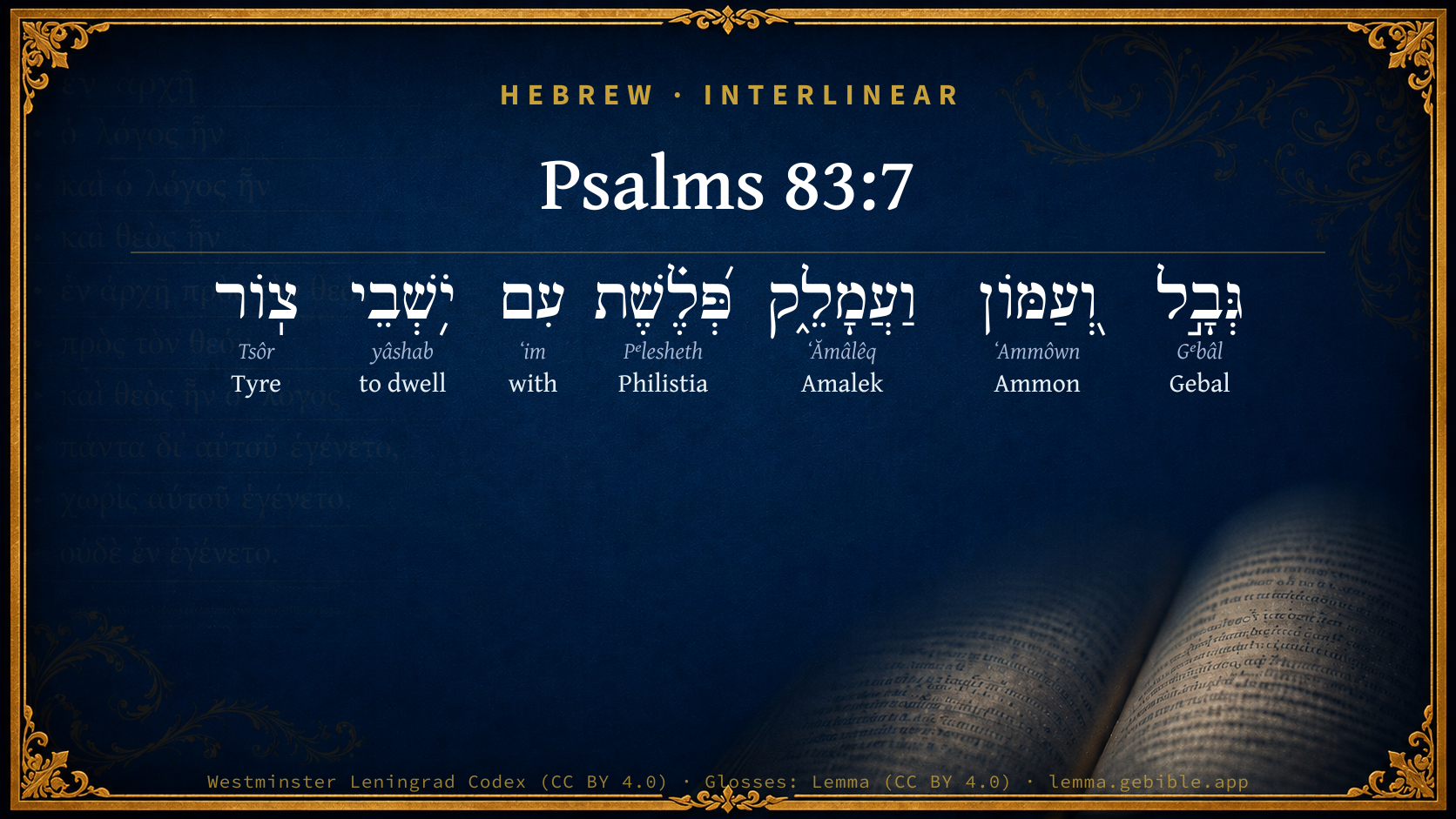
Psalms 83:7

Hebrew (Westminster Leningrad Codex) Psalms 83:7 appears in the Hebrew Old Testament. The text above is from the Westminster Leningrad Codex. Each word links to its Strong’s number, a concise gloss, and parsing drawn from the Open Scriptures Hebrew Bible morphology. Click any word for its full Brown-Driver-Briggs (BDB) entry.
Download image
Cite this verse

Psalms 83:7 (World English Bible). Public Domain. Lemma interlinear Bible study tool, https://lemma.gebible.app/v/psalms/83/7.

Show BibTeX & RIS
BibTeX
RIS
English Translation
Gebal, Ammon, and Amalek; Philistia with the inhabitants of Tyre;
World English Bible · Public Domain
Highlights
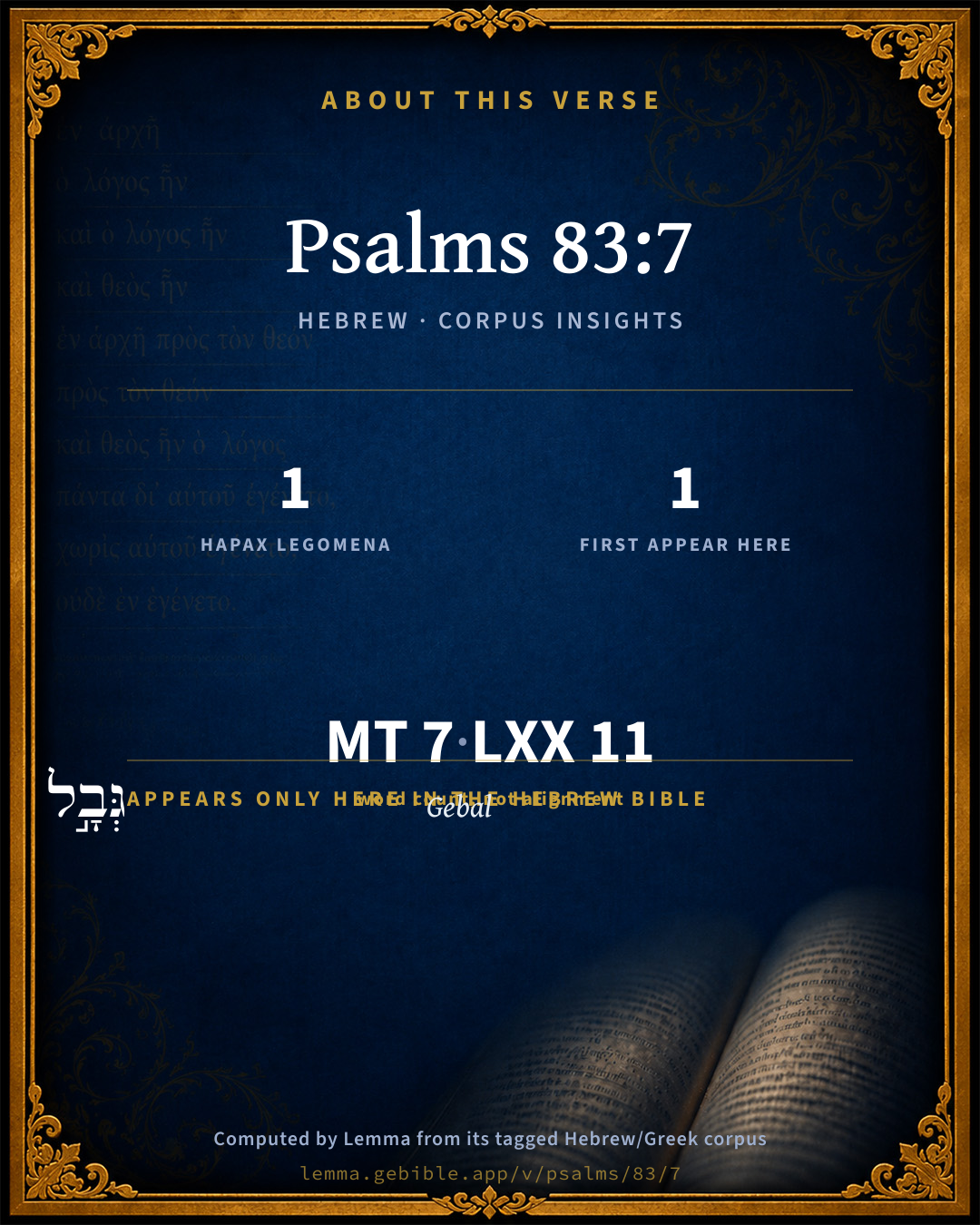
  • 1 hapax legomenon — only here in the Hebrew Bible
  • 1 first appearance in the Hebrew Bible
Full analysis ↓
Download a study sheet

One document with this verse’s original text, its word-by-word gloss line, the meaning frame, cross-references with their text, attributed commentary, and full source and license credits — printable, and it pastes into notes with its structure intact.

This verse Autodidact and up

Study sheet (.html) Plain text (.txt)

A passage Seminary Student

Up to 50 verses in one chapter. A passage sheet keeps up to 6 commentary sources and 12 cross-references per verse, in the order this page ranks them, and says so on the sheet whenever that leaves anything out. Ask for a single verse and you get the Autodidact verse sheet above.

Everything on this page stays free to read, with no account — the sheet is a download of what is already on screen, not access to it.

Want to remove ads? Support Godless Engineer
Compare translations 3

The same verse in 3 English versions, stacked beneath the original-language interlinear above. Click any original word for its lexicon entry.

Each is an independent rendering of the whole verse — the interlinear is not word-aligned to these translations.

Highlighted words mark where these versions differ — a whole-verse word diff, not a word-by-word alignment.

  • World English Bible Public Domain
    Gebal, Ammon, and Amalek; Philistia with the inhabitants of Tyre;
  • King James Version Public Domain
    Gebal, and Ammon, and Amalek; the Philistines with the inhabitants of Tyre;
  • unfoldingWord Literal Text CC BY-SA 4.0
    Gebal and Ammon and Amalek, Philistia with the dwellers of Tyre.

unfoldingWord Literal Text — © unfoldingWord, licensed CC BY-SA 4.0. Word-aligned USFM3 via Door43 (git.door43.org/unfoldingWord/en_ult).

Versions to compare (up to 4)

3 of 4 selected

Show all 18 translations

Every available English version of this verse, each an independent rendering of the whole verse.

  • World English Bible Public Domain
    Gebal, Ammon, and Amalek; Philistia with the inhabitants of Tyre;
  • Berean Standard Bible Public Domain
    of Gebal, Ammon, and Amalek, of Philistia with the people of Tyre.
  • Majority Standard Bible Public Domain
    of Gebal, Ammon, and Amalek, of Philistia with the people of Tyre.
  • King James Version Public Domain
    Gebal, and Ammon, and Amalek; the Philistines with the inhabitants of Tyre;
  • American Standard Version (1901) Public Domain
    Gebal, and Ammon, and Amalek; Philistia with the inhabitants of Tyre:
  • Revised Version (1885) Public Domain
    Gebal, and Ammon, and Amalek; Philistia with the inhabitants of Tyre:
  • Geneva Bible (1599) Public Domain
    Gebal and Ammon, and Amalech, the Philistims with the inhabitants of Tyrus:
  • Douay-Rheims (1899) Public Domain
    the tabernacles of the Edomites, and the Ismahelites: Moab, and the Agarens,
  • Young's Literal Translation Public Domain
    Gebal, and Ammon, and Amalek, Philistia with inhabitants of Tyre,
  • Literal Standard Version CC BY-SA 4.0
    Gebal, and Ammon, and Amalek, Philistia with inhabitants of Tyre,
  • Unlocked Literal Bible CC BY-SA 4.0
    Gebal, Ammon, Amalek; it also includes Philistia and the inhabitants of Tyre.
  • unfoldingWord Literal Text CC BY-SA 4.0
    Gebal and Ammon and Amalek, Philistia with the dwellers of Tyre.
  • Darby Bible Public Domain
    Gebal, and Ammon, and Amalek; Philistia, with the inhabitants of Tyre;
  • World Messianic Bible Public Domain
    Gebal, Ammon, and Amalek; Philistia with the inhabitants of Tyre;
  • Webster's Bible Public Domain
    \\83:6\\The tabernacles of Edom, and the Ishmaelites; of Moab, and the Hagarenes;
  • Free Bible Version CC BY-SA 4.0
    the people of Gebal and Ammon and Amalek, Philistia, and the inhabitants of Tyre.
  • Bible in Basic English Public Domain
    Gebal and Ammon and Amalek; the Philistines and the people of Tyre;
  • JPS Tanakh (1917) Public Domain
    (83-8) Gebal, and Ammon, and Amalek; Philistia with the inhabitants of Tyre;

Literal Standard Version (2020), Covenant Press — licensed CC BY-SA 4.0. Text via the HelloAO Bible API (eBible.org). Unlocked Literal Bible (unfoldingWord) — licensed CC BY-SA 4.0. Text via the HelloAO Bible API (eBible.org). unfoldingWord Literal Text — © unfoldingWord, licensed CC BY-SA 4.0. Word-aligned USFM3 via Door43 (git.door43.org/unfoldingWord/en_ult). Free Bible Version, Dr. Jonathan Gallagher — licensed CC BY-SA 4.0. Text via the HelloAO Bible API (eBible.org).

Word by word

More ways to search: Search by grammar → Find every occurrence → Compare this word →

Practice this passage: Drill this verse → Learn its vocabulary →

About this verse

These counts appear in no published source. They are computed here, from the morphology-tagged text and Lemma’s own curated glosses. What Lemma adds →

7
words
7
distinct lemmas
Wisdom
section

Notable vocabulary

1 hapax legomenon — a word that appears only here in the entire Hebrew Bible:

  • גְּבָ֣ל Gebal H1381

First appearance in Scripture

This word makes its first canonical appearance in the Hebrew Bible here:

  • גְּבָ֣ל Gebal H1381

Shared distinctive vocabulary

פְּ֝לֶ֗שֶׁת Philistia H6429 occurs in 8 verses of the Hebrew Bible. Also found in:

Grammatical profile

  • 1 verb
  • 5 nouns
  • 1 preposition

Verb forms

  • יֹ֥שְׁבֵי Qal · Participle Active

Hebrew & Septuagint length

In English translation the verse runs 10 words from the Hebrew and 14 from the Septuagint (LXX English) — closely comparable.

A rough comparison of the two English renderings, which tokenize alike — not a word-level alignment.

Word counts can differ between the Hebrew and the Greek without any difference in meaning — e.g. the Hebrew direct-object marker אֵת has no separate Greek word, and Greek often adds the article ὁ.

In the original languages it is 7 Hebrew tokens and 11 Greek tokens — but the two are counted differently (Hebrew bundles its prefixes and suffixes into one token; the Greek is in lemma form), so that isn’t a like-for-like length.

Cross-references

6

Topical passages linked to Psalms 83:7 in the Treasury of Scripture Knowledge — connected by theme and wording, ordered by reader-vote popularity; previews shown in the World English Bible.

  • Joshua 13:5 and the land of the Gebalites, and all Lebanon, toward the sunrise, from Baal Gad under Mount Hermon to the entrance of Hamath;
  • Ezekiel 27:3 and tell Tyre, you who dwell at the entry of the sea, who are the merchant of the peoples to many isles, thus says the Lord Yahweh: You, Tyre, have said, I am perfect in beauty.
  • Ezekiel 27:9 The old men of Gebal and the wise men of it were in you your repairers of ship seams: all the ships of the sea with their mariners were in you to deal in your merchandise.
  • 1 Samuel 4:1 The word of Samuel came to all Israel. Now Israel went out against the Philistines to battle, and encamped beside Ebenezer: and the Philistines encamped in Aphek.
  • 1 Samuel 15:2 Thus says Yahweh of Hosts, I have marked that which Amalek did to Israel, how he set himself against him in the way, when he came up out of Egypt.
  • Amos 1:9 Thus says Yahweh: "For three transgressions of Tyre, yes, for four, I will not turn away its punishment; Because they delivered up the whole community to Edom, And didn't remember the brotherly covenant;

Cross-references courtesy of OpenBible.info (CC BY 4.0).

Hebrew and Greek witnesses Masoretic Hebrew ↔ Greek Septuagint

The same verse in the two great witnesses to the Old Testament, shown verse-for-verse.

You’re reading Greek Psalm 82 (Hebrew Psalm 83). The Septuagint counts the superscription, so verse numbers can differ from the Hebrew — chapter-level alignment, not verse-by-verse. Numbering follows Rahlfs.

These are two independent witnesses, not word-aligned to each other, and the Septuagint is shown in lemma (dictionary) form.

Hebrew Psalms 83:7 Masoretic · Westminster Leningrad Codex

גְּבָ֣ל וְ֭עַמּוֹן וַעֲמָלֵ֑ק פְּ֝לֶ֗שֶׁת עִם יֹ֥שְׁבֵי צֽוֹר

Gebal, Ammon, and Amalek; Philistia with the inhabitants of Tyre;

World English Bible · Public Domain

Greek LXX Greek Psalm 82:7 Septuagint · lemma form

ὁ σκήνωμα ὁ ιδουμαίος καί ὁ ισμαηλῖτης μωαβ καί ὁ αγαρηνός

Gebal, and Ammon, and Amalec; the Philistines also, with them that dwell at Tyre.

LXX2012 (modern English Septuagint) · Public Domain

On this verse, Albert Barnes' Notes on the Bible discusses the Septuagint’s reading. Read the note in Commentary ↓

Hebrew: Westminster Leningrad Codex (CC BY 4.0). Greek: Septuagint (public domain); English from LXX2012 (modern English Septuagint) (Public Domain). How the Septuagint differs from the Hebrew →

Commentary

Notes on Psalms 83:7 from classic Christian and Jewish commentators (each source and its license shown beneath its notes). The classic Christian expositions comment on the surrounding passage and are grouped to its opening verse, so a note may address several verses; the Jewish commentaries on the Tanakh (Rashi and others) are per-verse, so they appear only where the commentator wrote on this verse.

Lemma curates 59 commentaries, every one of them public domain or Creative Commons licensed, each selected and text-cleaned for this edition rather than reprinted as found. About our sources →

Trapp's Complete Commentary

John Trapp

Psa 83:7 Gebal, and Ammon, and Amalek; the Philistines with the inhabitants of Tyre;

Ver. 7. Gebal, and Ammon, and Amalek] Sic enarrat et enumerat inimicos decem conglobatos, Eze 27:9. Answerable whereunto were the ten kings of Christendom, who gave their power to the beast. Gebal might be the inhabitants of Gabel, a city of Phoenicia, saith Stephanus; or of Syria, saith Strabo, which Volateran saith was called Gibel in his time, but anciently Biblus. See Jos 13:5.

John Trapp, A Commentary or Exposition upon All the Books of the Old and New Testament (1647–1656) — public domain. Text from a community e-Sword module.

J. A. Alexander on Psalms

Joseph Addison Alexander

8. (Psa 83:7). Gebal and Ammon and Amalek, Philistia with the inhabitants of Tyre. Gebal was probably a part of Idumea. Ammon and Amalek are joined in the same manner, Jdg 3:13, as Philistia and Tyre are, Eze 38:13, and Philistia, Tyre, and Edom, Amo 1:6-10.

Joseph Addison Alexander, The Psalms Translated and Explained (1850) — public domain. Text from a community e-Sword module.

Tyndale Open Study Notes

Tyndale Open Resources

83:7 The Gebalites probably came from Gebal/Byblos on the coast of Lebanon. • The Amalekites were located south of Israel in the Negev. • Philistia was southwest of Judah, by the Mediterranean Sea. • Tyre was a port city on the Mediterranean, northwest of Israel.

Tyndale Open Study Notes — © Tyndale Open Resources, licensed CC BY-SA 4.0. Text via the HelloAO Bible API.

Geneva Bible (1599)

Geneva Bible translators

Or, Zor.

Geneva Bible (1599) marginal notes — public domain. Text via Bolls.life.

Adam Clarke's Commentary

Verse 7. Gebal] The Giblites, who were probably the persons here designed, were a tribe of the ancient inhabitants of the land of Canaan, and are mentioned as unconquered at the death of Joshua, Jos 13:5. They are called stone-squarers or Giblites, 1Kg 5:18, and were of considerable assistance to Hiram king of Tyre, in preparing timber and stones for the building of the temple. They appear to have been eminent in the days of Ezekiel, who terms them the "ancients of Gebal, and the wise men-thereof," who were ship-builders, Eze 27:3. What is now called Gibyle, a place on the Mediterranean Sea, between Tripoli and Sidon, is supposed to be the remains of the city of the Giblites.

Ammon and Moab were then descendants of the children of Lot. Their bad origin is sufficiently known. See Ge 19:30, c. Calmet supposes that Ammon is put here for Men or Maon, the Meonians, a people who lived in the neighbourhood of the Amalekites and Idumeans. See the notes on 2Ch 20:1; 2Ch 26:7.

Amalek] The Amalekites are well known as the ancient and inveterate enemies of the Israelites. They were neighbours to the Idumeans.

The Philistines] These were tributaries to Jehoshaphat, 2Ch 17:11; but it seems they took advantage of the present times, to join in the great confederacy against him.

The inhabitants of Tyre] These probably joined the confederacy in hopes of making conquests, and extending their territory on the main land.

Adam Clarke's Commentary on the Bible (1810–1826) — public domain. Text from a community e-Sword/MySword module.

Ellicott's Commentary for English Readers

(7) Gebal.—If this is a noun, as generally supposed, and as printed in the text, we must take it as a synonym of Edom (the Gebalene of Eusebius). The Gebal of Eze_27:9 is not to be thought of; but it is most likely a verb:

“Both Ammon and Amalek are joined together,

The Philistines (are joined) with the men of Tyre.”

A Bible Commentary for English Readers, edited by Charles John Ellicott (1878–1897) — public domain. Text from a community e-Sword module.

The Cambridge Bible for Schools and Colleges

gen. ed. J. J. S. Perowne

7. the Philistines] Lit. Philistia. In Amo_1:6 ff., Amo_1:9 ff., Philistia and Tyre are censured for surrendering Israelite captives to Edom, which in its turn (Psa_83:11) is condemned for unbrotherly hostility to Israel.

The Cambridge Bible for Schools and Colleges (gen. ed. J. J. S. Perowne; Cambridge University Press, 1878–1918) — public domain. Text from a community e-Sword module.

John Gill's Exposition

Gebal,.... Gubleans, or Gebalites, as the Targum; the same with Giblites, Jos 23:5, or men of Gebal, Eze 27:9 the same with Byblus: these dwelt in Phoenicia, near Tyre, where Pliny (g) makes mention of a place called Gabale: the Syriac version joins it with Ammon, and renders it "the border of Ammon":

and Ammon and Amalek, the Philistines, with the inhabitants of Tyre; these are well known in Scripture, and as the enemies of Israel.

(g) Nat. Hist. l. 5. c. 20.

John Gill's Exposition of the Whole Bible (1746–1763) — public domain (CC PDM 1.0). Text via the HelloAO Bible API.

Albert Barnes' Notes on the Bible

Gebal - The Gebal here referred to was probably the same as Gebalene, the mountainous tract inhabited by the Edomites, extending from the Dead Sea southward toward Petra, and still called by the Arabs Djebal. (Gesenius, Lexicon) The word means mountain. Those who are here referred to were a part of the people of Edom.

And Ammon - The word Ammon means son of my people. Ammon was the son of Lot by his youngest daughter, Gen 19:38. The Ammonites, descended from him, dwelt beyond the Jordan in the tract of country between the streams of Jabbok and Arnon. These also would be naturally associated in such a confederacy. 1Sa 11:1-11.

And Amalek - The Amalekites were a very ancient people: In the traditions of the Arabians they are reckoned among the aboriginal inhabitants of that country. They inhabited the regions on the south of Palestine, between Idumea and Egypt. Compare Exo 17:8-16; Num 13:29; 1Sa 15:7. They also extended eastward of the Dead Sea and Mount Seir Num 24:20; Jdg 3:13; Jdg 6:3, Jdg 6:33; and they appear also to have settled down in Palestine itself, whence the name the Mount of the Amalekites, in the territory of Ephraim, Jdg 12:15.

The Philistines - Often mentioned in the Scriptures. They were the ancient inhabitants of Palestine, whence the name Philistia or Palestine. The word is supposed to mean the land of sojourners or strangers; hence, in the Septuagint they are uniformly called ἀλλοφύλοι allophuloi, those of another tribe, strangers, and their country is called γῆ ἀλλοφύλων gē allophulōn. They were constant enemies of the Hebrews, and it was natural that they should be engaged in such an alliance as this.

With the inhabitants of Tyre - On the situation of Tyre, see the Introduction to Isa. 23. Why Tyre should unite in this confederacy is not known. The purpose seems to have been to combine as many nations as possible against the Hebrew people, and - as far as it could be done - all those that were adjacent to it, so that it might be surrounded by enemies, and so that its destruction might be certain. It would not probably be difficult to find some pretext for inducing any of the kings of the surrounding nations to unite in such an unholy alliance. Kings, in general, have not been unwilling to form alliances against liberty.

Albert Barnes' Notes on the Bible (1834–1885) — public domain. Text from a community e-Sword/MySword module.

Matthew Poole's English Annotations

Gebal; either,

1. The Giblites or Gebalites, dwelling near Zidon, of whom 1Ki 5:18; Eze 27:9. Or,

2. An Arabian people, so called by ancient writers, dwelling in the southern border of Canaan, where most of the people here mentioned had their abode. Yet some of these were in the northern parts, and not far from the other Gebal, as some of the Philistines and the Tyrians.

Matthew Poole's English Annotations on the Holy Bible (1683–1685) — public domain. Text from a community e-Sword/MySword module.

The Treasury of David

Charles H. Spurgeon

Ver. 7. Gebal was probably a near neighbour of Edom, though there was a Gebal in the region of Tyre and Sidon.

And Ammon, and Amalek. Two other hereditary foes of Israel, fierce and remorseless as ravening wolves. In the roll of infamy let these names remain detestably immortalised. How thick they stand. Their name is legion, for they are many. Alas, poor Israel, how art thou to stand against such a Bloody League? Nor is this all. Here comes another tribe of ancient foemen,

the Philistines; who once blinded Samson, and captured the ark of the Lord; and here are old allies become new enemies; the builders of the temple conspiring to pull it down, even

the inhabitants of Tyre. These last were mercenaries who cared not at whose bidding they drew sword, so long as they carved something for their own advantage. True religion has had its quarrel with merchants and craftsmen, and because it has interfered with their gains, they have conspired against it.

Ver. 7. Gebal.

1. It is generally supposed to indicate the mountainous tract extending from the Dead Sea southward to Petra, still named Jebal. But some of the best writers identify it with No. 2, as mentioned in conjunction with Tyre.

2. A place spoken of in connection with Tyre, Eze 27:9. Most probably the residence of the Giblites, and therefore to the north of Palestine, Jos 13:5. The Giblites were employed by Hiram, king of Tyre, in preparing materials for Solomon's temple, 1Ki 5:18, margin. The Greek name of this place was Byblus. The town is called Jebeil, and has a population of about six hundred. It is about seventeen miles north of Beyroot. The ancient ruins are very extensive. Immense numbers of granite columns are strewn about in the village and over the surrounding fields. These columns are mostly small, varying from one foot to two feet in diameter. Some of the stones measure nearly twenty feet in length. The citadel is the most remarkable ruin. The port is nearly choked up with sand and ruins. George H. Whitney's "Hand Book of Bible Geography." 1872

None.

Psalms 83:8*

Charles H. Spurgeon's The Treasury of David (1869–1885) — public domain. Psalms only. Text from a community e-Sword/MySword module.

Whedon's Commentary on the Bible

Daniel D. Whedon

7. Gebal—Not the one mentioned, Eze_27:9, which was an important city of Phoenicia, the people of which are called “Giblites,” (Jos_13:5, translated “stone squarers,” 1Ki_5:18,) for these would probably be included under Tyre, being one of its cities or dependencies, mentioned in this same verse. But the name here seems rather to apply to the mountainous district lying south of the Dead Sea on the east of the Ghor, and north of the territory of Edom proper, known anciently as Gebalene, and now by the name Jebel, that is, mountain. It was settled, according to Josephus, by the sons of Eliphaz, son of Esau.

Ammon—Brother of Moab. Gen_19:37-38. They dwelt east of Gilead and northeast of Moab.

Amalek—A nomadic people of uncertain but ancient origin, (Gen_14:7,) roaming between the mountains of Edom on the east, and Egypt on the west, in the peninsula of Mount Sinai. Exo_17:8; Deu_25:17-18; 1Sa_15:7.Philistines—A powerful people on the west of Judah, the persistent enemies of Israel, descended from Mizraim. Gen_10:13-14.

Tyre— The commercial metropolis of the world, and the chief city of Phoenicia, on the northwest coast of Palestine. The old friendship between this city and the Hebrews, in the days of David and Solomon, was now forgotten, probably chiefly through the influence of the Phoenician princess, Jezebel. 1Ki_16:31

Daniel D. Whedon (gen. ed.), Commentary on the Old and New Testaments (1874–1909) — public domain. Text from a community e-Sword module.

The Pulpit Commentary

Gebal. There is no reason to doubt that the Phoenician town of the name, mentioned in Eze_27:9, and alluded to in Jos_13:5 and 1Ki_5:18, is meant. A southern Gebal, in the vicinity of Edom, is a fiction. Gebal was one of the most important of the Phoenician cities from the time of Shalmaneser II (B.C. 828-810) to that of Nebuchadnezzar (B.C. 635-560); see the author"s "History of Phoenicia," p. 79. And Ammon. Ammon, like Moab, was a perpetual enemy of the Jewish people from their entrance into Palestine to the time of the Maccabees. And Amalek. The Amalekites, on the contrary, disappear from history from the time of their destruction by the Simeonites in the reign of Hezekiah. (1Ch 5:42, 1Ch 5:43) The Philistines. Persistent enemies, like Edom, Moab, and Ammon. (see RAPC 1Ma 5:66) With the inhabitants of Tyre. Tyre, in early times, was friendly to Israel. (2Sa_5:11 1Ki_5:1-18 1Ki_9:26-28) and is not elsewhere mentioned as hostile until the reign of Uzziah. (Amo_1:9) She rejoiced, however, when Jerusalem was destroyed. (Eze_26:2)

The Pulpit Commentary (1880–1919), ed. H.D.M. Spence-Jones & Joseph S. Exell — public domain. Text from a community e-Sword module.

John Wesley's Explanatory Notes

Gebal - An Arabian people so called by ancient writers dwelling in the southern border of Canaan, where most of the people here mentioned had their abode.

John Wesley, Explanatory Notes Upon the Whole Bible (1754–1765) — public domain. Text via the GEBible commentary corpus.

Lesson kit

Teaching starters — assembled from the data on this page, not authored interpretation. Every prompt links to the verse data it draws on. Edit before teaching.

Psalms, in the Wisdom, opens this verse with 7 words (7 distinct Hebrew lemmas). Its most distinctive word is Gᵉbâl (“Gebal”). A historical commentator’s framing appears above. Read the whole chapter for the surrounding context.

Discussion questions

  1. What does “Gebal” (Gᵉbâl) contribute to the verse as a whole?
  2. This verse holds 1 word here found nowhere else in the Hebrew Bible. What might the rare word draw attention to?
  3. The word “Gebal” first appears here in Scripture. What is being introduced at this debut?
  4. Exodus 15:14 shares the word «Philistia» with this verse. How do the two illuminate each other?
  5. These translations render this verse differently; the difference is in the English rendering, not the original. What questions does that raise?
  6. The verb «יֹ֥שְׁבֵי» is Qal Participle Active. How does its form color the action?
  7. Reading how Trapp's Complete Commentary and J. A. Alexander on Psalms read this verse, where do the two commentators agree and where do they part?

Things to notice

Reading settings

Reading text

Shown beneath each verse's original-language words.

Old Testament
Old Testament edition

Read the OT as the Masoretic Hebrew (MT) or the Greek Septuagint (LXX).

English shown for the Greek Septuagint (in the Hebrew ↔ Greek comparison).

Comparing translations? Open the Compare panel on any verse page to stack up to four side by side.