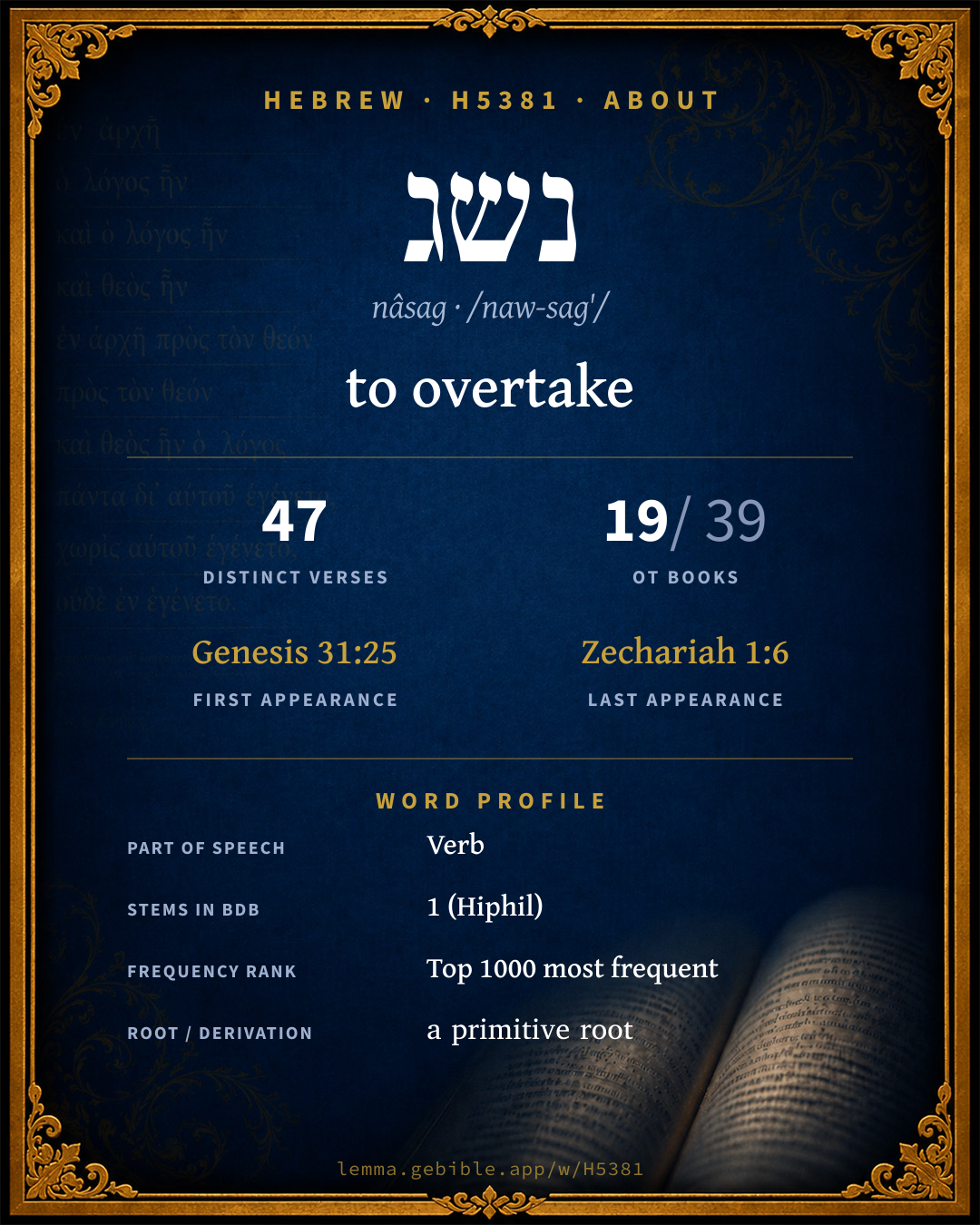
נָשַׂג
to overtake
‘to overtake’ is one of 4 main senses fuller range ↓
Full lexicon entry — Brown-Driver-Briggs (BDB)
From Brown-Driver-Briggs (BDB)
Where this word appears
Grammar key — what these labels mean
Part of speech
- Verb
- An action or state-of-being word.
Stem
- Hiphil
- The causative active stem (“he caused / brought about”). Here: ‘overtake’
Form
- Imperfect
- An incomplete, ongoing, or future action (“he will / would write”).
- Sequential Imperfect
- An imperfect with prefixed waw — the standard past-narrative form (waw-consecutive imperfect).
- Sequential Perfect
- A perfect with prefixed waw continuing a preceding imperfect or command (waw-consecutive perfect).
- Perfect
- A completed action or state — Hebrew marks aspect (completeness) more than strict tense (“he wrote”).
- Jussive
- A third- or second-person volitional form expressing wish or command (“let him write”).
- Participle Active
- A verbal adjective expressing ongoing or characteristic action (“writing / one who writes”).
- Infinitive Absolute
- An unbound verbal noun, often intensifying or standing in for a finite verb.
State
- Absolute
- The independent form of a noun, not bound to a following word.
- Construct
- A noun bound to a following noun in a possessive / “of” relationship (the construct chain).
Person
- 3rd Person
- The one spoken about (“he / she / it / they”).
- 1st Person
- The speaker (“I / we”).
- 2nd Person
- The one addressed (“you”).
Gender
- Feminine
- Grammatically feminine.
- Masculine
- Grammatically masculine.
- Common
- Either gender — not distinguished for this form.
Number
- Singular
- One.
- Plural
- More than one (in Hebrew, generally three or more).
Grammatical forms 19 distinct
- Verb, Hiphil, Imperfect, 3rd Person, Feminine, Singular 14 times (28%)
- Verb, Hiphil, Sequential Imperfect, 3rd Person, Masculine, Plural 4 times (8%)
- Verb, Hiphil, Imperfect, 3rd Person, Masculine, Plural 4 times (8%)
- Verb, Hiphil, Perfect, 3rd Person, Common, Plural 4 times (8%)
- Verb, Hiphil, Sequential Perfect, 3rd Person, Common, Plural 3 times (6%)
- Verb, Hiphil, Imperfect, 1st Person, Common, Singular 3 times (6%)
- Verb, Hiphil, Sequential Perfect, 3rd Person, Masculine, Singular 3 times (6%)
- Verb, Hiphil, Sequential Imperfect, 3rd Person, Masculine, Singular 2 times (4%)
+11 more forms (13 occurrences)
Parsed forms decoded from the imported morphology (morphhb / Westminster Leningrad Codex — WLC text public domain, morphhb tagging CC BY 4.0), counted across 50 parsed occurrences — not distinct verses.
Every verse where H5381 appears — 47 distinct verses across 19 books. Click any verse to open its interlinear word-by-word view. Verse text shown in the World English Bible for context — . Each verse’s Hebrew form is shown with its reference; the English is not keyword-highlighted, since the data carries no word-level English alignment. Use “Compare translations” on any verse to read it across multiple English versions. This concordance covers the Hebrew Bible; Septuagint (Greek Old Testament) occurrences are not indexed here.
Genesis 4 verses
- Genesis 31:25 וַ/יַּשֵּׂ֥ג conj + Hiphil wimpf 3ms Laban caught up with Jacob. Now Jacob had pitched his tent in the mountain, and Laban with his relatives encamped in the mountain of Gilead.
- Genesis 44:4 וְ/הִשַּׂגְתָּ/ם֙ conj + Hiphil wpf 2ms + sfx pers 3mp When they had gone out of the city, and were not yet far off, Joseph said to his steward, "Up, follow after the men. When you overtake them, ask them, 'Why have you rewarded evil for good?
- Genesis 44:6 וַֽ/יַּשִּׂגֵ֑/ם conj + Hiphil wimpf 3ms + sfx pers 3mp He overtook them, and he spoke to them these words.
- Genesis 47:9 הִשִּׂ֗יגוּ Hiphil pf 3cp Jacob said to Pharaoh, "The days of the years of my pilgrimage are one hundred thirty years. Few and evil have been the days of the years of my life, and they have not attained to the days of the years of the life of my fathers in the days of their pilgrimage."
Exodus 2 verses
- Exodus 14:9 וַ/יַּשִּׂ֤יגוּ conj + Hiphil wimpf 3mp The Egyptians pursued after them: all the horses and chariots of Pharaoh, his horsemen, and his army; and overtook them encamping by the sea, beside Pihahiroth, before Baal Zephon.
- Exodus 15:9 אַשִּׂ֖יג Hiphil impf 1cs The enemy said, 'I will pursue, I will overtake, I will divide the spoil. My desire shall be satisfied on them. I will draw my sword, my hand shall destroy them.'
Leviticus 11 verses
- Leviticus 5:11 תַשִּׂ֨יג Hiphil impf 3fs "'But if he can't afford two turtledoves, or two young pigeons, then he shall bring his offering for that in which he has sinned, the tenth part of an ephah of fine flour for a sin offering. He shall put no oil on it, neither shall he put any frankincense on it, for it is a sin offering.
- Leviticus 14:21 מַשֶּׂגֶת֒ Hiphil ptcp.act fs "If he is poor, and can't afford so much, then he shall take one male lamb for a trespass offering to be waved, to make atonement for him, and one tenth of an ephah of fine flour mingled with oil for a meal offering, and a log of oil;
- Leviticus 14:22 תַּשִּׂ֖יג Hiphil impf 3fs and two turtledoves, or two young pigeons, such as he is able to afford; and the one shall be a sin offering, and the other a burnt offering.
- Leviticus 14:30 תַּשִּׂ֖יג Hiphil impf 3fs He shall offer one of the turtledoves, or of the young pigeons, such as he is able to afford,
- Leviticus 14:31 תַּשִּׂ֞יג Hiphil impf 3fs even such as he is able to afford, the one for a sin offering, and the other for a burnt offering, with the meal offering. The priest shall make atonement for him who is to be cleansed before Yahweh."
- Leviticus 14:32 תַשִּׂ֥יג Hiphil impf 3fs This is the law for him in whom is the plague of leprosy, who is not able to afford the sacrifice for his cleansing.
- Leviticus 25:26 וְ/הִשִּׂ֣יגָה conj + Hiphil wpf 3fs If a man has no one to redeem it, and he becomes prosperous and finds sufficient means to redeem it;
- Leviticus 25:47 תַשִּׂ֗יג Hiphil impf 3fs "'If a stranger or sojourner with you becomes rich, and your brother beside him has grown poor, and sells himself to the stranger or foreigner living among you, or to a member of the stranger's family;
- Leviticus 25:49 הִשִּׂ֥יגָה Hiphil pf 3fs or his uncle, or his uncle's son, may redeem him, or any who is a close relative to him of his family may redeem him; or if he has grown rich, he may redeem himself.
- Leviticus 26:5 וְ/הִשִּׂ֨יג יַשִּׂ֣יג conj + Hiphil wpf 3ms Hiphil impf 3ms Your threshing shall reach to the vintage, and the vintage shall reach to the sowing time; and you shall eat your bread to the full, and dwell in your land safely.
- Leviticus 27:8 תַּשִּׂיג֙ Hiphil impf 3fs But if he is poorer than your valuation, then he shall be set before the priest, and the priest shall value him; according to the ability of him who vowed shall the priest value him.
Numbers 1 verse
Deuteronomy 4 verses
- Deuteronomy 19:6 וְ/הִשִּׂיג֛/וֹ conj + Hiphil wpf 3ms + sfx pers 3ms lest the avenger of blood pursue the manslayer, while his heart is hot, and overtake him, because the way is long, and strike him mortally; whereas he was not worthy of death, inasmuch as he didn't hate him in time past.
- Deuteronomy 28:2 וְ/הִשִּׂיגֻ֑/ךָ conj + Hiphil wpf 3cp + sfx pers 2ms and all these blessings shall come on you, and overtake you, if you shall listen to the voice of Yahweh your God.
- Deuteronomy 28:15 וְ/הִשִּׂיגֽוּ/ךָ conj + Hiphil wpf 3cp + sfx pers 2ms But it shall come to pass, if you will not listen to the voice of Yahweh your God, to observe to do all his commandments and his statutes which I command you this day, that all these curses shall come on you, and overtake you.
- Deuteronomy 28:45 וְ/הִשִּׂיג֔וּ/ךָ conj + Hiphil wpf 3cp + sfx pers 2ms All these curses shall come on you, and shall pursue you, and overtake you, until you are destroyed; because you didn't listen to the voice of Yahweh your God, to keep his commandments and his statutes which he commanded you:
Joshua 1 verse
1 Samuel 2 verses
- 1 Samuel 14:26 מַשִּׂ֤יג Hiphil ptcp.act ms When the people were come to the forest, behold, the honey dropped: but no man put his hand to his mouth; for the people feared the oath.
- 1 Samuel 30:8 הַֽ/אַשִּׂגֶ֑/נּוּ הַשֵּׂ֥ג תַּשִּׂ֖יג ptcl inter + Hiphil impf 1cs + sfx pers 3ms Hiphil inf.abs Hiphil impf 2ms David inquired of Yahweh, saying, If I pursue after this troop, shall I overtake them? He answered him, Pursue; for you shall surely overtake [them], and shall without fail recover [all].
2 Samuel 1 verse
2 Kings 1 verse
1 Chronicles 1 verse
Job 3 verses
- Job 24:2 יַשִּׂ֑יגוּ Hiphil impf 3mp There are people who remove the landmarks. They violently take away flocks, and feed them.
- Job 27:20 תַּשִּׂיגֵ֣/הוּ Hiphil impf 3fs + sfx pers 3ms Terrors overtake him like waters; A tempest steals him away in the night.
- Job 41:26 מַשִּׂיגֵ֣/הוּ Hiphil ptcp.act ms cs + sfx pers 3ms If one lay at him with the sword, it can't avail; Nor the spear, the dart, nor the pointed shaft.
Psalms 4 verses
- Psalms 7:5 וְ/יַשֵּׂ֗ג conj + Hiphil juss 3ms Let the enemy pursue my soul, and overtake it; Yes, let him tread my life down to the earth, And lay my glory in the dust. Selah.
- Psalms 18:37 וְ/אַשִּׂיגֵ֑/ם conj + Hiphil impf 1cs + sfx pers 3mp I will pursue my enemies, and overtake them. Neither will I turn again until they are consumed.
- Psalms 40:12 הִשִּׂיג֣וּ/נִי Hiphil pf 3cp + sfx pers 1cs For innumerable evils have surrounded me. My iniquities have overtaken me, so that I am not able to look up. They are more than the hairs of my head. My heart has failed me.
- Psalms 69:24 יַשִּׂיגֵֽ/ם Hiphil impf 3ms + sfx pers 3mp Pour out your indignation on them. Let the fierceness of your anger overtake them.
Proverbs 1 verse
Isaiah 3 verses
- Isaiah 35:10 יַשִּׂ֔יגוּ Hiphil impf 3mp and the ransomed of Yahweh shall return, and come with singing to Zion; and everlasting joy shall be on their heads: they shall obtain gladness and joy, and sorrow and sighing shall flee away.
- Isaiah 51:11 יַשִּׂיג֔וּ/ן Hiphil impf 3mp + sfx n The ransomed of Yahweh shall return, and come with singing to Zion; and everlasting joy shall be on their heads: they shall obtain gladness and joy; [and] sorrow and sighing shall flee away.
- Isaiah 59:9 תַשִּׂיגֵ֖/נוּ Hiphil impf 3fs + sfx pers 1cp Therefore is justice far from us, neither does righteousness overtake us: we look for light, but, behold, darkness; for brightness, but we walk in obscurity.
Jeremiah 3 verses
- Jeremiah 39:5 וַ/יַּשִּׂ֣גוּ conj + Hiphil wimpf 3mp But the army of the Chaldeans pursued after them, and overtook Zedekiah in the plains of Jericho: and when they had taken him, they brought him up to Nebuchadrezzar king of Babylon to Riblah in the land of Hamath; and he gave judgment on him.
- Jeremiah 42:16 תַּשִּׂ֥יג Hiphil impf 3fs then it shall happen, that the sword, which you fear, shall overtake you there in the land of Egypt; and the famine, about which you are afraid, shall follow hard after you there in Egypt; and there you shall die.
- Jeremiah 52:8 וַ/יַּשִּׂ֥יגוּ conj + Hiphil wimpf 3mp But the army of the Chaldeans pursued after the king, and overtook Zedekiah in the plains of Jericho; and all his army was scattered from him.
Lamentations 1 verse
Ezekiel 1 verse
Hosea 2 verses
- Hosea 2:7 תַשִּׂ֣יג Hiphil impf 3fs She will follow after her lovers, But she won't overtake them; And she will seek them, But won't find them. Then she will say, 'I will go and return to my first husband; For then was it better with me than now.'
- Hosea 10:9 תַשִּׂיגֵ֧/ם Hiphil impf 3fs + sfx pers 3mp "Israel, you have sinned from the days of Gibeah. There they remained. The battle against the children of iniquity doesn't overtake them in Gibeah.
Zechariah 1 verse
About this entry
At a glance — auto-summarized from this page’s data, not written by a person. Every figure links to its source below. This summary describes the numbers; it doesn’t interpret them.
נשג (nâsag) is a Hebrew verb most often rendered “to overtake.” Older and newer Bibles part ways — “overtook” in the King James Version, “reaches” (unfoldingWord Literal Text) in modern versions. See the renderings breakdown. It turns up in 47 verses across 19 books, a moderately common footprint. Scripture first uses it in Genesis 31:25. Not a single-sense word: explore its full sense range. The sections below give every sense, occurrence, and version rendering.
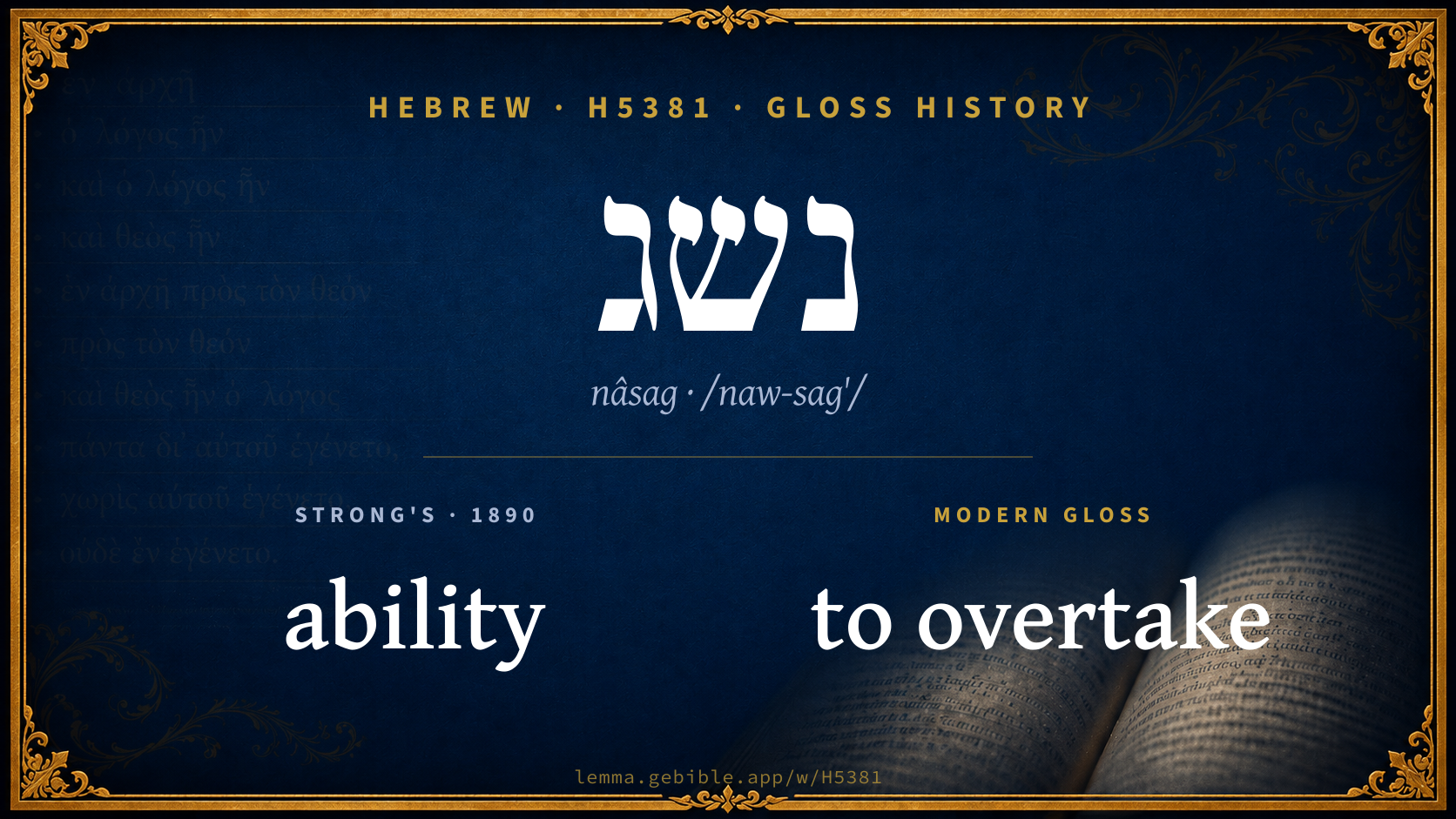
Gloss history
Strong's 1890 vs modern scholarship
About this word
Strong's H5381 catalogs a Hebrew word from the Hebrew Old Testament.
These counts are not copied from any lexicon or concordance. They are computed here, from the morphology-tagged Hebrew Old Testament. What Lemma adds →
- 47
- distinct verses
- The word appears in 47 distinct verses.
- 19 / 39
- OT books
- The word appears in 19 of 39 Old Testament books.
- #739
- by frequency
- Top 1000 most frequent Hebrew words (rank 739 of 8,640 Hebrew words by occurrence).
View all 47 occurrences in the concordance →
Most concentrated in
- Leviticus 11 verses 23%
- Genesis 4 verses 9%
- Deuteronomy 4 verses 9%
By section of the Old Testament
By traditional corpus
Conventional, traditional groupings — biblical authorship is debated, so this is a traditional corpus grouping, not an authorship claim. Each share is this word’s portion of its verses in that division of the Hebrew canon. Each figure is a share of the word’s 47 distinct verses.
- Torah (Pentateuch) 22 verses · 47%
- Prophets (Nevi'im) 15 verses · 32%
- Writings (Ketuvim) 10 verses · 21%
How translations render this word
Counts come from each version’s own published word-to-Strong’s tagging or interlinear alignment — an approximate guide to how each version renders this word, not a word-level alignment the data otherwise carries. Because each total is that version’s own tagged count, the per-version totals vary from one another and need not match the appearance or distinct-verse counts above. These counts may also differ from a printed concordance because Lemma counts each distinctly tagged rendering and does not collapse phrase taggings into a single head-word total. This is a fixed set of word-tagged versions (KJV, ASV, BSB, ULT) and does not change with the reading translation you choose elsewhere. Each version’s license is shown beside its name below (and on Sources).
- King James Version: Overtook 6×, Overtake 3×, Thee and overtake 3×
- American Standard Version: Overtake 5×, Overtook 4×, Shall reach 2×
- Berean Standard Bible: Overtook 5×, He can afford 3×, Overtake 3×
- unfoldingWord Literal Text: Reaches 6×, And 4×, Does 3×
King James Version Public Domain
Renders H5381 across 45 tagged occurrences — most commonly:
Plus 27 renderings that appear only once — usually multi-word phrases or single function words the recovered tagging swept in, not distinct renderings. Not rendered by a distinct English word in 5 further occurrences.
American Standard Version Public Domain
Renders H5381 across 45 tagged occurrences — most commonly:
Plus 30 renderings that appear only once — usually multi-word phrases or single function words the recovered tagging swept in, not distinct renderings.
Berean Standard Bible Public Domain
Renders H5381 across 47 tagged occurrences — most commonly:
Plus 21 renderings that appear only once — usually multi-word phrases or single function words the recovered tagging swept in, not distinct renderings. Not rendered by a distinct English word in 3 further occurrences.
unfoldingWord Literal Text CC BY-SA 4.0
Renders H5381 across 65 tagged occurrences — most commonly:
Plus other, less common renderings. Plus 30 renderings that appear only once — usually multi-word phrases or single function words the recovered tagging swept in, not distinct renderings.
Senses in the full BDB
What do BDB’s symbols mean?
BDB uses these scholarly abbreviations:
| Symbol | Meaning |
|---|---|
| 𝔊 | the Septuagint (the ancient Greek translation, LXX) |
| 𝔙 | the Vulgate (the Latin translation) |
| 𝔖 | the Syriac version (the Peshitta) |
| 𝔗 | the Targum (the Aramaic translation) |
| ψ | the Psalms |
| √ | root (the underlying root or stem) |
| ‖ | parallel passage (a synonymous or contrasted parallel) |
| † | the dagger: every passage where the word occurs is cited |
The 4 senses and sub-senses the full Brown-Driver-Briggs lexicon distinguishes for this word, in lexicon order (not ranked by frequency), with BDB’s own verbatim wording and sub-sense lettering. Shown in Hebrew script with BDB’s own scholarly abbreviations. The condensed entry is in the Lexicon Entry tab. See also the Forms in the corpus table below.
Hiphil
- 1. overtake
- 2.
- a. reach, attain
- b. cause to reach, bring, put
- 3. fig. one’s hand has reached, i.e. one is able, or has enough
Senses from the full Brown-Driver-Briggs lexicon (Brown, Driver, Briggs; Oxford 1906 — public domain), digitized via Sefaria, supplemented by the OpenScriptures HebrewLexicon (CC BY 4.0). Full attribution on Sources.
Word origin
[ נָשַׂג ] vb. only Hiph. reach, overtake
— Brown-Driver-Briggs (Oxford 1906, public domain), digitized via Sefaria, supplemented by the OpenScriptures HebrewLexicon (CC BY 4.0). See Sources.
Origin: a primitive root
Forms in the corpus
The 47 distinct written forms H5381 takes in the Hebrew Bible, most frequent first — each parse links to that stem’s occurrences in the concordance. Hebrew forms include their vowel points and cantillation, so a single lemma takes many written forms.
| Form | Parsing | Example | Uses |
|---|---|---|---|
| תַּשִּׂ֖יג | Verb, Hiphil, Imperfect, 3rd Person, Feminine, Singular | Ezekiel 46:7 | 4 |
| אַשִּׂ֖יג | Verb, Hiphil, Imperfect, 1st Person, Common, Singular | Exodus 15:9 | 1 |
| הִשִּׂ֖יגוּ | Verb, Hiphil, Perfect, 3rd Person, Common, Plural | Zechariah 1:6 | 1 |
| הִשִּׂ֗יגוּ | Verb, Hiphil, Perfect, 3rd Person, Common, Plural | Genesis 47:9 | 1 |
| הִשִּׂ֥יגָה | Verb, Hiphil, Perfect, 3rd Person, Feminine, Singular | Leviticus 25:49 | 1 |
| הִשִּׂיג֖וּ/הָ | Verb, Hiphil, Perfect, 3rd Person, Common, Plural | Lamentations 1:3 | 1 |
| הִשִּׂיג֣וּ/נִי | Verb, Hiphil, Perfect, 3rd Person, Common, Plural | Psalms 40:12 | 1 |
| הַֽ/אַשִּׂגֶ֑/נּוּ | Verb, Hiphil, Imperfect, 1st Person, Common, Singular | 1 Samuel 30:8 | 1 |
| הַשֵּׂ֥ג | Verb, Hiphil, Infinitive Absolute | 1 Samuel 30:8 | 1 |
| וְ/אַשִּׂיגֵ֑/ם | Verb, Hiphil, Imperfect, 1st Person, Common, Singular | Psalms 18:37 | 1 |
| וְ/הִשִּׂ֣יגָה | Verb, Hiphil, Sequential Perfect, 3rd Person, Feminine, Singular | Leviticus 25:26 | 1 |
| וְ/הִשִּׂ֨יג | Verb, Hiphil, Sequential Perfect, 3rd Person, Masculine, Singular | Leviticus 26:5 | 1 |
| וְ/הִשִּׂגָ֨/נוּ֙ | Verb, Hiphil, Sequential Perfect, 3rd Person, Masculine, Singular | 2 Samuel 15:14 | 1 |
| וְ/הִשִּׂיג֔וּ/ךָ | Verb, Hiphil, Sequential Perfect, 3rd Person, Common, Plural | Deuteronomy 28:45 | 1 |
| וְ/הִשִּׂיג֛/וֹ | Verb, Hiphil, Sequential Perfect, 3rd Person, Masculine, Singular | Deuteronomy 19:6 | 1 |
| וְ/הִשִּׂיגֻ֑/ךָ | Verb, Hiphil, Sequential Perfect, 3rd Person, Common, Plural | Deuteronomy 28:2 | 1 |
| וְ/הִשִּׂיגֽוּ/ךָ | Verb, Hiphil, Sequential Perfect, 3rd Person, Common, Plural | Deuteronomy 28:15 | 1 |
| וְ/הִשַּׂגְתָּ/ם֙ | Verb, Hiphil, Sequential Perfect, 2nd Person, Masculine, Singular | Genesis 44:4 | 1 |
| וְ/יַשֵּׂ֗ג | Verb, Hiphil, Jussive, 3rd Person, Masculine, Singular | Psalms 7:5 | 1 |
| וַ/יַּשִּׂ֣גוּ | Verb, Hiphil, Sequential Imperfect, 3rd Person, Masculine, Plural | Jeremiah 39:5 | 1 |
| וַ/יַּשִּׂ֤יגוּ | Verb, Hiphil, Sequential Imperfect, 3rd Person, Masculine, Plural | Exodus 14:9 | 1 |
| וַ/יַּשִּׂ֥גוּ | Verb, Hiphil, Sequential Imperfect, 3rd Person, Masculine, Plural | 2 Kings 25:5 | 1 |
| וַ/יַּשִּׂ֥יגוּ | Verb, Hiphil, Sequential Imperfect, 3rd Person, Masculine, Plural | Jeremiah 52:8 | 1 |
| וַ/יַּשֵּׂ֥ג | Verb, Hiphil, Sequential Imperfect, 3rd Person, Masculine, Singular | Genesis 31:25 | 1 |
| וַֽ/יַּשִּׂגֵ֑/ם | Verb, Hiphil, Sequential Imperfect, 3rd Person, Masculine, Singular | Genesis 44:6 | 1 |
| יַ֝שִּׂ֗יגוּ | Verb, Hiphil, Imperfect, 3rd Person, Masculine, Plural | Proverbs 2:19 | 1 |
| יַשִּׂ֑יגוּ | Verb, Hiphil, Imperfect, 3rd Person, Masculine, Plural | Job 24:2 | 1 |
| יַשִּׂ֔יגוּ | Verb, Hiphil, Imperfect, 3rd Person, Masculine, Plural | Isaiah 35:10 | 1 |
| יַשִּׂ֣יג | Verb, Hiphil, Imperfect, 3rd Person, Masculine, Singular | Leviticus 26:5 | 1 |
| יַשִּׂיג֔וּ/ן | Verb, Hiphil, Imperfect, 3rd Person, Masculine, Plural | Isaiah 51:11 | 1 |
| יַשִּׂיגֵֽ/ם | Verb, Hiphil, Imperfect, 3rd Person, Masculine, Singular | Psalms 69:24 | 1 |
| לְ/מַשֶּׂגֶת֒ | Verb, Hiphil, Participle Active, Feminine, Singular, Absolute | 1 Chronicles 21:12 | 1 |
| מַשִּׂ֤יג | Verb, Hiphil, Participle Active, Masculine, Singular, Absolute | 1 Samuel 14:26 | 1 |
| מַשִּׂיגֵ֣/הוּ | Verb, Hiphil, Participle Active, Masculine, Singular, Construct | Job 41:26 | 1 |
| מַשֶּׂגֶת֒ | Verb, Hiphil, Participle Active, Feminine, Singular, Absolute | Leviticus 14:21 | 1 |
| תַשִּׂ֗יג | Verb, Hiphil, Imperfect, 3rd Person, Feminine, Singular | Leviticus 25:47 | 1 |
| תַשִּׂ֣יג | Verb, Hiphil, Imperfect, 3rd Person, Feminine, Singular | Hosea 2:7 | 1 |
| תַשִּׂ֥יג | Verb, Hiphil, Imperfect, 3rd Person, Feminine, Singular | Leviticus 14:32 | 1 |
| תַשִּׂ֨יג | Verb, Hiphil, Imperfect, 3rd Person, Feminine, Singular | Leviticus 5:11 | 1 |
| תַשִּׂיגֵ֖/נוּ | Verb, Hiphil, Imperfect, 3rd Person, Feminine, Singular | Isaiah 59:9 | 1 |
| תַשִּׂיגֵ֧/ם | Verb, Hiphil, Imperfect, 3rd Person, Feminine, Singular | Hosea 10:9 | 1 |
| תַשִּׂיגֽוּ/ם | Verb, Hiphil, Imperfect, 2nd Person, Masculine, Plural | Joshua 2:5 | 1 |
| תַּשִּׂ֞יג | Verb, Hiphil, Imperfect, 3rd Person, Feminine, Singular | Leviticus 14:31 | 1 |
| תַּשִּׂ֣יג | Verb, Hiphil, Imperfect, 3rd Person, Feminine, Singular | Numbers 6:21 | 1 |
| תַּשִּׂ֥יג | Verb, Hiphil, Imperfect, 3rd Person, Feminine, Singular | Jeremiah 42:16 | 1 |
| תַּשִּׂיג֙ | Verb, Hiphil, Imperfect, 3rd Person, Feminine, Singular | Leviticus 27:8 | 1 |
| תַּשִּׂיגֵ֣/הוּ | Verb, Hiphil, Imperfect, 3rd Person, Feminine, Singular | Job 27:20 | 1 |
Septuagint verse parallels
This word appears in 45 verses that also exist in the Greek Old Testament (Septuagint), out of the 47 Hebrew verses it occurs in. You can read those verses in Greek by switching the Old Testament edition to the Septuagint.
Read these verses in the Septuagint
- Genesis 31:25
- Exodus 14:9
- Leviticus 5:11
- Numbers 6:21
- Deuteronomy 19:6
- Joshua 2:5
- 1 Samuel 14:26
- 2 Samuel 15:14
- 2 Kings 25:5
- 1 Chronicles 21:12
- Job 24:2
- Psalms 7:5
This is a verse-level parallel only — the same verses exist in both the Hebrew and Greek Old Testaments. No word-level Hebrew↔Greek correspondence is claimed: the data carries no such alignment, so no Greek word is shown as this Hebrew word’s translation. Coverage is not total — the Septuagint omits the deuterocanon and renumbers the Psalms, so some Hebrew verses have no direct Greek parallel.