
Proverbs 2:19

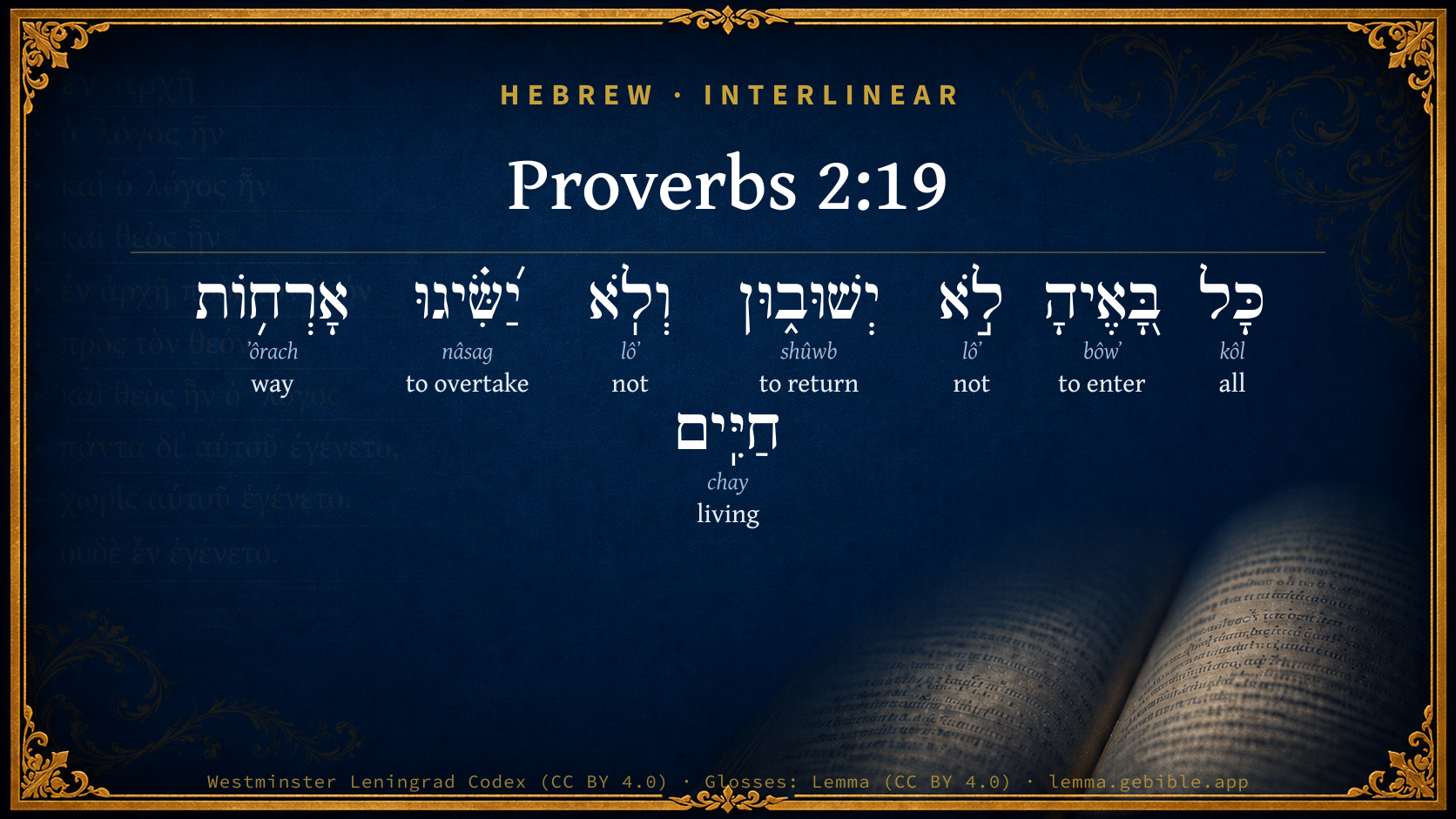
Hebrew (Westminster Leningrad Codex) Proverbs 2:19 appears in the Hebrew Old Testament. The text above is from the Westminster Leningrad Codex. Each word links to its Strong’s number, a concise gloss, and parsing drawn from the Open Scriptures Hebrew Bible morphology. Click any word for its full Brown-Driver-Briggs (BDB) entry.
Download image
Cite this verse

Proverbs 2:19 (World English Bible). Public Domain. Lemma interlinear Bible study tool, https://lemma.gebible.app/v/proverbs/2/19.

Show BibTeX & RIS
BibTeX
RIS
English Translation
None who go to her return again, Neither do they attain to the paths of life:
World English Bible · Public Domain
Download a study sheet

One document with this verse’s original text, its word-by-word gloss line, the meaning frame, cross-references with their text, attributed commentary, and full source and license credits — printable, and it pastes into notes with its structure intact.

This verse Autodidact and up

Study sheet (.html) Plain text (.txt)

A passage Seminary Student

Up to 50 verses in one chapter. A passage sheet keeps up to 6 commentary sources and 12 cross-references per verse, in the order this page ranks them, and says so on the sheet whenever that leaves anything out. Ask for a single verse and you get the Autodidact verse sheet above.

Everything on this page stays free to read, with no account — the sheet is a download of what is already on screen, not access to it.

Want to remove ads? Support Godless Engineer
Compare translations 3

The same verse in 3 English versions, stacked beneath the original-language interlinear above. Click any original word for its lexicon entry.

Each is an independent rendering of the whole verse — the interlinear is not word-aligned to these translations.

Highlighted words mark where these versions differ — a whole-verse word diff, not a word-by-word alignment.

  • World English Bible Public Domain
    None who go to her return again, Neither do they attain to the paths of life:
  • King James Version Public Domain
    None that go unto her return again, neither take they hold of the paths of life.
  • unfoldingWord Literal Text CC BY-SA 4.0
    All those who enter her will not return, and they will not reach the paths of life.

unfoldingWord Literal Text — © unfoldingWord, licensed CC BY-SA 4.0. Word-aligned USFM3 via Door43 (git.door43.org/unfoldingWord/en_ult).

Versions to compare (up to 4)

3 of 4 selected

Show all 18 translations

Every available English version of this verse, each an independent rendering of the whole verse.

  • World English Bible Public Domain
    None who go to her return again, Neither do they attain to the paths of life:
  • Berean Standard Bible Public Domain
    None who go to her return or negotiate the paths of life.
  • Majority Standard Bible Public Domain
    None who go to her return or negotiate the paths of life.
  • King James Version Public Domain
    None that go unto her return again, neither take they hold of the paths of life.
  • American Standard Version (1901) Public Domain
    None that go unto her return again, Neither do they attain unto the paths of life:
  • Revised Version (1885) Public Domain
    None that go unto her return again, neither do they attain unto the paths of life:
  • Geneva Bible (1599) Public Domain
    All they that goe vnto her, returne not againe, neither take they holde of the wayes of life.
  • Douay-Rheims (1899) Public Domain
    None that go in unto her shall return again, neither shall they take hold of the paths of life,
  • Young's Literal Translation Public Domain
    None going in unto her turn back, Nor do they reach the paths of life.
  • Literal Standard Version CC BY-SA 4.0
    None going in to her return, || Nor do they reach the paths of life.
  • Unlocked Literal Bible CC BY-SA 4.0
    All who go in to her will not return again and they will not find the paths of life.
  • unfoldingWord Literal Text CC BY-SA 4.0
    All those who enter her will not return, and they will not reach the paths of life.
  • Darby Bible Public Domain
    none that go unto her return again, neither do they attain to the paths of life:
  • World Messianic Bible Public Domain
    None who go to her return again, neither do they attain to the paths of life.
  • Webster's Bible Public Domain
    None that go to her return again, neither do they take hold of the paths of life.
  • Free Bible Version CC BY-SA 4.0
    No one who goes to her comes back; they don't ever find the way back to life again.
  • Bible in Basic English Public Domain
    Those who go to her do not come back again; their feet do not keep in the ways of life:
  • JPS Tanakh (1917) Public Domain
    None that go unto her return, neither do they attain unto the paths of life;

Literal Standard Version (2020), Covenant Press — licensed CC BY-SA 4.0. Text via the HelloAO Bible API (eBible.org). Unlocked Literal Bible (unfoldingWord) — licensed CC BY-SA 4.0. Text via the HelloAO Bible API (eBible.org). unfoldingWord Literal Text — © unfoldingWord, licensed CC BY-SA 4.0. Word-aligned USFM3 via Door43 (git.door43.org/unfoldingWord/en_ult). Free Bible Version, Dr. Jonathan Gallagher — licensed CC BY-SA 4.0. Text via the HelloAO Bible API (eBible.org).

Word by word

More ways to search: Search by grammar → Find every occurrence → Compare this word →

Practice this passage: Drill this verse → Learn its vocabulary →

About this verse

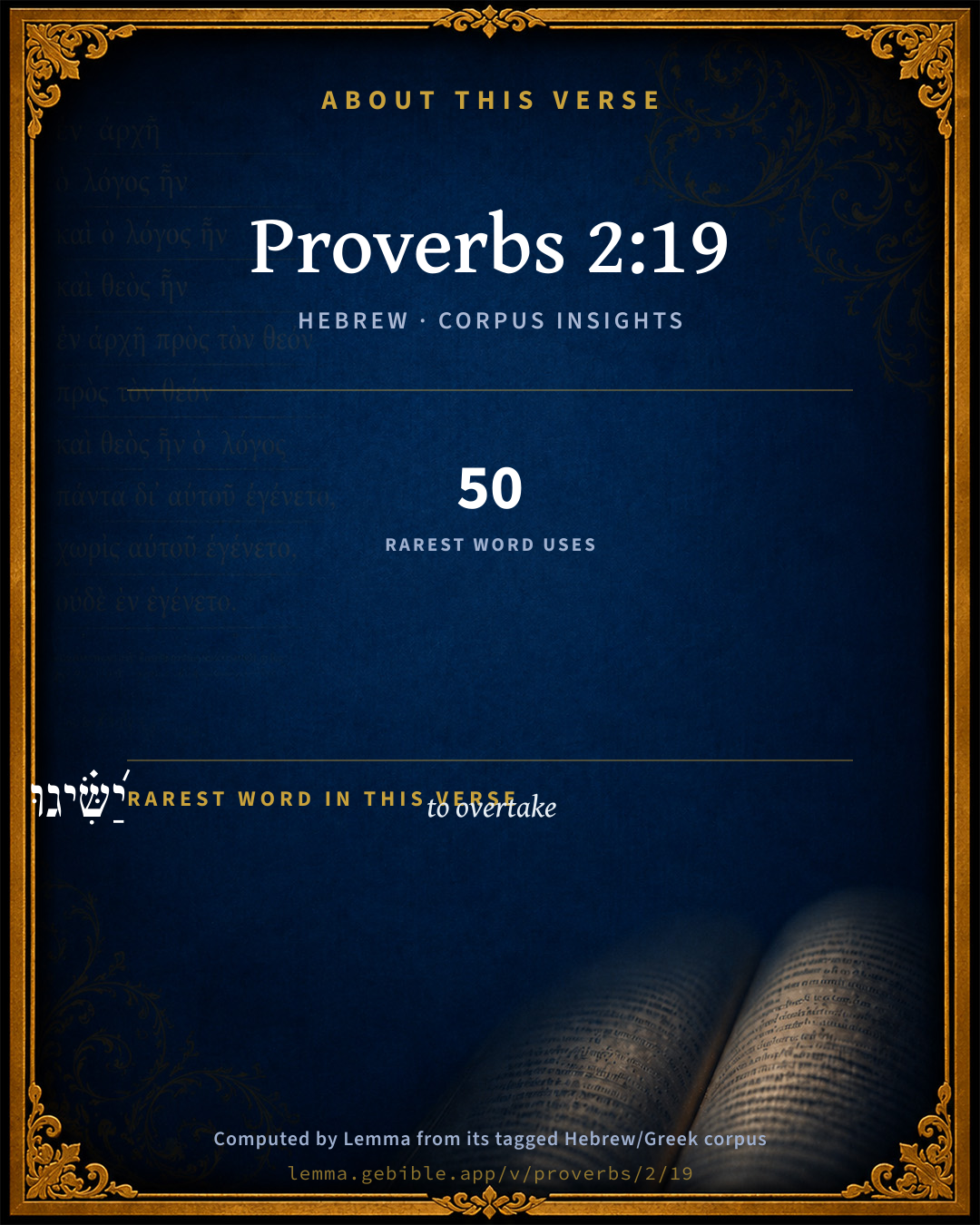
These counts appear in no published source. They are computed here, from the morphology-tagged text and Lemma’s own curated glosses. What Lemma adds →

8
words
7
distinct lemmas
Wisdom
section

Shared distinctive vocabulary

יַ֝שִּׂ֗יגוּ to overtake H5381 occurs in 47 verses of the Hebrew Bible. Also found in:

Grammatical profile

  • 3 verbs
  • 3 nouns
  • 2 particles

Verb forms

  • בָּ֭אֶיהָ Qal · Participle Active
  • יְשׁוּב֑וּן Qal · Imperfect
  • יַ֝שִּׂ֗יגוּ Hiphil · Imperfect

Repetition

A word recurs within this verse — often emphatic in Hebrew:

Hebrew & Septuagint length

In English translation the verse runs 16 words from the Hebrew and 25 from the Septuagint (LXX English) — the Septuagint runs noticeably longer here. See the side-by-side →

A rough comparison of the two English renderings, which tokenize alike — not a word-level alignment.

Word counts can differ between the Hebrew and the Greek without any difference in meaning — e.g. the Hebrew direct-object marker אֵת has no separate Greek word, and Greek often adds the article ὁ.

Cross-references

7

Topical passages linked to Proverbs 2:19 in the Treasury of Scripture Knowledge — connected by theme and wording, ordered by reader-vote popularity; previews shown in the World English Bible.

  • Ecclesiastes 7:26 I find more bitter than death the woman whose heart is snares and traps, whose hands are chains. Whoever pleases God shall escape from her; but the sinner will be ensnared by her.
  • Psalms 81:12 So I let them go after the stubbornness of their hearts, That they might walk in their own counsels.
  • Hosea 4:14 I will not punish your daughters when they play the prostitute, Nor your brides when they commit adultery; Because the men consort with prostitutes, And they sacrifice with the shrine prostitutes; And the people that does not understand will come to ruin.
  • Matthew 19:24–26 Again I tell you, it is easier for a camel to go through a needle's eye, than for a rich man to enter into the Kingdom of God."
  • Proverbs 4:18 But the path of the righteous is like the dawning light, That shines more and more until the perfect day.
  • Jeremiah 13:23 Can the Ethiopian change his skin, or the leopard his spots? then may you also do good, who are accustomed to do evil.
  • Hebrews 6:18 that by two immutable things, in which it is impossible for God to lie, we may have a strong encouragement, who have fled for refuge to take hold of the hope set before us.

Cross-references courtesy of OpenBible.info (CC BY 4.0).

Hebrew and Greek witnesses Masoretic Hebrew ↔ Greek Septuagint

The same verse in the two great witnesses to the Old Testament, shown verse-for-verse.

Here the Septuagint runs noticeably longer than the Hebrew — LXX2012 (modern English Septuagint) 25 words vs World English Bible 16. A rough length comparison of the two English translations, not a word-level alignment — read both below.

These are two independent witnesses, not word-aligned to each other, and the Septuagint is shown in lemma (dictionary) form.

Hebrew Proverbs 2:19 Masoretic · Westminster Leningrad Codex

כָּל בָּ֭אֶיהָ לֹ֣א יְשׁוּב֑וּן וְלֹֽא יַ֝שִּׂ֗יגוּ אָרְח֥וֹת חַיִּֽים

None who go to her return again, Neither do they attain to the paths of life:

World English Bible · Public Domain

Greek LXX Proverbs 2:19 Septuagint · lemma form

πᾶς ὁ πορεύομαι ἐν αὐτός οὐ ἀναστρέφω οὐδέ μή καταλαμβάνω τρίβος εὐθύς οὐ γάρ καταλαμβάνω ὑπό ἐνιαυτός ζωή

None that go by her shall return, neither shall they take hold of right paths, for they are not apprehended of the years of life.

LXX2012 (modern English Septuagint) · Public Domain

Hebrew: Westminster Leningrad Codex (CC BY 4.0). Greek: Septuagint (public domain); English from LXX2012 (modern English Septuagint) (Public Domain). How the Septuagint differs from the Hebrew →

Commentary

Notes on Proverbs 2:19 from classic Christian and Jewish commentators (each source and its license shown beneath its notes). The classic Christian expositions comment on the surrounding passage and are grouped to its opening verse, so a note may address several verses; the Jewish commentaries on the Tanakh (Rashi and others) are per-verse, so they appear only where the commentator wrote on this verse.

Lemma curates 59 commentaries, every one of them public domain or Creative Commons licensed, each selected and text-cleaned for this edition rather than reprinted as found. About our sources →

Trapp's Complete Commentary

John Trapp

Pro 2:19 None that go unto her return again, neither take they hold of the paths of life.

Ver. 19. None that go unto her return again.] Some of the ancients have herehence concluded that adultery is an unpardonable sin; but "all manner of sin and blasphemy shall be forgiven unto men," saith our Saviour, "save only the sin against the Holy Ghost." {Mat 12:31} True it is, that "a whore is a deep ditch, and a strange woman is a narrow pit"; - that {Pro 23:27} "whoredom, and wine, and new wine take away the heart"; - that {Hos 4:11} such are said to be "destitute of understanding," and to have lost even the light of nature; {Pro 6:32 Rom 1:28} to be "past feeling, and given up to a dead and dedolent disposition"; {Eph 4:18-19} to be "impudent," {Jer 2:3} - wherefore also they are compared to dogs {a} {Deu 23:18 2Sa 3:8} - and for the most part impenitent. {Ecc 7:28} Grace, as one well observeth, is seated in the powers of nature. Now carnal sins disable nature, and so set us in a greater distance from grace, as taking away the heart, &c. Howbeit "all things are possible with God"; {Mar 9:23; Mar 9:27} and though few have awakened out of this snare of the devil, yet some have, as David, and that woman in Luk 7:37; Luk 7:50, lest any humbled sinners should despair.

{a} κυνος ομματ εχων. - Hom.

John Trapp, A Commentary or Exposition upon All the Books of the Old and New Testament (1647–1656) — public domain. Text from a community e-Sword module.

Jamieson, Fausset & Brown

Robert Jamieson, A. R. Fausset & David Brown

that is, such as remain impenitent (compare Ecc 7:26).

paths of life-- (Psa 16:11), opposed to paths unto the dead.

Jamieson, Fausset & Brown — Commentary Critical and Explanatory on the Whole Bible (1871) — public domain (CC PDM 1.0). Text via the HelloAO Bible API.

Adam Clarke's Commentary

Verse 19. None that go unto her return again] There are very few instances of prostitutes ever returning to the paths of sobriety and truth; perhaps not one of such as become prostitutes through a natural propensity to debauchery. Among those who have been deceived, debauched, and abandoned, many have been reclaimed; and to such alone penitentiaries may be useful; to the others they may only be incentives to farther sinning. Rakes and debauchees are sometimes converted: but most of them never lay hold on the path of life; they have had their health destroyed, and never recover it. The original, חיים chaiyim, means lives; not only the health of the body is destroyed, but the soul is ruined. Thus the unhappy man may be said to be doubly slain.

Adam Clarke's Commentary on the Bible (1810–1826) — public domain. Text from a community e-Sword/MySword module.

The Cambridge Bible for Schools and Colleges

gen. ed. J. J. S. Perowne

19. take they hold of] Rather, reach, or (R.V.) attain unto.

The Cambridge Bible for Schools and Colleges (gen. ed. J. J. S. Perowne; Cambridge University Press, 1878–1918) — public domain. Text from a community e-Sword module.

John Gill's Exposition

None that go unto her return again,.... That is, those that commit whoredom with her return not again by repentance, and to a sober and chaste way of living, at least but very few; hence some of the ancients thought adultery was the unpardonable sin; but it is certain that some have been recovered by the power of divine grace, and have been brought to repentance for their impure manner of life, and have truly believed in Christ, and lived sober and godly lives afterwards; but, as the Targum adds, they do not return "in peace", but with great distress of mind, remorse of conscience, and bitterness of soul; and these instances are rare; generally speaking, such as are ensnared by an adulterous woman, whose heart is snares and nets, and whose hands are as bands, are held so fast by her that they seldom get out again, though some few may escape, Ecc 7:26. The words may be rendered, "all that go into her (z) shall not return again"; no, very few of them. And it is a very rare thing, when men are fallen into idolatry, superstition, will worship, and heresy, that they are recovered out of this snare of the devil; there is a peradventure they may, but it is not often that they be loosed from it, Ti2 2:25;

neither take they hold of the paths of life; Christ, and the ways of Christ, which lead to eternal life; few there be that find these paths and walk in them, Mat 7:14; and especially such as are drawn aside by an impure woman, they are held so fast by her alluring charms, and so bewildered by her art of deceiving, that they are like persons that are led out of their way, and cannot find it again.

(z) "omnes ingredientes eam", Pagninus, Montanus.

John Gill's Exposition of the Whole Bible (1746–1763) — public domain (CC PDM 1.0). Text via the HelloAO Bible API.

Albert Barnes' Notes on the Bible

The words describe more than the fatal persistency of the sinful habit when once formed. A resurrection from that world of the dead to “the paths of life” is all but impossible.

Albert Barnes' Notes on the Bible (1834–1885) — public domain. Text from a community e-Sword/MySword module.

Haydock's Catholic Bible Commentary

Life. A sincere conversion is so rare among people once addicted to impurity, (Haydock) which resembles a deep pit. (Calmet) --- This illness is hardly removed. (Menochius)

George Leo Haydock (1774–1849), Haydock's Catholic Family Bible and Commentary, 1859 edition — public domain. Excludes Psalms (Douay-Rheims chapter numbering differs from Protestant) and Deuterocanonical books (Catholic canon only).

Matthew Poole's English Annotations

None; few or none; an hyperbolical expression, used Isa 64:7.

That go unto her; that go to her house, or that lie with her, as this phrase is used, Gen 16:4; 30:4; Jos 2:13.

Return again, from her and from this wickedness, unto God. Adulterers and whoremongers are very rarely brought to repentance, but are generally hardened by the power and deceitfulness of that lust, and by God’s just judgment, peculiarly inflicted upon such persons, Heb 13:4. He alludes to the nature of corporal death, from which no man can without a miracle return to this life.

Of the paths of life; of those courses which lead to true and eternal life.

Matthew Poole's English Annotations on the Holy Bible (1683–1685) — public domain. Text from a community e-Sword/MySword module.

The Pulpit Commentary

None that go unto her return again. The fate of the companions of the strange woman is described as irrevocable. All who visit her shall not return again. The Targum reads, "They shall not return in peace." The difficulty which they who give themselves up to the indulgence of lust and passion encounter in extricating themselves makes the statement of the teacher an almost universal truth. Hence St. Chrysostom says, "It is as difficult to bring back a libidinous person to chastity as a dead man to life." This passage led some of the Fathers to declare that the sin of adultery was unpardonable. Fornication was classed by the scholastic divines among the seven deadly sins, and it has this character given to it in the Litany: "From fornication, and all other deadly sin." St. Paul says, "No whoremonger nor unclean person...hath any inheritance in the kingdom of Christ and of God". (Eph_5:5; cf. 1Co_6:9 Rev_22:15) The sin which they commit who have dealings with the strange woman is deadly and leads on to death, and from death there is no return, nor laying hold of or regaining the paths of life. (see Job_7:9, Job_7:10) Compare the words with which Deiphobe, the Cumaean sibyl, addresses Aeneas"Tros Anchysiade, facilis descensus Averno Sed revocare gradum superasque evadere ad auras, Hoc opus, hic labor est. (Virgil, "AEneid," 6:126-129)

"O Trojan, son of Anchyses, easy is the path that leads to hell. But to retrace one"s steps, and escape to the upper regions, this is a work, this is a task."

The Pulpit Commentary (1880–1919), ed. H.D.M. Spence-Jones & Joseph S. Exell — public domain. Text from a community e-Sword module.

Rashi

Rabbi Shlomo Yitzchaki (Rashi)

none...return It is hard for them to part with it and to repent.

Rashi on the Tanakh — English translations: “The Judaica Press complete Tanach with Rashi, translated by A. J. Rosenberg” (CC BY 4.0); “Pentateuch with Rashi's commentary by M. Rosenbaum and A.M. Silbermann, 1929-1934” (public domain); “The Metsudah Tanach series, Lakewood, N.J” (CC BY 4.0); and “The Book of Joshua, Metsudah Publications, 1997” (CC BY 4.0). Text via Sefaria.

Lesson kit

Teaching starters — assembled from the data on this page, not authored interpretation. Every prompt links to the verse data it draws on. Edit before teaching.

Proverbs, in the Wisdom, opens this verse with 8 words (7 distinct Hebrew lemmas). Its most distinctive word is nâsag (“to overtake”). The Greek Septuagint runs longer here. A historical commentator’s framing appears above. Read the whole chapter for the surrounding context.

Discussion questions

  1. What does “to overtake” (nâsag) contribute to the verse as a whole?
  2. How does Genesis 31:25, which shares the word «to overtake», read alongside this verse?
  3. What does the repetition of “not” (2× in this one verse) do in this verse?
  4. The Septuagint runs longer here than the Hebrew. What might account for the difference?
  5. These translations render this verse differently. What is at stake in choosing one wording over another?
  6. «בָּ֭אֶיהָ» is a Qal Participle Active verb. How does that grammatical form shape the action described?
  7. Compare how Trapp's Complete Commentary and Jamieson, Fausset & Brown read this verse. Where do they agree or differ?

Things to notice

Reading settings

Reading text

Shown beneath each verse's original-language words.

Old Testament
Old Testament edition

Read the OT as the Masoretic Hebrew (MT) or the Greek Septuagint (LXX).

English shown for the Greek Septuagint (in the Hebrew ↔ Greek comparison).

Comparing translations? Open the Compare panel on any verse page to stack up to four side by side.