
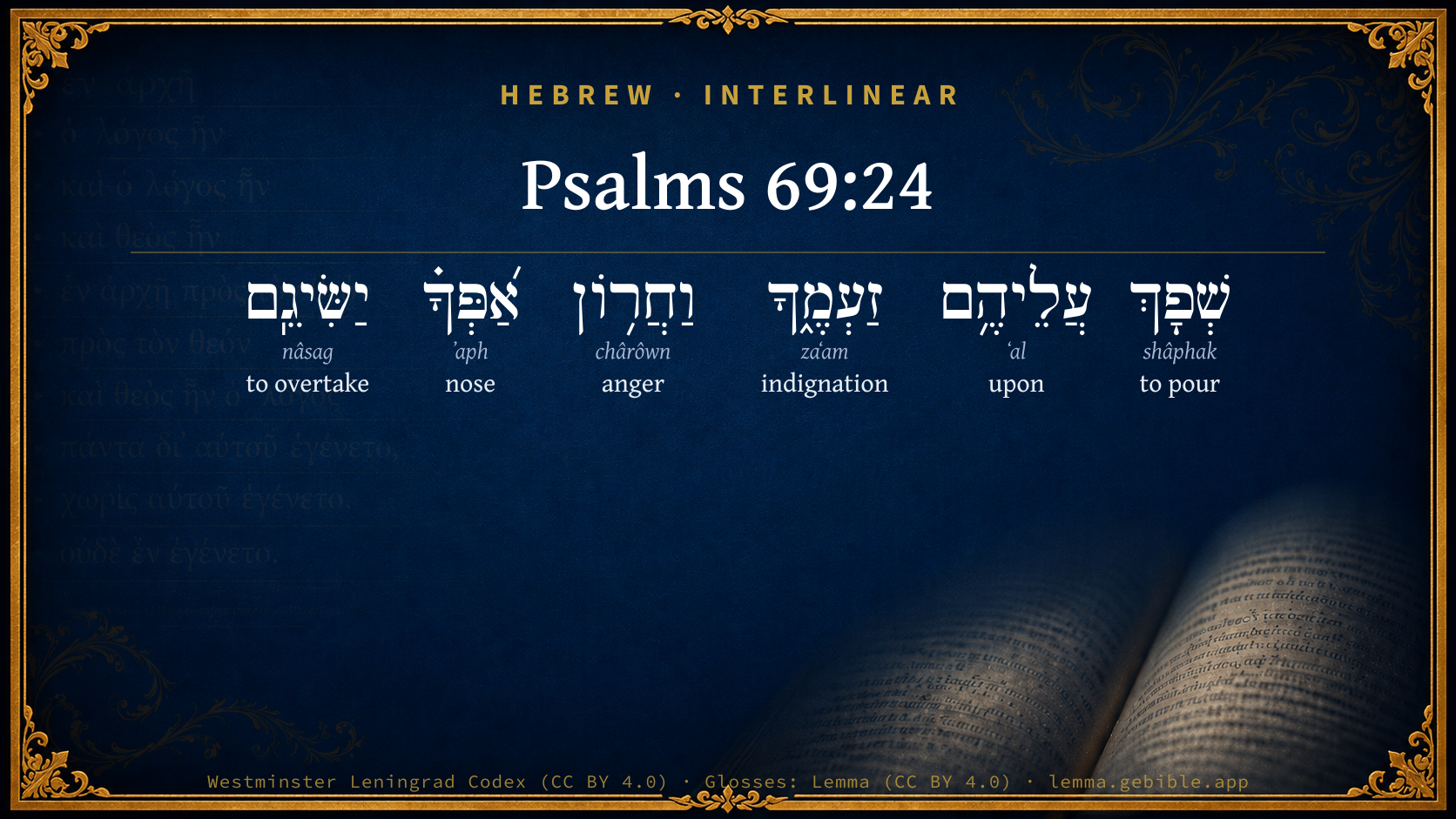
Psalms 69:24

Hebrew (Westminster Leningrad Codex) Psalms 69:24 appears in the Hebrew Old Testament. The text above is from the Westminster Leningrad Codex. Each word links to its Strong’s number, a concise gloss, and parsing drawn from the Open Scriptures Hebrew Bible morphology. Click any word for its full Brown-Driver-Briggs (BDB) entry.
Download image
Cite this verse

Psalms 69:24 (World English Bible). Public Domain. Lemma interlinear Bible study tool, https://lemma.gebible.app/v/psalms/69/24.

Show BibTeX & RIS
BibTeX
RIS
English Translation
Pour out your indignation on them. Let the fierceness of your anger overtake them.
World English Bible · Public Domain
Download a study sheet

One document with this verse’s original text, its word-by-word gloss line, the meaning frame, cross-references with their text, attributed commentary, and full source and license credits — printable, and it pastes into notes with its structure intact.

This verse Autodidact and up

Study sheet (.html) Plain text (.txt)

A passage Seminary Student

Up to 50 verses in one chapter. A passage sheet keeps up to 6 commentary sources and 12 cross-references per verse, in the order this page ranks them, and says so on the sheet whenever that leaves anything out. Ask for a single verse and you get the Autodidact verse sheet above.

Everything on this page stays free to read, with no account — the sheet is a download of what is already on screen, not access to it.

Want to remove ads? Support Godless Engineer
Compare translations 3

The same verse in 3 English versions, stacked beneath the original-language interlinear above. Click any original word for its lexicon entry.

Each is an independent rendering of the whole verse — the interlinear is not word-aligned to these translations.

Highlighted words mark where these versions differ — a whole-verse word diff, not a word-by-word alignment.

  • World English Bible Public Domain
    Pour out your indignation on them. Let the fierceness of your anger overtake them.
  • King James Version Public Domain
    Pour out thine indignation upon them, and let thy wrathful anger take hold of them.
  • unfoldingWord Literal Text CC BY-SA 4.0
    Pour your indignation on them, and let the burning of your nose overtake them.

unfoldingWord Literal Text — © unfoldingWord, licensed CC BY-SA 4.0. Word-aligned USFM3 via Door43 (git.door43.org/unfoldingWord/en_ult).

Versions to compare (up to 4)

3 of 4 selected

Show all 18 translations

Every available English version of this verse, each an independent rendering of the whole verse.

  • World English Bible Public Domain
    Pour out your indignation on them. Let the fierceness of your anger overtake them.
  • Berean Standard Bible Public Domain
    Pour out Your wrath upon them, and let Your burning anger overtake them.
  • Majority Standard Bible Public Domain
    Pour out Your wrath upon them, and let Your burning anger overtake them.
  • King James Version Public Domain
    Pour out thine indignation upon them, and let thy wrathful anger take hold of them.
  • American Standard Version (1901) Public Domain
    Pour out thine indignation upon them, And let the fierceness of thine anger overtake them.
  • Revised Version (1885) Public Domain
    Pour out thine indignation upon them, and let the fierceness of thine anger overtake them.
  • Geneva Bible (1599) Public Domain
    Powre out thine anger vpon them, and let thy wrathfull displeasure take them.
  • Douay-Rheims (1899) Public Domain
    Let their eyes be darkened that they see not; and their back bend thou down always.
  • Young's Literal Translation Public Domain
    Pour upon them Thine indignation, And the fierceness of Thine anger doth seize them.
  • Literal Standard Version CC BY-SA 4.0
    Pour Your indignation on them, || And the fierceness of Your anger seizes them.
  • Unlocked Literal Bible CC BY-SA 4.0
    Pour out your indignation on them, and let the fierceness of your anger overtake them.
  • unfoldingWord Literal Text CC BY-SA 4.0
    Pour your indignation on them, and let the burning of your nose overtake them.
  • Darby Bible Public Domain
    Pour out thine indignation upon them, and let the fierceness of thine anger take hold of them.
  • World Messianic Bible Public Domain
    Pour out your indignation on them. Let the fierceness of your anger overtake them.
  • Webster's Bible Public Domain
    \\69:23\\Let their eyes be darkened, that they see not; and make their loins continually to shake.
  • Free Bible Version CC BY-SA 4.0
    Pour out your judgment on them; chase them down in your fierce anger.
  • Bible in Basic English Public Domain
    Let your curse come on them; let the heat of your wrath overtake them.
  • JPS Tanakh (1917) Public Domain
    (69-25) Pour out Thine indignation upon them, and let the fierceness of Thine anger overtake them.

Literal Standard Version (2020), Covenant Press — licensed CC BY-SA 4.0. Text via the HelloAO Bible API (eBible.org). Unlocked Literal Bible (unfoldingWord) — licensed CC BY-SA 4.0. Text via the HelloAO Bible API (eBible.org). unfoldingWord Literal Text — © unfoldingWord, licensed CC BY-SA 4.0. Word-aligned USFM3 via Door43 (git.door43.org/unfoldingWord/en_ult). Free Bible Version, Dr. Jonathan Gallagher — licensed CC BY-SA 4.0. Text via the HelloAO Bible API (eBible.org).

Word by word

More ways to search: Search by grammar → Find every occurrence → Compare this word →

Practice this passage: Drill this verse → Learn its vocabulary →

About this verse

These counts appear in no published source. They are computed here, from the morphology-tagged text and Lemma’s own curated glosses. What Lemma adds →

6
words
6
distinct lemmas
Wisdom
section

Notable vocabulary

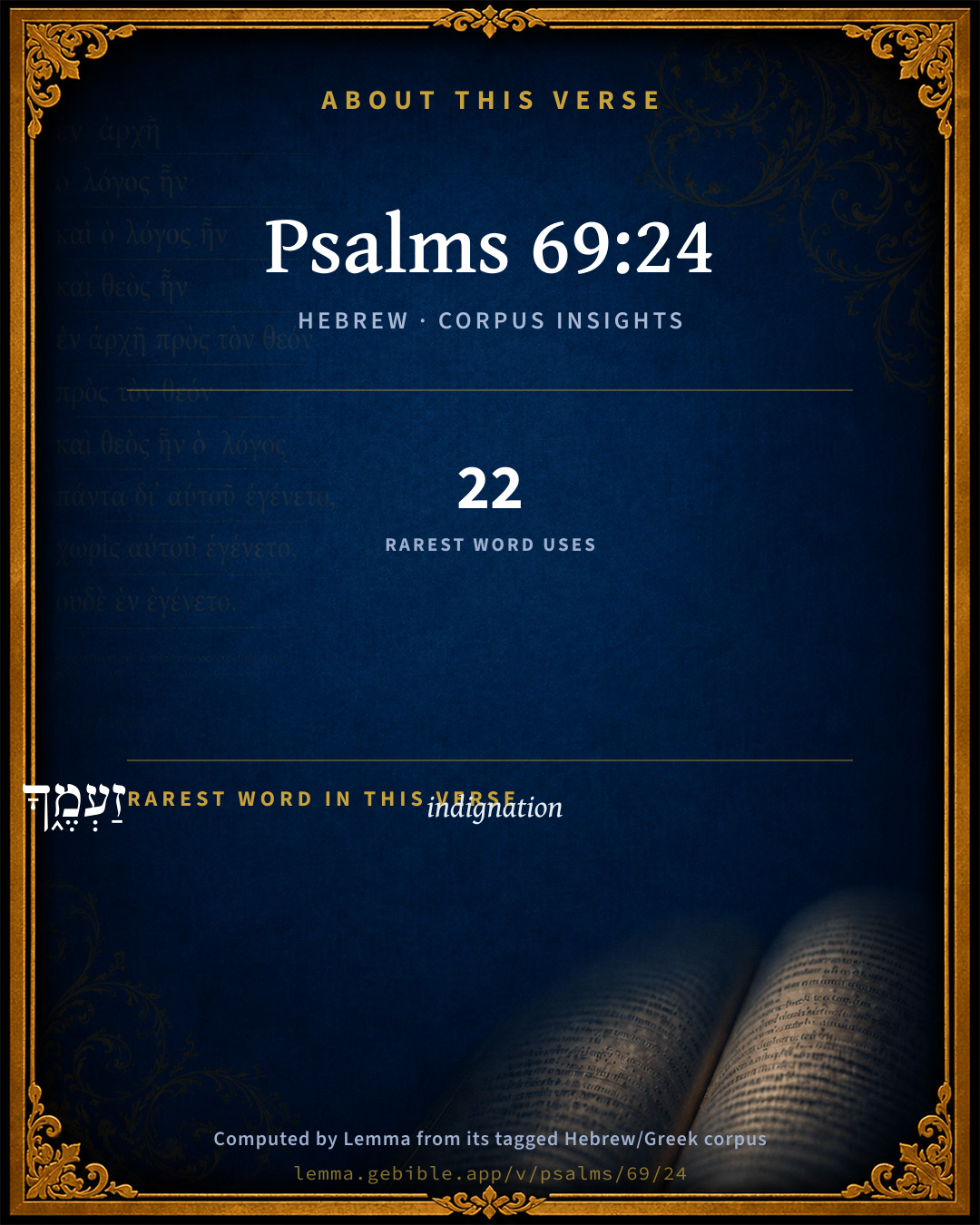
The rarest word here is זַעְמֶ֑ךָ indignation H2195 — appearing just 22 times in the whole Hebrew Bible.

Shared distinctive vocabulary

זַעְמֶ֑ךָ indignation H2195 occurs in 22 verses of the Hebrew Bible. Also found in:

Grammatical profile

  • 2 verbs
  • 3 nouns
  • 1 preposition

Verb forms

  • שְׁפָךְ Qal · Imperative
  • יַשִּׂיגֵֽם Hiphil · Imperfect

Hebrew & Septuagint length

In English translation the verse runs 14 words from the Hebrew and 17 from the Septuagint (LXX English) — closely comparable.

A rough comparison of the two English renderings, which tokenize alike — not a word-level alignment.

Word counts can differ between the Hebrew and the Greek without any difference in meaning — e.g. the Hebrew direct-object marker אֵת has no separate Greek word, and Greek often adds the article ὁ.

Cross-references

14

Topical passages linked to Psalms 69:24 in the Treasury of Scripture Knowledge — connected by theme and wording, ordered by reader-vote popularity; previews shown in the World English Bible.

  • Psalms 79:6 Pour out your wrath on the nations that don't know you; On the kingdoms that don't call on your name;
  • Hosea 5:10 The princes of Judah are like those who remove a landmark. I will pour out my wrath on them like water.
  • Revelation 16:1 I heard a loud voice out of the temple, saying to the seven angels, "Go and pour out the seven bowls of the wrath of God on the earth!"
  • Luke 21:22 For these are days of vengeance, that all things which are written may be fulfilled.
  • Exodus 15:15 Then the chiefs of Edom were dismayed. Trembling takes hold of the mighty men of Moab. All the inhabitants of Canaan are melted away.
  • Leviticus 26:14–46 "'But if you will not listen to me, and will not do all these commandments;
  • Deuteronomy 28:15–68 But it shall come to pass, if you will not listen to the voice of Yahweh your God, to observe to do all his commandments and his statutes which I command you this day, that all these curses shall come on you, and overtake you.
  • Deuteronomy 29:18–28 lest there should be among you man, or woman, or family, or tribe, whose heart turns away this day from Yahweh our God, to go to serve the gods of those nations; lest there should be among you a root that bears gall and wormwood;
  • Deuteronomy 31:17 Then my anger shall be kindled against them in that day, and I will forsake them, and I will hide my face from them, and they shall be devoured, and many evils and troubles shall come on them; so that they will say in that day, Haven't these evils come on us because our God is not among us?
  • Deuteronomy 32:20–26 He said, I will hide my face from them, I will see what their end shall be: For they are a very perverse generation, Children in whom is no faithfulness.
  • Isaiah 13:8 and they shall be dismayed; pangs and sorrows shall take hold [of them]; they shall be in pain as a woman in travail: they shall look in amazement one at another; their faces [shall be] faces of flame.
  • Zechariah 1:6 But my words and my decrees, which I commanded my servants the prophets, didn't they overtake your fathers? "Then they repented and said, 'Just as Yahweh of Hosts determined to do to us, according to our ways, and according to our practices, so he has dealt with us.'"
  • Matthew 23:35–37 that on you may come all the righteous blood shed on the earth, from the blood of righteous Abel to the blood of Zachariah son of Barachiah, whom you killed between the sanctuary and the altar.
  • 1 Thessalonians 2:15–16 who killed both the Lord Jesus and their own prophets, and drove us out, and didn't please God, and are contrary to all men;

Cross-references courtesy of OpenBible.info (CC BY 4.0).

Hebrew and Greek witnesses Masoretic Hebrew ↔ Greek Septuagint

The same verse in the two great witnesses to the Old Testament, shown verse-for-verse.

You’re reading Greek Psalm 68 (Hebrew Psalm 69). The Septuagint counts the superscription, so verse numbers can differ from the Hebrew — chapter-level alignment, not verse-by-verse. Numbering follows Rahlfs.

These are two independent witnesses, not word-aligned to each other, and the Septuagint is shown in lemma (dictionary) form.

Hebrew Psalms 69:24 Masoretic · Westminster Leningrad Codex

שְׁפָךְ עֲלֵיהֶ֥ם זַעְמֶ֑ךָ וַחֲר֥וֹן אַ֝פְּךָ֗ יַשִּׂיגֵֽם

Pour out your indignation on them. Let the fierceness of your anger overtake them.

World English Bible · Public Domain

Greek LXX Greek Psalm 68:24 Septuagint · lemma form

σκοτίζω ὁ ὀφθαλμός αὐτός ὁ μή βλέπω καί ὁ νῶτον αὐτός διά πᾶς συνκάμπτω

Pour out your wrath upon them, and let the fury of your anger take hold on them.

LXX2012 (modern English Septuagint) · Public Domain

Hebrew: Westminster Leningrad Codex (CC BY 4.0). Greek: Septuagint (public domain); English from LXX2012 (modern English Septuagint) (Public Domain). How the Septuagint differs from the Hebrew →

Commentary

Notes on Psalms 69:24 from classic Christian and Jewish commentators (each source and its license shown beneath its notes). The classic Christian expositions comment on the surrounding passage and are grouped to its opening verse, so a note may address several verses; the Jewish commentaries on the Tanakh (Rashi and others) are per-verse, so they appear only where the commentator wrote on this verse.

Lemma curates 59 commentaries, every one of them public domain or Creative Commons licensed, each selected and text-cleaned for this edition rather than reprinted as found. About our sources →

Trapp's Complete Commentary

John Trapp

Psa 69:24 Pour out thine indignation upon them, and let thy wrathful anger take hold of them.

Ver. 24. Pour out thine indignation upon them] By indignation, saith Basil, we are to understand speedy vengeance; by wrath, durable. This is befallen the nation of the Jews to the utmost, 1Th 2:14-16, or to the end, as some render it.

John Trapp, A Commentary or Exposition upon All the Books of the Old and New Testament (1647–1656) — public domain. Text from a community e-Sword module.

Joseph Benson's Commentary

Psa 69:24. Pour out — Thou wilt pour out thine indignation upon them, &c. — Thou wilt, on a sudden, bring so many evils upon them, that they shall not be able to escape; but will feel that they suffer the most dismal effects of thy severest and lasting displeasure. How terribly and awfully has God fulfilled this threatening also! “Never was indignation so poured out, never did wrath so take hold on any nation, as on that which once was, beyond every other, beloved and favoured. The wrath, says St. Paul, 1Th 2:16, is come upon them to the uttermost, εις τελος, to the end, to the very last dregs of the cup of fury. Let every church, which boasts of favours bestowed, and privileges conferred upon her, remember the consequences of their being abused by Jerusalem; let every individual do the same.”

Joseph Benson's Commentary on the Old and New Testaments (1811–1818) — public domain. Text from a community e-Sword module.

J. A. Alexander on Psalms

Joseph Addison Alexander

25. (Psa 69:24). Pour upon them thine anger, and let the heat of thy wrath, thy hot wrath, overtake them, reach them after they have long seemed to escape it and expected to escape it still.

Joseph Addison Alexander, The Psalms Translated and Explained (1850) — public domain. Text from a community e-Sword module.

Jamieson, Fausset & Brown

Robert Jamieson, A. R. Fausset & David Brown

An utter desolation awaits them. They will not only be driven from their homes, but their homes--or, literally, "palaces," indicative of wealth--shall be desolate (compare Mat 23:38).

Jamieson, Fausset & Brown — Commentary Critical and Explanatory on the Whole Bible (1871) — public domain (CC PDM 1.0). Text via the HelloAO Bible API.

John Calvin's Commentaries

24. Pour out thy fury upon them. It is not surprising that David utters a lengthened series of imprecations; for we know well that the frantic enemies of the Church, into whom it was his object to inspire terror, are not easily moved. He therefore lifts up his voice against them in tones of greater vehemence, that they might be led to desist from their wrongful and insolent conduct. He, however, had principally an eye to true believers, who, being oppressed with calamities, have no other stay to lean upon, but such as arises from the voice which they hear proceeding from the mouth of God, declaring the terrible vengeance which is prepared for their enemies, if, indeed, they are among the reprobate. As to those of whose repentance and amendment there was some hope, David would have had them to be corrected by chastisements; but as to those whose repentance and reformation were hopeless, he prays that destruction may fall upon their heads, that thus they might not escape the punishment which was appointed for them, and which they had deserved.

John Calvin's Commentaries (1540-1563) — public domain. Text from the Calvin Translation Society English edition (1840s-50s) via the Christian Classics Ethereal Library (ccel.org). Calvin's coverage is partial (roughly two-thirds of the Bible); uncommented books and verses are honest gaps, never fabricated. The 19th-century editor's footnotes and remarks are omitted so the notes are faithfully Calvin's own voice.

The Cambridge Bible for Schools and Colleges

gen. ed. J. J. S. Perowne

24. Cp. Psa_79:6; Jer_10:25. and let &c.] R.V., and let the fierceness of thine anger overtake them.

The Cambridge Bible for Schools and Colleges (gen. ed. J. J. S. Perowne; Cambridge University Press, 1878–1918) — public domain. Text from a community e-Sword module.

John Gill's Exposition

Pour out thine indignation upon them,.... Not a few drops of it only, but a flood of it, sweeping away and bearing down all before it; which was done when wrath came upon them to the uttermost, in the destruction of their city, temple, and nation, Th1 2:16;

let thy wrathful anger take hold of them; follow after them, overtake them, seize upon them, and hold them fast, that they may not escape. It denotes the severity of God towards them; the fierceness and fury of his wrath upon them; and that their destruction would be inevitable, and an entire and utter one.

John Gill's Exposition of the Whole Bible (1746–1763) — public domain (CC PDM 1.0). Text via the HelloAO Bible API.

Albert Barnes' Notes on the Bible

Pour out thine indignation upon them - That is, Punish them for their sins; or, do justice to them.

And let thy wrathful anger - literally, “the burning of thy wrath;” glow of anger; burning wrath. See Num 25:4; Num 32:14, 1Sa 28:18. This is undoubtedly a petition that God would visit them with the severity of his indignation; or, it expresses the belief of the psalmist that they “deserved” such tokens of his displeasure.

Take hold of them - Seize upon them; overtake them when they expect to escape.

Albert Barnes' Notes on the Bible (1834–1885) — public domain. Text from a community e-Sword/MySword module.

Matthew Poole's English Annotations

In such other ways and judgments as thou shalt think fit.

Matthew Poole's English Annotations on the Holy Bible (1683–1685) — public domain. Text from a community e-Sword/MySword module.

The Treasury of David

Charles H. Spurgeon

Ver. 24. Pour out thine indignation upon them. What can be too severe a penalty for those who reject the incarnate God, and refuse to obey the commands of his mercy? They deserve to be flooded with wrath, and they shall be; for upon all who rebel against the Saviour, Christ the Lord, "the wrath is come to the uttermost." 1Th 2:16. God's indignation is no trifle; the anger of a holy, just, omnipotent, and infinite Being, is above all things to be dreaded; even a drop of it consumes, but to have it poured upon us is inconceivably dreadful. O God, who knoweth the power of thine anger?

And let thy wrathful anger take hold of them. Grasping them, arresting them, abiding on them. If they flee, let it overtake and seize them; let it lay them by the heels in the condemned cell, so that they cannot escape from execution. It shall indeed be so with all the finally impenitent, and it ought to be so. God is not to be insulted with impunity, and his Son, our ever gracious Saviour, the best gift of infinite love, is not to be scorned and scoffed at for nothing. He that despised Moses' law died without mercy, but what shall be the "sorer punishment" reserved for those who have trodden under foot the Son of God?

Ver 23-28. He denounces ten plagues, or effects of God's wrath, to come upon them for their wickedness. David Dickson.

Ver. 24. Pour out. Observe what is denoted by pouring out. First, the facility with which God is able, without any labour, to destroy his enemies, as easy is it as to incline a vial full of liquid and pour it out. Secondly, the pouring out denotes the abundance of his anger. Thirdly, that his wrath is sudden, overwhelming, and inevitable. When it drops, one must take care; when it is poured forth, it crushes the thoughtless. Thomas Le Blanc.

None.

Psalms 69:25*

Charles H. Spurgeon's The Treasury of David (1869–1885) — public domain. Psalms only. Text from a community e-Sword/MySword module.

The Pulpit Commentary

Pour out thine indignation upon them, and let thy wrathful anger take hold of them. At any rate, be angry with them, and show thine anger in some way or other. Let them net escape scatheless. A general malediction, after which the writer returns to particulars.

The Pulpit Commentary (1880–1919), ed. H.D.M. Spence-Jones & Joseph S. Exell — public domain. Text from a community e-Sword module.

unfoldingWord translationNotes

Door43 World Missions Community

Pour out your indignation on them

God's demonstration of his anger is described as if he poured it out on his enemies like water. (See: Metaphor)

indignation

anger of a person who has suffered injustice

the fierceness of your anger

"your burning anger" or "your strong anger"

overtake them

God's judgment on his enemies is described as if he ran after them and caught them. (See: Metaphor)

be a desolation

This abstract noun can be stated as "abandoned." AT: "become abandoned" (See: Abstract Nouns)

translationWords

anger

desolate

life

tent

unfoldingWord translationNotes — © Distant Shores Media and the Door43 World Missions Community, licensed CC BY-SA 4.0. Source: git.door43.org/Door43/en_tn.

Lesson kit

Teaching starters — assembled from the data on this page, not authored interpretation. Every prompt links to the verse data it draws on. Edit before teaching.

Psalms, in the Wisdom, opens this verse with 6 words (6 distinct Hebrew lemmas). Its most distinctive word is zaʻam (“indignation”). A historical commentator’s framing appears above. Read the whole chapter for the surrounding context.

Discussion questions

  1. The word zaʻam carries the sense “indignation.” How does it shape the verse?
  2. How does Psalms 38:3, which shares the word «indignation», read alongside this verse?
  3. The translations on this page render this verse differently — a whole-verse word diff, not a word-by-word alignment. What might account for the different wordings?
  4. «שְׁפָךְ» is a Qal Imperative verb. How does that grammatical form shape the action described?
  5. Compare how Trapp's Complete Commentary and Joseph Benson's Commentary read this verse. Where do they agree or differ?

Things to notice

Reading settings

Reading text

Shown beneath each verse's original-language words.

Old Testament
Old Testament edition

Read the OT as the Masoretic Hebrew (MT) or the Greek Septuagint (LXX).

English shown for the Greek Septuagint (in the Hebrew ↔ Greek comparison).

Comparing translations? Open the Compare panel on any verse page to stack up to four side by side.