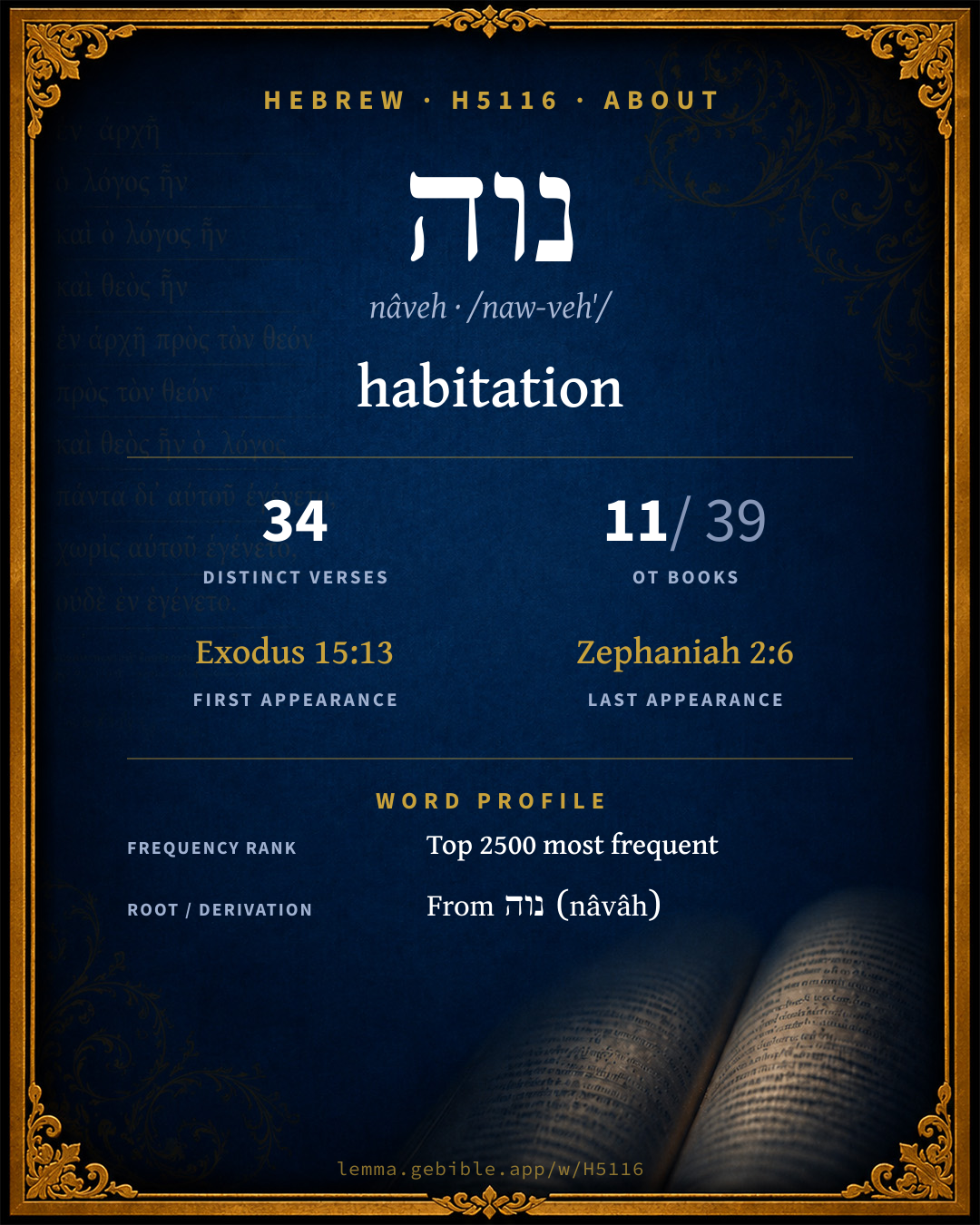
נָוֶה
habitation
also: abode, pasture fuller range ↓
Full lexicon entry — Brown-Driver-Briggs (BDB)
From Brown-Driver-Briggs (BDB)
Where this word appears
See every Construct-state word in the Hebrew Bible →
Grammar key — what these labels mean
Part of speech
- Noun
- A naming word — a person, place, thing, or idea.
Noun type
- Common
- A common noun — a general class of person, place, or thing (“king,” “city,” “water”), not a specific name.
State
- Construct
- A noun bound to a following noun in a possessive / “of” relationship (the construct chain).
- Absolute
- The independent form of a noun, not bound to a following word.
Gender
- Both
- Attested as both masculine and feminine.
- Feminine
- Grammatically feminine.
Number
- Singular
- One.
- Plural
- More than one (in Hebrew, generally three or more).
Grammatical forms
- Noun, Common, Both, Singular, Construct 26 times (74%)
- Noun, Common, Both, Singular, Absolute 7 times (20%)
- Adjective, Adjective, Feminine, Singular, Construct 1 time (3%)
- Noun, Common, Both, Plural, Construct 1 time (3%)
Parsed forms decoded from the imported morphology (morphhb / Westminster Leningrad Codex — WLC text public domain, morphhb tagging CC BY 4.0), counted across 35 parsed occurrences — not distinct verses.
Every verse where H5116 appears — 34 distinct verses across 11 books. Click any verse to open its interlinear word-by-word view. Verse text shown in the World English Bible for context — . Each verse’s Hebrew form is shown with its reference; the English is not keyword-highlighted, since the data carries no word-level English alignment. Use “Compare translations” on any verse to read it across multiple English versions. This concordance covers the Hebrew Bible; Septuagint (Greek Old Testament) occurrences are not indexed here.
Exodus 1 verse
2 Samuel 2 verses
- 2 Samuel 7:8 הַ/נָּוֶ֔ה ptcl def.art + n c bs Now therefore thus shall you tell my servant David, Thus says Yahweh of Hosts, I took you from the sheep pen, from following the sheep, that you should be prince over my people, over Israel;
- 2 Samuel 15:25 נָוֵֽ/הוּ n c bs cs + sfx pers 3ms The king said to Zadok, Carry back the ark of God into the city: if I shall find favor in the eyes of Yahweh, he will bring me again, and show me both it, and his habitation:
1 Chronicles 1 verse
Job 4 verses
- Job 5:3 נָוֵ֣/הוּ n c bs cs + sfx pers 3ms I have seen the foolish taking root, But suddenly I cursed his habitation.
- Job 5:24 נָ֝וְ/ךָ n c bs cs + sfx pers 2ms You shall know that your tent is in peace. You shall visit your fold, and shall miss nothing.
- Job 8:6 נְוַ֣ת n c bs cs If you were pure and upright, Surely now he would awaken for you, And make the habitation of your righteousness prosperous.
- Job 18:15 נָוֵ֣/הוּ n c bs cs + sfx pers 3ms There shall dwell in his tent that which is none of his. Sulfur shall be scattered on his habitation.
Psalms 2 verses
Proverbs 3 verses
- Proverbs 3:33 וּ/נְוֵ֖ה conj + n c bs cs Yahweh's curse is in the house of the wicked, But he blesses the habitation of the righteous.
- Proverbs 21:20 בִּ/נְוֵ֣ה prep + n c bs cs There is precious treasure and oil in the dwelling of the wise; But a foolish man swallows it up.
- Proverbs 24:15 לִ/נְוֵ֣ה prep + n c bs cs Don't lay in wait, wicked man, against the habitation of the righteous. Don't destroy his resting-place:
Isaiah 6 verses
- Isaiah 27:10 נָוֶ֕ה n c bs For the fortified city is solitary, a habitation deserted and forsaken, like the wilderness: there shall the calf feed, and there shall he lie down, and consume the branches of it.
- Isaiah 32:18 בִּ/נְוֵ֣ה prep + n c bs cs My people shall abide in a peaceable habitation, and in safe dwellings, and in quiet resting-places.
- Isaiah 33:20 נָוֶ֣ה n c bs Look on Zion, the city of our solemnities: your eyes shall see Jerusalem a quiet habitation, a tent that shall not be removed, the stakes of it shall never be plucked up, neither shall any of the cords of it be broken.
- Isaiah 34:13 נְוֵ֣ה n c bs cs Thorns shall come up in its palaces, nettles and thistles in the fortresses of it; and it shall be a habitation of jackals, a court for ostriches.
- Isaiah 35:7 בִּ/נְוֵ֤ה prep + n c bs cs The glowing sand shall become a pool, and the thirsty ground springs of water: in the habitation of jackals, where they lay, shall be grass with reeds and rushes.
- Isaiah 65:10 לִ/נְוֵה prep + n c bs cs Sharon shall be a fold of flocks, and the valley of Achor a place for herds to lie down in, for my people who have sought me.
Jeremiah 11 verses
- Jeremiah 10:25 נָוֵ֖/הוּ n c bs cs + sfx pers 3ms Pour out your wrath on the nations that don't know you, and on the families that don't call on your name: for they have devoured Jacob, yes, they have devoured him and consumed him, and have laid waste his habitation.
- Jeremiah 23:3 נְוֵ/הֶ֖ן n c bs cs + sfx pers 3fp I will gather the remnant of my flock out of all the countries where I have driven them, and will bring them again to their folds; and they shall be fruitful and multiply.
- Jeremiah 25:30 נָוֵ֔/הוּ n c bs cs + sfx pers 3ms Therefore prophesy you against them all these words, and tell them, Yahweh will roar from on high, and utter his voice from his holy habitation; he will mightily roar against his fold; he will give a shout, as those who tread [the grapes], against all the inhabitants of the earth.
- Jeremiah 31:23 נְוֵה n c bs cs Thus says Yahweh of Hosts, the God of Israel, Yet again shall they use this speech in the land of Judah and in the cities of it, when I shall bring again their captivity: Yahweh bless you, habitation of righteousness, mountain of holiness.
- Jeremiah 33:12 נְוֵ֣ה n c bs cs Thus says Yahweh of Hosts: Yet again shall there be in this place, which is waste, without man and without animal, and in all the cities of it, a habitation of shepherds causing their flocks to lie down.
- Jeremiah 49:19 נְוֵ֣ה n c bs cs Behold, he shall come up like a lion from the pride of the Jordan against the strong habitation: for I will suddenly make them run away from it; and whoever is chosen, him will I appoint over it: for who is like me? and who will appoint me a time? and who is the shepherd who will stand before me?
- Jeremiah 49:20 נְוֵ/הֶֽם n c bs cs + sfx pers 3mp Therefore hear the counsel of Yahweh, that he has taken against Edom; and his purposes, that he has purposed against the inhabitants of Teman: Surely they shall drag them away, [even] the little ones of the flock; surely he shall make their habitation desolate over them.
- Jeremiah 50:7 נְוֵה n c bs cs All who found them have devoured them; and their adversaries said, We are not guilty, because they have sinned against Yahweh, the habitation of righteousness, even Yahweh, the hope of their fathers.
- Jeremiah 50:19 נָוֵ֔/הוּ n c bs cs + sfx pers 3ms I will bring Israel again to his pasture, and he shall feed on Carmel and Bashan, and his soul shall be satisfied on the hills of Ephraim and in Gilead.
- Jeremiah 50:44 נְוֵ֣ה n c bs cs Behold, [the enemy] shall come up like a lion from the pride of the Jordan against the strong habitation: for I will suddenly make them run away from it; and whoever is chosen, him will I appoint over it: for who is like me? and who will appoint me a time? and who is the shepherd who can stand before me?
- Jeremiah 50:45 נָוֶֽה n c bs Therefore hear the counsel of Yahweh, that he has taken against Babylon; and his purposes, that he has purposed against the land of the Chaldeans: Surely they shall drag them away, [even] the little ones of the flock; surely he shall make their habitation desolate over them.
Ezekiel 2 verses
- Ezekiel 25:5 לִ/נְוֵ֣ה prep + n c bs cs I will make Rabbah a stable for camels, and the children of Ammon a couching-place for flocks: and you shall know that I am Yahweh.
- Ezekiel 34:14 נְוֵ/הֶ֑ם בְּ/נָ֣וֶה n c bs cs + sfx pers 3mp prep + n c bs I will feed them with good pasture; and on the mountains of the height of Israel shall their fold be: there shall they lie down in a good fold; and on fat pasture shall they feed on the mountains of Israel.
Hosea 1 verse
Zephaniah 1 verse
About this entry
At a glance — auto-summarized from this page’s data, not written by a person. Every figure links to its source below. This summary describes the numbers; it doesn’t interpret them.
נוה — transliterated nâveh — is a Hebrew word carrying the sense “habitation.” Where the King James Version says “habitation,” newer translations reach for “pasture” (Berean Standard Bible); the renderings breakdown has the detail. The Hebrew Bible uses it across 34 verses — moderately common. More than a quarter of its appearances fall in Jeremiah. Alongside “habitation” the lexicon also lists “abode” and “pasture” — part of its full sense range. See the sense tree, 34-verse concordance, and the renderings breakdown below.
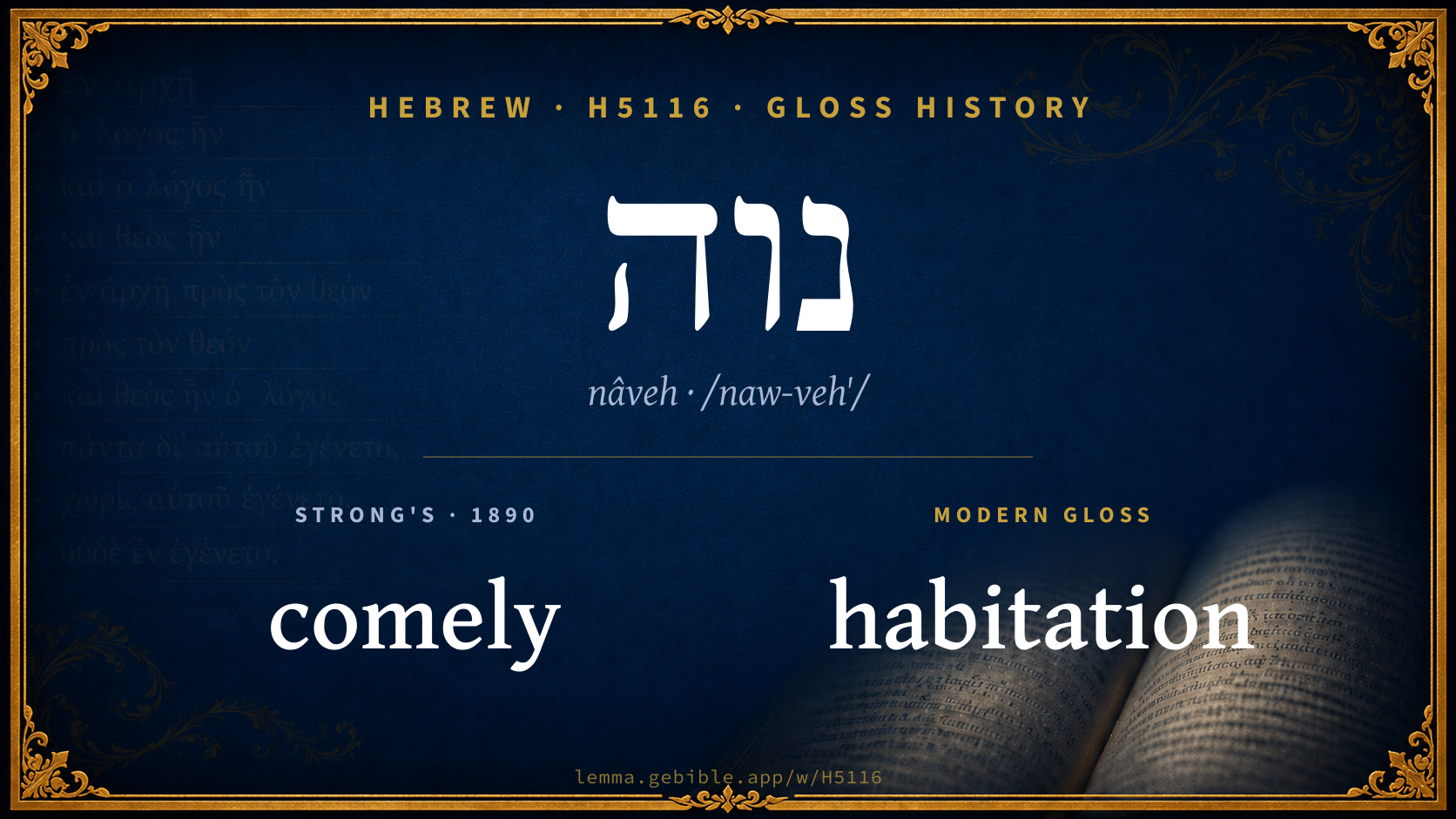
Gloss history
Strong's 1890 vs modern scholarship
About this word
Strong's H5116 catalogs a Hebrew word from the Hebrew Old Testament.
These counts are not copied from any lexicon or concordance. They are computed here, from the morphology-tagged Hebrew Old Testament. What Lemma adds →
- 34
- distinct verses
- The word appears in 34 distinct verses.
- 11 / 39
- OT books
- The word appears in 11 of 39 Old Testament books.
- #1,023
- by frequency
- Top 2500 most frequent Hebrew words (rank 1,023 of 8,640 Hebrew words by occurrence).
View all 34 occurrences in the concordance →
By section of the Old Testament
By traditional corpus
Conventional, traditional groupings — biblical authorship is debated, so this is a traditional corpus grouping, not an authorship claim. Each share is this word’s portion of its verses in that division of the Hebrew canon. Each figure is a share of the word’s 34 distinct verses.
- Prophets (Nevi'im) 23 verses · 68%
- Writings (Ketuvim) 10 verses · 29%
- Torah (Pentateuch) 1 verse · 3%
How translations render this word
Counts come from each version’s own published word-to-Strong’s tagging or interlinear alignment — an approximate guide to how each version renders this word, not a word-level alignment the data otherwise carries. Because each total is that version’s own tagged count, the per-version totals vary from one another and need not match the appearance or distinct-verse counts above. These counts may also differ from a printed concordance because Lemma counts each distinctly tagged rendering and does not collapse phrase taggings into a single head-word total. This is a fixed set of word-tagged versions (KJV, ASV, BSB, ULT) and does not change with the reading translation you choose elsewhere. Each version’s license is shown beside its name below (and on Sources).
BDB lists this Strong’s number as 4 distinct words (homographs). Each count above pools all of them and is not split by sense — see the Senses section below. A low-frequency rendering may belong to a different one of those words, not the primary meaning.
- King James Version†: Habitation 13×, Thee from the sheepcote 2×
- American Standard Version†: Habitation 12×, Fold 2×, Surely he shall make their habitation 2×
- Berean Standard Bible†: Pasture 11×, Dwelling 2×, Grazing land 2×
- unfoldingWord Literal Text†: Habitation 5×, Habitation of 5×, Pasture 5×
King James Version Public Domain
Renders H5116 across 36† tagged occurrences — most commonly:
Plus 21 renderings that appear only once — usually multi-word phrases or single function words the recovered tagging swept in, not distinct renderings.
American Standard Version Public Domain
Renders H5116 across 36† tagged occurrences — most commonly:
Plus 14 renderings that appear only once — usually multi-word phrases or single function words the recovered tagging swept in, not distinct renderings.
Berean Standard Bible Public Domain
Renders H5116 across 37† tagged occurrences — most commonly:
Plus 12 renderings that appear only once — usually multi-word phrases or single function words the recovered tagging swept in, not distinct renderings.
unfoldingWord Literal Text CC BY-SA 4.0
Renders H5116 across 29† tagged occurrences — most commonly:
Plus 14 renderings that appear only once — usually multi-word phrases or single function words the recovered tagging swept in, not distinct renderings.
Senses in the full BDB
Hebrew verbs can shift meaning by stem (binyan): Qal is the basic action, Niphal is often passive or reflexive, Piel often intensifies or makes it factitive, and Hiphil is typically causative. The senses below are grouped under the stem BDB assigns to each.
What do BDB’s symbols mean?
BDB uses these scholarly abbreviations:
| Symbol | Meaning |
|---|---|
| 𝔊 | the Septuagint (the ancient Greek translation, LXX) |
| 𝔙 | the Vulgate (the Latin translation) |
| 𝔖 | the Syriac version (the Peshitta) |
| 𝔗 | the Targum (the Aramaic translation) |
| ψ | the Psalms |
| √ | root (the underlying root or stem) |
| ‖ | parallel passage (a synonymous or contrasted parallel) |
| † | the dagger: every passage where the word occurs is cited |
The 4 senses and sub-senses the full Brown-Driver-Briggs lexicon distinguishes for this word, in lexicon order (not ranked by frequency), with BDB’s own verbatim wording and sub-sense lettering. Shown in Hebrew script with BDB’s own scholarly abbreviations. The condensed entry is in the Lexicon Entry tab. See also the Forms in the corpus table below.
נוה I only
Hiphil
- (si vera l.) lit. beautify (then connected with נאה be comely, so Buhl SS; cf. NH נוה Niph. shew oneself beautiful, Nithp. adorn oneself, נָוֶה adj. beautiful, LevyNHWB);—Impf. 1 s. sf. אַנְוֵהוּ Ex 15:2 I will beautify, adorn him (with praises; obj. י׳; ‖ רומם; 𝔊 δοξάσω, 𝔙 glorificabo).—Adj. נָוָה Je 6:2, v. נָאוֶה sub [נָאָה]. e.g. Exodus 15:2
נוה II denom. dwell, abide (si vera l.)
Qal
- Impf. 3 ms. לֹא יִנְוֶה Hb 2:5 he shall not abide, so Ke; Hi rest (cf. Da); We proposes יִרְוֶה be satiated, cf. 𝔖 Krochm יָנוּחַ. e.g. Habakkuk 2:5
נוה III pasture, meadow
- 1. pasture, meadow: נ׳ הָרֹעִים Am 1:2, cf. Zp 2:6 (‖ גִּדְרוֹת צֹאן; v. also [כָּרָה] p. 500 supr.); especially נְאוֹת (הַ)מִּדְבָּר Je 9:9; 23:10 ψ 65:13, Jo 1:19, 20; 2:22; נ׳ דֶּשֶׁא ψ 23:2 grassy pastures; נ׳ אֱלֹהִים ψ 83:13 pastures of God, i.e. the land of Canaan, נ׳ יַעֲקֹב La 2:2; נ׳ הַשָּׁלוֹם Je 25:37 meadows of peace; e.g. Amos 1:2
- 2. נ׳ חָמָס ψ 74:20 appar. habitations (?) of violence, but read prob. גַּאֲוָה וְח׳, so Bi Che (v. 73:6).—Je 6:2 v. sub [נָאָה]; Jb 8:6 v. i. נָוֶה. e.g. Psalms 74:20
נוה IV dwelling, abiding
Senses from the full Brown-Driver-Briggs lexicon (Brown, Driver, Briggs; Oxford 1906 — public domain), digitized via Sefaria, supplemented by the OpenScriptures HebrewLexicon (CC BY 4.0). Full attribution on Sources.
Word origin
II. vb.denom. dwell, abide (si vera l.);—only
III. n.f. pasture, meadow;—pl. cstr. נְוֹת Zp 2:6, usually נְאוֹת ψ 23:2 + 11 times;—
II. adj. dwelling, abiding;—only (si vera l.) נְוַת בַּיִת ψ 68:13 she that is abiding at home.—נָוָה Je 6:2 v. נָאוֶה sub [נָאָה].
— Brown-Driver-Briggs (Oxford 1906, public domain), digitized via Sefaria, supplemented by the OpenScriptures HebrewLexicon (CC BY 4.0). See Sources.
Derived from נוה (nâvâh) (H5115) — to dwell.
Jastrow Dictionary
A second Hebrew/Aramaic lexicon for comparison, covering Aramaic and post-biblical (Talmudic, Targumic, Midrashic) usage that the biblical-Hebrew BDB does not. Matched by lemma rather than by Strong’s number, so a lemma may carry more than one Jastrow headword (shown separately below), and the entries cover usage well beyond the Bible.
נָוָה
- to be pleasing, v. נוי.
נָוֶה I
- , (= נָאֶה) becoming, handsome. Arakh. III, 1 הנ׳ שבישראל Ar. (ed. הנָּאֶה) the handsomest in Israel, v. כָּאוּר. Naz. I, 1 אהא נ׳ Mish. (Bab. ed. נאה; Y. ed. נָאוֶה) I will be handsome (like the Nazarite).
נָוֶה II
- ,, v. אָוָה II) marked-off place, circle, dwelling. Y. Ber. IX, 13ᶜ bot. (ref. to Jer. XXV, 30) בשביל נָוֵיהוּ on account of his (destroyed) dwelling (the Temple); Midr. Till. to Ps. XVIII. Mekh. B’shall., Shir., s. 3 (ref. to ואנוהו, Ex. XV, 2) ואין נ׳ אלא וכ׳ (not נאה) naveh means the Temple (ref. to Ps. LXXIX, 7, a. e.). Sot. 9ᵃ (ref. to Ps. XXXIII, 1) אל תקרי נאוה אלא נְוֵה תהלה read not nâvah (becoming) but n’veh of glory, i.e. a dwelling of glory is that of the righteous (which no human hand is permitted to destroy). Ib. 47ᵇ (ref. to Hab. II, 5) לא יִנְוֶה אפי׳ בנ׳ שלו he will not be pleasing (popular) even in his own household; B. Bath. 98ᵃ; Yalk. Hab. 562. Keth. XIII, 9 מוציאין מנ׳ הרעה נ׳ היפה וכ׳ a husband may compel his wife to move with him from a worse to a better house (and style of living). Ib. הנ׳ היפה בודק, v. בָּדַק. Ib. 110ᵇ לאיתויי … לנ׳ הרע including even a change from a better to a worse household; Arakh. 3ᵇ.—Trnsf. climate; health. Gen. R. s. 64 [read:] מפני מה לא גזרו על הנ׳ … שנָוָהּ רע why did they not forbid (as unclean) the air of Gerariké? Because its climate is bad; Y. Shebi. VI, 36ᶜ bot. מפני מה לא גזרו על הרוח … שנִיוְיָהּ וכ׳. Ib. והרי עזה ניויה יפה but there is Gaza whose climate is healthy. Y. B. Bath. II, 13ᶜ top נִיאוֹ רע (prob. to be read: נִיוְיוֹ) a tree makes the neighborhood unhealthy; v. נוֹי 2. e.g. Jeremiah 25:30
נָוֶה
- , נָוֶוה III pr. n. pl. Naveh, east of Gadara in Galilee (v. Neub. Géogr. p. 245). Lev. R. s. 23, a. e., v. חַלָּמִישׁ.—Ruth R. to II, 19 ר׳ שילא דנווה; Lev. R. s. 34 דנַוְהָא.—Y. Shebi. VI, 36ᶜ bot. חוטא דנ׳ the line passing N. [prob. Neveh in Peraea].
נוי
- (b. h.) to be becoming, pleasing. Sot. 47ᵇ, a. e. יִנְוֶה, v. נָוֶה II.
- 1. to beautify, adorn. Y. Peah I, 15ᵇ (ref. to Ex. XV, 2) וכי … לַנְווֹת את בוראו is it possible for man to beautify his Maker?; Mekh. B’shall., Shir., s. 3 להַנְווֹת קונו; (Yalk. Ex. 244 להשוות לקונו, v. infra).—2) to equal, adapt one’s self to. Sabb. 133ᵇ (expl. ואנוהו, Ex. l. c.) הוי דומה לו be like Him; Mekh. l. c. נדמה לו let us be like Him. Yalk. l. c. וכי … להשוות לקוני is it possible for man to equal his Creator? e.g. Exodus 15:2
- to adorn one’s self. Mekh. l. c. אֶנָּוֶוה לפניו, v. נָאָה.
- to make one’s self handsome, to be vain. Sot. I, 8 אבשלום נ׳ בשערו Y. ed. (Mish. a. Bab. ed. 9ᵇ נתגאה) Absalom was vain of his hair.
- to beautify. Mekh. l. c. (ref. to ואניהו, v. supra) נַיֶּינּוּ ושַׁבְּחוּ להב"ה וכ׳ beautify Him, and praise the Lord before all nations (Yalk. l. c. אגיד נאותיו ושְׁבָחוֹ וכ׳, v. נָאֶה).
נוי ²
- Hithpa. הִתְנַוֶּה to fall away, v. נִוְנֶה.
A Dictionary of the Targumim, the Talmud Babli and Yerushalmi, and the Midrashic Literature (Marcus Jastrow; London, Luzac, 1903) — Public Domain. Digitized via Sefaria. Digitized via Sefaria. Full attribution on Sources.
Forms in the corpus
The 26 distinct written forms H5116 takes in the Hebrew Bible, most frequent first — each parse links to that state’s occurrences in the concordance. Hebrew forms include their vowel points and cantillation, so a single lemma takes many written forms.
Same root — word family
Other BDB entries built from the same root as H5116, grouped by Strong’s listed origin. These share a root / origin per the lexicon — not necessarily a shared meaning. Each links to that word’s own entry.
Derives from
Derived from this word
Proper names from this root
People and places named from this root — a name, not an additional meaning of the word.
Compare all same-root words → 1 of the same-root words is a proper name (a person or place). They share a root, not necessarily a meaning.
Septuagint verse parallels
This word appears in 30 verses that also exist in the Greek Old Testament (Septuagint), out of the 34 Hebrew verses it occurs in. You can read those verses in Greek by switching the Old Testament edition to the Septuagint.
Read these verses in the Septuagint
- Exodus 15:13
- 2 Samuel 7:8
- 1 Chronicles 17:7
- Job 5:3
- Psalms 68:12
- Proverbs 3:33
- Isaiah 27:10
- Jeremiah 10:25
- Ezekiel 25:5
- Hosea 9:13
- Zephaniah 2:6
This is a verse-level parallel only — the same verses exist in both the Hebrew and Greek Old Testaments. No word-level Hebrew↔Greek correspondence is claimed: the data carries no such alignment, so no Greek word is shown as this Hebrew word’s translation. Coverage is not total — the Septuagint omits the deuterocanon and renumbers the Psalms, so some Hebrew verses have no direct Greek parallel.