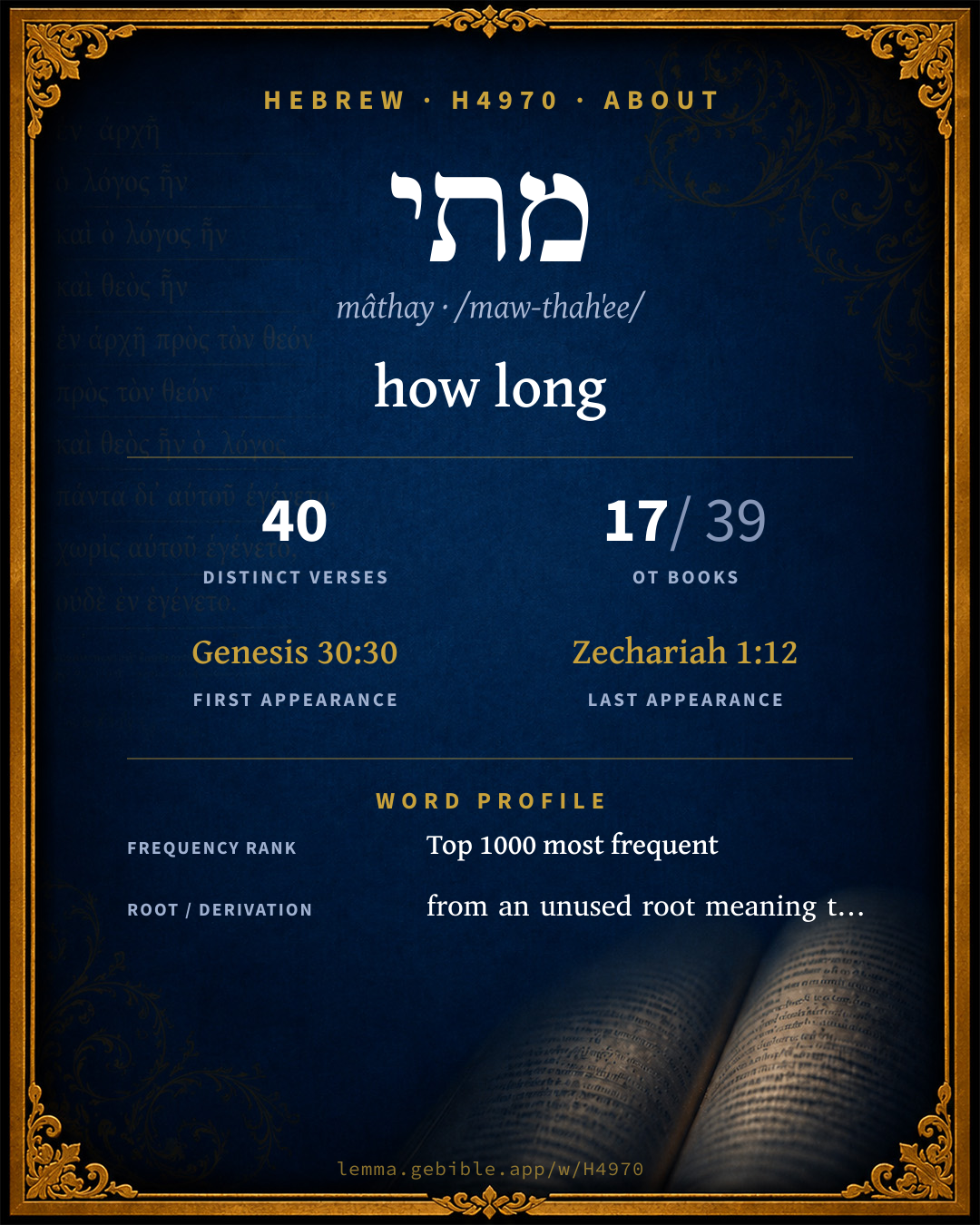
מָתַי
how long
‘how long’ is one of 2 main senses fuller range ↓
Full lexicon entry — Brown-Driver-Briggs (BDB)
From Brown-Driver-Briggs (BDB)
Where this word appears
Grammar key — what these labels mean
Part of speech
- Particle
- A short function word — article, negation, interrogative, the sign of the direct object, and the like.
Every verse where H4970 appears — 40 distinct verses across 17 books. Click any verse to open its interlinear word-by-word view. Verse text shown in the World English Bible for context — . Each verse’s Hebrew form is shown with its reference; the English is not keyword-highlighted, since the data carries no word-level English alignment. Use “Compare translations” on any verse to read it across multiple English versions. This concordance covers the Hebrew Bible; Septuagint (Greek Old Testament) occurrences are not indexed here.
Genesis 1 verse
Exodus 3 verses
- Exodus 8:9 לְ/מָתַ֣י prep + ptcl inter Moses said to Pharaoh, "I give you the honor of setting the time that I should pray for you, and for your servants, and for your people, that the frogs be destroyed from you and your houses, and remain in the river only."
- Exodus 10:3 מָתַ֣י ptcl inter Moses and Aaron went in to Pharaoh, and said to him, "This is what Yahweh, the God of the Hebrews, says: 'How long will you refuse to humble yourself before me? Let my people go, that they may serve me.
- Exodus 10:7 מָתַי֙ ptcl inter Pharaoh's servants said to him, "How long will this man be a snare to us? Let the men go, that they may serve Yahweh, their God. Don't you yet know that Egypt is destroyed?"
Numbers 1 verse
1 Samuel 2 verses
- 1 Samuel 1:14 מָתַ֖י ptcl inter Eli said to her, How long will you be drunken? put away your wine from you.
- 1 Samuel 16:1 מָתַי֙ ptcl inter Yahweh said to Samuel, How long will you mourn for Saul, seeing I have rejected him from being king over Israel? fill your horn with oil, and go: I will send you to Jesse the Bethlehemite; for I have provided me a king among his sons.
2 Samuel 1 verse
1 Kings 1 verse
Nehemiah 1 verse
Job 1 verse
Psalms 12 verses
- Psalms 6:3 מָתָֽי ptcl inter My soul is also in great anguish. But you, Yahweh--how long?
- Psalms 41:5 מָתַ֥י ptcl inter My enemies speak evil against me: "When will he die, and his name perish?"
- Psalms 42:2 מָתַ֥י ptcl inter My soul thirsts for God, for the living God. When shall I come and appear before God?
- Psalms 74:10 מָתַ֣י ptcl inter How long, God, shall the adversary reproach? Shall the enemy blaspheme your name forever?
- Psalms 80:4 מָתַ֥י ptcl inter Yahweh God of hosts, How long will you be angry against the prayer of your people?
- Psalms 82:2 מָתַ֥י ptcl inter "How long will you judge unjustly, And show partiality to the wicked?" Selah.
- Psalms 90:13 מָתָ֑י ptcl inter Relent, Yahweh! How long? Have compassion on your servants!
- Psalms 94:3 מָתַ֖י מָ֝תַ֗י ptcl inter ptcl inter Yahweh, how long will the wicked, How long will the wicked triumph?
- Psalms 94:8 מָתַ֥י ptcl inter Consider, you senseless among the people; You fools, when will you be wise?
- Psalms 101:2 מָ֭תַי ptcl inter I will be careful to live a blameless life. When will you come to me? I will walk within my house with a blameless heart.
- Psalms 119:82 מָתַ֥י ptcl inter My eyes fail for your word. I say, "When will you comfort me?"
- Psalms 119:84 מָתַ֬י ptcl inter How many are the days of your servant? When will you execute judgment on those who persecute me?
Proverbs 3 verses
- Proverbs 1:22 מָתַ֣י ptcl inter "How long, you simple ones, will you love simplicity? How long will mockers delight themselves in mockery, And fools hate knowledge?
- Proverbs 6:9 מָתַ֖י מָ֝תַ֗י ptcl inter ptcl inter How long will you sleep, sluggard? When will you arise out of your sleep?
- Proverbs 23:35 מָתַ֥י ptcl inter "They hit me, and I was not hurt; They beat me, and I don't feel it! When will I wake up? I can do it again. I can find another."
Isaiah 1 verse
Jeremiah 7 verses
- Jeremiah 4:14 מָתַ֛י ptcl inter Jerusalem, wash your heart from wickedness, that you may be saved. How long shall your evil thoughts lodge within you?
- Jeremiah 4:21 מָתַ֖י ptcl inter How long shall I see the standard, and hear the sound of the trumpet?
- Jeremiah 12:4 מָתַי֙ ptcl inter How long shall the land mourn, and the herbs of the whole country wither? for the wickedness of those who dwell therein, the animals are consumed, and the birds; because they said, He shall not see our latter end.
- Jeremiah 13:27 מָתַ֖י ptcl inter I have seen your abominations, even your adulteries, and your neighing, the lewdness of your prostitution, on the hills in the field. Woe to you, Jerusalem! you will not be made clean; how long shall it yet be?
- Jeremiah 23:26 מָתַ֗י ptcl inter How long shall this be in the heart of the prophets who prophesy lies, even the prophets of the deceit of their own heart?
- Jeremiah 31:22 מָתַי֙ ptcl inter How long will you go here and there, you backsliding daughter? for Yahweh has created a new thing in the earth: a woman shall encompass a man.
- Jeremiah 47:5 מָתַ֖י ptcl inter Baldness is come on Gaza; Ashkelon is brought to nothing, the remnant of their valley: how long will you cut yourself?
Daniel 2 verses
- Daniel 8:13 מָתַ֞י ptcl inter Then I heard a holy one speaking; and another holy one said to that certain one who spoke, How long shall be the vision [concerning] the continual [burnt-offering], and the disobedience that makes desolate, to give both the sanctuary and the host to be trodden under foot?
- Daniel 12:6 מָתַ֖י ptcl inter One said to the man clothed in linen, who was above the waters of the river, How long shall it be to the end of these wonders?
Hosea 1 verse
Amos 1 verse
Habakkuk 1 verse
Zechariah 1 verse
About this entry
At a glance — auto-summarized from this page’s data, not written by a person. Every figure links to its source below. This summary describes the numbers; it doesn’t interpret them.
The Hebrew word מתי centers on the idea of “how long.” First canonically at Genesis 30:30, it enters the text early. The Hebrew Bible uses it across 40 verses — moderately common. Psalms dominates its distribution — 12 of 40 verses. Its meaning spans more than one sense — see its full sense range. Dig into 40-verse concordance and the renderings breakdown below.
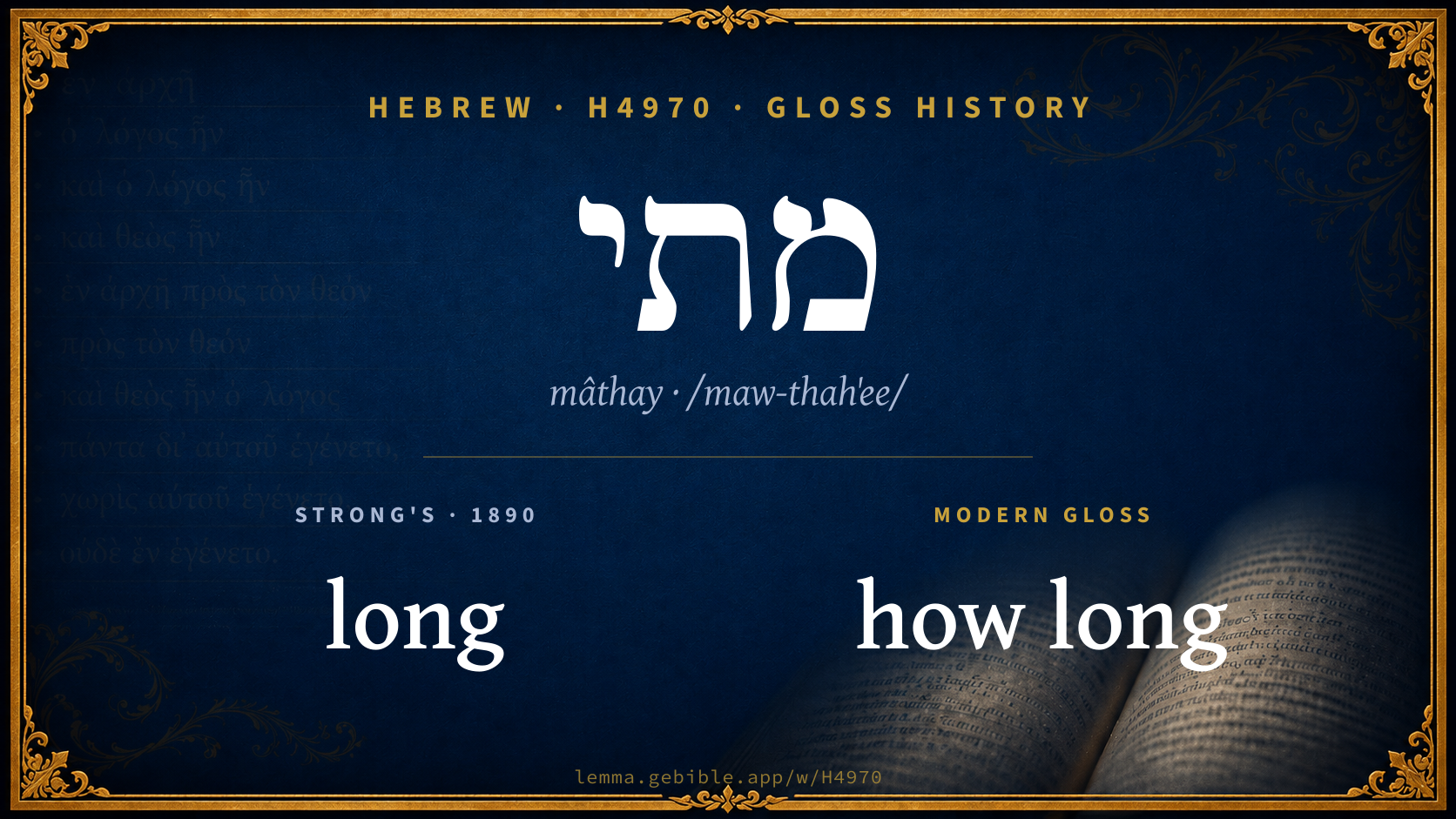
Gloss history
Strong's 1890 vs modern scholarship
About this word
Strong's H4970 catalogs a Hebrew word from the Hebrew Old Testament.
These counts are not copied from any lexicon or concordance. They are computed here, from the morphology-tagged Hebrew Old Testament. What Lemma adds →
- 40
- distinct verses
- The word appears in 40 distinct verses.
- 17 / 39
- OT books
- The word appears in 17 of 39 Old Testament books.
- #837
- by frequency
- Top 1000 most frequent Hebrew words (rank 837 of 8,640 Hebrew words by occurrence).
View all 40 occurrences in the concordance →
By section of the Old Testament
By traditional corpus
Conventional, traditional groupings — biblical authorship is debated, so this is a traditional corpus grouping, not an authorship claim. Each share is this word’s portion of its verses in that division of the Hebrew canon. Each figure is a share of the word’s 40 distinct verses.
- Writings (Ketuvim) 19 verses · 48%
- Prophets (Nevi'im) 16 verses · 40%
- Torah (Pentateuch) 5 verses · 13%
How translations render this word
Counts come from each version’s own published word-to-Strong’s tagging or interlinear alignment — an approximate guide to how each version renders this word, not a word-level alignment the data otherwise carries. Because each total is that version’s own tagged count, the per-version totals vary from one another and need not match the appearance or distinct-verse counts above. These counts may also differ from a printed concordance because Lemma counts each distinctly tagged rendering and does not collapse phrase taggings into a single head-word total. This is a fixed set of word-tagged versions (KJV, ASV, BSB, ULT) and does not change with the reading translation you choose elsewhere. Each version’s license is shown beside its name below (and on Sources).
- King James Version: How long 1×, Now when 1×, Over me when 1×
- American Standard Version: How long 1×, Now when 1×, Over me 1×
- Berean Standard Bible: When 13×, Long 3×, How long 2×
- unfoldingWord Literal Text: When 35×, How long 2×, Will 2×
King James Version Public Domain
Renders H4970 across 3 tagged occurrences — most commonly:
American Standard Version Public Domain
Renders H4970 across 3 tagged occurrences — most commonly:
Berean Standard Bible Public Domain
Renders H4970 across 20 tagged occurrences — most commonly:
Plus 2 renderings that appear only once — usually multi-word phrases or single function words the recovered tagging swept in, not distinct renderings. Not rendered by a distinct English word in 23 further occurrences.
unfoldingWord Literal Text CC BY-SA 4.0
Renders H4970 across 42 tagged occurrences — most commonly:
Plus 3 renderings that appear only once — usually multi-word phrases or single function words the recovered tagging swept in, not distinct renderings.
Senses in the full BDB
What do BDB’s symbols mean?
BDB uses these scholarly abbreviations:
| Symbol | Meaning |
|---|---|
| 𝔊 | the Septuagint (the ancient Greek translation, LXX) |
| 𝔙 | the Vulgate (the Latin translation) |
| 𝔖 | the Syriac version (the Peshitta) |
| 𝔗 | the Targum (the Aramaic translation) |
| ψ | the Psalms |
| √ | root (the underlying root or stem) |
| ‖ | parallel passage (a synonymous or contrasted parallel) |
| † | the dagger: every passage where the word occurs is cited |
The 3 senses and sub-senses the full Brown-Driver-Briggs lexicon distinguishes for this word, in lexicon order (not ranked by frequency), with BDB’s own verbatim wording and sub-sense lettering. Shown in Hebrew script with BDB’s own scholarly abbreviations. The condensed entry is in the Lexicon Entry tab. See also the Forms in the corpus table below.
- a. alone, †Gn 30:30 מָתַי אעשׂה גם אנכי לביתי when shall I also do, etc.? Am 8:5 ψ 41:6; 42:3; 94:8; 101:2; 119:82, 84 Pr 6:9b; 23:35 Jb 7:4 מָתַי אָקוּם, Ne 2:6. e.g. Genesis 30:30
- b. לְמָתַי against when? †Ex 8:5 לְמָתַי אַעְתִּיר לְךָ. e.g. Exodus 8:5
- c. עַד־מָתַי until when? how long? sq. impf. Ex 10:7 עד מתי יהיה זה לנו למוקשׁ, 1 S 1:14 Je 4:14, 21 ψ 74:10; 82:2; 94:3 Pr 1:22 +, sq. ptcp. 1 S 16:1 1 K 18:21 עַד־מָתַי אַתֶּם פֹּסְחִים עַל־שְׁתֵּי הַסְּעִפִּים, sq. pf. †Ex 10:3 ψ 80:5; עַד מָתַי לֹא †2 S 2:26 Ho 8:5 Zc 1:12; alone, Is 6:11 וָאֹמַר עַד־מָתַי אֲדֹנָי, Hb 2:6 הוֹי הַמַּרְבֶּה לֹא־לוֹ עַד־מָתַי; with an aposiop., ψ 6:4 וְאַתָּה י׳ עַד־מָתָ֑י, 90:13. b. אַחֲרֵי מָתַי עוֹד after how long yet? †Je 13:27. e.g. Exodus 10:7
Senses from the full Brown-Driver-Briggs lexicon (Brown, Driver, Briggs; Oxford 1906 — public domain), digitized via Sefaria, supplemented by the OpenScriptures HebrewLexicon (CC BY 4.0). Full attribution on Sources.
Word origin
interrog.adv. when? (Arabic مَتَى Assyrian mati: in NH and Aramaic with the interrog. אַי, אֵימָתִי, אֵימָת, ܐܶܡܰܬܝ ), in OT only of future time:
— Brown-Driver-Briggs (Oxford 1906, public domain), digitized via Sefaria, supplemented by the OpenScriptures HebrewLexicon (CC BY 4.0). See Sources.
Origin: from an unused root meaning to extend
Jastrow Dictionary
A second Hebrew/Aramaic lexicon for comparison, covering Aramaic and post-biblical (Talmudic, Targumic, Midrashic) usage that the biblical-Hebrew BDB does not. Matched by lemma rather than by Strong’s number, so a lemma may carry more than one Jastrow headword (shown separately below), and the entries cover usage well beyond the Bible.
מַתַּי
- pr. n. m., v. מַתַּאי
מַתִּי
- , v. מוּת
מָתַי
- (b. h.) when? Ber. I, 1 מִמָּ׳ Ar. (ed. מאֵימָתַי). Midr. Till. to Ps. IV, 3; 5 עד מ׳ וכ׳ how long will you &c.? Succ. 56ᵇ; a. fr.
A Dictionary of the Targumim, the Talmud Babli and Yerushalmi, and the Midrashic Literature (Marcus Jastrow; London, Luzac, 1903) — Public Domain. Digitized via Sefaria. Digitized via Sefaria. Full attribution on Sources.
Forms in the corpus
The 15 distinct written forms H4970 takes in the Hebrew Bible, most frequent first — each parse links to that state’s occurrences in the concordance. Hebrew forms include their vowel points and cantillation, so a single lemma takes many written forms.
| Form | Parsing | Example | Uses |
|---|---|---|---|
| מָתַ֖י | Particle, Interrogative | Daniel 12:6 | 8 |
| מָתַ֥י | Particle, Interrogative | Proverbs 23:35 | 7 |
| מָתַי֙ | Particle, Interrogative | Exodus 10:7 | 5 |
| מָתַ֣י | Particle, Interrogative | Exodus 10:3 | 4 |
| מָתַ֗י | Particle, Interrogative | Jeremiah 23:26 | 3 |
| מָתַ֛י | Particle, Interrogative | Genesis 30:30 | 3 |
| מָתַ֞י | Particle, Interrogative | Amos 8:5 | 3 |
| מָ֝תַ֗י | Particle, Interrogative | Proverbs 6:9 | 2 |
| מָתַ֕י | Particle, Interrogative | Habakkuk 2:6 | 2 |
| וּ/מָתַ֣י | Particle, Interrogative | Nehemiah 2:6 | 1 |
| לְ/מָתַ֣י | Particle, Interrogative | Exodus 8:9 | 1 |
| מָ֭תַי | Particle, Interrogative | Psalms 101:2 | 1 |
| מָתַ֬י | Particle, Interrogative | Psalms 119:84 | 1 |
| מָתָ֑י | Particle, Interrogative | Psalms 90:13 | 1 |
| מָתָֽי | Particle, Interrogative | Psalms 6:3 | 1 |
Same root — word family
Other BDB entries built from the same root as H4970, grouped by Strong’s listed origin. These share a root / origin per the lexicon — not necessarily a shared meaning. Each links to that word’s own entry.
Derived from this word
Compare all same-root words → They share a root, not necessarily a meaning.
Septuagint verse parallels
This word appears in 37 verses that also exist in the Greek Old Testament (Septuagint), out of the 40 Hebrew verses it occurs in. You can read those verses in Greek by switching the Old Testament edition to the Septuagint.
Read these verses in the Septuagint
- Genesis 30:30
- Exodus 8:9
- Numbers 14:27
- 1 Samuel 1:14
- 2 Samuel 2:26
- 1 Kings 18:21
- Job 7:4
- Psalms 6:3
- Proverbs 1:22
- Isaiah 6:11
- Jeremiah 4:14
- Daniel 8:13
This is a verse-level parallel only — the same verses exist in both the Hebrew and Greek Old Testaments. No word-level Hebrew↔Greek correspondence is claimed: the data carries no such alignment, so no Greek word is shown as this Hebrew word’s translation. Coverage is not total — the Septuagint omits the deuterocanon and renumbers the Psalms, so some Hebrew verses have no direct Greek parallel.