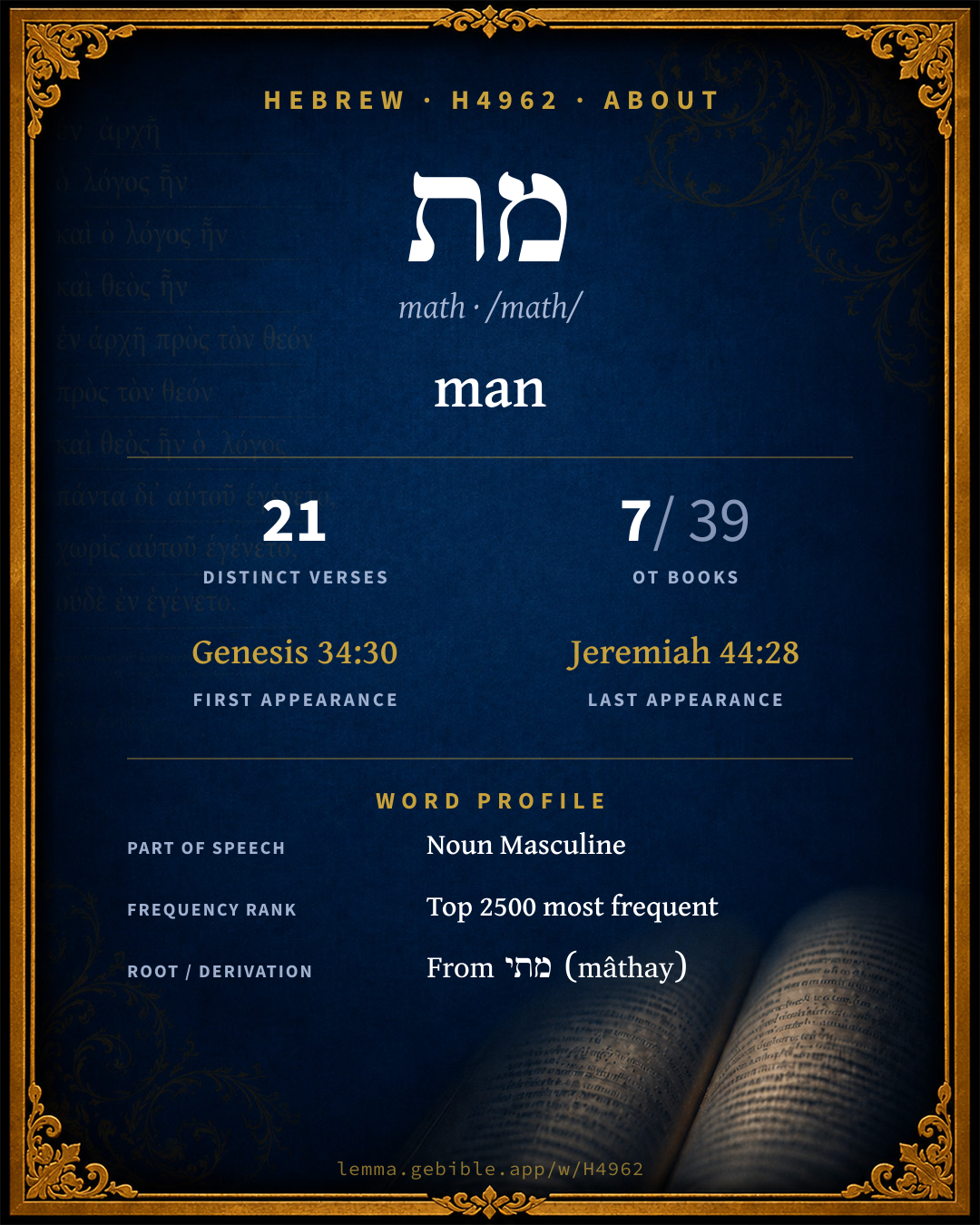
מַת
man
‘man’ is one of 4 main senses fuller range ↓
Full lexicon entry — Brown-Driver-Briggs (BDB)
From Brown-Driver-Briggs (BDB)
Where this word appears
See every Construct-state word in the Hebrew Bible →
Grammar key — what these labels mean
Part of speech
- Noun
- A naming word — a person, place, thing, or idea.
Noun type
- Common
- A common noun — a general class of person, place, or thing (“king,” “city,” “water”), not a specific name.
State
- Construct
- A noun bound to a following noun in a possessive / “of” relationship (the construct chain).
- Absolute
- The independent form of a noun, not bound to a following word.
Gender
- Masculine
- Grammatically masculine.
Number
- Plural
- More than one (in Hebrew, generally three or more).
Grammatical forms
- Noun, Common, Masculine, Plural, Construct 16 times (73%)
- Noun, Common, Masculine, Plural, Absolute 6 times (27%)
Parsed forms decoded from the imported morphology (morphhb / Westminster Leningrad Codex — WLC text public domain, morphhb tagging CC BY 4.0), counted across 22 parsed occurrences — not distinct verses.
Every verse where H4962 appears — 21 distinct verses across 7 books. Click any verse to open its interlinear word-by-word view. Verse text shown in the World English Bible for context — . Each verse’s Hebrew form is shown with its reference; the English is not keyword-highlighted, since the data carries no word-level English alignment. Use “Compare translations” on any verse to read it across multiple English versions. This concordance covers the Hebrew Bible; Septuagint (Greek Old Testament) occurrences are not indexed here.
Genesis 1 verse
Deuteronomy 6 verses
- Deuteronomy 2:34 מְתִ֔ם n c mp We took all his cities at that time, and utterly destroyed every inhabited city, with the women and the little ones; we left none remaining:
- Deuteronomy 3:6 מְתִ֔ם n c mp We utterly destroyed them, as we did to Sihon king of Heshbon, utterly destroying every inhabited city, with the women and the little ones.
- Deuteronomy 4:27 מְתֵ֣י n c mp cs Yahweh will scatter you among the peoples, and you shall be left few in number among the nations, where Yahweh shall lead you away.
- Deuteronomy 26:5 בִּ/מְתֵ֣י prep + n c mp cs You shall answer and say before Yahweh your God, A Syrian ready to perish was my father; and he went down into Egypt, and sojourned there, few in number; and he became there a nation, great, mighty, and populous.
- Deuteronomy 28:62 בִּ/מְתֵ֣י prep + n c mp cs You shall be left few in number, whereas you were as the stars of the sky for multitude; because you didn't listen to the voice of Yahweh your God.
- Deuteronomy 33:6 מְתָ֖י/ו n c mp cs + sfx pers 3ms Let Reuben live, and not die; Nor let his men be few.
1 Chronicles 1 verse
Job 6 verses
- Job 11:3 מְתִ֣ים n c mp Should your boastings make men hold their peace? When you mock, shall no man make you ashamed?
- Job 11:11 מְתֵי n c mp cs For he knows false men. He sees iniquity also, even though he doesn't consider it.
- Job 19:19 מְתֵ֣י n c mp cs All my familiar friends abhor me. They whom I loved have turned against me.
- Job 22:15 מְתֵי n c mp cs Will you keep the old way Which wicked men have trodden,
- Job 24:12 מְתִ֨ים n c mp From out of the populous city, men groan. The soul of the wounded cries out, Yet God doesn't regard the folly.
- Job 31:31 מְתֵ֣י n c mp cs If the men of my tent have not said, 'Who can find one who has not been filled with his meat?'
Psalms 3 verses
- Psalms 17:14 מִֽ/מְתִ֥ים מִֽ/מְתִ֬ים prep + n c mp prep + n c mp From men by your hand, Yahweh, From men of the world, whose portion is in this life. You fill the belly of your cherished ones. Your sons have plenty, And they store up wealth for their children.
- Psalms 26:4 מְתֵי n c mp cs I have not sat with deceitful men, Neither will I go in with hypocrites.
- Psalms 105:12 מְתֵ֣י n c mp cs When they were but a few men in number, Yes, very few, and foreigners in it.
Isaiah 3 verses
- Isaiah 3:25 מְתַ֖יִ/ךְ n c mp cs + sfx pers 2fs Your men shall fall by the sword, And your mighty in the war.
- Isaiah 5:13 מְתֵ֣י n c mp cs Therefore my people go into captivity for lack of knowledge; Their honorable men are famished, And their multitudes are parched with thirst.
- Isaiah 41:14 מְתֵ֖י n c mp cs Don't be afraid, you worm Jacob, and you men of Israel; I will help you, says Yahweh, and your Redeemer is the Holy One of Israel.
Jeremiah 1 verse
About this entry
At a glance — auto-summarized from this page’s data, not written by a person. Every figure links to its source below. This summary describes the numbers; it doesn’t interpret them.
At its core, מת (math) means “man.” Not a single-sense word: explore its full sense range. It appears 21 verses across 7 books of the Hebrew Bible, among its uncommon vocabulary. The word gravitates to Deuteronomy (29%), then Job and Psalms. Scripture first uses it in Genesis 34:30. Each statement above links to its evidence; the full detail follows below.
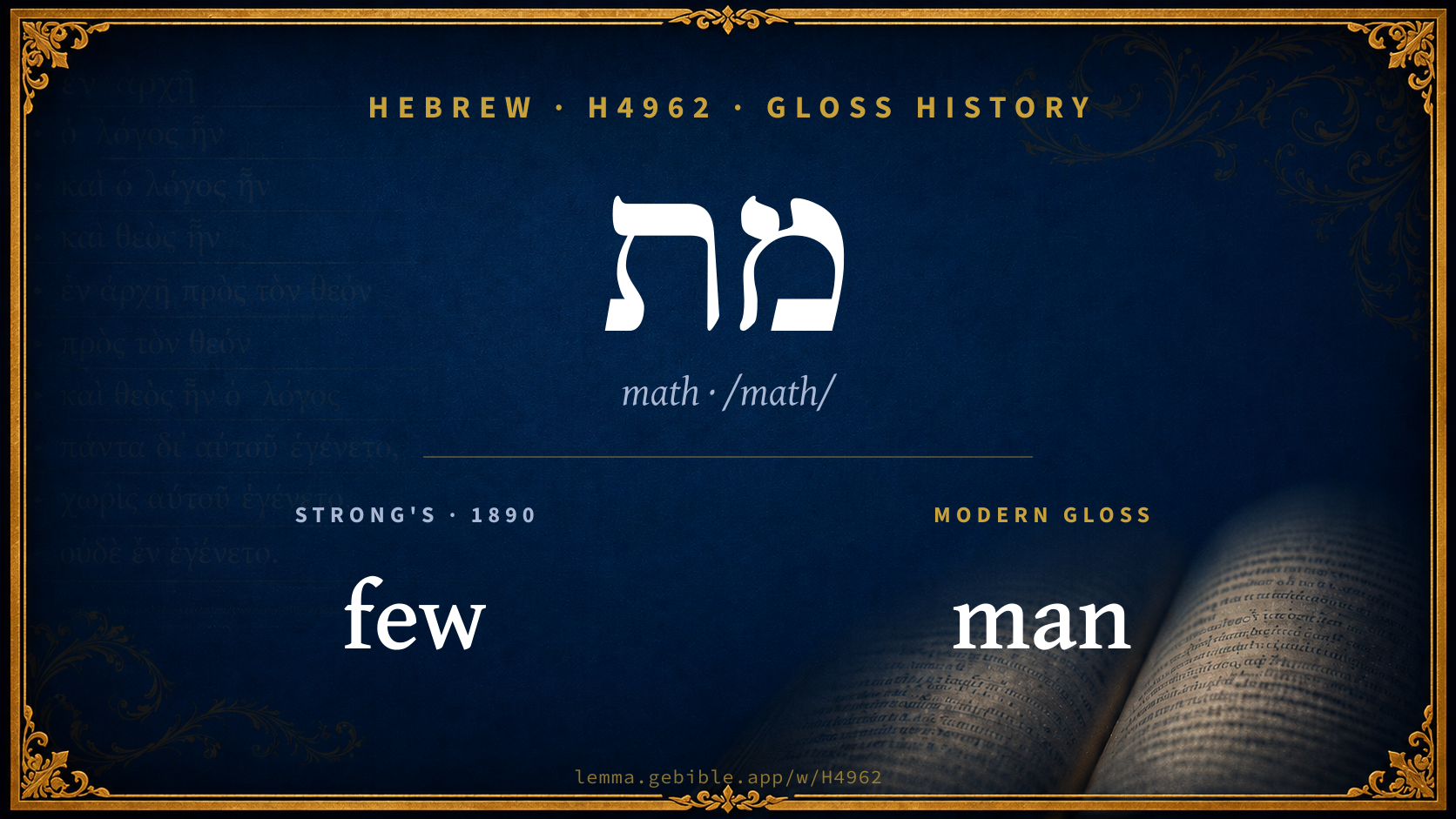
Gloss history
Strong's 1890 vs modern scholarship
About this word
Strong's H4962 catalogs a Hebrew word from the Hebrew Old Testament.
These counts are not copied from any lexicon or concordance. They are computed here, from the morphology-tagged Hebrew Old Testament. What Lemma adds →
- 21
- distinct verses
- The word appears in 21 distinct verses.
- 7 / 39
- OT books
- The word appears in 7 of 39 Old Testament books.
- #1,412
- by frequency
- Top 2500 most frequent Hebrew words (rank 1,412 of 8,640 Hebrew words by occurrence).
View all 21 occurrences in the concordance →
Most concentrated in
- Deuteronomy 6 verses 29%
- Job 6 verses 29%
- Psalms 3 verses 14%
By section of the Old Testament
By traditional corpus
Conventional, traditional groupings — biblical authorship is debated, so this is a traditional corpus grouping, not an authorship claim. Each share is this word’s portion of its verses in that division of the Hebrew canon. Each figure is a share of the word’s 21 distinct verses.
- Writings (Ketuvim) 10 verses · 48%
- Torah (Pentateuch) 7 verses · 33%
- Prophets (Nevi'im) 4 verses · 19%
How translations render this word
Counts come from each version’s own published word-to-Strong’s tagging or interlinear alignment — an approximate guide to how each version renders this word, not a word-level alignment the data otherwise carries. Because each total is that version’s own tagged count, the per-version totals vary from one another and need not match the appearance or distinct-verse counts above. These counts may also differ from a printed concordance because Lemma counts each distinctly tagged rendering and does not collapse phrase taggings into a single head-word total. This is a fixed set of word-tagged versions (KJV, ASV, BSB, ULT) and does not change with the reading translation you choose elsewhere. Each version’s license is shown beside its name below (and on Sources).
- King James Version: Men 11×
- American Standard Version: Men 9×, Every inhabited 2×, Few 2×
- Berean Standard Bible: Men 10×, Few 3×
- unfoldingWord Literal Text: Men 7×, Men of 5×, Few 2×
King James Version Public Domain
Renders H4962 across 21 tagged occurrences — most commonly:
Plus 10 renderings that appear only once — usually multi-word phrases or single function words the recovered tagging swept in, not distinct renderings. Not rendered by a distinct English word in 1 further occurrence.
American Standard Version Public Domain
Renders H4962 across 20 tagged occurrences — most commonly:
Plus 7 renderings that appear only once — usually multi-word phrases or single function words the recovered tagging swept in, not distinct renderings.
Berean Standard Bible Public Domain
Renders H4962 across 20 tagged occurrences — most commonly:
Plus 7 renderings that appear only once — usually multi-word phrases or single function words the recovered tagging swept in, not distinct renderings. Not rendered by a distinct English word in 2 further occurrences.
unfoldingWord Literal Text CC BY-SA 4.0
Renders H4962 across 21 tagged occurrences — most commonly:
Plus 5 renderings that appear only once — usually multi-word phrases or single function words the recovered tagging swept in, not distinct renderings.
7 senses and sub-senses in the full BDB
What do BDB’s symbols mean?
BDB uses these scholarly abbreviations:
| Symbol | Meaning |
|---|---|
| 𝔊 | the Septuagint (the ancient Greek translation, LXX) |
| 𝔙 | the Vulgate (the Latin translation) |
| 𝔖 | the Syriac version (the Peshitta) |
| 𝔗 | the Targum (the Aramaic translation) |
| ψ | the Psalms |
| √ | root (the underlying root or stem) |
| ‖ | parallel passage (a synonymous or contrasted parallel) |
| † | the dagger: every passage where the word occurs is cited |
The 7 senses and sub-senses the full Brown-Driver-Briggs lexicon distinguishes for this word, in lexicon order (not ranked by frequency), with BDB’s own verbatim wording and sub-sense lettering. Shown in Hebrew script with BDB’s own scholarly abbreviations. The condensed entry is in the Lexicon Entry tab. See also the Forms in the corpus table below.
- 1. males, men, Is 3:25 (‖ גְּכוּרָתֵךְ); more distinctly, עִיר מְתִם (וְ)הַנָּשִׁים וְהַטָּף Dt 2:34; 3:6 every city of males (male population, cf. Dr), and the women, etc.; Ju 20:48 (v. supr.; opp. בְּהֵמָה). e.g. Isaiah 3:25
- 2. usually less emphasis on sex, in prose only phr.:
- a. מְתֵי מִסְפָּר men of number (numerable, i.e. few) Gn 34:30 (J; appos. of אֲנִי = Jacob, representing his family), Dt 4:27 Je 44:28, also ψ 105:12 = 1 Ch 16:19; cf. וִיהִי מְתָיו מִסְפָּר Dt 33:6 and (but) let his men be few. e.g. Genesis 34:30
- b. בִּמְתֵי מְעָ֑ט = consisting of a few men Dt 26:5; 28:62. e.g. Deuteronomy 26:5
- 3. elsewhere only poet., sex usually not emph.:
- a. Jb 11:3; 24:12 ψ 17:14(×2) (but text prob. corrupt, cf. Bae We; at least om. ממתים ידך Ol Bi Che, cf. Hup-Now); מְתֵי ישׂראל Is 41:14. e.g. Job 11:3
- b. poet. phr.: מְתֵי שָׁוְא men of falsehood Jb 11:11 ψ 26:4; מ׳ אָוֶן Jb 22:15 men of wickedness; מ׳ סוֹדִי 19:19 men of my circle; מ׳ אָהֳלִי Jb 31:31 men of my tent (household); מ׳ רָעָב Is 5:13 men of hunger, but read probably מְזֵי ר׳ sucked out, empty from hunger (as Dt 32:24) Ew De Che Di Du (cf. מָזֶה). e.g. Job 11:11
Senses from the full Brown-Driver-Briggs lexicon (Brown, Driver, Briggs; Oxford 1906 — public domain), digitized via Sefaria, supplemented by the OpenScriptures HebrewLexicon (CC BY 4.0). Full attribution on Sources.
Word origin
n.m. male, man (מְתוּ־ in n.pr.; Zinj. מת coll. males, male offspring; Assyrian mutu, husband; Ethiopic ምት: id.; cf. Egyptian m-t, phallus, male, Steindorff in BaNB § 2 b, δ);—only pl. מְתִים Jb 11:3 + 3 times, מְתִם Dt 2:34; 3:6 + Ju 20:48 (probably), for MT מְתֹם, so GFM; cstr. מְתֵי Gn 34:30 + 13 times; sf. 2 fs. מְתַיִךְ Is 3:25; 3 ms. מְתָיו Dt 33:6;—
— Brown-Driver-Briggs (Oxford 1906, public domain), digitized via Sefaria, supplemented by the OpenScriptures HebrewLexicon (CC BY 4.0). See Sources.
Derived from מתי (mâthay) (H4970) — how long.
Jastrow Dictionary
A second Hebrew/Aramaic lexicon for comparison, covering Aramaic and post-biblical (Talmudic, Targumic, Midrashic) usage that the biblical-Hebrew BDB does not. Matched by lemma rather than by Strong’s number, so a lemma may carry more than one Jastrow headword (shown separately below), and the entries cover usage well beyond the Bible.
מֵת
- dying, dead; corpse. Ber. 3ᵇ בפני המת in the presence of a dead body; דבריו של מת affairs concerning the dead. Ib. 18ᵇ, a. e. קשה רמה למת וכ׳ the gnawing of the worm is as painful to the buried corpse as a pin &c.; a. v. fr.—מת מצוה, v. מִצְוָה.—Pl. מֵתִים, constr. מֵתֵי. M. Kat. 20ᵃ מתי מצוה, v. מִצְוָה. Ber. 18ᵇ. Tosef. Sabb. VI (VII), 1 לבין המ׳ to the graveyard; a. v. fr.—Snh. 55ᵃ, a. fr. משמש מת coition with membrum mortuum
A Dictionary of the Targumim, the Talmud Babli and Yerushalmi, and the Midrashic Literature (Marcus Jastrow; London, Luzac, 1903) — Public Domain. Digitized via Sefaria. Digitized via Sefaria. Full attribution on Sources.
Forms in the corpus
The 11 distinct written forms H4962 takes in the Hebrew Bible, most frequent first — each parse links to that state’s occurrences in the concordance. Hebrew forms include their vowel points and cantillation, so a single lemma takes many written forms.
| Form | Parsing | Example | Uses |
|---|---|---|---|
| מְתֵ֣י | Noun, Common, Masculine, Plural, Construct | Deuteronomy 4:27 | 8 |
| מְתֵי | Noun, Common, Masculine, Plural, Construct | Job 11:11 | 3 |
| בִּ/מְתֵ֣י | Noun, Common, Masculine, Plural, Construct | Deuteronomy 26:5 | 2 |
| מְתִ֔ם | Noun, Common, Masculine, Plural, Absolute | Deuteronomy 2:34 | 2 |
| מְתִ֣ים | Noun, Common, Masculine, Plural, Absolute | Job 11:3 | 1 |
| מְתִ֨ים | Noun, Common, Masculine, Plural, Absolute | Job 24:12 | 1 |
| מְתֵ֖י | Noun, Common, Masculine, Plural, Construct | Isaiah 41:14 | 1 |
| מְתַ֖יִ/ךְ | Noun, Common, Masculine, Plural, Construct | Isaiah 3:25 | 1 |
| מְתָ֖י/ו | Noun, Common, Masculine, Plural, Construct | Deuteronomy 33:6 | 1 |
| מִֽ/מְתִ֥ים | Noun, Common, Masculine, Plural, Absolute | Psalms 17:14 | 1 |
| מִֽ/מְתִ֬ים | Noun, Common, Masculine, Plural, Absolute | Psalms 17:14 | 1 |
Same root — word family
Other BDB entries built from the same root as H4962, grouped by Strong’s listed origin. These share a root / origin per the lexicon — not necessarily a shared meaning. Each links to that word’s own entry.
Derives from
Proper names from this root
People and places named from this root — a name, not an additional meaning of the word.
Compare all same-root words → 2 of the same-root words are proper names (people or places). They share a root, not necessarily a meaning.
Septuagint verse parallels
This word appears in 20 verses that also exist in the Greek Old Testament (Septuagint), out of the 21 Hebrew verses it occurs in. You can read those verses in Greek by switching the Old Testament edition to the Septuagint.
Read these verses in the Septuagint
This is a verse-level parallel only — the same verses exist in both the Hebrew and Greek Old Testaments. No word-level Hebrew↔Greek correspondence is claimed: the data carries no such alignment, so no Greek word is shown as this Hebrew word’s translation. Coverage is not total — the Septuagint omits the deuterocanon and renumbers the Psalms, so some Hebrew verses have no direct Greek parallel.