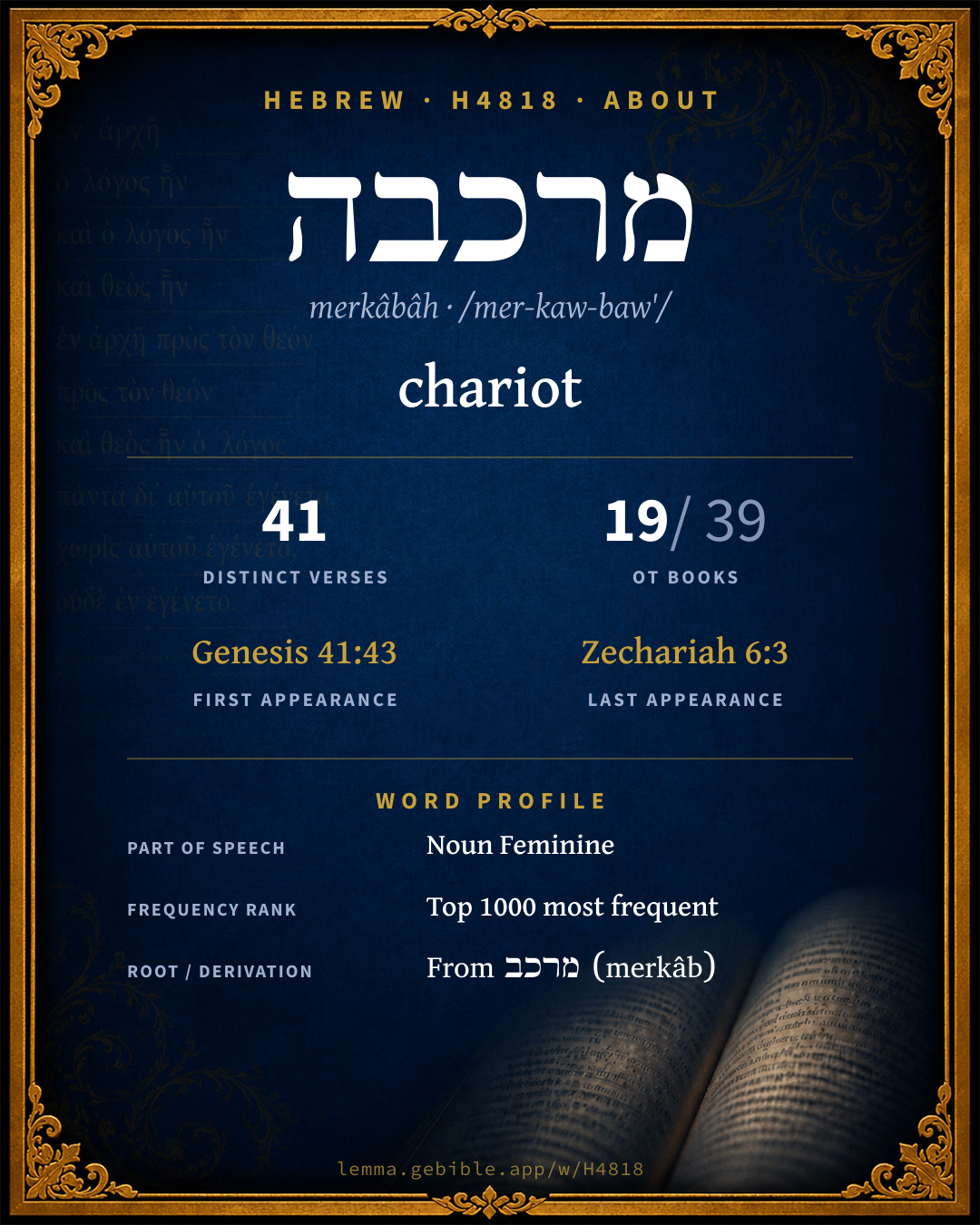
מֶרְכָּבָה
chariot
Full lexicon entry — Brown-Driver-Briggs (BDB)
From Brown-Driver-Briggs (BDB)
Where this word appears
See every Absolute-state word in the Hebrew Bible →
Grammar key — what these labels mean
Part of speech
- Noun
- A naming word — a person, place, thing, or idea.
Noun type
- Common
- A common noun — a general class of person, place, or thing (“king,” “city,” “water”), not a specific name.
State
- Absolute
- The independent form of a noun, not bound to a following word.
- Construct
- A noun bound to a following noun in a possessive / “of” relationship (the construct chain).
Gender
- Feminine
- Grammatically feminine.
Number
- Singular
- One.
- Plural
- More than one (in Hebrew, generally three or more).
Grammatical forms
- Noun, Common, Feminine, Singular, Absolute 22 times (50%)
- Noun, Common, Feminine, Plural, Construct 13 times (30%)
- Noun, Common, Feminine, Singular, Construct 5 times (11%)
- Noun, Common, Feminine, Plural, Absolute 4 times (9%)
Parsed forms decoded from the imported morphology (morphhb / Westminster Leningrad Codex — WLC text public domain, morphhb tagging CC BY 4.0), counted across 44 parsed occurrences — not distinct verses.
Every verse where H4818 appears — 41 distinct verses across 19 books. Click any verse to open its interlinear word-by-word view. Verse text shown in the World English Bible for context — . Each verse’s Hebrew form is shown with its reference; the English is not keyword-highlighted, since the data carries no word-level English alignment. Use “Compare translations” on any verse to read it across multiple English versions. This concordance covers the Hebrew Bible; Septuagint (Greek Old Testament) occurrences are not indexed here.
Genesis 2 verses
- Genesis 41:43 בְּ/מִרְכֶּ֤בֶת prep + n c fs cs and he made him to ride in the second chariot which he had. They cried before him, "Bow the knee!" He set him over all the land of Egypt.
- Genesis 46:29 מֶרְכַּבְתּ֔/וֹ n c fs cs + sfx pers 3ms Joseph made ready his chariot, and went up to meet Israel, his father, in Goshen. He presented himself to him, and fell on his neck, and wept on his neck a good while.
Exodus 2 verses
- Exodus 14:25 מַרְכְּבֹתָ֔י/ו n c fp cs + sfx pers 3ms He took off their chariot wheels, and they drove them heavily; so that the Egyptians said, "Let's flee from the face of Israel, for Yahweh fights for them against the Egyptians!"
- Exodus 15:4 מַרְכְּבֹ֥ת n c fp cs Pharaoh's chariots and his host has he cast into the sea; His chosen captains are sunk in the Red Sea.
Joshua 2 verses
- Joshua 11:6 מַרְכְּבֹתֵי/הֶ֖ם n c fp cs + sfx pers 3mp Yahweh said to Joshua, Don't be afraid because of them; for tomorrow at this time will I deliver them up all slain before Israel: you shall hamstring their horses, and burn their chariots with fire.
- Joshua 11:9 מַרְכְּבֹתֵי/הֶ֖ם n c fp cs + sfx pers 3mp Joshua did to them as Yahweh bade him: he hamstrung their horses, and burnt their chariots with fire.
Judges 2 verses
- Judges 4:15 הַ/מֶּרְכָּבָ֖ה ptcl def.art + n c fs Yahweh confused Sisera, and all his chariots, and all his host, with the edge of the sword before Barak; and Sisera alighted from his chariot, and fled away on his feet.
- Judges 5:28 מַרְכְּבוֹתָֽי/ו n c fp cs + sfx pers 3ms Through the window she looked forth, and cried, The mother of Sisera [cried] through the lattice, Why is his chariot so long in coming? Why do the wheels of his chariots wait?
1 Samuel 1 verse
2 Samuel 1 verse
1 Kings 5 verses
- 1 Kings 7:33 הַ/מֶּרְכָּבָ֑ה ptcl def.art + n c fs The work of the wheels was like the work of a chariot wheel: their axles, and their rims, and their spokes, and their naves, were all molten.
- 1 Kings 10:29 מֶרְכָּבָ֤ה n c fs A chariot came up and went out of Egypt for six hundred [shekels] of silver, and a horse for one hundred fifty; and so for all the kings of the Hittites, and for the kings of Syria, did they bring them out by their means.
- 1 Kings 12:18 בַּ/מֶּרְכָּבָ֔ה prep det + n c fs Then king Rehoboam sent Adoram, who was over the men subject to forced labor; and all Israel stoned him to death with stones. King Rehoboam made speed to get him up to his chariot, to flee to Jerusalem.
- 1 Kings 20:33 הַ/מֶּרְכָּבָֽה ptcl def.art + n c fs Now the men observed diligently, and hurried to catch whether it were his mind; and they said, Your brother Ben Hadad. Then he said, Go you, bring him. Then Ben Hadad came forth to him; and he caused him to come up into the chariot.
- 1 Kings 22:35 בַּ/מֶּרְכָּבָ֖ה prep det + n c fs The battle increased that day: and the king was stayed up in his chariot against the Syrians, and died at even; and the blood ran out of the wound into the bottom of the chariot.
2 Kings 5 verses
- 2 Kings 5:21 הַ/מֶּרְכָּבָ֛ה ptcl def.art + n c fs So Gehazi followed after Naaman. When Naaman saw one running after him, he alighted from the chariot to meet him, and said, Is all well?
- 2 Kings 5:26 מֶרְכַּבְתּ֖/וֹ n c fs cs + sfx pers 3ms He said to him, Didn't my heart go with you, when the man turned from his chariot to meet you? Is it a time to receive money, and to receive garments, and olive groves and vineyards, and sheep and oxen, and men-servants and maid-servants?
- 2 Kings 9:27 הַ/מֶּרְכָּבָ֗ה ptcl def.art + n c fs But when Ahaziah the king of Judah saw this, he fled by the way of the garden-house. Jehu followed after him, and said, Smite him also in the chariot: [and they struck him] at the ascent of Gur, which is by Ibleam. He fled to Megiddo, and died there.
- 2 Kings 10:15 הַ/מֶּרְכָּבָֽה ptcl def.art + n c fs When he was departed there, he lighted on Jehonadab the son of Rechab coming to meet him; and he greeted him, and said to him, Is your heart right, as my heart is with your heart? Jehonadab answered, It is. If it be, give me your hand. He gave him his hand; and he took him up to him into the chariot.
- 2 Kings 23:11 מַרְכְּב֥וֹת n c fp cs He took away the horses that the kings of Judah had given to the sun, at the entrance of the house of Yahweh, by the chamber of Nathan-melech the chamberlain, which was in the precincts; and he burned the chariots of the sun with fire.
1 Chronicles 1 verse
2 Chronicles 6 verses
- 2 Chronicles 1:17 מֶרְכָּבָה֙ n c fs They brought up and brought out of Egypt a chariot for six hundred pieces of silver, and a horse for one hundred fifty: and so for all the kings of the Hittites, and the kings of Syria, did they bring them out by their means.
- 2 Chronicles 9:25 וּ/מַרְכָּב֔וֹת conj + n c fp Solomon had four thousand stalls for horses and chariots, and twelve thousand horsemen, that he bestowed in the chariot cities, and with the king at Jerusalem.
- 2 Chronicles 10:18 בַּ/מֶּרְכָּבָ֔ה prep det + n c fs Then king Rehoboam sent Hadoram, who was over the men subject to forced labor; and the children of Israel stoned him to death with stones. King Rehoboam made speed to get him up to his chariot, to flee to Jerusalem.
- 2 Chronicles 14:9 וּ/מַרְכָּב֖וֹת conj + n c fp There came out against them Zerah the Ethiopian with an army of a million troops, and three hundred chariots; and he came to Mareshah.
- 2 Chronicles 18:34 בַּ/מֶּרְכָּבָ֛ה prep det + n c fs The battle increased that day: however the king of Israel stayed himself up in his chariot against the Syrians until the even; and about the time of the going down of the sun he died.
- 2 Chronicles 35:24 הַ/מֶּרְכָּבָ֗ה ptcl def.art + n c fs So his servants took him out of the chariot, and put him in the second chariot that he had, and brought him to Jerusalem; and he died, and was buried in the tombs of his fathers. All Judah and Jerusalem mourned for Josiah.
Song of Solomon 1 verse
Isaiah 3 verses
- Isaiah 2:7 לְ/מַרְכְּבֹתָֽי/ו prep + n c fp cs + sfx pers 3ms Their land is full of silver and gold, Neither is there any end of their treasures. Their land also is full of horses, Neither is there any end of their chariots.
- Isaiah 22:18 מַרְכְּב֣וֹת n c fp cs He will surely wind you round and round, [and toss you] like a ball into a large country; there shall you die, and there shall be the chariots of your glory, you shame of your lord's house.
- Isaiah 66:15 מַרְכְּבֹתָ֑י/ו n c fp cs + sfx pers 3ms For, behold, Yahweh will come with fire, and his chariots shall be like the whirlwind; to render his anger with fierceness, and his rebuke with flames of fire.
Jeremiah 1 verse
Joel 1 verse
Micah 2 verses
- Micah 1:13 הַ/מֶּרְכָּבָ֛ה ptcl def.art + n c fs Harness the chariot to the swift steed, inhabitant of Lachish. She was the beginning of sin to the daughter of Zion; For the transgressions of Israel were found in you.
- Micah 5:10 מַרְכְּבֹתֶֽי/ךָ n c fp cs + sfx pers 2ms "It will happen in that day," says Yahweh, "That I will cut off your horses out of the midst of you, And will destroy your chariots.
Nahum 1 verse
Habakkuk 1 verse
Haggai 1 verse
Zechariah 3 verses
- Zechariah 6:1 מַרְכָּבוֹת֙ n c fp Again I lifted up my eyes, and saw, and, behold, four chariots came out from between two mountains; and the mountains were mountains of brass.
- Zechariah 6:2 בַּ/מֶּרְכָּבָ֥ה וּ/בַ/מֶּרְכָּבָ֥ה prep det + n c fs conj + prep det + n c fs In the first chariot were red horses; in the second chariot black horses;
- Zechariah 6:3 וּ/בַ/מֶּרְכָּבָ֥ה וּ/בַ/מֶּרְכָּבָה֙ conj + prep det + n c fs conj + prep det + n c fs in the third chariot white horses; and in the fourth chariot dappled horses, all of them powerful.
About this entry
At a glance — auto-summarized from this page’s data, not written by a person. Every figure links to its source below. This summary describes the numbers; it doesn’t interpret them.
מרכבה — transliterated merkâbâh — is a Hebrew noun carrying the sense “chariot.” It first appears in Genesis 41:43. The Hebrew Bible uses it across 41 verses — moderately common. Each statement above links to its evidence; the full detail follows below.
Gloss history
Strong's 1890 vs modern scholarship
About this word
Strong's H4818 catalogs a Hebrew word from the Hebrew Old Testament.
These counts are not copied from any lexicon or concordance. They are computed here, from the morphology-tagged Hebrew Old Testament. What Lemma adds →
- 41
- distinct verses
- The word appears in 41 distinct verses.
- 19 / 39
- OT books
- The word appears in 19 of 39 Old Testament books.
- #819
- by frequency
- Top 1000 most frequent Hebrew words (rank 819 of 8,640 Hebrew words by occurrence).
View all 41 occurrences in the concordance →
Most concentrated in
- 2 Chronicles 6 verses 15%
- 1 Kings 5 verses 12%
- 2 Kings 5 verses 12%
By section of the Old Testament
By traditional corpus
Conventional, traditional groupings — biblical authorship is debated, so this is a traditional corpus grouping, not an authorship claim. Each share is this word’s portion of its verses in that division of the Hebrew canon. Each figure is a share of the word’s 41 distinct verses.
- Prophets (Nevi'im) 29 verses · 71%
- Writings (Ketuvim) 8 verses · 20%
- Torah (Pentateuch) 4 verses · 10%
How translations render this word
Counts come from each version’s own published word-to-Strong’s tagging or interlinear alignment — an approximate guide to how each version renders this word, not a word-level alignment the data otherwise carries. Because each total is that version’s own tagged count, the per-version totals vary from one another and need not match the appearance or distinct-verse counts above. These counts may also differ from a printed concordance because Lemma counts each distinctly tagged rendering and does not collapse phrase taggings into a single head-word total. This is a fixed set of word-tagged versions (KJV, ASV, BSB, ULT) and does not change with the reading translation you choose elsewhere. Each version’s license is shown beside its name below (and on Sources).
- King James Version: Chariot 21×, Chariots 19×
- American Standard Version: Chariot 22×, Chariots 15×
- Berean Standard Bible: Chariot 21×, Chariots 17×
- unfoldingWord Literal Text: Chariot 26×, Chariots 12×, The 5×
King James Version Public Domain
Renders H4818 across 44 tagged occurrences — most commonly:
Plus 4 renderings that appear only once — usually multi-word phrases or single function words the recovered tagging swept in, not distinct renderings.
American Standard Version Public Domain
Renders H4818 across 44 tagged occurrences — most commonly:
Plus 7 renderings that appear only once — usually multi-word phrases or single function words the recovered tagging swept in, not distinct renderings.
Berean Standard Bible Public Domain
Renders H4818 across 41 tagged occurrences — most commonly:
Plus 3 renderings that appear only once — usually multi-word phrases or single function words the recovered tagging swept in, not distinct renderings. Not rendered by a distinct English word in 3 further occurrences.
unfoldingWord Literal Text CC BY-SA 4.0
Renders H4818 across 51 tagged occurrences — most commonly:
Plus 4 renderings that appear only once — usually multi-word phrases or single function words the recovered tagging swept in, not distinct renderings.
Senses in BDB
The 1 sense BDB distinguishes for this word, in lexicon order (not ranked by frequency or importance). The full entry — with sub-senses — is in the Lexicon Entry tab.
- chariot
Word origin
n.f. chariot;—abs. מ׳ Ju 4:15 +, cstr. מִרְכֶּ֫בֶת †Gn 41:43; sf. מֶרְכַּבְתּוֹ 46:29 +; pl. מַרְכָּבוֹת Zc 6:1 +; cstr. מַרְכְּבוֹת 2 K 23:11 +, -בֹת Ex 15:4; sf. מַרְכְּבֹתֶיךָ Mi 5:10; Hb 3:8, etc.;—chariot (often ‖ סוּס(ים), 1 S 8:11 פָרָשִׁים): especially war-chariot, Egypt., Ex 14:25 (J), 15:4 (song), 2 Ch 14:8; from Muṣri in N. Syriac (according to Wkl., v. מצרים ad fin., cf. Kit 1 K 10:28 Benz1b.) 1 K 10:29 = 2 Ch 1:17; Can., Jos 11:6, 9 (JE), Ju 4:15 (‖ רֶכֶב), 5:28 (‖ id.); Assyrian, Is 2:7; Na 3:2; foe from north Je 4:13, nations in gen. Hg 2:22; Isr. and Jud. 1 K 20:33; 22:35 = 2 Ch 18:34; 2 K 9:27; 10:15; 2 Ch 35:24; Mi 5:10; fig. of י׳’s chariots Is 66:15; Hb 3:8, cf. (in vision) Zc 6:1, 2(×2), 3(×2); מ׳ for dignity and display Gn 41:43 (E), 46:29 (J), 1 S 8:11(×2); 2 S 15:1; 2 K 5:21, 26, מַרְכְּבוֹת כְּבוֹדֶ֑ךָ Is 22:18 (iron.); used in flight 1 K 12:18 = 2 Ch 10:18, Mi 1:13; מַרְכְּבוֹת הַשֶּׁמֶשׁ 2 K 23:11 (idolatrous); הַמּ׳ הַכְּרוּבִים (read מִרְכֶּבֶת הַכּ׳, 𝔊 Benz) 1 Ch 28:18 (on this conception of cherubim in temple v. Benz); מ׳ in similes: כְּמַעֲשֵׂה אוֹפַן הַמּ׳ 1 K 7:33, כְּקוֹל מ׳ Jo 2:5; obscure מַר׳ עַמִּי נָדִיב Ct 6:12 chariots of my people, a prince (?)—בֵּית מַרְכָּבוֹת v. p. 112.
— Brown-Driver-Briggs (Oxford 1906, public domain), digitized via Sefaria, supplemented by the OpenScriptures HebrewLexicon (CC BY 4.0). See Sources.
Derived from מרכב (merkâb) (H4817) — chariot.
Jastrow Dictionary
A second Hebrew/Aramaic lexicon for comparison, covering Aramaic and post-biblical (Talmudic, Targumic, Midrashic) usage that the biblical-Hebrew BDB does not. Matched by lemma rather than by Strong’s number, so a lemma may carry more than one Jastrow headword (shown separately below), and the entries cover usage well beyond the Bible.
מֶרְכָּבָה
- preced.) chariot. Esth. R. to I, 2 (ref. to II Chr. IX, 17) [read:] שהיה עשוי כמֶרְכַּבְתּוֹ של מי וכ׳ it was made like the chariot of him who spoke and the world existed. Num. R. s. 12 אגרת … ומֶרְכַּבְתָּהּ Igrath … and her chariot; a. e.—Esp. the divine chariot of the vision of Ezekiel (Ez. I); מעשה מ׳, or מ׳ the mystic speculations on the divine chariot, esoterics. Gen. R. s. 82 האבות הן הן המ׳ the patriarchs are the divine chariot. Ḥag. II, 1. Ib. 13ᵃ אגמרך במעשה המ׳ I shall instruct thee in the secret of the vision of Ezekiel. Ib. עד היכן מעשה המ׳ up to which verse (in Ez. I) do the speculations on ‘the Chariot’ go (the communication of which is subject to certain restrictions)?—Tosef. Meg. IV (III), 28. Cant. R. to I, 4 (ref. to חדריו ib.) מנין … ויגלה להם חדרי מ׳ how should Ezekiel be able to reveal to them the inwardness of the Chariot? Ib. 10 שמא בחדרי מ׳ וכ׳ hast thou perhaps been studying the secrets of the Chariot?; Lev. R. s. 16 בסדרי מ׳ (corr. acc.); a. fr.—Pl. מֶרְכָּבוֹת. Pesik. Baḥod., p. 107ᵇ; Pesik. R. s. 21; a. fr. e.g. 2 Chronicles 9:17
A Dictionary of the Targumim, the Talmud Babli and Yerushalmi, and the Midrashic Literature (Marcus Jastrow; London, Luzac, 1903) — Public Domain. Digitized via Sefaria. Digitized via Sefaria. Full attribution on Sources.
Forms in the corpus
The 36 distinct written forms H4818 takes in the Hebrew Bible, most frequent first — each parse links to that state’s occurrences in the concordance. Hebrew forms include their vowel points and cantillation, so a single lemma takes many written forms.
Septuagint verse parallels
This word appears in 39 verses that also exist in the Greek Old Testament (Septuagint), out of the 41 Hebrew verses it occurs in. You can read those verses in Greek by switching the Old Testament edition to the Septuagint.
Read these verses in the Septuagint
- Genesis 41:43
- Exodus 14:25
- Joshua 11:6
- Judges 4:15
- 1 Samuel 8:11
- 2 Samuel 15:1
- 1 Kings 10:29
- 2 Kings 5:21
- 1 Chronicles 28:18
- 2 Chronicles 1:17
- Song of Solomon 6:12
- Isaiah 2:7
This is a verse-level parallel only — the same verses exist in both the Hebrew and Greek Old Testaments. No word-level Hebrew↔Greek correspondence is claimed: the data carries no such alignment, so no Greek word is shown as this Hebrew word’s translation. Coverage is not total — the Septuagint omits the deuterocanon and renumbers the Psalms, so some Hebrew verses have no direct Greek parallel.