
Song of Solomon 6:12

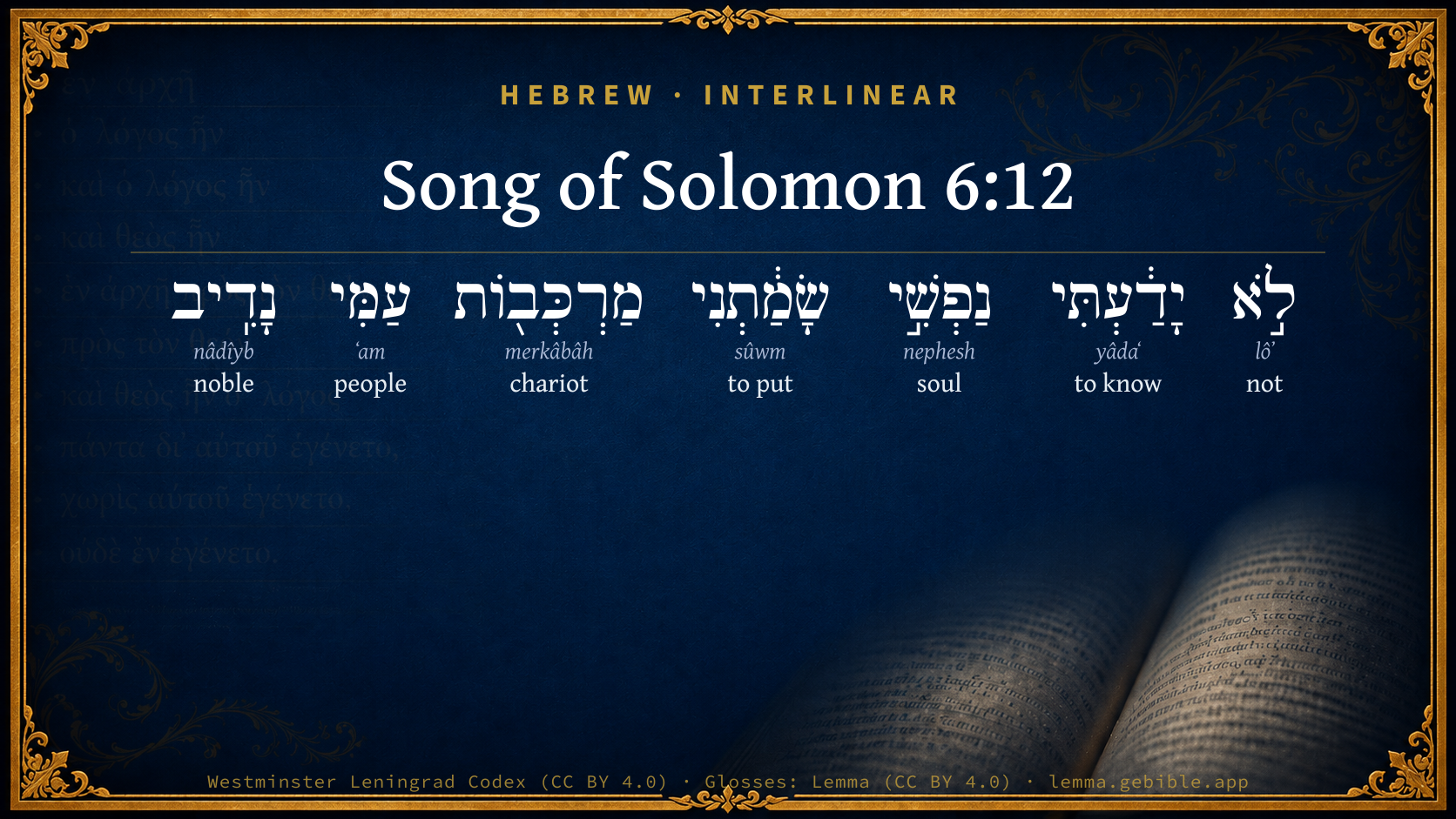
Hebrew (Westminster Leningrad Codex) Song of Solomon 6:12 appears in the Hebrew Old Testament. The text above is from the Westminster Leningrad Codex. Each word links to its Strong’s number, a concise gloss, and parsing drawn from the Open Scriptures Hebrew Bible morphology. Click any word for its full Brown-Driver-Briggs (BDB) entry.
Download image
Cite this verse

Song of Solomon 6:12 (World English Bible). Public Domain. Lemma interlinear Bible study tool, https://lemma.gebible.app/v/song-of-solomon/6/12.

Show BibTeX & RIS
BibTeX
RIS
English Translation
Without realizing it, My desire set me with my royal people's chariots. Friends
World English Bible · Public Domain
Download a study sheet

One document with this verse’s original text, its word-by-word gloss line, the meaning frame, cross-references with their text, attributed commentary, and full source and license credits — printable, and it pastes into notes with its structure intact.

This verse Autodidact and up

Study sheet (.html) Plain text (.txt)

A passage Seminary Student

Up to 50 verses in one chapter. A passage sheet keeps up to 6 commentary sources and 12 cross-references per verse, in the order this page ranks them, and says so on the sheet whenever that leaves anything out. Ask for a single verse and you get the Autodidact verse sheet above.

Everything on this page stays free to read, with no account — the sheet is a download of what is already on screen, not access to it.

Want to remove ads? Support Godless Engineer
Compare translations 3

The same verse in 3 English versions, stacked beneath the original-language interlinear above. Click any original word for its lexicon entry.

Each is an independent rendering of the whole verse — the interlinear is not word-aligned to these translations.

Highlighted words mark where these versions differ — a whole-verse word diff, not a word-by-word alignment.

  • World English Bible Public Domain
    Without realizing it, My desire set me with my royal people's chariots. Friends
  • King James Version Public Domain
    Or ever I was aware, my soul made me like the chariots of Amminadib.
  • unfoldingWord Literal Text CC BY-SA 4.0
    I did not know—my soul put me the chariots of my people, a noble.

unfoldingWord Literal Text — © unfoldingWord, licensed CC BY-SA 4.0. Word-aligned USFM3 via Door43 (git.door43.org/unfoldingWord/en_ult).

Versions to compare (up to 4)

3 of 4 selected

Show all 18 translations

Every available English version of this verse, each an independent rendering of the whole verse.

  • World English Bible Public Domain
    Without realizing it, My desire set me with my royal people's chariots. Friends
  • Berean Standard Bible Public Domain
    Before I realized it, my desire had set me among the royal chariots of my people.
  • Majority Standard Bible Public Domain
    Before I realized it, my desire had set me among the royal chariots of my people.
  • King James Version Public Domain
    Or ever I was aware, my soul made me like the chariots of Amminadib.
  • American Standard Version (1901) Public Domain
    Before I was aware, my soul set me `Among' the chariots of my princely people.
  • Revised Version (1885) Public Domain
    Or ever I was aware, my soul set me among the chariots of my princely people.
  • Geneva Bible (1599) Public Domain
    Returne, returne, O Shulamite, returne: returne that we may behold thee. What shall you see in the Shulamite, but as the company of an armie?
  • Douay-Rheims (1899) Public Domain
    Return, return, O Sulamitess: return, return that we may behold thee.
  • Young's Literal Translation Public Domain
    I knew not my soul, It made me -- chariots of my people Nadib.
  • Literal Standard Version CC BY-SA 4.0
    I did not know my soul, || It made me—chariots of my people Nadib.
  • Unlocked Literal Bible CC BY-SA 4.0
    I was so happy that I felt I was riding in the chariot of a prince.
  • unfoldingWord Literal Text CC BY-SA 4.0
    I did not know—my soul put me the chariots of my people, a noble.
  • Darby Bible Public Domain
    Before I was aware, My soul set me upon the chariots of my willing people.
  • World Messianic Bible Public Domain
    Without realizing it, my desire set me with my royal people’s chariots.
  • Webster's Bible Public Domain
    Or ere I was aware, my soul made me like the chariots of Amminadib.
  • Free Bible Version CC BY-SA 4.0
    I was so excited it was like I was riding in a royal chariot.
  • Bible in Basic English Public Domain
    Before I was conscious of it,...
  • JPS Tanakh (1917) Public Domain
    Before I was aware, my soul set me upon the chariots of my princely people.

Literal Standard Version (2020), Covenant Press — licensed CC BY-SA 4.0. Text via the HelloAO Bible API (eBible.org). Unlocked Literal Bible (unfoldingWord) — licensed CC BY-SA 4.0. Text via the HelloAO Bible API (eBible.org). unfoldingWord Literal Text — © unfoldingWord, licensed CC BY-SA 4.0. Word-aligned USFM3 via Door43 (git.door43.org/unfoldingWord/en_ult). Free Bible Version, Dr. Jonathan Gallagher — licensed CC BY-SA 4.0. Text via the HelloAO Bible API (eBible.org).

Word by word

More ways to search: Search by grammar → Find every occurrence → Compare this word →

Practice this passage: Drill this verse → Learn its vocabulary →

About this verse

These counts appear in no published source. They are computed here, from the morphology-tagged text and Lemma’s own curated glosses. What Lemma adds →

7
words
7
distinct lemmas
Wisdom
section

Shared distinctive vocabulary

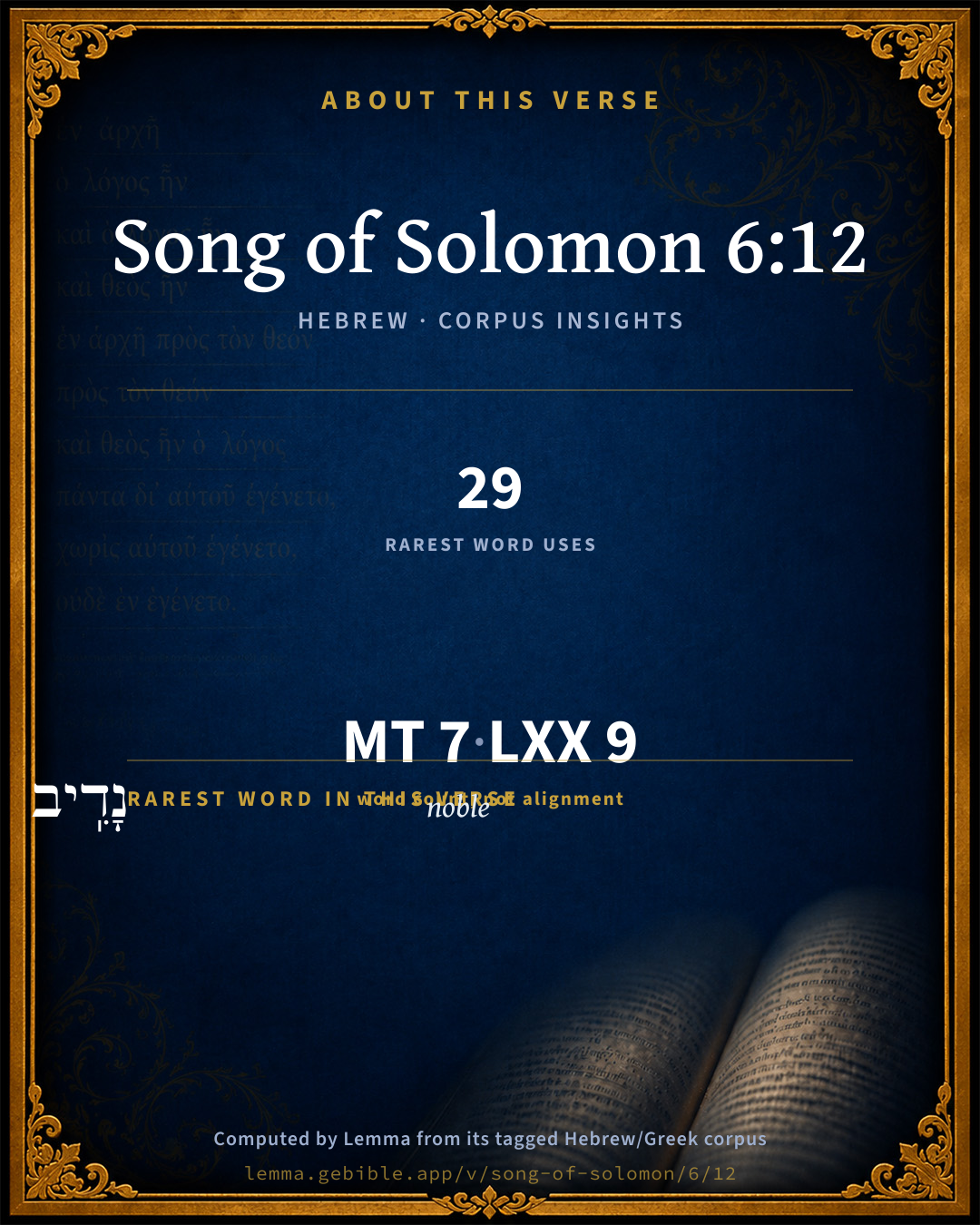
נָדִֽיב noble H5081 occurs in 26 verses of the Hebrew Bible. Also found in:

Grammatical profile

  • 2 verbs
  • 3 nouns
  • 1 adjective
  • 1 particle

Verb forms

  • יָדַ֔עְתִּי Qal · Perfect
  • שָׂמַ֔תְנִי Qal · Perfect

Hebrew & Septuagint length

In English translation the verse runs 13 words from the Hebrew and 25 from the Septuagint (LXX English) — the Septuagint runs noticeably longer here. See the side-by-side →

A rough comparison of the two English renderings, which tokenize alike — not a word-level alignment.

Word counts can differ between the Hebrew and the Greek without any difference in meaning — e.g. the Hebrew direct-object marker אֵת has no separate Greek word, and Greek often adds the article ὁ.

In the original languages it is 7 Hebrew tokens and 9 Greek tokens — but the two are counted differently (Hebrew bundles its prefixes and suffixes into one token; the Greek is in lemma form), so that isn’t a like-for-like length.

Cross-references

3

Topical passages linked to Song of Solomon 6:12 in the Treasury of Scripture Knowledge — connected by theme and wording, ordered by reader-vote popularity; previews shown in the World English Bible.

  • Hosea 11:8–9 "How can I give you up, Ephraim? How can I hand you over, Israel? How can I make you like Admah? How can I make you like Zeboiim? My heart is turned within me, My compassion is aroused.
  • Luke 15:20 "He arose, and came to his father. But while he was still far off, his father saw him, and was moved with compassion, and ran, and fell on his neck, and kissed him.
  • Jeremiah 31:18–20 I have surely heard Ephraim bemoaning himself [thus], You have chastised me, and I was chastised, as a calf unaccustomed [to the yoke]: turn you me, and I shall be turned; for you are Yahweh my God.

Cross-references courtesy of OpenBible.info (CC BY 4.0).

Hebrew and Greek witnesses Masoretic Hebrew ↔ Greek Septuagint

The same verse in the two great witnesses to the Old Testament, shown verse-for-verse.

Here the Septuagint runs noticeably longer than the Hebrew — LXX2012 (modern English Septuagint) 25 words vs World English Bible 13. A rough length comparison of the two English translations, not a word-level alignment — read both below.

These are two independent witnesses, not word-aligned to each other, and the Septuagint is shown in lemma (dictionary) form.

Hebrew Song of Solomon 6:12 Masoretic · Westminster Leningrad Codex

לֹ֣א יָדַ֔עְתִּי נַפְשִׁ֣י שָׂמַ֔תְנִי מַרְכְּב֖וֹת עַמִּי נָדִֽיב

Without realizing it, My desire set me with my royal people's chariots. Friends

World English Bible · Public Domain

Greek LXX Song of Solomon 6:12 Septuagint · lemma form

οὐ γιγνώσκω ὁ ψυχή ἐγώ τίθημι ἐγώ ἅρμα αμιναδαβ

Return, return, O Sunamite; return, return, and we will look at you. What will you⌃ see in the Sunamite? She comes as bands of armies.

LXX2012 (modern English Septuagint) · Public Domain

Hebrew: Westminster Leningrad Codex (CC BY 4.0). Greek: Septuagint (public domain); English from LXX2012 (modern English Septuagint) (Public Domain). How the Septuagint differs from the Hebrew →

Commentary

Notes on Song of Solomon 6:12 from classic Christian and Jewish commentators (each source and its license shown beneath its notes). The classic Christian expositions comment on the surrounding passage and are grouped to its opening verse, so a note may address several verses; the Jewish commentaries on the Tanakh (Rashi and others) are per-verse, so they appear only where the commentator wrote on this verse.

Lemma curates 59 commentaries, every one of them public domain or Creative Commons licensed, each selected and text-cleaned for this edition rather than reprinted as found. About our sources →

Trapp's Complete Commentary

John Trapp

Son 6:12 Or ever I was aware, my soul made me [like] the chariots of Amminadib.

Ver. 12. Or ever I was aware, my soul, &c.] Heb., I knew not. So Christ speaketh after the manner of men. And it is as if he should say, I could not conceive that my people were in so good a forwardness, as indeed I found them; for they have over and above answered mine expectation, being "full of goodness," as those believing Romans, {Rom 15:14} "filled with all knowledge," and always abounding in the work of the Lord; from whom therefore they shall be sure to receive "a full reward." {2Jn 1:8} Or thus, "I know not," that is, I perceived not that the vines flourished, the pomegranates budded, that all was ripe and ready; therefore I withdrew myself for a season, O my spouse; and therein I dealt with thee no otherwise, than as good gardeners and vinedressers do, who coming (perhaps before the time of fruit) to look for fruit, and finding none, depart for present, till a more convenient season. But that thou mayest know my dear love and tender care of thy comfort, behold my haste to call thee to thy former feelings again. For dicto citius, I say more quickly, "my soul set me on the chariots of Amminadib," who may seem to be some famous chariot driver of Solomon’s, that could outdrive all the rest. There is another sense given of these words, and perhaps a better. For by some these are thonght to be the words of the Church confessing her ignorance. I knew not, Lord, saith she, that thou wast gone down into the garden to do those things. I thought rather that thou hadst departed in great anger against me for my negligence; and therefore I sought thee carefully, I made out after thee with all my might; my soul made me like the chariots of Amminadib; Amor addidit alas, I drove furiously till I had found thee. I was like unto those two women in Zechariah, that "had wings, and wind in their wings." {Zec 5:9} This was well; that missing her spouse, she followed so hard after him. "My soul cleaveth after thee," saith David, {Psa 63:8} thereby showing his love, constance, and humility. But then that was not so well; that she so far mistook Christ, as to think that he went away from her in deep displeasure, and kept away from her, as loathing her company. Such hard conceits of Christ, and heavy conceits we are apt to have of ourselves, as if he had forsaken us, because we cannot presently find him, whenas he is only gone down in his garden to prune it, or to see how things thrive there, as if he had cast off the care of us; because, finding us too light, he "make us heavy (as there is need) with manifold temptations." {1Pe 1:6} We are therefore "judged of the Lord, that we may not be condemned with the world": {1Co 11:32} He leaves us on the other side the stile (as fathers sometimes do their children), and then helps us over when we cry. To say God hath cast us off, because he hath hid his face, is a fallacy fetched out of the devil’s topics. Non est argumentum aversi Dei quemadmodum diabolus interpretatur, sed potius paternae ipsius benevolentiae, saith learned Lavater. {a} It is not an argument of God’s wrath and displeasure, as the devil would make it, but rather of his fatherly love and affection; he hides his love, as Joseph did, out of increasement of love. And yet how apt are we to say in this case, with those malcontents in Malachi, In quo dilexisti nos? Wherein hast thou loved us? and with those Israelites in the wilderness, "Is God among us?" as if that could not be, and they athirst. {Exo 17:7} "O my Lord," said Gideon, "If the Lord be with us, why then is all this evil befallen us?" {Jdg 6:12} And, "Lord God," said Abraham, when he had received many gracious promises, "what wilt thou give me, seeing I go childless?" {Gen 15:1-2} We see then how ready the best of us are to cast the helve after the hatchet, as they say; and, like little children, because we may not have what we would, sullenly to say, God loves us not, and we will not have what he thinks good to give unto us. "My soul refused comfort," saith he in Psa 77:2; and "I said, My hope and my strength is perished from the Lord: remembering mine afflictions and my misery, the wormwood and the gall." {Lam 3:18-19} This our folly and fault we must confess to Christ, as the Church here doth; and beseech him, by his Spirit, to teach us better things, that we may not mistake the cause of our calamities, and make them heavier than God meant them, by our frowardness and impatience. Pondus ipsa iactatione incommodius sit, saith Seneca.

{a} Lavat. in Prov. iii.

John Trapp, A Commentary or Exposition upon All the Books of the Old and New Testament (1647–1656) — public domain. Text from a community e-Sword module.

The Biblical Illustrator

Joseph S. Exell

Son_6:12

Or ever I was aware, my soul made me like the chariots of Ammi-nadib.

The influence of the unseen

The world passeth away and the lusts thereof. The spiritual alone is permanent. Some men acquire notoriety in their day, their name passes into a proverb, and yet, singular to say, in after times, we find their names recorded, but we are at a loss to know what their deeds were which made them so famous. I have read Out a text in which a mans name occurs about whom we know nothing. As a proverbial saying, it may be regarded as an illustration of the spontaneity and intuition of the heart. The affections under the guidance of the will becoming a chariot, in which the man is borne away.

I. Spiritual spontaneity. Spontaneity signifies that which is voluntary and unconstrained, free and instantaneous action. Without spontaneity our lives would sink to the dull, dead level of things, we should be mere links in the great chain of cause and effect. Without spontaneity we should be things, not men. This power, this pure activity is necessary to our personality. We are about to speak of the spontaneity of life--that is, spiritual life. By the spontaneity of this life, we mean that its impulses, sensibilities, and affections are not the result of a painful and protracted effort, but spring from life as its natural manifestation and development. There is naturalness in all the forms of life. We are often struck with the unnatural character of some mens religion. It seems like something that belongs to the man, a mere accident or appendage; he can put it on as a garment, but he can divest himself of it at any moment. What naturalness there is in life, in the modest, quiet beauty of the flower, that opens itself to drink in the dew and the sunlight, and gives its perfume to every breath that passes by, and does this spontaneously, for it is the law of its life. Some few illustrations of the spontaneity of life may make our meaning more apparent. When the physical organization is perfect, when there is health as well as life, the body performs many of its functions without effort and unconsciously. The man runs without weariness, and walks without fainting. Life is like a stream sparkling in the sunshine, making its own music as it flows on, sustained and nourished by the fountain that gave it birth. It is the sick man who frequently places his finger on the pulse. It is the man out of health who has the study of his own nature forced upon him, and who is constantly seeking to reproduce and restore harmony. A man who lives near to God and has constant communion with Him, will have Divine beauty put upon him. He may, like Moses, put a veil over his face, but at any moment he can put off the veil, and go in and speak with God. There is no necessity for the soul to see that the strings of the instrument are tuned concert pitch, at any instant she can awaken music and call on all spiritual faculties like so many choristers to blend their voices in one song. A man need not, like Saul, the first king of Israel, force himself to offer sacrifice. There are spiritual instincts: My heart and my flesh cry out for God. There is no fixedness of heart: Oh God, my heart is fixed. there is spontaneity: Or ever I was aware, my soul made me like the chariots of Ammi-nadib. The highest acts of the spiritual life are for the most part acts of pure spontaneity. Life is in its incipient and undeveloped forms, when we must learn to see, to speak, to walk; and so in the beginning of the spiritual life, there must be effort, and painful consciousness, till we grow up into Him who is the Head, even Christ. How may we attain this high spiritual state? We must seek the constant actings of the Spirit, and yield ourselves to the felt influence of the Holy Ghost. The Spirit is to help our infirmities,--that is, the Spirit is to lift us up, to raise, to elevate us; the Spirit gives wings to the soul, so that we maybe borne up into a spiritual region, and commune with spiritual things. We must get the unity of our whole nature. You must live in constant communion with God. Let me say, there is real happiness and great peace resulting from this spontaneity of life. There is the Sabbath of the soul; the work of the new creation being over, God still comes to man, and walks in the garden in the cool of the day. Love manifests itself to love; a living God to a living soul. In this state you will be prepared to use all things; you will be ready to receive Divine communications; you will be fitted for all seasons of fellowship. Worldly men instinctively go after the world. They come to the sanctuary, but they go where their heart goes: Or ever I was aware, my soul made me like the chariots of Amminadib. There is spontaneity in sin. It becomes natural--it awakens no astonishment--man seeks his gratification in it.

II. The intuitions of the heart. The circumstances in the chapter are these: The bridegroom is without the bride, but he goes into scenes where she has been, which seem to him filled with her presence; everything reminds him of her--his heart goes after her, he instinctively feels that she is near, though he does not see her. We are influenced by the unseen. The true centre of our life--of all its thoughts, feelings, and energies--is the unseen. There is an attractive force, of even higher power than the force which draws bodies to the earth. Our life is in God; our holiness is the shadow of His light; our love the birth of His love. The regenerated soul goes to God to find satisfaction in Him; it goes instinctively, by the law of its new life, to have communion with God. The spiritual man finds, or ever he is aware, his heart has lifted him up to heaven. The unseen influences us. There are influences which do not act on the senses, but on the spirit, which do not proceed from anything that may be seen or that is handled, but from the spiritual. Men are influenced by fellowship, by example, by mind acting on mind, by the literature of the day, by the daily papers. We are influenced by the past, by the writings of men who have entered the unseen world. And are not our minds open to the direct influences of the Spirit of God? Cannot the Father of our spirits draw near to us, and illuminate, sanctify, and commune with our hearts? A man must be spiritual to recognize and appropriate spiritual things. What is meant by a man being spiritual? That he is born of the Spirit, that he lives in the Spirit, that his own spiritual nature has the mastery over the outward and the physical--that there is a state of real spiritual unity. With his well-balanced mind he can respond to spiritual impressions, and make use of spiritual opportunities. This ready response is indispensable; the vision will not tarry. A right state of heart is necessary that we may be able to take advantage of all opportunities, that we may be prepared, not only for the Sabbath, but for all times, so as to respond to all spiritual impressions and impulses. A right state of heart is necessary that we may be fitted for manifestations. We must be prepared, like the disciples in the upper room, waiting for the promise of the Father, for suddenly there may come a sound from heaven. We must be prepared, like mariners who have long been becalmed, but who see indications of a breeze springing up, and so make all ready to take every possible advantage of the wind which presently will sweep over the waters. We must be prepared to ascend the mount, so that at any moment we hear the Divine voice saying,--Come up, and I will make all My goodness pass before you, we may go up and see the glory. We must walk in the light, as He is in the light, that we may have fellowship one with another. (H. J. Bevis.)

The chariots of Ammi-nadib

It appears to me that without in the slightest degree wresting the passage, or deviating from an honest interpretation, we may understand that this is the language of the Church concerning Christ. If so, Christs words conclude at the end of the tenth verse, and it is the Church that speaks at the eleventh. There is not an instance in the whole Song, so far as I can remember, of the Prince Himself speaking in the first person singular; either, therefore, this would be a solitary exception, or else, following the current plan, where the same pronoun is used, the Church is speaking to Christ, and telling him of herself.

I. What is the most wanted in all religious exercises is the motion, the exercise of the soul. Or ever I was aware, my soul made me--or my soul became--like the chariots of Ammi-nadib. Soul-worship is the soul of worship, and if you take away the soul from the worship, you have killed the worship; it becomes dead and barren henceforth. There are professors in this world who are perfectly content if they have gone through the mechanical part of public devotion. If they have occupied their seats, joined in the hymns and the prayers, and listened to the preaching, they go away quite content and easy. Only that prayer which comes from our heart can get to Gods heart. Oh, that we may be more and more scrupulous and watchful in these things! In the diary of Oliver Heywood, one of the ejected ministers, he often says, God helped me in prayer in my chamber and in the family. And once he writes thus--In my chamber this morning I met with more than ordinary incomings of grace and outgoings of heart to God. Be it always recollected that we do not pray at all, unless the soul is drawn out in pleading and beseeching the Lord.

II. Sometimes it happens that the heart is not in the best state for devotion. If religion be a matter of soul, it cannot always be attended to with equal pleasure and advantage. You can always grind a barrel-organ; it will invariably give you the same discordant noise, which people call music, but the human voice will not admit of being wound up in the same fashion, nor will it for the most part discharge the same monotonous functions. The great singer finds that his voice changes, and that he cannot always use it with the same freedom. If the voice is a delicate organ, how much more delicate is the soul! The soul is continually the subject of changes. Ah, how often it changes because of its contact with the body! If we could be disembodied, oh, how we would praise God and pray to Him! The spirit truly is willing, but the flesh is weak. And then, alas, our sins are a much more serious hindrance to our devotion. Perhaps we have been angry. How can we come before the Lord calmly when our spirit has been just now tossed with tempest? Probably we have been seeking the world, and going after it with all our might. How can we suddenly pull up, and put all our strength into a vigorous seeking of the kingdom of God and His righteousness in a moment? Now Gods grace can help us to overcome all these things, and can even make our souls like the chariots of Ammi-nadib. We do not want grace for such emergencies. The soul, in its different phases and states, has need of help from the sanctuary to which it repairs.

III. There are seasons when our heart is sweetly moved towards God. Or ever I was aware, my soul made me like the chariots of Ammi-nadib. Have ye not proved welcome opportunities when all your thoughts have been quickened, enlivened, and stimulated to activity in the highest degree about your highest interests? All within us was awake; there was not a slumbering faculty. Our memory told us of the goodness of the Lord in days gone by; and our hopes were regaled by the mercy which we had not tasted yet, but which was made sure to us by promise, and brought near to us by faith. Our faith was active and bright of eye. Our love especially shed a clear light over our prospects. Oh, we have had our blessed times, when our soul has been light and rapid as the chariots of Ammi-nadib! And at such times we were conscious of great elevation. The chariots of Ammi-nadib were those of a prince. And oh, we were no more mean, and low, and beggarly, and grovelling, but we saw Christ, and were made kings and princes and priests with Him. Then we could have performed martyrs deeds. Then we were no cowards, we were afraid of no foes. We had princely thoughts then, large, liberal, generous, capacious thoughts concerning Christ and His people, His cause, and His conquests: our souls were like the chariots of Ammi-nadib. At the same time they were full of power; for, when the chariots of Ammi-nadib went forth, who could stop them? Such was our spirit. We laughed at thoughts of death, and poured contempt upon the trials of life. We were strong in the Lord and in the power of His might. Oh, what splendid times we have had when God has been with us. Oh, yes! in Gods house you have known the days of heaven upon earth. Not unfrequently too have I known that the Lord has appeared to His people and warmed their hearts when they have been working for Him.

IV. Sometimes the sweet seasons come to us when we do not expect them. Or ever I was aware, my soul made me like the chariots of Ammi-nadib. Some poor hearts do not reckon ever to have these joys again. They say, No, no, they are all gone; the last leaf has blown from the tree; the, last flower has faded in the garden. My summer is past. It is all over with me! That is the bitter complaint and the hollow murmuring of unbelief. But the Lord for whom ye wait can suddenly appear, and while you are saying hard things of yourself He can refute them with the beams of His countenance. Even at this very moment you may stand like Hannah, a woman of sorrowful spirit, feeling as if you would be sent away empty; yea, and Gods servant himself may address you with rough words as Eli did her, and may even tell you that you are drunken, when it is deep grief that enfeebles your steps and chokes your voice; and all the while the Lord may have in store for you such a blessing as you have never dreamed of; and He may say to thee, Go thy way, My daughter; I have heard thy petition, thy soul shall have its desire. Or ever I was aware, while my unbelief led me to think such a thing impossible, Thou hast made me like the chariots of Ammi-nadib. (C. H. Spurgeon.)

The Biblical Illustrator, edited by Joseph S. Exell (c. 1880s–1900s) — public domain. Text from a community e-Sword module.

Joseph Benson's Commentary

Son 6:12. Or ever I was aware — I was surprised with a vehement desire of my spouse, which is to be understood figuratively, and so as to agree with the majesty and omniscience of Christ. My soul made me, &c. — Eager in my desire, and swift in my motion toward the church. Amminadib is supposed to be some eminent charioteer then well known, and famous for his speed in driving chariots.

Joseph Benson's Commentary on the Old and New Testaments (1811–1818) — public domain. Text from a community e-Sword module.

Tyndale Open Study Notes

Tyndale Open Resources

6:12 to the chariot of a noble man: Desire leads to the union of the man and the woman. There may be support here for Solomon being the husband, though this description could be a metaphor for the joys of romance (cp. 1:16-17).

Tyndale Open Study Notes — © Tyndale Open Resources, licensed CC BY-SA 4.0. Text via the HelloAO Bible API.

Geneva Bible (1599)

Geneva Bible translators

O ye people of Jerusalem: for Jerusalem was called Salem which signifieth peace.

Geneva Bible (1599) marginal notes — public domain. Text via Bolls.life.

Adam Clarke's Commentary

Verse 12. The chariots of Amminadib.] Probably for their great speed these chariots became proverbial. The passage marks a strong agitation of mind, and something like what we term palpitation of the heart. As I am not aware of any spiritual meaning here, I must be excused from commenting on that which is literal. Amminadib signifies my noble or princely people; but it may here be a proper name, and Amminadib might be celebrated for his skill and rapidity in driving, as Jehu was.

Adam Clarke's Commentary on the Bible (1810–1826) — public domain. Text from a community e-Sword/MySword module.

The Cambridge Bible for Schools and Colleges

gen. ed. J. J. S. Perowne

12. This is probably the most difficult verse in the whole book to interpret satisfactorily. Perhaps it may best be rendered as in R.V. my soul (or, desire, marg.) set me among the chariots of my princely people. That nephesh may mean ‘appetite’ or ‘desire’ is clear from Pro_23:2. So taken, the words would mean that when she was engaged in inspecting and enjoying the gardens, suddenly, before she knew, her longing to see the plants brought her among the chariots of her noble people, i.e. of noble people who were hers, i.e. rulers of her land. She suddenly came upon the train of King Solomon, as they were on the way from or to some royal dwelling in the North. But it must be confessed that the translation of Ammi-nadib as ‘my princely people’ is not very satisfactory, though the omission of the article with the adj. after a noun defined by a pronominal suffix is not uncommon. (Cp. Ges.-K. Gramm. § 126, h and z). The text may be corrupt, but the extensive changes of reading proposed by Budde, Grätz, and Cheyne do not mend matters much, and are none of them convincing. But if the meaning we have found in these words is even generally correct, it is fatal to Budde’s theory that the book is a mere collection of unconnected marriage songs. Nothing can be made of them on that hypothesis, and all who support it have to get rid of them, either by amending them, or excising them.

The Cambridge Bible for Schools and Colleges (gen. ed. J. J. S. Perowne; Cambridge University Press, 1878–1918) — public domain. Text from a community e-Sword module.

Matthew Poole's English Annotations

Or ever I was aware; I was surprised with a sudden and vehement desire of enjoying my spouse; which is to be understood figuratively, and so as to agree with the majesty and omnisciency of Christ.

My soul made me; I made myself; which may signify Christ’s activity in stirring up his affections to the church: or, I was made; for the active phrase is oft understood passively, and the soul is commonly put for the person.

Like the chariots of Ammi-nadib; eager in my desire and swift in my motion towards the church. Ammi-nadib is supposed to be some eminent charioteer then well known, and famous for his speed in driving chariots. But this clause with the former is otherwise rendered, both in the margin and by others, and that very agreeably to the Hebrew words, my soul set me on the chariots of my willing (or, as others, noble or princely) people, i.e. which mine and the bride’s friends had prepared to bring me to the bride with more expedition, into which I ascended with all my soul, as longing to come to my bride.

Matthew Poole's English Annotations on the Holy Bible (1683–1685) — public domain. Text from a community e-Sword/MySword module.

Whedon's Commentary on the Bible

Daniel D. Whedon

12. Or ever I was aware — Hebrew, I knew not; that is, unconsciously, unintentionally.

Made me — Hebrew, set me.

Amminadib — Hebrew, the escort of the prince. “By some influence, of which I could hardly explain the cause, I joined the chariots of the escort of the King.” The most careful and rigorous construction of the Hebrew comes to this as the sense and design of the verse. It explains how she left her home — which she herself cannot quite understand — and came with the King’s train from the pavilion in the country, and afterward to the palace in the capital. This bashful, half-hinted, half-suppressed confession, skilful as if from the lips of the Jocaste of Sophocles, tells what seems passing strange to the heroine herself — that she should be at all in royal company.

Daniel D. Whedon (gen. ed.), Commentary on the Old and New Testaments (1874–1909) — public domain. Text from a community e-Sword module.

John Wesley's Explanatory Notes

Or ever - I was surprized with a vehement desire of my spouse, which is to be understood figuratively, and so as to agree with the majesty and omnisciency of Christ. Ammi-nadib - Eager in my desire, and swift in my motion towards the church. Ammi- nadib is supposed to be some eminent charioteer then well known, and famous for his speed in driving chariots.

John Wesley, Explanatory Notes Upon the Whole Bible (1754–1765) — public domain. Text via the GEBible commentary corpus.

Rashi

Rabbi Shlomo Yitzchaki (Rashi)

I did not know The congregation of Israel laments: I did not know to beware of sin, that I should retain my honor and my greatness, and I erred in the matter of groundless hatred and controversy, which intensified during the reign of the Hasmonean kings, Hyrcanus and Aristobulus, until one of them brought the kingdom of Rome and received the kingship from their hand and became their vassal, and since then, my soul made me to be chariots, that the nobility of other nations ride upon me.

a princely people Heb. עַמִי נָדִיב like:. עַם נָדִיב, the “yud” being superfluous, like the “yud” of (Deut. 33:16): “the One Who took up His abode (שֹּׁכְנִי) in the thornbush”; (Gen. 31:39): “stolen (גְנֻבְתִי) by day”; (Lam. 1:1): “populous (רַבָּתִי עַם).”

my soul made me I myself appointed them over me, as it is stated (Jer. 13:21): “and you accustomed them to be princes over you as head.”

Rashi on the Tanakh — English translations: “The Judaica Press complete Tanach with Rashi, translated by A. J. Rosenberg” (CC BY 4.0); “Pentateuch with Rashi's commentary by M. Rosenbaum and A.M. Silbermann, 1929-1934” (public domain); “The Metsudah Tanach series, Lakewood, N.J” (CC BY 4.0); and “The Book of Joshua, Metsudah Publications, 1997” (CC BY 4.0). Text via Sefaria.

Lesson kit

Teaching starters — assembled from the data on this page, not authored interpretation. Every prompt links to the verse data it draws on. Edit before teaching.

Song of Solomon, in the Wisdom, opens this verse with 7 words (7 distinct Hebrew lemmas). Its most distinctive word is nâdîyb (“noble”). The Greek Septuagint runs longer here. A historical commentator’s framing appears above. Read the whole chapter for the surrounding context.

Discussion questions

  1. What does “noble” (nâdîyb) contribute to the verse as a whole?
  2. Exodus 35:5 shares the word «noble» with this verse. How do the two illuminate each other?
  3. Compared with the Hebrew, the Septuagint runs longer here. What questions does that raise?
  4. These translations render this verse differently; the difference is in the English rendering, not the original. What questions does that raise?
  5. The verb «יָדַ֔עְתִּי» is Qal Perfect. How does its form color the action?
  6. Reading how Trapp's Complete Commentary and The Biblical Illustrator read this verse, where do the two commentators agree and where do they part?

Things to notice

Reading settings

Reading text

Shown beneath each verse's original-language words.

Old Testament
Old Testament edition

Read the OT as the Masoretic Hebrew (MT) or the Greek Septuagint (LXX).

English shown for the Greek Septuagint (in the Hebrew ↔ Greek comparison).

Comparing translations? Open the Compare panel on any verse page to stack up to four side by side.