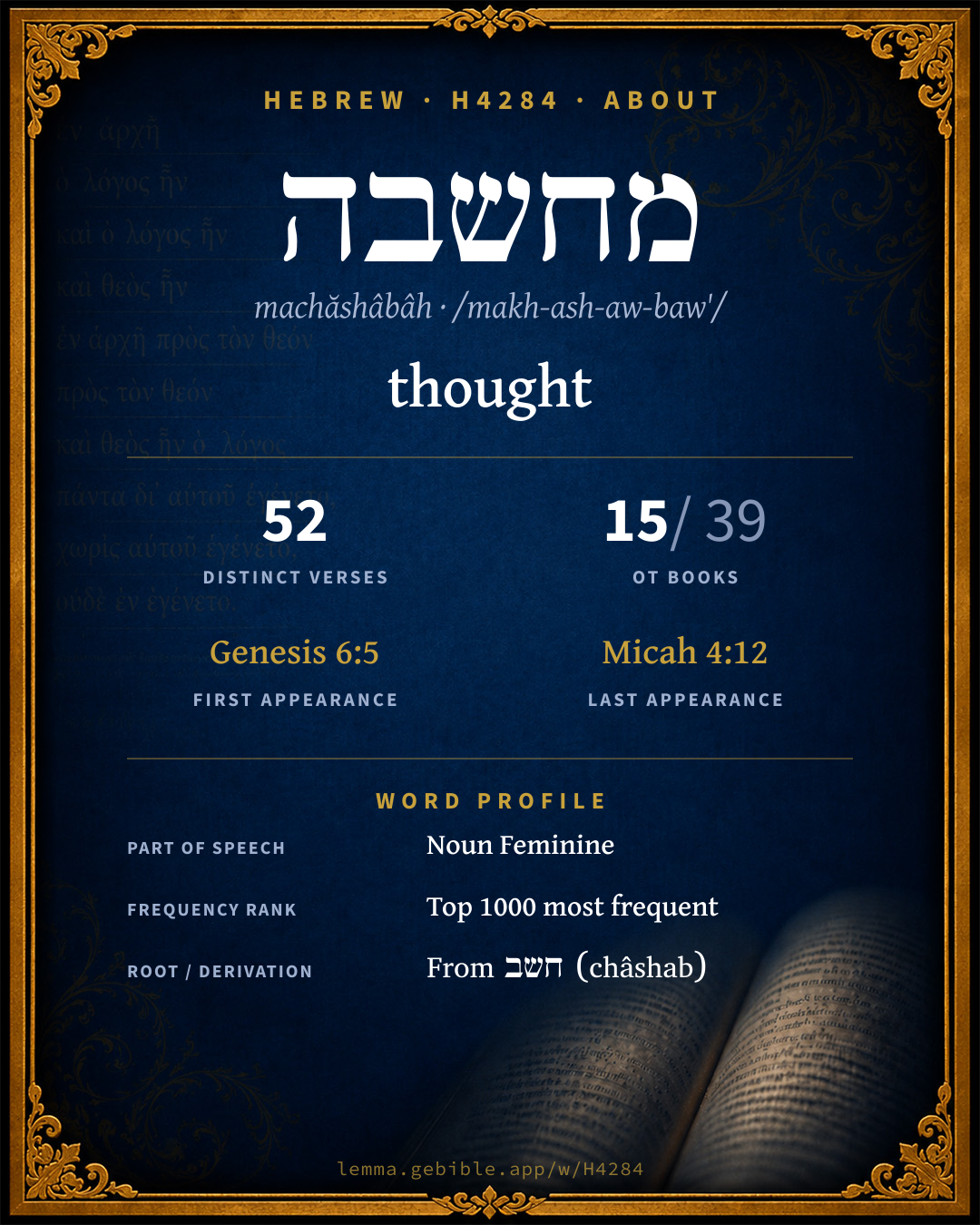
מַחֲשָׁבָה
thought
‘thought’ is one of 4 main senses fuller range ↓
Full lexicon entry — Brown-Driver-Briggs (BDB)
From Brown-Driver-Briggs (BDB)
Where this word appears
Grammar key — what these labels mean
Part of speech
- Noun
- A naming word — a person, place, thing, or idea.
Noun type
- Common
- A common noun — a general class of person, place, or thing (“king,” “city,” “water”), not a specific name.
State
- Construct
- A noun bound to a following noun in a possessive / “of” relationship (the construct chain).
- Absolute
- The independent form of a noun, not bound to a following word.
Gender
- Feminine
- Grammatically feminine.
Number
- Plural
- More than one (in Hebrew, generally three or more).
- Singular
- One.
Every verse where H4284 appears in the Book of Esther — 3 distinct verses. Click any verse to open its interlinear word-by-word view. Verse text shown in the World English Bible for context — . Each verse’s Hebrew form is shown with its reference; the English is not keyword-highlighted, since the data carries no word-level English alignment. Use “Compare translations” on any verse to read it across multiple English versions. This concordance covers the Hebrew Bible; Septuagint (Greek Old Testament) occurrences are not indexed here.
Esther
- Esther 8:3 מַֽחֲשַׁבְתּ֔/וֹ n c fs cs + sfx pers 3ms Esther spoke yet again before the king, and fell down at his feet, and begged him with tears to put away the mischief of Haman the Agagite, and his device that he had devised against the Jews.
- Esther 8:5 מַחֲשֶׁ֜בֶת n c fs cs She said, If it please the king, and if I have found favor in his sight, and the thing seem right before the king, and I be pleasing in his eyes, let it be written to reverse the letters devised by Haman, the son of Hammedatha the Agagite, which he wrote to destroy the Jews who are in all the king's provinces:
- Esther 9:25 מַחֲשַׁבְתּ֧/וֹ n c fs cs + sfx pers 3ms but when [the matter] came before the king, he commanded by letters that his wicked device, which he had devised against the Jews, should return on his own head, and that he and his sons should be hanged on the gallows.
About this entry
At a glance — auto-summarized from this page’s data, not written by a person. Every figure links to its source below. This summary describes the numbers; it doesn’t interpret them.
מחשבה (machăshâbâh) is a Hebrew noun most often rendered “thought.” It is not a single-sense word — see its full sense range. The Hebrew Bible uses it across 52 verses — moderately common. Debuting at Genesis 6:5, it then recurs through the corpus. Related forms include חשב, חשב and חשב. The sections below give every sense, occurrence, and version rendering.
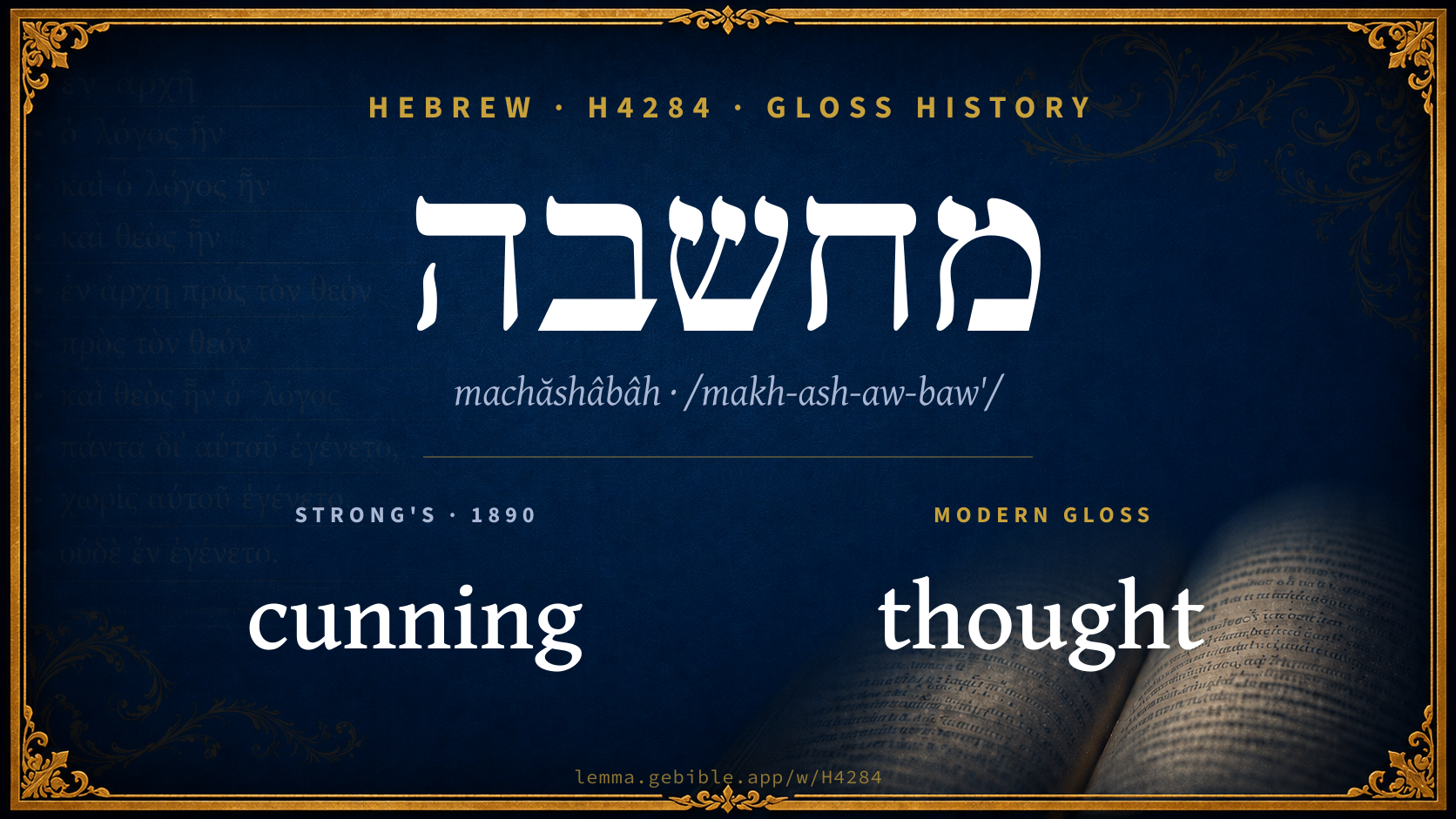
Gloss history
Strong's 1890 vs modern scholarship
About this word
Strong's H4284 catalogs a Hebrew word from the Hebrew Old Testament.
These counts are not copied from any lexicon or concordance. They are computed here, from the morphology-tagged Hebrew Old Testament. What Lemma adds →
- 52
- distinct verses
- The word appears in 52 distinct verses.
- 15 / 39
- OT books
- The word appears in 15 of 39 Old Testament books.
- #678
- by frequency
- Top 1000 most frequent Hebrew words (rank 678 of 8,640 Hebrew words by occurrence).
View all 52 occurrences in the concordance →
By section of the Old Testament
By traditional corpus
Conventional, traditional groupings — biblical authorship is debated, so this is a traditional corpus grouping, not an authorship claim. Each share is this word’s portion of its verses in that division of the Hebrew canon. Each figure is a share of the word’s 52 distinct verses.
- Writings (Ketuvim) 27 verses · 52%
- Prophets (Nevi'im) 20 verses · 38%
- Torah (Pentateuch) 5 verses · 10%
How translations render this word
Counts come from each version’s own published word-to-Strong’s tagging or interlinear alignment — an approximate guide to how each version renders this word, not a word-level alignment the data otherwise carries. Because each total is that version’s own tagged count, the per-version totals vary from one another and need not match the appearance or distinct-verse counts above. These counts may also differ from a printed concordance because Lemma counts each distinctly tagged rendering and does not collapse phrase taggings into a single head-word total. This is a fixed set of word-tagged versions (KJV, ASV, BSB, ULT) and does not change with the reading translation you choose elsewhere. Each version’s license is shown beside its name below (and on Sources).
- King James Version: Thoughts 22×, Devices 7×, Device 3×
- American Standard Version: Thoughts 20×, Purposes 6×, Devices 5×
- Berean Standard Bible: Thoughts 13×, Plans 8×, Artistic 3×
- unfoldingWord Literal Text: Thoughts 14×, Plans 9×, Plans of 6×
King James Version Public Domain
Renders H4284 across 56 tagged occurrences — most commonly:
Plus 17 renderings that appear only once — usually multi-word phrases or single function words the recovered tagging swept in, not distinct renderings.
American Standard Version Public Domain
Renders H4284 across 56 tagged occurrences — most commonly:
Plus 17 renderings that appear only once — usually multi-word phrases or single function words the recovered tagging swept in, not distinct renderings.
Berean Standard Bible Public Domain
Renders H4284 across 52 tagged occurrences — most commonly:
Plus 15 renderings that appear only once — usually multi-word phrases or single function words the recovered tagging swept in, not distinct renderings. Not rendered by a distinct English word in 4 further occurrences.
unfoldingWord Literal Text CC BY-SA 4.0
Renders H4284 across 51 tagged occurrences — most commonly:
Plus 14 renderings that appear only once — usually multi-word phrases or single function words the recovered tagging swept in, not distinct renderings.
Senses in the full BDB
What do BDB’s symbols mean?
BDB uses these scholarly abbreviations:
| Symbol | Meaning |
|---|---|
| 𝔊 | the Septuagint (the ancient Greek translation, LXX) |
| 𝔙 | the Vulgate (the Latin translation) |
| 𝔖 | the Syriac version (the Peshitta) |
| 𝔗 | the Targum (the Aramaic translation) |
| ψ | the Psalms |
| √ | root (the underlying root or stem) |
| ‖ | parallel passage (a synonymous or contrasted parallel) |
| † | the dagger: every passage where the word occurs is cited |
The 5 senses and sub-senses the full Brown-Driver-Briggs lexicon distinguishes for this word, in lexicon order (not ranked by frequency), with BDB’s own verbatim wording and sub-sense lettering. Shown in Hebrew script with BDB’s own scholarly abbreviations. The condensed entry is in the Lexicon Entry tab. See also the Forms in the corpus table below.
- 1. thought:
- a. of man מ׳ אדם ψ 94:11; מ׳ לֵב ψ 33:11 thoughts of the mind; (כל) יצר מ׳ (לב) Gn 6:5 (J), 1 Ch 28:9; 29:18. e.g. Psalms 94:11
- b. of God מ׳ יהוה Mi 4:12; c. אֶל־ ψ 40:6; עַל־ Je 51:29; the thoughts of God are exceeding deep ψ 92:6; higher than man’s thoughts Is 55:8(×2), 9(×2). e.g. Micah 4:12
- 2. device, plan, purpose Is 55:7; 59:7; 65:2; 66:18 Je 6:19; 18:12 ψ 56:6 Pr 19:21 Jb 21:27 La 3:60, 61 Est 8:5; מ׳ חָרוּץ Pr 21:5; מ׳ עֲרוּמִים Jb 5:12; מ׳ צדיקים Pr 12:5; מ׳ עמים ψ 33:10; מ׳ און Is 59:7 Je 4:14 Pr 6:18; מ׳ רע Pr 15:26; מ׳ שָׁלוֹם Je 21:11; חשׁב מ׳ devise devices 2 S 14:14 Je 11:19; 18:11, 18; 29:11; 49:20, 30; 50:45 Ez 38:10 Dn 11:24, 25 Est 8:3; 9:25; מ׳ as subj. of נָכוֹן be established Pr 16:3; 20:18; הפר מ׳ break plans Pr 15:22. e.g. Isaiah 55:7
- 3. invention Ex 31:4; 35:32, 33, 35 (all P), 2 Ch 2:13; 26:15 (v. חָשַׁב I 5). e.g. Exodus 31:4
Senses from the full Brown-Driver-Briggs lexicon (Brown, Driver, Briggs; Oxford 1906 — public domain), digitized via Sefaria, supplemented by the OpenScriptures HebrewLexicon (CC BY 4.0). Full attribution on Sources.
Word origin
n.f. thought, device (chiefly poet. and late)—abs. מ׳ Je 18:11; 49:30; מַחֲשֶׁ֫בֶת Ez 38:10; מַחֲשָׁ֑בֶת Ex 35:33 2 Ch 2:13; cstr. מַחֲשֶׁ֫בֶת Est 8:5 2 Ch 26:15; sf. מַחֲשַׁבְתּוֹ Est 8:3; 9:25; pl. מַחֲשָׁבוֹת Je 11:19 + 7 times; מַחֲשָׁבֹת Ex 31:4 + 3 times; cstr. מַחְשְׁבוֹת Is 59:7 + 13 times; מַחְשְׁבֹת Gn 6:5; sf. מַחְשְׁבוֹתַי Is 55:8 etc. + 19 times sfs.;—
— Brown-Driver-Briggs (Oxford 1906, public domain), digitized via Sefaria, supplemented by the OpenScriptures HebrewLexicon (CC BY 4.0). See Sources.
Derived from חשב (châshab) (H2803) — to think.
Jastrow Dictionary
A second Hebrew/Aramaic lexicon for comparison, covering Aramaic and post-biblical (Talmudic, Targumic, Midrashic) usage that the biblical-Hebrew BDB does not. Matched by lemma rather than by Strong’s number, so a lemma may carry more than one Jastrow headword (shown separately below), and the entries cover usage well beyond the Bible.
מַחֲשָׁבָה
- 1. thought, plan. Ber. 61ᵃ בתחלה עלה במ׳ וכ׳ it was the original plan to create &c.—Kidd. 40ᵃ מ׳ שעושה פרי an intention which bears fruit (is carried out). Ib. מ׳ טובה מצרפה וכ׳ the merit of a good intention does the Lord (in rewarding) add to that of a good deed; Y. Peah I, 16ᵇ top; a. fr.
- 2. troubled mind, care, apprehension. Snh. 26ᵇ מ׳ מועלת וכ׳ trouble (about sustenance) affects the memory even for the words of the Law (makes one forget one’s learning).—Pl. מַחֲשָׁבוֹת. Ib. 19ᵇ, v. בַּצַל. Ib. 26ᵇ (ref. to Ps. XI, 3) אילו מַחְשְׁבוֹתָיו וכ׳ if this wicked man’s plans be not frustrated, what will the righteous man do? e.g. Psalms 11:3
A Dictionary of the Targumim, the Talmud Babli and Yerushalmi, and the Midrashic Literature (Marcus Jastrow; London, Luzac, 1903) — Public Domain. Digitized via Sefaria. Digitized via Sefaria. Full attribution on Sources.
Forms in the corpus
The 42 distinct written forms H4284 takes in the Hebrew Bible, most frequent first — each parse links to that state’s occurrences in the concordance. Hebrew forms include their vowel points and cantillation, so a single lemma takes many written forms.
Same root — word family
Other BDB entries built from the same root as H4284, grouped by Strong’s listed origin. These share a root / origin per the lexicon — not necessarily a shared meaning. Each links to that word’s own entry.
Derives from
Shares the same root
- חשב chăshab H2804 to think
- חשב chêsheb H2805 girdle
- חשבון cheshbôwn H2808 reckoning
- חשבון chishshâbôwn H2810 device
Derived from this word
Proper names from this root
People and places named from this root — a name, not an additional meaning of the word.
- חשבדנה Chashbaddânâh H2806 Hashbadana
- חשבה Chăshubâh H2807 Hashubah
- חשביה Chăshabyâh H2811 Hashabiah
- חשוב Chashshûwb H2815 Hashub
Compare all same-root words → Showing 4 of 11 — not the complete family. 4 of the same-root words are proper names (people or places). They share a root, not necessarily a meaning.
Septuagint verse parallels
This word appears in 48 verses that also exist in the Greek Old Testament (Septuagint), out of the 52 Hebrew verses it occurs in. You can read those verses in Greek by switching the Old Testament edition to the Septuagint.
Read these verses in the Septuagint
- Genesis 6:5
- Exodus 31:4
- 2 Samuel 14:14
- 1 Chronicles 28:9
- 2 Chronicles 2:14
- Esther 8:3
- Job 5:12
- Psalms 33:10
- Proverbs 6:18
- Isaiah 55:7
- Jeremiah 4:14
- Lamentations 3:60
This is a verse-level parallel only — the same verses exist in both the Hebrew and Greek Old Testaments. No word-level Hebrew↔Greek correspondence is claimed: the data carries no such alignment, so no Greek word is shown as this Hebrew word’s translation. Coverage is not total — the Septuagint omits the deuterocanon and renumbers the Psalms, so some Hebrew verses have no direct Greek parallel.